GETTING WHERE YOU WANT TO GO BY
KNOWING WHERE YOU HAVE BEEN
PRESENTED BY:
CHIRAG KIRON
* INTRODUCTION
* PR ERA’S
* PR DEFINITIONS
* ANCIENT ORIGINS
* OTHER IMPORTANT PR EVENTS
* EVOLUTION OF PR IN INDIA
* REFERENCES
INTRODUCTION
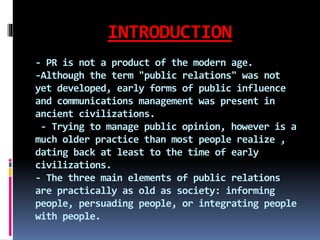
- PR is not a product of the modern age.
-Although the term "public relations" was not
yet developed, early forms of public influence
and communications management was present in
ancient civilizations.
- Trying to manage public opinion, however is a
much older practice than most people realize ,
dating back at least to the time of early
civilizations.
- The three main elements of public relations
are practically as old as society: informing
people, persuading people, or integrating people
with people.
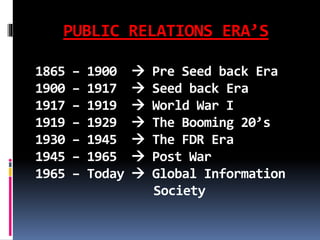
PUBLIC RELATIONS ERA’S
1865 – 1900  Pre Seed back Era
1900 – 1917  Seed back Era
1917 – 1919  World War I
1919 – 1929  The Booming 20’s
1930 – 1945  The FDR Era
1945 – 1965  Post War
1965 – Today  Global Information
Society
DEFINITON OF PR:
In August 1978, the World Assembly of Public Relations
Associations defined the field as
“The art and social science of analyzing trends, predicting
their consequences, counseling organizational leaders and
implementing planned programs of action, which will serve
both the organization and the public interest”
Public Relations society of America, a professional trade
association, defined public relations in 1982 as:
"Public relations helps an organization and its publics
adapt mutually to each other."
In 2011 and 2012, the PRSA developed a crowd-sourced
definition:
"Public relations is a strategic communication process that
builds mutually beneficial relationships between
organizations and their publics."
Public relations can also be defined as
“The practice of managing communication between an
organization and its publics.”
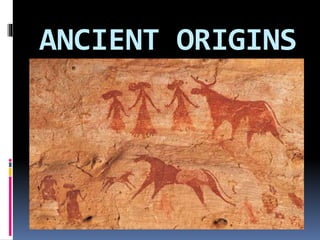
ANCIENT ORIGINS
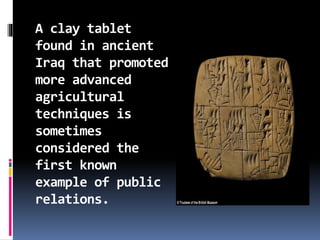
A clay tablet
found in ancient
Iraq that promoted
more advanced
agricultural
techniques is
sometimes
considered the
first known
example of public
relations.
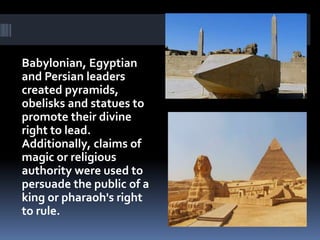
Babylonian, Egyptian
and Persian leaders
created pyramids,
obelisks and statues to
promote their divine
right to lead.
Additionally, claims of
magic or religious
authority were used to
persuade the public of a
king or pharaoh's right
to rule.
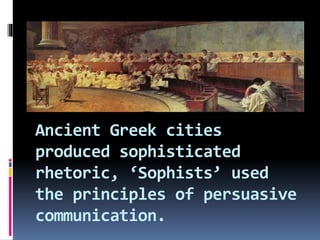
Ancient Greek cities
produced sophisticated
rhetoric, ‘Sophists’ used
the principles of persuasive
communication.
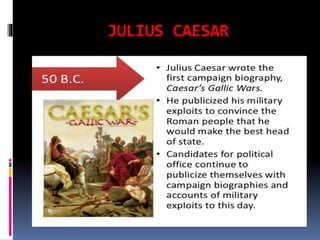
JULIUS CAESAR
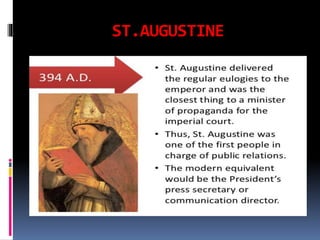
ST.AUGUSTINE
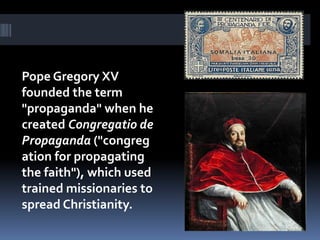
Pope Gregory XV
founded the term
"propaganda" when he
created Congregatio de
Propaganda ("congreg
ation for propagating
the faith"), which used
trained missionaries to
spread Christianity.
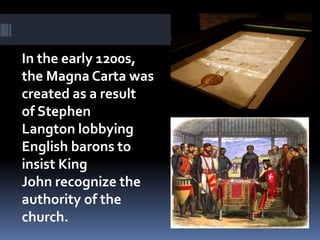
In the early 1200s,
the Magna Carta was
created as a result
of Stephen
Langton lobbying
English barons to
insist King
John recognize the
authority of the
church.
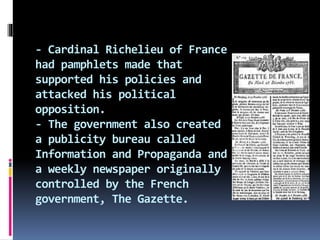
- Cardinal Richelieu of France
had pamphlets made that
supported his policies and
attacked his political
opposition.
- The government also created
a publicity bureau called
Information and Propaganda and
a weekly newspaper originally
controlled by the French
government, The Gazette.
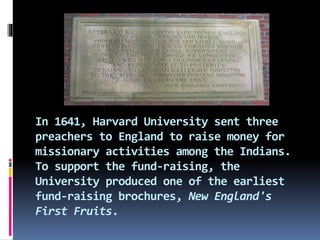
In 1641, Harvard University sent three
preachers to England to raise money for
missionary activities among the Indians.
To support the fund-raising, the
University produced one of the earliest
fund-raising brochures, New England's
First Fruits.
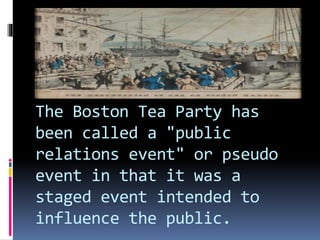
The Boston Tea Party has
been called a "public
relations event" or pseudo
event in that it was a
staged event intended to
influence the public.
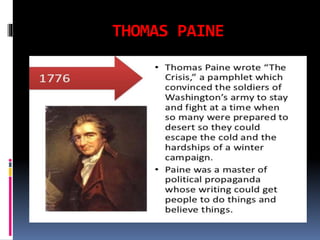
THOMAS PAINE
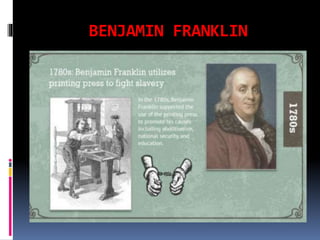
BENJAMIN FRANKLIN
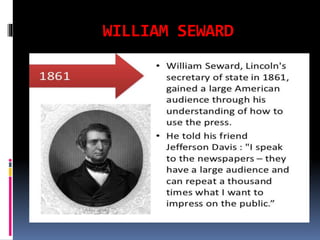
WILLIAM SEWARD
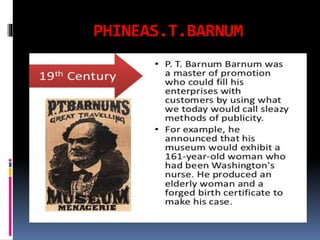
PHINEAS.T.BARNUM
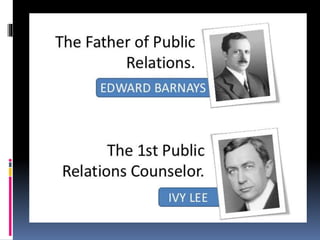
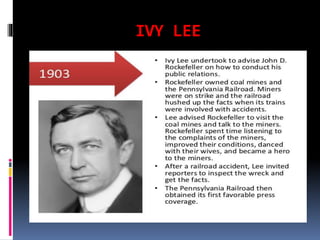
IVY LEE
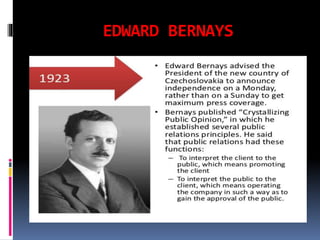
EDWARD BERNAYS
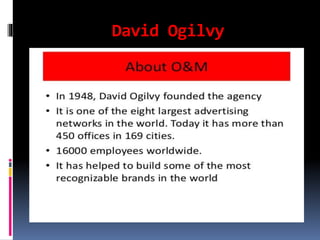
David Ogilvy
OTHER IMPORTANT EVENTS
- The first newsletter and the first daily
newspaper were founded in Germany in 1609 and
1615 respectively.
- A then-anonymous pamphlet in 1738 by Maria
Theresa of the Austrian Empire was
influential in criticizing the freemasons and
advocating for an alliance between the
British, Dutch and Austrian governments.
- An early version of the press release was
used when King's College (now Columbia
University), sent out an announcement of its
1758 graduation ceremonies and several
newspapers printed the information.
- Princeton was the first university to make it
a routine practice of supplying newspapers with
information about activities at the college.
- Early environmental campaigning groups like
the Coal Abatement Society and the Congo Reform
Association were formed in the late 1800s.
- In the late 1800s many of the now-standard
practices of media relations, such as conducting
interviews and press conferences emerged.
- Industrial firms began to promote their public
image. The German steel and armaments
company Krupp created the first corporate press
department in 1870 to write articles, brochures
and other communications advertising the firm.
- The first US corporate PR department
was established in 1889 by Westinghouse
Corporation.
- The first public relations department
was created by the inventor and
industrialist George Westinghouse in 1889
when he hired two men to publicize his
pet project, alternating current (AC)
electricity.
- The first appearance of the term
"public relations" was in the 1897 Year
Book of Railway Literature.
REFERENCES
* http://www.prsa.org/
* Wikipedia
Public Relations History

Public Relations History

  • 1.
    GETTING WHERE YOUWANT TO GO BY KNOWING WHERE YOU HAVE BEEN PRESENTED BY: CHIRAG KIRON
  • 2.
    * INTRODUCTION * PRERA’S * PR DEFINITIONS * ANCIENT ORIGINS * OTHER IMPORTANT PR EVENTS * EVOLUTION OF PR IN INDIA * REFERENCES
  • 3.
    INTRODUCTION - PR isnot a product of the modern age. -Although the term "public relations" was not yet developed, early forms of public influence and communications management was present in ancient civilizations. - Trying to manage public opinion, however is a much older practice than most people realize , dating back at least to the time of early civilizations. - The three main elements of public relations are practically as old as society: informing people, persuading people, or integrating people with people.
  • 4.
    PUBLIC RELATIONS ERA’S 1865– 1900  Pre Seed back Era 1900 – 1917  Seed back Era 1917 – 1919  World War I 1919 – 1929  The Booming 20’s 1930 – 1945  The FDR Era 1945 – 1965  Post War 1965 – Today  Global Information Society
  • 5.
    DEFINITON OF PR: InAugust 1978, the World Assembly of Public Relations Associations defined the field as “The art and social science of analyzing trends, predicting their consequences, counseling organizational leaders and implementing planned programs of action, which will serve both the organization and the public interest” Public Relations society of America, a professional trade association, defined public relations in 1982 as: "Public relations helps an organization and its publics adapt mutually to each other." In 2011 and 2012, the PRSA developed a crowd-sourced definition: "Public relations is a strategic communication process that builds mutually beneficial relationships between organizations and their publics." Public relations can also be defined as “The practice of managing communication between an organization and its publics.”
  • 6.
  • 7.
    A clay tablet foundin ancient Iraq that promoted more advanced agricultural techniques is sometimes considered the first known example of public relations.
  • 8.
    Babylonian, Egyptian and Persianleaders created pyramids, obelisks and statues to promote their divine right to lead. Additionally, claims of magic or religious authority were used to persuade the public of a king or pharaoh's right to rule.
  • 9.
    Ancient Greek cities producedsophisticated rhetoric, ‘Sophists’ used the principles of persuasive communication.
  • 10.
  • 11.
  • 12.
    Pope Gregory XV foundedthe term "propaganda" when he created Congregatio de Propaganda ("congreg ation for propagating the faith"), which used trained missionaries to spread Christianity.
  • 13.
    In the early1200s, the Magna Carta was created as a result of Stephen Langton lobbying English barons to insist King John recognize the authority of the church.
  • 14.
    - Cardinal Richelieuof France had pamphlets made that supported his policies and attacked his political opposition. - The government also created a publicity bureau called Information and Propaganda and a weekly newspaper originally controlled by the French government, The Gazette.
  • 15.
    In 1641, HarvardUniversity sent three preachers to England to raise money for missionary activities among the Indians. To support the fund-raising, the University produced one of the earliest fund-raising brochures, New England's First Fruits.
  • 16.
    The Boston TeaParty has been called a "public relations event" or pseudo event in that it was a staged event intended to influence the public.
  • 17.
  • 18.
  • 19.
  • 20.
  • 22.
  • 23.
  • 24.
  • 25.
    OTHER IMPORTANT EVENTS -The first newsletter and the first daily newspaper were founded in Germany in 1609 and 1615 respectively. - A then-anonymous pamphlet in 1738 by Maria Theresa of the Austrian Empire was influential in criticizing the freemasons and advocating for an alliance between the British, Dutch and Austrian governments. - An early version of the press release was used when King's College (now Columbia University), sent out an announcement of its 1758 graduation ceremonies and several newspapers printed the information.
  • 26.
    - Princeton wasthe first university to make it a routine practice of supplying newspapers with information about activities at the college. - Early environmental campaigning groups like the Coal Abatement Society and the Congo Reform Association were formed in the late 1800s. - In the late 1800s many of the now-standard practices of media relations, such as conducting interviews and press conferences emerged. - Industrial firms began to promote their public image. The German steel and armaments company Krupp created the first corporate press department in 1870 to write articles, brochures and other communications advertising the firm.
  • 27.
    - The firstUS corporate PR department was established in 1889 by Westinghouse Corporation. - The first public relations department was created by the inventor and industrialist George Westinghouse in 1889 when he hired two men to publicize his pet project, alternating current (AC) electricity. - The first appearance of the term "public relations" was in the 1897 Year Book of Railway Literature.
  • 30.