MEDIA IMPERIALISM REFORMULATED
BY OLIVER BOYD-BARRET
ENCO 1101- INTRODUCTION TO INTERNATIONAL COMMUNICATION
KULIYYAH OF LANGUAGES AND MANAGEMENT
SHARIFAH SALWA BINTI ABDUL KARIM
ALI KHAIRI BIN ASRI 1511343
ANIS FARHANAH BINTI AZMI 1431826
ANIZ AFRINA BINTI MOHD ZIN 1718822
AYU NURAIN NABILA BINTI ANUAR 1712246
MOHAMAD TAUFIQ BIN MOHAMAD NOH 1519371
NUR WARDAH BINTI RAMLAN 1720732
Two Model of Media Imperialism
• Cultural imperialism
• Dependency
Cultural Imperialism Theory
• Cultural imperialism theory states that Western Nations dominate the media
around the world which in return has a powerful effect on Third world cultures
by imposing on them Western views and therefore destroying their Native
Culture.
• Cultural imperialism is the practice of promoting , distinguishing, separating and
artificially injecting the culture of one nation into another.
• Globalization of media and the internet are accelerating the process of cultural
imperialism
• The practice of promoting a more powerful culture over a least known culture
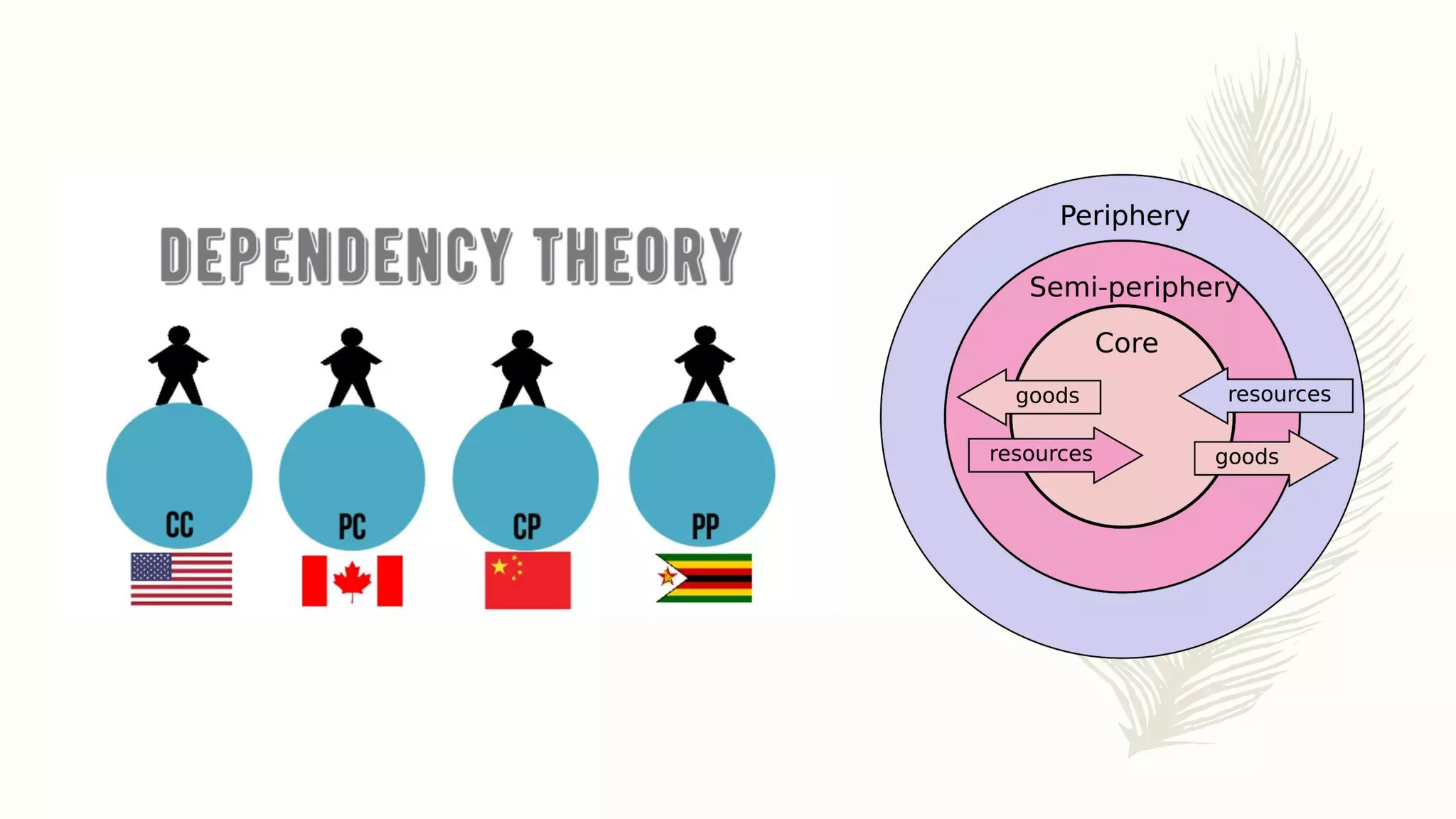
Dependency Theory
 The development of the rich world was achieved by the exploitation of the
developing world.
 The diagram shows how resources are moving from periphery (developing) to
the core (developed)
 Developing countries moved into production of cash crops (coffee, tea, cocoa)
which meant they were no longer subsistent and actually dependent on
developed countries for food imports and food aid.
 The development of many countries were slowed down or stopped by the
arrival of the colonist. Many countries were richer before colonisations than
after.
 Dependency theory is based on a Marxist view of the world, which sees
globalisation in terms of the spread of market capitalism, and the
exploitation of cheap labour and resources in return for the obsolete
technologies of the West.
 The dominant view of dependency theorists is that there is a dominant
world capitalist system that relies on a division of labour between the rich
'core' countries and poor 'peripheral' countries. Over time, the core
countries will exploit their dominance over an increasingly marginalised
periphery.
Two models of cultural
imperialism
1) Schiller Model
 The global power structures in the international communication industry and
the links between transnational business and dominant states.
 The argument stated that in the pursuit of commercial interest US- based
transnational corporations, often in league with Western military and political
interest were undermining the cultural autonomy of Southern countries.
 Creating a dependency on both the hardware and software of communication
and media in the developing countries.
 Historical continuities in its quest for systemic power and control of global
communication.
 Selling media-related US hardware and software.
 Promoting the image of the USA and the world that was favorable to American
interests.
 Advertising American goods and services
 Directly through the provision of more channels for advertising.
 Indirectly through the display of consumer lifestyles.
2) Generic Model
 The generic model developed in integrates time/space considerations. It is
more widely applicable than the Schiller Model.
 Attributed great influence to the media expansion of major power.
 It acknowledge the “multidimensionality” of media forms and degrees of
dependence and imperialism so it is not important if the focus is on the third
world of the developed world.
 The model can be used to analyze for instance, the domination of American
television in the UK.
Marxist analysis of Imperialism
 Marxist analysis wanting to investigate the continuing dependence of post-
colonial states on previous imperial powers within the context of post-Second
World War US dominance.
 Political interdependence had to be judge by the continuing economic and
cultural dependence. (e.g. education, ideas, media, language)
The Film Industry
 The British film industry which in the late 1990s is stronger than it has been for
years, is still overshadowed by the success of Hollywood products.
 In 1997, 103 UK films and 193 US films were released in the UK, but the US
films get 73.5 % of the total income.
 Control of distribution and exhibition contributes to the success of other US
commercial activities, including film-related branding of toys, clothes and
other goods.
 Hollywood film dominance inevitably carries over to video sales and television
replays.
International Television and Print News
 Major wholesale suppliers of international television and print news to
television, radio stations and daily newspaper throughout the world are news
agencies, whose headquarters are in New York, London and Paris.
 These news agencies directly or indirectly represent a lineage of dominance.
 Some of the international satellite broadcasters include BBC World, CNN,
MSNBC and Fox Television, which are client of the wholesalers.
Global Manufacture of Personal-computer
 Global manufacture of personal-computer operating systems is almost entirely in the hands
of one US corporation, Microsoft.
 Production of chips for such machines is largely controlled by another American
corporation, Intel.
 Gateway services to the internet are mainly controlled by two US software product,
Microsoft Internet Explorer and Netscape and most of the internet sites are dominated by
the USA.
 Web-page designers tend to support software standards that are compatible with the
dominant browser, and Microsoft has been paying internet service providers to bundle
Explorer with their services.
 They signed exclusive deals where Microsoft’s Explorer will be required for access to parts of
the web sites which the companies are establishing .
 Through control of desktop operating systems and internet browsers, Microsoft seeks to
control the business computers managing web sites at the other end.
 It also represents a threat to the computing standards of the internet-oriented Java
language.
 Java was designed to be platform-independent.
 Microsoft’s goal is to divert Java into a new Microsoft-controlled system that runs best
only on Windows-based machines.
 when Microsoft invested in Apple Computer in 1997 they agreed that in exchange Apple
would bundle Explorer in every Apple computer and support Microsoft’s Java standards.
 Over 65% of new intranet sites are deployed on Microsoft Windows NT servers.
 Microsoft control extends beyond operating systems and software applications to
development tools used by a majority of programmers and IT professionals.
 Principal global media companies identified by Herman and McChesney are
News Corporation, Time Warner, Disney, Viacom, Bertelsmann, TCI, Universal
and General Electricas they have very big sales figures.
 In the case of telephony, US-SBC Communications, the Texs-based telecoms
company, purchased Southern New England Telecommunications, in a move to
a long-distance telephony market.
 SBC bought PacificTelesis Group giving it California, Nevada and undersea
access to Asia and land access to mexican and South American markets.
Concept of
Media
Imperialism
– Media activity is controlled by one
nation/groups at the expense of others
– Colonization process of communication space
The
Framework
– No necessary relationship with
territory/technology
– Necessarily related to the resources and for a
for human
Territorial
Imperialism
– Its object the conquest of a finite territory
– Ambitions of conquerors may lead them to
annex yet more territory
Value of
Communication
– Enhanced relative to the size and quality of
audiences
– More resources & skills to attract gain more
great influence
– E.g: Internet (Instagram, Twitter, YouTube)
VS
Concept of
“Imperialism”
– Concentrate on agency
– Have regard for inequalities
– Be alert to communications regulation as
conquest
– To be conscious of communications space as
the site for struggle and resistance.
Media
Imperialism
Cultural
ImperialismVS
Benefits of the Concept
 It recognized that imperialism could vary between different media, and
between different levels, dimensions or sphere of activities within any one
sector of the media industries.
Problems of the Concept
 It talked about inter media relations, and excluded non media interests.
 Ignored the questions of audience
Centres of
media
production
which enjoy
INTERNATIONAL
INFLUENCE
BOMBAY for
Hindi film
CAIRO for Arabic
television, radio
and print
production
MEXICO and
BRAZIL for
telenovelas
HONG KONG as supplier of
television programming for
China and Taiwan
AUSTRALIA as a state-
subsidized film export trade
has generated several soap
operas successfully in other
English-speaking countries
notably British
Most households are served by multi-channel, 50 –
60 channels
Local cable network clients have a choice of several
international and domestic satellite-delivered
services in a variety of local languages including
Hindi and English
Both above are more ‘advanced’ in this respect
than the United Kingdom, where most of the
population (depending on area) still receives only a
range of 4 or 5 terrestrial networks.
The number of television stations doubled in the
period 1990-6 from approximately 125-250.
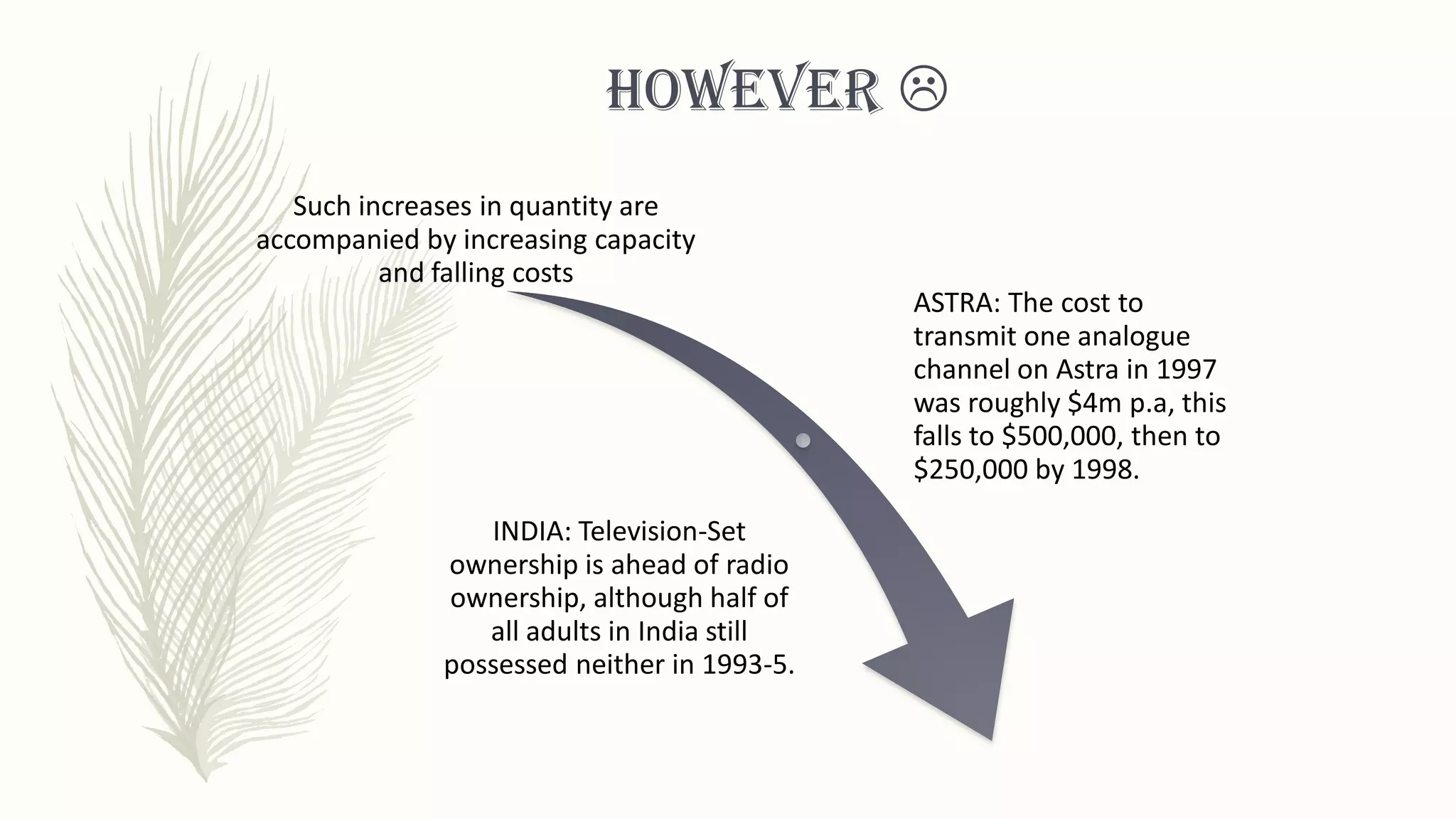
HOWEVER 
Such increases in quantity are
accompanied by increasing capacity
and falling costs
ASTRA: The cost to
transmit one analogue
channel on Astra in 1997
was roughly $4m p.a, this
falls to $500,000, then to
$250,000 by 1998.
INDIA: Television-Set
ownership is ahead of radio
ownership, although half of
all adults in India still
possessed neither in 1993-5.
International
JOURNALISM
Wall Street
Journal
Financial
Times
Newsweek
International
Herald
Trebune
The phenomenon of
international journalism is
still associated mainly with
prestige titles selling to elite
business audience, and
most national press systems
are still strongly ‘local’ in
terms of ownership and
structure; but the influence
of international press
corporations testifies to the
continuing importance of
corporatism in press
journalism.
Whoops!
Growth of local
production may be too
threatened and overtaken
by international satellite
distribution.
Example: Availability of cable
television, international
satellite and video in India is
weakening the influence of
the Bombay industry.
Overall growth in capacity
increases dependence on
imports to fill available
time, which guarantee the
interest of large,
international advertisers.
EFFECTS OF NEWS AGENCIES
1) The total number of global print agencies has diminished rather than increased.
2) There has been a growth of TV AND Internet news providers.
3) There is little evidence to suggest that major imbalances with respect to distribution of
resources or attention.
4) There is little encouraging evidence that alternative media (e.g. DepthNews, Gemini, Inter
Press Service) have a significant impact on mainstream media.
Conclusion
 Significance of media-imperialism theory is to understand the nature of the
relationship between national economies and global capitalist economy by
using role of culture and media.
 Major defect of media-imperialism theory:
• embedded in a radical political discourse against USA.
• it has never been empirically applied to a sufficiently
comprehensive degree.

Media Imperialism Reformulated

  • 1.
    MEDIA IMPERIALISM REFORMULATED BYOLIVER BOYD-BARRET ENCO 1101- INTRODUCTION TO INTERNATIONAL COMMUNICATION KULIYYAH OF LANGUAGES AND MANAGEMENT SHARIFAH SALWA BINTI ABDUL KARIM ALI KHAIRI BIN ASRI 1511343 ANIS FARHANAH BINTI AZMI 1431826 ANIZ AFRINA BINTI MOHD ZIN 1718822 AYU NURAIN NABILA BINTI ANUAR 1712246 MOHAMAD TAUFIQ BIN MOHAMAD NOH 1519371 NUR WARDAH BINTI RAMLAN 1720732
  • 2.
    Two Model ofMedia Imperialism • Cultural imperialism • Dependency
  • 3.
    Cultural Imperialism Theory •Cultural imperialism theory states that Western Nations dominate the media around the world which in return has a powerful effect on Third world cultures by imposing on them Western views and therefore destroying their Native Culture. • Cultural imperialism is the practice of promoting , distinguishing, separating and artificially injecting the culture of one nation into another. • Globalization of media and the internet are accelerating the process of cultural imperialism • The practice of promoting a more powerful culture over a least known culture
  • 4.
    Dependency Theory  Thedevelopment of the rich world was achieved by the exploitation of the developing world.  The diagram shows how resources are moving from periphery (developing) to the core (developed)  Developing countries moved into production of cash crops (coffee, tea, cocoa) which meant they were no longer subsistent and actually dependent on developed countries for food imports and food aid.  The development of many countries were slowed down or stopped by the arrival of the colonist. Many countries were richer before colonisations than after.
  • 5.
     Dependency theoryis based on a Marxist view of the world, which sees globalisation in terms of the spread of market capitalism, and the exploitation of cheap labour and resources in return for the obsolete technologies of the West.  The dominant view of dependency theorists is that there is a dominant world capitalist system that relies on a division of labour between the rich 'core' countries and poor 'peripheral' countries. Over time, the core countries will exploit their dominance over an increasingly marginalised periphery.
  • 7.
    Two models ofcultural imperialism 1) Schiller Model  The global power structures in the international communication industry and the links between transnational business and dominant states.  The argument stated that in the pursuit of commercial interest US- based transnational corporations, often in league with Western military and political interest were undermining the cultural autonomy of Southern countries.  Creating a dependency on both the hardware and software of communication and media in the developing countries.  Historical continuities in its quest for systemic power and control of global communication.
  • 8.
     Selling media-relatedUS hardware and software.  Promoting the image of the USA and the world that was favorable to American interests.  Advertising American goods and services  Directly through the provision of more channels for advertising.  Indirectly through the display of consumer lifestyles.
  • 9.
    2) Generic Model The generic model developed in integrates time/space considerations. It is more widely applicable than the Schiller Model.  Attributed great influence to the media expansion of major power.  It acknowledge the “multidimensionality” of media forms and degrees of dependence and imperialism so it is not important if the focus is on the third world of the developed world.  The model can be used to analyze for instance, the domination of American television in the UK.
  • 10.
    Marxist analysis ofImperialism  Marxist analysis wanting to investigate the continuing dependence of post- colonial states on previous imperial powers within the context of post-Second World War US dominance.  Political interdependence had to be judge by the continuing economic and cultural dependence. (e.g. education, ideas, media, language)
  • 11.
    The Film Industry The British film industry which in the late 1990s is stronger than it has been for years, is still overshadowed by the success of Hollywood products.  In 1997, 103 UK films and 193 US films were released in the UK, but the US films get 73.5 % of the total income.  Control of distribution and exhibition contributes to the success of other US commercial activities, including film-related branding of toys, clothes and other goods.  Hollywood film dominance inevitably carries over to video sales and television replays.
  • 12.
    International Television andPrint News  Major wholesale suppliers of international television and print news to television, radio stations and daily newspaper throughout the world are news agencies, whose headquarters are in New York, London and Paris.  These news agencies directly or indirectly represent a lineage of dominance.  Some of the international satellite broadcasters include BBC World, CNN, MSNBC and Fox Television, which are client of the wholesalers.
  • 13.
    Global Manufacture ofPersonal-computer  Global manufacture of personal-computer operating systems is almost entirely in the hands of one US corporation, Microsoft.  Production of chips for such machines is largely controlled by another American corporation, Intel.  Gateway services to the internet are mainly controlled by two US software product, Microsoft Internet Explorer and Netscape and most of the internet sites are dominated by the USA.  Web-page designers tend to support software standards that are compatible with the dominant browser, and Microsoft has been paying internet service providers to bundle Explorer with their services.  They signed exclusive deals where Microsoft’s Explorer will be required for access to parts of the web sites which the companies are establishing .
  • 14.
     Through controlof desktop operating systems and internet browsers, Microsoft seeks to control the business computers managing web sites at the other end.  It also represents a threat to the computing standards of the internet-oriented Java language.  Java was designed to be platform-independent.  Microsoft’s goal is to divert Java into a new Microsoft-controlled system that runs best only on Windows-based machines.  when Microsoft invested in Apple Computer in 1997 they agreed that in exchange Apple would bundle Explorer in every Apple computer and support Microsoft’s Java standards.  Over 65% of new intranet sites are deployed on Microsoft Windows NT servers.  Microsoft control extends beyond operating systems and software applications to development tools used by a majority of programmers and IT professionals.
  • 15.
     Principal globalmedia companies identified by Herman and McChesney are News Corporation, Time Warner, Disney, Viacom, Bertelsmann, TCI, Universal and General Electricas they have very big sales figures.  In the case of telephony, US-SBC Communications, the Texs-based telecoms company, purchased Southern New England Telecommunications, in a move to a long-distance telephony market.  SBC bought PacificTelesis Group giving it California, Nevada and undersea access to Asia and land access to mexican and South American markets.
  • 16.
    Concept of Media Imperialism – Mediaactivity is controlled by one nation/groups at the expense of others – Colonization process of communication space
  • 17.
    The Framework – No necessaryrelationship with territory/technology – Necessarily related to the resources and for a for human
  • 18.
    Territorial Imperialism – Its objectthe conquest of a finite territory – Ambitions of conquerors may lead them to annex yet more territory
  • 19.
    Value of Communication – Enhancedrelative to the size and quality of audiences – More resources & skills to attract gain more great influence – E.g: Internet (Instagram, Twitter, YouTube)
  • 20.
  • 21.
    Concept of “Imperialism” – Concentrateon agency – Have regard for inequalities – Be alert to communications regulation as conquest – To be conscious of communications space as the site for struggle and resistance.
  • 22.
  • 23.
    Benefits of theConcept  It recognized that imperialism could vary between different media, and between different levels, dimensions or sphere of activities within any one sector of the media industries.
  • 24.
    Problems of theConcept  It talked about inter media relations, and excluded non media interests.  Ignored the questions of audience
  • 25.
    Centres of media production which enjoy INTERNATIONAL INFLUENCE BOMBAYfor Hindi film CAIRO for Arabic television, radio and print production MEXICO and BRAZIL for telenovelas HONG KONG as supplier of television programming for China and Taiwan AUSTRALIA as a state- subsidized film export trade has generated several soap operas successfully in other English-speaking countries notably British
  • 26.
    Most households areserved by multi-channel, 50 – 60 channels Local cable network clients have a choice of several international and domestic satellite-delivered services in a variety of local languages including Hindi and English Both above are more ‘advanced’ in this respect than the United Kingdom, where most of the population (depending on area) still receives only a range of 4 or 5 terrestrial networks. The number of television stations doubled in the period 1990-6 from approximately 125-250.
  • 27.
    HOWEVER  Such increasesin quantity are accompanied by increasing capacity and falling costs ASTRA: The cost to transmit one analogue channel on Astra in 1997 was roughly $4m p.a, this falls to $500,000, then to $250,000 by 1998. INDIA: Television-Set ownership is ahead of radio ownership, although half of all adults in India still possessed neither in 1993-5.
  • 28.
    International JOURNALISM Wall Street Journal Financial Times Newsweek International Herald Trebune The phenomenonof international journalism is still associated mainly with prestige titles selling to elite business audience, and most national press systems are still strongly ‘local’ in terms of ownership and structure; but the influence of international press corporations testifies to the continuing importance of corporatism in press journalism.
  • 29.
    Whoops! Growth of local productionmay be too threatened and overtaken by international satellite distribution. Example: Availability of cable television, international satellite and video in India is weakening the influence of the Bombay industry. Overall growth in capacity increases dependence on imports to fill available time, which guarantee the interest of large, international advertisers.
  • 30.
    EFFECTS OF NEWSAGENCIES 1) The total number of global print agencies has diminished rather than increased. 2) There has been a growth of TV AND Internet news providers. 3) There is little evidence to suggest that major imbalances with respect to distribution of resources or attention. 4) There is little encouraging evidence that alternative media (e.g. DepthNews, Gemini, Inter Press Service) have a significant impact on mainstream media.
  • 31.
    Conclusion  Significance ofmedia-imperialism theory is to understand the nature of the relationship between national economies and global capitalist economy by using role of culture and media.  Major defect of media-imperialism theory: • embedded in a radical political discourse against USA. • it has never been empirically applied to a sufficiently comprehensive degree.