JOURN 220:
Module One
1
The Story of Journalism
Jason Nix
Spokane Falls
Community College
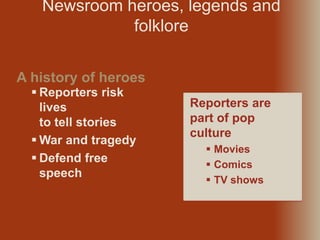
 Reporters risk
lives
to tell stories
 War and tragedy
 Defend free
speech
Newsroom heroes, legends and
folklore
A history of heroes
Reporters are
part of pop
culture
 Movies
 Comics
 TV shows
3
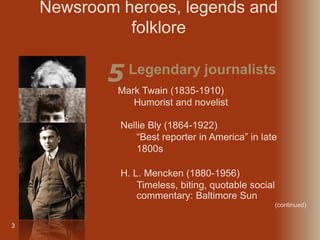
5 Legendary journalists
Mark Twain (1835-1910)
Humorist and novelist
Nellie Bly (1864-1922)
“Best reporter in America” in late
1800s
H. L. Mencken (1880-1956)
Timeless, biting, quotable social
commentary: Baltimore Sun
(continued)
Newsroom heroes, legends and
folklore
Newsroom heroes, legends and
folklore
4
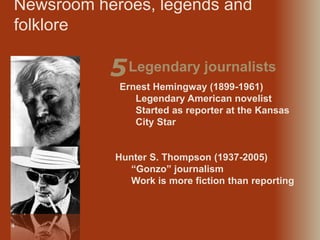
5Legendary journalists
Ernest Hemingway (1899-1961)
Legendary American novelist
Started as reporter at the Kansas
City Star
Hunter S. Thompson (1937-2005)
“Gonzo” journalism
Work is more fiction than reporting
5
Female reporters are gutsy, idealistic,
beautiful and single.
Male reporters are surly, cynical loners.
Reporters routinely solve mysteries.
Reporters ambush, dodge, shout.
Reporters drink at their desks.
Reporters have a liberal bias.
5 Myths about reporters
Newsroom heroes, legends and
folklore
6
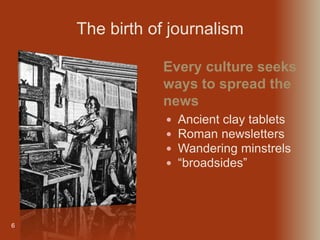
 Ancient clay tablets
 Roman newsletters
 Wandering minstrels
 “broadsides”
Every culture seeks
ways to spread the
news
The birth of journalism
7
 Technological
progress
 Impact of bigger,
faster presses.
 Specialized form of
literary expression
 Constantly evolving,
reflecting and
shaping.
Different views of history
• Quest for free speech
• Struggle between
Authority and the
People.
The birth of journalism
8
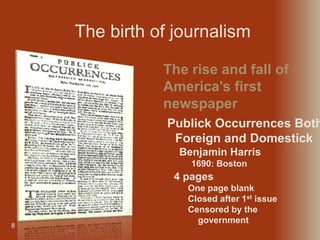
Publick Occurrences Both
Foreign and Domestick
Benjamin Harris
1690: Boston
The rise and fall of
America’s first
newspaper
The birth of journalism
4 pages
One page blank
Closed after 1st issue
Censored by the
government
The birth of journalism
9
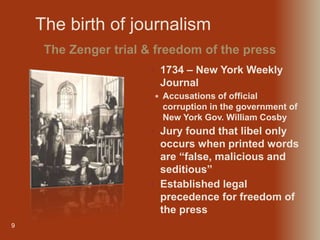
 1734 – New York Weekly
Journal
 Accusations of official
corruption in the government of
New York Gov. William Cosby
 Jury found that libel only
occurs when printed words
are “false, malicious and
seditious”
 Established legal
precedence for freedom of
the press
The Zenger trial & freedom of the press
The birth of journalism
10
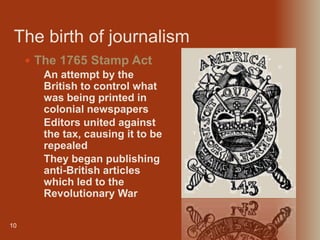
 The 1765 Stamp Act
• An attempt by the
British to control what
was being printed in
colonial newspapers
• Editors united against
the tax, causing it to be
repealed
• They began publishing
anti-British articles
which led to the
Revolutionary War
The birth of journalism
11
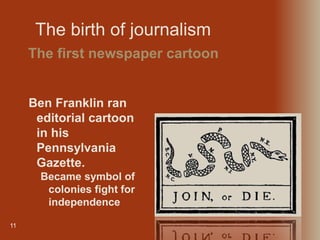
The first newspaper cartoon
Ben Franklin ran
editorial cartoon
in his
Pennsylvania
Gazette.
Became symbol of
colonies fight for
independence
The birth of journalism
12
Patriotism, propaganda & the
Revolutionary War
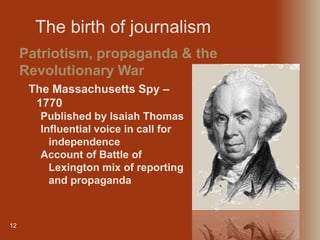
The Massachusetts Spy –
1770
Published by Isaiah Thomas
Influential voice in call for
independence
Account of Battle of
Lexington mix of reporting
and propaganda
13
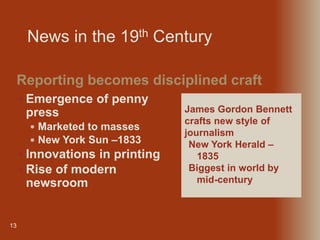
 Emergence of penny
press
 Marketed to masses
 New York Sun –1833
 Innovations in printing
 Rise of modern
newsroom
Reporting becomes disciplined craft
James Gordon Bennett
crafts new style of
journalism
New York Herald –
1835
Biggest in world by
mid-century
News in the 19th Century
14
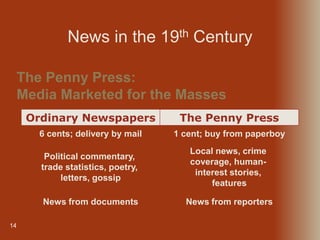
The Penny Press:
Media Marketed for the Masses
News in the 19th Century
Ordinary Newspapers The Penny Press
6 cents; delivery by mail 1 cent; buy from paperboy
Political commentary,
trade statistics, poetry,
letters, gossip
Local news, crime
coverage, human-
interest stories,
features
News from documents News from reporters
15
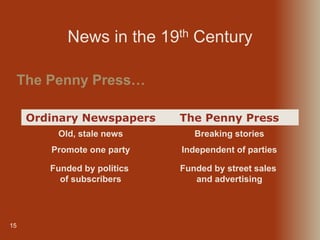
The Penny Press…
News in the 19th Century
Ordinary Newspapers The Penny Press
Old, stale news Breaking stories
Funded by politics
of subscribers
Funded by street sales
and advertising
Promote one party Independent of parties
16
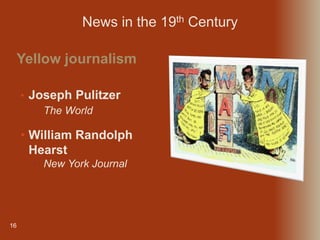
• Joseph Pulitzer
• The World
Yellow journalism
News in the 19th Century
• William Randolph
Hearst
• New York Journal
17
 Loud headlines
 Sensational stories on
sin and sex
 Lavish use of pictures
 Often faked
Yellow journalism’s golden age
News in the 19th Century
Sunday supplements
Comics and features
Rumors disguised as
news
Led to war with Spain
18
 Horace Greely
 Liberal, crusading
social reformer
 Henry Raymond
 NY Times
Transcending Yellow Journalism
News in the 19th Century
19
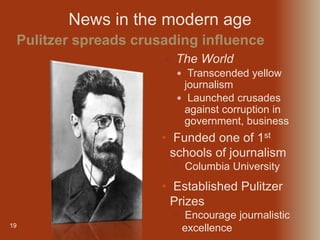
 The World
 Transcended yellow
journalism
 Launched crusades
against corruption in
government, business
Pulitzer spreads crusading influence
News in the modern age
• Funded one of 1st
schools of journalism
• Columbia University
• Established Pulitzer
Prizes
• Encourage journalistic
excellence
20
 Competition too
appealing
 Radio had sound and
music
 Movie newsreels added
faces to voices
 By 1950, television
 Now, Internet
Radio, TV bring end to
newspaper’s media monopoly
News in the modern age
Newspapers respond
 Tighter writing
 Better formatting
 Improved design
 Corporate
consolidation
21
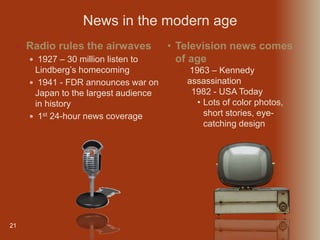
 Radio rules the airwaves
 1927 – 30 million listen to
Lindberg’s homecoming
 1941 - FDR announces war on
Japan to the largest audience
in history
 1st 24-hour news coverage
News in the modern age
• Television news comes
of age
• 1963 – Kennedy
assassination
• 1982 - USA Today
• Lots of color photos,
short stories, eye-
catching design
22
Inverted pyramid
No longer Americans’ first, or
favorite, source of news
More facts;
less sensationalism
More readable
Radio, TV and the Newspaper
Meanwhile, back at the
newspaper…
News in the modern age
23
Which media do YOU believe most
when you hear conflicting versions of
a news story?
News in the modern age
• Local TV news
• Radio news
• Local newspaper
• Web site
• National TV news
• Bloggers
24
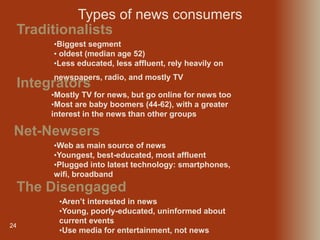
Traditionalists
Types of news consumers
•Biggest segment
• oldest (median age 52)
•Less educated, less affluent, rely heavily on
newspapers, radio, and mostly TV
Integrators
•Mostly TV for news, but go online for news too
•Most are baby boomers (44-62), with a greater
interest in the news than other groups
Net-Newsers
•Web as main source of news
•Youngest, best-educated, most affluent
•Plugged into latest technology: smartphones,
wifi, broadband
The Disengaged
•Aren’t interested in news
•Young, poorly-educated, uninformed about
current events
•Use media for entertainment, not news
JOURN 220:
Module One
25
The Story of Journalism
Jason Nix
Spokane Falls
Community College

Module One

  • 1.
    JOURN 220: Module One 1 TheStory of Journalism Jason Nix Spokane Falls Community College
  • 2.
     Reporters risk lives totell stories  War and tragedy  Defend free speech Newsroom heroes, legends and folklore A history of heroes Reporters are part of pop culture  Movies  Comics  TV shows
  • 3.
    3 5 Legendary journalists MarkTwain (1835-1910) Humorist and novelist Nellie Bly (1864-1922) “Best reporter in America” in late 1800s H. L. Mencken (1880-1956) Timeless, biting, quotable social commentary: Baltimore Sun (continued) Newsroom heroes, legends and folklore
  • 4.
    Newsroom heroes, legendsand folklore 4 5Legendary journalists Ernest Hemingway (1899-1961) Legendary American novelist Started as reporter at the Kansas City Star Hunter S. Thompson (1937-2005) “Gonzo” journalism Work is more fiction than reporting
  • 5.
    5 Female reporters aregutsy, idealistic, beautiful and single. Male reporters are surly, cynical loners. Reporters routinely solve mysteries. Reporters ambush, dodge, shout. Reporters drink at their desks. Reporters have a liberal bias. 5 Myths about reporters Newsroom heroes, legends and folklore
  • 6.
    6  Ancient claytablets  Roman newsletters  Wandering minstrels  “broadsides” Every culture seeks ways to spread the news The birth of journalism
  • 7.
    7  Technological progress  Impactof bigger, faster presses.  Specialized form of literary expression  Constantly evolving, reflecting and shaping. Different views of history • Quest for free speech • Struggle between Authority and the People. The birth of journalism
  • 8.
    8 Publick Occurrences Both Foreignand Domestick Benjamin Harris 1690: Boston The rise and fall of America’s first newspaper The birth of journalism 4 pages One page blank Closed after 1st issue Censored by the government
  • 9.
    The birth ofjournalism 9  1734 – New York Weekly Journal  Accusations of official corruption in the government of New York Gov. William Cosby  Jury found that libel only occurs when printed words are “false, malicious and seditious”  Established legal precedence for freedom of the press The Zenger trial & freedom of the press
  • 10.
    The birth ofjournalism 10  The 1765 Stamp Act • An attempt by the British to control what was being printed in colonial newspapers • Editors united against the tax, causing it to be repealed • They began publishing anti-British articles which led to the Revolutionary War
  • 11.
    The birth ofjournalism 11 The first newspaper cartoon Ben Franklin ran editorial cartoon in his Pennsylvania Gazette. Became symbol of colonies fight for independence
  • 12.
    The birth ofjournalism 12 Patriotism, propaganda & the Revolutionary War The Massachusetts Spy – 1770 Published by Isaiah Thomas Influential voice in call for independence Account of Battle of Lexington mix of reporting and propaganda
  • 13.
    13  Emergence ofpenny press  Marketed to masses  New York Sun –1833  Innovations in printing  Rise of modern newsroom Reporting becomes disciplined craft James Gordon Bennett crafts new style of journalism New York Herald – 1835 Biggest in world by mid-century News in the 19th Century
  • 14.
    14 The Penny Press: MediaMarketed for the Masses News in the 19th Century Ordinary Newspapers The Penny Press 6 cents; delivery by mail 1 cent; buy from paperboy Political commentary, trade statistics, poetry, letters, gossip Local news, crime coverage, human- interest stories, features News from documents News from reporters
  • 15.
    15 The Penny Press… Newsin the 19th Century Ordinary Newspapers The Penny Press Old, stale news Breaking stories Funded by politics of subscribers Funded by street sales and advertising Promote one party Independent of parties
  • 16.
    16 • Joseph Pulitzer •The World Yellow journalism News in the 19th Century • William Randolph Hearst • New York Journal
  • 17.
    17  Loud headlines Sensational stories on sin and sex  Lavish use of pictures  Often faked Yellow journalism’s golden age News in the 19th Century Sunday supplements Comics and features Rumors disguised as news Led to war with Spain
  • 18.
    18  Horace Greely Liberal, crusading social reformer  Henry Raymond  NY Times Transcending Yellow Journalism News in the 19th Century
  • 19.
    19  The World Transcended yellow journalism  Launched crusades against corruption in government, business Pulitzer spreads crusading influence News in the modern age • Funded one of 1st schools of journalism • Columbia University • Established Pulitzer Prizes • Encourage journalistic excellence
  • 20.
    20  Competition too appealing Radio had sound and music  Movie newsreels added faces to voices  By 1950, television  Now, Internet Radio, TV bring end to newspaper’s media monopoly News in the modern age Newspapers respond  Tighter writing  Better formatting  Improved design  Corporate consolidation
  • 21.
    21  Radio rulesthe airwaves  1927 – 30 million listen to Lindberg’s homecoming  1941 - FDR announces war on Japan to the largest audience in history  1st 24-hour news coverage News in the modern age • Television news comes of age • 1963 – Kennedy assassination • 1982 - USA Today • Lots of color photos, short stories, eye- catching design
  • 22.
    22 Inverted pyramid No longerAmericans’ first, or favorite, source of news More facts; less sensationalism More readable Radio, TV and the Newspaper Meanwhile, back at the newspaper… News in the modern age
  • 23.
    23 Which media doYOU believe most when you hear conflicting versions of a news story? News in the modern age • Local TV news • Radio news • Local newspaper • Web site • National TV news • Bloggers
  • 24.
    24 Traditionalists Types of newsconsumers •Biggest segment • oldest (median age 52) •Less educated, less affluent, rely heavily on newspapers, radio, and mostly TV Integrators •Mostly TV for news, but go online for news too •Most are baby boomers (44-62), with a greater interest in the news than other groups Net-Newsers •Web as main source of news •Youngest, best-educated, most affluent •Plugged into latest technology: smartphones, wifi, broadband The Disengaged •Aren’t interested in news •Young, poorly-educated, uninformed about current events •Use media for entertainment, not news
  • 25.
    JOURN 220: Module One 25 TheStory of Journalism Jason Nix Spokane Falls Community College