


lcome to the world of
urnalism, where
porters have been
gging dirt, raking muck,
king headlines and
adlines for centuries
w. It’s a history full of
bloid trash, of slimy
nsationalists, of
runkards, deadbeats and
mmers” (as a Harvard
iversity president once
scribed reporters).
But it’s a history full of
roes, too: men and
men risking their lives
tell stories of war and
agedy, risking
prisonment to defend
ee speech. And as you
n see here, reports have
come beloved characters
p culture, too, turning up
movies, comics and TV
ows as if guided by an
cult hand.
Every culture seeks
effective ways to spread
new information and gossip.
In ancient times, news was
written on clay tablets. In
Caesar’s age, Romans read
newsletters compiled by
correspondents and
handwritten by slaves.
Wandering minstrels spread
news (and the plague) in the
Middle Ages. Them came
ink on paper. Voices on
airwaves. Newsreels, Web
sites, And 24-hour cable
news networks.
Thus when scholars
analyze the rich history of
journalism, some view it in
terms of technological
progress—for example, the
dramatic impact of
bigger, faster printing
presses.
Others see journalism as
a specialized form literary
expression, one that’s
constantly
evolving, reflecting and
shaping its culture.
Others see it as an
inspiring quest for free
speech, an endless power
struggle between Authority
(trying to control
information) and the People
(trying to learn the truth).
Which brings to mind the
words of A.J. Liefling:
“Freedom of the press is
guaranteed only to htose
who own one.”
In the pages ahead, we’ll
take a quick tour of 600
years of journalism
history, from hieroglyphics
to hypertext: the media, the
message and the politics.
Technical advances and
brilliant ideas forged a new
style of journalism. It was a
century of change, and
newspapers changed
dramatically. The typi
newspaper of 1800 wa
undisciplined mishma
legislative proceeding
long-winded essays a
secondhand gossip. B
1900, a new breed of
tor had emerged. Jour
had become big busin
Reporting was becom
disciplined craft. And
newspapers were bec
more entertaining and
essential than ever, w
most of the features w
expect today: Snappy
headlines, Ads, Comic
Sports pages. And an
“inverted pyramid” sty
writing that made stori
tighter and newsier.
Radio and television
brought an end to
newspapers’ media
monopoly. Why? Well
yourself: Which did yo
Covering the news
Inside Reporting
Tim Harrower
5
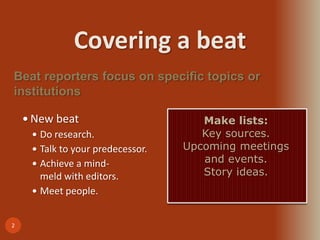
Covering a beat
2
 New beat
 Do research.
 Talk to your predecessor.
 Achieve a mind-
meld with editors.
 Meet people.
Beat reporters focus on specific topics or
institutions
Make lists:
Key sources.
Upcoming meetings
and events.
Story ideas.
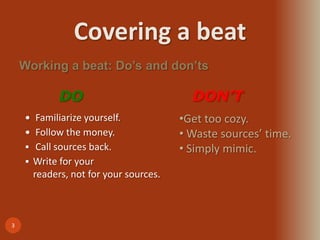
Covering a beat
3
 Familiarize yourself.
 Follow the money.
 Call sources back.
 Write for your
readers, not for your sources.
Working a beat: Do’s and don’ts
DO
•Get too cozy.
• Waste sources’ time.
• Simply mimic.
DON’T
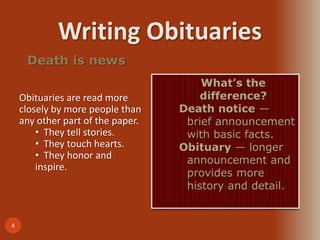
Writing Obituaries
4
Death is news
Obituaries are read more
closely by more people than
any other part of the paper.
• They tell stories.
• They touch hearts.
• They honor and
inspire.
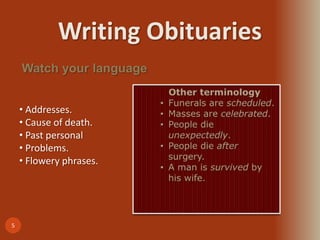
Writing Obituaries
5
Watch your language
• Addresses.
• Cause of death.
• Past personal
• Problems.
• Flowery phrases.
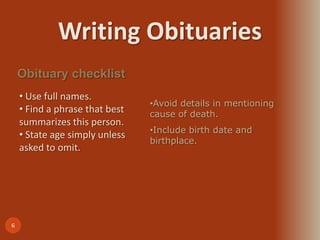
Writing Obituaries
6
Obituary checklist
• Use full names.
• Find a phrase that best
summarizes this person.
• State age simply unless
asked to omit.
•Avoid details in mentioning
cause of death.
•Include birth date and
birthplace.
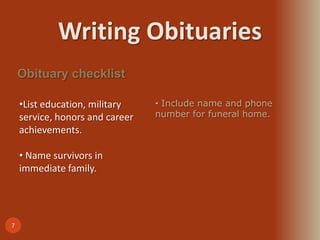
Writing Obituaries
7
Obituary checklist
•List education, military
service, honors and career
achievements.
• Name survivors in
immediate family.
• Include name and phone
number for funeral home.
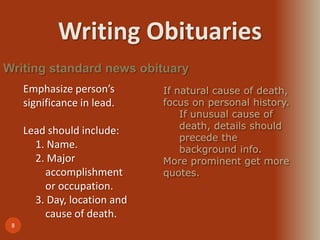
Writing Obituaries
8
Writing standard news obituary
Emphasize person’s
significance in lead.
Lead should include:
1. Name.
2. Major
accomplishment
or occupation.
3. Day, location and
cause of death.
If natural cause of death,
focus on personal history.
If unusual cause of
death, details should
precede the
background info.
More prominent get more
quotes.
Writing Obituaries
9
The feature obituary
• Looser, friendlier style.
• Create an illusion of
intimacy.
• Omit attributions.
Writing Obituaries
10
Talking with families about
the deceased
• Don’t be squeamish.
• If you’re not sure what to
say, use a script.
• Be supportive.
• Be willing to listen.
• If it will be a long
obituary, gather
as much detail as possible.
• Avoid the
awkwardly obvious.
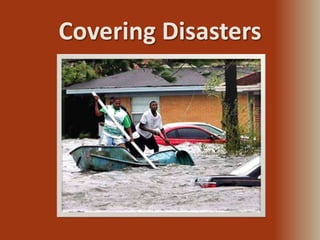
Covering Disasters
How do editors decide what is
and is not a news story?
• Severity: death, damage or injury
• Impact: how many people are affected
• Proximity: The more local it is, the more
impact on your readers.
How to prepare
•Anticipate worst-case scenarios
• Check your history
• Obtain information on local agencies’ emergency planning
• Keep a phone list handy
• Devise a newsroom battle plan
• Prepare a field kit
What to do when you arrive
on the scene?
•Go to where the action is
• Question authorities first
• Talk to victims and eyewitnesses
• Record details that capture the scene
• Check in often with your editors, and collaborate
Dealing with victims
• Ask permission
• Go slowly
• Empathize – but watch what you say
Covering fires
16
Reporting and writing fire stories
• Identify yourself.
• Find the command post.
• Introduce yourself to
command.
•Get as close as you can.
• Wear boots.
Coveringfires
17
Reporting and writing fire stories
Firefighters only see
part of the story.
Watch your language.
 Be specific
 Destroyed
 Conflagration
 Holocaust
 Guts
 Razed
Covering fires
18
Fire story checklist
 Victim names.
 Extent of injuries/cause
of death.
 Type of building.
 Location.
 Time.
 How the fire was discovered.
 Cause of fire.
 Number of fire fighters.
 Estimated cost of damage.
Covering fires
19
Fire story checklist…
Extent of insurance
coverage.
 Acts of heroism.
 Weather.
 Effect of fire on
evacuees.
 Plans to relocate victims
or rebuild structures.
 Arrests or citations.
 Anecdotes and
descriptions.
 Any other unusual
aspects.
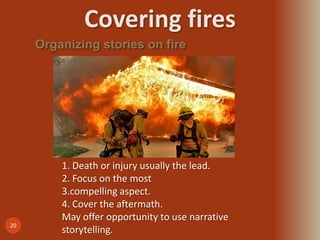
Covering fires
20
Organizing stories on fire
1. Death or injury usually the lead.
2. Focus on the most
3.compelling aspect.
4. Cover the aftermath.
May offer opportunity to use narrative
storytelling.
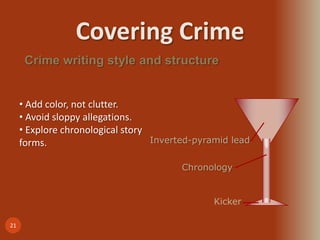
Covering Crime
21
Crime writing style and structure
• Add color, not clutter.
• Avoid sloppy allegations.
• Explore chronological story
forms.
Kicker
Inverted-pyramid lead
Chronology
Covering Crime
22
Covering the crime beat
• Get to know everyone.
• Find what information is
available.
• Get familiar with police
procedures.
• Use a scanner.
Covering Crime
23
Covering the crime beat
• Be prepared for
anything.
• Think trends.
• Convey the human
drama.
•Remember
teachers, coaches, ministers
and public officials are big
news.
Covering Crime
24
What you should withhold
• Names of minors.
• Names of victims of
sensitive crimes.
• Names of endangered
victims.
• Labeling people as
suspects.
• Stereotypes.
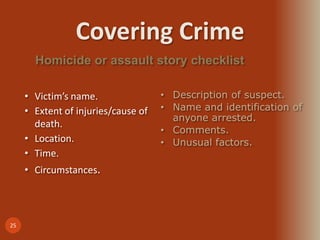
Covering Crime
25
Homicide or assault story checklist
• Victim’s name.
• Extent of injuries/cause of
death.
• Location.
• Time.
• Circumstances.
• Description of suspect.
• Name and identification of
anyone arrested.
• Comments.
• Unusual factors.
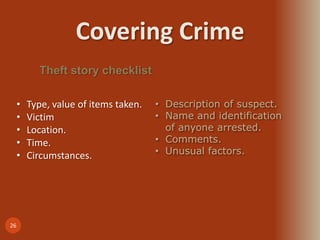
Covering Crime
26
Theft story checklist
• Type, value of items taken.
• Victim
• Location.
• Time.
• Circumstances.
• Description of suspect.
• Name and identification
of anyone arrested.
• Comments.
• Unusual factors.
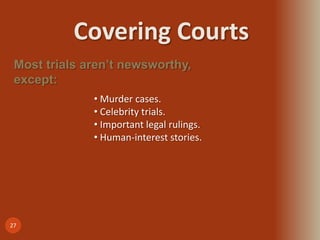
Covering Courts
27
Most trials aren’t newsworthy,
except:
• Murder cases.
• Celebrity trials.
• Important legal rulings.
• Human-interest stories.
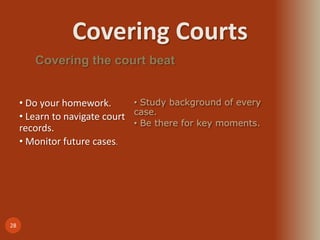
Covering Courts
28
Covering the court beat
• Do your homework.
• Learn to navigate court
records.
• Monitor future cases.
• Study background of every
case.
• Be there for key moments.
Covering Courts
29
Covering the court beat
• Don’t trust everything
attorneys tell you.
• Stay neutral.
• Double-check all your facts.
• Be balanced and careful.
• Be a storyteller.
Covering Courts
30
Criminal and civil court procedures
Misdemeanors – minor
offenses
Felonies – serious crimes
Civil suits – resolve
disputes, recover right or
obtain compensation
Covering Courts
31
Misdemeanors
• Arrest or citation.
• Charges reviewed.
• Arraignment.
• Pretrial conference.
• Pretrial motions.
• Trial.
• Verdict/sentencing.
Covering Courts
32
Felonies
• Arrest or citation.
• First court appearance.
• Grand jury.
• Preliminary hearing.
• Arraignment.
• Pretrial conference/
motions.
• Trial.
• Verdict/sentencing.
• Appeal.
Covering Courts
33
Civil suits
• Suit filed.
• Hearings and motions.
• Pretrial conference.
• Trial.
• Judgment.
• Appeal.
Covering Courts
34
Court story checklist
Court name.
Judge’s name.
Specific charges.
Translation of jargon.
 Brief recap.
 Description and details.
 Quotes and dialogue.
 What happens next.
Covering Courts
35
Verdict story checklist
Sentence.
Details about jury deliberations.
Reactions from central characters.
What it means.
Covering Courts
36
Covering campaigns and elections
• Prioritize.
• Get to know the candidates.
• Do your homework.
• Use reliable experts.
• Brainstorm story ideas.
• Spread onto the Web.
Covering Courts
37
Keeping tabs of governmental policies and
players
Decision making.
The election process.
Money.
Covering Politics
38
1 Politicians lie.
2 Politicians will schmooze you so they
can use you.
Unfortunate truths about
covering politics4
3 Everybody believes your
stories are biased.
Covering Politics
39
4 People don’t want to read about government process.
Unfortunate truths…4
You must peel away
layer after layer to get
to the truth.
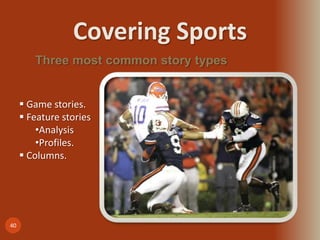
Covering Sports
40
Three most common story types
 Game stories.
 Feature stories
•Analysis
•Profiles.
 Columns.
Covering Sports
41
Game story checklist
• Final score
• Teams’ names
• When and where
• Key players and key plays
• Quotes
• Strategies
• Key statistics
• Injuries
• Both teams’ records
• What the game means
• Other relevant factors
Covering Sports
42
Advance sporting event checklist
 Significance of game
 History
 Key players
 Records and recent
performances
 Quotes
 Strategies
 Injuries
 Other factors
 Who’s favored
 Time, place and ticket
information
Covering Sports
43
Compiling, crunching sport stats
• Conduct solid research.
• Take careful notes.
• Use stats selectively.
• Add charts, graphs or sidebars, if
needed.
Covering Sports
44
Sports style
• Team name usually plural.
• High school athletes are
girls and boys.
• Abbreviate league names.
• Avoid native American team
names.
• Use figures for measurements.
• Use numerals for scores and
time.
Covering Sports
45
Tips for the sports beat
Covering events
• Know the sport.
• Cultivate your sources.
• Ask tough, pointed
questions.
Writing stories
• Think plot, not play-by-
play.
• Avoid jargon and clichés.
• Remember, it’s a game.
lcome to the world of
urnalism, where
porters have been
gging dirt, raking
muck, king headlines
and adlines for centuries
w. It’s a history full of
bloid trash, of slimy
nsationalists, of
runkards, deadbeats and
mmers” (as a Harvard
iversity president once
scribed reporters).
But it’s a history full of
roes, too: men and
men risking their lives
tell stories of war and
agedy, risking
prisonment to defend
ee speech. And as you
n see here, reports have
come beloved characters
p culture, too, turning up
movies, comics and TV
ows as if guided by an
cult hand.
Every culture seeks
effective ways to spread
new information and gossip.
In ancient times, news was
written on clay tablets. In
Caesar’s age, Romans read
newsletters compiled by
correspondents and
handwritten by slaves.
Wandering minstrels spread
news (and the plague) in the
Middle Ages. Them came
ink on paper. Voices on
airwaves. Newsreels, Web
sites, And 24-hour cable
news networks.
Thus when scholars
analyze the rich history of
journalism, some view it in
terms of technological
progress—for example, the
dramatic impact of
bigger, faster printing
presses.
Others see journalism as
a specialized form literary
expression, one that’s
constantly
evolving, reflecting and
shaping its culture.
Others see it as an
inspiring quest for free
speech, an endless power
struggle between Authority
(trying to control
information) and the People
(trying to learn the truth).
Which brings to mind the
words of A.J. Liefling:
“Freedom of the press is
guaranteed only to htose
who own one.”
In the pages ahead, we’ll
take a quick tour of 600
years of journalism
history, from hieroglyphics
to hypertext: the media, the
message and the politics.
Technical advances and
brilliant ideas forged a new
style of journalism. It was a
century of change, and
newspapers changed
dramatically. The typi
newspaper of 1800 wa
undisciplined mishma
legislative proceeding
long-winded essays a
secondhand gossip. B
1900, a new breed of
tor had emerged. Jour
had become big busin
Reporting was becom
disciplined craft. And
newspapers were bec
more entertaining and
essential than ever, w
most of the features w
expect today: Snappy
headlines, Ads, Comic
Sports pages. And an
“inverted pyramid” sty
writing that made stori
tighter and newsier.
Radio and television
brought an end to
newspapers’ media
monopoly. Why? Well
yourself: Which did yo
Covering the news
Inside Reporting
Tim Harrower
5

Chapter 5

  • 1.
    lcome to theworld of urnalism, where porters have been gging dirt, raking muck, king headlines and adlines for centuries w. It’s a history full of bloid trash, of slimy nsationalists, of runkards, deadbeats and mmers” (as a Harvard iversity president once scribed reporters). But it’s a history full of roes, too: men and men risking their lives tell stories of war and agedy, risking prisonment to defend ee speech. And as you n see here, reports have come beloved characters p culture, too, turning up movies, comics and TV ows as if guided by an cult hand. Every culture seeks effective ways to spread new information and gossip. In ancient times, news was written on clay tablets. In Caesar’s age, Romans read newsletters compiled by correspondents and handwritten by slaves. Wandering minstrels spread news (and the plague) in the Middle Ages. Them came ink on paper. Voices on airwaves. Newsreels, Web sites, And 24-hour cable news networks. Thus when scholars analyze the rich history of journalism, some view it in terms of technological progress—for example, the dramatic impact of bigger, faster printing presses. Others see journalism as a specialized form literary expression, one that’s constantly evolving, reflecting and shaping its culture. Others see it as an inspiring quest for free speech, an endless power struggle between Authority (trying to control information) and the People (trying to learn the truth). Which brings to mind the words of A.J. Liefling: “Freedom of the press is guaranteed only to htose who own one.” In the pages ahead, we’ll take a quick tour of 600 years of journalism history, from hieroglyphics to hypertext: the media, the message and the politics. Technical advances and brilliant ideas forged a new style of journalism. It was a century of change, and newspapers changed dramatically. The typi newspaper of 1800 wa undisciplined mishma legislative proceeding long-winded essays a secondhand gossip. B 1900, a new breed of tor had emerged. Jour had become big busin Reporting was becom disciplined craft. And newspapers were bec more entertaining and essential than ever, w most of the features w expect today: Snappy headlines, Ads, Comic Sports pages. And an “inverted pyramid” sty writing that made stori tighter and newsier. Radio and television brought an end to newspapers’ media monopoly. Why? Well yourself: Which did yo Covering the news Inside Reporting Tim Harrower 5
  • 2.
    Covering a beat 2 New beat  Do research.  Talk to your predecessor.  Achieve a mind- meld with editors.  Meet people. Beat reporters focus on specific topics or institutions Make lists: Key sources. Upcoming meetings and events. Story ideas.
  • 3.
    Covering a beat 3 Familiarize yourself.  Follow the money.  Call sources back.  Write for your readers, not for your sources. Working a beat: Do’s and don’ts DO •Get too cozy. • Waste sources’ time. • Simply mimic. DON’T
  • 4.
    Writing Obituaries 4 Death isnews Obituaries are read more closely by more people than any other part of the paper. • They tell stories. • They touch hearts. • They honor and inspire.
  • 5.
    Writing Obituaries 5 Watch yourlanguage • Addresses. • Cause of death. • Past personal • Problems. • Flowery phrases.
  • 6.
    Writing Obituaries 6 Obituary checklist •Use full names. • Find a phrase that best summarizes this person. • State age simply unless asked to omit. •Avoid details in mentioning cause of death. •Include birth date and birthplace.
  • 7.
    Writing Obituaries 7 Obituary checklist •Listeducation, military service, honors and career achievements. • Name survivors in immediate family. • Include name and phone number for funeral home.
  • 8.
    Writing Obituaries 8 Writing standardnews obituary Emphasize person’s significance in lead. Lead should include: 1. Name. 2. Major accomplishment or occupation. 3. Day, location and cause of death. If natural cause of death, focus on personal history. If unusual cause of death, details should precede the background info. More prominent get more quotes.
  • 9.
    Writing Obituaries 9 The featureobituary • Looser, friendlier style. • Create an illusion of intimacy. • Omit attributions.
  • 10.
    Writing Obituaries 10 Talking withfamilies about the deceased • Don’t be squeamish. • If you’re not sure what to say, use a script. • Be supportive. • Be willing to listen. • If it will be a long obituary, gather as much detail as possible. • Avoid the awkwardly obvious.
  • 11.
  • 12.
    How do editorsdecide what is and is not a news story? • Severity: death, damage or injury • Impact: how many people are affected • Proximity: The more local it is, the more impact on your readers.
  • 13.
    How to prepare •Anticipateworst-case scenarios • Check your history • Obtain information on local agencies’ emergency planning • Keep a phone list handy • Devise a newsroom battle plan • Prepare a field kit
  • 14.
    What to dowhen you arrive on the scene? •Go to where the action is • Question authorities first • Talk to victims and eyewitnesses • Record details that capture the scene • Check in often with your editors, and collaborate
  • 15.
    Dealing with victims •Ask permission • Go slowly • Empathize – but watch what you say
  • 16.
    Covering fires 16 Reporting andwriting fire stories • Identify yourself. • Find the command post. • Introduce yourself to command. •Get as close as you can. • Wear boots.
  • 17.
    Coveringfires 17 Reporting and writingfire stories Firefighters only see part of the story. Watch your language.  Be specific  Destroyed  Conflagration  Holocaust  Guts  Razed
  • 18.
    Covering fires 18 Fire storychecklist  Victim names.  Extent of injuries/cause of death.  Type of building.  Location.  Time.  How the fire was discovered.  Cause of fire.  Number of fire fighters.  Estimated cost of damage.
  • 19.
    Covering fires 19 Fire storychecklist… Extent of insurance coverage.  Acts of heroism.  Weather.  Effect of fire on evacuees.  Plans to relocate victims or rebuild structures.  Arrests or citations.  Anecdotes and descriptions.  Any other unusual aspects.
  • 20.
    Covering fires 20 Organizing storieson fire 1. Death or injury usually the lead. 2. Focus on the most 3.compelling aspect. 4. Cover the aftermath. May offer opportunity to use narrative storytelling.
  • 21.
    Covering Crime 21 Crime writingstyle and structure • Add color, not clutter. • Avoid sloppy allegations. • Explore chronological story forms. Kicker Inverted-pyramid lead Chronology
  • 22.
    Covering Crime 22 Covering thecrime beat • Get to know everyone. • Find what information is available. • Get familiar with police procedures. • Use a scanner.
  • 23.
    Covering Crime 23 Covering thecrime beat • Be prepared for anything. • Think trends. • Convey the human drama. •Remember teachers, coaches, ministers and public officials are big news.
  • 24.
    Covering Crime 24 What youshould withhold • Names of minors. • Names of victims of sensitive crimes. • Names of endangered victims. • Labeling people as suspects. • Stereotypes.
  • 25.
    Covering Crime 25 Homicide orassault story checklist • Victim’s name. • Extent of injuries/cause of death. • Location. • Time. • Circumstances. • Description of suspect. • Name and identification of anyone arrested. • Comments. • Unusual factors.
  • 26.
    Covering Crime 26 Theft storychecklist • Type, value of items taken. • Victim • Location. • Time. • Circumstances. • Description of suspect. • Name and identification of anyone arrested. • Comments. • Unusual factors.
  • 27.
    Covering Courts 27 Most trialsaren’t newsworthy, except: • Murder cases. • Celebrity trials. • Important legal rulings. • Human-interest stories.
  • 28.
    Covering Courts 28 Covering thecourt beat • Do your homework. • Learn to navigate court records. • Monitor future cases. • Study background of every case. • Be there for key moments.
  • 29.
    Covering Courts 29 Covering thecourt beat • Don’t trust everything attorneys tell you. • Stay neutral. • Double-check all your facts. • Be balanced and careful. • Be a storyteller.
  • 30.
    Covering Courts 30 Criminal andcivil court procedures Misdemeanors – minor offenses Felonies – serious crimes Civil suits – resolve disputes, recover right or obtain compensation
  • 31.
    Covering Courts 31 Misdemeanors • Arrestor citation. • Charges reviewed. • Arraignment. • Pretrial conference. • Pretrial motions. • Trial. • Verdict/sentencing.
  • 32.
    Covering Courts 32 Felonies • Arrestor citation. • First court appearance. • Grand jury. • Preliminary hearing. • Arraignment. • Pretrial conference/ motions. • Trial. • Verdict/sentencing. • Appeal.
  • 33.
    Covering Courts 33 Civil suits •Suit filed. • Hearings and motions. • Pretrial conference. • Trial. • Judgment. • Appeal.
  • 34.
    Covering Courts 34 Court storychecklist Court name. Judge’s name. Specific charges. Translation of jargon.  Brief recap.  Description and details.  Quotes and dialogue.  What happens next.
  • 35.
    Covering Courts 35 Verdict storychecklist Sentence. Details about jury deliberations. Reactions from central characters. What it means.
  • 36.
    Covering Courts 36 Covering campaignsand elections • Prioritize. • Get to know the candidates. • Do your homework. • Use reliable experts. • Brainstorm story ideas. • Spread onto the Web.
  • 37.
    Covering Courts 37 Keeping tabsof governmental policies and players Decision making. The election process. Money.
  • 38.
    Covering Politics 38 1 Politicianslie. 2 Politicians will schmooze you so they can use you. Unfortunate truths about covering politics4 3 Everybody believes your stories are biased.
  • 39.
    Covering Politics 39 4 Peopledon’t want to read about government process. Unfortunate truths…4 You must peel away layer after layer to get to the truth.
  • 40.
    Covering Sports 40 Three mostcommon story types  Game stories.  Feature stories •Analysis •Profiles.  Columns.
  • 41.
    Covering Sports 41 Game storychecklist • Final score • Teams’ names • When and where • Key players and key plays • Quotes • Strategies • Key statistics • Injuries • Both teams’ records • What the game means • Other relevant factors
  • 42.
    Covering Sports 42 Advance sportingevent checklist  Significance of game  History  Key players  Records and recent performances  Quotes  Strategies  Injuries  Other factors  Who’s favored  Time, place and ticket information
  • 43.
    Covering Sports 43 Compiling, crunchingsport stats • Conduct solid research. • Take careful notes. • Use stats selectively. • Add charts, graphs or sidebars, if needed.
  • 44.
    Covering Sports 44 Sports style •Team name usually plural. • High school athletes are girls and boys. • Abbreviate league names. • Avoid native American team names. • Use figures for measurements. • Use numerals for scores and time.
  • 45.
    Covering Sports 45 Tips forthe sports beat Covering events • Know the sport. • Cultivate your sources. • Ask tough, pointed questions. Writing stories • Think plot, not play-by- play. • Avoid jargon and clichés. • Remember, it’s a game.
  • 46.
    lcome to theworld of urnalism, where porters have been gging dirt, raking muck, king headlines and adlines for centuries w. It’s a history full of bloid trash, of slimy nsationalists, of runkards, deadbeats and mmers” (as a Harvard iversity president once scribed reporters). But it’s a history full of roes, too: men and men risking their lives tell stories of war and agedy, risking prisonment to defend ee speech. And as you n see here, reports have come beloved characters p culture, too, turning up movies, comics and TV ows as if guided by an cult hand. Every culture seeks effective ways to spread new information and gossip. In ancient times, news was written on clay tablets. In Caesar’s age, Romans read newsletters compiled by correspondents and handwritten by slaves. Wandering minstrels spread news (and the plague) in the Middle Ages. Them came ink on paper. Voices on airwaves. Newsreels, Web sites, And 24-hour cable news networks. Thus when scholars analyze the rich history of journalism, some view it in terms of technological progress—for example, the dramatic impact of bigger, faster printing presses. Others see journalism as a specialized form literary expression, one that’s constantly evolving, reflecting and shaping its culture. Others see it as an inspiring quest for free speech, an endless power struggle between Authority (trying to control information) and the People (trying to learn the truth). Which brings to mind the words of A.J. Liefling: “Freedom of the press is guaranteed only to htose who own one.” In the pages ahead, we’ll take a quick tour of 600 years of journalism history, from hieroglyphics to hypertext: the media, the message and the politics. Technical advances and brilliant ideas forged a new style of journalism. It was a century of change, and newspapers changed dramatically. The typi newspaper of 1800 wa undisciplined mishma legislative proceeding long-winded essays a secondhand gossip. B 1900, a new breed of tor had emerged. Jour had become big busin Reporting was becom disciplined craft. And newspapers were bec more entertaining and essential than ever, w most of the features w expect today: Snappy headlines, Ads, Comic Sports pages. And an “inverted pyramid” sty writing that made stori tighter and newsier. Radio and television brought an end to newspapers’ media monopoly. Why? Well yourself: Which did yo Covering the news Inside Reporting Tim Harrower 5