Designing m-Learning
based on SE principles

     ดร.ศศิพร อุษณวศิน
     ผอ.หลักสู ตรปริญญาโท สาขาวิศวกรรมซอฟต์ แวร์
     สถาบันวิทยาการสารสนเทศ (ISIS)
     มหาวิทยาลัยศรีปทุม
     sasiporn.us@spu.ac.th
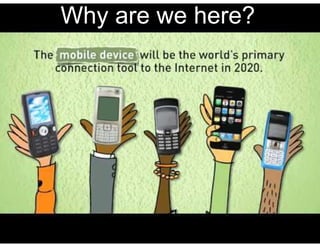
Why are we here?
e- vs. vs. m- Learning
• e-Learning refers to online learning, web-
  based learning, virtual universities and
  classrooms, digital collaboration and
  technology assisted distance learning.

• m-Learning is an e-Learning that is
  independent of time and space.
Misconception


m-learning = effective learning


Replace instructors & class room
It’s TRUE only when..


m-learning = effective learning

      GOOD DESIGN
Software Engineering Principle


Software engineering (SE) is an application of a
systematic, disciplined, quantifiable approach to the
development, operation, and maintenance of
software. [WiKi]

Software => solution/tool that fulfills USER NEEDs
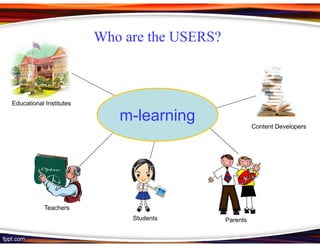
Who are the USERS?

Educational Institutes
                            Thailand Cloud Platform
                            m-learning
                             for Education Services
                                                                Content Developers


            Teachers
                                Students              Parents
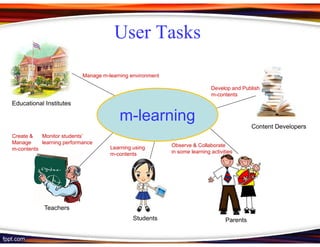
User Tasks
                           Manage m-learning environment

                                                                            Develop and Publish
                                                                            m-contents
Educational Institutes
                                        Thailand Cloud Platform
                                         m-learning
                                         for Education Services
                                                                                            Content Developers
Create &   Monitor students’
Manage     learning performance
                                     Learning using        Observe & Collaborate
m-contents
                                     m-contents            in some learning activities


            Teachers
                                              Students                            Parents
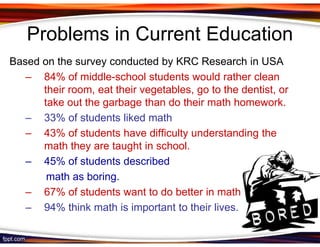
Problems in Current Education
Based on the survey conducted by KRC Research in USA
   – 84% of middle-school students would rather clean
      their room, eat their vegetables, go to the dentist, or
      take out the garbage than do their math homework.
   – 33% of students liked math
   – 43% of students have difficulty understanding the
      math they are taught in school.
   – 45% of students described
       math as boring.
   – 67% of students want to do better in math
   – 94% think math is important to their lives.
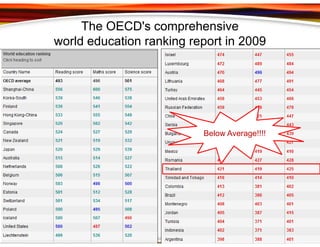
The OECD's comprehensive
world education ranking report in 2009


                          Below Average!!!!
Effects of m-Learning
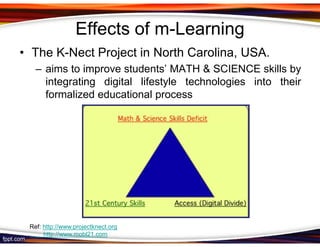
• The K-Nect Project in North Carolina, USA.
   – aims to improve students’ MATH & SCIENCE skills by
     integrating digital lifestyle technologies into their
     formalized educational process


 Ref: http://www.projectknect.org
      http://www.mobl21.com
M-Learning Changes Student Behavior
Based on the K-NECT project:
• Kids who hate doing homework, get it out of the
  way on the bus ride home.
• Students who would never consider cracking
  open a book, are reading classic English
  literature.
• Students also used social networking facilities to
  help one another other with the problem solving.
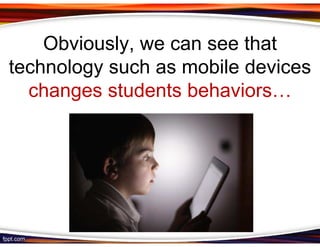
Obviously, we can see that
technology such as mobile devices
  changes students behaviors
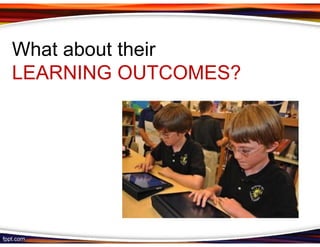
What about their
LEARNING OUTCOMES?
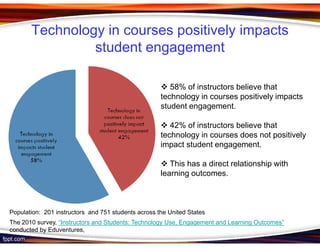
Technology in courses positively impacts
                student engagement

                                                        58% of instructors believe that
                                                     technology in courses positively impacts
                                                     student engagement.

                                                        42% of instructors believe that
                                                     technology in courses does not positively
                                                     impact student engagement.

                                                        This has a direct relationship with
                                                     learning outcomes.


Population: 201 instructors and 751 students across the United States
The 2010 survey, “Instructors and Students: Technology Use, Engagement and Learning Outcomes”
conducted by Eduventures,
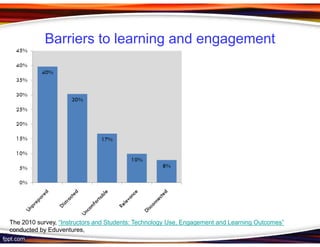
Barriers to learning and engagement


The 2010 survey, “Instructors and Students: Technology Use, Engagement and Learning Outcomes”
conducted by Eduventures,
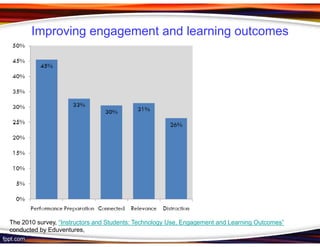
Improving engagement and learning outcomes


The 2010 survey, “Instructors and Students: Technology Use, Engagement and Learning Outcomes”
conducted by Eduventures,
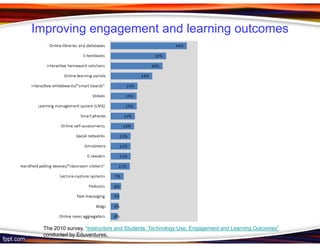
Improving engagement and learning outcomes


 The 2010 survey, “Instructors and Students: Technology Use, Engagement and Learning Outcomes”
 conducted by Eduventures,
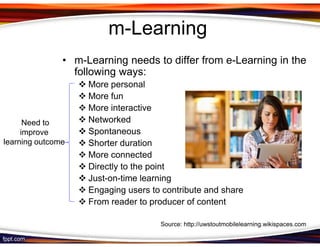
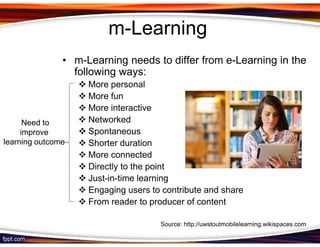
m-Learning
               • m-Learning needs to differ from e-Learning in the
                 following ways:
                    More personal
                    More fun
                    More interactive
      Need to       Networked
     improve        Spontaneous
learning outcome    Shorter duration
                    More connected
                    Directly to the point
                    Just-on-time learning
                    Engaging users to contribute and share
                    From reader to producer of content

                                     Source: http://uwstoutmobilelearning.wikispaces.com
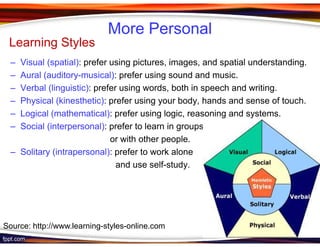
More Personal
 Learning Styles
  – Visual (spatial): prefer using pictures, images, and spatial understanding.
  – Aural (auditory-musical): prefer using sound and music.
  – Verbal (linguistic): prefer using words, both in speech and writing.
  – Physical (kinesthetic): prefer using your body, hands and sense of touch.
  – Logical (mathematical): prefer using logic, reasoning and systems.
  – Social (interpersonal): prefer to learn in groups
                             or with other people.
  – Solitary (intrapersonal): prefer to work alone
                               and use self-study.


Source: http://www.learning-styles-online.com
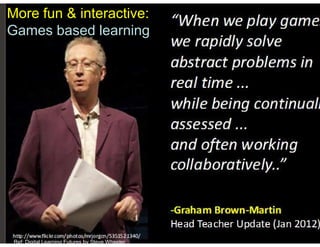
More fun & interactive:
Games based learning


 Ref: Digital Learning Futures by Steve Wheeler
More Network & Collaboration
• Middle and high school students are using social
  media to connect with one another on homework
  and group projects.
    – For example, Facebook and similar social media
      programs allow students to gather outside of class to
      collaborate and exchange ideas about assignments.
      Some schools successfully use blogs as teaching
      tools, which has the benefit of reinforcing skills in
      English, written expression, and creativity.

Source: Ito M, Horst H, Bittani M, et al.Living and Learning With New Media: Summary of
Findings From the Digital Youth Project. Chicago, IL: John D. and Catherine T. MacArthur
Foundation Reports on Digital Media and Learning; 2008
m-Learning
               • m-Learning needs to differ from e-Learning in the
                 following ways:
                    More personal
                    More fun
                    More interactive
      Need to       Networked
     improve        Spontaneous
learning outcome    Shorter duration
                    More connected
                    Directly to the point
                    Just-in-time learning
                    Engaging users to contribute and share
                    From reader to producer of content

                                     Source: http://uwstoutmobilelearning.wikispaces.com
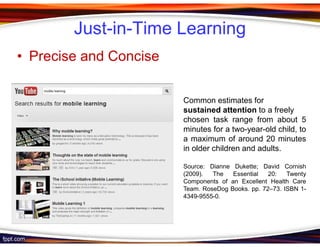
Just-in-Time Learning
• Precise and Concise

                        Common estimates for
                        sustained attention to a freely
                        chosen task range from about 5
                        minutes for a two-year-old child, to
                        a maximum of around 20 minutes
                        in older children and adults.

                        Source: Dianne Dukette; David Cornish
                        (2009).  The   Essential   20:   Twenty
                        Components of an Excellent Health Care
                        Team. RoseDog Books. pp. 72–73. ISBN 1-
                        4349-9555-0.
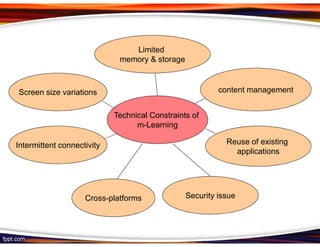
Limited
                             memory & storage


Screen size variations                                   content management


                            Technical Constraints of
                                  m-Learning

Intermittent connectivity                                  Reuse of existing
                                                             applications


                    Cross-platforms             Security issue
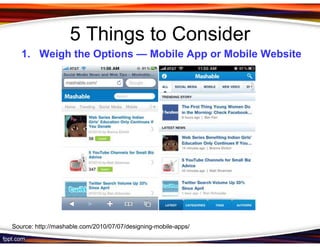
5 Things to Consider
   1. Weigh the Options — Mobile App or Mobile Website


Source: http://mashable.com/2010/07/07/designing-mobile-apps/
5 Things to Consider
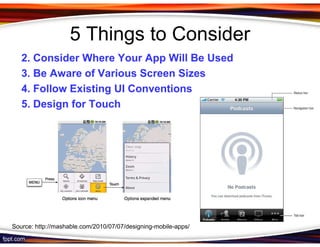
   2. Consider Where Your App Will Be Used
   3. Be Aware of Various Screen Sizes
   4. Follow Existing UI Conventions
   5. Design for Touch


Source: http://mashable.com/2010/07/07/designing-mobile-apps/
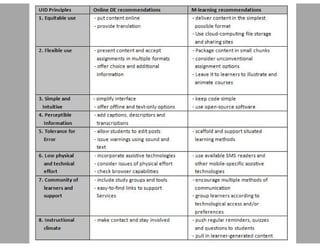
Design Criteria of m-Learning Content
• Content should be delivered in short ‘nuggets’ rather than
  large units of information
• Content should be platform and device independent
• Content should be adaptive to each student’s lifestyle
• Content should be design as reusable objects that can be
  re-configured and re-packaged
• Content should be described with ‘metadata’ so that it can
  be easily discover
• Content delivery mode should be selected to effectively
  facilitate the learning activity using user friendly interface
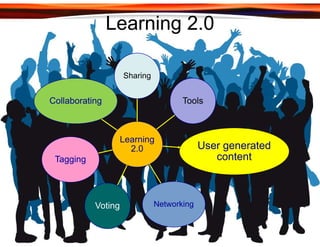
Learning 2.0

                    Sharing


Collaborating                        Tools


                    Learning
                      2.0                  User generated
 Tagging                                      content


           Voting             Networking
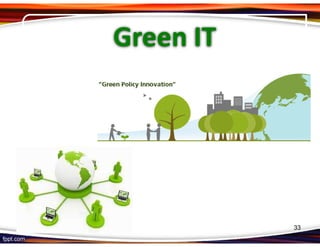
Green IT


           33
Carbon Footprint

– The carbon footprint is an estimate of the
  amount of CO2e emitted by the use of ICT.

– Computers and telecommunications equipment
  contributes about 2% to greenhouse gas
  emissions.


                                               34
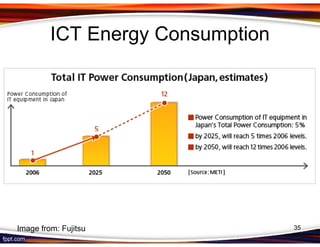
ICT Energy Consumption


Image from: Fujitsu               35
Energy Consumption
– Operating energy is a measure of the energy used
  to operate the ICT equipment.
   • This can be measured directly using an energy meter
     (electric meter) which measures the electrical energy
     used.
   • Alternatively, the energy use may be estimated from
     the power the equipment uses (specified in Watt),
     multiplied by the estimated amount of time the
     equipment will be used (in Hours) to give the energy
     (in Kilowatt hours).


                                                             36
Greenhouse Gas Conversion
• Greenhouse gas conversion factors are used to calculate
  the amount of greenhouse gas emissions caused by
  energy use.
• The conversion factor is used to convert energy
  consumed in kWh to kg of equivalent carbon dioxide.
• For example,
   – a computer using 200 W of power for 10 hours per day
     uses 2 kWh of energy. Multiplying by a conversion
     factor of 0.537 Kg CO2/kWh produces a total of 1.074
     Kg CO2 per day.

Example of online calculator:
http://thaicfcalculator.tgo.or.th/
                                                       37
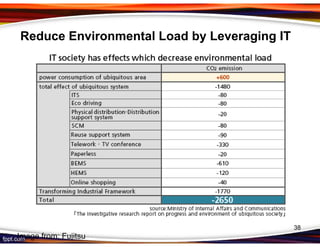
Reduce Environmental Load by Leveraging IT


                                             38
Image from: Fujitsu
"Technology maybe fosters some
   things and dampens others.
  It's definitely about balance.”

Rosemarie Truglio, from the children's TV
    producers Sesame Workshop,
THANK YOU
     FOR
YOUR ATTENTION
Master of Science in Software Engineering
                (MS.SE)

M-Learning

  • 1.
    Designing m-Learning based onSE principles ดร.ศศิพร อุษณวศิน ผอ.หลักสู ตรปริญญาโท สาขาวิศวกรรมซอฟต์ แวร์ สถาบันวิทยาการสารสนเทศ (ISIS) มหาวิทยาลัยศรีปทุม sasiporn.us@spu.ac.th
  • 2.
  • 5.
    e- vs. vs.m- Learning • e-Learning refers to online learning, web- based learning, virtual universities and classrooms, digital collaboration and technology assisted distance learning. • m-Learning is an e-Learning that is independent of time and space.
  • 6.
    Misconception m-learning = effectivelearning Replace instructors & class room
  • 7.
    It’s TRUE onlywhen.. m-learning = effective learning GOOD DESIGN
  • 8.
    Software Engineering Principle Softwareengineering (SE) is an application of a systematic, disciplined, quantifiable approach to the development, operation, and maintenance of software. [WiKi] Software => solution/tool that fulfills USER NEEDs
  • 9.
    Who are theUSERS? Educational Institutes Thailand Cloud Platform m-learning for Education Services Content Developers Teachers Students Parents
  • 10.
    User Tasks Manage m-learning environment Develop and Publish m-contents Educational Institutes Thailand Cloud Platform m-learning for Education Services Content Developers Create & Monitor students’ Manage learning performance Learning using Observe & Collaborate m-contents m-contents in some learning activities Teachers Students Parents
  • 11.
    Problems in CurrentEducation Based on the survey conducted by KRC Research in USA – 84% of middle-school students would rather clean their room, eat their vegetables, go to the dentist, or take out the garbage than do their math homework. – 33% of students liked math – 43% of students have difficulty understanding the math they are taught in school. – 45% of students described math as boring. – 67% of students want to do better in math – 94% think math is important to their lives.
  • 12.
    The OECD's comprehensive worldeducation ranking report in 2009 Below Average!!!!
  • 13.
    Effects of m-Learning •The K-Nect Project in North Carolina, USA. – aims to improve students’ MATH & SCIENCE skills by integrating digital lifestyle technologies into their formalized educational process Ref: http://www.projectknect.org http://www.mobl21.com
  • 14.
    M-Learning Changes StudentBehavior Based on the K-NECT project: • Kids who hate doing homework, get it out of the way on the bus ride home. • Students who would never consider cracking open a book, are reading classic English literature. • Students also used social networking facilities to help one another other with the problem solving.
  • 15.
    Obviously, we cansee that technology such as mobile devices changes students behaviors
  • 16.
  • 17.
    Technology in coursespositively impacts student engagement 58% of instructors believe that technology in courses positively impacts student engagement. 42% of instructors believe that technology in courses does not positively impact student engagement. This has a direct relationship with learning outcomes. Population: 201 instructors and 751 students across the United States The 2010 survey, “Instructors and Students: Technology Use, Engagement and Learning Outcomes” conducted by Eduventures,
  • 18.
    Barriers to learningand engagement The 2010 survey, “Instructors and Students: Technology Use, Engagement and Learning Outcomes” conducted by Eduventures,
  • 19.
    Improving engagement andlearning outcomes The 2010 survey, “Instructors and Students: Technology Use, Engagement and Learning Outcomes” conducted by Eduventures,
  • 20.
    Improving engagement andlearning outcomes The 2010 survey, “Instructors and Students: Technology Use, Engagement and Learning Outcomes” conducted by Eduventures,
  • 21.
    m-Learning • m-Learning needs to differ from e-Learning in the following ways: More personal More fun More interactive Need to Networked improve Spontaneous learning outcome Shorter duration More connected Directly to the point Just-on-time learning Engaging users to contribute and share From reader to producer of content Source: http://uwstoutmobilelearning.wikispaces.com
  • 22.
    More Personal LearningStyles – Visual (spatial): prefer using pictures, images, and spatial understanding. – Aural (auditory-musical): prefer using sound and music. – Verbal (linguistic): prefer using words, both in speech and writing. – Physical (kinesthetic): prefer using your body, hands and sense of touch. – Logical (mathematical): prefer using logic, reasoning and systems. – Social (interpersonal): prefer to learn in groups or with other people. – Solitary (intrapersonal): prefer to work alone and use self-study. Source: http://www.learning-styles-online.com
  • 23.
    More fun &interactive: Games based learning Ref: Digital Learning Futures by Steve Wheeler
  • 24.
    More Network &Collaboration • Middle and high school students are using social media to connect with one another on homework and group projects. – For example, Facebook and similar social media programs allow students to gather outside of class to collaborate and exchange ideas about assignments. Some schools successfully use blogs as teaching tools, which has the benefit of reinforcing skills in English, written expression, and creativity. Source: Ito M, Horst H, Bittani M, et al.Living and Learning With New Media: Summary of Findings From the Digital Youth Project. Chicago, IL: John D. and Catherine T. MacArthur Foundation Reports on Digital Media and Learning; 2008
  • 25.
    m-Learning • m-Learning needs to differ from e-Learning in the following ways: More personal More fun More interactive Need to Networked improve Spontaneous learning outcome Shorter duration More connected Directly to the point Just-in-time learning Engaging users to contribute and share From reader to producer of content Source: http://uwstoutmobilelearning.wikispaces.com
  • 26.
    Just-in-Time Learning • Preciseand Concise Common estimates for sustained attention to a freely chosen task range from about 5 minutes for a two-year-old child, to a maximum of around 20 minutes in older children and adults. Source: Dianne Dukette; David Cornish (2009). The Essential 20: Twenty Components of an Excellent Health Care Team. RoseDog Books. pp. 72–73. ISBN 1- 4349-9555-0.
  • 27.
    Limited memory & storage Screen size variations content management Technical Constraints of m-Learning Intermittent connectivity Reuse of existing applications Cross-platforms Security issue
  • 28.
    5 Things toConsider 1. Weigh the Options — Mobile App or Mobile Website Source: http://mashable.com/2010/07/07/designing-mobile-apps/
  • 29.
    5 Things toConsider 2. Consider Where Your App Will Be Used 3. Be Aware of Various Screen Sizes 4. Follow Existing UI Conventions 5. Design for Touch Source: http://mashable.com/2010/07/07/designing-mobile-apps/
  • 30.
    Design Criteria ofm-Learning Content • Content should be delivered in short ‘nuggets’ rather than large units of information • Content should be platform and device independent • Content should be adaptive to each student’s lifestyle • Content should be design as reusable objects that can be re-configured and re-packaged • Content should be described with ‘metadata’ so that it can be easily discover • Content delivery mode should be selected to effectively facilitate the learning activity using user friendly interface
  • 32.
    Learning 2.0 Sharing Collaborating Tools Learning 2.0 User generated Tagging content Voting Networking
  • 33.
  • 34.
    Carbon Footprint – Thecarbon footprint is an estimate of the amount of CO2e emitted by the use of ICT. – Computers and telecommunications equipment contributes about 2% to greenhouse gas emissions. 34
  • 35.
  • 36.
    Energy Consumption – Operatingenergy is a measure of the energy used to operate the ICT equipment. • This can be measured directly using an energy meter (electric meter) which measures the electrical energy used. • Alternatively, the energy use may be estimated from the power the equipment uses (specified in Watt), multiplied by the estimated amount of time the equipment will be used (in Hours) to give the energy (in Kilowatt hours). 36
  • 37.
    Greenhouse Gas Conversion •Greenhouse gas conversion factors are used to calculate the amount of greenhouse gas emissions caused by energy use. • The conversion factor is used to convert energy consumed in kWh to kg of equivalent carbon dioxide. • For example, – a computer using 200 W of power for 10 hours per day uses 2 kWh of energy. Multiplying by a conversion factor of 0.537 Kg CO2/kWh produces a total of 1.074 Kg CO2 per day. Example of online calculator: http://thaicfcalculator.tgo.or.th/ 37
  • 38.
    Reduce Environmental Loadby Leveraging IT 38 Image from: Fujitsu
  • 39.
    "Technology maybe fosterssome things and dampens others. It's definitely about balance.” Rosemarie Truglio, from the children's TV producers Sesame Workshop,
  • 40.
    THANK YOU FOR YOUR ATTENTION
  • 41.
    Master of Sciencein Software Engineering (MS.SE)