EDU626 Integrating Educational Technology Spring 2012


Educational Technology & Digital Learning
2


        What is Technology?
. . . technology is about more than gadgets
 and gizmos
  – Technology concerns itself with
     understanding how knowledge is
     creatively applied to organised
     tasks involving people and
     machines that meet sustainable
     goals.
      • What is technology?
        By: Professor Andy Lane
        (The Open University)
        14 September 2006
3


        What about Media?
What do you mean, media?
  – Not mediums (that‘s spiritualism)!
  – Nor:
     • When the media ask him [George W. Bush] a question, he
       answers, ‗Can I use a lifeline?‘
       ~ Robin Williams
  – 2media 1 : a medium of cultivation, conveyance, or
    expression; especially : MEDIUM 2b
    1me·di·um 2 : a means of effecting or conveying

    something:
    b plural usually media (1) : a channel or system of
    communication, information, or entertainment
4


Is there a connection?
   Media are for communication
   Therefore, technology applications in media apply
    knowledge to me sustainable communication goals
     – In developing this site, we, the students of the
       Vancouver Film School-Multimedia, first had to
       define what the term media involved. It was our
       belief that the word itself implies the notion of
       communication. Therefore, anything that was
       once used to relay a message would be applicable.
        • The Dead Media Project
          http://student.vfs.com/~deadmedia/dedmedia.html
5


Dead Media?
  – ―. . . some media do, in fact, perish. Such as: the
    phenakistoscope. The teleharmonium. The Edison
    wax cylinder. The stereopticon. The Panorama.
    Early 20th century electric searchlight spectacles.
    Morton Heilig's early virtual reality. Telefon
    Hirmondo. The various species of magic lantern.
    The pneumatic transfer tubes that once riddled the
    underground of Chicago. Was the Antikythera
    Device a medium? How about the Big Character
    Poster Democracy Wall in Peking in the early 80s?
  – Never heard of any of these? Well, that's the
    problem.
     • Bruce Sterling Dead Media Manifesto
6


What is Educational Technology?
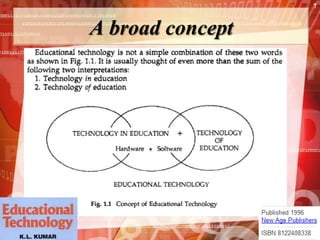
Educational technology is
  – the application of technology in education
  – or, ways in which ―knowledge is creatively
    applied to organised tasks [in education]
    involving people and machines that meet
    sustainable goals [for example, in teaching].‖
  – Thus, chalk and a blackboard,
    pen and paper, textbooks and
    the big ol‘ pointer, they all are
    forms of educational
    technology!
7


A broad concept
8


An evolving concept
9


Computing History

    http://ei.cs.vt.edu/~history/

       http://www.computerhistory.org/


  http://www.thocp.net/
10


Internet History
 http://www.archive.org/


                http://www.archive.org/web/web.php


     http://www.pbs.org/opb/nerds2.0.1/


http://www.walthowe.com/navnet/history.html
11


         Media in Schools
Stone tablets?
• Wax tablets?

• Slate tablets?

• Silicon tablets?
12


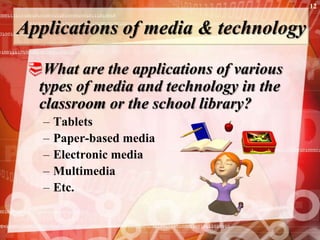
Applications of media & technology

 What are the applications of various
  types of media and technology in the
  classroom or the school library?
   –   Tablets
   –   Paper-based media
   –   Electronic media
   –   Multimedia
   –   Etc.
13


Also assistive technology
14


    Technology includes Web 2.0
    Blogs and podcasts, oh my!
     – Blogs and podcasts are changing the way we interact
       with information on the Internet . . . These are part of a
       reinvention of the Internet, referred to as Web 2.0,
       which is focused on using Internet technologies to
       connect people and information.
     – While the idea as a whole extends into social
       bookmarking, collaborative development, and other
       tools, Web 2.0 is firmly rooted in the basic ideas of
       blogs.


Read Harris’s blog Infomancy
15


  The implications of web 2.0
The web effect: Clay Shirky’s
 Here Comes Everybody
 (2009)
 – One of the biggest shifts that Shirky
   outlines is emergence of the amateur
   over and above the expert. In many
   professions, it is now practically
   impossible to preserve occupational
   selectivity and authority.
    • Mark Meynell in blog Quaerentia
16
17


   November on participation
From “Myths and Opportunities” video
  – ―One of the things I think is critical is, a kid needs to
    make a contribution . . . Well, what we did, I believe,
    over time—and the irony is, technology did this—
    because we invented all kinds of machinery, we don‘t
    need kids working any more. And so, we‘ve robbed
    them of their sense of making a contribution to
    community.‖
  – ―I think one of the breakthrough ideas is to change the
    concept of the learner into some who becomes a
    contributor by doing their work. It means we have to
    redefine the work. That represents the shift of control
    from the teacher . . . to the network of children‖
18


What is November’s proposal?
Encourage
 children to be:
  – Researchers
  – Reflectors
  – Writers
  – ―Students
    researching the
    kinds of assignments
    they would like to do,
    rather than the teacher
    coming up with the assignment.‖
19

  But how does that square with our
      definition of technology?

What is Technology?
  – Technology concerns itself with
    understanding how knowledge is creatively
    applied to organised tasks involving people
    and machines that meet sustainable goals.
     • By: Professor Andy Lane (The Open University)
Digital Learning?
21


 What is Digital Learning?
Definition:
  – Digital learning is any instructional
    practice that is effectively using
    technology to strengthen the student
    learning experience.
    •
22


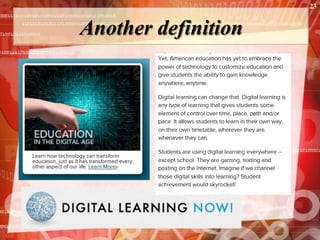
Another definition
23


Another definition
24


Do we need a day for digital learning?
 What is Digital Learning Day?
   – Digital Learning Day is a culminating event in a
     year-round national awareness campaign to
     improve teaching and learning for all children. On
     Digital Learning Day, we are asking everyone, no
     matter your comfort with technology–teachers,
     librarians, school leaders, afterschool programs,
     community groups, parents–to sign up and be
     counted in this effort . . .
      •

Educational Technology and Digital Learning

  • 1.
    EDU626 Integrating EducationalTechnology Spring 2012 Educational Technology & Digital Learning
  • 2.
    2 What is Technology? . . . technology is about more than gadgets and gizmos – Technology concerns itself with understanding how knowledge is creatively applied to organised tasks involving people and machines that meet sustainable goals. • What is technology? By: Professor Andy Lane (The Open University) 14 September 2006
  • 3.
    3 What about Media? What do you mean, media? – Not mediums (that‘s spiritualism)! – Nor: • When the media ask him [George W. Bush] a question, he answers, ‗Can I use a lifeline?‘ ~ Robin Williams – 2media 1 : a medium of cultivation, conveyance, or expression; especially : MEDIUM 2b 1me·di·um 2 : a means of effecting or conveying something: b plural usually media (1) : a channel or system of communication, information, or entertainment
  • 4.
    4 Is there aconnection?  Media are for communication  Therefore, technology applications in media apply knowledge to me sustainable communication goals – In developing this site, we, the students of the Vancouver Film School-Multimedia, first had to define what the term media involved. It was our belief that the word itself implies the notion of communication. Therefore, anything that was once used to relay a message would be applicable. • The Dead Media Project http://student.vfs.com/~deadmedia/dedmedia.html
  • 5.
    5 Dead Media? – ―. . . some media do, in fact, perish. Such as: the phenakistoscope. The teleharmonium. The Edison wax cylinder. The stereopticon. The Panorama. Early 20th century electric searchlight spectacles. Morton Heilig's early virtual reality. Telefon Hirmondo. The various species of magic lantern. The pneumatic transfer tubes that once riddled the underground of Chicago. Was the Antikythera Device a medium? How about the Big Character Poster Democracy Wall in Peking in the early 80s? – Never heard of any of these? Well, that's the problem. • Bruce Sterling Dead Media Manifesto
  • 6.
    6 What is EducationalTechnology? Educational technology is – the application of technology in education – or, ways in which ―knowledge is creatively applied to organised tasks [in education] involving people and machines that meet sustainable goals [for example, in teaching].‖ – Thus, chalk and a blackboard, pen and paper, textbooks and the big ol‘ pointer, they all are forms of educational technology!
  • 7.
  • 8.
  • 9.
    9 Computing History http://ei.cs.vt.edu/~history/ http://www.computerhistory.org/ http://www.thocp.net/
  • 10.
    10 Internet History http://www.archive.org/ http://www.archive.org/web/web.php http://www.pbs.org/opb/nerds2.0.1/ http://www.walthowe.com/navnet/history.html
  • 11.
    11 Media in Schools Stone tablets? • Wax tablets? • Slate tablets? • Silicon tablets?
  • 12.
    12 Applications of media& technology What are the applications of various types of media and technology in the classroom or the school library? – Tablets – Paper-based media – Electronic media – Multimedia – Etc.
  • 13.
  • 14.
    14 Technology includes Web 2.0 Blogs and podcasts, oh my! – Blogs and podcasts are changing the way we interact with information on the Internet . . . These are part of a reinvention of the Internet, referred to as Web 2.0, which is focused on using Internet technologies to connect people and information. – While the idea as a whole extends into social bookmarking, collaborative development, and other tools, Web 2.0 is firmly rooted in the basic ideas of blogs. Read Harris’s blog Infomancy
  • 15.
    15 Theimplications of web 2.0 The web effect: Clay Shirky’s Here Comes Everybody (2009) – One of the biggest shifts that Shirky outlines is emergence of the amateur over and above the expert. In many professions, it is now practically impossible to preserve occupational selectivity and authority. • Mark Meynell in blog Quaerentia
  • 16.
  • 17.
    17 November on participation From “Myths and Opportunities” video – ―One of the things I think is critical is, a kid needs to make a contribution . . . Well, what we did, I believe, over time—and the irony is, technology did this— because we invented all kinds of machinery, we don‘t need kids working any more. And so, we‘ve robbed them of their sense of making a contribution to community.‖ – ―I think one of the breakthrough ideas is to change the concept of the learner into some who becomes a contributor by doing their work. It means we have to redefine the work. That represents the shift of control from the teacher . . . to the network of children‖
  • 18.
    18 What is November’sproposal? Encourage children to be: – Researchers – Reflectors – Writers – ―Students researching the kinds of assignments they would like to do, rather than the teacher coming up with the assignment.‖
  • 19.
    19 Buthow does that square with our definition of technology? What is Technology? – Technology concerns itself with understanding how knowledge is creatively applied to organised tasks involving people and machines that meet sustainable goals. • By: Professor Andy Lane (The Open University)
  • 20.
  • 21.
    21 What isDigital Learning? Definition: – Digital learning is any instructional practice that is effectively using technology to strengthen the student learning experience. •
  • 22.
  • 23.
  • 24.
    24 Do we needa day for digital learning? What is Digital Learning Day? – Digital Learning Day is a culminating event in a year-round national awareness campaign to improve teaching and learning for all children. On Digital Learning Day, we are asking everyone, no matter your comfort with technology–teachers, librarians, school leaders, afterschool programs, community groups, parents–to sign up and be counted in this effort . . . •