http://mlearning.muohio.edu/mlc
   Twitter: @miami_mlearning
What is the MLC?
• A joint venture between SEAS, AIMS, and
  IT Services
  – Unify efforts in mobile space on the campus
  – Provide faculty, staff, and students a resource
    for mobile learning and mobile computing
  – Support faculty by providing software
    development expertise


                         2
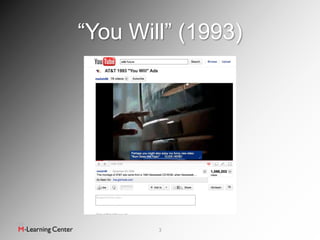
“You Will” (1993)


        3
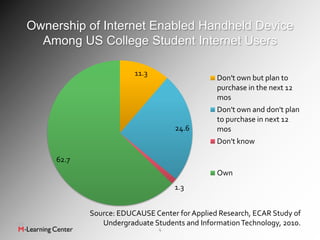
Ownership of Internet Enabled Handheld Device
  Among US College Student Internet Users

                        11.3
                                               Don't own but plan to
                                               purchase in the next 12
                                               mos
                                               Don't own and don't plan
                                               to purchase in next 12
                                   24.6        mos
                                               Don't know

     62.7
                                               Own
                                   1.3


            Source: EDUCAUSE Center for Applied Research, ECAR Study of
               Undergraduate Students and Information Technology, 2010.
                               4
Get out your phones!
     http://bit.ly/mFodgm
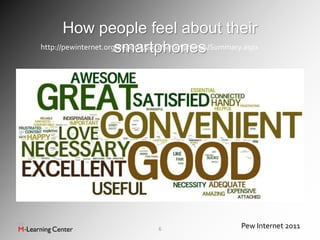
How people feel about their
                      smartphones
http://pewinternet.org/Reports/2011/Smartphones/Summary.aspx


                                6                      Pew Internet 2011
App Crazy (iear.org)
• Viewers and e-readers                   • Games
   – iAnnotate, Kindle, Nook, GoodR       • Reference
     eader                                   –   Wikipanion, Newsy (news
• Notes                                          aggregator)
   – Notetaker HD, Dragon                 • Mapping
     Dictation, Evernote                     – Map
• Office Suite                            • Storage
   – iWork:                                  – GoodReader
     Numbers, Keynote, Pages
                                          • Brainstorming
• Real-time communication
                                             – Popplet, Adobe Ideas
   – AIM, Skype, Airsketch
                                          • Content Specific (education
• Social Networking
                                            apps)
   – Facebook, Twitter, Glympse


                                      7
Technology in the
•            classroom? Report
    New Media Consortium’s Horizon
    calls for adoption of mobile technology in
    the education for both K-12 and Higher Ed
• Abilene Christian, IIT, etc.
• iPad initiatives
    – http://nyti.ms/eIN2Dp
    – http://bit.ly/fOVW2J

                             8
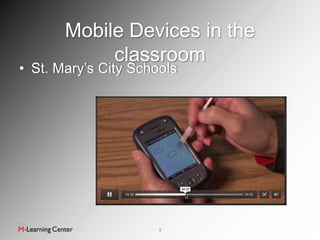
Mobile Devices in the
            classroom
• St. Mary’s City Schools


                      9
Is it Mobile Learning?
Does using a mobile device in the
  classroom mean that you are
     using mobile learning?

                10
What is M-Learning?
• M-Learning provides an        • Trying to meet students
  experience that is:             where they are and in a
  – Personalized                  context that allows us
  – Authentic                     to engage them
  – Situated                      anywhere and anytime
• 24/7 Learning                 • Facilitate active
  – Anytime                       learning
  – Anything                    • Leverages mobile
  – Anywhere                      platform
                                • Creates new
                                  opportunities
                           11
What is M-Learning?
• Geo-Historian Project [13]
  – Supports authentic and
    situated learning
  – Unite schools with community
    resources
  – Students can develop digital
    resources for community
  – Example: Cuyahoga River
    Dam

                       12
Do students learn?
   How do we know whether
students learn with these tools?


               13
The Problem
• Mobile Learning pedagogies are not well
  defined…
  – Schools buy mobile technologies, but do not
    know how to use them.
  – Little research on the effectiveness of m-learning
    solutions
• Ex. Citizen Science (Project Noah)
  – Learners may be disengaged from core-aspects
    of inquiry-based learning

                          14
So…
• What we want to know:
  – Does disengagement from some inquiry-based
    learning process impact one’s ability to learn?
  – Can mobile devices improve engagement and
    learning without a full understanding of some
    research problem?
• Research Thesis:
  – Data collection through a mobile device can
    improve learning when a researcher is fully
    engaged in some method of inquiry-based
    instruction.
                         15
Inquiry-Based Learning
• Creation of a classroom environment where students are
  engaged in open-ended, student-centered, and hands-on
  activities. [14]
• Banchi et al. suggest there are 4 levels of inquiry [2]


               [2] Heather Banchi and Randy Bell. The many levels of inquiry. Science
                                      16
               and Children, October 2008.
Theoretical Foundations
• Traxler argues that mobile learning is able to
  provide an experience that is
  personalized, authentic, and situated. [12]
• Authentic and situated learning has the ability to
  increase student engagement and information
  retention. [11]
• Mobile devices can respond to varying needs of
  learners. [11]
• Communication capabilities of mobile devices
  make it easy for leaners to collaborate and
  communicate. [11]
                           17
Inquiry and Effect on Education
• Research project looking at 2 different groups
  of people:
  – Lead Researchers
     • Have Full Participation in scientific process
  – Volunteers
     • Have Limited Participation in scientific process
• Focus on basic scientific method model
  – Research Buddy most effective in the
    “Experiment” step

                              18
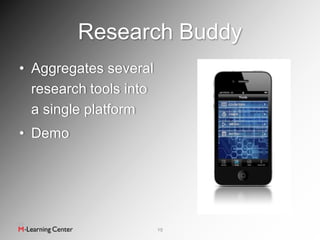
Research Buddy
• Aggregates several
  research tools into
  a single platform
• Demo


                        19
Research
• External Grants
  – Research Buddy: Revolutionizing
    Undergraduate Student Research using
    Mobile Technology. (PI: G. Gannod, co-PI: G.
    Platt, Procter & Gamble, 2011, $10,000 total).
    This project is funded by a Procter & Gamble
    Higher Education Grant.
  – Summer Support for K. Bachman, Nestle
    Corporation, Summer 2011.
                        20
Recommendations

Gannod, G.C., and Bachman, K.M., Integrating M-Learning in a
Broad Context: Issues and Recommendations, Proceedings of
the Conference on Mobile Learning, IADIS, 2011.

                             21
Process
• Graduate Seminar in CSE      • 3 classes of
  formed to develop              recommendations
  recommendations                – Adoption
• Developed rubric based on      – Technology
  existing m-learning            – Cost
  literature
• Analyzed existing m-
  learning techniques
• Discussed issues with K-12
  m-learning practitioner

                         22
Adoption: M-learning should…
• Not be viewed as a replacement for existing
  techniques but rather as a supplement
• Be used to facilitate different dimensions of
  learning
• Be used to facilitate collaboration with instructors
  and other learners
• Be adopted as an institutional or broad initiative
  rather than a pilot by a small set of early adopters
• Be accompanied by protective measures to
  prevent abuses
• Accompanied by training for major constituents
                            23
Technology: M-learning
             technologies…
• Should be extensible and programmable
  to support creation of add-ons
• Should be selected according to its
  intended use
• Should be accompanied with application
  acquisition policies (to address content
  abuse)
                      24
Budget and Cost: Initiatives
                   should…
• Consider a number of cost attributes
  including:
  – Quality of alternatives, relative replacement
    schedules, network
    infrastructure, management software, IT
    support
• Consider pairing digital learning and m-
  learning with other cost savings (such as
  facilities costs)
                         25
Conclusions
• Mobile technology has the potential to disrupt
  education
• Adoption of Mobile Learning should avoid
  rush to acquire technology and instead focus
  on pedagogy
  – Take advantage of “mobile” with tools like
    Research Buddy
• Mobile efforts at Miami provide opportunities
  for students, faculty, and staff to get involved

                          26
References
• [11] Carly Shuler. Pockets of potential: Using mobile
  technologies to promote chil dren's learning. Technical
  report, The Joan Ganz Cooney Center at Sesame
  Workshop, January 2009.
• [12] J. Traxler. Mobile learning: the moving nger writes and
  having writ. . . . The International Review of Research in Open
  and Distance Learning, 8 (2), 2007.
• [13] M. van't Hooft and McNeal T. Mobile phones for mobile
  learning: The geo-historian project. In Proc. of the 2010
  American Educational Research Association
  Conference, 2010.
• [14] Alan Colburn. An inquiry primer. Science Scope, pages
  42-44, 2000.
                                27

It forum short-021012

  • 1.
    http://mlearning.muohio.edu/mlc Twitter: @miami_mlearning
  • 2.
    What is theMLC? • A joint venture between SEAS, AIMS, and IT Services – Unify efforts in mobile space on the campus – Provide faculty, staff, and students a resource for mobile learning and mobile computing – Support faculty by providing software development expertise 2
  • 3.
  • 4.
    Ownership of InternetEnabled Handheld Device Among US College Student Internet Users 11.3 Don't own but plan to purchase in the next 12 mos Don't own and don't plan to purchase in next 12 24.6 mos Don't know 62.7 Own 1.3 Source: EDUCAUSE Center for Applied Research, ECAR Study of Undergraduate Students and Information Technology, 2010. 4
  • 5.
    Get out yourphones! http://bit.ly/mFodgm
  • 6.
    How people feelabout their smartphones http://pewinternet.org/Reports/2011/Smartphones/Summary.aspx 6 Pew Internet 2011
  • 7.
    App Crazy (iear.org) •Viewers and e-readers • Games – iAnnotate, Kindle, Nook, GoodR • Reference eader – Wikipanion, Newsy (news • Notes aggregator) – Notetaker HD, Dragon • Mapping Dictation, Evernote – Map • Office Suite • Storage – iWork: – GoodReader Numbers, Keynote, Pages • Brainstorming • Real-time communication – Popplet, Adobe Ideas – AIM, Skype, Airsketch • Content Specific (education • Social Networking apps) – Facebook, Twitter, Glympse 7
  • 8.
    Technology in the • classroom? Report New Media Consortium’s Horizon calls for adoption of mobile technology in the education for both K-12 and Higher Ed • Abilene Christian, IIT, etc. • iPad initiatives – http://nyti.ms/eIN2Dp – http://bit.ly/fOVW2J 8
  • 9.
    Mobile Devices inthe classroom • St. Mary’s City Schools 9
  • 10.
    Is it MobileLearning? Does using a mobile device in the classroom mean that you are using mobile learning? 10
  • 11.
    What is M-Learning? •M-Learning provides an • Trying to meet students experience that is: where they are and in a – Personalized context that allows us – Authentic to engage them – Situated anywhere and anytime • 24/7 Learning • Facilitate active – Anytime learning – Anything • Leverages mobile – Anywhere platform • Creates new opportunities 11
  • 12.
    What is M-Learning? •Geo-Historian Project [13] – Supports authentic and situated learning – Unite schools with community resources – Students can develop digital resources for community – Example: Cuyahoga River Dam 12
  • 13.
    Do students learn? How do we know whether students learn with these tools? 13
  • 14.
    The Problem • MobileLearning pedagogies are not well defined… – Schools buy mobile technologies, but do not know how to use them. – Little research on the effectiveness of m-learning solutions • Ex. Citizen Science (Project Noah) – Learners may be disengaged from core-aspects of inquiry-based learning 14
  • 15.
    So… • What wewant to know: – Does disengagement from some inquiry-based learning process impact one’s ability to learn? – Can mobile devices improve engagement and learning without a full understanding of some research problem? • Research Thesis: – Data collection through a mobile device can improve learning when a researcher is fully engaged in some method of inquiry-based instruction. 15
  • 16.
    Inquiry-Based Learning • Creationof a classroom environment where students are engaged in open-ended, student-centered, and hands-on activities. [14] • Banchi et al. suggest there are 4 levels of inquiry [2] [2] Heather Banchi and Randy Bell. The many levels of inquiry. Science 16 and Children, October 2008.
  • 17.
    Theoretical Foundations • Traxlerargues that mobile learning is able to provide an experience that is personalized, authentic, and situated. [12] • Authentic and situated learning has the ability to increase student engagement and information retention. [11] • Mobile devices can respond to varying needs of learners. [11] • Communication capabilities of mobile devices make it easy for leaners to collaborate and communicate. [11] 17
  • 18.
    Inquiry and Effecton Education • Research project looking at 2 different groups of people: – Lead Researchers • Have Full Participation in scientific process – Volunteers • Have Limited Participation in scientific process • Focus on basic scientific method model – Research Buddy most effective in the “Experiment” step 18
  • 19.
    Research Buddy • Aggregatesseveral research tools into a single platform • Demo 19
  • 20.
    Research • External Grants – Research Buddy: Revolutionizing Undergraduate Student Research using Mobile Technology. (PI: G. Gannod, co-PI: G. Platt, Procter & Gamble, 2011, $10,000 total). This project is funded by a Procter & Gamble Higher Education Grant. – Summer Support for K. Bachman, Nestle Corporation, Summer 2011. 20
  • 21.
    Recommendations Gannod, G.C., andBachman, K.M., Integrating M-Learning in a Broad Context: Issues and Recommendations, Proceedings of the Conference on Mobile Learning, IADIS, 2011. 21
  • 22.
    Process • Graduate Seminarin CSE • 3 classes of formed to develop recommendations recommendations – Adoption • Developed rubric based on – Technology existing m-learning – Cost literature • Analyzed existing m- learning techniques • Discussed issues with K-12 m-learning practitioner 22
  • 23.
    Adoption: M-learning should… •Not be viewed as a replacement for existing techniques but rather as a supplement • Be used to facilitate different dimensions of learning • Be used to facilitate collaboration with instructors and other learners • Be adopted as an institutional or broad initiative rather than a pilot by a small set of early adopters • Be accompanied by protective measures to prevent abuses • Accompanied by training for major constituents 23
  • 24.
    Technology: M-learning technologies… • Should be extensible and programmable to support creation of add-ons • Should be selected according to its intended use • Should be accompanied with application acquisition policies (to address content abuse) 24
  • 25.
    Budget and Cost:Initiatives should… • Consider a number of cost attributes including: – Quality of alternatives, relative replacement schedules, network infrastructure, management software, IT support • Consider pairing digital learning and m- learning with other cost savings (such as facilities costs) 25
  • 26.
    Conclusions • Mobile technologyhas the potential to disrupt education • Adoption of Mobile Learning should avoid rush to acquire technology and instead focus on pedagogy – Take advantage of “mobile” with tools like Research Buddy • Mobile efforts at Miami provide opportunities for students, faculty, and staff to get involved 26
  • 27.
    References • [11] CarlyShuler. Pockets of potential: Using mobile technologies to promote chil dren's learning. Technical report, The Joan Ganz Cooney Center at Sesame Workshop, January 2009. • [12] J. Traxler. Mobile learning: the moving nger writes and having writ. . . . The International Review of Research in Open and Distance Learning, 8 (2), 2007. • [13] M. van't Hooft and McNeal T. Mobile phones for mobile learning: The geo-historian project. In Proc. of the 2010 American Educational Research Association Conference, 2010. • [14] Alan Colburn. An inquiry primer. Science Scope, pages 42-44, 2000. 27

Editor's Notes

  • #15 Also they’re not using devices outside of the classroom
  • #16 In answering these questions, this will help address the problems mentioned in the previous slideCompared to researchers who are not using a mobile devices for data collection or are not complete participants in some inquiry-based instruction method.
  • #17 We will focus on structured inquiry
  • #18 Theoretical theories supporting mobile-learning…Meaning that mobile learning goes beyond the mere consumption of information to providing an experience that can be tailored to each unique individual, can solve real-world problems, at the time and place a solution is needed. Shuler suggests that learners retain info. Better when learning takes place at the exact time and place the learner demands the information. Concepts are also easier to remember when presented in authentic environments. Mobile devices can adapt to different interests, preferences, or knowledge backgrounds and can even encourage learners to communicate.
  • #24 Are these de-ontological meta-ethicsInstitutional vs pilot = sustainabilityTeacher buy-inDimensions => inquiry-based? Explorative? Personalized, situated, authenticProtective measures => ethics
  • #25 Intended use = first speaker again