Assignment
Submitted to: Submitted By:
Somalatha. S Neethu Unni
Lecturer in Mathematics Mathematics
MMTC, Vilakudy MMTC, Vilakudy
2
MOBILE LEARNING
3
INDEX
Sl.No CONTENT PAGE NO
1 Introduction 4
2 Background 7
3 Approaches 9
4 Challenges 14
5 Technologies 16
6 Educational Implication 17
7 Conclusion 19
4
1 INTRODUCTION
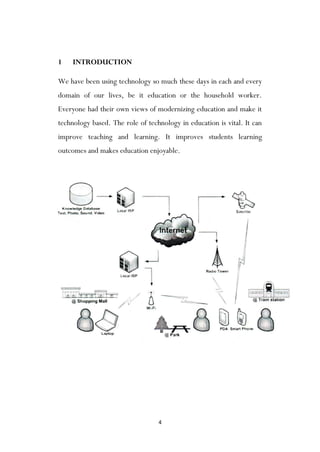
We have been using technology so much these days in each and every
domain of our lives, be it education or the household worker.
Everyone had their own views of modernizing education and make it
technology based. The role of technology in education is vital. It can
improve teaching and learning. It improves students learning
outcomes and makes education enjoyable.
5
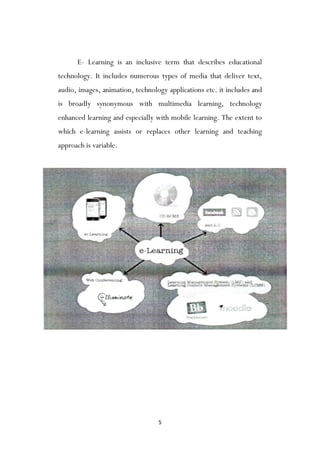
E- Learning is an inclusive term that describes educational
technology. It includes numerous types of media that deliver text,
audio, images, animation, technology applications etc. it includes and
is broadly synonymous with multimedia learning, technology
enhanced learning and especially with mobile learning. The extent to
which e-learning assists or replaces other learning and teaching
approach is variable.
6
MOBILE LEARNING (M- Learning)
“You cannot teach people everything they need to know. The best you
can do is position them where they can find what they need to know when they
need to know it” – Seymour papert.
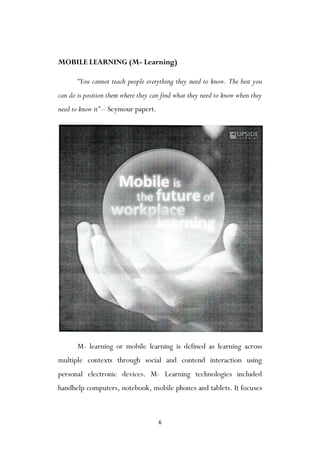
M- learning or mobile learning is defined as learning across
multiple contexts through social and contend interaction using
personal electronic devices. M- Learning technologies included
handhelp computers, notebook, mobile phones and tablets. It focuses
7
on the mobility of the leaner, interacting with portable technologies.
Using mobile tools for creating learning aids and materials becomes
and important part of informal learning.
M- learning is convenient in that it is accessible form virtually
anywhere. M –learning likes other forms of e-learning is also
collaborating. Sharing is almost instant among everyone using the
same content which leads to the reception of instant feedback and
tips. M-learning also brings strong portability by replacing books and
notes with small devices, filled with tailored learning contents. In
addition, it is simple to utilize mobile learning for a more effective
and entertaining experience.
2. BACKGOUND
8
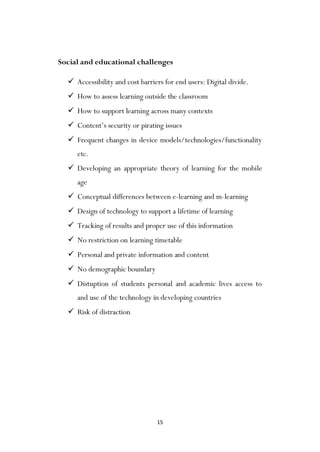
Mobile learning delivers e-learning on small form factor devices to:
 Deliver education materials and promote learning
 Faster communications and collaboration
 Conduct assessments and evaluations
 Provide access to performance support and knowledge
 Capture evidence of learning activity
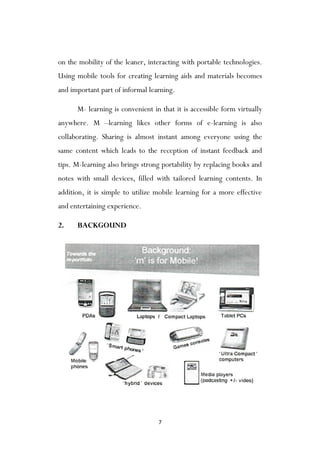
Today, any number of portable devices can quickly and easily
deliver and support these functions. Cell phones or smartphones,
multi-game devices, personal media players (PMPs), personal digital
assistants (PDAs), and wireless single-purpose devices can help
deliver coaching and mentoring, conduct assessments and evaluations
(e.g, equizzes; tests; surveys and polls; and certifications), provide
on-the-job support and access to information, educational references,
and deliver podcaste, update alerts, forms and checklists.
In these ways, mobile learning can enhance and support more
traditional learning modes, making it more portable and accessible.
Mobile devices can also serve as powerful date collection tools and
facilitate the capture of user created content.
Department of Homeland Security (DHS), Intelligence
community, and law enforcement are utilizing mobile technology are
utilizing mobile technology for information management.
9
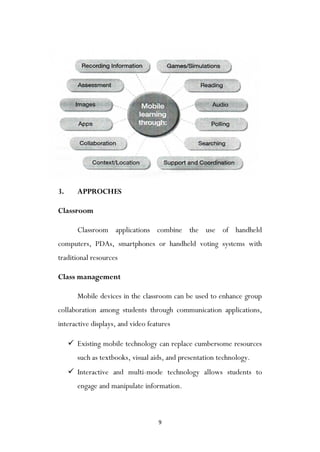
3. APPROCHES
Classroom
Classroom applications combine the use of handheld
computers, PDAs, smartphones or handheld voting systems with
traditional resources
Class management
Mobile devices in the classroom can be used to enhance group
collaboration among students through communication applications,
interactive displays, and video features
 Existing mobile technology can replace cumbersome resources
such as textbooks, visual aids, and presentation technology.
 Interactive and multi-mode technology allows students to
engage and manipulate information.
10
 Mobile device features with WIFI capabilities allow for on-
demand access to information.
 Access to classroom activities and information on mobile
deveices provides a continuum for learning inside and outside
the classroom.
In an experiment to make learning mobile through the use of
tablet computers, 32% of 8th
grade students at Stone middle school
found that they were more engaged in the classroom and had a better
understanding of course material. In a literature review conducted by
future Lab, researchers found that increased communication,
collaboration, and understanding of concepts was a result of mobile
technology applications.
Blended learning
Blended learning combines brick-and-mortar schooling with
online delivery of content and instruction. Mobile devices provide
support that enhances teaching and learning in a virtual classroom
environment.
Class management
Mobile devices are used both in the brick- and mortar setting
as well as in the online setting to enhance the education experience.
 The mobile phone can be used especially for distance education
or with students whose courses require them to be highly
11
mobile and in particular to communicate information regarding
availability of assignment results, venue changes and
cancellations, etc. it can also be of value to business people.
Eg. Sales representatives who do not wish to waste time away
from their busy schedules to attend formal training events.
 Mobile devices facilitate online interaction between instructor
and student, and student to student.
 Blended learning takes the classroom out of a traditional brick-
and-mortar setting. Students become part of virtual
communities used for collaboration. Blended learning
transition away from a traditional teaching environment to a
customized and interactive web platform for the user.
Podcasting
Podcasting consists of listening to audio recordings of lectures.
It can be used to review live lectures and to provide opportunities for
students to rehearse oral presentations. Podcasts may also provide
supplemental information to enhance traditional lectures.
Psychological research suggests that university students who
download podcast lectures achieve substantially higher exam results
than these who attend the lecture in person.
Podcasts may be delivered using syndication, although this
method of delivery is not always easily adopted.
12
Outdoors
 Learning in museums or galleries with handheld or wearable
technologies
 Learning outdoors (e.g on field trips).
 Continuous learning and portable tools for military personnel.
At work
M-learning in a workplace can be very different from a school‟s
context. Although employees do occasionally attend face to face
training events, the majority of work-based learning happens on the
job, often at the moment of need. Because of this, m-learning is being
used in a wider range of modes:
 On the job training for someone who accesses training on a
mobile device.
 Just in time training to solve a problem or gain an update.
 Performance support. Immedicate access to tools to streamline
a work-task
 Reference guides and eBooks
 Checklists.
Due to the very diverse training needs across a large
organization, self-serve learning is more common than is found at the
school, or college level. Mobile is seen as an effective way to reach a
large number of employees easier and more effectively.
13
 Increased accessibility to training for remote work force and
sales team members
 Increased learner engagement levels
 Improved skill retention
 Faster turnaround on training materials.
Lifelong learning and self-learning
The use if personal technology to support informal or lifelong
learning, such as using handheld dictionaries and other devices for
language learning, is an approach that is not to be overlooked.
Mobile technologies and approaches, i.e Mobile assisted
Language Learning (MALL), are also used to assist in language
learning. For instance handheld computers, cell phones and
podcasting have been used to help people acquire and develop
language skills.
Other
 Improving levels of literacy, numeracy, and participation in
education amongst young adults.
 Using the communication features of a mobile phone as part of
a larger learning activity, e.g: sending media or texts in to a
central portfolio, or exporting audio files from a learning
platform to your phone.
14
 Developing workforce skills and readiness among youth and
young adults.
4. CHALLENGES
Technical challenges
 Connectivity and battery life
 Screen size and key size
 Meeting required bandwidth for nonstop/fast streaming
 Number of file/asset formats supported by a specific device
 Content security or copyright issue from authoring group
 Multiple standards, multiple screen sizes, multiple operating
system
 Reworking existing E-learning materials for mobile platforms
 Limited memory
 Risk of sudden obsolescence
15
Social and educational challenges
 Accessibility and cost barriers for end users: Digital divide.
 How to assess learning outside the classroom
 How to support learning across many contexts
 Content‟s security or pirating issues
 Frequent changes in device models/technologies/functionality
etc.
 Developing an appropriate theory of learning for the mobile
age
 Conceptual differences between e-learning and m-learning
 Design of technology to support a lifetime of learning
 Tracking of results and proper use of this information
 No restriction on learning timetable
 Personal and private information and content
 No demographic boundary
 Distuption of students personal and academic lives access to
and use of the technology in developing countries
 Risk of distraction
16
5. THENOLOGIES
Mobile devise and personal technologies that can support
mobile learning include:
 Smartphone, an aggregator of most of the following
technologies
 E-book
 Handheld audio and multimedia guides, in museums and
galleries
 Handheld game console, modern gaming consoles such as Sony
PSP or Nintendo DS
 Personal audio player, e.g. for listening to audio recording sof
lectures (podcasting)
 Personal Digital Assistant, in the classroom and outdoors
 Tablet computer
 UMPC, mobile phone, camera phone and Smart phone
Technical and delivery support for mobile learning include:
 3GP for compression and delivery method of audio-visual
content associated with mobile learning
 GPRS mobile date service, provides high speed connection and
data transfer rate
 Wi-Fi gives access to instructors and resources via internet
 Could computing for storing and sharing files
17
 Mobile web and mobile Apps for the dominant content formats
for Smart phones
10 WAYS THAT M LEARNING WILL REVOLUTIONIZE
EDUCATION
 Continuous learning
 Educational leap forging
 A new crop of older, linelong leaners
 Braking gender boundaries, reducing physical burdens
 A new literacy emerges: software literacy
 Education long tail
 Teachers and pupils trade roles
 Synergies with mobile banking and mobile health initiatives
 New opportunities for traditional, educational institutions
 A revolution leading to customized education
6. EDUCATIONAL IMPLICATION
Tutors who have used M-learning programs and techniques
have made the following value statements in favour of M-learning.
 It is important to bring new technology into the classroom.
 Devices used are more lightweight than books and PCs.
 Mobile learning can be used to diversify the types of learning
activities students partake in (or a blended learning approach).
18
 Mobile learning supports the learning process rather than being
integral to it.
 Mobile learning can be a useful add-on tool for students with
special needs. However, for SMS and MMS this might be
dependent on the students‟ specific disabilities or difficulties
involved.
 Mobile learning can be used as a „hook‟ to re-engage
disaffected youth.
 Relavely inexpensive opportunities, as the cost of mobile
devices are significantly less than PCs and laptops
 Multimedia content delivery and creation options.
 Continuous and situated learning support
 Decrease in training costs
 Potentially a more rewarding learning experience
19
7. CONCLUSION
Over the past ten years mobile learning has grown from a
minor research interest to set of significant projects in schools,
workplace, museums, cities and rural areas around the world. The
M-learning community is still fragmented, with different national
perspectives, differences between academia and industry, and
between the school, higher education and lifelong learning sectors.
Technologies currently being researched for mobile learning include
Location aware learning, anyhow mobile is the future of workplace
learning.
REFERENCES
 Various magazines and journals
 www. Wikipedia.com
 www.kajeet.com/4u/education/MLM-form.html
 “M-learning: A new Approach to Learn Better” – Mandeep
Sing, International journal of education and allied sciences 2

Assignment

  • 1.
    Assignment Submitted to: SubmittedBy: Somalatha. S Neethu Unni Lecturer in Mathematics Mathematics MMTC, Vilakudy MMTC, Vilakudy
  • 2.
  • 3.
    3 INDEX Sl.No CONTENT PAGENO 1 Introduction 4 2 Background 7 3 Approaches 9 4 Challenges 14 5 Technologies 16 6 Educational Implication 17 7 Conclusion 19
  • 4.
    4 1 INTRODUCTION We havebeen using technology so much these days in each and every domain of our lives, be it education or the household worker. Everyone had their own views of modernizing education and make it technology based. The role of technology in education is vital. It can improve teaching and learning. It improves students learning outcomes and makes education enjoyable.
  • 5.
    5 E- Learning isan inclusive term that describes educational technology. It includes numerous types of media that deliver text, audio, images, animation, technology applications etc. it includes and is broadly synonymous with multimedia learning, technology enhanced learning and especially with mobile learning. The extent to which e-learning assists or replaces other learning and teaching approach is variable.
  • 6.
    6 MOBILE LEARNING (M-Learning) “You cannot teach people everything they need to know. The best you can do is position them where they can find what they need to know when they need to know it” – Seymour papert. M- learning or mobile learning is defined as learning across multiple contexts through social and contend interaction using personal electronic devices. M- Learning technologies included handhelp computers, notebook, mobile phones and tablets. It focuses
  • 7.
    7 on the mobilityof the leaner, interacting with portable technologies. Using mobile tools for creating learning aids and materials becomes and important part of informal learning. M- learning is convenient in that it is accessible form virtually anywhere. M –learning likes other forms of e-learning is also collaborating. Sharing is almost instant among everyone using the same content which leads to the reception of instant feedback and tips. M-learning also brings strong portability by replacing books and notes with small devices, filled with tailored learning contents. In addition, it is simple to utilize mobile learning for a more effective and entertaining experience. 2. BACKGOUND
  • 8.
    8 Mobile learning deliverse-learning on small form factor devices to:  Deliver education materials and promote learning  Faster communications and collaboration  Conduct assessments and evaluations  Provide access to performance support and knowledge  Capture evidence of learning activity Today, any number of portable devices can quickly and easily deliver and support these functions. Cell phones or smartphones, multi-game devices, personal media players (PMPs), personal digital assistants (PDAs), and wireless single-purpose devices can help deliver coaching and mentoring, conduct assessments and evaluations (e.g, equizzes; tests; surveys and polls; and certifications), provide on-the-job support and access to information, educational references, and deliver podcaste, update alerts, forms and checklists. In these ways, mobile learning can enhance and support more traditional learning modes, making it more portable and accessible. Mobile devices can also serve as powerful date collection tools and facilitate the capture of user created content. Department of Homeland Security (DHS), Intelligence community, and law enforcement are utilizing mobile technology are utilizing mobile technology for information management.
  • 9.
    9 3. APPROCHES Classroom Classroom applicationscombine the use of handheld computers, PDAs, smartphones or handheld voting systems with traditional resources Class management Mobile devices in the classroom can be used to enhance group collaboration among students through communication applications, interactive displays, and video features  Existing mobile technology can replace cumbersome resources such as textbooks, visual aids, and presentation technology.  Interactive and multi-mode technology allows students to engage and manipulate information.
  • 10.
    10  Mobile devicefeatures with WIFI capabilities allow for on- demand access to information.  Access to classroom activities and information on mobile deveices provides a continuum for learning inside and outside the classroom. In an experiment to make learning mobile through the use of tablet computers, 32% of 8th grade students at Stone middle school found that they were more engaged in the classroom and had a better understanding of course material. In a literature review conducted by future Lab, researchers found that increased communication, collaboration, and understanding of concepts was a result of mobile technology applications. Blended learning Blended learning combines brick-and-mortar schooling with online delivery of content and instruction. Mobile devices provide support that enhances teaching and learning in a virtual classroom environment. Class management Mobile devices are used both in the brick- and mortar setting as well as in the online setting to enhance the education experience.  The mobile phone can be used especially for distance education or with students whose courses require them to be highly
  • 11.
    11 mobile and inparticular to communicate information regarding availability of assignment results, venue changes and cancellations, etc. it can also be of value to business people. Eg. Sales representatives who do not wish to waste time away from their busy schedules to attend formal training events.  Mobile devices facilitate online interaction between instructor and student, and student to student.  Blended learning takes the classroom out of a traditional brick- and-mortar setting. Students become part of virtual communities used for collaboration. Blended learning transition away from a traditional teaching environment to a customized and interactive web platform for the user. Podcasting Podcasting consists of listening to audio recordings of lectures. It can be used to review live lectures and to provide opportunities for students to rehearse oral presentations. Podcasts may also provide supplemental information to enhance traditional lectures. Psychological research suggests that university students who download podcast lectures achieve substantially higher exam results than these who attend the lecture in person. Podcasts may be delivered using syndication, although this method of delivery is not always easily adopted.
  • 12.
    12 Outdoors  Learning inmuseums or galleries with handheld or wearable technologies  Learning outdoors (e.g on field trips).  Continuous learning and portable tools for military personnel. At work M-learning in a workplace can be very different from a school‟s context. Although employees do occasionally attend face to face training events, the majority of work-based learning happens on the job, often at the moment of need. Because of this, m-learning is being used in a wider range of modes:  On the job training for someone who accesses training on a mobile device.  Just in time training to solve a problem or gain an update.  Performance support. Immedicate access to tools to streamline a work-task  Reference guides and eBooks  Checklists. Due to the very diverse training needs across a large organization, self-serve learning is more common than is found at the school, or college level. Mobile is seen as an effective way to reach a large number of employees easier and more effectively.
  • 13.
    13  Increased accessibilityto training for remote work force and sales team members  Increased learner engagement levels  Improved skill retention  Faster turnaround on training materials. Lifelong learning and self-learning The use if personal technology to support informal or lifelong learning, such as using handheld dictionaries and other devices for language learning, is an approach that is not to be overlooked. Mobile technologies and approaches, i.e Mobile assisted Language Learning (MALL), are also used to assist in language learning. For instance handheld computers, cell phones and podcasting have been used to help people acquire and develop language skills. Other  Improving levels of literacy, numeracy, and participation in education amongst young adults.  Using the communication features of a mobile phone as part of a larger learning activity, e.g: sending media or texts in to a central portfolio, or exporting audio files from a learning platform to your phone.
  • 14.
    14  Developing workforceskills and readiness among youth and young adults. 4. CHALLENGES Technical challenges  Connectivity and battery life  Screen size and key size  Meeting required bandwidth for nonstop/fast streaming  Number of file/asset formats supported by a specific device  Content security or copyright issue from authoring group  Multiple standards, multiple screen sizes, multiple operating system  Reworking existing E-learning materials for mobile platforms  Limited memory  Risk of sudden obsolescence
  • 15.
    15 Social and educationalchallenges  Accessibility and cost barriers for end users: Digital divide.  How to assess learning outside the classroom  How to support learning across many contexts  Content‟s security or pirating issues  Frequent changes in device models/technologies/functionality etc.  Developing an appropriate theory of learning for the mobile age  Conceptual differences between e-learning and m-learning  Design of technology to support a lifetime of learning  Tracking of results and proper use of this information  No restriction on learning timetable  Personal and private information and content  No demographic boundary  Distuption of students personal and academic lives access to and use of the technology in developing countries  Risk of distraction
  • 16.
    16 5. THENOLOGIES Mobile deviseand personal technologies that can support mobile learning include:  Smartphone, an aggregator of most of the following technologies  E-book  Handheld audio and multimedia guides, in museums and galleries  Handheld game console, modern gaming consoles such as Sony PSP or Nintendo DS  Personal audio player, e.g. for listening to audio recording sof lectures (podcasting)  Personal Digital Assistant, in the classroom and outdoors  Tablet computer  UMPC, mobile phone, camera phone and Smart phone Technical and delivery support for mobile learning include:  3GP for compression and delivery method of audio-visual content associated with mobile learning  GPRS mobile date service, provides high speed connection and data transfer rate  Wi-Fi gives access to instructors and resources via internet  Could computing for storing and sharing files
  • 17.
    17  Mobile weband mobile Apps for the dominant content formats for Smart phones 10 WAYS THAT M LEARNING WILL REVOLUTIONIZE EDUCATION  Continuous learning  Educational leap forging  A new crop of older, linelong leaners  Braking gender boundaries, reducing physical burdens  A new literacy emerges: software literacy  Education long tail  Teachers and pupils trade roles  Synergies with mobile banking and mobile health initiatives  New opportunities for traditional, educational institutions  A revolution leading to customized education 6. EDUCATIONAL IMPLICATION Tutors who have used M-learning programs and techniques have made the following value statements in favour of M-learning.  It is important to bring new technology into the classroom.  Devices used are more lightweight than books and PCs.  Mobile learning can be used to diversify the types of learning activities students partake in (or a blended learning approach).
  • 18.
    18  Mobile learningsupports the learning process rather than being integral to it.  Mobile learning can be a useful add-on tool for students with special needs. However, for SMS and MMS this might be dependent on the students‟ specific disabilities or difficulties involved.  Mobile learning can be used as a „hook‟ to re-engage disaffected youth.  Relavely inexpensive opportunities, as the cost of mobile devices are significantly less than PCs and laptops  Multimedia content delivery and creation options.  Continuous and situated learning support  Decrease in training costs  Potentially a more rewarding learning experience
  • 19.
    19 7. CONCLUSION Over thepast ten years mobile learning has grown from a minor research interest to set of significant projects in schools, workplace, museums, cities and rural areas around the world. The M-learning community is still fragmented, with different national perspectives, differences between academia and industry, and between the school, higher education and lifelong learning sectors. Technologies currently being researched for mobile learning include Location aware learning, anyhow mobile is the future of workplace learning. REFERENCES  Various magazines and journals  www. Wikipedia.com  www.kajeet.com/4u/education/MLM-form.html  “M-learning: A new Approach to Learn Better” – Mandeep Sing, International journal of education and allied sciences 2