From E-Learning to M-Learning
Terese Bird and Gráinne Conole, University of
Leicester
MobiLearnAsia 2013, Singapore
1st October, 2013
Outline
• The evolving landscape of e-
learning to m-learning (mobile e-
learning)
• Affordances of new technologies
• Learner experience
• New m-pedagogies and
implications
• Teacher practice and paradoxes
• Strategies for change
– Intervention framework: linking
research to policy and practice
– New approaches to design
Research questions
• What:
– Is the learner experience and teacher practice?
– Are the emergent technologies and their affordances?
– Resources, Open Educational Resources and
practices, and Pedagogical Patterns are there and how
are they being used?
– M-Pedagogies are there and how do they facilitate
different forms of learning?
– New learning design approaches can be used to
promote and support m-learning?
– Strategies are in place to promote and support e-
learning?
– Theories and methodologies are been used?
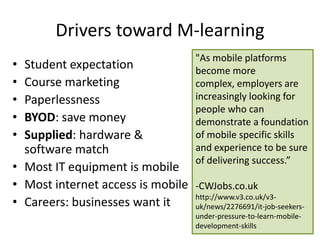
Drivers toward M-learning
• Student expectation
• Course marketing
• Paperlessness
• BYOD: save money
• Supplied: hardware &
software match
• Most IT equipment is mobile
• Most internet access is mobile
• Careers: businesses want it
"As mobile platforms
become more
complex, employers are
increasingly looking for
people who can
demonstrate a foundation
of mobile specific skills
and experience to be sure
of delivering success.”
-CWJobs.co.uk
http://www.v3.co.uk/v3-
uk/news/2276691/it-job-seekers-
under-pressure-to-learn-mobile-
development-skills
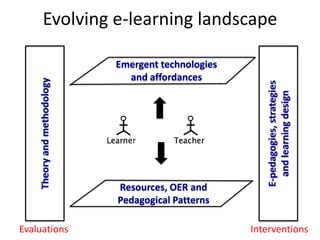
Emergent technologies
and affordances
Resources, OER and
Pedagogical Patterns
Evolving e-learning landscape
E-pedagogies,strategies
andlearningdesign
Interventions
Theoryandmethodology
Evaluations
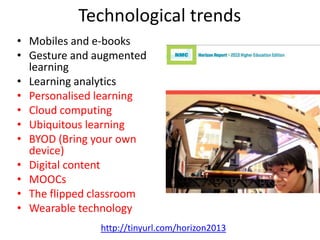
Technological trends
• Mobiles and e-books
• Gesture and augmented
learning
• Learning analytics
• Personalised learning
• Cloud computing
• Ubiquitous learning
• BYOD (Bring your own
device)
• Digital content
• MOOCs
• The flipped classroom
• Wearable technology
http://tinyurl.com/horizon2013
7
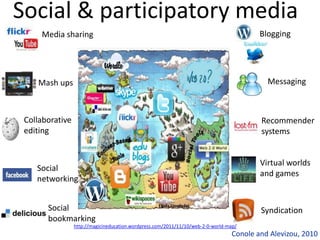
Media sharing
Collaborative
editing
Social
networking
Virtual worlds
and games
Syndication
Messaging
Social
bookmarking
Recommender
systems
Mash ups
Blogging
Conole and Alevizou, 2010
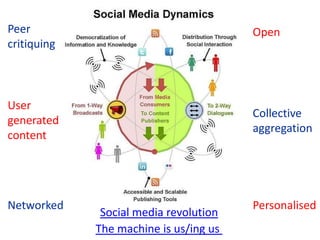
Social & participatory media
http://magicineducation.wordpress.com/2011/11/10/web-2-0-world-map/
User
generated
content
Peer
critiquing
Networked
Collective
aggregation
Personalised
Open
Social media revolution
The machine is us/ing us
Activity
• What are characteristics of good learning?
• Draw on your own experience as a learner and
as a teacher – think about a really good and
bad experience for your own background
• What are the barriers and success factors of
successful learning?
Discussion
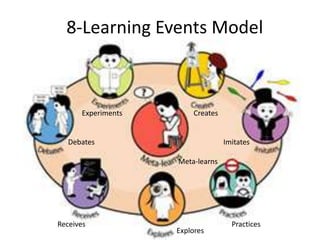
8-Learning Events Model
Experiments Creates
Receives
Explores
Practices
Imitates
Meta-learns
Debates
From E-Learning to M-Learning
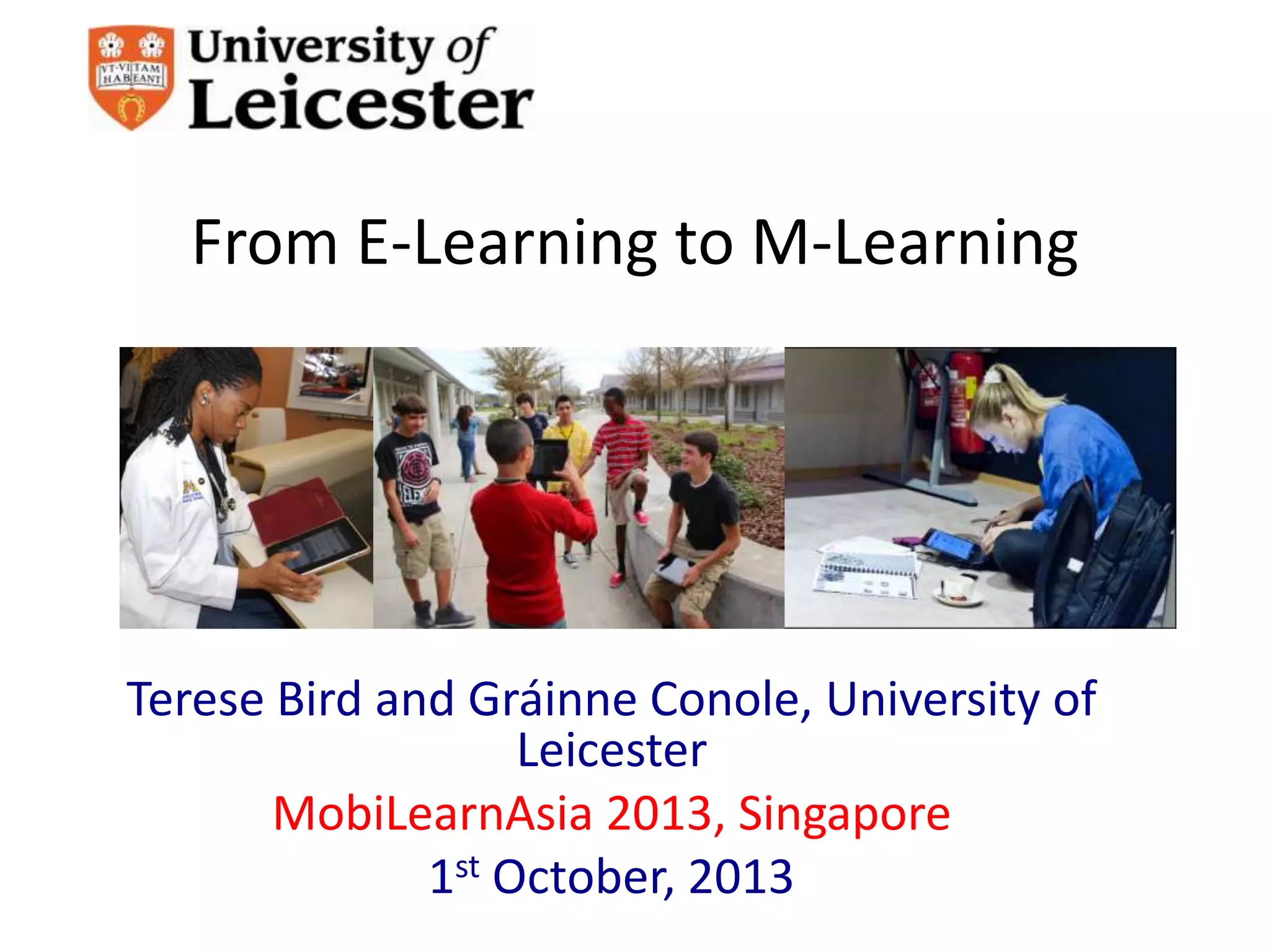
• More than just mobile e-learning
– Anytime, anywhere for the learner (efficiency)
– Enables learning in special location (i.e. fieldwork)
• New affordances of mobile
– Small and compact
– Personal
– Capturing sound, video, image
– New tech i.e. augmented reality
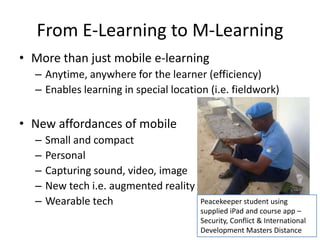
– Wearable tech Peacekeeper student using
supplied iPad and course app –
Security, Conflict & International
Development Masters Distance
Other Leicester examples
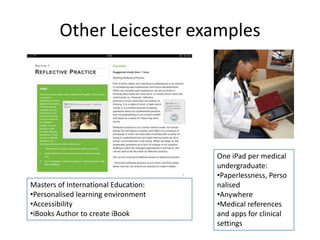
One iPad per medical
undergraduate:
•Paperlessness, Perso
nalised
•Anywhere
•Medical references
and apps for clinical
settings
Masters of International Education:
•Personalised learning environment
•Accessibility
•iBooks Author to create iBook
E-Pedagogies to M-Pedagogies
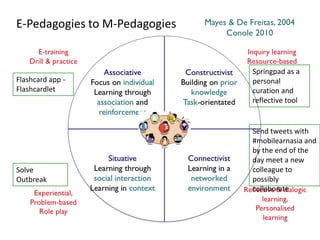
Flashcard app -
Flashcardlet
Solve
Outbreak
Send tweets with
#mobilearnasia and
by the end of the
day meet a new
colleague to
possibly
collaborate
Springpad as a
personal
curation and
reflective tool
16
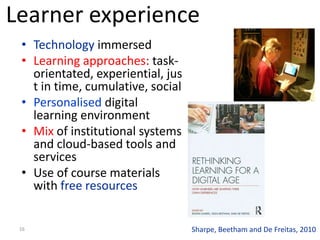
• Technology immersed
• Learning approaches: task-
orientated, experiential, jus
t in time, cumulative, social
• Personalised digital
learning environment
• Mix of institutional systems
and cloud-based tools and
services
• Use of course materials
with free resources
Sharpe, Beetham and De Freitas, 2010
Learner experience
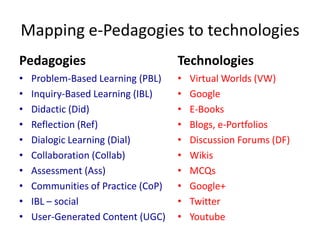
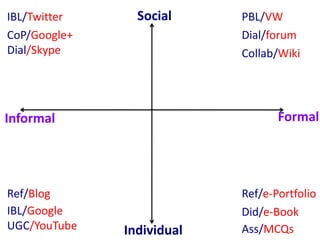
Mapping e-Pedagogies to technologies
Pedagogies
• Problem-Based Learning (PBL)
• Inquiry-Based Learning (IBL)
• Didactic (Did)
• Reflection (Ref)
• Dialogic Learning (Dial)
• Collaboration (Collab)
• Assessment (Ass)
• Communities of Practice (CoP)
• IBL – social
• User-Generated Content (UGC)
Technologies
• Virtual Worlds (VW)
• Google
• E-Books
• Blogs, e-Portfolios
• Discussion Forums (DF)
• Wikis
• MCQs
• Google+
• Twitter
• Youtube
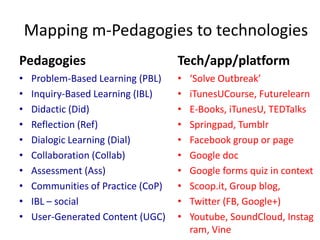
Mapping m-Pedagogies to technologies
Pedagogies
• Problem-Based Learning (PBL)
• Inquiry-Based Learning (IBL)
• Didactic (Did)
• Reflection (Ref)
• Dialogic Learning (Dial)
• Collaboration (Collab)
• Assessment (Ass)
• Communities of Practice (CoP)
• IBL – social
• User-Generated Content (UGC)
Tech/app/platform
• ‘Solve Outbreak’
• iTunesUCourse, Futurelearn
• E-Books, iTunesU, TEDTalks
• Springpad, Tumblr
• Facebook group or page
• Google doc
• Google forms quiz in context
• Scoop.it, Group blog,
• Twitter (FB, Google+)
• Youtube, SoundCloud, Instag
ram, Vine
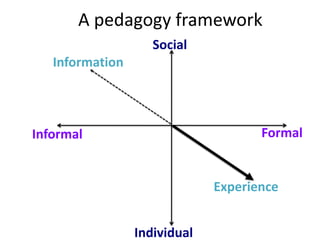
Social
Individual
Informal Formal
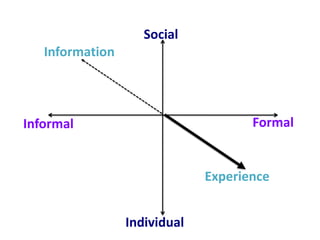
Information
Experience
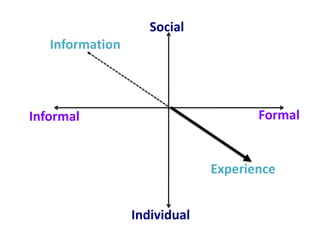
A pedagogy framework
Social
Individual
Informal Formal
Information
Experience
Social
Individual
Informal Formal
PBL/VW
Dial/forum
Collab/Wiki
IBL/Twitter
CoP/Google+
Dial/Skype
Ref/Blog
IBL/Google
UGC/YouTube
Ref/e-Portfolio
Did/e-Book
Ass/MCQs
Social
Individual
Informal Formal
Information
Experience
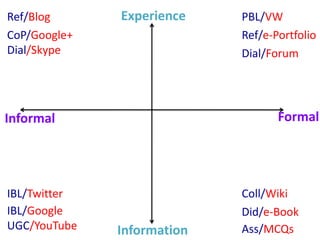
Experience
Information
Informal Formal
PBL/VW
Ref/e-Portfolio
Dial/Forum
Ref/Blog
CoP/Google+
Dial/Skype
IBL/Twitter
IBL/Google
UGC/YouTube
Coll/Wiki
Did/e-Book
Ass/MCQs
24
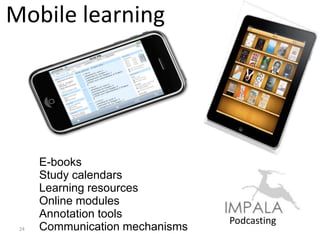
Mobile learning
E-books
Study calendars
Learning resources
Online modules
Annotation tools
Communication mechanisms
Podcasting
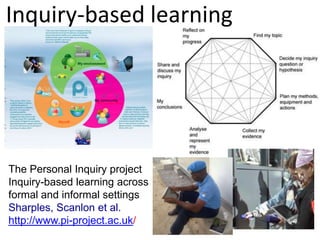
The Personal Inquiry project
Inquiry-based learning across
formal and informal settings
Sharples, Scanlon et al.
http://www.pi-project.ac.uk/
My community
Inquiry-based learning
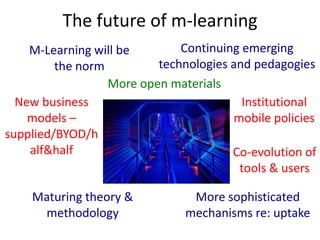
M-Learning will be
the norm
New business
models –
supplied/BYOD/h
alf&half Co-evolution of
tools & users
Maturing theory &
methodology
More sophisticated
mechanisms re: uptake
The future of m-learning
Continuing emerging
technologies and pedagogies
Institutional
mobile policies
More open materials
Task:
• Choose a lesson in which to incorporate
mobile learning
• Choose a pedagogical approach
• Sketch out how you will deploy this
pedagogical approach with mobile
• Share with your group
• Critique each other’s work: what are
issues, problems, opportunities?
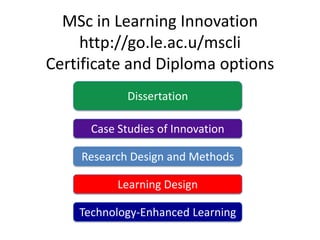
MSc in Learning Innovation
http://go.le.ac.u/mscli
Certificate and Diploma options
Technology-Enhanced Learning
Learning Design
Research Design and Methods
Case Studies of Innovation
Dissertation
From E-Learning to M-Learning

From E-Learning to M-Learning

  • 1.
    From E-Learning toM-Learning Terese Bird and Gráinne Conole, University of Leicester MobiLearnAsia 2013, Singapore 1st October, 2013
  • 2.
    Outline • The evolvinglandscape of e- learning to m-learning (mobile e- learning) • Affordances of new technologies • Learner experience • New m-pedagogies and implications • Teacher practice and paradoxes • Strategies for change – Intervention framework: linking research to policy and practice – New approaches to design
  • 3.
    Research questions • What: –Is the learner experience and teacher practice? – Are the emergent technologies and their affordances? – Resources, Open Educational Resources and practices, and Pedagogical Patterns are there and how are they being used? – M-Pedagogies are there and how do they facilitate different forms of learning? – New learning design approaches can be used to promote and support m-learning? – Strategies are in place to promote and support e- learning? – Theories and methodologies are been used?
  • 4.
    Drivers toward M-learning •Student expectation • Course marketing • Paperlessness • BYOD: save money • Supplied: hardware & software match • Most IT equipment is mobile • Most internet access is mobile • Careers: businesses want it "As mobile platforms become more complex, employers are increasingly looking for people who can demonstrate a foundation of mobile specific skills and experience to be sure of delivering success.” -CWJobs.co.uk http://www.v3.co.uk/v3- uk/news/2276691/it-job-seekers- under-pressure-to-learn-mobile- development-skills
  • 5.
    Emergent technologies and affordances Resources,OER and Pedagogical Patterns Evolving e-learning landscape E-pedagogies,strategies andlearningdesign Interventions Theoryandmethodology Evaluations
  • 6.
    Technological trends • Mobilesand e-books • Gesture and augmented learning • Learning analytics • Personalised learning • Cloud computing • Ubiquitous learning • BYOD (Bring your own device) • Digital content • MOOCs • The flipped classroom • Wearable technology http://tinyurl.com/horizon2013
  • 7.
    7 Media sharing Collaborative editing Social networking Virtual worlds andgames Syndication Messaging Social bookmarking Recommender systems Mash ups Blogging Conole and Alevizou, 2010 Social & participatory media http://magicineducation.wordpress.com/2011/11/10/web-2-0-world-map/
  • 8.
  • 9.
    Activity • What arecharacteristics of good learning? • Draw on your own experience as a learner and as a teacher – think about a really good and bad experience for your own background • What are the barriers and success factors of successful learning?
  • 10.
  • 11.
    8-Learning Events Model ExperimentsCreates Receives Explores Practices Imitates Meta-learns Debates
  • 12.
    From E-Learning toM-Learning • More than just mobile e-learning – Anytime, anywhere for the learner (efficiency) – Enables learning in special location (i.e. fieldwork) • New affordances of mobile – Small and compact – Personal – Capturing sound, video, image – New tech i.e. augmented reality – Wearable tech Peacekeeper student using supplied iPad and course app – Security, Conflict & International Development Masters Distance
  • 13.
    Other Leicester examples OneiPad per medical undergraduate: •Paperlessness, Perso nalised •Anywhere •Medical references and apps for clinical settings Masters of International Education: •Personalised learning environment •Accessibility •iBooks Author to create iBook
  • 14.
    E-Pedagogies to M-Pedagogies Flashcardapp - Flashcardlet Solve Outbreak Send tweets with #mobilearnasia and by the end of the day meet a new colleague to possibly collaborate Springpad as a personal curation and reflective tool
  • 16.
    16 • Technology immersed •Learning approaches: task- orientated, experiential, jus t in time, cumulative, social • Personalised digital learning environment • Mix of institutional systems and cloud-based tools and services • Use of course materials with free resources Sharpe, Beetham and De Freitas, 2010 Learner experience
  • 17.
    Mapping e-Pedagogies totechnologies Pedagogies • Problem-Based Learning (PBL) • Inquiry-Based Learning (IBL) • Didactic (Did) • Reflection (Ref) • Dialogic Learning (Dial) • Collaboration (Collab) • Assessment (Ass) • Communities of Practice (CoP) • IBL – social • User-Generated Content (UGC) Technologies • Virtual Worlds (VW) • Google • E-Books • Blogs, e-Portfolios • Discussion Forums (DF) • Wikis • MCQs • Google+ • Twitter • Youtube
  • 18.
    Mapping m-Pedagogies totechnologies Pedagogies • Problem-Based Learning (PBL) • Inquiry-Based Learning (IBL) • Didactic (Did) • Reflection (Ref) • Dialogic Learning (Dial) • Collaboration (Collab) • Assessment (Ass) • Communities of Practice (CoP) • IBL – social • User-Generated Content (UGC) Tech/app/platform • ‘Solve Outbreak’ • iTunesUCourse, Futurelearn • E-Books, iTunesU, TEDTalks • Springpad, Tumblr • Facebook group or page • Google doc • Google forms quiz in context • Scoop.it, Group blog, • Twitter (FB, Google+) • Youtube, SoundCloud, Instag ram, Vine
  • 19.
  • 20.
  • 21.
  • 22.
  • 23.
  • 24.
    24 Mobile learning E-books Study calendars Learningresources Online modules Annotation tools Communication mechanisms Podcasting
  • 25.
    The Personal Inquiryproject Inquiry-based learning across formal and informal settings Sharples, Scanlon et al. http://www.pi-project.ac.uk/ My community Inquiry-based learning
  • 26.
    M-Learning will be thenorm New business models – supplied/BYOD/h alf&half Co-evolution of tools & users Maturing theory & methodology More sophisticated mechanisms re: uptake The future of m-learning Continuing emerging technologies and pedagogies Institutional mobile policies More open materials
  • 27.
    Task: • Choose alesson in which to incorporate mobile learning • Choose a pedagogical approach • Sketch out how you will deploy this pedagogical approach with mobile • Share with your group • Critique each other’s work: what are issues, problems, opportunities?
  • 28.
    MSc in LearningInnovation http://go.le.ac.u/mscli Certificate and Diploma options Technology-Enhanced Learning Learning Design Research Design and Methods Case Studies of Innovation Dissertation

Editor's Notes

  • #7 Horizon 2103
  • #9 New version of Right here right now
  • #19 Mobile version of openmark
  • #22 Add mobile versions
  • #28 Add the activity icon