Viewing systems in
VR surgery
DR ABHISHEK GHELANI MS
SHANTI SAROJ NETRALAY
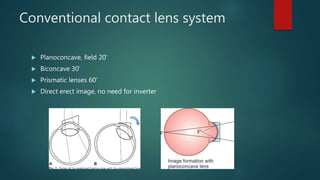
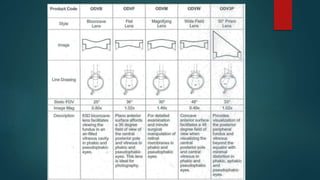
Conventional contact lens system
 Planoconcave, field 20’
 Biconcave 30’
 Prismatic lenses 60’
 Direct erect image, no need for inverter
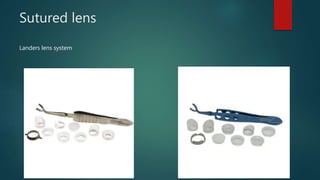
Sutured lens
Landers lens system
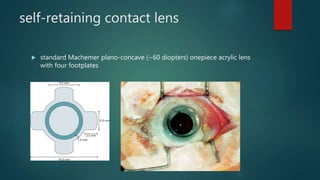
self-retaining contact lens
 standard Machemer plano-concave (−60 diopters) onepiece acrylic lens
with four footplates
Wide angle viewing systems
 based on the principle of binocular indirect ophthalmomicroscopy
 contact and noncontact mode
Non contact viewing Contact viewing
Advantages
• assistant is not required
• no intraoperative corneal trauma
• provides a good view during air-fluid
exchange and in patients with steep corneas
and small pupils
Advantages
• image resolution and stereopsis are superior
• field of view is also wider
Disadvantages
• Poor view in patients with corneal trauma
• Need an assistant
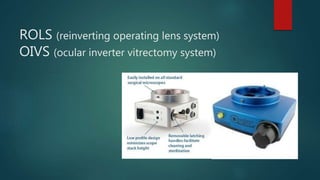
ROLS (reinverting operating lens system)
OIVS (ocular inverter vitrectomy system)
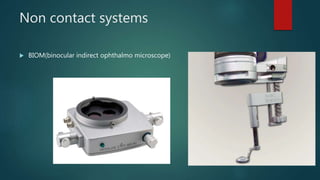
Non contact systems
 BIOM(binocular indirect ophthalmo microscope)
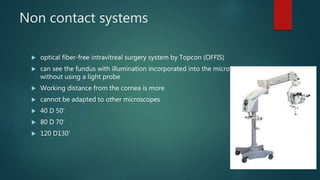
Non contact systems
 optical fiber-free intravitreal surgery system by Topcon (OFFIS)
 can see the fundus with illumination incorporated into the microscope
without using a light probe
 Working distance from the cornea is more
 cannot be adapted to other microscopes
 40 D 50’
 80 D 70’
 120 D130’
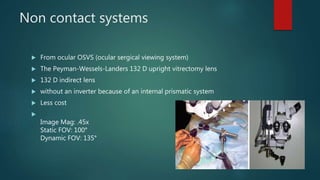
Non contact systems
 From ocular OSVS (ocular sergical viewing system)
 The Peyman-Wessels-Landers 132 D upright vitrectomy lens
 132 D indirect lens
 without an inverter because of an internal prismatic system
 Less cost

Image Mag: .45x
Static FOV: 100°
Dynamic FOV: 135°
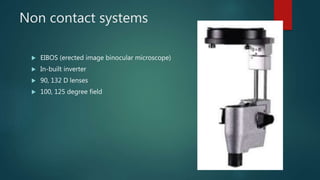
Non contact systems
 EIBOS (erected image binocular microscope)
 In-built inverter
 90, 132 D lenses
 100, 125 degree field
Non contact systems
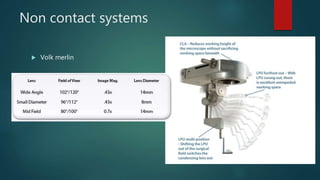
 Volk merlin
Non contact systems
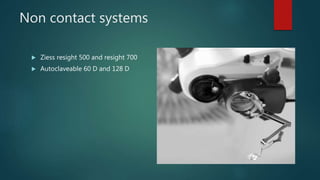
 Ziess resight 500 and resight 700
 Autoclaveable 60 D and 128 D
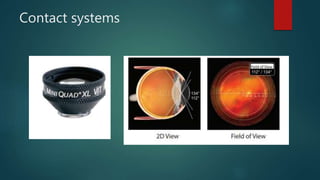
Contact Systems
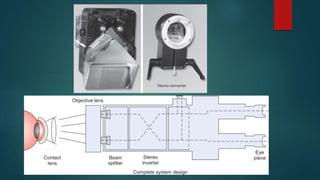
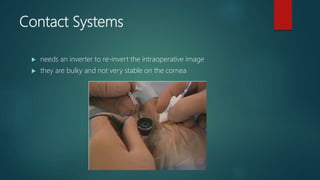
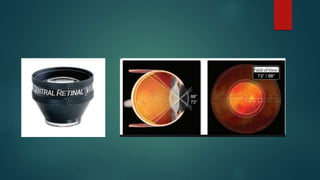
 needs an inverter to re-invert the intraoperative image
 they are bulky and not very stable on the cornea
Contact systems
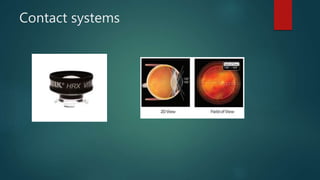
Contact systems
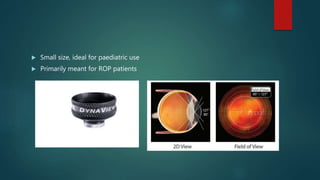
 Small size, ideal for paediatric use
 Primarily meant for ROP patients
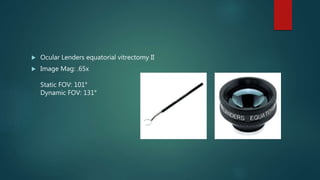
 Ocular Lenders equatorial vitrectomy II
 Image Mag: .65x
Static FOV: 101°
Dynamic FOV: 131°
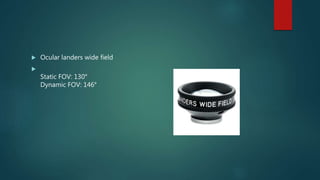
 Ocular landers wide field

Static FOV: 130°
Dynamic FOV: 146°
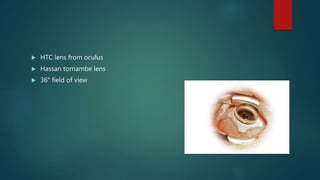
 HTC lens from oculus
 Hassan tornambe lens
 36° field of view
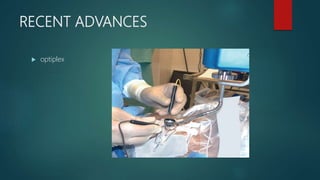
RECENT ADVANCES
 optiplex
THANK YOU

viewing systems in vitrectomy

  • 2.
    Viewing systems in VRsurgery DR ABHISHEK GHELANI MS SHANTI SAROJ NETRALAY
  • 3.
    Conventional contact lenssystem  Planoconcave, field 20’  Biconcave 30’  Prismatic lenses 60’  Direct erect image, no need for inverter
  • 4.
  • 6.
    self-retaining contact lens standard Machemer plano-concave (−60 diopters) onepiece acrylic lens with four footplates
  • 7.
    Wide angle viewingsystems  based on the principle of binocular indirect ophthalmomicroscopy  contact and noncontact mode Non contact viewing Contact viewing Advantages • assistant is not required • no intraoperative corneal trauma • provides a good view during air-fluid exchange and in patients with steep corneas and small pupils Advantages • image resolution and stereopsis are superior • field of view is also wider Disadvantages • Poor view in patients with corneal trauma • Need an assistant
  • 9.
    ROLS (reinverting operatinglens system) OIVS (ocular inverter vitrectomy system)
  • 10.
    Non contact systems BIOM(binocular indirect ophthalmo microscope)
  • 12.
    Non contact systems optical fiber-free intravitreal surgery system by Topcon (OFFIS)  can see the fundus with illumination incorporated into the microscope without using a light probe  Working distance from the cornea is more  cannot be adapted to other microscopes  40 D 50’  80 D 70’  120 D130’
  • 13.
    Non contact systems From ocular OSVS (ocular sergical viewing system)  The Peyman-Wessels-Landers 132 D upright vitrectomy lens  132 D indirect lens  without an inverter because of an internal prismatic system  Less cost  Image Mag: .45x Static FOV: 100° Dynamic FOV: 135°
  • 14.
    Non contact systems EIBOS (erected image binocular microscope)  In-built inverter  90, 132 D lenses  100, 125 degree field
  • 15.
  • 16.
    Non contact systems Ziess resight 500 and resight 700  Autoclaveable 60 D and 128 D
  • 17.
    Contact Systems  needsan inverter to re-invert the intraoperative image  they are bulky and not very stable on the cornea
  • 18.
  • 19.
  • 20.
     Small size,ideal for paediatric use  Primarily meant for ROP patients
  • 22.
     Ocular Lendersequatorial vitrectomy II  Image Mag: .65x Static FOV: 101° Dynamic FOV: 131°
  • 23.
     Ocular landerswide field  Static FOV: 130° Dynamic FOV: 146°
  • 24.
     HTC lensfrom oculus  Hassan tornambe lens  36° field of view
  • 25.
  • 26.