Cell Division
Binary Fission, Mitosis & Meiosis
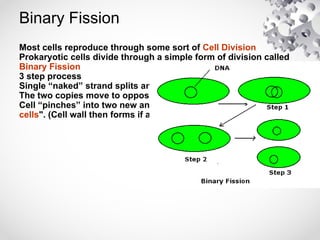
Binary Fission
Most cells reproduce through some sort of Cell Division
Prokaryotic cells divide through a simple form of division called
Binary Fission
3 step process
Single “naked” strand splits and forms a duplicate of itself.
The two copies move to opposite sides of the cell
Cell “pinches” into two new and identical cells called "daughter
cells". (Cell wall then forms if applicable)
Mitosis
• Eukaryotes divide by a more complicated system called Mitosis
• This is because:
1. They have a nucleus which must be broken up and then
reformed
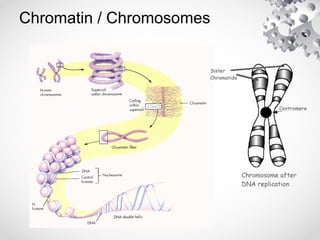
2. They have their DNA “packaged” in the form of Chromosomes
3. Chromosomes are composed of Chromatin
1. Made of DNA Strands & Proteins
4. Also contain Nucleosomes containing Histones - Proteins the
DNA is wrapped around Name for the DNA/Protein complex is
Chromatin
5. They usually have more than 1 chromosome (Humans have 23
pairs)
6. They have numerous organelles to equally share
Chromatin / Chromosomes
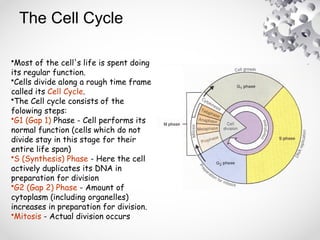
The Cell Cycle
•Most of the cell's life is spent doing
its regular function.
•Cells divide along a rough time frame
called its Cell Cycle.
•The Cell cycle consists of the
folowing steps:
•G1 (Gap 1) Phase - Cell performs its
normal function (cells which do not
divide stay in this stage for their
entire life span)
•S (Synthesis) Phase - Here the cell
actively duplicates its DNA in
preparation for division
•G2 (Gap 2) Phase - Amount of
cytoplasm (including organelles)
increases in preparation for division.
•Mitosis - Actual division occurs
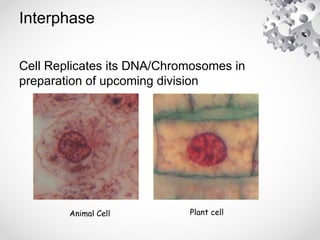
Interphase
Cell Replicates its DNA/Chromosomes in
preparation of upcoming division
Animal Cell Plant cell
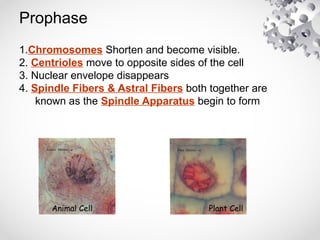
Prophase
1.Chromosomes Shorten and become visible.
2. Centrioles move to opposite sides of the cell
3. Nuclear envelope disappears
4. Spindle Fibers & Astral Fibers both together are
known as the Spindle Apparatus begin to form
Animal Cell Plant Cell
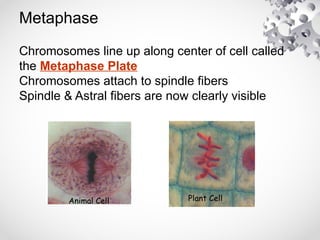
Metaphase
Chromosomes line up along center of cell called
the Metaphase Plate
Chromosomes attach to spindle fibers
Spindle & Astral fibers are now clearly visible
Animal Cell Plant Cell
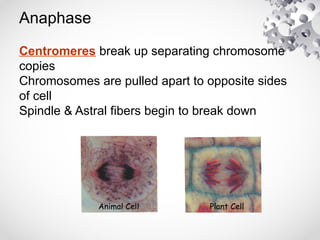
Anaphase
Centromeres break up separating chromosome
copies
Chromosomes are pulled apart to opposite sides
of cell
Spindle & Astral fibers begin to break down
Animal Cell Plant Cell
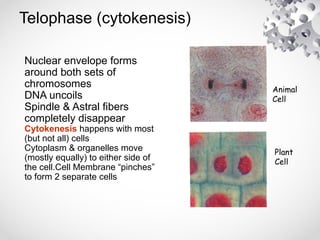
Telophase (cytokenesis)
Nuclear envelope forms
around both sets of
chromosomes
DNA uncoils
Spindle & Astral fibers
completely disappear
Cytokenesis happens with most
(but not all) cells
Cytoplasm & organelles move
(mostly equally) to either side of
the cell.Cell Membrane “pinches”
to form 2 separate cells
Animal
Cell
Plant
Cell
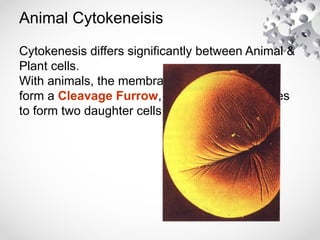
Animal Cytokeneisis
Cytokenesis differs significantly between Animal &
Plant cells.
With animals, the membranes pinch together to
form a Cleavage Furrow, which eventually fuses
to form two daughter cells
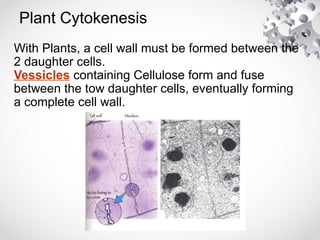
Plant Cytokenesis
With Plants, a cell wall must be formed between the
2 daughter cells.
Vessicles containing Cellulose form and fuse
between the tow daughter cells, eventually forming
a complete cell wall.
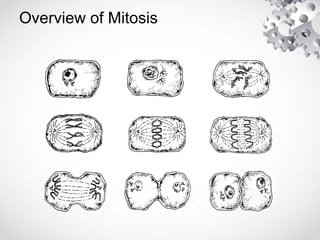
Overview of Mitosis
Meiosis
• Similar in many ways to mitosis
• Several differences
• Involves 2 cell divisions
• Results in 4 cells with 1/2 the normal
genetic information
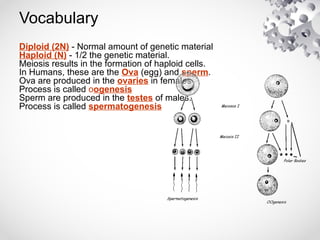
Vocabulary
Diploid (2N) - Normal amount of genetic material
Haploid (N) - 1/2 the genetic material.
Meiosis results in the formation of haploid cells.
In Humans, these are the Ova (egg) and sperm.
Ova are produced in the ovaries in females
Process is called oogenesis
Sperm are produced in the testes of males.
Process is called spermatogenesis
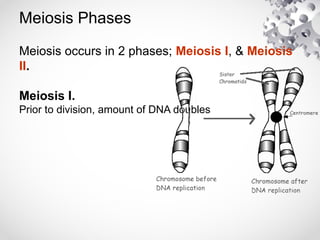
Meiosis Phases
Meiosis occurs in 2 phases; Meiosis I, & Meiosis
II.
Meiosis I.
Prior to division, amount of DNA doubles
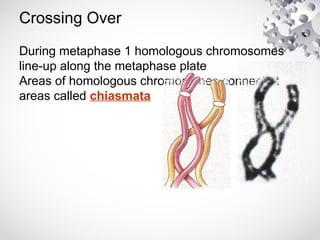
Crossing Over
During metaphase 1 homologous chromosomes
line-up along the metaphase plate
Areas of homologous chromosomes connect at
areas called chiasmata
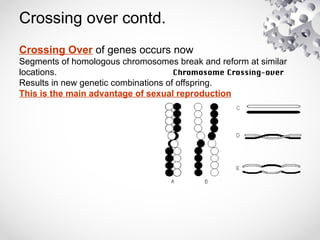
Crossing over contd.
Crossing Over of genes occurs now
Segments of homologous chromosomes break and reform at similar
locations.
Results in new genetic combinations of offspring.
This is the main advantage of sexual reproduction
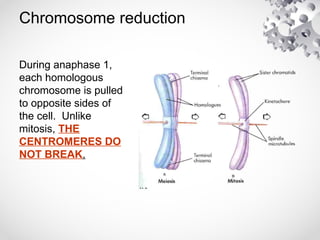
Chromosome reduction
During anaphase 1,
each homologous
chromosome is pulled
to opposite sides of
the cell. Unlike
mitosis, THE
CENTROMERES DO
NOT BREAK.
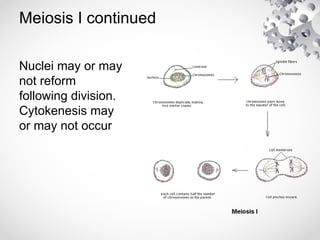
Meiosis I continued
Nuclei may or may
not reform
following division.
Cytokenesis may
or may not occur
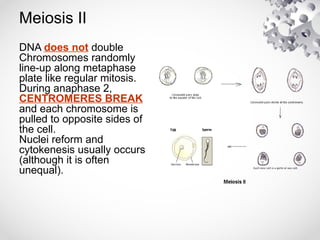
Meiosis II
DNA does not double
Chromosomes randomly
line-up along metaphase
plate like regular mitosis.
During anaphase 2,
CENTROMERES BREAK
and each chromosome is
pulled to opposite sides of
the cell.
Nuclei reform and
cytokenesis usually occurs
(although it is often
unequal).
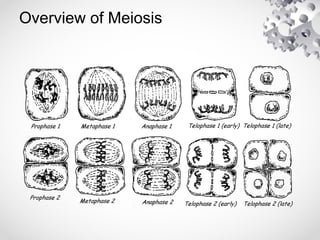
Overview of Meiosis
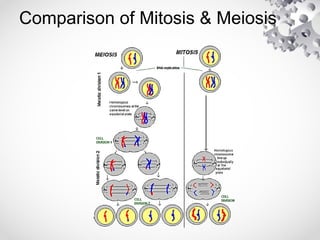
Comparison of Mitosis & Meiosis

CELL DVS by shuvendu................pptx

  • 1.
  • 2.
    Binary Fission Most cellsreproduce through some sort of Cell Division Prokaryotic cells divide through a simple form of division called Binary Fission 3 step process Single “naked” strand splits and forms a duplicate of itself. The two copies move to opposite sides of the cell Cell “pinches” into two new and identical cells called "daughter cells". (Cell wall then forms if applicable)
  • 3.
    Mitosis • Eukaryotes divideby a more complicated system called Mitosis • This is because: 1. They have a nucleus which must be broken up and then reformed 2. They have their DNA “packaged” in the form of Chromosomes 3. Chromosomes are composed of Chromatin 1. Made of DNA Strands & Proteins 4. Also contain Nucleosomes containing Histones - Proteins the DNA is wrapped around Name for the DNA/Protein complex is Chromatin 5. They usually have more than 1 chromosome (Humans have 23 pairs) 6. They have numerous organelles to equally share
  • 4.
  • 5.
    The Cell Cycle •Mostof the cell's life is spent doing its regular function. •Cells divide along a rough time frame called its Cell Cycle. •The Cell cycle consists of the folowing steps: •G1 (Gap 1) Phase - Cell performs its normal function (cells which do not divide stay in this stage for their entire life span) •S (Synthesis) Phase - Here the cell actively duplicates its DNA in preparation for division •G2 (Gap 2) Phase - Amount of cytoplasm (including organelles) increases in preparation for division. •Mitosis - Actual division occurs
  • 6.
    Interphase Cell Replicates itsDNA/Chromosomes in preparation of upcoming division Animal Cell Plant cell
  • 7.
    Prophase 1.Chromosomes Shorten andbecome visible. 2. Centrioles move to opposite sides of the cell 3. Nuclear envelope disappears 4. Spindle Fibers & Astral Fibers both together are known as the Spindle Apparatus begin to form Animal Cell Plant Cell
  • 8.
    Metaphase Chromosomes line upalong center of cell called the Metaphase Plate Chromosomes attach to spindle fibers Spindle & Astral fibers are now clearly visible Animal Cell Plant Cell
  • 9.
    Anaphase Centromeres break upseparating chromosome copies Chromosomes are pulled apart to opposite sides of cell Spindle & Astral fibers begin to break down Animal Cell Plant Cell
  • 10.
    Telophase (cytokenesis) Nuclear envelopeforms around both sets of chromosomes DNA uncoils Spindle & Astral fibers completely disappear Cytokenesis happens with most (but not all) cells Cytoplasm & organelles move (mostly equally) to either side of the cell.Cell Membrane “pinches” to form 2 separate cells Animal Cell Plant Cell
  • 11.
    Animal Cytokeneisis Cytokenesis differssignificantly between Animal & Plant cells. With animals, the membranes pinch together to form a Cleavage Furrow, which eventually fuses to form two daughter cells
  • 12.
    Plant Cytokenesis With Plants,a cell wall must be formed between the 2 daughter cells. Vessicles containing Cellulose form and fuse between the tow daughter cells, eventually forming a complete cell wall.
  • 13.
  • 14.
    Meiosis • Similar inmany ways to mitosis • Several differences • Involves 2 cell divisions • Results in 4 cells with 1/2 the normal genetic information
  • 15.
    Vocabulary Diploid (2N) -Normal amount of genetic material Haploid (N) - 1/2 the genetic material. Meiosis results in the formation of haploid cells. In Humans, these are the Ova (egg) and sperm. Ova are produced in the ovaries in females Process is called oogenesis Sperm are produced in the testes of males. Process is called spermatogenesis
  • 16.
    Meiosis Phases Meiosis occursin 2 phases; Meiosis I, & Meiosis II. Meiosis I. Prior to division, amount of DNA doubles
  • 17.
    Crossing Over During metaphase1 homologous chromosomes line-up along the metaphase plate Areas of homologous chromosomes connect at areas called chiasmata
  • 18.
    Crossing over contd. CrossingOver of genes occurs now Segments of homologous chromosomes break and reform at similar locations. Results in new genetic combinations of offspring. This is the main advantage of sexual reproduction
  • 19.
    Chromosome reduction During anaphase1, each homologous chromosome is pulled to opposite sides of the cell. Unlike mitosis, THE CENTROMERES DO NOT BREAK.
  • 20.
    Meiosis I continued Nucleimay or may not reform following division. Cytokenesis may or may not occur
  • 21.
    Meiosis II DNA doesnot double Chromosomes randomly line-up along metaphase plate like regular mitosis. During anaphase 2, CENTROMERES BREAK and each chromosome is pulled to opposite sides of the cell. Nuclei reform and cytokenesis usually occurs (although it is often unequal).
  • 22.
  • 23.