MISSILE
CLASSIFICATION
DINESH BABU.V -AP/AERO-NIET
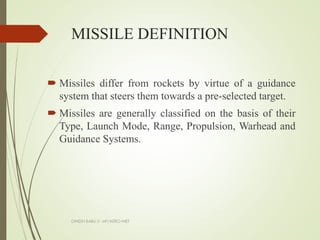
MISSILE DEFINITION
 Missiles differ from rockets by virtue of a guidance
system that steers them towards a pre-selected target.
 Missiles are generally classified on the basis of their
Type, Launch Mode, Range, Propulsion, Warhead and
Guidance Systems.
DINESH BABU.V -AP/AERO-NIET
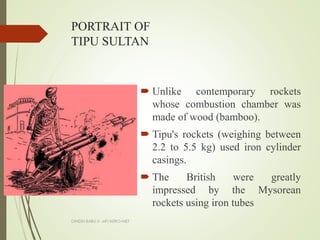
PORTRAIT OF
TIPU SULTAN
 Unlike contemporary rockets
whose combustion chamber was
made of wood (bamboo).
 Tipu's rockets (weighing between
2.2 to 5.5 kg) used iron cylinder
casings.
 The British were greatly
impressed by the Mysorean
rockets using iron tubes
DINESH BABU.V -AP/AERO-NIET
Classification of Missile
Type:
Cruise Missile
Ballistic Missile
Range:
Short Range Missile
Medium Range Missile
Intermediate Range
Ballistic Missile
Intercontinental
Ballistic Missile
Launch Mode:
Surface-to-Surface Missile
Surface-to-Air Missile
Surface (Coast)-to-Sea Missile
Air-to-Air Missile
Air-to-Surface Missile
Sea-to-Sea Missile
Sea-to-Surface (Coast) Missile
Anti-Tank Missile
DINESH BABU.V -AP/AERO-NIET
Classification of Missile
Propulsion:
Solid Propulsion
Liquid
Propulsion
Hybrid
Propulsion
Ramjet
Scramjet
Cryogenic
Warhead:
Conventional
Strategic
Guidance Systems:
Wire Guidance
Command Guidance
Terrain Comparison Guidance
Terrestrial Guidance
Inertial Guidance
Beam Rider Guidance
Laser Guidance
RF and GPS Reference
DINESH BABU.V -AP/AERO-NIET
ON THE BASIS OF TYPE
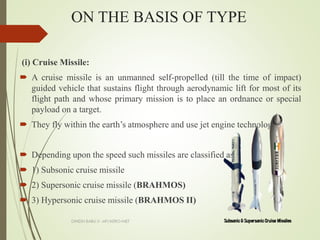
(i) Cruise Missile:
 A cruise missile is an unmanned self-propelled (till the time of impact)
guided vehicle that sustains flight through aerodynamic lift for most of its
flight path and whose primary mission is to place an ordnance or special
payload on a target.
 They fly within the earth’s atmosphere and use jet engine technology
 Depending upon the speed such missiles are classified as:
 1) Subsonic cruise missile
 2) Supersonic cruise missile (BRAHMOS)
 3) Hypersonic cruise missile (BRAHMOS II)
DINESH BABU.V -AP/AERO-NIET
BASED ON MISSILE TYPE
(ii) Ballistic Missile:
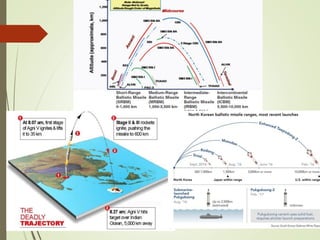
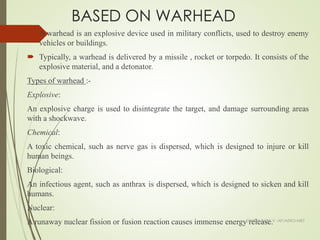
 A ballistic missile is a missile that has a
ballistic trajectory over most of its flight
path, regardless of whether or not it is a
weapon-delivery vehicle.
 . The missile carry a huge payload. The
carriage of a deadly warhead is justified
by the distance the missile travels.
Ballistic missiles can be launched from
ships and land based facilities.
 example, Prithvi I, Prithvi II, Agni I, Agni
II and Dhanush ballistic missiles are
currently operational in the Indian
defence forces.
DINESH BABU.V -AP/AERO-NIET
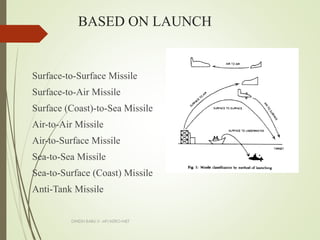
BASED ON LAUNCH
Surface-to-Surface Missile
Surface-to-Air Missile
Surface (Coast)-to-Sea Missile
Air-to-Air Missile
Air-to-Surface Missile
Sea-to-Sea Missile
Sea-to-Surface (Coast) Missile
Anti-Tank Missile
DINESH BABU.V -AP/AERO-NIET
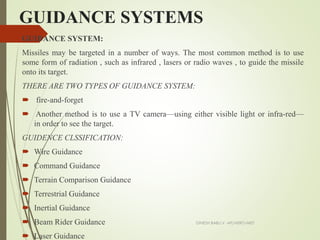
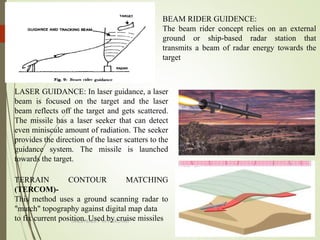
BASED ON RANGE
• Short Range Missile
• Medium Range Missile
• Intermediate Range Ballistic
Missile
• Intercontinental Ballistic Missile
DINESH BABU.V -AP/AERO-NIET
BASED ON WARHEAD
 A warhead is an explosive device used in military conflicts, used to destroy enemy
vehicles or buildings.
 Typically, a warhead is delivered by a missile , rocket or torpedo. It consists of the
explosive material, and a detonator.
Types of warhead :-
Explosive:
An explosive charge is used to disintegrate the target, and damage surrounding areas
with a shockwave.
Chemical:
A toxic chemical, such as nerve gas is dispersed, which is designed to injure or kill
human beings.
Biological:
An infectious agent, such as anthrax is dispersed, which is designed to sicken and kill
humans.
Nuclear:
A runaway nuclear fission or fusion reaction causes immense energy release.DINESH BABU.V -AP/AERO-NIET
GUIDANCE SYSTEMS
GUIDANCE SYSTEM:
Missiles may be targeted in a number of ways. The most common method is to use
some form of radiation , such as infrared , lasers or radio waves , to guide the missile
onto its target.
THERE ARE TWO TYPES OF GUIDANCE SYSTEM:
 fire-and-forget
 Another method is to use a TV camera—using either visible light or infra-red—
in order to see the target.
GUIDENCE CLSSIFICATION:
 Wire Guidance
 Command Guidance
 Terrain Comparison Guidance
 Terrestrial Guidance
 Inertial Guidance
 Beam Rider Guidance
 Laser Guidance
DINESH BABU.V -AP/AERO-NIET
BEAM RIDER GUIDENCE:
The beam rider concept relies on an external
ground or ship-based radar station that
transmits a beam of radar energy towards the
target
LASER GUIDANCE: In laser guidance, a laser
beam is focused on the target and the laser
beam reflects off the target and gets scattered.
The missile has a laser seeker that can detect
even miniscule amount of radiation. The seeker
provides the direction of the laser scatters to the
guidance system. The missile is launched
towards the target.
TERRAIN CONTOUR MATCHING
(TERCOM)-
This method uses a ground scanning radar to
"match" topography against digital map data
to fix current position. Used by cruise missiles
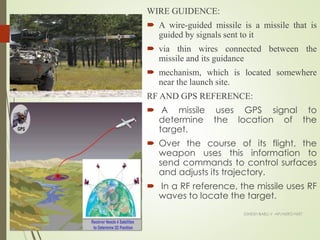
WIRE GUIDENCE:
 A wire-guided missile is a missile that is
guided by signals sent to it
 via thin wires connected between the
missile and its guidance
 mechanism, which is located somewhere
near the launch site.
RF AND GPS REFERENCE:
 A missile uses GPS signal to
determine the location of the
target.
 Over the course of its flight, the
weapon uses this information to
send commands to control surfaces
and adjusts its trajectory.
 In a RF reference, the missile uses RF
waves to locate the target.
DINESH BABU.V -AP/AERO-NIET
BASED ON PROPULSION
Solid Propulsion
Liquid Propulsion
Hybrid Propulsion
Ramjet
Scramjet
Cryogenic
DINESH BABU.V -AP/AERO-NIET

Missile classification

  • 1.
  • 2.
    MISSILE DEFINITION  Missilesdiffer from rockets by virtue of a guidance system that steers them towards a pre-selected target.  Missiles are generally classified on the basis of their Type, Launch Mode, Range, Propulsion, Warhead and Guidance Systems. DINESH BABU.V -AP/AERO-NIET
  • 3.
    PORTRAIT OF TIPU SULTAN Unlike contemporary rockets whose combustion chamber was made of wood (bamboo).  Tipu's rockets (weighing between 2.2 to 5.5 kg) used iron cylinder casings.  The British were greatly impressed by the Mysorean rockets using iron tubes DINESH BABU.V -AP/AERO-NIET
  • 4.
    Classification of Missile Type: CruiseMissile Ballistic Missile Range: Short Range Missile Medium Range Missile Intermediate Range Ballistic Missile Intercontinental Ballistic Missile Launch Mode: Surface-to-Surface Missile Surface-to-Air Missile Surface (Coast)-to-Sea Missile Air-to-Air Missile Air-to-Surface Missile Sea-to-Sea Missile Sea-to-Surface (Coast) Missile Anti-Tank Missile DINESH BABU.V -AP/AERO-NIET
  • 5.
    Classification of Missile Propulsion: SolidPropulsion Liquid Propulsion Hybrid Propulsion Ramjet Scramjet Cryogenic Warhead: Conventional Strategic Guidance Systems: Wire Guidance Command Guidance Terrain Comparison Guidance Terrestrial Guidance Inertial Guidance Beam Rider Guidance Laser Guidance RF and GPS Reference DINESH BABU.V -AP/AERO-NIET
  • 6.
  • 7.
    ON THE BASISOF TYPE (i) Cruise Missile:  A cruise missile is an unmanned self-propelled (till the time of impact) guided vehicle that sustains flight through aerodynamic lift for most of its flight path and whose primary mission is to place an ordnance or special payload on a target.  They fly within the earth’s atmosphere and use jet engine technology  Depending upon the speed such missiles are classified as:  1) Subsonic cruise missile  2) Supersonic cruise missile (BRAHMOS)  3) Hypersonic cruise missile (BRAHMOS II) DINESH BABU.V -AP/AERO-NIET
  • 8.
    BASED ON MISSILETYPE (ii) Ballistic Missile:  A ballistic missile is a missile that has a ballistic trajectory over most of its flight path, regardless of whether or not it is a weapon-delivery vehicle.  . The missile carry a huge payload. The carriage of a deadly warhead is justified by the distance the missile travels. Ballistic missiles can be launched from ships and land based facilities.  example, Prithvi I, Prithvi II, Agni I, Agni II and Dhanush ballistic missiles are currently operational in the Indian defence forces. DINESH BABU.V -AP/AERO-NIET
  • 9.
    BASED ON LAUNCH Surface-to-SurfaceMissile Surface-to-Air Missile Surface (Coast)-to-Sea Missile Air-to-Air Missile Air-to-Surface Missile Sea-to-Sea Missile Sea-to-Surface (Coast) Missile Anti-Tank Missile DINESH BABU.V -AP/AERO-NIET
  • 10.
    BASED ON RANGE •Short Range Missile • Medium Range Missile • Intermediate Range Ballistic Missile • Intercontinental Ballistic Missile DINESH BABU.V -AP/AERO-NIET
  • 11.
  • 12.
    BASED ON WARHEAD A warhead is an explosive device used in military conflicts, used to destroy enemy vehicles or buildings.  Typically, a warhead is delivered by a missile , rocket or torpedo. It consists of the explosive material, and a detonator. Types of warhead :- Explosive: An explosive charge is used to disintegrate the target, and damage surrounding areas with a shockwave. Chemical: A toxic chemical, such as nerve gas is dispersed, which is designed to injure or kill human beings. Biological: An infectious agent, such as anthrax is dispersed, which is designed to sicken and kill humans. Nuclear: A runaway nuclear fission or fusion reaction causes immense energy release.DINESH BABU.V -AP/AERO-NIET
  • 13.
    GUIDANCE SYSTEMS GUIDANCE SYSTEM: Missilesmay be targeted in a number of ways. The most common method is to use some form of radiation , such as infrared , lasers or radio waves , to guide the missile onto its target. THERE ARE TWO TYPES OF GUIDANCE SYSTEM:  fire-and-forget  Another method is to use a TV camera—using either visible light or infra-red— in order to see the target. GUIDENCE CLSSIFICATION:  Wire Guidance  Command Guidance  Terrain Comparison Guidance  Terrestrial Guidance  Inertial Guidance  Beam Rider Guidance  Laser Guidance DINESH BABU.V -AP/AERO-NIET
  • 14.
    DINESH BABU.V -AP/AERO-NIET BEAMRIDER GUIDENCE: The beam rider concept relies on an external ground or ship-based radar station that transmits a beam of radar energy towards the target LASER GUIDANCE: In laser guidance, a laser beam is focused on the target and the laser beam reflects off the target and gets scattered. The missile has a laser seeker that can detect even miniscule amount of radiation. The seeker provides the direction of the laser scatters to the guidance system. The missile is launched towards the target. TERRAIN CONTOUR MATCHING (TERCOM)- This method uses a ground scanning radar to "match" topography against digital map data to fix current position. Used by cruise missiles
  • 15.
    WIRE GUIDENCE:  Awire-guided missile is a missile that is guided by signals sent to it  via thin wires connected between the missile and its guidance  mechanism, which is located somewhere near the launch site. RF AND GPS REFERENCE:  A missile uses GPS signal to determine the location of the target.  Over the course of its flight, the weapon uses this information to send commands to control surfaces and adjusts its trajectory.  In a RF reference, the missile uses RF waves to locate the target. DINESH BABU.V -AP/AERO-NIET
  • 16.
    BASED ON PROPULSION SolidPropulsion Liquid Propulsion Hybrid Propulsion Ramjet Scramjet Cryogenic DINESH BABU.V -AP/AERO-NIET