done by
dutta
1041110404
E.C.E-G
INDUSTRIAL TRAINING ON
STUDY ON VARIOUS MISSILE
TECHNOLOGIES AND ITS
APPLICATIONS AND MISSILE
CONTROL SYSTEMS
DONE AT DEFENSE RESEARCH AND DEVELOPMENT
ORGANISATION (DRDO),DNEC,RCI ,HYDERABAD
About Defence Research Development Organization(DRDO)
 The Defence Research and Development Organisation (DRDO) is an agency of the Republic
of India responsible for the development of technology for use by the military headquartered
in New Delhi India. It was formed in 1958 by the merger of the Technical Development
Establishment and the Directorate of Technical Development and Production with the Defence
Science Organisation
 DRDO has a network of 52 laboratories which are engaged in developing defence technologies
covering various fields, like aeronautics, armaments, electronic and computer sciences, human
resource development, life sciences, materials, missiles, combat vehicles development and
naval research and development. The organization includes more than 5,000 scientists and
about 25,000 other scientific, technical and supporting personnel.
 DRDO was formed in 1958 from the amalgamation of the then already functioning
Technical Development Establishment (TDEs) of the Indian Army and the
Directorate of Technical Development & Production (DTDP) with the Defence
Science Organisation (DSO). DRDO was then a small organisation with 10
establishments or laboratories. Over the years, it has grown multi-directionally in
terms of the variety of subject disciplines, number of laboratories, achievements and
stature.
 Basic knowledge about missiles
 Types of missiles
 Popular missiles developed by DRDO
 Missile control systems
 Latest missile technologies
 Conclusion
CONTENTS
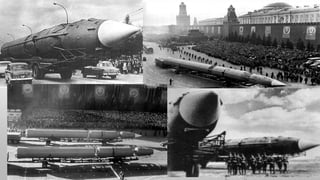
INTRODUCTION –
 In order to maintain peace in any nation politics is not enough, in excess to this we want some offensive
as well as defensive weapons which will help us at the time of terrorists attack ,one such weapon is
missle .
 The word missile comes from the Latin verb mittere, meaning “to send”.
 Missile is defined as an object or weapon that is fired, thrown, dropped, or otherwise projected at a target
or missile
is also defined as self- propelled projectile used as weapon.
 Missiles are typically propelled by rockets or jet engines.
ABOUT MISSILE
SYSTEM COMPONENTS OF MISSILE
Targeting and/or guidance system
Flight system
Engine
Warhead
Targeting and/or guidance-Missiles may be targeted in a number of ways. The most
common method is to use some form of radiation such as infrared, lasers or radio waves to
guide the missile onto its target. This radiation may emanate from the target (such as the
heat of an engine or the radio waves from an enemy radar), it may be provided by the
missile itself (such as a radar) or it may be provided by a friendly third party
Flight system-Whether a guided missile uses a targeting system, a guidance system or
both, it needs a flight system. The flight system uses the data from the targeting or guidance
system to maneuver the missile in flight, allowing it to counter inaccuracies in the missile or
to follow a moving target. There are two main systems: vectored thrust (for missiles that are
powered throughout the guidance phase of their flight) and aerodynamic maneuvering
(wings, fins, canards, etc.).
Engine-Missiles are powered by an engine, generally either a type of rocket or jet engine.
Rockets are generally of the solid fuel type for ease of maintenance and fast deployment,
although some larger ballistic missiles use liquid fuel rockets. Jet engines are generally
used in cruise missiles, most commonly of the turbojet type, due to its relative simplicity and
low frontal area. Turbofans and ramjets are the only other common forms of jet engine
propulsion, although any type of engine could theoretically be used
War head-Missiles generally have one or more explosive warheads, although other
weapon types may also be used. The warhead or warheads of a missile provides its
primary destructive power (many missiles have extensive secondary destructive power due
to the high kinetic energy of the weapon and unburnt fuel that may be on board). Other
warhead types include submunitions , incendiaries, nuclear weapons ,
chemical, biological or radiological weapons or kinetic energy penetrators. Warheadless
missiles are often used for testing and training purposes
.
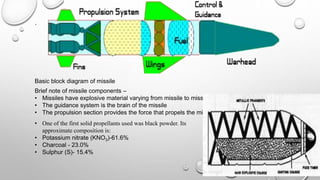
Basic block diagram of missile
Brief note of missile components –
• Missiles have explosive material varying from missile to missile
• The guidance system is the brain of the missile
• The propulsion section provides the force that propels the missile
• One of the first solid propellants used was black powder. Its
approximate composition is:
• Potassium nitrate (KNO3)-61.6%
• Charcoal - 23.0%
• Sulphur (S)- 15.4%
Types of
missiles
Surface to surface missile
• It is a missile designed to be launched from the ground to destroy
another surface or ground target.
Air to air missile
• It is a guided missile fired from an aircraft for the purpose of
destroying another aircraft.
Air to surface missile
• It is a missile that is designed to be launched from military aircraft to
strike a ground targets such as warships ,military camps and many
more.
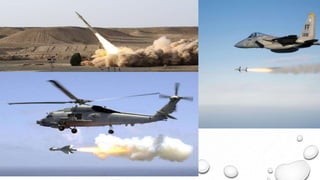
Heat-seeking Missile
Is most commonly associated with the detection of infrared radiation. All
objects with a temperature greater than absolute zero emit infrared energy,
the most common characteristic of which is heat. Detection of this heat can
be utilized for many purposes.
Military adaptations of infrared technology began during World War II. A
device called the Sniperscope was developed by the Allies, enabling the
soldiers to see and shoot at night by distinguishing the heat differentials of
the terrain. In addition to the Sniperscope and other night‐vision devices,
the potential of this technology for guidance purposes began to be realized.
An infrared detector could be added to a missile, allowing the missile to
seek out and follow the heat given off by the target. The U.S. military has
since developed a number of such missiles, beginning with the Sidewinder,
an antiaircraft missile successfully tested in 1953 and deployed in 1956.
This new missile was quickly adapted for use by the other service
branches, especially the air force. Since that time, missiles equipped with
infrared seekers, including the Sidewinder and the Maverick, have been
responsible for the destruction of aviation, maritime, and ground targets.
specifications
Weight -188 pounds (85.3 kg)
Length-9 feet 11 inches (3.02 m)
Diameter-5 in (127.0 mm)
Warhead-WDU-17/B annular blast-frag
Warhead weight-20.8 lb (9.4 kg)
Detonation mechanism-Magnetic influence (old models)
Active infrared (AIM-9L onwards)
Engine-Hercules/Bermite MK 36 Solid-fuel rocket
Wingspan 11 in (279.4 mm)
Operational range-0.6 to 22 miles (1.0 to 35.4 km)
Speed- Mach 2.5
Guidance system- Infrared homing (most models)
semi-active radar homing (AIM-9C)
Launch platform-Aircraft
How to avoid a heat seeking missile
COUNTERMEASURES
The DHS is focusing on technology derived from military aircraft: pyrotechnic
chaff that distracts missile guidance systems. Alternatively, planes can emit
fields of IR radiation. The preferred method is directional IR countermeasures,
lasers that zap inbound bogies and disrupt their tracking.
The Bad News: Fireworks-like chaff won't stop newer missiles and at 2,500
degrees could start collateral fires on the ground. The airline industry says
lasers could cost $100 billion
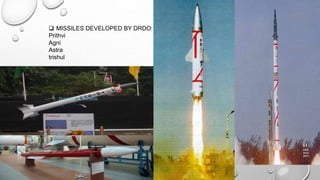
 MISSILES DEVELOPED BY DRDO:
Prithvi
Agni
Astra
trishul
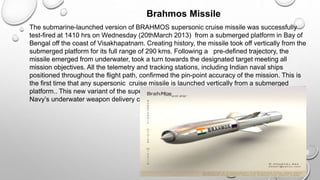
Brahmos Missile
The submarine-launched version of BRAHMOS supersonic cruise missile was successfully
test-fired at 1410 hrs on Wednesday (20thMarch 2013) from a submerged platform in Bay of
Bengal off the coast of Visakhapatnam. Creating history, the missile took off vertically from the
submerged platform for its full range of 290 kms. Following a pre-defined trajectory, the
missile emerged from underwater, took a turn towards the designated target meeting all
mission objectives. All the telemetry and tracking stations, including Indian naval ships
positioned throughout the flight path, confirmed the pin-point accuracy of the mission. This is
the first time that any supersonic cruise missile is launched vertically from a submerged
platform.. This new variant of the supersonic cruise missile will add more fire power to the
Navy’s underwater weapon delivery capabilities.
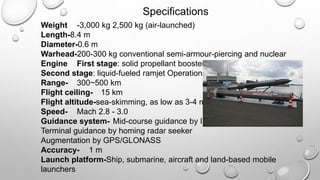
Specifications
Weight -3,000 kg 2,500 kg (air-launched)
Length-8.4 m
Diameter-0.6 m
Warhead-200-300 kg conventional semi-armour-piercing and nuclear
Engine First stage: solid propellant booster
Second stage: liquid-fueled ramjet Operational
Range- 300~500 km
Flight ceiling- 15 km
Flight altitude-sea-skimming, as low as 3-4 meters
Speed- Mach 2.8 - 3.0
Guidance system- Mid-course guidance by INS
Terminal guidance by homing radar seeker
Augmentation by GPS/GLONASS
Accuracy- 1 m
Launch platform-Ship, submarine, aircraft and land-based mobile
launchers
MISSILE CONTROL
SYSTEMS
 A missile GUIDANCE system keeps the missile on the proper flight
path from launcher to target, in accordance with signals received from
control points, from the target, or from other sources of information.
 The missile CONTROL system keeps the missile in the proper flight
attitude.
 Flight attitude stabilization is absolutely necessary if the missile is to
respond properly to guidance signals.
 For example, assume that the missile has rolled 90 degrees
clockwise from the proper attitude.
 Now, if it receives a "right turn" command from the guidance system,
operation of the control surfaces will actually turn the missile
downward, rather than to the right.
 But if the control system keeps the missile in the proper attitude,
guidance signals will be correctly interpreted, and will produce the
desired correction in the missile flight path.
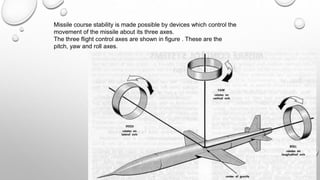
Missile course stability is made possible by devices which control the
movement of the missile about its three axes.
The three flight control axes are shown in figure . These are the
pitch, yaw and roll axes.
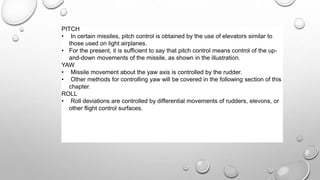
PITCH
• In certain missiles, pitch control is obtained by the use of elevators similar to
those used on light airplanes.
• For the present, it is sufficient to say that pitch control means control of the up-
and-down movements of the missile, as shown in the illustration.
YAW
• Missile movement about the yaw axis is controlled by the rudder.
• Other methods for controlling yaw will be covered in the following section of this
chapter.
ROLL
• Roll deviations are controlled by differential movements of rudders, elevons, or
other flight control surfaces.
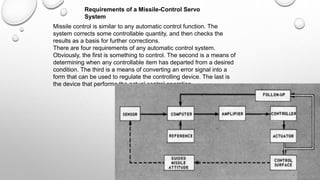
Missile control is similar to any automatic control function. The
system corrects some controllable quantity, and then checks the
results as a basis for further corrections.
There are four requirements of any automatic control system.
Obviously, the first is something to control. The second is a means of
determining when any controllable item has departed from a desired
condition. The third is a means of converting an error signal into a
form that can be used to regulate the controlling device. The last is
the device that performs the actual control operation.
Requirements of a Missile-Control Servo
System
Sensor
 In some respects, the sensor unit is the most important section
of the guidance system because it detects the form of energy
being used to guide the missile.
 If the sensor unit fails, there can be no guidance.
 The kind of sensor that is used will be determined by such
factors as maximum operating range, operating conditions, the
kind of information needed, the accuracy required, viewing
angle and weight and size of the sensor, and the type of target
and its speed.
Amplifiers
• Each of the sensor units we have discussed produces an
output; in most cases this output is a voltage. A computer is
used to compare the sensor output voltage with the
reference voltage.
• If the missile is off course, the two voltages will not be the
same. The computer will then generate an error signal, which
will be used to operate the missile control surfaces and bring
the missile back on course.
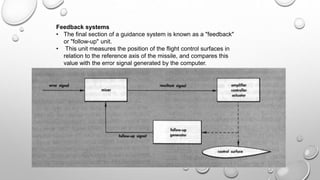
Feedback systems
• The final section of a guidance system is known as a "feedback"
or "follow-up" unit.
• This unit measures the position of the flight control surfaces in
relation to the reference axis of the missile, and compares this
value with the error signal generated by the computer.
LATEST MISSILE TECHNOLOGIES
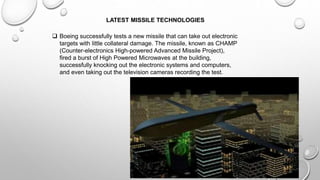
 Boeing successfully tests a new missile that can take out electronic
targets with little collateral damage. The missile, known as CHAMP
(Counter-electronics High-powered Advanced Missile Project),
fired a burst of High Powered Microwaves at the building,
successfully knocking out the electronic systems and computers,
and even taking out the television cameras recording the test.
CONCLUSION
With this I conclude my topic by saying that
missiles are harmful for happy and peaceful
life , but in todays world there is more
amount of terrorism prevailing out as well
as threat from the neighboring countries . In
these conditions if required we can use it
for the welfare of our own country men
WORKS CITED
• WWW.AUTHORSTREAM.COM
• WIKIPEDIA
• HTTP://WWW.INDIASTRATEGIC.IN/MISSILE.HTM
• HTTP://WWW.HNSA.ORG/DOC/MISSILE/INDEX.HTM

missile_tech_presentationondiffmissles.pptx

  • 1.
    done by dutta 1041110404 E.C.E-G INDUSTRIAL TRAININGON STUDY ON VARIOUS MISSILE TECHNOLOGIES AND ITS APPLICATIONS AND MISSILE CONTROL SYSTEMS DONE AT DEFENSE RESEARCH AND DEVELOPMENT ORGANISATION (DRDO),DNEC,RCI ,HYDERABAD
  • 2.
    About Defence ResearchDevelopment Organization(DRDO)  The Defence Research and Development Organisation (DRDO) is an agency of the Republic of India responsible for the development of technology for use by the military headquartered in New Delhi India. It was formed in 1958 by the merger of the Technical Development Establishment and the Directorate of Technical Development and Production with the Defence Science Organisation  DRDO has a network of 52 laboratories which are engaged in developing defence technologies covering various fields, like aeronautics, armaments, electronic and computer sciences, human resource development, life sciences, materials, missiles, combat vehicles development and naval research and development. The organization includes more than 5,000 scientists and about 25,000 other scientific, technical and supporting personnel.  DRDO was formed in 1958 from the amalgamation of the then already functioning Technical Development Establishment (TDEs) of the Indian Army and the Directorate of Technical Development & Production (DTDP) with the Defence Science Organisation (DSO). DRDO was then a small organisation with 10 establishments or laboratories. Over the years, it has grown multi-directionally in terms of the variety of subject disciplines, number of laboratories, achievements and stature.
  • 3.
     Basic knowledgeabout missiles  Types of missiles  Popular missiles developed by DRDO  Missile control systems  Latest missile technologies  Conclusion CONTENTS
  • 4.
    INTRODUCTION –  Inorder to maintain peace in any nation politics is not enough, in excess to this we want some offensive as well as defensive weapons which will help us at the time of terrorists attack ,one such weapon is missle .  The word missile comes from the Latin verb mittere, meaning “to send”.  Missile is defined as an object or weapon that is fired, thrown, dropped, or otherwise projected at a target or missile is also defined as self- propelled projectile used as weapon.  Missiles are typically propelled by rockets or jet engines.
  • 6.
    ABOUT MISSILE SYSTEM COMPONENTSOF MISSILE Targeting and/or guidance system Flight system Engine Warhead Targeting and/or guidance-Missiles may be targeted in a number of ways. The most common method is to use some form of radiation such as infrared, lasers or radio waves to guide the missile onto its target. This radiation may emanate from the target (such as the heat of an engine or the radio waves from an enemy radar), it may be provided by the missile itself (such as a radar) or it may be provided by a friendly third party
  • 7.
    Flight system-Whether aguided missile uses a targeting system, a guidance system or both, it needs a flight system. The flight system uses the data from the targeting or guidance system to maneuver the missile in flight, allowing it to counter inaccuracies in the missile or to follow a moving target. There are two main systems: vectored thrust (for missiles that are powered throughout the guidance phase of their flight) and aerodynamic maneuvering (wings, fins, canards, etc.). Engine-Missiles are powered by an engine, generally either a type of rocket or jet engine. Rockets are generally of the solid fuel type for ease of maintenance and fast deployment, although some larger ballistic missiles use liquid fuel rockets. Jet engines are generally used in cruise missiles, most commonly of the turbojet type, due to its relative simplicity and low frontal area. Turbofans and ramjets are the only other common forms of jet engine propulsion, although any type of engine could theoretically be used War head-Missiles generally have one or more explosive warheads, although other weapon types may also be used. The warhead or warheads of a missile provides its primary destructive power (many missiles have extensive secondary destructive power due to the high kinetic energy of the weapon and unburnt fuel that may be on board). Other warhead types include submunitions , incendiaries, nuclear weapons , chemical, biological or radiological weapons or kinetic energy penetrators. Warheadless missiles are often used for testing and training purposes
  • 8.
    . Basic block diagramof missile Brief note of missile components – • Missiles have explosive material varying from missile to missile • The guidance system is the brain of the missile • The propulsion section provides the force that propels the missile • One of the first solid propellants used was black powder. Its approximate composition is: • Potassium nitrate (KNO3)-61.6% • Charcoal - 23.0% • Sulphur (S)- 15.4%
  • 9.
    Types of missiles Surface tosurface missile • It is a missile designed to be launched from the ground to destroy another surface or ground target. Air to air missile • It is a guided missile fired from an aircraft for the purpose of destroying another aircraft. Air to surface missile • It is a missile that is designed to be launched from military aircraft to strike a ground targets such as warships ,military camps and many more.
  • 11.
    Heat-seeking Missile Is mostcommonly associated with the detection of infrared radiation. All objects with a temperature greater than absolute zero emit infrared energy, the most common characteristic of which is heat. Detection of this heat can be utilized for many purposes. Military adaptations of infrared technology began during World War II. A device called the Sniperscope was developed by the Allies, enabling the soldiers to see and shoot at night by distinguishing the heat differentials of the terrain. In addition to the Sniperscope and other night‐vision devices, the potential of this technology for guidance purposes began to be realized. An infrared detector could be added to a missile, allowing the missile to seek out and follow the heat given off by the target. The U.S. military has since developed a number of such missiles, beginning with the Sidewinder, an antiaircraft missile successfully tested in 1953 and deployed in 1956. This new missile was quickly adapted for use by the other service branches, especially the air force. Since that time, missiles equipped with infrared seekers, including the Sidewinder and the Maverick, have been responsible for the destruction of aviation, maritime, and ground targets.
  • 12.
    specifications Weight -188 pounds(85.3 kg) Length-9 feet 11 inches (3.02 m) Diameter-5 in (127.0 mm) Warhead-WDU-17/B annular blast-frag Warhead weight-20.8 lb (9.4 kg) Detonation mechanism-Magnetic influence (old models) Active infrared (AIM-9L onwards) Engine-Hercules/Bermite MK 36 Solid-fuel rocket Wingspan 11 in (279.4 mm) Operational range-0.6 to 22 miles (1.0 to 35.4 km) Speed- Mach 2.5 Guidance system- Infrared homing (most models) semi-active radar homing (AIM-9C) Launch platform-Aircraft
  • 13.
    How to avoida heat seeking missile COUNTERMEASURES The DHS is focusing on technology derived from military aircraft: pyrotechnic chaff that distracts missile guidance systems. Alternatively, planes can emit fields of IR radiation. The preferred method is directional IR countermeasures, lasers that zap inbound bogies and disrupt their tracking. The Bad News: Fireworks-like chaff won't stop newer missiles and at 2,500 degrees could start collateral fires on the ground. The airline industry says lasers could cost $100 billion
  • 15.
     MISSILES DEVELOPEDBY DRDO: Prithvi Agni Astra trishul
  • 16.
    Brahmos Missile The submarine-launchedversion of BRAHMOS supersonic cruise missile was successfully test-fired at 1410 hrs on Wednesday (20thMarch 2013) from a submerged platform in Bay of Bengal off the coast of Visakhapatnam. Creating history, the missile took off vertically from the submerged platform for its full range of 290 kms. Following a pre-defined trajectory, the missile emerged from underwater, took a turn towards the designated target meeting all mission objectives. All the telemetry and tracking stations, including Indian naval ships positioned throughout the flight path, confirmed the pin-point accuracy of the mission. This is the first time that any supersonic cruise missile is launched vertically from a submerged platform.. This new variant of the supersonic cruise missile will add more fire power to the Navy’s underwater weapon delivery capabilities.

  • 17.
    Specifications Weight -3,000 kg2,500 kg (air-launched) Length-8.4 m Diameter-0.6 m Warhead-200-300 kg conventional semi-armour-piercing and nuclear Engine First stage: solid propellant booster Second stage: liquid-fueled ramjet Operational Range- 300~500 km Flight ceiling- 15 km Flight altitude-sea-skimming, as low as 3-4 meters Speed- Mach 2.8 - 3.0 Guidance system- Mid-course guidance by INS Terminal guidance by homing radar seeker Augmentation by GPS/GLONASS Accuracy- 1 m Launch platform-Ship, submarine, aircraft and land-based mobile launchers
  • 18.
    MISSILE CONTROL SYSTEMS  Amissile GUIDANCE system keeps the missile on the proper flight path from launcher to target, in accordance with signals received from control points, from the target, or from other sources of information.  The missile CONTROL system keeps the missile in the proper flight attitude.  Flight attitude stabilization is absolutely necessary if the missile is to respond properly to guidance signals.  For example, assume that the missile has rolled 90 degrees clockwise from the proper attitude.  Now, if it receives a "right turn" command from the guidance system, operation of the control surfaces will actually turn the missile downward, rather than to the right.  But if the control system keeps the missile in the proper attitude, guidance signals will be correctly interpreted, and will produce the desired correction in the missile flight path.
  • 19.
    Missile course stabilityis made possible by devices which control the movement of the missile about its three axes. The three flight control axes are shown in figure . These are the pitch, yaw and roll axes.
  • 20.
    PITCH • In certainmissiles, pitch control is obtained by the use of elevators similar to those used on light airplanes. • For the present, it is sufficient to say that pitch control means control of the up- and-down movements of the missile, as shown in the illustration. YAW • Missile movement about the yaw axis is controlled by the rudder. • Other methods for controlling yaw will be covered in the following section of this chapter. ROLL • Roll deviations are controlled by differential movements of rudders, elevons, or other flight control surfaces.
  • 21.
    Missile control issimilar to any automatic control function. The system corrects some controllable quantity, and then checks the results as a basis for further corrections. There are four requirements of any automatic control system. Obviously, the first is something to control. The second is a means of determining when any controllable item has departed from a desired condition. The third is a means of converting an error signal into a form that can be used to regulate the controlling device. The last is the device that performs the actual control operation. Requirements of a Missile-Control Servo System
  • 22.
    Sensor  In somerespects, the sensor unit is the most important section of the guidance system because it detects the form of energy being used to guide the missile.  If the sensor unit fails, there can be no guidance.  The kind of sensor that is used will be determined by such factors as maximum operating range, operating conditions, the kind of information needed, the accuracy required, viewing angle and weight and size of the sensor, and the type of target and its speed. Amplifiers • Each of the sensor units we have discussed produces an output; in most cases this output is a voltage. A computer is used to compare the sensor output voltage with the reference voltage. • If the missile is off course, the two voltages will not be the same. The computer will then generate an error signal, which will be used to operate the missile control surfaces and bring the missile back on course.
  • 23.
    Feedback systems • Thefinal section of a guidance system is known as a "feedback" or "follow-up" unit. • This unit measures the position of the flight control surfaces in relation to the reference axis of the missile, and compares this value with the error signal generated by the computer.
  • 24.
    LATEST MISSILE TECHNOLOGIES Boeing successfully tests a new missile that can take out electronic targets with little collateral damage. The missile, known as CHAMP (Counter-electronics High-powered Advanced Missile Project), fired a burst of High Powered Microwaves at the building, successfully knocking out the electronic systems and computers, and even taking out the television cameras recording the test.
  • 26.
    CONCLUSION With this Iconclude my topic by saying that missiles are harmful for happy and peaceful life , but in todays world there is more amount of terrorism prevailing out as well as threat from the neighboring countries . In these conditions if required we can use it for the welfare of our own country men
  • 27.
    WORKS CITED • WWW.AUTHORSTREAM.COM •WIKIPEDIA • HTTP://WWW.INDIASTRATEGIC.IN/MISSILE.HTM • HTTP://WWW.HNSA.ORG/DOC/MISSILE/INDEX.HTM