GUIDED MISSILE
SUBMITTED BY :
KANHAIYA KUMAR
5TH SEM MECHANICAL BRANCH
IT- GURU GHASIDAS UNIVERSITY,
BILASPUR, (C.G)
CONTENT
1. INTRODUCTION
2. HISTORY OF MISSILE
3. CLASSIFICATION OF MISSILE
4. GUIDANCE SYSTEM AND CONTROL
5. TYPES OF ENGINES
6. WARHEADS AND FUZES
7. CONCLUSION
INTRODUCTION
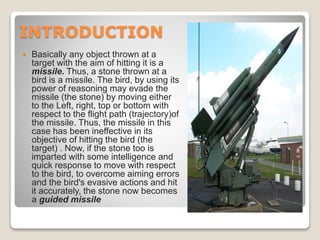
 Basically any object thrown at a
target with the aim of hitting it is a
missile. Thus, a stone thrown at a
bird is a missile. The bird, by using its
power of reasoning may evade the
missile (the stone) by moving either
to the Left, right, top or bottom with
respect to the flight path (trajectory)of
the missile. Thus, the missile in this
case has been ineffective in its
objective of hitting the bird (the
target) . Now, if the stone too is
imparted with some intelligence and
quick response to move with respect
to the bird, to overcome aiming errors
and the bird's evasive actions and hit
it accurately, the stone now becomes
a guided missile
HISTORY
 Rockets were used in China and
India around 1000 AD for fireworks
as well as for war purposes
 During the 18th century, unguided
rocket propelled missiles were used
by Hyder Ali and his son Tipu Sultan
against the British.
 The current phase in the history of
missiles began during the World War
I1 with the use of V1 and V2
missiles by Germany
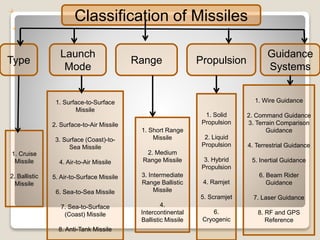
Classification of Missiles
Type Range Propulsion
Guidance
Systems
Launch
Mode
1. Surface-to-Surface
Missile
2. Surface-to-Air Missile
3. Surface (Coast)-to-
Sea Missile
4. Air-to-Air Missile
5. Air-to-Surface Missile
6. Sea-to-Sea Missile
7. Sea-to-Surface
(Coast) Missile
8. Anti-Tank Missile
1. Short Range
Missile
2. Medium
Range Missile
3. Intermediate
Range Ballistic
Missile
4.
Intercontinental
Ballistic Missile
1. Wire Guidance
2. Command Guidance
3. Terrain Comparison
Guidance
4. Terrestrial Guidance
5. Inertial Guidance
6. Beam Rider
Guidance
7. Laser Guidance
8. RF and GPS
Reference
1. Solid
Propulsion
2. Liquid
Propulsion
3. Hybrid
Propulsion
4. Ramjet
5. Scramjet
6.
Cryogenic
1. Cruise
Missile
2. Ballistic
Missile
Ballistic missile
 A ballistic missile is a missile that
has a ballistic trajectory over most
of its flight path ,regardless of
whether or not it is a weapon-
delivery vehicle .Ballistic missiles
are categorized according to their
range , maximum distance
measured along the surface of
earth’s ellipsoid from the point of
launch to the point of impact of
the last element of their payload.
 Ballistic missiles can be launched
from ships and land based
facilities. For example ,Prithvi I
,Prithvi II ,Agni I , Agni II and
Agni III,Dhanush ballistic missiles
are currently operational in the
Indian Defense Forces.
Cruise missile
 A cruise missile is an
unmanned self-propelled
guided vehicle that sustains
flight through aerodynamic lift
for most of its flight path and
whose primary mission is to
place an ordnance or special
payload on a target. They fly
within the earth’s atmosphere
and use jet engine technology
.Depending upon the speed
such missiles are classified as:
 1. Subsonic cruise missile
 2.Supersonic cruise missile
 3.Hypersonic cruise missile
GUIDANCE SYSTEM AND
CONTROL
 Missiles may be targeted in a number of ways. The
most common method is to use some form of
radiation, such as infrared, lasers or radio waves, to
guide the missile onto its target. This radiation may
emanate from the target (such as the heat of an
engine or the radio waves from an enemy radar), it
may be provided by the missile itself (such as a
radar), or it may be provided by a friendly third party
(such as the radar of the launch vehicle/platform, or a
laser designator operated by friendly infantry).
 Many missiles use a combination of two or more of the
above methods to improve accuracy and the chances
of a successful engagement
Types of guidance system
 Command guidance
 Homing or seeker guidance
 Beam rider guidance
 Inertial guidance, and
 Stellar guidance
For a specific mission, particular guidance
technique is used.
Command guidance
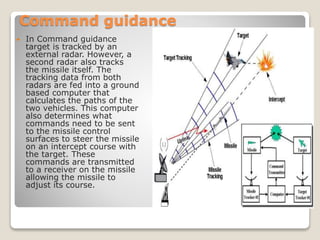
 In Command guidance
target is tracked by an
external radar. However, a
second radar also tracks
the missile itself. The
tracking data from both
radars are fed into a ground
based computer that
calculates the paths of the
two vehicles. This computer
also determines what
commands need to be sent
to the missile control
surfaces to steer the missile
on an intercept course with
the target. These
commands are transmitted
to a receiver on the missile
allowing the missile to
adjust its course.
Homing guidance
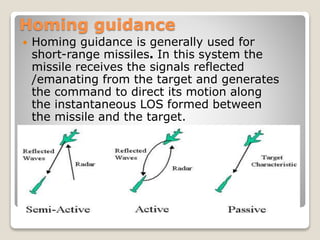
 Homing guidance is generally used for
short-range missiles. In this system the
missile receives the signals reflected
/emanating from the target and generates
the command to direct its motion along
the instantaneous LOS formed between
the missile and the target.
 ACTIVE HOMING GUIDANCE
In the active homing guidance system, the missile itself
carries the transmitter and the receiver. The signal,
generally electromagnetic radiation, is transmitted at the
target and the reflected signal is received. In this
system, the missile is not dependent on the ground
launcher. Active homing can be used for guidance in all
phases.
 SEMI-ACTIVE GUIDANCE
In semi-active guidance, the source for target illumination
is located in the launcher and the missile has only the
receiver. The rest of the process is identical to active type.
 PASSIVE GUIDANCE
In passive homing type, the missile has only a receiver and
detects signals emanating (not reflected) from the target. The
signals could be electromagnetic or infrared or both. 'The
missile has in its homing head detectors sensitive to infrared
or electromagnetic radiation.
Warheads and fuzes
The only purpose of the missile is to deliver a warhead
to the target. The function of the warhead is to damage
the target. The warhead is located in the missile. In
most of the tactical missiles, the warhead is based on
conventional chemical explosives called high explosive.
The non-nuclear high explosive warheads and
kinetic energy warheads. These are specifically
designed for different roles:
 Shaped charge warhead (anti-tank or anti-armour)
 Fragment type (anti-aircraft, anti-personnel),
 Blast-cum-earth shock (for damaging built up
structures), and
 Incendiary type(against fuel and ammunition dumps,
etc.)
Fuzes
 Every warhead must have a fuzes.Fuzes
are the devices which sense the right
moment to detonate the warhead.
 The most common types of fuzes:
(1) Impact fuze
(2) Altitude fuze
(3) Proximity Fuze
conclusion
With this we conclude our topic by
saying that missiles are harmful for
happy and peaceful life, but in today’s
world, there is more amount of terrorism
prevailing out as well as threat from the
neighboring countries, in these
conditions if required we can use it for
the welfare of our own country men.
THANK YOU

Guided missile

  • 1.
    GUIDED MISSILE SUBMITTED BY: KANHAIYA KUMAR 5TH SEM MECHANICAL BRANCH IT- GURU GHASIDAS UNIVERSITY, BILASPUR, (C.G)
  • 2.
    CONTENT 1. INTRODUCTION 2. HISTORYOF MISSILE 3. CLASSIFICATION OF MISSILE 4. GUIDANCE SYSTEM AND CONTROL 5. TYPES OF ENGINES 6. WARHEADS AND FUZES 7. CONCLUSION
  • 3.
    INTRODUCTION  Basically anyobject thrown at a target with the aim of hitting it is a missile. Thus, a stone thrown at a bird is a missile. The bird, by using its power of reasoning may evade the missile (the stone) by moving either to the Left, right, top or bottom with respect to the flight path (trajectory)of the missile. Thus, the missile in this case has been ineffective in its objective of hitting the bird (the target) . Now, if the stone too is imparted with some intelligence and quick response to move with respect to the bird, to overcome aiming errors and the bird's evasive actions and hit it accurately, the stone now becomes a guided missile
  • 4.
    HISTORY  Rockets wereused in China and India around 1000 AD for fireworks as well as for war purposes  During the 18th century, unguided rocket propelled missiles were used by Hyder Ali and his son Tipu Sultan against the British.  The current phase in the history of missiles began during the World War I1 with the use of V1 and V2 missiles by Germany
  • 5.
    Classification of Missiles TypeRange Propulsion Guidance Systems Launch Mode 1. Surface-to-Surface Missile 2. Surface-to-Air Missile 3. Surface (Coast)-to- Sea Missile 4. Air-to-Air Missile 5. Air-to-Surface Missile 6. Sea-to-Sea Missile 7. Sea-to-Surface (Coast) Missile 8. Anti-Tank Missile 1. Short Range Missile 2. Medium Range Missile 3. Intermediate Range Ballistic Missile 4. Intercontinental Ballistic Missile 1. Wire Guidance 2. Command Guidance 3. Terrain Comparison Guidance 4. Terrestrial Guidance 5. Inertial Guidance 6. Beam Rider Guidance 7. Laser Guidance 8. RF and GPS Reference 1. Solid Propulsion 2. Liquid Propulsion 3. Hybrid Propulsion 4. Ramjet 5. Scramjet 6. Cryogenic 1. Cruise Missile 2. Ballistic Missile
  • 6.
    Ballistic missile  Aballistic missile is a missile that has a ballistic trajectory over most of its flight path ,regardless of whether or not it is a weapon- delivery vehicle .Ballistic missiles are categorized according to their range , maximum distance measured along the surface of earth’s ellipsoid from the point of launch to the point of impact of the last element of their payload.  Ballistic missiles can be launched from ships and land based facilities. For example ,Prithvi I ,Prithvi II ,Agni I , Agni II and Agni III,Dhanush ballistic missiles are currently operational in the Indian Defense Forces.
  • 7.
    Cruise missile  Acruise missile is an unmanned self-propelled guided vehicle that sustains flight through aerodynamic lift for most of its flight path and whose primary mission is to place an ordnance or special payload on a target. They fly within the earth’s atmosphere and use jet engine technology .Depending upon the speed such missiles are classified as:  1. Subsonic cruise missile  2.Supersonic cruise missile  3.Hypersonic cruise missile
  • 8.
    GUIDANCE SYSTEM AND CONTROL Missiles may be targeted in a number of ways. The most common method is to use some form of radiation, such as infrared, lasers or radio waves, to guide the missile onto its target. This radiation may emanate from the target (such as the heat of an engine or the radio waves from an enemy radar), it may be provided by the missile itself (such as a radar), or it may be provided by a friendly third party (such as the radar of the launch vehicle/platform, or a laser designator operated by friendly infantry).  Many missiles use a combination of two or more of the above methods to improve accuracy and the chances of a successful engagement
  • 9.
    Types of guidancesystem  Command guidance  Homing or seeker guidance  Beam rider guidance  Inertial guidance, and  Stellar guidance For a specific mission, particular guidance technique is used.
  • 10.
    Command guidance  InCommand guidance target is tracked by an external radar. However, a second radar also tracks the missile itself. The tracking data from both radars are fed into a ground based computer that calculates the paths of the two vehicles. This computer also determines what commands need to be sent to the missile control surfaces to steer the missile on an intercept course with the target. These commands are transmitted to a receiver on the missile allowing the missile to adjust its course.
  • 11.
    Homing guidance  Homingguidance is generally used for short-range missiles. In this system the missile receives the signals reflected /emanating from the target and generates the command to direct its motion along the instantaneous LOS formed between the missile and the target.
  • 12.
     ACTIVE HOMINGGUIDANCE In the active homing guidance system, the missile itself carries the transmitter and the receiver. The signal, generally electromagnetic radiation, is transmitted at the target and the reflected signal is received. In this system, the missile is not dependent on the ground launcher. Active homing can be used for guidance in all phases.  SEMI-ACTIVE GUIDANCE In semi-active guidance, the source for target illumination is located in the launcher and the missile has only the receiver. The rest of the process is identical to active type.  PASSIVE GUIDANCE In passive homing type, the missile has only a receiver and detects signals emanating (not reflected) from the target. The signals could be electromagnetic or infrared or both. 'The missile has in its homing head detectors sensitive to infrared or electromagnetic radiation.
  • 13.
    Warheads and fuzes Theonly purpose of the missile is to deliver a warhead to the target. The function of the warhead is to damage the target. The warhead is located in the missile. In most of the tactical missiles, the warhead is based on conventional chemical explosives called high explosive. The non-nuclear high explosive warheads and kinetic energy warheads. These are specifically designed for different roles:  Shaped charge warhead (anti-tank or anti-armour)  Fragment type (anti-aircraft, anti-personnel),  Blast-cum-earth shock (for damaging built up structures), and  Incendiary type(against fuel and ammunition dumps, etc.)
  • 14.
    Fuzes  Every warheadmust have a fuzes.Fuzes are the devices which sense the right moment to detonate the warhead.  The most common types of fuzes: (1) Impact fuze (2) Altitude fuze (3) Proximity Fuze
  • 15.
    conclusion With this weconclude our topic by saying that missiles are harmful for happy and peaceful life, but in today’s world, there is more amount of terrorism prevailing out as well as threat from the neighboring countries, in these conditions if required we can use it for the welfare of our own country men.
  • 16.