UNIT IV
STAGING OF
ROCKETS AND
MISSILES
DINESH BABU.V
REASONS FOR MULTISTAGING:
1. To improve performance by eliminating dead weight during powered flight.
2. To maintain acceleration within reasonable limits by reducing thrust in mid
flight.
A multistage (or multi-stage) rocket is a rocket that uses two or more
stages, each of which contains its own engines and propellant.
A tandem or serial stage is mounted on top of another stage; a parallel
stage is attached alongside another stage
DINESH BABU-AP-AERO NIET
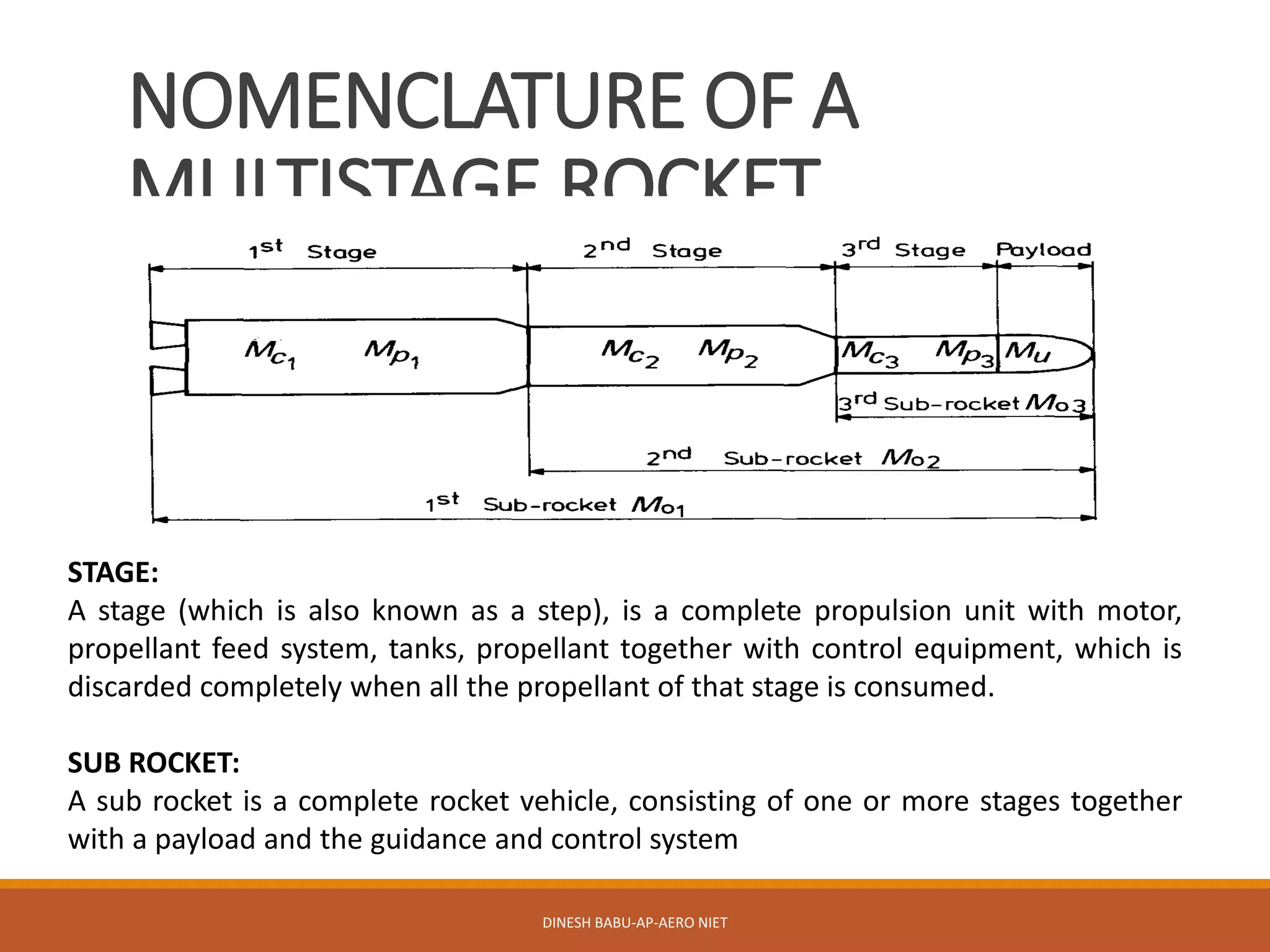
NOMENCLATURE OF A
MULTISTAGE ROCKET
DINESH BABU-AP-AERO NIET
STAGE:
A stage (which is also known as a step), is a complete propulsion unit with motor,
propellant feed system, tanks, propellant together with control equipment, which is
discarded completely when all the propellant of that stage is consumed.
SUB ROCKET:
A sub rocket is a complete rocket vehicle, consisting of one or more stages together
with a payload and the guidance and control system
TYPES OF MUTISTAGE ROCKETS:
There are two fundamental types of rocket staging. They are,
1. Series staging
2. Parallel staging
1.SERIES STAGING:
Series staging is also known as vertical staging. In a series staged rocket, the second stage
fires after the first stage is finished. The series staging is also known as tandem staging.
Some of the best examples of series rockets are, Explorer I and Saturn V.
2.PARALLEL STAGING:
Parallel staging is defined as staging a vehicle such that the upper stage engines are also
used during lower stage operation. This is usually accomplished by arranging the stages
alongside one another, hence the name parallel staging. The perfect example of parallel
staging is Titan III C
DINESH BABU-AP-AERO NIET
ADVANTAGES:
1. Reduction of gravitational losses.
2. In a gravitational field, the parallel staging is always advantageous to consume the
propellant as fast as possible.
DISADVANTAGES:
1. The disadvantage of parallel staging is that the rocket is likely to be bulky and for the
flight through the atmosphere the drag penalty may be large.
2. The second disadvantage of parallel staging is the reduction in nozzle efficiency
DINESH BABU-AP-AERO NIET
STAGE SEPARATION TECHNIQUES:
In multistage launch vehicles the stage separation process is broadly
classified into two
categories. They are,
1. SEPARATION OCCURING WITHIN THE
ATMOSPHERE.
2. SEPARATION OCCURING OUT OF ATMOSPHERE.
DINESH BABU-AP-AERO NIET
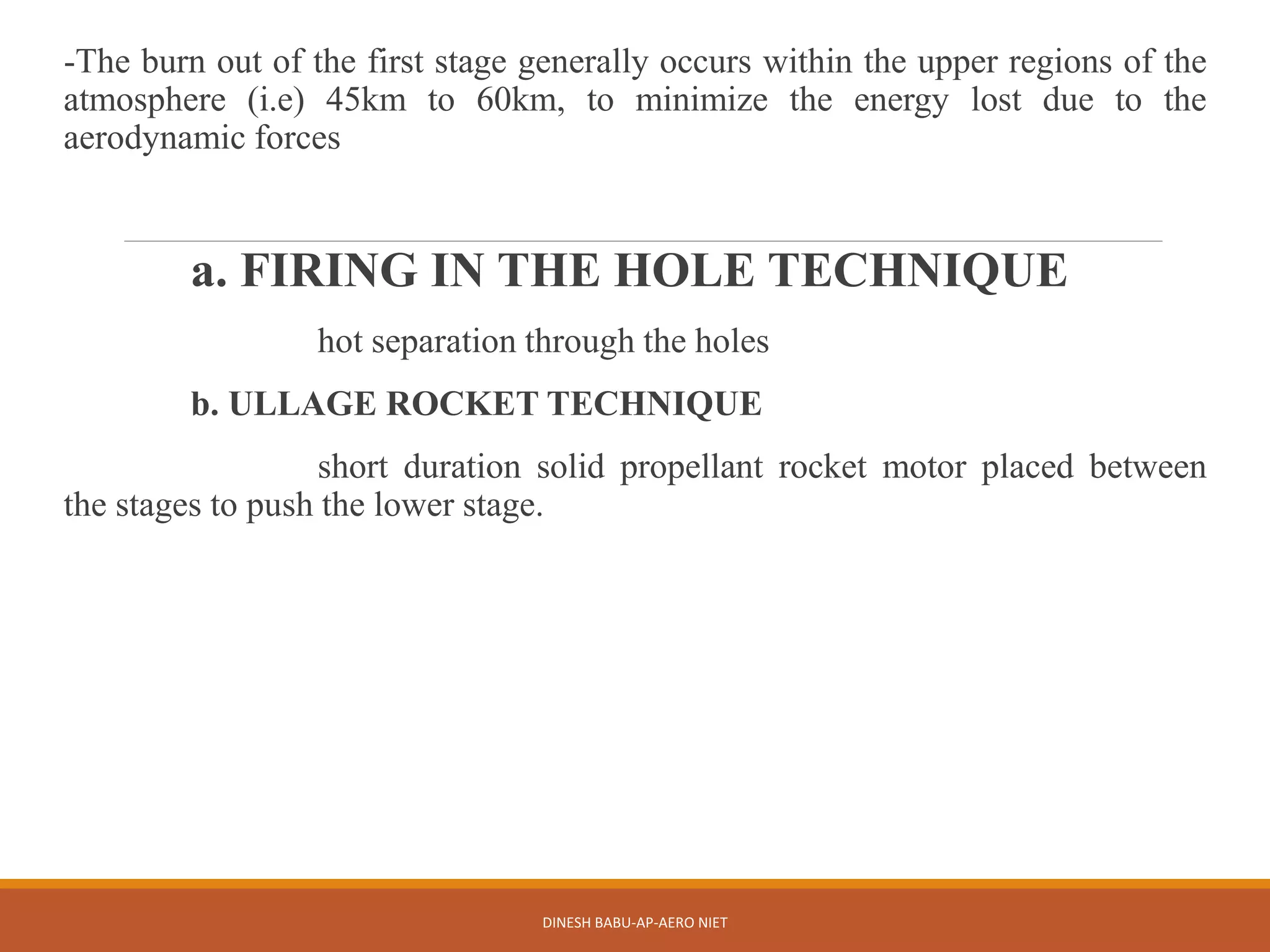
1. SEPARATION OCCURING WITHIN
THE ATMOSPHERE:
.Separation within the atmosphere is otherwise known as booster
separation/lower stage separation/strap on separation
DINESH BABU-AP-AERO NIET
-The burn out of the first stage generally occurs within the upper regions of the
atmosphere (i.e) 45km to 60km, to minimize the energy lost due to the
aerodynamic forces
a. FIRING IN THE HOLE TECHNIQUE
hot separation through the holes
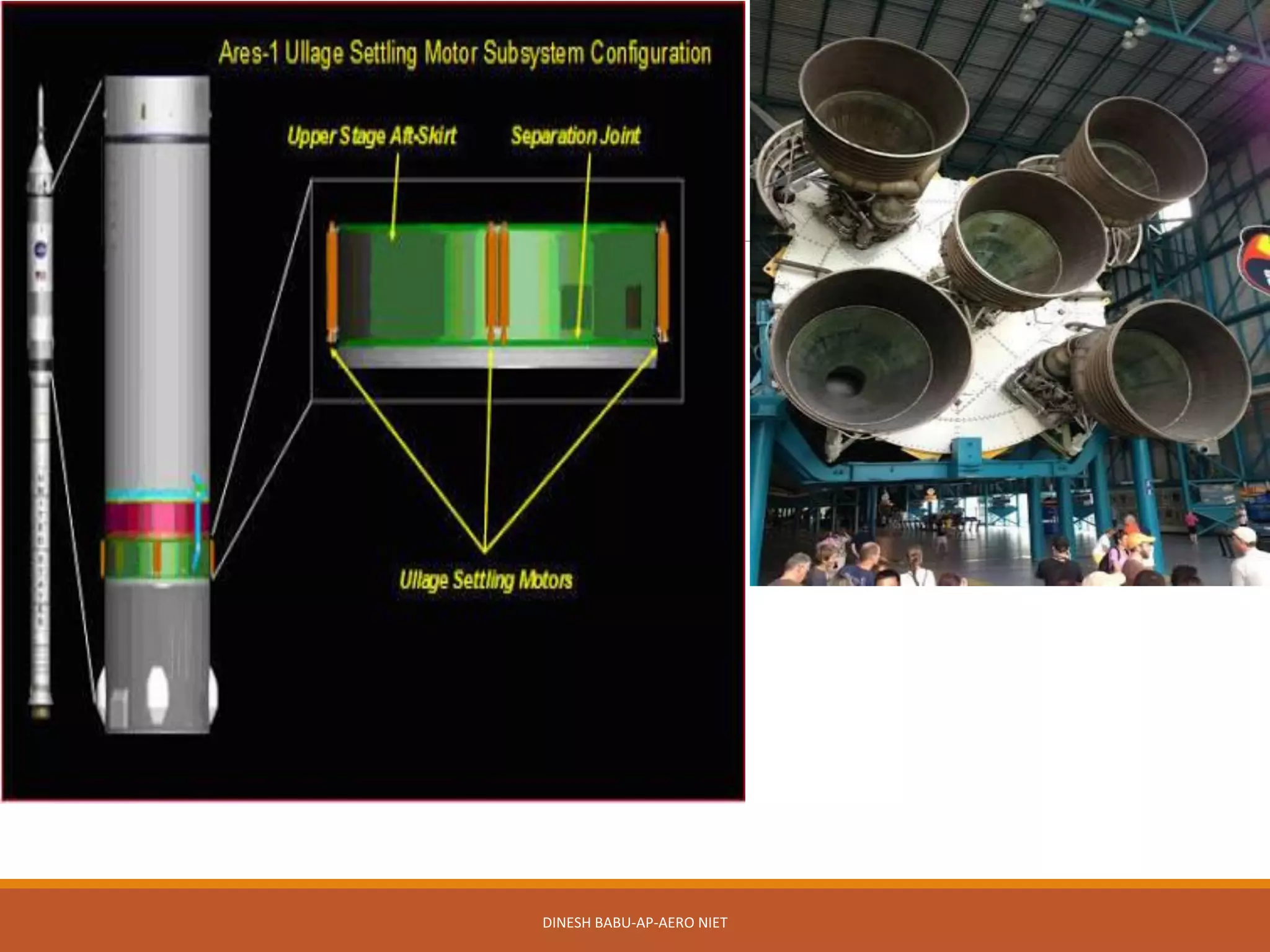
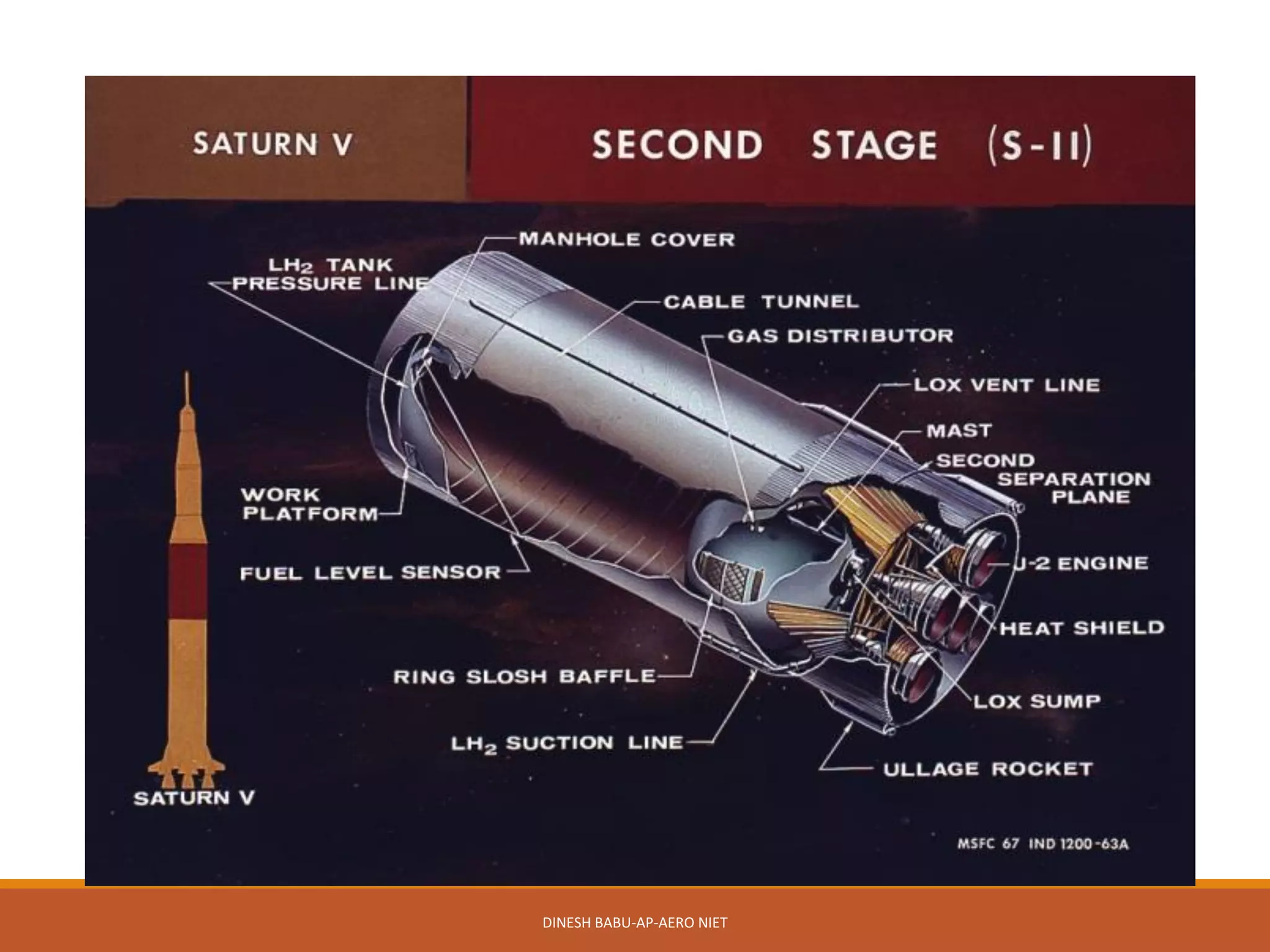
b. ULLAGE ROCKET TECHNIQUE
short duration solid propellant rocket motor placed between
the stages to push the lower stage.
DINESH BABU-AP-AERO NIET
2. SEPARATION OUT OF
ATMOSPHERE (IN SPACE):
DINESH BABU-AP-AERO NIET
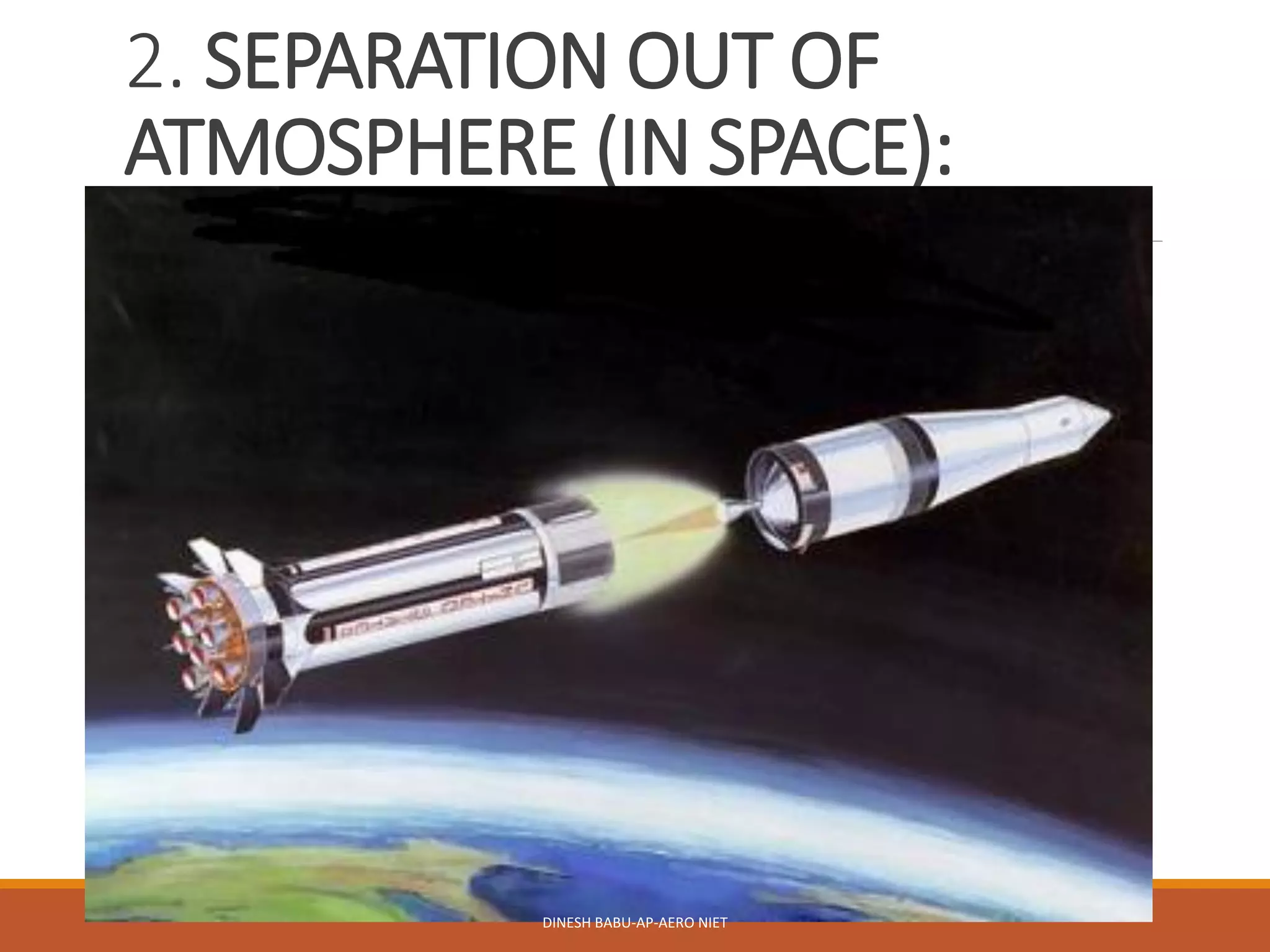
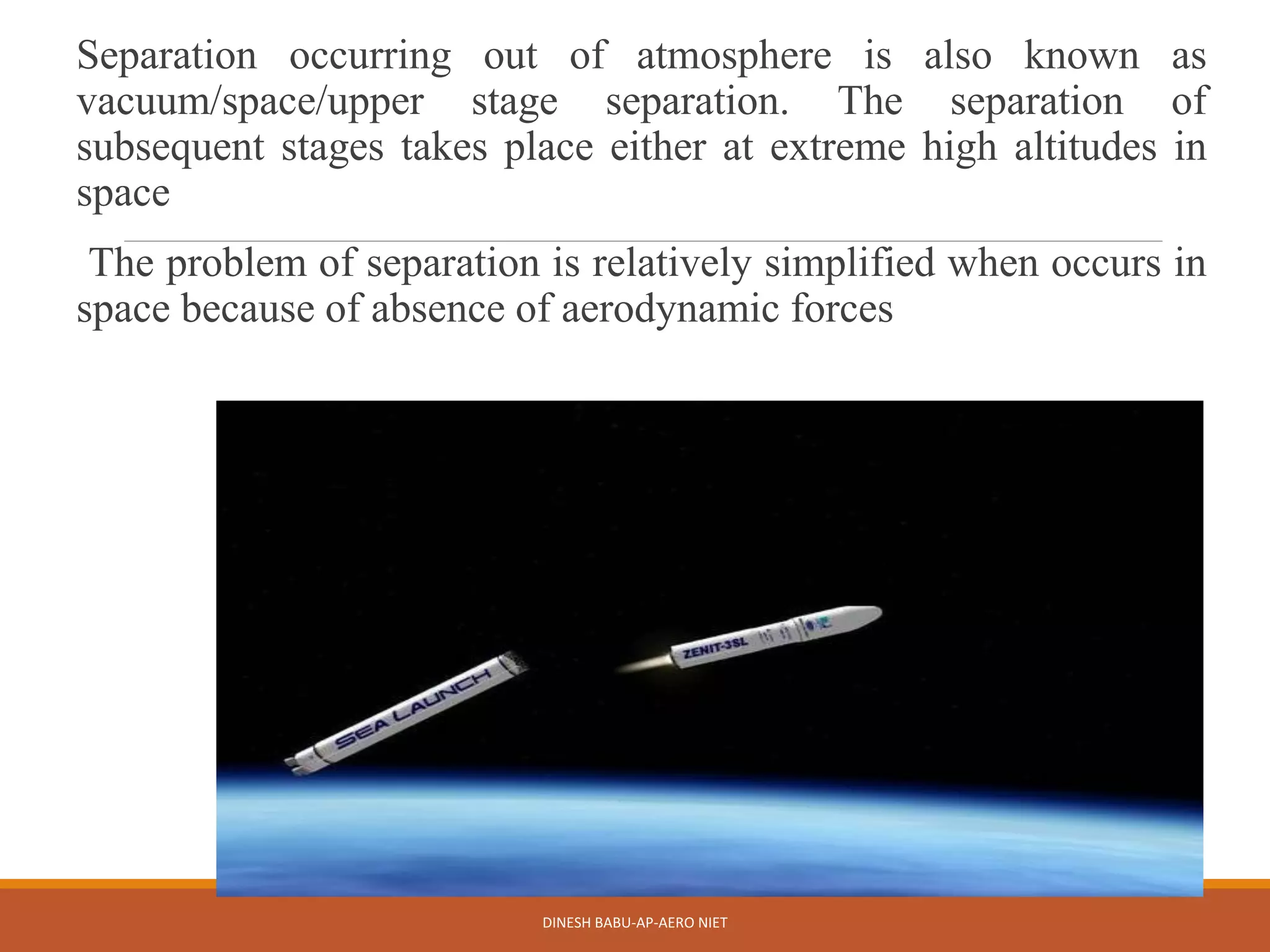
Separation occurring out of atmosphere is also known as
vacuum/space/upper stage separation. The separation of
subsequent stages takes place either at extreme high altitudes in
space
The problem of separation is relatively simplified when occurs in
space because of absence of aerodynamic forces
DINESH BABU-AP-AERO NIET
This separation technique involves two methods.
a. HELICAL COMPRESSION SPRING
TECHNOLOGY
b. SHORT DURATION SOLID PROPELLANT
TECHNOLOGY
ADVANTAGES:
1. No separate command is needed for actuation
2. Highly reliable
DRAW BACK:
1. Much heavier when compared to other jettisoning system.
DINESH BABU-AP-AERO NIET
STAGE SEPARATION SYSTEMS:
Selection of stage separation system of launch vehicle is an extensive and
exhaustive process.
The critical criterions are,
1. Joint rotation
2. Simultaneity
3. Reliability
4. Confinement of debris
5. Low shock levels
6. Weight
7. Cost.
DINESH BABU-AP-AERO NIET

Unit iv - Rockets and Misiles

  • 1.
    UNIT IV STAGING OF ROCKETSAND MISSILES DINESH BABU.V
  • 2.
    REASONS FOR MULTISTAGING: 1.To improve performance by eliminating dead weight during powered flight. 2. To maintain acceleration within reasonable limits by reducing thrust in mid flight. A multistage (or multi-stage) rocket is a rocket that uses two or more stages, each of which contains its own engines and propellant. A tandem or serial stage is mounted on top of another stage; a parallel stage is attached alongside another stage DINESH BABU-AP-AERO NIET
  • 3.
    NOMENCLATURE OF A MULTISTAGEROCKET DINESH BABU-AP-AERO NIET STAGE: A stage (which is also known as a step), is a complete propulsion unit with motor, propellant feed system, tanks, propellant together with control equipment, which is discarded completely when all the propellant of that stage is consumed. SUB ROCKET: A sub rocket is a complete rocket vehicle, consisting of one or more stages together with a payload and the guidance and control system
  • 4.
    TYPES OF MUTISTAGEROCKETS: There are two fundamental types of rocket staging. They are, 1. Series staging 2. Parallel staging 1.SERIES STAGING: Series staging is also known as vertical staging. In a series staged rocket, the second stage fires after the first stage is finished. The series staging is also known as tandem staging. Some of the best examples of series rockets are, Explorer I and Saturn V. 2.PARALLEL STAGING: Parallel staging is defined as staging a vehicle such that the upper stage engines are also used during lower stage operation. This is usually accomplished by arranging the stages alongside one another, hence the name parallel staging. The perfect example of parallel staging is Titan III C DINESH BABU-AP-AERO NIET
  • 5.
    ADVANTAGES: 1. Reduction ofgravitational losses. 2. In a gravitational field, the parallel staging is always advantageous to consume the propellant as fast as possible. DISADVANTAGES: 1. The disadvantage of parallel staging is that the rocket is likely to be bulky and for the flight through the atmosphere the drag penalty may be large. 2. The second disadvantage of parallel staging is the reduction in nozzle efficiency DINESH BABU-AP-AERO NIET
  • 6.
    STAGE SEPARATION TECHNIQUES: Inmultistage launch vehicles the stage separation process is broadly classified into two categories. They are, 1. SEPARATION OCCURING WITHIN THE ATMOSPHERE. 2. SEPARATION OCCURING OUT OF ATMOSPHERE. DINESH BABU-AP-AERO NIET
  • 7.
    1. SEPARATION OCCURINGWITHIN THE ATMOSPHERE: .Separation within the atmosphere is otherwise known as booster separation/lower stage separation/strap on separation DINESH BABU-AP-AERO NIET
  • 8.
    -The burn outof the first stage generally occurs within the upper regions of the atmosphere (i.e) 45km to 60km, to minimize the energy lost due to the aerodynamic forces a. FIRING IN THE HOLE TECHNIQUE hot separation through the holes b. ULLAGE ROCKET TECHNIQUE short duration solid propellant rocket motor placed between the stages to push the lower stage. DINESH BABU-AP-AERO NIET
  • 9.
  • 10.
  • 11.
    2. SEPARATION OUTOF ATMOSPHERE (IN SPACE): DINESH BABU-AP-AERO NIET
  • 12.
    Separation occurring outof atmosphere is also known as vacuum/space/upper stage separation. The separation of subsequent stages takes place either at extreme high altitudes in space The problem of separation is relatively simplified when occurs in space because of absence of aerodynamic forces DINESH BABU-AP-AERO NIET
  • 13.
    This separation techniqueinvolves two methods. a. HELICAL COMPRESSION SPRING TECHNOLOGY b. SHORT DURATION SOLID PROPELLANT TECHNOLOGY ADVANTAGES: 1. No separate command is needed for actuation 2. Highly reliable DRAW BACK: 1. Much heavier when compared to other jettisoning system. DINESH BABU-AP-AERO NIET
  • 14.
    STAGE SEPARATION SYSTEMS: Selectionof stage separation system of launch vehicle is an extensive and exhaustive process. The critical criterions are, 1. Joint rotation 2. Simultaneity 3. Reliability 4. Confinement of debris 5. Low shock levels 6. Weight 7. Cost. DINESH BABU-AP-AERO NIET