By
Arvind Srivastava
Mechanical Engineering
National Institute of Technology Warangal
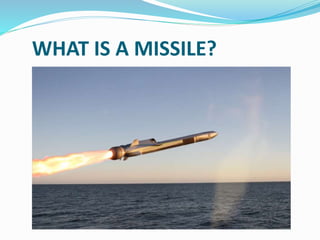
WHAT IS A MISSILE?
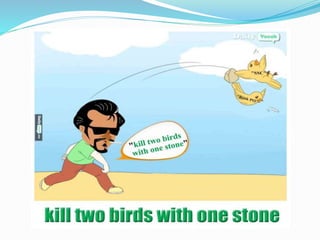
• Basically any object thrown at a target with the aim of
hitting it is a missile. Thus, a stone thrown at a bird is
a missile.
• The bird, by using its power of reasoning may evade
the missile (the stone) by moving either to the Left,
right, top or bottom with respect to the flight path
(trajectory) of the missile. Thus, the missile in this case
has been ineffective in its objective of hitting the bird
(the target.
• Now, if the stone too is imparted with some
intelligence and quick response to move with respect to
the bird, to overcome aiming errors and the bird's
evasive actions and hit it accurately, the stone now
becomes a guided missile.
 Hence, in modern era, a missile is a self-propelled
precision-guided munition system, as opposed to an
unguided self-propelled munition, referred to as a
rocket.
 The incorporation of energy source in a missile to
provide the required force for its movement
(propulsion) intelligence to go in the correct direction
(guidance) and effective maneuvering (control) are
mainly the technologies of guided missiles. They help
in making a missile specific to a target, that is, they
determine the size, range and state of motion of a
missile.
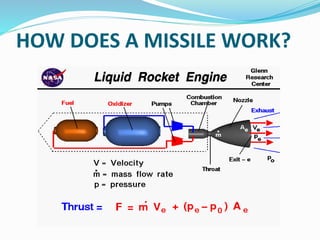
HOW DOES A MISSILE WORK?
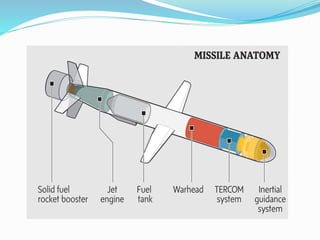
COMPONENTS IN A MISSILE
There are four main components in a missile:
 WARHEAD
 PROPULSION SYSTEM
 GUIDANCE SYSTEM
 CONTROL SYSTEM
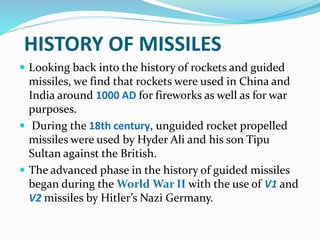
HISTORY OF MISSILES
 Looking back into the history of rockets and guided
missiles, we find that rockets were used in China and
India around 1000 AD for fireworks as well as for war
purposes.
 During the 18th century, unguided rocket propelled
missiles were used by Hyder Ali and his son Tipu
Sultan against the British.
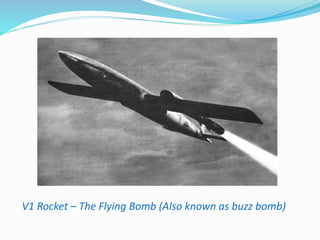
 The advanced phase in the history of guided missiles
began during the World War II with the use of V1 and
V2 missiles by Hitler’s Nazi Germany.
V1 Rocket – The Flying Bomb (Also known as buzz bomb)
CLASSIFICATION OF MISSILES
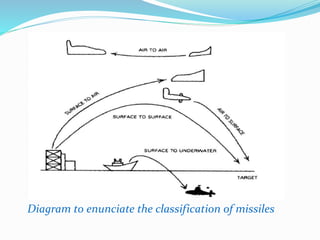
On the method of launching, the missiles are classified
as:
 Surface-to-surface-missiles (SSM)
 Surface-to-air missiles (SAM)
 Air-to-air missiles (AAM)
 Air-to-surface missiles (ASM
Diagram to enunciate the classification of missiles
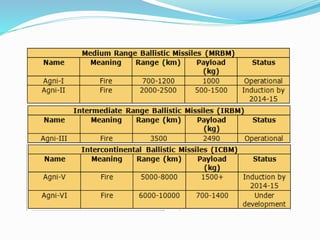
On the basis of range, missiles can also be classified as:
 Short-range missiles
 Medium-range ballistic missiles (MRBM)
 Intermediate range ballistic missiles(IRBM)
 Intercontinental or long-range ballistic
missiles(ICBM).
GUIDANCE SYSTEM IN MISSILES
The guidance system in missiles consists of two units:
 Electronic unit
 Mechanical unit
The purpose of electronic unit is to anticipate the
location of target, compare it with LOS(Line of Sight)
and send the necessary command to the mechanical
unit.
The purpose of mechanical unit is to act in the way,
commanded by EU and keep the missile stable during
the flight.
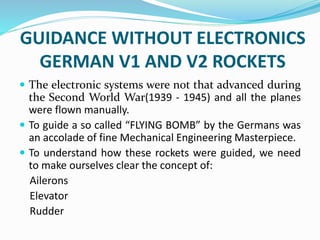
GUIDANCE WITHOUT ELECTRONICS
GERMAN V1 AND V2 ROCKETS
 The electronic systems were not that advanced during
the Second World War(1939 - 1945) and all the planes
were flown manually.
 To guide a so called “FLYING BOMB” by the Germans was
an accolade of fine Mechanical Engineering Masterpiece.
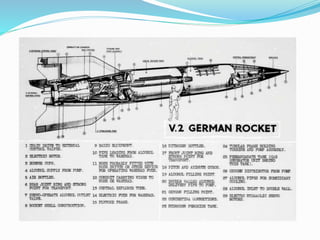
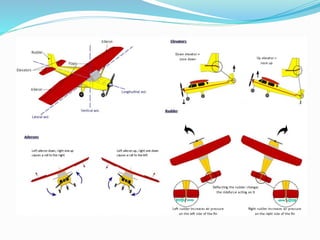
 To understand how these rockets were guided, we need
to make ourselves clear the concept of:
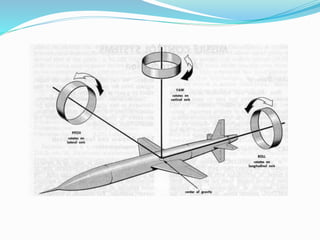
Ailerons
Elevator
Rudder
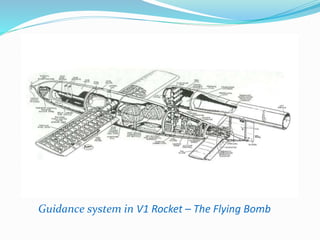
Guidance system in V1 Rocket – The Flying Bomb
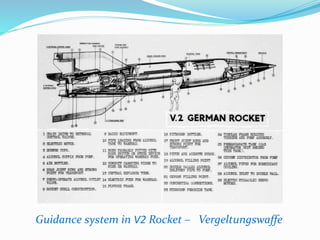
Guidance system in V2 Rocket – Vergeltungswaffe
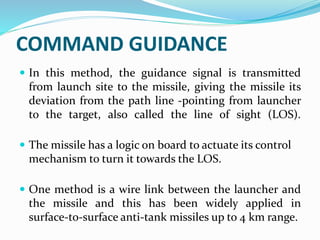
 We have already stated that guidance is that aspect of a
missile system which helps it to decide the direction in
which the missile should move. Generally this decision
has to be taken at very short intervals of time (1/50th
of a second) during the flight of the missile.
 The different types of guidance :
Command guidance
Homing guidance
Beam rider guidance
Inertial guidance
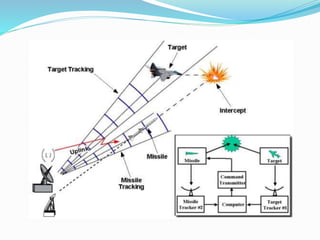
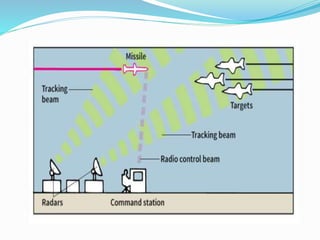
COMMAND GUIDANCE
 In this method, the guidance signal is transmitted
from launch site to the missile, giving the missile its
deviation from the path line -pointing from launcher
to the target, also called the line of sight (LOS).
 The missile has a logic on board to actuate its control
mechanism to turn it towards the LOS.
 One method is a wire link between the launcher and
the missile and this has been widely applied in
surface-to-surface anti-tank missiles up to 4 km range.
 The deviation of the missile from target to launch line
of sight is computed on the ground at short intervals
(30-50 m/s) and then updated commands are
transmitted to the missile.
 To compute errors, instantaneous positions of missile
and target are found out. This is done by means of
radar, TV or infrared sensors located on the launcher.
 Most of the anti-tank missiles and some of surface-to-
air missiles use command guidance.
ADVANTAGE
An important advantage of command guidance systems
is that very little guidance equipment need be carried in
the missile itself.
Because target tracking and flight path computation are
carried out by tracking radars and the associated
computers on the ground, the missile need carry only its
control system and a receiver to accept the signals.
Reduction in the amount of guidance equipment carried
in the missile means more room for a larger warhead.
DISADVANTAGE
The disadvantage of command guidance is that it cannot
be used against a situation of multiple targets. The
system can guide only a limited number of missiles at
one time.
HOMING GUIDANCE
 Homing guidance is generally used for short-range
missiles. In this system the missile receives the signals
reflected/emanating from the target and generates the
command to direct its motion along the instantaneous
LOS formed between the missile and the target.
 In homing guidance the missile steers itself towards a
target using an onboard seeker which is able to detect
some distinguishing characteristics of the target.
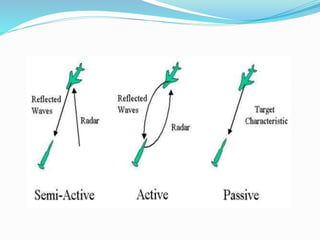
TYPES OF HOMING GUIDANCE
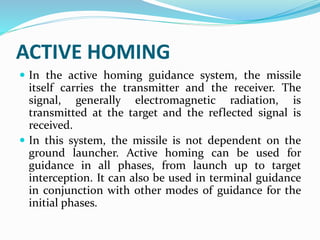
Homing guidance can be divided into three main
variant:
 Active Homing
 Semi-Active Homing
 Passive Homing
ACTIVE HOMING
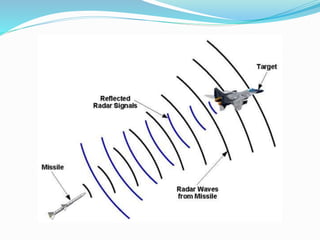
 In the active homing guidance system, the missile
itself carries the transmitter and the receiver. The
signal, generally electromagnetic radiation, is
transmitted at the target and the reflected signal is
received.
 In this system, the missile is not dependent on the
ground launcher. Active homing can be used for
guidance in all phases, from launch up to target
interception. It can also be used in terminal guidance
in conjunction with other modes of guidance for the
initial phases.
HARPOON AGM
The AGM-
84D Harpoon is an
all-weather, over-the-
horizon, anti-ship
missile system
produced by Boeing
[formerly McDonnell
Douglas].
The Harpoon's activ
e radar guidance,
warhead design, and
low-level, sea-
skimming cruise
trajectory assure high
survivability and
effectiveness
SEMI-ACTIVE HOMING
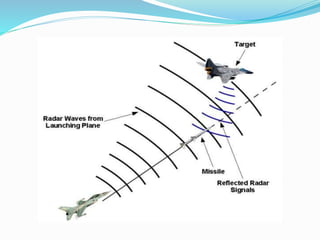
 In semi-active guidance, the source for target
illumination is located in the launcher and the missile
has only the receiver. The rest of the process is
identical to active type.
 This type helps to have a simple onboard system and
can be used for longer ranges (up to 50 to 60 km).
Examples of this are the missiles Seahawk, Sea dart
and Sea sparrow.
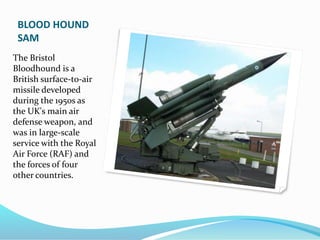
BLOOD HOUND
SAM
The Bristol
Bloodhound is a
British surface-to-air
missile developed
during the 1950s as
the UK's main air
defense weapon, and
was in large-scale
service with the Royal
Air Force (RAF) and
the forces of four
other countries.
PASSIVE HOMING
 In passive homing type, the missile has only a receiver
and detects signals emanating (not reflected) from the
target. The signals could be electromagnetic or
infrared or both. 'The missile has in its homing head
detectors sensitive to infrared or electromagnetic
radiation.
 The missile where infrared homing is used are also
called heat-seeking missiles. This system can also be
used in conjunction with other modes of guidance in
the same way as the active system
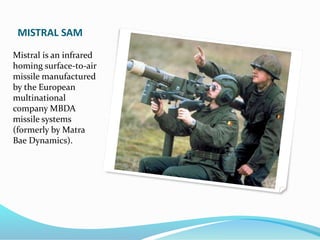
MISTRAL SAM
Mistral is an infrared
homing surface-to-air
missile manufactured
by the European
multinational
company MBDA
missile systems
(formerly by Matra
Bae Dynamics).
BEAM RIDER GUIDANCE
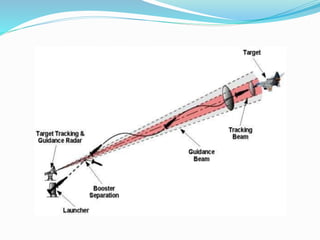
 In this method, the guidance system is to illuminate the
target by radiation of a beam of energy from a radar antenna
pointed at the target.
 The missile is fired into this beam and thereafter gets guided
over the beam till it hits or misses the target.
 In a beam rider guidance system, equipment in the missile
measures the displacement of the missile from the Centre of
the radar beam then appropriate action by the control
system steers the missile back into the Centre of the beam.
 If the missile is flying in the Centre of the beam, no signals
are sent to the control system, indicating that no corrective
action is necessary.
 This type of guidance system is relatively simple, less
complex with increased reliability and lower cost. The
limitation is that the trajectory requires high lateral
acceleration during the terminal phase.
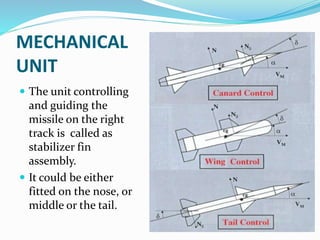
MECHANICAL
UNIT
 The unit controlling
and guiding the
missile on the right
track is called as
stabilizer fin
assembly.
 It could be either
fitted on the nose, or
middle or the tail.
REFERENCES
 http://www.drdo.gov.in/drdo/data/Guided%20Missiles.p
df
 https://en.wikipedia.org/wiki/Missile_guidance
 http://www.revathiengineering.com/rtb.html
 http://dynlab.mpe.nus.edu.sg/mpelsb/mdts/GW%203n%
20v2.pdf
THANK YOU

Guidance system in missiles

  • 1.
  • 2.
    WHAT IS AMISSILE?
  • 3.
    • Basically anyobject thrown at a target with the aim of hitting it is a missile. Thus, a stone thrown at a bird is a missile. • The bird, by using its power of reasoning may evade the missile (the stone) by moving either to the Left, right, top or bottom with respect to the flight path (trajectory) of the missile. Thus, the missile in this case has been ineffective in its objective of hitting the bird (the target. • Now, if the stone too is imparted with some intelligence and quick response to move with respect to the bird, to overcome aiming errors and the bird's evasive actions and hit it accurately, the stone now becomes a guided missile.
  • 5.
     Hence, inmodern era, a missile is a self-propelled precision-guided munition system, as opposed to an unguided self-propelled munition, referred to as a rocket.  The incorporation of energy source in a missile to provide the required force for its movement (propulsion) intelligence to go in the correct direction (guidance) and effective maneuvering (control) are mainly the technologies of guided missiles. They help in making a missile specific to a target, that is, they determine the size, range and state of motion of a missile.
  • 6.
    HOW DOES AMISSILE WORK?
  • 7.
    COMPONENTS IN AMISSILE There are four main components in a missile:  WARHEAD  PROPULSION SYSTEM  GUIDANCE SYSTEM  CONTROL SYSTEM
  • 9.
    HISTORY OF MISSILES Looking back into the history of rockets and guided missiles, we find that rockets were used in China and India around 1000 AD for fireworks as well as for war purposes.  During the 18th century, unguided rocket propelled missiles were used by Hyder Ali and his son Tipu Sultan against the British.  The advanced phase in the history of guided missiles began during the World War II with the use of V1 and V2 missiles by Hitler’s Nazi Germany.
  • 10.
    V1 Rocket –The Flying Bomb (Also known as buzz bomb)
  • 12.
    CLASSIFICATION OF MISSILES Onthe method of launching, the missiles are classified as:  Surface-to-surface-missiles (SSM)  Surface-to-air missiles (SAM)  Air-to-air missiles (AAM)  Air-to-surface missiles (ASM
  • 13.
    Diagram to enunciatethe classification of missiles
  • 14.
    On the basisof range, missiles can also be classified as:  Short-range missiles  Medium-range ballistic missiles (MRBM)  Intermediate range ballistic missiles(IRBM)  Intercontinental or long-range ballistic missiles(ICBM).
  • 15.
    GUIDANCE SYSTEM INMISSILES The guidance system in missiles consists of two units:  Electronic unit  Mechanical unit The purpose of electronic unit is to anticipate the location of target, compare it with LOS(Line of Sight) and send the necessary command to the mechanical unit. The purpose of mechanical unit is to act in the way, commanded by EU and keep the missile stable during the flight.
  • 16.
    GUIDANCE WITHOUT ELECTRONICS GERMANV1 AND V2 ROCKETS  The electronic systems were not that advanced during the Second World War(1939 - 1945) and all the planes were flown manually.  To guide a so called “FLYING BOMB” by the Germans was an accolade of fine Mechanical Engineering Masterpiece.  To understand how these rockets were guided, we need to make ourselves clear the concept of: Ailerons Elevator Rudder
  • 18.
    Guidance system inV1 Rocket – The Flying Bomb
  • 19.
    Guidance system inV2 Rocket – Vergeltungswaffe
  • 20.
     We havealready stated that guidance is that aspect of a missile system which helps it to decide the direction in which the missile should move. Generally this decision has to be taken at very short intervals of time (1/50th of a second) during the flight of the missile.  The different types of guidance : Command guidance Homing guidance Beam rider guidance Inertial guidance
  • 21.
    COMMAND GUIDANCE  Inthis method, the guidance signal is transmitted from launch site to the missile, giving the missile its deviation from the path line -pointing from launcher to the target, also called the line of sight (LOS).  The missile has a logic on board to actuate its control mechanism to turn it towards the LOS.  One method is a wire link between the launcher and the missile and this has been widely applied in surface-to-surface anti-tank missiles up to 4 km range.
  • 24.
     The deviationof the missile from target to launch line of sight is computed on the ground at short intervals (30-50 m/s) and then updated commands are transmitted to the missile.  To compute errors, instantaneous positions of missile and target are found out. This is done by means of radar, TV or infrared sensors located on the launcher.  Most of the anti-tank missiles and some of surface-to- air missiles use command guidance.
  • 25.
    ADVANTAGE An important advantageof command guidance systems is that very little guidance equipment need be carried in the missile itself. Because target tracking and flight path computation are carried out by tracking radars and the associated computers on the ground, the missile need carry only its control system and a receiver to accept the signals. Reduction in the amount of guidance equipment carried in the missile means more room for a larger warhead.
  • 26.
    DISADVANTAGE The disadvantage ofcommand guidance is that it cannot be used against a situation of multiple targets. The system can guide only a limited number of missiles at one time.
  • 27.
    HOMING GUIDANCE  Homingguidance is generally used for short-range missiles. In this system the missile receives the signals reflected/emanating from the target and generates the command to direct its motion along the instantaneous LOS formed between the missile and the target.  In homing guidance the missile steers itself towards a target using an onboard seeker which is able to detect some distinguishing characteristics of the target.
  • 28.
    TYPES OF HOMINGGUIDANCE Homing guidance can be divided into three main variant:  Active Homing  Semi-Active Homing  Passive Homing
  • 30.
    ACTIVE HOMING  Inthe active homing guidance system, the missile itself carries the transmitter and the receiver. The signal, generally electromagnetic radiation, is transmitted at the target and the reflected signal is received.  In this system, the missile is not dependent on the ground launcher. Active homing can be used for guidance in all phases, from launch up to target interception. It can also be used in terminal guidance in conjunction with other modes of guidance for the initial phases.
  • 32.
    HARPOON AGM The AGM- 84DHarpoon is an all-weather, over-the- horizon, anti-ship missile system produced by Boeing [formerly McDonnell Douglas]. The Harpoon's activ e radar guidance, warhead design, and low-level, sea- skimming cruise trajectory assure high survivability and effectiveness
  • 33.
    SEMI-ACTIVE HOMING  Insemi-active guidance, the source for target illumination is located in the launcher and the missile has only the receiver. The rest of the process is identical to active type.  This type helps to have a simple onboard system and can be used for longer ranges (up to 50 to 60 km). Examples of this are the missiles Seahawk, Sea dart and Sea sparrow.
  • 35.
    BLOOD HOUND SAM The Bristol Bloodhoundis a British surface-to-air missile developed during the 1950s as the UK's main air defense weapon, and was in large-scale service with the Royal Air Force (RAF) and the forces of four other countries.
  • 36.
    PASSIVE HOMING  Inpassive homing type, the missile has only a receiver and detects signals emanating (not reflected) from the target. The signals could be electromagnetic or infrared or both. 'The missile has in its homing head detectors sensitive to infrared or electromagnetic radiation.  The missile where infrared homing is used are also called heat-seeking missiles. This system can also be used in conjunction with other modes of guidance in the same way as the active system
  • 37.
    MISTRAL SAM Mistral isan infrared homing surface-to-air missile manufactured by the European multinational company MBDA missile systems (formerly by Matra Bae Dynamics).
  • 38.
    BEAM RIDER GUIDANCE In this method, the guidance system is to illuminate the target by radiation of a beam of energy from a radar antenna pointed at the target.  The missile is fired into this beam and thereafter gets guided over the beam till it hits or misses the target.  In a beam rider guidance system, equipment in the missile measures the displacement of the missile from the Centre of the radar beam then appropriate action by the control system steers the missile back into the Centre of the beam.  If the missile is flying in the Centre of the beam, no signals are sent to the control system, indicating that no corrective action is necessary.
  • 40.
     This typeof guidance system is relatively simple, less complex with increased reliability and lower cost. The limitation is that the trajectory requires high lateral acceleration during the terminal phase.
  • 41.
    MECHANICAL UNIT  The unitcontrolling and guiding the missile on the right track is called as stabilizer fin assembly.  It could be either fitted on the nose, or middle or the tail.
  • 47.
    REFERENCES  http://www.drdo.gov.in/drdo/data/Guided%20Missiles.p df  https://en.wikipedia.org/wiki/Missile_guidance http://www.revathiengineering.com/rtb.html  http://dynlab.mpe.nus.edu.sg/mpelsb/mdts/GW%203n% 20v2.pdf
  • 48.