NASA Technology Landscape


                        PM Challenge
                       Galveston, Texas
                       February 9-10, 2010

                                             Minoo N. Dastoor
                                             Chief Technologist
Used with permission                         NASA, IPP Office
Technology in Extreme Environments

                                                  • Launch $
                             High performance     • Aeronautics Applications
                                  weight          • Human Habitats
       Meteorite
        Impact
          &
         Dust                                                             Multifunctional
      Resistance                                                           Intelligence


• Highly electrostatic
• Ultrafine                                                           • Scientific Productivity
• Human Habitats                                                      • Human “Amplifiers”
                                                                      • IVHM


    Extreme
    Radiation                                                              Ultra-sensitive
   Resistance                                                              Signal capture


• Mission to Europa:
                           Extreme        • Lunar Surface:           • Voyager:
  1-5 Mrads
                         Temperature        -233 °C to 123 °C          Signal From 9.3 x 10⁹mi
                          Resistance      • Mars Surface:
                                            -87 °C to -5 °C
                                                                                                  22
Technology Drivers: Human Spaceflight


              Productivity                                  Safety
• Human-Machine Symbiosis                                          • Radiation
• Sensors/Nano-electronics/                                        • Life Support
  Computing
• Data Mining                   Human                              • Counter Measures
                                                                   • Vehicle Health Mgmt.
• Full Cells/Energy
  Storage                     Spaceflight

                                          Cost
                                 • High Strength/Light Weight
                       • Multifunctionality     • Thermal Management
                                                                                            3
Examples of Critical Technology Needs: Human Spaceflight


• Entry, Descent, and Landing Technology

• Nuclear Propulsion and Power

• LOX-Methane Propulsion and Cryogenic Propellant Storage

• Closed-Loop Life Support

• Surface Mobility Systems

• In-Situ Resource Utilization Systems

• High Bandwidth Communications

• Radiation Protection


                                                             4
Space Operations Mission Directorate


                                    Space
  Space Shuttle                  Communications


International Space                   Space
      Station                     Transportation


                                                   5
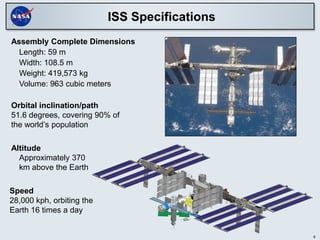
ISS Specifications
Assembly Complete Dimensions
  Length: 59 m
  Width: 108.5 m
  Weight: 419,573 kg
  Volume: 963 cubic meters

Orbital inclination/path
51.6 degrees, covering 90% of
the world’s population

Altitude
  Approximately 370
  km above the Earth

Speed
28,000 kph, orbiting the
Earth 16 times a day


                                                6
International Space Station Overview

Salient Features
   Complex of research laboratories in low Earth
    orbit (LEO) in which U.S. and international
    astronauts conduct scientific and technological
    investigations in a space environment
   International Partnership including ESA, CSA,
    JAXA and RSA
   Heavily dependent on crew and cargo
    transportation by multiple capabilities from
    several countries

Partners:                                             Objectives
                                                         Support scientific research for human space
   Canadian Space Agency                                 exploration and other activities requiring the
                                                          unique attributes of humans in space
   European Space Agency
                                                         Consistent with the Vision for Space
   Japan Aerospace Exploration Agency                    Exploration, ISS research is focused on
                                                          science and technology development that will
                                                          prepare human explorers to travel beyond
   National Aeronautics and
                                                          LEO
    Space Administration
                                                         Advance the international collaboration of
   Russian Federal Space Agency                          peaceful human space flight endeavors

                                                                                                           7
Science Modules


Destiny            Columbus                 Kibo

          Overarching Constraints:
            • Up Mass         • Power
            • Down Mass       • Crew Time
                                                   8
                                                   8
Technology Challenges/Priorities: SOMD


Space Communications          Space Transportation

• Optical Communication      • Automated Optical Tracking
                               and Identification
• Spacecraft RF Technology
                             • Transportation Test
• Antenna Array Transmit
                               Requirements and
  Technology
                               Instrumentation
• Programmable
                             • Automated Collection and
  Communication System
                               Transfer of Data


                                                            9
The Science Mission Directorate


                                  10
                                  10
Technology Challenges/Priorities: SMD

• New Remote Sensing Technologies to better see,
  detect, and measure the Earth, the sun, the solar
  system, and the universe

• Large, Lower Cost, Lightweight Mirrors and Space-
  Deployable Structures for the next generation of
  large telescopes and antennas

• Novel Platforms, including power and propulsion
  technologies, that can take instruments to new
  vantage points

• Intelligent Distributed Systems that enable
  advanced communications, efficient data
  processing and transfer, and autonomous
  operations of land- and space-based assets

• Information Synthesis to derive useful knowledge
  from extremely large data sets through
  visualization, advanced simulations, analysis, and
  seamlessly linked models

                                                       11
Aeronautics Research Mission Directorate (ARMD)


Fundamental Aeronautics                   Aviation Safety


   Airspace Systems                       Aeronautics Test


                                                             12
Aeronautics Mission Directorate

The Overarching Mission of NASA’s Aeronautics Research Mission
Directorate (ARMD):
  To advance U.S. technological leadership in aeronautics in partnership with industry,
   academia, and other government agencies that conduct aeronautics-related
   research.
  ARMD supports the Agency's goal of developing a balanced overall program of
   science, exploration, and aeronautics, and ARMD’s research plans also directly
   support the National Aeronautics R&D Policy and accompanying Executive Order
   13419.

The Three Core Principles of ARMD:
  We will dedicate ourselves to the mastery and intellectual stewardship of the core
   competencies of Aeronautics for the Nation in all flight regimes.
  We will focus our research in areas that are appropriate to NASA’s unique
   capabilities.
  We will directly address the fundamental research needs of the Next Generation Air
   Transportation System (NextGen) in partnership with the member agencies of the
   Joint Planning and Development Office (JPDO).


                                                                                           13
Aeronautics Research Programs

     Fundamental Aeronautics Program                                   Aviation Safety Program
    Conduct cutting-edge research that will produce            Conduct cutting-edge research that will produce
innovative concepts, tools, and technologies to enable         innovative concepts, tools, and technologies to
 revolutionary changes for vehicles that fly in all speed    improve the intrinsic safety attributes of current and
                       regimes.                                                 future aircraft.


                                                                                                    SVS HUD


                                       Airspace Systems Program
               Directly address the fundamental ATM research needs for NextGen by developing
          revolutionary concepts, capabilities, and technologies that will enable significant increases in
                                the capacity, efficiency and flexibility of the NAS.                                  14
Innovative Partnerships Program


Matching Technology Needs with Technology Capabilities
                                                         15
Innovative Partnerships Program Elements

 Technology          Innovation       Partnership
   Infusion           Incubator      Development


• Small Business    • Centennial      • Intellectual
  Innovation          Challenges        Property
  Research (SBIR)   • FAST              Management
• Small Business                      • Technology
                    • Innovation
  Technology                            Transfer
                      Transfusion
  Transfer
                    • Innovative      • New Innovative
  Research (STTR)
                      Technology        Partnerships
• IPP Seed Fund
                    • New Business
                      Models

                                                         16
                                                         16
What Does IPP Provide?

• Funding or Leveraged Resources
   – NASA SBIR/STTR funds several hundred small businesses
   – IPP Seed Fund seeks partnerships to leverage resources with the
     private sector and other Federal labs
   – Centennial Challenges offers millions in purses
• Technology and Software
   – Access through licensing or other partnerships
• Access to Facilities and Test Capabilities
   – Access to NASA’s facilities through partnerships
   – Technology demonstration opportunities through FAST
• Expertise
   – Access to NASA’s technical expertise through partnerships
• Facilitation to enable partnerships
• Advocacy as a change agent to try new things


                                                                       17
Mars Exploration Rovers   SBIR Technology Infusion Examples

                                                  Lithium-ion
                                                  batteries for


                                                                  Stardust and Orion
                                                  battery
                                                  packs.


                                                 Heat switches
                                                 to control
                           ASCII chip for
                                                 radiator for
                           memory modules
                                                 electronics
                           and analog-to-
                                                 package.
                           digital converters.
Space Shuttle and ISS


                                                                  Mars Phoenix Lander
Interested in Partnering with NASA?


          Contact the relevant IPP Center Chief(s):

Center   Name              Email                             Phone
ARC      Lisa Lockyer      Lisa.L.Lockyer@nasa.gov           (650) 604-0149
DFRC     Gregory Poteat    Gregory.A.Poteat@nasa.gov         (661) 276-3872
GRC      Kathy Needham     Kathleen.K.Needham@nasa.gov       (216) 433-2802
GSFC     Nona Cheeks       Nona.K.Cheeks@nasa.gov            (301) 286-8504
JPL      Andrew Gray       Gray@jpl.nasa.gov                 (818) 354-4906
JSC      Michele Brekke    Michele.A.Brekke@nasa.gov         (281) 483-4614
KSC      Dave Makufka      David.R.Makufka@nasa.gov          (321) 867-6227
LaRC     Beth Plentovich   Elizabeth.B.Plentovich@nasa.gov   (757) 864-2857
MSFC     Jim Dowdy         Jim.Dowdy@nasa.gov                (256) 544-7604
SSC      Ramona Travis     Ramona.E.Travis@nasa.gov          (228) 688-1660


                                                                              19
                                                                              19
National Aeronautics and Space Administration

               www.nasa.gov


                                                20
                                                20

Mino

  • 1.
    NASA Technology Landscape PM Challenge Galveston, Texas February 9-10, 2010 Minoo N. Dastoor Chief Technologist Used with permission NASA, IPP Office
  • 2.
    Technology in ExtremeEnvironments • Launch $ High performance • Aeronautics Applications weight • Human Habitats Meteorite Impact & Dust Multifunctional Resistance Intelligence • Highly electrostatic • Ultrafine • Scientific Productivity • Human Habitats • Human “Amplifiers” • IVHM Extreme Radiation Ultra-sensitive Resistance Signal capture • Mission to Europa: Extreme • Lunar Surface: • Voyager: 1-5 Mrads Temperature -233 °C to 123 °C Signal From 9.3 x 10⁹mi Resistance • Mars Surface: -87 °C to -5 °C 22
  • 3.
    Technology Drivers: HumanSpaceflight Productivity Safety • Human-Machine Symbiosis • Radiation • Sensors/Nano-electronics/ • Life Support Computing • Data Mining Human • Counter Measures • Vehicle Health Mgmt. • Full Cells/Energy Storage Spaceflight Cost • High Strength/Light Weight • Multifunctionality • Thermal Management 3
  • 4.
    Examples of CriticalTechnology Needs: Human Spaceflight • Entry, Descent, and Landing Technology • Nuclear Propulsion and Power • LOX-Methane Propulsion and Cryogenic Propellant Storage • Closed-Loop Life Support • Surface Mobility Systems • In-Situ Resource Utilization Systems • High Bandwidth Communications • Radiation Protection 4
  • 5.
    Space Operations MissionDirectorate Space Space Shuttle Communications International Space Space Station Transportation 5
  • 6.
    ISS Specifications Assembly CompleteDimensions Length: 59 m Width: 108.5 m Weight: 419,573 kg Volume: 963 cubic meters Orbital inclination/path 51.6 degrees, covering 90% of the world’s population Altitude Approximately 370 km above the Earth Speed 28,000 kph, orbiting the Earth 16 times a day 6
  • 7.
    International Space StationOverview Salient Features  Complex of research laboratories in low Earth orbit (LEO) in which U.S. and international astronauts conduct scientific and technological investigations in a space environment  International Partnership including ESA, CSA, JAXA and RSA  Heavily dependent on crew and cargo transportation by multiple capabilities from several countries Partners: Objectives  Support scientific research for human space  Canadian Space Agency exploration and other activities requiring the unique attributes of humans in space  European Space Agency  Consistent with the Vision for Space  Japan Aerospace Exploration Agency Exploration, ISS research is focused on science and technology development that will prepare human explorers to travel beyond  National Aeronautics and LEO Space Administration  Advance the international collaboration of  Russian Federal Space Agency peaceful human space flight endeavors 7
  • 8.
    Science Modules Destiny Columbus Kibo Overarching Constraints: • Up Mass • Power • Down Mass • Crew Time 8 8
  • 9.
    Technology Challenges/Priorities: SOMD SpaceCommunications Space Transportation • Optical Communication • Automated Optical Tracking and Identification • Spacecraft RF Technology • Transportation Test • Antenna Array Transmit Requirements and Technology Instrumentation • Programmable • Automated Collection and Communication System Transfer of Data 9
  • 10.
    The Science MissionDirectorate 10 10
  • 11.
    Technology Challenges/Priorities: SMD •New Remote Sensing Technologies to better see, detect, and measure the Earth, the sun, the solar system, and the universe • Large, Lower Cost, Lightweight Mirrors and Space- Deployable Structures for the next generation of large telescopes and antennas • Novel Platforms, including power and propulsion technologies, that can take instruments to new vantage points • Intelligent Distributed Systems that enable advanced communications, efficient data processing and transfer, and autonomous operations of land- and space-based assets • Information Synthesis to derive useful knowledge from extremely large data sets through visualization, advanced simulations, analysis, and seamlessly linked models 11
  • 12.
    Aeronautics Research MissionDirectorate (ARMD) Fundamental Aeronautics Aviation Safety Airspace Systems Aeronautics Test 12
  • 13.
    Aeronautics Mission Directorate TheOverarching Mission of NASA’s Aeronautics Research Mission Directorate (ARMD):  To advance U.S. technological leadership in aeronautics in partnership with industry, academia, and other government agencies that conduct aeronautics-related research.  ARMD supports the Agency's goal of developing a balanced overall program of science, exploration, and aeronautics, and ARMD’s research plans also directly support the National Aeronautics R&D Policy and accompanying Executive Order 13419. The Three Core Principles of ARMD:  We will dedicate ourselves to the mastery and intellectual stewardship of the core competencies of Aeronautics for the Nation in all flight regimes.  We will focus our research in areas that are appropriate to NASA’s unique capabilities.  We will directly address the fundamental research needs of the Next Generation Air Transportation System (NextGen) in partnership with the member agencies of the Joint Planning and Development Office (JPDO). 13
  • 14.
    Aeronautics Research Programs Fundamental Aeronautics Program Aviation Safety Program Conduct cutting-edge research that will produce Conduct cutting-edge research that will produce innovative concepts, tools, and technologies to enable innovative concepts, tools, and technologies to revolutionary changes for vehicles that fly in all speed improve the intrinsic safety attributes of current and regimes. future aircraft. SVS HUD Airspace Systems Program Directly address the fundamental ATM research needs for NextGen by developing revolutionary concepts, capabilities, and technologies that will enable significant increases in the capacity, efficiency and flexibility of the NAS. 14
  • 15.
    Innovative Partnerships Program MatchingTechnology Needs with Technology Capabilities 15
  • 16.
    Innovative Partnerships ProgramElements Technology Innovation Partnership Infusion Incubator Development • Small Business • Centennial • Intellectual Innovation Challenges Property Research (SBIR) • FAST Management • Small Business • Technology • Innovation Technology Transfer Transfusion Transfer • Innovative • New Innovative Research (STTR) Technology Partnerships • IPP Seed Fund • New Business Models 16 16
  • 17.
    What Does IPPProvide? • Funding or Leveraged Resources – NASA SBIR/STTR funds several hundred small businesses – IPP Seed Fund seeks partnerships to leverage resources with the private sector and other Federal labs – Centennial Challenges offers millions in purses • Technology and Software – Access through licensing or other partnerships • Access to Facilities and Test Capabilities – Access to NASA’s facilities through partnerships – Technology demonstration opportunities through FAST • Expertise – Access to NASA’s technical expertise through partnerships • Facilitation to enable partnerships • Advocacy as a change agent to try new things 17
  • 18.
    Mars Exploration Rovers SBIR Technology Infusion Examples Lithium-ion batteries for Stardust and Orion battery packs. Heat switches to control ASCII chip for radiator for memory modules electronics and analog-to- package. digital converters. Space Shuttle and ISS Mars Phoenix Lander
  • 19.
    Interested in Partneringwith NASA? Contact the relevant IPP Center Chief(s): Center Name Email Phone ARC Lisa Lockyer Lisa.L.Lockyer@nasa.gov (650) 604-0149 DFRC Gregory Poteat Gregory.A.Poteat@nasa.gov (661) 276-3872 GRC Kathy Needham Kathleen.K.Needham@nasa.gov (216) 433-2802 GSFC Nona Cheeks Nona.K.Cheeks@nasa.gov (301) 286-8504 JPL Andrew Gray Gray@jpl.nasa.gov (818) 354-4906 JSC Michele Brekke Michele.A.Brekke@nasa.gov (281) 483-4614 KSC Dave Makufka David.R.Makufka@nasa.gov (321) 867-6227 LaRC Beth Plentovich Elizabeth.B.Plentovich@nasa.gov (757) 864-2857 MSFC Jim Dowdy Jim.Dowdy@nasa.gov (256) 544-7604 SSC Ramona Travis Ramona.E.Travis@nasa.gov (228) 688-1660 19 19
  • 20.
    National Aeronautics andSpace Administration www.nasa.gov 20 20