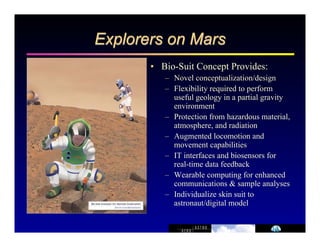
An Astronaut ‘Bio-Suit’ 
System: 
Exploration-Class Missions 
Cam Brensinger, Christopher Carr, Bradley Pitts, Joe Saleh 
Professor Dava J. Newman, Ph.D. 
MIT Department of Aeronautics and Astronautics 
Harvard-MIT Division of Health Science and Technology 
October 30, 2001 
Field exploration, including field geology, will be a major part of 
future human and robotic exploration of the Martian surface.
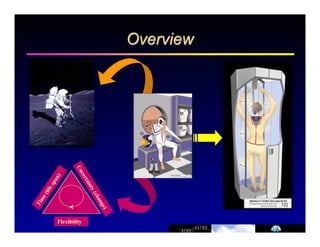
Overview 
Time (life span) 
Uncertainty (change) 
Flexibility
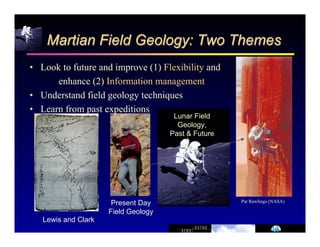
Marrttiian Fiielld Geollogy:: Two Themes 
• Look to future and improve (1) Flexibility and 
enhance (2) Information management 
• Understand field geology techniques 
• Learn from past expeditions 
Pat Rawlings (NASA) 
Lewis and Clark 
Present Day 
Field Geology 
Lunar Field 
Geology, 
Past & Future
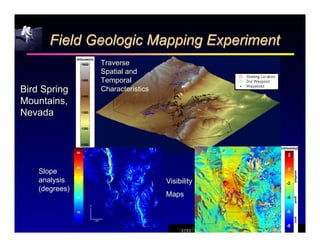
Fiielld Geollogiic Mappiing Experriimentt 
Traverse 
Spatial and 
Temporal 
Characteristics 
Slope 
analysis 
(degrees) 
Visibility 
Maps 
Bird Spring 
Mountains, 
Nevada
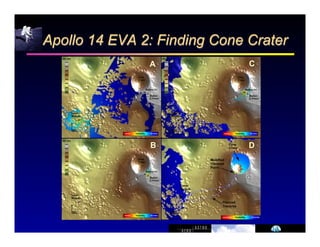
Apollllo 14 EVA 2:: Fiindiing Cone Crratterr 
A 
B 
C 
D
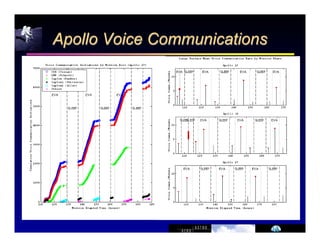
Apollo Voice Communications
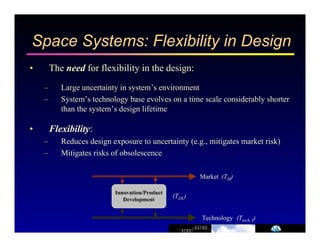
Space Systems: Flexibility in Design 
• The need for flexibility in the design: 
– Large uncertainty in system’s environment 
– System’s technology base evolves on a time scale considerably shorter 
than the system’s design lifetime 
• Flexibility: 
– Reduces design exposure to uncertainty (e.g., mitigates market risk) 
– Mitigates risks of obsolescence 
Market 
Technology 
Innovation/Product 
Development (TDL) 
(TM) 
(Ttech, I)
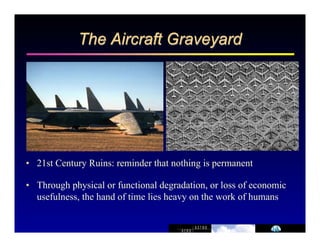
The Aircraft Graveyard 
• 21st Century Ruins: reminder that nothing is permanent 
• Through physical or functional degradation, or loss of economic 
usefulness, the hand of time lies heavy on the work of humans
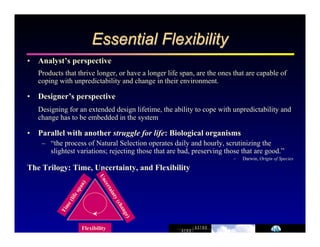
Essential Flexibility 
• Analyst’s perspective 
• 
Products that thrive longer, or have a longer life span, are the ones that are capable of 
coping with unpredictability and change in their environment. 
• Designer’s perspective 
Designing for an extended design lifetime, the ability to cope with unpredictability and 
change has to be embedded in the system 
• Parallel with another struggle for life: Biological organisms 
– “the process of Natural Selection operates daily and hourly, scrutinizing the 
slightest variations; rejecting those that are bad, preserving those that are good.” 
– Darwin, Origin of Species 
The Trilogy: Time, Uncertainty, and Flexibility 
Time (life span) 
Uncertainty (change) 
Flexibility
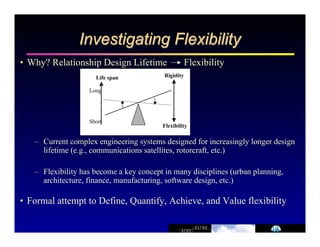
Investigating Flexibility 
• Why? Relationship Design Lifetime Flexibility 
Life span 
Long 
Short 
Rigidity 
Flexibility 
– Current complex engineering systems designed for increasingly longer design 
lifetime (e.g., communications satellites, rotorcraft, etc.) 
– Flexibility has become a key concept in many disciplines (urban planning, 
architecture, finance, manufacturing, software design, etc.) 
• Formal attempt to Define, Quantify, Achieve, and Value flexibility
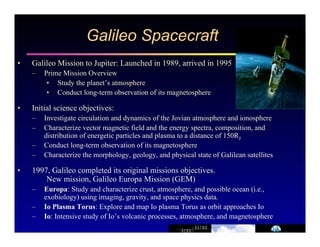
Galileo Spacecraft 
• Galileo Mission to Jupiter: Launched in 1989, arrived in 1995 
– Prime Mission Overview 
• Study the planet’s atmosphere 
• Conduct long-term observation of its magnetosphere 
• Initial science objectives: 
– Investigate circulation and dynamics of the Jovian atmosphere and ionosphere 
– Characterize vector magnetic field and the energy spectra, composition, and 
distribution of energetic particles and plasma to a distance of 150RJ 
– Conduct long-term observation of its magnetosphere 
– Characterize the morphology, geology, and physical state of Galilean satellites 
• 1997, Galileo completed its original missions objectives. 
New mission, Galileo Europa Mission (GEM) 
– Europa: Study and characterize crust, atmosphere, and possible ocean (i.e., 
exobiology) using imaging, gravity, and space physics data. 
– Io Plasma Torus: Explore and map Io plasma Torus as orbit approaches Io 
– Io: Intensive study of Io’s volcanic processes, atmosphere, and magnetosphere
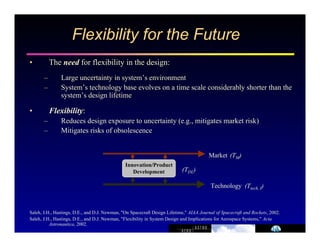
• The need for flexibility in the design: 
– Large uncertainty in system’s environment 
– System’s technology base evolves on a time scale considerably shorter than the 
system’s design lifetime 
• Flexibility: 
– Reduces design exposure to uncertainty (e.g., mitigates market risk) 
– Mitigates risks of obsolescence 
Saleh, J.H., Hastings, D.E., and D.J. Newman, "On Spacecraft Design Lifetime," AIAA Journal of Spacecraft and Rockets, 2002. 
Saleh, J.H., Hastings, D.E., and D.J. Newman, "Flexibility in System Design and Implications for Aerospace Systems," Acta 
Astronautica, 2002. 
Market 
Technology 
Innovation/Product 
Development (TDL) 
(TM) 
(Ttech, I) 
Flexibility for the Future
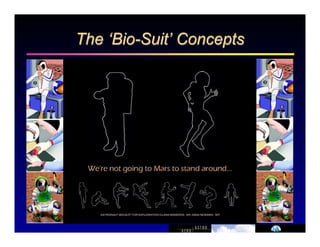
The ‘‘Bio-Suit’’ Concepts
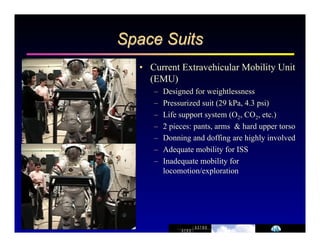
Space Suits 
• Current Extravehicular Mobility Unit 
(EMU) 
– Designed for weightlessness 
– Pressurized suit (29 kPa, 4.3 psi) 
– Life support system (O2, CO2, etc.) 
– 2 pieces: pants, arms & hard upper torso 
– Donning and doffing are highly involved 
– Adequate mobility for ISS 
– Inadequate mobility for 
locomotion/exploration
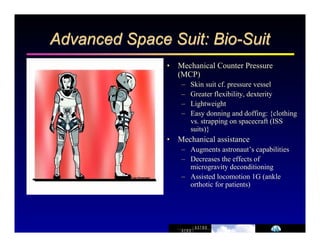
Advanced Space Suit: Bio-Suit 
• Mechanical Counter Pressure 
(MCP) 
– Skin suit cf. pressure vessel 
– Greater flexibility, dexterity 
– Lightweight 
– Easy donning and doffing: {clothing 
vs. strapping on spacecraft (ISS 
suits)} 
• Mechanical assistance 
– Augments astronaut’s capabilities 
– Decreases the effects of 
microgravity deconditioning 
– Assisted locomotion 1G (ankle 
orthotic for patients)
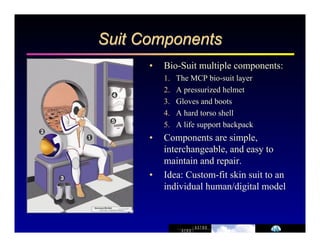
Suit Components 
• Bio-Suit multiple components: 
1. The MCP bio-suit layer 
2. A pressurized helmet 
3. Gloves and boots 
4. A hard torso shell 
5. A life support backpack 
• Components are simple, 
interchangeable, and easy to 
maintain and repair. 
• Idea: Custom-fit skin suit to an 
individual human/digital model
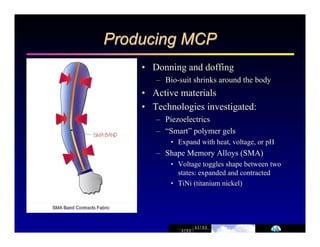
Producing MCP 
• Donning and doffing 
– Bio-suit shrinks around the body 
• Active materials 
• Technologies investigated: 
– Piezoelectrics 
– “Smart” polymer gels 
• Expand with heat, voltage, or pH 
– Shape Memory Alloys (SMA) 
• Voltage toggles shape between two 
states: expanded and contracted 
• TiNi (titanium nickel)
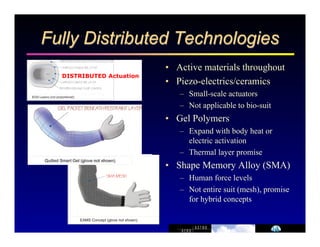
Fully Distributed Technologies 
• Active materials throughout 
• Piezo-electrics/ceramics 
– Small-scale actuators 
– Not applicable to bio-suit 
• Gel Polymers 
– Expand with body heat or 
electric activation 
– Thermal layer promise 
• Shape Memory Alloy (SMA) 
– Human force levels 
– Not entire suit (mesh), promise 
for hybrid concepts
DISTRIBUTED Actuation
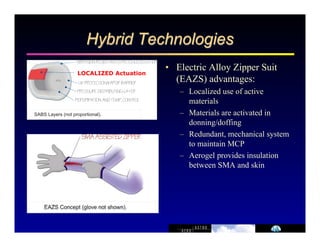
Hybrid Technologies
• Electric Alloy Zipper Suit 
(EAZS) advantages: 
– Localized use of active 
materials 
– Materials are activated in 
donning/doffing 
– Redundant, mechanical system 
to maintain MCP 
– Aerogel provides insulation 
between SMA and skin 
LOCALIZED Actuation
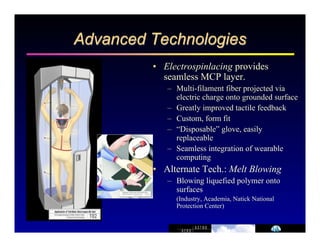
Advanced Technologies 
• Electrospinlacing provides 
seamless MCP layer. 
– Multi-filament fiber projected via 
electric charge onto grounded surface 
– Greatly improved tactile feedback 
– Custom, form fit 
– “Disposable” glove, easily 
replaceable 
– Seamless integration of wearable 
computing 
• Alternate Tech.: Melt Blowing 
– Blowing liquefied polymer onto 
surfaces 
(Industry, Academia, Natick National 
Protection Center)

Astronaut biosuitsystemoct01

  • 1.
    An Astronaut ‘Bio-Suit’ System: Exploration-Class Missions Cam Brensinger, Christopher Carr, Bradley Pitts, Joe Saleh Professor Dava J. Newman, Ph.D. MIT Department of Aeronautics and Astronautics Harvard-MIT Division of Health Science and Technology October 30, 2001 Field exploration, including field geology, will be a major part of future human and robotic exploration of the Martian surface.
  • 2.
    Overview Time (lifespan) Uncertainty (change) Flexibility
  • 3.
    Marrttiian Fiielld Geollogy::Two Themes • Look to future and improve (1) Flexibility and enhance (2) Information management • Understand field geology techniques • Learn from past expeditions Pat Rawlings (NASA) Lewis and Clark Present Day Field Geology Lunar Field Geology, Past & Future
  • 4.
    Fiielld Geollogiic MappiingExperriimentt Traverse Spatial and Temporal Characteristics Slope analysis (degrees) Visibility Maps Bird Spring Mountains, Nevada
  • 5.
    Apollllo 14 EVA2:: Fiindiing Cone Crratterr A B C D
  • 6.
  • 7.
    Space Systems: Flexibilityin Design • The need for flexibility in the design: – Large uncertainty in system’s environment – System’s technology base evolves on a time scale considerably shorter than the system’s design lifetime • Flexibility: – Reduces design exposure to uncertainty (e.g., mitigates market risk) – Mitigates risks of obsolescence Market Technology Innovation/Product Development (TDL) (TM) (Ttech, I)
  • 8.
    The Aircraft Graveyard • 21st Century Ruins: reminder that nothing is permanent • Through physical or functional degradation, or loss of economic usefulness, the hand of time lies heavy on the work of humans
  • 9.
    Essential Flexibility •Analyst’s perspective • Products that thrive longer, or have a longer life span, are the ones that are capable of coping with unpredictability and change in their environment. • Designer’s perspective Designing for an extended design lifetime, the ability to cope with unpredictability and change has to be embedded in the system • Parallel with another struggle for life: Biological organisms – “the process of Natural Selection operates daily and hourly, scrutinizing the slightest variations; rejecting those that are bad, preserving those that are good.” – Darwin, Origin of Species The Trilogy: Time, Uncertainty, and Flexibility Time (life span) Uncertainty (change) Flexibility
  • 10.
    Investigating Flexibility •Why? Relationship Design Lifetime Flexibility Life span Long Short Rigidity Flexibility – Current complex engineering systems designed for increasingly longer design lifetime (e.g., communications satellites, rotorcraft, etc.) – Flexibility has become a key concept in many disciplines (urban planning, architecture, finance, manufacturing, software design, etc.) • Formal attempt to Define, Quantify, Achieve, and Value flexibility
  • 11.
    Galileo Spacecraft •Galileo Mission to Jupiter: Launched in 1989, arrived in 1995 – Prime Mission Overview • Study the planet’s atmosphere • Conduct long-term observation of its magnetosphere • Initial science objectives: – Investigate circulation and dynamics of the Jovian atmosphere and ionosphere – Characterize vector magnetic field and the energy spectra, composition, and distribution of energetic particles and plasma to a distance of 150RJ – Conduct long-term observation of its magnetosphere – Characterize the morphology, geology, and physical state of Galilean satellites • 1997, Galileo completed its original missions objectives. New mission, Galileo Europa Mission (GEM) – Europa: Study and characterize crust, atmosphere, and possible ocean (i.e., exobiology) using imaging, gravity, and space physics data. – Io Plasma Torus: Explore and map Io plasma Torus as orbit approaches Io – Io: Intensive study of Io’s volcanic processes, atmosphere, and magnetosphere
  • 12.
    • The needfor flexibility in the design: – Large uncertainty in system’s environment – System’s technology base evolves on a time scale considerably shorter than the system’s design lifetime • Flexibility: – Reduces design exposure to uncertainty (e.g., mitigates market risk) – Mitigates risks of obsolescence Saleh, J.H., Hastings, D.E., and D.J. Newman, "On Spacecraft Design Lifetime," AIAA Journal of Spacecraft and Rockets, 2002. Saleh, J.H., Hastings, D.E., and D.J. Newman, "Flexibility in System Design and Implications for Aerospace Systems," Acta Astronautica, 2002. Market Technology Innovation/Product Development (TDL) (TM) (Ttech, I) Flexibility for the Future
  • 13.
  • 14.
    Space Suits •Current Extravehicular Mobility Unit (EMU) – Designed for weightlessness – Pressurized suit (29 kPa, 4.3 psi) – Life support system (O2, CO2, etc.) – 2 pieces: pants, arms & hard upper torso – Donning and doffing are highly involved – Adequate mobility for ISS – Inadequate mobility for locomotion/exploration
  • 15.
    Advanced Space Suit:Bio-Suit • Mechanical Counter Pressure (MCP) – Skin suit cf. pressure vessel – Greater flexibility, dexterity – Lightweight – Easy donning and doffing: {clothing vs. strapping on spacecraft (ISS suits)} • Mechanical assistance – Augments astronaut’s capabilities – Decreases the effects of microgravity deconditioning – Assisted locomotion 1G (ankle orthotic for patients)
  • 16.
    Suit Components •Bio-Suit multiple components: 1. The MCP bio-suit layer 2. A pressurized helmet 3. Gloves and boots 4. A hard torso shell 5. A life support backpack • Components are simple, interchangeable, and easy to maintain and repair. • Idea: Custom-fit skin suit to an individual human/digital model
  • 17.
    Producing MCP •Donning and doffing – Bio-suit shrinks around the body • Active materials • Technologies investigated: – Piezoelectrics – “Smart” polymer gels • Expand with heat, voltage, or pH – Shape Memory Alloys (SMA) • Voltage toggles shape between two states: expanded and contracted • TiNi (titanium nickel)
  • 18.
    Fully Distributed Technologies • Active materials throughout • Piezo-electrics/ceramics – Small-scale actuators – Not applicable to bio-suit • Gel Polymers – Expand with body heat or electric activation – Thermal layer promise • Shape Memory Alloy (SMA) – Human force levels – Not entire suit (mesh), promise for hybrid concepts
  • 19.
  • 20.
  • 21.
    • Electric AlloyZipper Suit (EAZS) advantages: – Localized use of active materials – Materials are activated in donning/doffing – Redundant, mechanical system to maintain MCP – Aerogel provides insulation between SMA and skin LOCALIZED Actuation
  • 22.
    Advanced Technologies •Electrospinlacing provides seamless MCP layer. – Multi-filament fiber projected via electric charge onto grounded surface – Greatly improved tactile feedback – Custom, form fit – “Disposable” glove, easily replaceable – Seamless integration of wearable computing • Alternate Tech.: Melt Blowing – Blowing liquefied polymer onto surfaces (Industry, Academia, Natick National Protection Center)