Meeting NASA’s Technology Challenges Through
                    Innovation and Collaboration


                           Andrew Petro/Doug Comstock
             Director, Innovative Partnerships Program – NASA Headquarters

                       NASA Project Management Challenge 2010
                                  Galveston, Texas
Used with permission              February 9, 2010
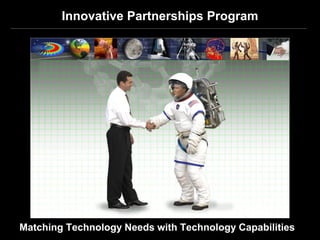
Innovative Partnerships Program


Matching Technology Needs with Technology Capabilities
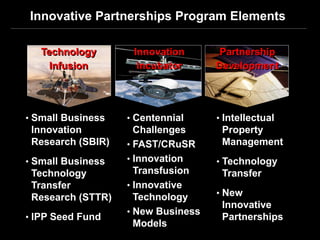
Innovative Partnerships Program Elements

   Technology       Innovation      Partnership
     Infusion        Incubator      Development


• Small Business   • Centennial     • Intellectual
 Innovation          Challenges      Property
 Research (SBIR)   • FAST/CRuSR      Management
• Small Business   • Innovation     • Technology
 Technology          Transfusion     Transfer
 Transfer          • Innovative
 Research (STTR)     Technology     • New
                                     Innovative
                   • New Business
• IPP Seed Fund                      Partnerships
                     Models
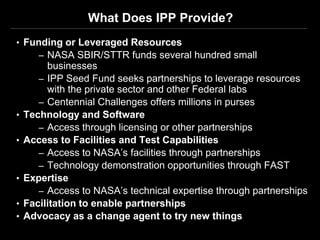
What Does IPP Provide?
• Funding or Leveraged Resources
     – NASA SBIR/STTR funds several hundred small
         businesses
       – IPP Seed Fund seeks partnerships to leverage resources
         with the private sector and other Federal labs
       – Centennial Challenges offers millions in purses
•   Technology and Software
       – Access through licensing or other partnerships
•   Access to Facilities and Test Capabilities
       – Access to NASA’s facilities through partnerships
       – Technology demonstration opportunities through FAST
•   Expertise
       – Access to NASA’s technical expertise through partnerships
•   Facilitation to enable partnerships
•   Advocacy as a change agent to try new things
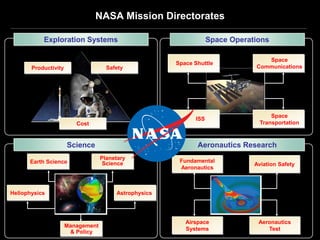
NASA Mission Directorates

           Exploration Systems                                     Space Operations

                                                                                  Space
                                                       Space Shuttle
       Productivity                  Safety                                    Communications


                                                                                     Space
                                                             ISS
                         Cost                                                    Transportation


                      Science                                 Aeronautics Research
                                   Planetary            Fundamental
      Earth Science                 Science                                    Aviation Safety
                                                        Aeronautics


Heliophysics                            Astrophysics


                                                          Airspace              Aeronautics
                      Management
                                                          Systems                  Test
                       & Policy
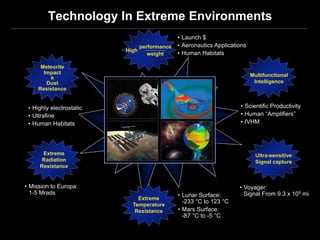
Technology In Extreme Environments
                                               • Launch $
                                 performance   • Aeronautics Applications
                          High
                                    weight     • Human Habitats

      Meteorite
       Impact                                                               Multifunctional
          &
       Dust                                                                  Intelligence
     Resistance


 • Highly electrostatic                                               • Scientific Productivity
 • Ultrafine                                                          • Human “Amplifiers”
 • Human Habitats                                                     • IVHM


      Extreme                                                                 Ultra-sensitive
     Radiation                                                                Signal capture
     Resistance


• Mission to Europa:                                                  • Voyager:
  1-5 Mrads                                    • Lunar Surface:         Signal From 9.3 x 10⁹ mi
                              Extreme
                                                 -233 °C to 123 °C
                            Temperature
                             Resistance        • Mars Surface:
                                                 -87 °C to -5 °C
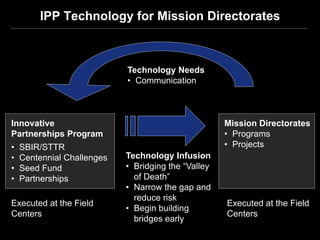
IPP Technology for Mission Directorates


                            Technology Needs
                            • Communication


Innovative                                           Mission Directorates
Partnerships Program                                 • Programs
•   SBIR/STTR                                        • Projects
•   Centennial Challenges   Technology Infusion
•   Seed Fund               • Bridging the “Valley
•   Partnerships              of Death”
                            • Narrow the gap and
                              reduce risk
Executed at the Field                                Executed at the Field
                            • Begin building
Centers                                              Centers
                              bridges early
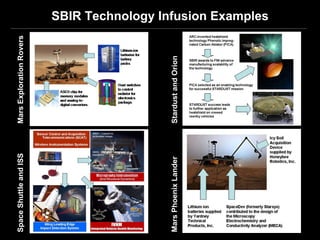
Space Shuttle and ISS   Mars Exploration Rovers


Mars Phoenix Lander     Stardust and Orion
                                                  SBIR Technology Infusion Examples
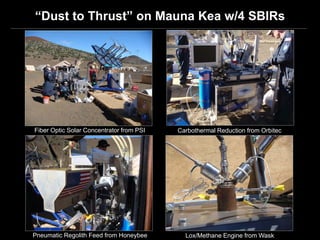
“Dust to Thrust” on Mauna Kea w/4 SBIRs


Fiber Optic Solar Concentrator from PSI   Carbothermal Reduction from Orbitec


Pneumatic Regolith Feed from Honeybee       Lox/Methane Engine from Wask
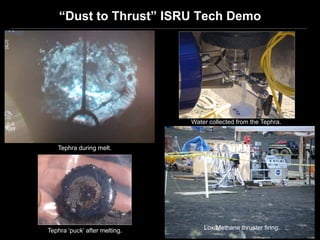
“Dust to Thrust” ISRU Tech Demo


                               Water collected from the Tephra.


   Tephra during melt.


Tephra ‘puck’ after melting.       Lox/Methane thruster firing.
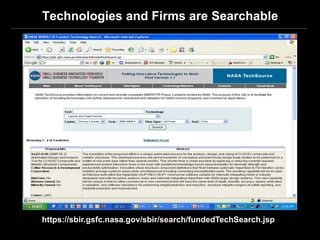
Technologies and Firms are Searchable


https://sbir.gsfc.nasa.gov/sbir/search/fundedTechSearch.jsp
Hallmarks of Success

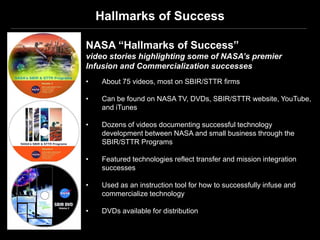
NASA “Hallmarks of Success”
video stories highlighting some of NASA’s premier
Infusion and Commercialization successes
•   About 75 videos, most on SBIR/STTR firms

•   Can be found on NASA TV, DVDs, SBIR/STTR website, YouTube,
    and iTunes

•   Dozens of videos documenting successful technology
    development between NASA and small business through the
    SBIR/STTR Programs

•   Featured technologies reflect transfer and mission integration
    successes

•   Used as an instruction tool for how to successfully infuse and
    commercialize technology

•   DVDs available for distribution
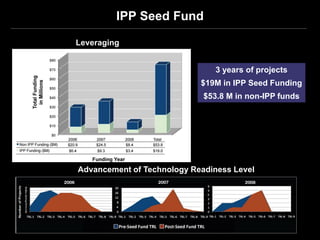
IPP Seed Fund

Leveraging


                                3 years of projects
                            $19M in IPP Seed Funding
                             $53.8 M in non-IPP funds


Advancement of Technology Readiness Level
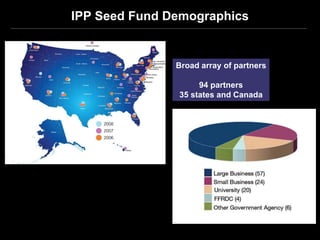
IPP Seed Fund Demographics


               Broad array of partners

                    94 partners
               35 states and Canada
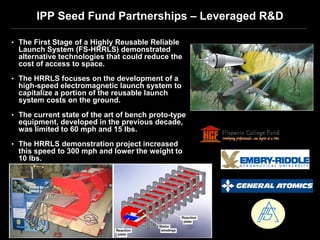
IPP Seed Fund Partnerships – Leveraged R&D

• The First Stage of a Highly Reusable Reliable
  Launch System (FS-HRRLS) demonstrated
  alternative technologies that could reduce the
  cost of access to space.
• The HRRLS focuses on the development of a
  high-speed electromagnetic launch system to
  capitalize a portion of the reusable launch
  system costs on the ground.
• The current state of the art of bench proto-type
  equipment, developed in the previous decade,
  was limited to 60 mph and 15 lbs.
• The HRRLS demonstration project increased
  this speed to 300 mph and lower the weight to
  10 lbs.
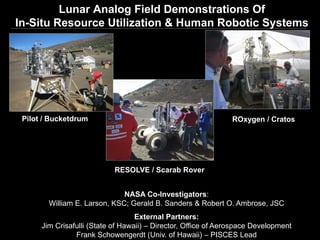
Lunar Analog Field Demonstrations Of
In-Situ Resource Utilization & Human Robotic Systems


 Pilot / Bucketdrum                                            ROxygen / Cratos


                            RESOLVE / Scarab Rover


                              NASA Co-Investigators:
        William E. Larson, KSC; Gerald B. Sanders & Robert O. Ambrose, JSC
                                   External Partners:
      Jim Crisafulli (State of Hawaii) – Director, Office of Aerospace Development
                Frank Schowengerdt (Univ. of Hawaii) – PISCES Lead
Innovation Incubator Highlights

• Centennial Challenges - Incentive Prizes
       – Seeking technology solutions from new sources for NASA and the nation
       – Five competition events in 2009
              • $3.65M in prizes awarded to eight different teams
       – Announced new Green Flight Challenge for supper-efficient aircraft
       – Will announce several new challenges in 2010
• FAST and CRuSR
       – Seeking to advance technology maturity and promote use of commercial services.
       – Using parabolic flight services for zero and reduced-gravity technology testing
       – 19 projects flown in 2009, will offer similar opportunity in 2010
       – CRuSR program initiated to support future use of suborbital vehicles for research
• Innovation Transfusion
       – Seeking to tap into external sources of innovation to benefit NASA.
       – Two Innovation Ambassadors assignments begun in 2009, more planned for 2010
       – Innovation Scout visits planed for 2010
• Innovative Technology Initiative
       – Supporting proof-of-concept projects for “game-changing” technologies
       – Funded 20 projects across NASA in 2009, selected from over 230 proposals
       – Expanding program for 2010 and beyond
Centennial Challenges
NASA Prizes for the Citizen-Inventor
• 19 competitions held since 2005, $4.5M in prizes
  awarded to 13 different teams

•   Five competition events in 2009
      • $3.65M in prizes awarded to eight different teams
      • Regolith Excavation – robotic devices to exploit lunar resources
           • Three winners, among 23 competing teams, claimed $750K
      • Lunar Lander – robust, reusable rocket-powered vehicles
           • Three teams flew a total of five vehicles, two teams shared $1.65M in prizes
      • Power Beaming – wireless power transmission over a 1 kilometer distance
           • $900K won by one team in an unprecedented technology demonstration
      • Astronaut Glove – new techniques for strong, flexible gloves
           • $350K won by two veteran competitors
      • Strong Tether – seeking materials 50% stronger than best existing
           • Two-meter long carbon nano-tube tether demonstrated, but no winner

•   Announced new Green Flight Challenge for super-efficient aircraft in July
•   Venue for Regolith Excavation became permanent Lunar Regolith Testbed at NASA
    Ames Research Park, in partnership with California Space Authority
Centennial Challenges

Plans for 2010 and Beyond
• Next round of Power Beaming and Strong Tether Challenges in 2010
• Green Flight Challenge in July, 2011 – eight teams already registered

•   Prize ideas solicited from the public and across NASA – about 200
    ideas generated                                                           Green Flight
•   Will announce several new challenges in 2010 with $5.5M available for prizes
      • Candidates include:
           • Energy storage
           • Participatory science
           • Miniature satellites
           • Low-cost concepts for access to space
           • Robotics for exploration or space operations
                                                                          Power Beaming

• Will seek to enhance participation and impact with new prizes
    • Education
          • University-level along with open-level competition
          • K-12 science and engineering activities
    • Larger numbers of competitors
    • Relevance of technologies to national and global needs
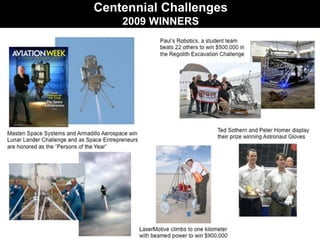
Centennial Challenges
    2009 WINNERS
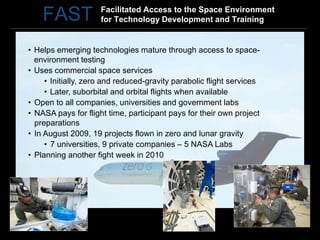
Facilitated Access to the Space Environment
    FAST             for Technology Development and Training


• Helps emerging technologies mature through access to space-
  environment testing
• Uses commercial space services
     • Initially, zero and reduced-gravity parabolic flight services
     • Later, suborbital and orbital flights when available
• Open to all companies, universities and government labs
• NASA pays for flight time, participant pays for their own project
  preparations
• In August 2009, 19 projects flown in zero and lunar gravity
     • 7 universities, 9 private companies – 5 NASA Labs
• Planning another fight week in 2010
Innovation Transfusion

• Tapping into external sources of innovation to benefit NASA

• Working with Offices of Chief Engineer and Human Capital

• Innovation Ambassadors - Technical training experience for 3
 months to a year with an external organization

     – One assignment completed at MIT Media Lab

     – Assignment underway at National Renewable Energy Lab

     – Targeting assignment near NASA Centers for 2010 due to lack
       of funding

• Innovation Scouts - Workshops with NASA and external
 organizations focused on specific innovations
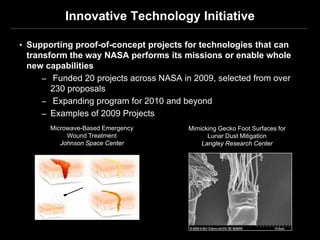
Innovative Technology Initiative

• Supporting proof-of-concept projects for technologies that can
 transform the way NASA performs its missions or enable whole
 new capabilities
     – Funded 20 projects across NASA in 2009, selected from over
       230 proposals
     – Expanding program for 2010 and beyond
     – Examples of 2009 Projects
       Microwave-Based Emergency        Mimicking Gecko Foot Surfaces for
            Wound Treatment                   Lunar Dust Mitigation
          Johnson Space Center              Langley Research Center
Administrator Bolden Announces CRuSR
     Speech to Nat’l Assoc. of Investment Companies, Oct. 20, 2009*


• NASA must determine efficient and effective ways to leverage
 the power, and innovation of American industry and the
 American entrepreneur.
• In the 1920s, the U.S. Post Office became a major customer
 for airmail, which created the demand that justified the private
 investment in many airlines.
• NASA is doing something similar right now. We are engaged in
 a new program — the Commercial Reusable Suborbital
 Research program — that will buy space transportation
 services from the emerging reusable spaceflight companies to
 conduct science research, technology development, with a
 keen focus on education.”
       * http://www.nasa.gov/pdf/395165main_Bolden_NAIC_Speech.pdf

                                                                     24
Benefits of Commercial Reusable Suborbital Research

• Through a user-focused program, NASA-sponsored researchers,
  engineers, technologists and educators would be able to conduct
  hands-on activities in near-space for the first time.
• This new environment provides several technical benefits to NASA.
     – Reducing the risk for use of new technologies in future missions.
     – Developing and testing medical procedures.
     – Access to 3-4 minutes of microgravity for discovery and testing.
     – Routine recovery of payload.
     – Frequent flights.
• Provides new options for career development and public
  engagement.
     – Inspiring new careers in aerospace .
     – Training the workforce of the future.
     – Creating greater excitement in the space program.
• Providing a competitive edge for the new commercial space
  industry.
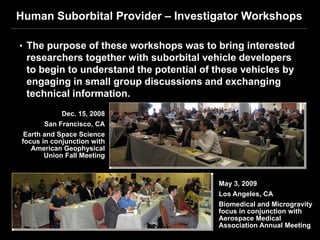
Human Suborbital Provider – Investigator Workshops

• The purpose of these workshops was to bring interested
 researchers together with suborbital vehicle developers
 to begin to understand the potential of these vehicles by
 engaging in small group discussions and exchanging
 technical information.
            Dec. 15, 2008
      San Francisco, CA
 Earth and Space Science
focus in conjunction with
   American Geophysical
       Union Fall Meeting


                                         May 3, 2009
                                         Los Angeles, CA
                                         Biomedical and Microgravity
                                         focus in conjunction with
                                         Aerospace Medical
                                         Association Annual Meeting
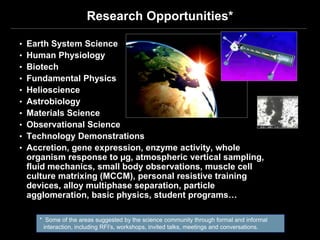
Research Opportunities*

•   Earth System Science
•   Human Physiology
•   Biotech
•   Fundamental Physics
•   Helioscience
•   Astrobiology
•   Materials Science
•   Observational Science
•   Technology Demonstrations
•   Accretion, gene expression, enzyme activity, whole
    organism response to µg, atmospheric vertical sampling,
    fluid mechanics, small body observations, muscle cell
    culture matrixing (MCCM), personal resistive training
    devices, alloy multiphase separation, particle
    agglomeration, basic physics, student programs…

       * Some of the areas suggested by the science community through formal and informal
        interaction, including RFI’s, workshops, invited talks, meetings and conversations.
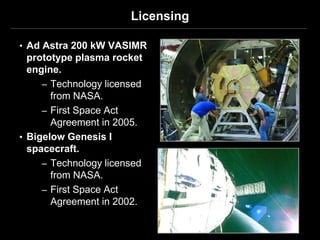
Licensing

• Ad Astra 200 kW VASIMR
  prototype plasma rocket
  engine.
     – Technology licensed
       from NASA.
     – First Space Act
       Agreement in 2005.
• Bigelow Genesis I
  spacecraft.
     – Technology licensed
       from NASA.
     – First Space Act
       Agreement in 2002.
Open Source Software Development

• New problem tracking software incorporated into latest Shuttle
 mission.
• The Problem Reporting Analysis and Corrective Action (PRACA)
 system was created by the Human-Computer Interaction Group at
 NASA Ames Research Center.
  – The Ames IPP Office open-sourced the PRACA software in April
    2008 using open-source Bugzilla tools.
  – The updated version – developed for an order of magnitude less
    than using traditional methods – is being used by Lockheed Martin
    and ATK Space Launch Systems.
  – The single, universally accessible PRACA package is replacing a
    set of more than 40 different database systems that had been used
    over the past 30 years by the many different parts of the shuttle
    program.
  – PRACA systems are being used in the Constellation program and
    will be implemented program-wide in the Space Shuttle in March
    2009.
Commercial Space and NASA


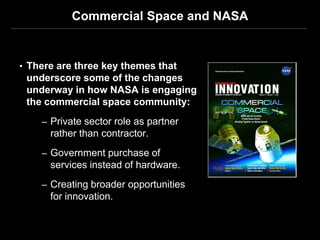
• There are three key themes that
 underscore some of the changes
 underway in how NASA is engaging
 the commercial space community:
    – Private sector role as partner
      rather than contractor.
    – Government purchase of
      services instead of hardware.
    – Creating broader opportunities
      for innovation.
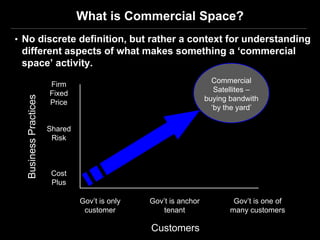
What is Commercial Space?
• No discrete definition, but rather a context for understanding
 different aspects of what makes something a ‘commercial
 space’ activity.
                                                                    Commercial
                       Firm
                                                                     Satellites –
                       Fixed
  Business Practices


                                                                  buying bandwith
                       Price
                                                                    ‘by the yard’

                       Shared
                        Risk


                        Cost
                        Plus

                                Gov’t is only   Gov’t is anchor           Gov’t is one of
                                 customer          tenant                many customers

                                                Customers
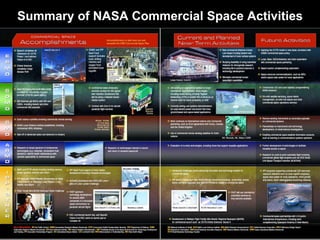
Summary of NASA Commercial Space Activities
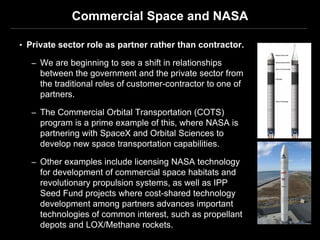
Commercial Space and NASA

• Private sector role as partner rather than contractor.

   – We are beginning to see a shift in relationships
     between the government and the private sector from
     the traditional roles of customer-contractor to one of
     partners.

   – The Commercial Orbital Transportation (COTS)
     program is a prime example of this, where NASA is
     partnering with SpaceX and Orbital Sciences to
     develop new space transportation capabilities.

   – Other examples include licensing NASA technology
     for development of commercial space habitats and
     revolutionary propulsion systems, as well as IPP
     Seed Fund projects where cost-shared technology
     development among partners advances important
     technologies of common interest, such as propellant
     depots and LOX/Methane rockets.
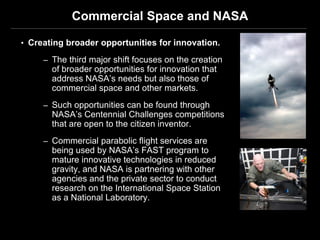
Commercial Space and NASA

• Creating broader opportunities for innovation.

     – The third major shift focuses on the creation
       of broader opportunities for innovation that
       address NASA’s needs but also those of
       commercial space and other markets.
     – Such opportunities can be found through
       NASA’s Centennial Challenges competitions
       that are open to the citizen inventor.
     – Commercial parabolic flight services are
       being used by NASA’s FAST program to
       mature innovative technologies in reduced
       gravity, and NASA is partnering with other
       agencies and the private sector to conduct
       research on the International Space Station
       as a National Laboratory.
Commercial Space and NASA
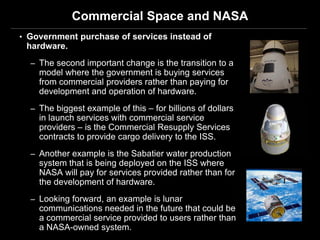
• Government purchase of services instead of
 hardware.
  – The second important change is the transition to a
    model where the government is buying services
    from commercial providers rather than paying for
    development and operation of hardware.
  – The biggest example of this – for billions of dollars
    in launch services with commercial service
    providers – is the Commercial Resupply Services
    contracts to provide cargo delivery to the ISS.
  – Another example is the Sabatier water production
    system that is being deployed on the ISS where
    NASA will pay for services provided rather than for
    the development of hardware.
  – Looking forward, an example is lunar
    communications needed in the future that could be
    a commercial service provided to users rather than
    a NASA-owned system.
Finding Technologies

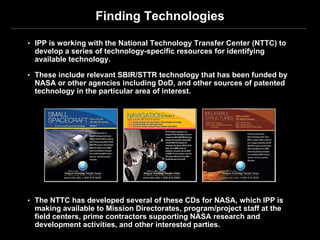
• IPP is working with the National Technology Transfer Center (NTTC) to
 develop a series of technology-specific resources for identifying
 available technology.

• These include relevant SBIR/STTR technology that has been funded by
 NASA or other agencies including DoD, and other sources of patented
 technology in the particular area of interest.


• The NTTC has developed several of these CDs for NASA, which IPP is
 making available to Mission Directorates, program/project staff at the
 field centers, prime contractors supporting NASA research and
 development activities, and other interested parties.
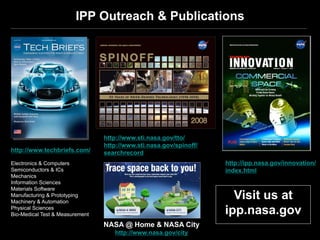
IPP Outreach & Publications


                                 http://www.sti.nasa.gov/tto/
                                 http://www.sti.nasa.gov/spinoff/
http://www.techbriefs.com/       searchrecord
Electronics & Computers                                             http://ipp.nasa.gov/innovation/
Semiconductors & ICs                                                index.html
Mechanics
Information Sciences
Materials Software
Manufacturing & Prototyping
Machinery & Automation
                                                                      Visit us at
Physical Sciences
Bio-Medical Test & Measurement                                      ipp.nasa.gov
                                 NASA @ Home & NASA City
                                    http://www.nasa.gov/city
Interested in partnering?

         Contact the relevant IPP Center Chief(s):
Center   Name             Email                         Phone
ARC   Lisa Lockyer     Lisa.L.Lockyer@nasa.gov         (650) 604-0149
DFRC Gregory Poteat    Gregory.A.Poteat@nasa.gov       (661) 276-3872
GRC Kathy Needham      Kathleen.K.Needham@nasa.gov     (216) 433-2802
GSFC Nona Cheeks       Nona.K.Cheeks@nasa.gov          (301) 286-8504
JPL   Andrew Gray      Gray@jpl.nasa.gov               (818) 354-4906
JSC   Michele Brekke   Michele.A.Brekke@nasa.gov       (281) 483-4614
KSC   Dave Makufka     David.R.Makufka@nasa.gov        (321) 867-6227
LaRC Beth Plentovich   Elizabeth.B.Plentovich@nasa.gov (757) 864-2857
MSFC Jim Dowdy         Jim.Dowdy@nasa.gov              (256) 544-7604
SSC   Ramona Travis    Ramona.E.Travis@nasa.gov        (228) 688-1660
National Aeronautics and Space Administration

               www.nasa.gov

Comstock petro

  • 1.
    Meeting NASA’s TechnologyChallenges Through Innovation and Collaboration Andrew Petro/Doug Comstock Director, Innovative Partnerships Program – NASA Headquarters NASA Project Management Challenge 2010 Galveston, Texas Used with permission February 9, 2010
  • 2.
    Innovative Partnerships Program MatchingTechnology Needs with Technology Capabilities
  • 3.
    Innovative Partnerships ProgramElements Technology Innovation Partnership Infusion Incubator Development • Small Business • Centennial • Intellectual Innovation Challenges Property Research (SBIR) • FAST/CRuSR Management • Small Business • Innovation • Technology Technology Transfusion Transfer Transfer • Innovative Research (STTR) Technology • New Innovative • New Business • IPP Seed Fund Partnerships Models
  • 4.
    What Does IPPProvide? • Funding or Leveraged Resources – NASA SBIR/STTR funds several hundred small businesses – IPP Seed Fund seeks partnerships to leverage resources with the private sector and other Federal labs – Centennial Challenges offers millions in purses • Technology and Software – Access through licensing or other partnerships • Access to Facilities and Test Capabilities – Access to NASA’s facilities through partnerships – Technology demonstration opportunities through FAST • Expertise – Access to NASA’s technical expertise through partnerships • Facilitation to enable partnerships • Advocacy as a change agent to try new things
  • 5.
    NASA Mission Directorates Exploration Systems Space Operations Space Space Shuttle Productivity Safety Communications Space ISS Cost Transportation Science Aeronautics Research Planetary Fundamental Earth Science Science Aviation Safety Aeronautics Heliophysics Astrophysics Airspace Aeronautics Management Systems Test & Policy
  • 6.
    Technology In ExtremeEnvironments • Launch $ performance • Aeronautics Applications High weight • Human Habitats Meteorite Impact Multifunctional & Dust Intelligence Resistance • Highly electrostatic • Scientific Productivity • Ultrafine • Human “Amplifiers” • Human Habitats • IVHM Extreme Ultra-sensitive Radiation Signal capture Resistance • Mission to Europa: • Voyager: 1-5 Mrads • Lunar Surface: Signal From 9.3 x 10⁹ mi Extreme -233 °C to 123 °C Temperature Resistance • Mars Surface: -87 °C to -5 °C
  • 7.
    IPP Technology forMission Directorates Technology Needs • Communication Innovative Mission Directorates Partnerships Program • Programs • SBIR/STTR • Projects • Centennial Challenges Technology Infusion • Seed Fund • Bridging the “Valley • Partnerships of Death” • Narrow the gap and reduce risk Executed at the Field Executed at the Field • Begin building Centers Centers bridges early
  • 8.
    Space Shuttle andISS Mars Exploration Rovers Mars Phoenix Lander Stardust and Orion SBIR Technology Infusion Examples
  • 9.
    “Dust to Thrust”on Mauna Kea w/4 SBIRs Fiber Optic Solar Concentrator from PSI Carbothermal Reduction from Orbitec Pneumatic Regolith Feed from Honeybee Lox/Methane Engine from Wask
  • 10.
    “Dust to Thrust”ISRU Tech Demo Water collected from the Tephra. Tephra during melt. Tephra ‘puck’ after melting. Lox/Methane thruster firing.
  • 11.
    Technologies and Firmsare Searchable https://sbir.gsfc.nasa.gov/sbir/search/fundedTechSearch.jsp
  • 12.
    Hallmarks of Success NASA“Hallmarks of Success” video stories highlighting some of NASA’s premier Infusion and Commercialization successes • About 75 videos, most on SBIR/STTR firms • Can be found on NASA TV, DVDs, SBIR/STTR website, YouTube, and iTunes • Dozens of videos documenting successful technology development between NASA and small business through the SBIR/STTR Programs • Featured technologies reflect transfer and mission integration successes • Used as an instruction tool for how to successfully infuse and commercialize technology • DVDs available for distribution
  • 13.
    IPP Seed Fund Leveraging 3 years of projects $19M in IPP Seed Funding $53.8 M in non-IPP funds Advancement of Technology Readiness Level
  • 14.
    IPP Seed FundDemographics Broad array of partners 94 partners 35 states and Canada
  • 15.
    IPP Seed FundPartnerships – Leveraged R&D • The First Stage of a Highly Reusable Reliable Launch System (FS-HRRLS) demonstrated alternative technologies that could reduce the cost of access to space. • The HRRLS focuses on the development of a high-speed electromagnetic launch system to capitalize a portion of the reusable launch system costs on the ground. • The current state of the art of bench proto-type equipment, developed in the previous decade, was limited to 60 mph and 15 lbs. • The HRRLS demonstration project increased this speed to 300 mph and lower the weight to 10 lbs.
  • 16.
    Lunar Analog FieldDemonstrations Of In-Situ Resource Utilization & Human Robotic Systems Pilot / Bucketdrum ROxygen / Cratos RESOLVE / Scarab Rover NASA Co-Investigators: William E. Larson, KSC; Gerald B. Sanders & Robert O. Ambrose, JSC External Partners: Jim Crisafulli (State of Hawaii) – Director, Office of Aerospace Development Frank Schowengerdt (Univ. of Hawaii) – PISCES Lead
  • 17.
    Innovation Incubator Highlights •Centennial Challenges - Incentive Prizes – Seeking technology solutions from new sources for NASA and the nation – Five competition events in 2009 • $3.65M in prizes awarded to eight different teams – Announced new Green Flight Challenge for supper-efficient aircraft – Will announce several new challenges in 2010 • FAST and CRuSR – Seeking to advance technology maturity and promote use of commercial services. – Using parabolic flight services for zero and reduced-gravity technology testing – 19 projects flown in 2009, will offer similar opportunity in 2010 – CRuSR program initiated to support future use of suborbital vehicles for research • Innovation Transfusion – Seeking to tap into external sources of innovation to benefit NASA. – Two Innovation Ambassadors assignments begun in 2009, more planned for 2010 – Innovation Scout visits planed for 2010 • Innovative Technology Initiative – Supporting proof-of-concept projects for “game-changing” technologies – Funded 20 projects across NASA in 2009, selected from over 230 proposals – Expanding program for 2010 and beyond
  • 18.
    Centennial Challenges NASA Prizesfor the Citizen-Inventor • 19 competitions held since 2005, $4.5M in prizes awarded to 13 different teams • Five competition events in 2009 • $3.65M in prizes awarded to eight different teams • Regolith Excavation – robotic devices to exploit lunar resources • Three winners, among 23 competing teams, claimed $750K • Lunar Lander – robust, reusable rocket-powered vehicles • Three teams flew a total of five vehicles, two teams shared $1.65M in prizes • Power Beaming – wireless power transmission over a 1 kilometer distance • $900K won by one team in an unprecedented technology demonstration • Astronaut Glove – new techniques for strong, flexible gloves • $350K won by two veteran competitors • Strong Tether – seeking materials 50% stronger than best existing • Two-meter long carbon nano-tube tether demonstrated, but no winner • Announced new Green Flight Challenge for super-efficient aircraft in July • Venue for Regolith Excavation became permanent Lunar Regolith Testbed at NASA Ames Research Park, in partnership with California Space Authority
  • 19.
    Centennial Challenges Plans for2010 and Beyond • Next round of Power Beaming and Strong Tether Challenges in 2010 • Green Flight Challenge in July, 2011 – eight teams already registered • Prize ideas solicited from the public and across NASA – about 200 ideas generated Green Flight • Will announce several new challenges in 2010 with $5.5M available for prizes • Candidates include: • Energy storage • Participatory science • Miniature satellites • Low-cost concepts for access to space • Robotics for exploration or space operations Power Beaming • Will seek to enhance participation and impact with new prizes • Education • University-level along with open-level competition • K-12 science and engineering activities • Larger numbers of competitors • Relevance of technologies to national and global needs
  • 20.
  • 21.
    Facilitated Access tothe Space Environment FAST for Technology Development and Training • Helps emerging technologies mature through access to space- environment testing • Uses commercial space services • Initially, zero and reduced-gravity parabolic flight services • Later, suborbital and orbital flights when available • Open to all companies, universities and government labs • NASA pays for flight time, participant pays for their own project preparations • In August 2009, 19 projects flown in zero and lunar gravity • 7 universities, 9 private companies – 5 NASA Labs • Planning another fight week in 2010
  • 22.
    Innovation Transfusion • Tappinginto external sources of innovation to benefit NASA • Working with Offices of Chief Engineer and Human Capital • Innovation Ambassadors - Technical training experience for 3 months to a year with an external organization – One assignment completed at MIT Media Lab – Assignment underway at National Renewable Energy Lab – Targeting assignment near NASA Centers for 2010 due to lack of funding • Innovation Scouts - Workshops with NASA and external organizations focused on specific innovations
  • 23.
    Innovative Technology Initiative •Supporting proof-of-concept projects for technologies that can transform the way NASA performs its missions or enable whole new capabilities – Funded 20 projects across NASA in 2009, selected from over 230 proposals – Expanding program for 2010 and beyond – Examples of 2009 Projects Microwave-Based Emergency Mimicking Gecko Foot Surfaces for Wound Treatment Lunar Dust Mitigation Johnson Space Center Langley Research Center
  • 24.
    Administrator Bolden AnnouncesCRuSR Speech to Nat’l Assoc. of Investment Companies, Oct. 20, 2009* • NASA must determine efficient and effective ways to leverage the power, and innovation of American industry and the American entrepreneur. • In the 1920s, the U.S. Post Office became a major customer for airmail, which created the demand that justified the private investment in many airlines. • NASA is doing something similar right now. We are engaged in a new program — the Commercial Reusable Suborbital Research program — that will buy space transportation services from the emerging reusable spaceflight companies to conduct science research, technology development, with a keen focus on education.” * http://www.nasa.gov/pdf/395165main_Bolden_NAIC_Speech.pdf 24
  • 25.
    Benefits of CommercialReusable Suborbital Research • Through a user-focused program, NASA-sponsored researchers, engineers, technologists and educators would be able to conduct hands-on activities in near-space for the first time. • This new environment provides several technical benefits to NASA. – Reducing the risk for use of new technologies in future missions. – Developing and testing medical procedures. – Access to 3-4 minutes of microgravity for discovery and testing. – Routine recovery of payload. – Frequent flights. • Provides new options for career development and public engagement. – Inspiring new careers in aerospace . – Training the workforce of the future. – Creating greater excitement in the space program. • Providing a competitive edge for the new commercial space industry.
  • 26.
    Human Suborbital Provider– Investigator Workshops • The purpose of these workshops was to bring interested researchers together with suborbital vehicle developers to begin to understand the potential of these vehicles by engaging in small group discussions and exchanging technical information. Dec. 15, 2008 San Francisco, CA Earth and Space Science focus in conjunction with American Geophysical Union Fall Meeting May 3, 2009 Los Angeles, CA Biomedical and Microgravity focus in conjunction with Aerospace Medical Association Annual Meeting
  • 27.
    Research Opportunities* • Earth System Science • Human Physiology • Biotech • Fundamental Physics • Helioscience • Astrobiology • Materials Science • Observational Science • Technology Demonstrations • Accretion, gene expression, enzyme activity, whole organism response to µg, atmospheric vertical sampling, fluid mechanics, small body observations, muscle cell culture matrixing (MCCM), personal resistive training devices, alloy multiphase separation, particle agglomeration, basic physics, student programs… * Some of the areas suggested by the science community through formal and informal interaction, including RFI’s, workshops, invited talks, meetings and conversations.
  • 28.
    Licensing • Ad Astra200 kW VASIMR prototype plasma rocket engine. – Technology licensed from NASA. – First Space Act Agreement in 2005. • Bigelow Genesis I spacecraft. – Technology licensed from NASA. – First Space Act Agreement in 2002.
  • 29.
    Open Source SoftwareDevelopment • New problem tracking software incorporated into latest Shuttle mission. • The Problem Reporting Analysis and Corrective Action (PRACA) system was created by the Human-Computer Interaction Group at NASA Ames Research Center. – The Ames IPP Office open-sourced the PRACA software in April 2008 using open-source Bugzilla tools. – The updated version – developed for an order of magnitude less than using traditional methods – is being used by Lockheed Martin and ATK Space Launch Systems. – The single, universally accessible PRACA package is replacing a set of more than 40 different database systems that had been used over the past 30 years by the many different parts of the shuttle program. – PRACA systems are being used in the Constellation program and will be implemented program-wide in the Space Shuttle in March 2009.
  • 30.
    Commercial Space andNASA • There are three key themes that underscore some of the changes underway in how NASA is engaging the commercial space community: – Private sector role as partner rather than contractor. – Government purchase of services instead of hardware. – Creating broader opportunities for innovation.
  • 31.
    What is CommercialSpace? • No discrete definition, but rather a context for understanding different aspects of what makes something a ‘commercial space’ activity. Commercial Firm Satellites – Fixed Business Practices buying bandwith Price ‘by the yard’ Shared Risk Cost Plus Gov’t is only Gov’t is anchor Gov’t is one of customer tenant many customers Customers
  • 32.
    Summary of NASACommercial Space Activities
  • 33.
    Commercial Space andNASA • Private sector role as partner rather than contractor. – We are beginning to see a shift in relationships between the government and the private sector from the traditional roles of customer-contractor to one of partners. – The Commercial Orbital Transportation (COTS) program is a prime example of this, where NASA is partnering with SpaceX and Orbital Sciences to develop new space transportation capabilities. – Other examples include licensing NASA technology for development of commercial space habitats and revolutionary propulsion systems, as well as IPP Seed Fund projects where cost-shared technology development among partners advances important technologies of common interest, such as propellant depots and LOX/Methane rockets.
  • 34.
    Commercial Space andNASA • Creating broader opportunities for innovation. – The third major shift focuses on the creation of broader opportunities for innovation that address NASA’s needs but also those of commercial space and other markets. – Such opportunities can be found through NASA’s Centennial Challenges competitions that are open to the citizen inventor. – Commercial parabolic flight services are being used by NASA’s FAST program to mature innovative technologies in reduced gravity, and NASA is partnering with other agencies and the private sector to conduct research on the International Space Station as a National Laboratory.
  • 35.
    Commercial Space andNASA • Government purchase of services instead of hardware. – The second important change is the transition to a model where the government is buying services from commercial providers rather than paying for development and operation of hardware. – The biggest example of this – for billions of dollars in launch services with commercial service providers – is the Commercial Resupply Services contracts to provide cargo delivery to the ISS. – Another example is the Sabatier water production system that is being deployed on the ISS where NASA will pay for services provided rather than for the development of hardware. – Looking forward, an example is lunar communications needed in the future that could be a commercial service provided to users rather than a NASA-owned system.
  • 36.
    Finding Technologies • IPPis working with the National Technology Transfer Center (NTTC) to develop a series of technology-specific resources for identifying available technology. • These include relevant SBIR/STTR technology that has been funded by NASA or other agencies including DoD, and other sources of patented technology in the particular area of interest. • The NTTC has developed several of these CDs for NASA, which IPP is making available to Mission Directorates, program/project staff at the field centers, prime contractors supporting NASA research and development activities, and other interested parties.
  • 37.
    IPP Outreach &Publications http://www.sti.nasa.gov/tto/ http://www.sti.nasa.gov/spinoff/ http://www.techbriefs.com/ searchrecord Electronics & Computers http://ipp.nasa.gov/innovation/ Semiconductors & ICs index.html Mechanics Information Sciences Materials Software Manufacturing & Prototyping Machinery & Automation Visit us at Physical Sciences Bio-Medical Test & Measurement ipp.nasa.gov NASA @ Home & NASA City http://www.nasa.gov/city
  • 38.
    Interested in partnering? Contact the relevant IPP Center Chief(s): Center Name Email Phone ARC Lisa Lockyer Lisa.L.Lockyer@nasa.gov (650) 604-0149 DFRC Gregory Poteat Gregory.A.Poteat@nasa.gov (661) 276-3872 GRC Kathy Needham Kathleen.K.Needham@nasa.gov (216) 433-2802 GSFC Nona Cheeks Nona.K.Cheeks@nasa.gov (301) 286-8504 JPL Andrew Gray Gray@jpl.nasa.gov (818) 354-4906 JSC Michele Brekke Michele.A.Brekke@nasa.gov (281) 483-4614 KSC Dave Makufka David.R.Makufka@nasa.gov (321) 867-6227 LaRC Beth Plentovich Elizabeth.B.Plentovich@nasa.gov (757) 864-2857 MSFC Jim Dowdy Jim.Dowdy@nasa.gov (256) 544-7604 SSC Ramona Travis Ramona.E.Travis@nasa.gov (228) 688-1660
  • 39.
    National Aeronautics andSpace Administration www.nasa.gov