Lunar Exploration
Innovation Challenges

     PM Challenge 2010


            Robert M. Kelso
  Manager, Lunar Commercial Services
            February 2010

                                       Used with Permission
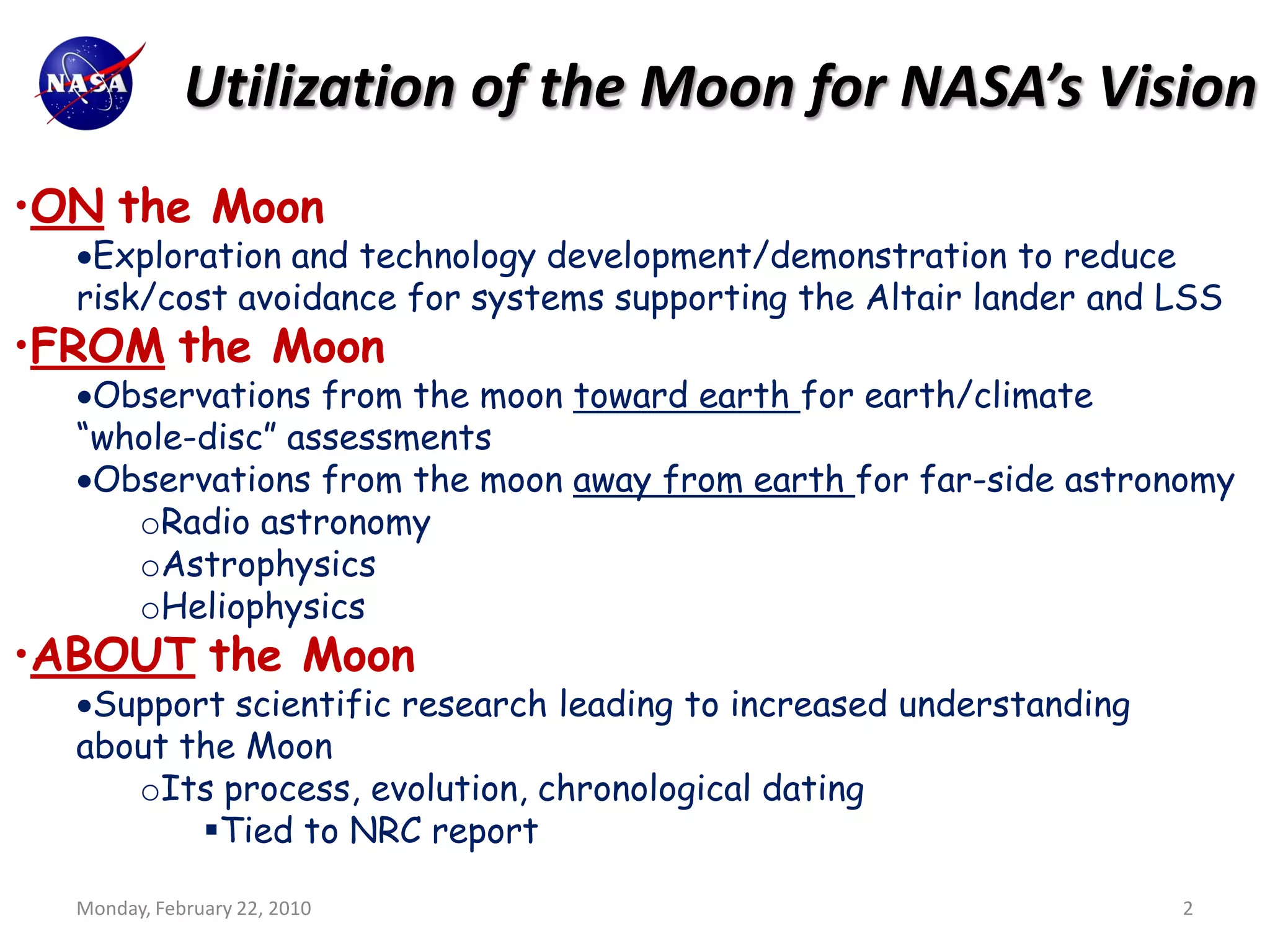
Utilization of the Moon for NASA’s Vision
•ON the Moon
  •Exploration and technology development/demonstration to reduce
  risk/cost avoidance for systems supporting the Altair lander and LSS
•FROM the Moon
  •Observations from the moon toward earth for earth/climate
  “whole-disc” assessments
  •Observations from the moon away from earth for far-side astronomy
     oRadio astronomy
     oAstrophysics
     oHeliophysics
•ABOUT the Moon
  •Support scientific research leading to increased understanding
  about the Moon
     oIts process, evolution, chronological dating
         Tied to NRC report

  Monday, February 22, 2010                                         2
Lunar Commercialization Goal
• Obtain lunar data for NASA through commercial
  services
   – Utilize emerging commercial capability to land
     payloads on the Moon
          • Includes lunar data purchase and/or NASA lunar instrument
            delivery
   – Cost to NASA that is less than a dedicated NASA
     robotic mission


   – Contracted services could begin in late 2011
     timeframe
 Monday, February 22, 2010                                         3
Fundamental Change for NASA
  Apollo Model
   From NASA as the
 customer funding prime
contractors on a cost plus
     fixed fee basis
                               Increased
                             Private Sector
                              Resources

                                                Commercial –
                                              (COTS/CRS) Model
                                          To NASA as a customer and partner,
                                        working with other customers, financiers,
                                        and emerging space companies on fixed
                                       price basis to secure capabilities, services
                                                       and products
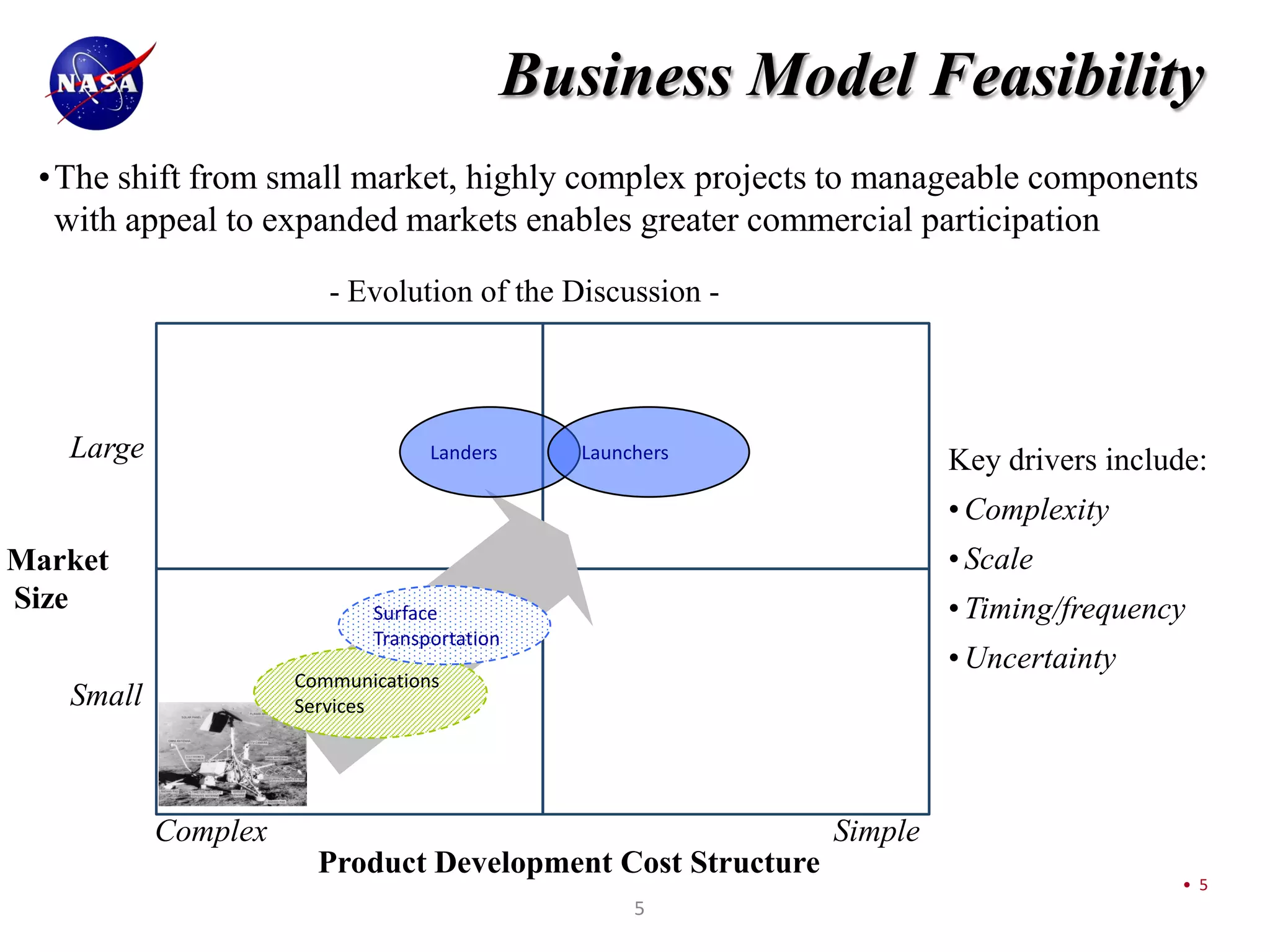
Business Model Feasibility
 •The shift from small market, highly complex projects to manageable components
  with appeal to expanded markets enables greater commercial participation
                        - Evolution of the Discussion -


   Large                          Landers      Launchers
                                                                     Key drivers include:
                                                                     • Complexity
Market                                                               • Scale
Size                        Surface                                  • Timing/frequency
                            Transportation
                                                                     • Uncertainty
                     Communications
   Small             Services


           Complex                                          Simple
                       Product Development Cost Structure
                                                                                       • 5
                                                    5
Demand Framework
                      - US Government                      - Non-US Government -
                      -                              Tier 1
                           ESMD

- Space                   Science Directorate
Focused
-         Planetary    Astrophysics/   Earth         Tier 2
          Science      Heliophysics    Science


- Broad
Focus -


  Academics

                                                                                   • 6
                                                 6
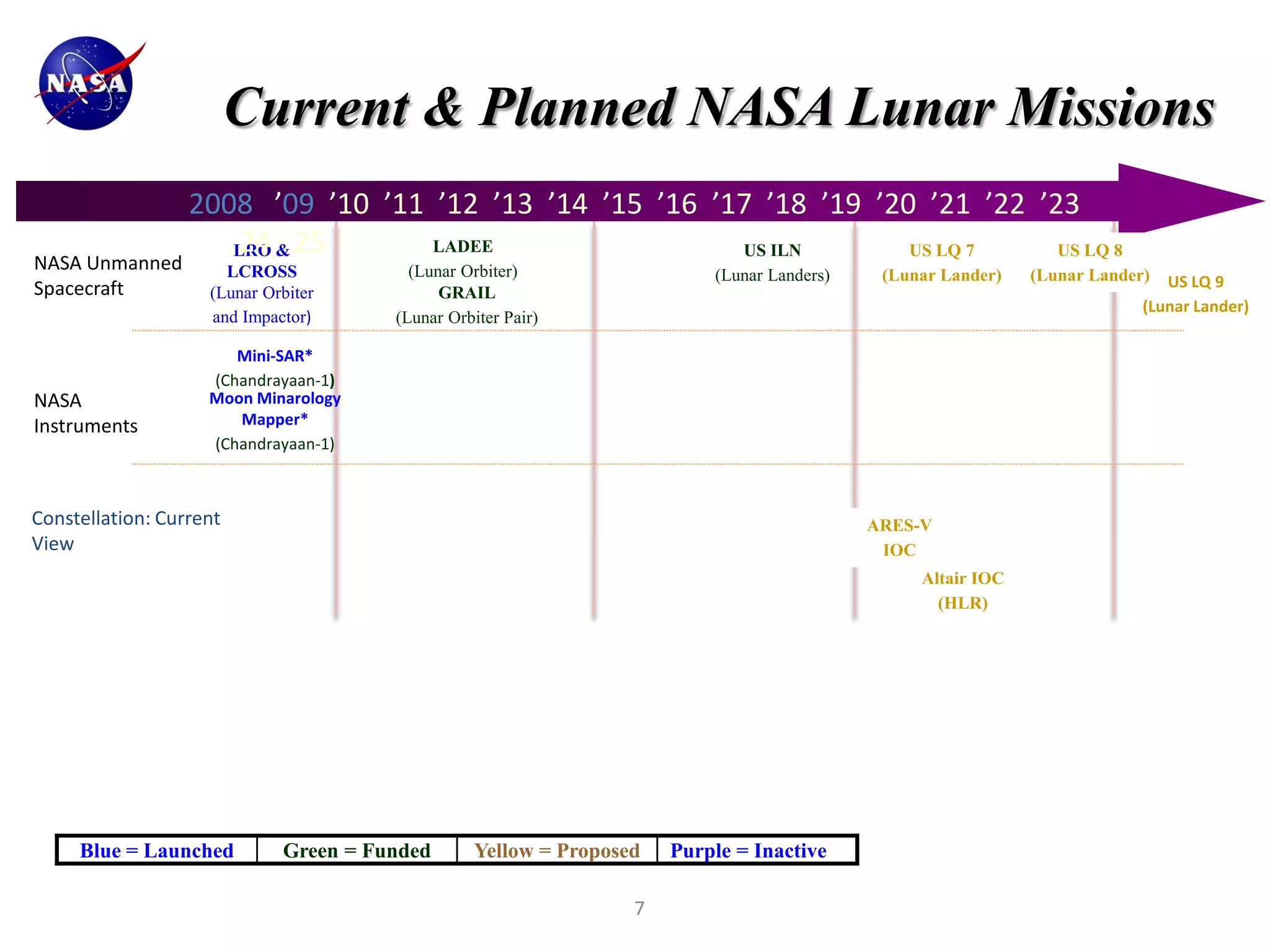
Current & Planned NASA Lunar Missions
                  2008 ’09 ’10 ’11 ’12 ’13 ’14 ’15 ’16 ’17 ’18 ’19 ’20 ’21 ’22 ’23
                     ’24 &’25
                     LRO           LADEE                 US ILN       US LQ 7    US LQ 8
NASA Unmanned         LCROSS             (Lunar Orbiter)                 (Lunar Landers)    (Lunar Lander)   (Lunar Lander)  US LQ 9
Spacecraft          (Lunar Orbiter           GRAIL
                                                                                                                          (Lunar Lander)
                    and Impactor)      (Lunar Orbiter Pair)

                       Mini-SAR*
                    (Chandrayaan-1)
NASA                Moon Minarology
Instruments            Mapper*
                    (Chandrayaan-1)


Constellation: Current                                                                     ARES-V
View                                                                                        IOC
                                                                                                Altair IOC
                                                                                                  (HLR)


     Blue = Launched         Green = Funded      Yellow = Proposed   Purple = Inactive

                                                                 7
Current & Planned Lunar Missions:
                                              Tier One International Agencies
                    2008 ’09 ‘10 ‘11 ‘12 ‘13 ‘14 ‘15 ‘16 ‘17 ‘18 ‘19 ‘20 ‘21 ‘22 ‘23
                       ‘24 ‘25Chang’e 2 Chang’e 3    Chang’e 4
                   Chang’e 1                                                                                                             Chinese Manned
                                   More Advanced     Lunar Rover                Lunar Sample                                              Lunar Mission
                  Lunar Orbiter
China National                      Lunar Orbiter                                  Return
Space Agency

                 SELENE/Kaguya                       SELENE 2/Kaguya 2               Japanese Robotic                               Japanese International
                   Lunar Orbiter                        Lunar Orbiter                 Lunar Mission                                      Moon Base
                                                                                                    Assumed by Inference:
Japan Aerospace                                                                                                                     Japanese Manned
                                                                                               First Japanese Manned Mission
Exploration Agency                                                                                                                   Lunar Mission

                                         Luna-Glob 1 1
                                           Luna-Glob       Luna-Grunt 1            Luna-Grunt 2      Russian Robotic
                                         Lunar Orbiter
                                           Lunar Orbiter   Lunar Orbiter,          More Advanced       Lunar Base
                                         and Impactor       Lander, and            Lunar Orbiter,
                                          Luna-Glob 2
                                           and Impactor
                                         Luna-Glob 2
                                                           Sample Return            Lander, and
                                         Luna-Glob 2 2
                                          Lunar Lander
                                           Luna-Glob
                                         Lunar Lander
Roscosmos                                Lunar Lander
                                           Lunar Lander                            Sample Return

                 Chandrayaan-1              Chandrayaan-2                                                                              Indian Manned
                  Lunar Orbiter            Lunar Orbiter with                                                                          Lunar Mission
                                             Lunar Rover                                          Assumed by Inference:
Indian Space     Moon Impact Probe
                                                                                               First Indian Manned Mission
Research Organisation

                                                                                                          European               European Aurora
                                                                                                         Autonomous               Manned Lunar
European Space                                                                                          Lunar Lander             Mission Program
Agency                                                                                                                         (possibly with NASA)

 Blue = Launched           Green = Funded           Yellow = Proposed       Red = Discussed

                                                                            8
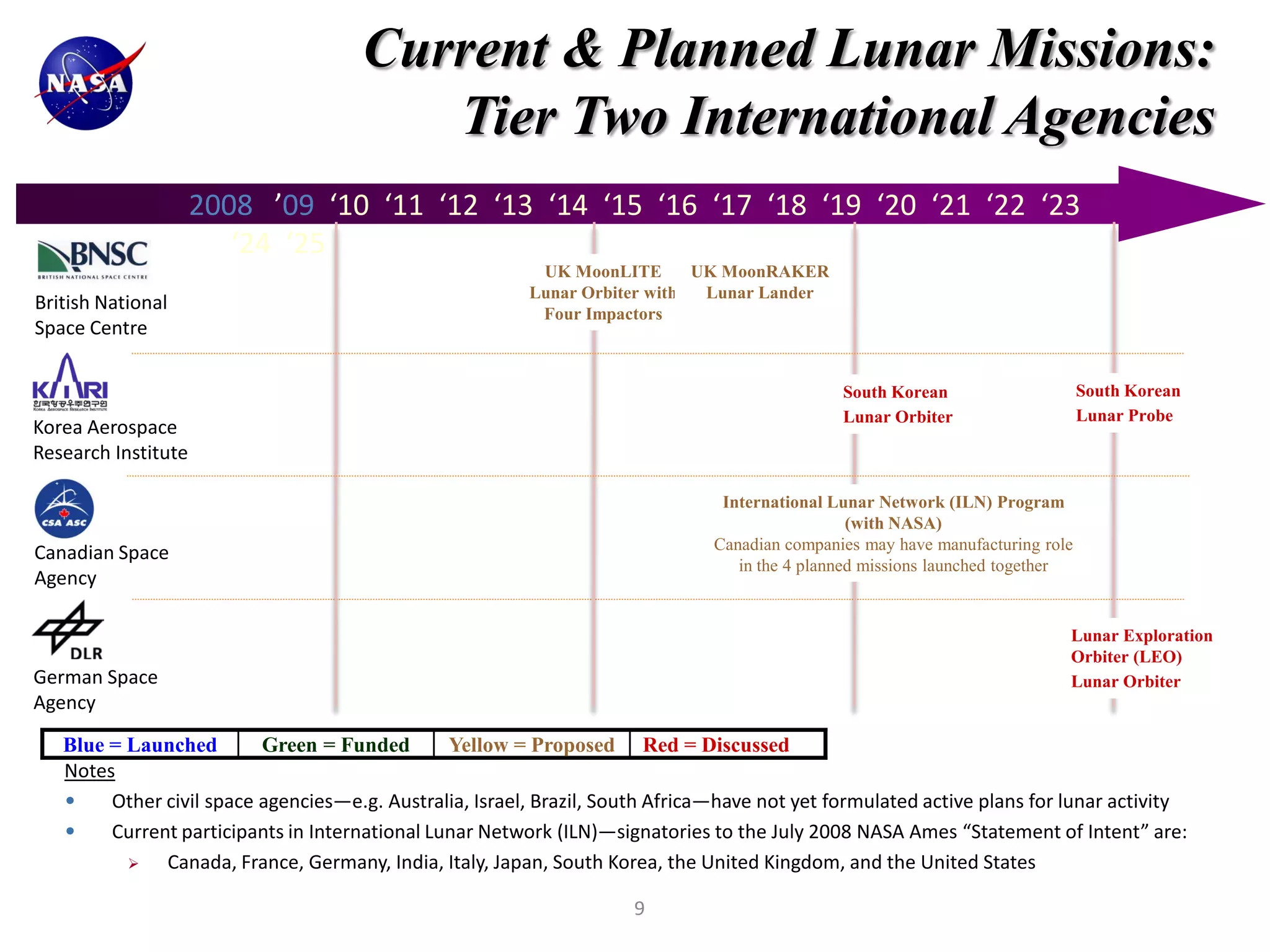
Current & Planned Lunar Missions:
                                         Tier Two International Agencies
                     2008 ’09 ‘10 ‘11 ‘12 ‘13 ‘14 ‘15 ‘16 ‘17 ‘18 ‘19 ‘20 ‘21 ‘22 ‘23
                        ‘24 ‘25
                                                          UK MoonLITE       UK MoonRAKER
                                                         Lunar Orbiter with  Lunar Lander
British National                                          Four Impactors
Space Centre

                                                                                               South Korean                     South Korean
                                                                                               Lunar Orbiter                    Lunar Probe
Korea Aerospace
Research Institute

                                                                                International Lunar Network (ILN) Program
                                                                                                 (with NASA)
                                                                               Canadian companies may have manufacturing role
Canadian Space
                                                                                  in the 4 planned missions launched together
Agency

                                                                                                                            Lunar Exploration
                                                                                                                            Orbiter (LEO)
German Space                                                                                                                Lunar Orbiter
Agency

   Blue = Launched        Green = Funded        Yellow = Proposed Red = Discussed
   Notes
   •    Other civil space agencies—e.g. Australia, Israel, Brazil, South Africa—have not yet formulated active plans for lunar activity
   •    Current participants in International Lunar Network (ILN)—signatories to the July 2008 NASA Ames “Statement of Intent” are:
             Canada, France, Germany, India, Italy, Japan, South Korea, the United Kingdom, and the United States

                                                                      9
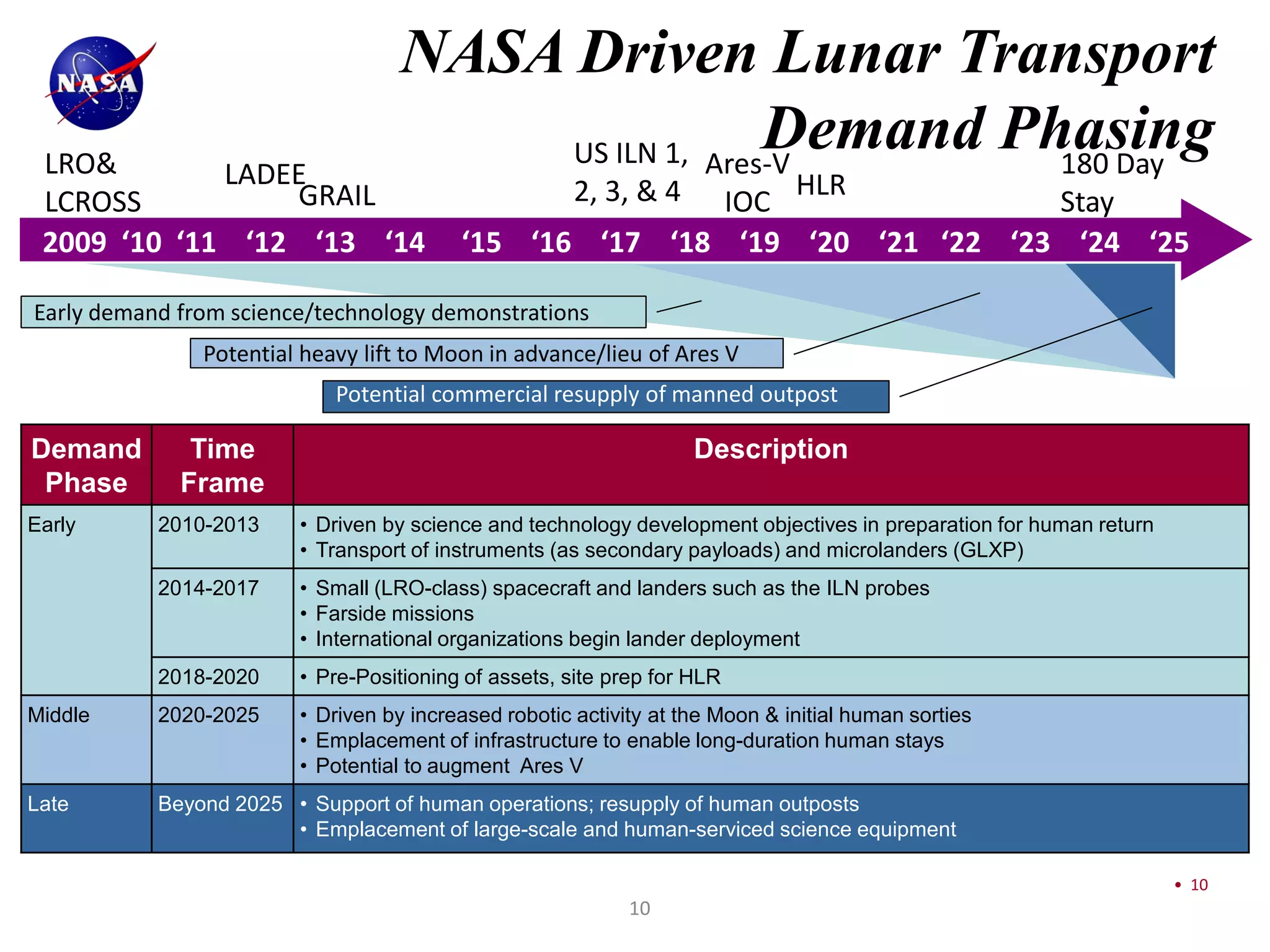
NASA Driven Lunar Transport
 LRO&
                                                      Demand Phasing
                                        US ILN 1, Ares-V       180 Day
             LADEE                                           HLR
 LCROSS          GRAIL                                2, 3, & 4
                                                        IOC                 Stay
 2009 ‘10 ‘11 ‘12 ‘13 ‘14                ‘15 ‘16 ‘17 ‘18 ‘19 ‘20 ‘21 ‘22 ‘23 ‘24 ‘25

Early demand from science/technology demonstrations
               Potential heavy lift to Moon in advance/lieu of Ares V
                            Potential commercial resupply of manned outpost

Demand        Time                                                 Description
 Phase       Frame
Early      2010-2013    • Driven by science and technology development objectives in preparation for human return
                        • Transport of instruments (as secondary payloads) and microlanders (GLXP)
           2014-2017    • Small (LRO-class) spacecraft and landers such as the ILN probes
                        • Farside missions
                        • International organizations begin lander deployment
           2018-2020    • Pre-Positioning of assets, site prep for HLR
Middle     2020-2025    • Driven by increased robotic activity at the Moon & initial human sorties
                        • Emplacement of infrastructure to enable long-duration human stays
                        • Potential to augment Ares V
Late       Beyond 2025 • Support of human operations; resupply of human outposts
                       • Emplacement of large-scale and human-serviced science equipment

                                                                                                                    • 10
                                                            10
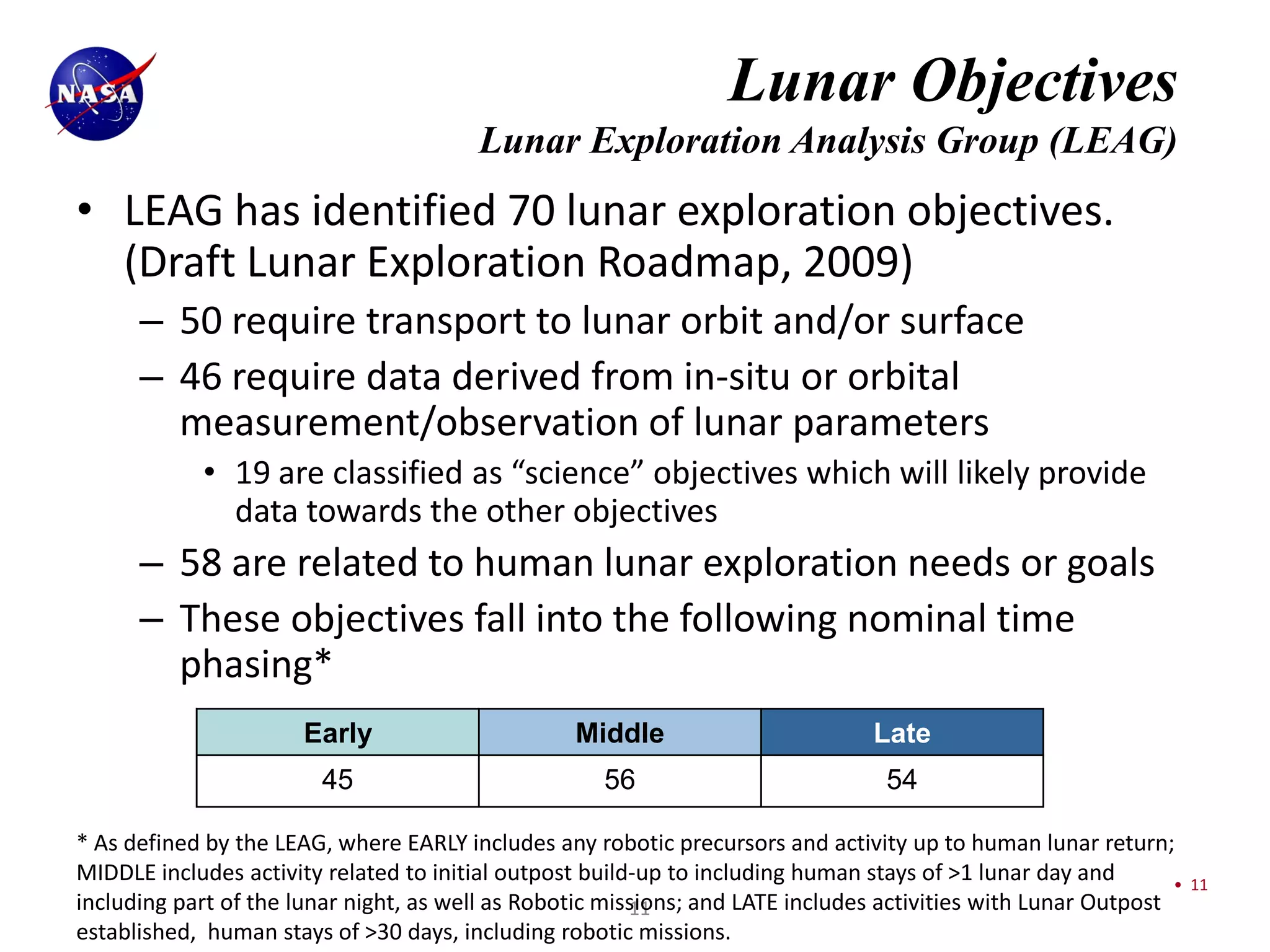
Lunar Objectives
                                         Lunar Exploration Analysis Group (LEAG)
• LEAG has identified 70 lunar exploration objectives.
  (Draft Lunar Exploration Roadmap, 2009)
      – 50 require transport to lunar orbit and/or surface
      – 46 require data derived from in-situ or orbital
        measurement/observation of lunar parameters
            • 19 are classified as “science” objectives which will likely provide
              data towards the other objectives
      – 58 are related to human lunar exploration needs or goals
      – These objectives fall into the following nominal time
        phasing*
                       Early                       Middle                        Late
                         45                          56                           54

* As defined by the LEAG, where EARLY includes any robotic precursors and activity up to human lunar return;
MIDDLE includes activity related to initial outpost build-up to including human stays of >1 lunar day and       •   11
including part of the lunar night, as well as Robotic missions; and LATE includes activities with Lunar Outpost
                                                         11
established, human stays of >30 days, including robotic missions.
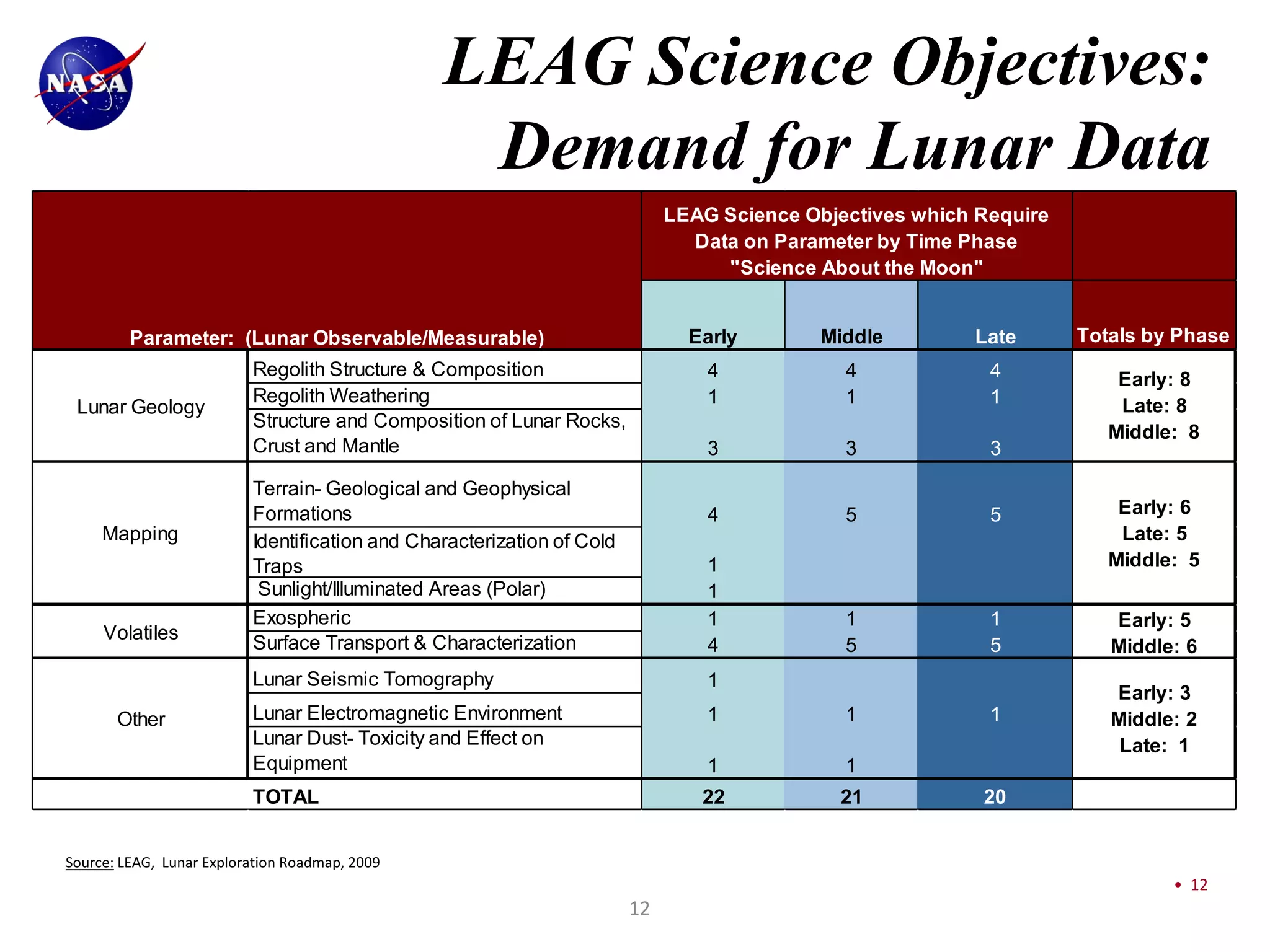
LEAG Science Objectives:
                                                 Demand for Lunar Data
                                                                             LEAG Science Objectives which Require
                                                                               Data on Parameter by Time Phase
                                                                                  "Science About the Moon"


         Parameter: (Lunar Observable/Measurable)                              Early        Middle        Late       Totals by Phase
                          Regolith Structure & Composition                       4            4             4            Early: 8
                          Regolith Weathering                                    1            1             1            Late: 8
 Lunar Geology
                          Structure and Composition of Lunar Rocks,
                                                                                                                        Middle: 8
                          Crust and Mantle                                       3            3             3

                          Terrain- Geological and Geophysical
                          Formations                                             4            5             5            Early: 6
     Mapping              Identification and Characterization of Cold                                                    Late: 5
                          Traps                                                  1                                      Middle: 5
                           Sunlight/Illuminated Areas (Polar)                    1
                          Exospheric                                             1            1             1           Early: 5
     Volatiles
                          Surface Transport & Characterization                   4            5             5           Middle: 6
                          Lunar Seismic Tomography                               1
                                                                                                                        Early: 3
       Other              Lunar Electromagnetic Environment                      1            1             1           Middle: 2
                          Lunar Dust- Toxicity and Effect on                                                             Late: 1
                          Equipment                                              1            1
                          TOTAL                                                 22            21           20


Source: LEAG, Lunar Exploration Roadmap, 2009
                                                                                                                              • 12
                                                                        12
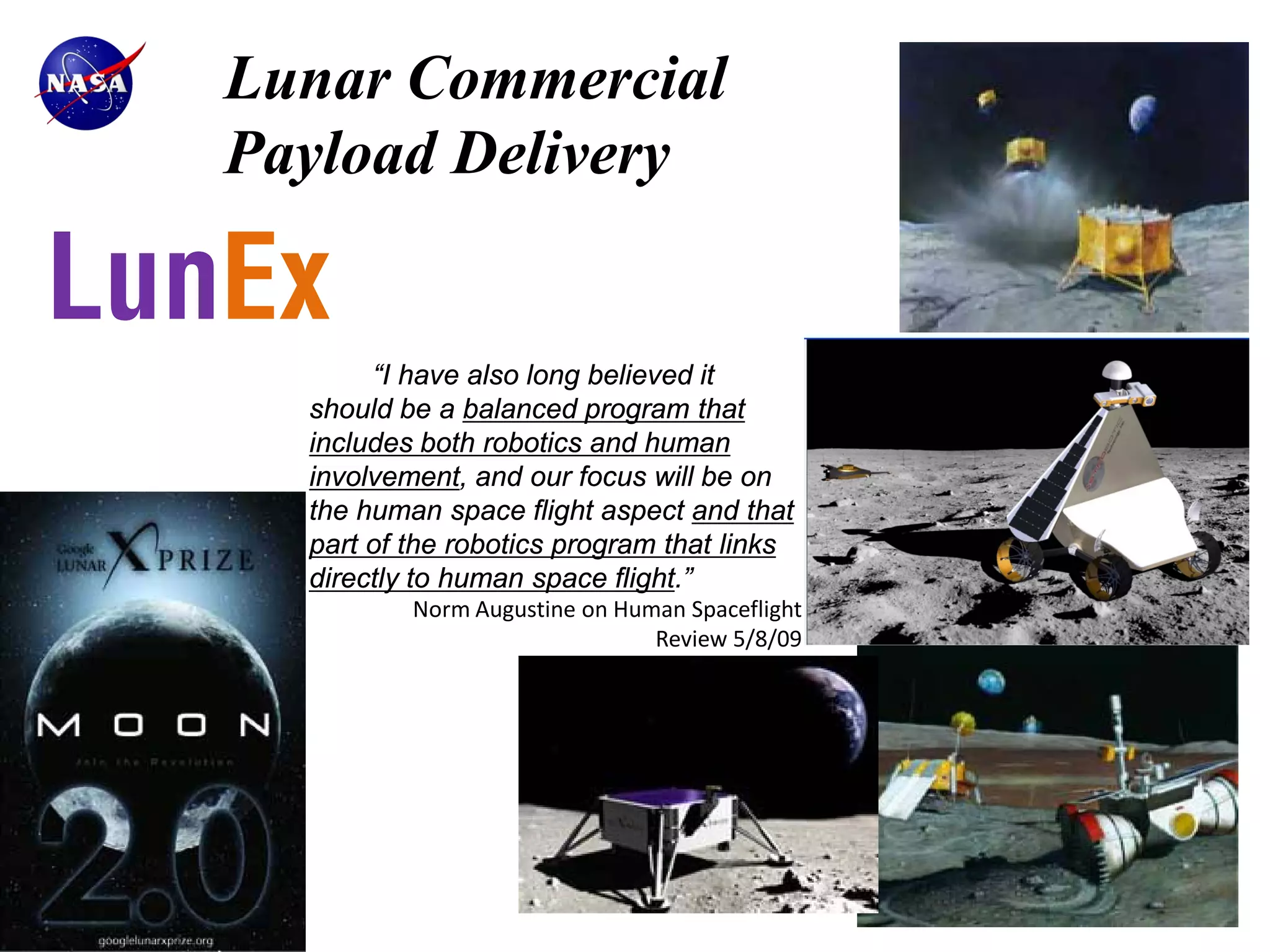
Lunar Commercial
   Payload Delivery

LunEx
          “I have also long believed it
     should be a balanced program that
     includes both robotics and human
     involvement, and our focus will be on
     the human space flight aspect and that
     part of the robotics program that links
     directly to human space flight.”
             Norm Augustine on Human Spaceflight
                                  Review 5/8/09
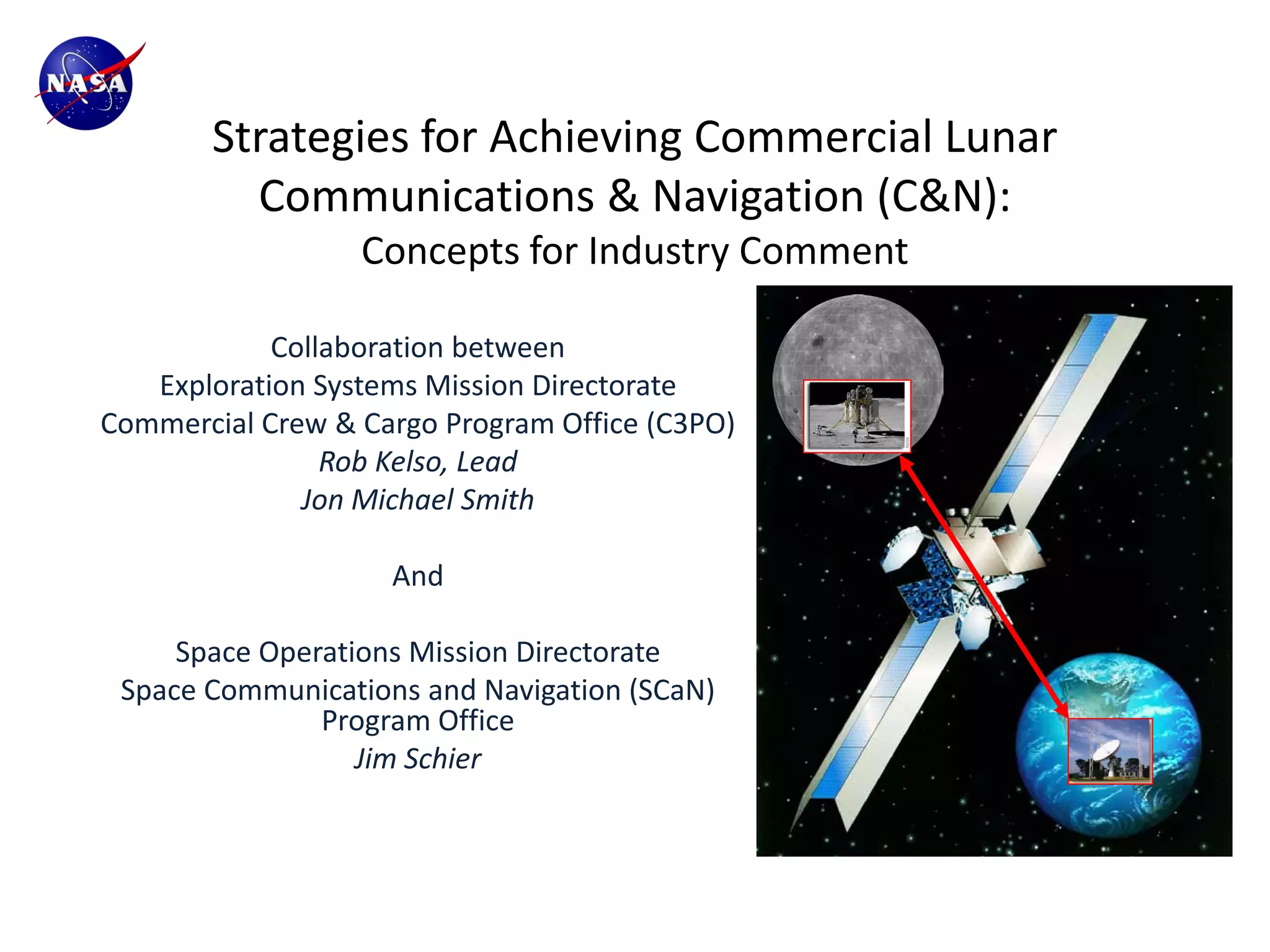
Strategies for Achieving Commercial Lunar
         Communications & Navigation (C&N):
                  Concepts for Industry Comment

            Collaboration between
   Exploration Systems Mission Directorate
Commercial Crew & Cargo Program Office (C3PO)
                Rob Kelso, Lead
              Jon Michael Smith

                    And

     Space Operations Mission Directorate
 Space Communications and Navigation (SCaN)
               Program Office
                  Jim Schier
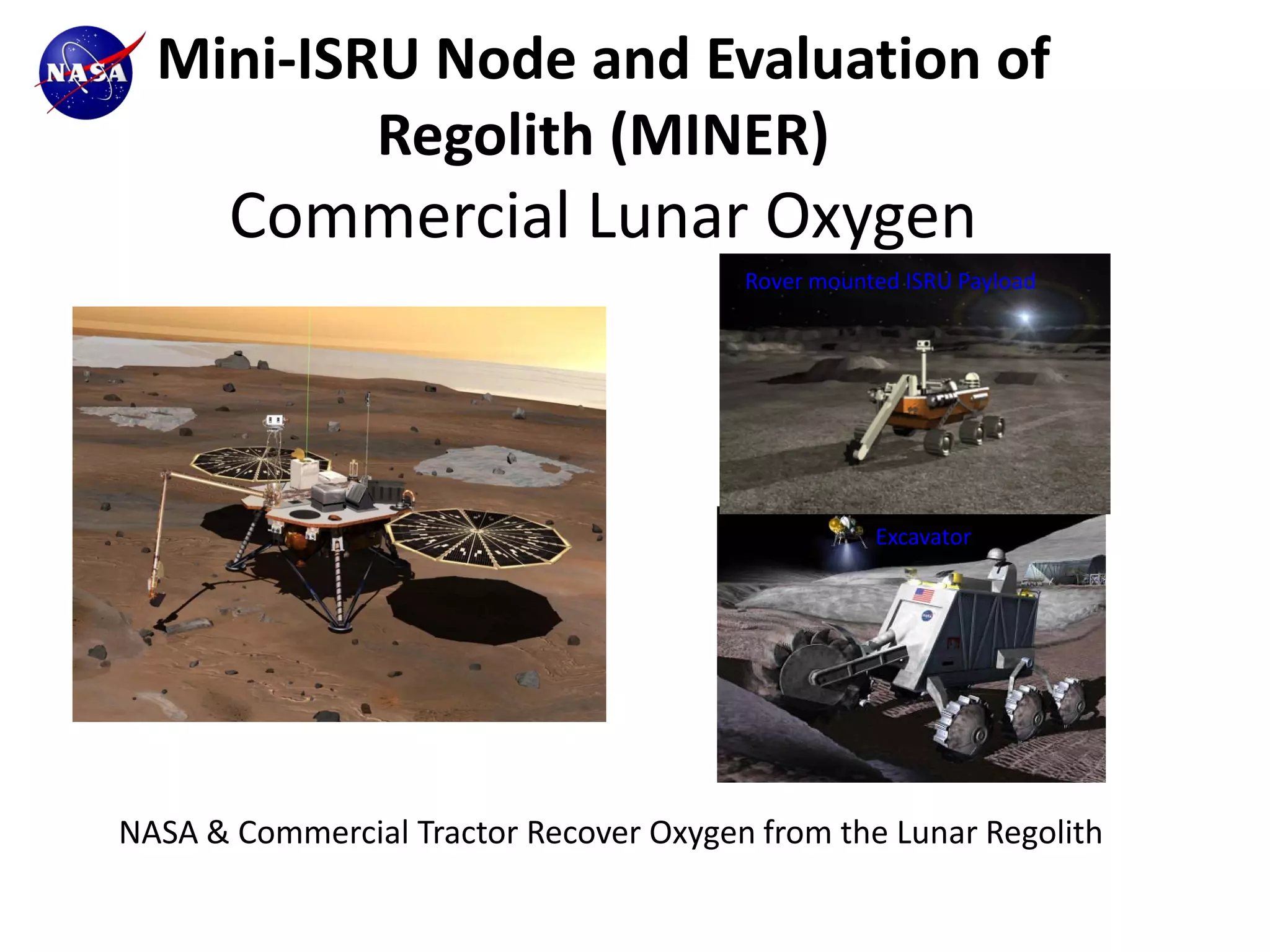
Mini-ISRU Node and Evaluation of
          Regolith (MINER)
       Commercial Lunar Oxygen
                                        Rover mounted ISRU Payload


                                                   Excavator


NASA & Commercial Tractor Recover Oxygen from the Lunar Regolith
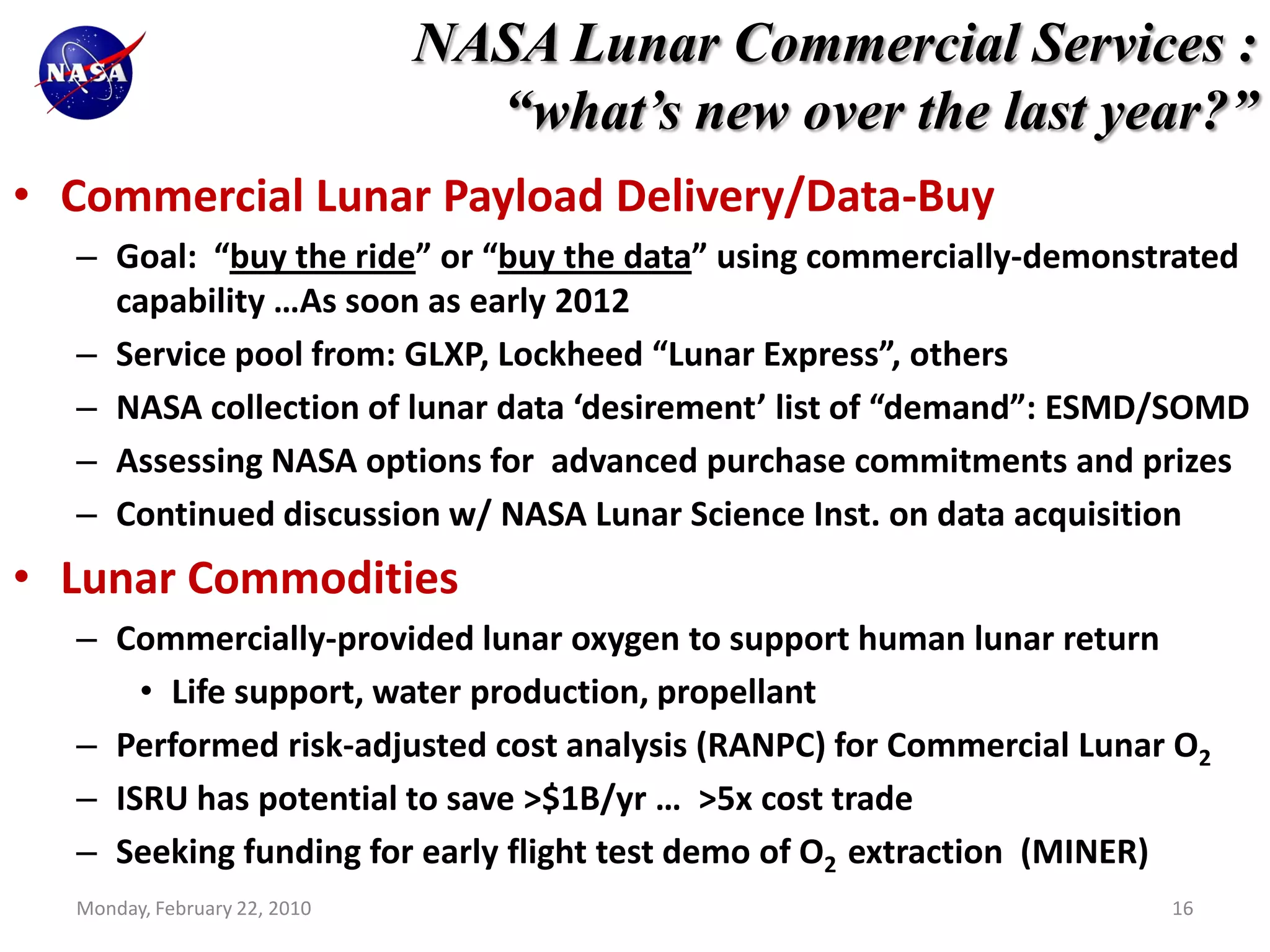
NASA Lunar Commercial Services :
                                “what’s new over the last year?”
• Commercial Lunar Payload Delivery/Data-Buy
  – Goal: “buy the ride” or “buy the data” using commercially-demonstrated
    capability …As soon as early 2012
  – Service pool from: GLXP, Lockheed “Lunar Express”, others
  – NASA collection of lunar data ‘desirement’ list of “demand”: ESMD/SOMD
  – Assessing NASA options for advanced purchase commitments and prizes
  – Continued discussion w/ NASA Lunar Science Inst. on data acquisition
• Lunar Commodities
  – Commercially-provided lunar oxygen to support human lunar return
      • Life support, water production, propellant
  – Performed risk-adjusted cost analysis (RANPC) for Commercial Lunar O2
  – ISRU has potential to save >$1B/yr … >5x cost trade
  – Seeking funding for early flight test demo of O2 extraction (MINER)
  Monday, February 22, 2010                                           16
Lunar Commercial activities this fall….
• Collection of “Orphan” equipment list
  – Assessment of utilization
  – Assessment of early demand vs science value
• Two funded studies
  – Lunar Transportation Market Assessment (Futron)
  – MINER Pre-Phase A conceptual assessment (NASA)
• Assessment of Augustine Report and resultant
  NASA strategic planning

Kelso.robert

  • 1.
    Lunar Exploration Innovation Challenges PM Challenge 2010 Robert M. Kelso Manager, Lunar Commercial Services February 2010 Used with Permission
  • 2.
    Utilization of theMoon for NASA’s Vision •ON the Moon •Exploration and technology development/demonstration to reduce risk/cost avoidance for systems supporting the Altair lander and LSS •FROM the Moon •Observations from the moon toward earth for earth/climate “whole-disc” assessments •Observations from the moon away from earth for far-side astronomy oRadio astronomy oAstrophysics oHeliophysics •ABOUT the Moon •Support scientific research leading to increased understanding about the Moon oIts process, evolution, chronological dating Tied to NRC report Monday, February 22, 2010 2
  • 3.
    Lunar Commercialization Goal •Obtain lunar data for NASA through commercial services – Utilize emerging commercial capability to land payloads on the Moon • Includes lunar data purchase and/or NASA lunar instrument delivery – Cost to NASA that is less than a dedicated NASA robotic mission – Contracted services could begin in late 2011 timeframe Monday, February 22, 2010 3
  • 4.
    Fundamental Change forNASA Apollo Model From NASA as the customer funding prime contractors on a cost plus fixed fee basis Increased Private Sector Resources Commercial – (COTS/CRS) Model To NASA as a customer and partner, working with other customers, financiers, and emerging space companies on fixed price basis to secure capabilities, services and products
  • 5.
    Business Model Feasibility •The shift from small market, highly complex projects to manageable components with appeal to expanded markets enables greater commercial participation - Evolution of the Discussion - Large Landers Launchers Key drivers include: • Complexity Market • Scale Size Surface • Timing/frequency Transportation • Uncertainty Communications Small Services Complex Simple Product Development Cost Structure • 5 5
  • 6.
    Demand Framework - US Government - Non-US Government - - Tier 1 ESMD - Space Science Directorate Focused - Planetary Astrophysics/ Earth Tier 2 Science Heliophysics Science - Broad Focus - Academics • 6 6
  • 7.
    Current & PlannedNASA Lunar Missions 2008 ’09 ’10 ’11 ’12 ’13 ’14 ’15 ’16 ’17 ’18 ’19 ’20 ’21 ’22 ’23 ’24 &’25 LRO LADEE US ILN US LQ 7 US LQ 8 NASA Unmanned LCROSS (Lunar Orbiter) (Lunar Landers) (Lunar Lander) (Lunar Lander) US LQ 9 Spacecraft (Lunar Orbiter GRAIL (Lunar Lander) and Impactor) (Lunar Orbiter Pair) Mini-SAR* (Chandrayaan-1) NASA Moon Minarology Instruments Mapper* (Chandrayaan-1) Constellation: Current ARES-V View IOC Altair IOC (HLR) Blue = Launched Green = Funded Yellow = Proposed Purple = Inactive 7
  • 8.
    Current & PlannedLunar Missions: Tier One International Agencies 2008 ’09 ‘10 ‘11 ‘12 ‘13 ‘14 ‘15 ‘16 ‘17 ‘18 ‘19 ‘20 ‘21 ‘22 ‘23 ‘24 ‘25Chang’e 2 Chang’e 3 Chang’e 4 Chang’e 1 Chinese Manned More Advanced Lunar Rover Lunar Sample Lunar Mission Lunar Orbiter China National Lunar Orbiter Return Space Agency SELENE/Kaguya SELENE 2/Kaguya 2 Japanese Robotic Japanese International Lunar Orbiter Lunar Orbiter Lunar Mission Moon Base Assumed by Inference: Japan Aerospace Japanese Manned First Japanese Manned Mission Exploration Agency Lunar Mission Luna-Glob 1 1 Luna-Glob Luna-Grunt 1 Luna-Grunt 2 Russian Robotic Lunar Orbiter Lunar Orbiter Lunar Orbiter, More Advanced Lunar Base and Impactor Lander, and Lunar Orbiter, Luna-Glob 2 and Impactor Luna-Glob 2 Sample Return Lander, and Luna-Glob 2 2 Lunar Lander Luna-Glob Lunar Lander Roscosmos Lunar Lander Lunar Lander Sample Return Chandrayaan-1 Chandrayaan-2 Indian Manned Lunar Orbiter Lunar Orbiter with Lunar Mission Lunar Rover Assumed by Inference: Indian Space Moon Impact Probe First Indian Manned Mission Research Organisation European European Aurora Autonomous Manned Lunar European Space Lunar Lander Mission Program Agency (possibly with NASA) Blue = Launched Green = Funded Yellow = Proposed Red = Discussed 8
  • 9.
    Current & PlannedLunar Missions: Tier Two International Agencies 2008 ’09 ‘10 ‘11 ‘12 ‘13 ‘14 ‘15 ‘16 ‘17 ‘18 ‘19 ‘20 ‘21 ‘22 ‘23 ‘24 ‘25 UK MoonLITE UK MoonRAKER Lunar Orbiter with Lunar Lander British National Four Impactors Space Centre South Korean South Korean Lunar Orbiter Lunar Probe Korea Aerospace Research Institute International Lunar Network (ILN) Program (with NASA) Canadian companies may have manufacturing role Canadian Space in the 4 planned missions launched together Agency Lunar Exploration Orbiter (LEO) German Space Lunar Orbiter Agency Blue = Launched Green = Funded Yellow = Proposed Red = Discussed Notes • Other civil space agencies—e.g. Australia, Israel, Brazil, South Africa—have not yet formulated active plans for lunar activity • Current participants in International Lunar Network (ILN)—signatories to the July 2008 NASA Ames “Statement of Intent” are:  Canada, France, Germany, India, Italy, Japan, South Korea, the United Kingdom, and the United States 9
  • 10.
    NASA Driven LunarTransport LRO& Demand Phasing US ILN 1, Ares-V 180 Day LADEE HLR LCROSS GRAIL 2, 3, & 4 IOC Stay 2009 ‘10 ‘11 ‘12 ‘13 ‘14 ‘15 ‘16 ‘17 ‘18 ‘19 ‘20 ‘21 ‘22 ‘23 ‘24 ‘25 Early demand from science/technology demonstrations Potential heavy lift to Moon in advance/lieu of Ares V Potential commercial resupply of manned outpost Demand Time Description Phase Frame Early 2010-2013 • Driven by science and technology development objectives in preparation for human return • Transport of instruments (as secondary payloads) and microlanders (GLXP) 2014-2017 • Small (LRO-class) spacecraft and landers such as the ILN probes • Farside missions • International organizations begin lander deployment 2018-2020 • Pre-Positioning of assets, site prep for HLR Middle 2020-2025 • Driven by increased robotic activity at the Moon & initial human sorties • Emplacement of infrastructure to enable long-duration human stays • Potential to augment Ares V Late Beyond 2025 • Support of human operations; resupply of human outposts • Emplacement of large-scale and human-serviced science equipment • 10 10
  • 11.
    Lunar Objectives Lunar Exploration Analysis Group (LEAG) • LEAG has identified 70 lunar exploration objectives. (Draft Lunar Exploration Roadmap, 2009) – 50 require transport to lunar orbit and/or surface – 46 require data derived from in-situ or orbital measurement/observation of lunar parameters • 19 are classified as “science” objectives which will likely provide data towards the other objectives – 58 are related to human lunar exploration needs or goals – These objectives fall into the following nominal time phasing* Early Middle Late 45 56 54 * As defined by the LEAG, where EARLY includes any robotic precursors and activity up to human lunar return; MIDDLE includes activity related to initial outpost build-up to including human stays of >1 lunar day and • 11 including part of the lunar night, as well as Robotic missions; and LATE includes activities with Lunar Outpost 11 established, human stays of >30 days, including robotic missions.
  • 12.
    LEAG Science Objectives: Demand for Lunar Data LEAG Science Objectives which Require Data on Parameter by Time Phase "Science About the Moon" Parameter: (Lunar Observable/Measurable) Early Middle Late Totals by Phase Regolith Structure & Composition 4 4 4 Early: 8 Regolith Weathering 1 1 1 Late: 8 Lunar Geology Structure and Composition of Lunar Rocks, Middle: 8 Crust and Mantle 3 3 3 Terrain- Geological and Geophysical Formations 4 5 5 Early: 6 Mapping Identification and Characterization of Cold Late: 5 Traps 1 Middle: 5 Sunlight/Illuminated Areas (Polar) 1 Exospheric 1 1 1 Early: 5 Volatiles Surface Transport & Characterization 4 5 5 Middle: 6 Lunar Seismic Tomography 1 Early: 3 Other Lunar Electromagnetic Environment 1 1 1 Middle: 2 Lunar Dust- Toxicity and Effect on Late: 1 Equipment 1 1 TOTAL 22 21 20 Source: LEAG, Lunar Exploration Roadmap, 2009 • 12 12
  • 13.
    Lunar Commercial Payload Delivery LunEx “I have also long believed it should be a balanced program that includes both robotics and human involvement, and our focus will be on the human space flight aspect and that part of the robotics program that links directly to human space flight.” Norm Augustine on Human Spaceflight Review 5/8/09
  • 14.
    Strategies for AchievingCommercial Lunar Communications & Navigation (C&N): Concepts for Industry Comment Collaboration between Exploration Systems Mission Directorate Commercial Crew & Cargo Program Office (C3PO) Rob Kelso, Lead Jon Michael Smith And Space Operations Mission Directorate Space Communications and Navigation (SCaN) Program Office Jim Schier
  • 15.
    Mini-ISRU Node andEvaluation of Regolith (MINER) Commercial Lunar Oxygen Rover mounted ISRU Payload Excavator NASA & Commercial Tractor Recover Oxygen from the Lunar Regolith
  • 16.
    NASA Lunar CommercialServices : “what’s new over the last year?” • Commercial Lunar Payload Delivery/Data-Buy – Goal: “buy the ride” or “buy the data” using commercially-demonstrated capability …As soon as early 2012 – Service pool from: GLXP, Lockheed “Lunar Express”, others – NASA collection of lunar data ‘desirement’ list of “demand”: ESMD/SOMD – Assessing NASA options for advanced purchase commitments and prizes – Continued discussion w/ NASA Lunar Science Inst. on data acquisition • Lunar Commodities – Commercially-provided lunar oxygen to support human lunar return • Life support, water production, propellant – Performed risk-adjusted cost analysis (RANPC) for Commercial Lunar O2 – ISRU has potential to save >$1B/yr … >5x cost trade – Seeking funding for early flight test demo of O2 extraction (MINER) Monday, February 22, 2010 16
  • 17.
    Lunar Commercial activitiesthis fall…. • Collection of “Orphan” equipment list – Assessment of utilization – Assessment of early demand vs science value • Two funded studies – Lunar Transportation Market Assessment (Futron) – MINER Pre-Phase A conceptual assessment (NASA) • Assessment of Augustine Report and resultant NASA strategic planning