



John M. Grunsfeld
Associate Administrator
Science Mission Directorate
@SciAstro
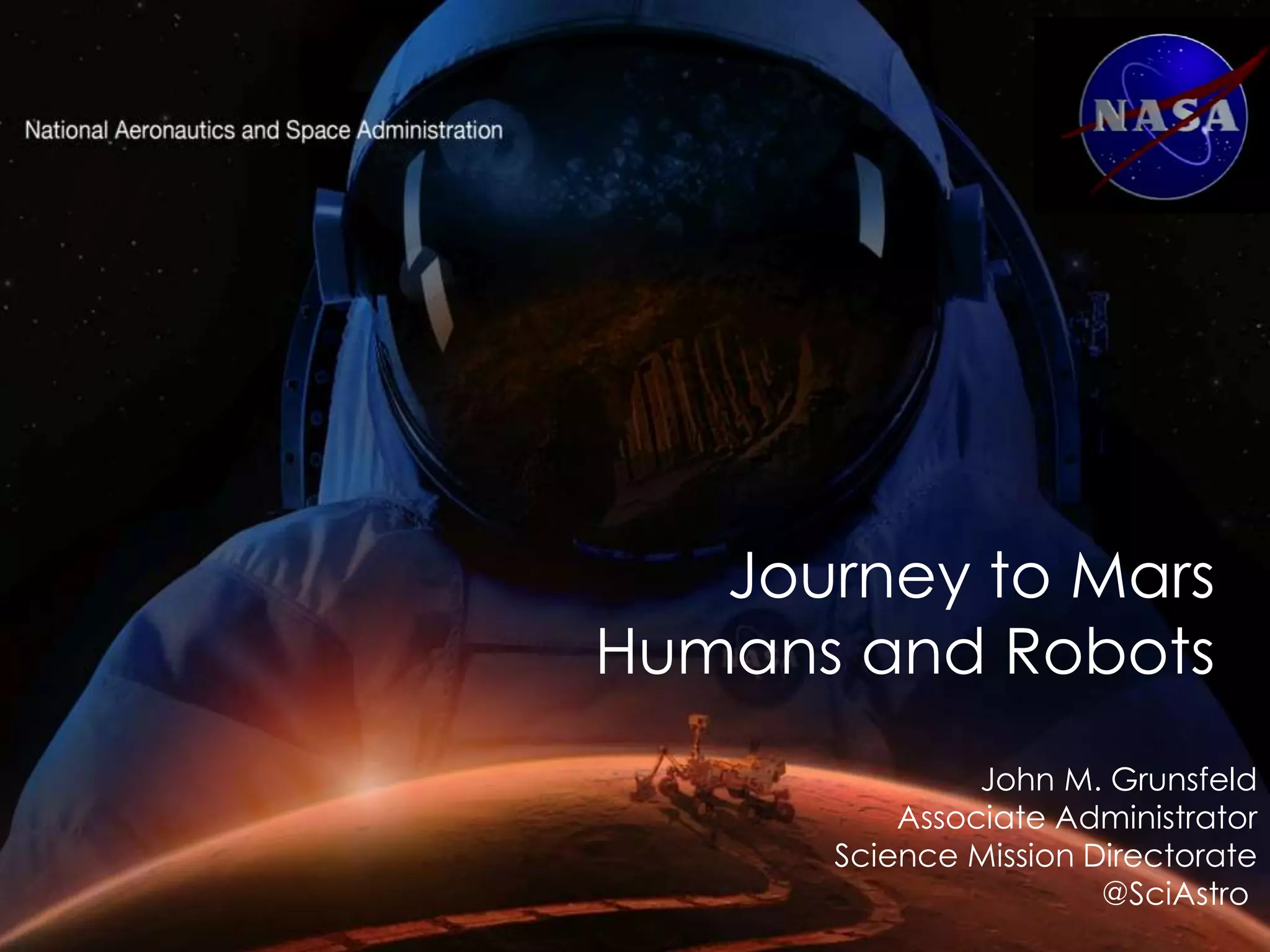
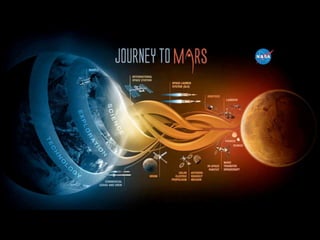
Journey to Mars
Humans and Robots
Innovate
Explore
Discover
Inspire
www.nasa.gov
Our Mission:
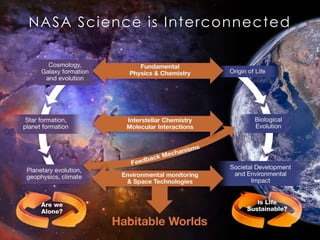
NASA Science is Interconnected
Question: Does the increase in dexterity and
intelligence merit the cost of being onsite for
science exploration, and if so how do we
best combine the strengths of humans and
robots?
Flashback: 2002
Section 2
CB/John Grunsfeld
Exploration Blueprint
NASA Internal use only 29-Oct-02
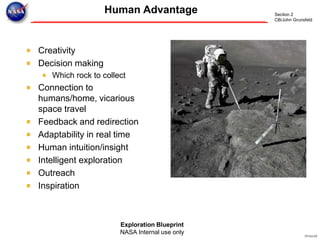
Creativity
Decision making
Which rock to collect
Connection to
humans/home, vicarious
space travel
Feedback and redirection
Adaptability in real time
Human intuition/insight
Intelligent exploration
Outreach
Inspiration
Human Advantage
Section 2
CB/John Grunsfeld
Exploration Blueprint
NASA Internal use only 29-Oct-02
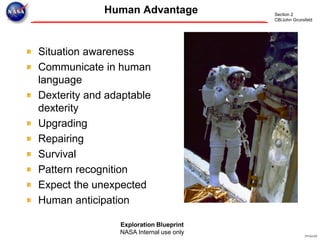
Human Advantage
Situation awareness
Communicate in human
language
Dexterity and adaptable
dexterity
Upgrading
Repairing
Survival
Pattern recognition
Expect the unexpected
Human anticipation
Section 2
CB/John Grunsfeld
Exploration Blueprint
NASA Internal use only 29-Oct-02
Who is going to repair
the robots?
Tele-robotic control
w/minimal latency
Multi-sensor, non-linear,
adaptable processing
Self-healing
Current robotic
technology limited to
simple tasks, or
combinations of simple
tasks
Human Advantage
Section 2
CB/John Grunsfeld
Exploration Blueprint
NASA Internal use only 29-Oct-02
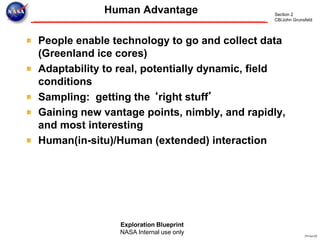
Human Advantage
People enable technology to go and collect data
(Greenland ice cores)
Adaptability to real, potentially dynamic, field
conditions
Sampling: getting the ‘right stuff’
Gaining new vantage points, nimbly, and rapidly,
and most interesting
Human(in-situ)/Human (extended) interaction
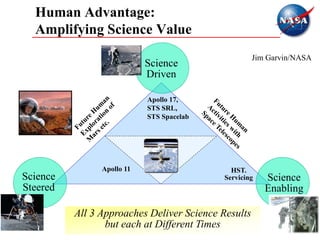
Human Advantage:
Amplifying Science Value
Science
Driven
Science
Steered
Science
Enabling
All 3 Approaches Deliver Science Results
but each at Different Times
ISS
Apollo 17,
STS SRL,
STS Spacelab
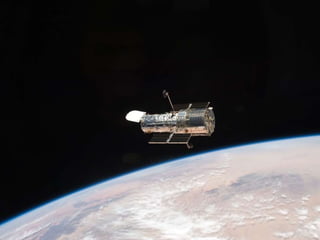
Apollo 11 HST.
Servicing
Jim Garvin/NASA
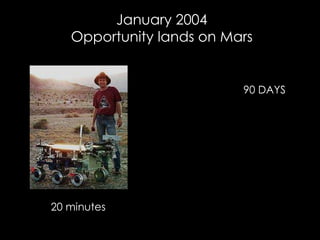
Flashback: 2004
January 2004
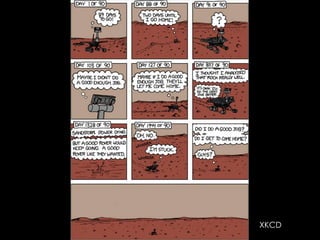
Opportunity lands on Mars
90 DAYS
20 minutes
Analysis of the Benefits and Costs Associated with
Human Space Flight
• A Review of Findings
• March 4, 2004
John Grunsfeld
Office of the Chief Scientist
Results and Findings
from a Recent Study
March 19, 2004
Liam Sarsfield
Office of the Chief Engineer
DRAFT: EYES ONLY – DO NOT PRINT OR REPRODUCE
Office of the Chief Engineer Office of the Chief Scientist
- 15 -
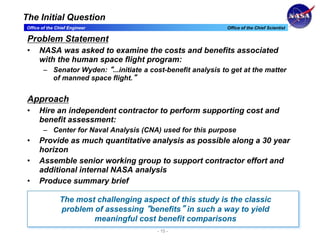
The Initial Question
Problem Statement
• NASA was asked to examine the costs and benefits associated
with the human space flight program:
– Senator Wyden: “...initiate a cost-benefit analysis to get at the matter
of manned space flight.”
Approach
• Hire an independent contractor to perform supporting cost and
benefit assessment:
– Center for Naval Analysis (CNA) used for this purpose
• Provide as much quantitative analysis as possible along a 30 year
horizon
• Assemble senior working group to support contractor effort and
additional internal NASA analysis
• Produce summary brief
The most challenging aspect of this study is the classic
problem of assessing “benefits” in such a way to yield
meaningful cost benefit comparisons
Office of the Chief Engineer Office of the Chief Scientist
- 16 -
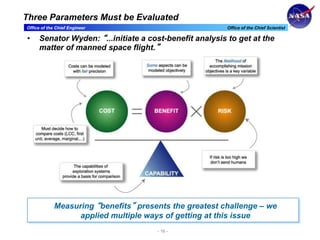
Three Parameters Must be Evaluated
• Senator Wyden: “...initiate a cost-benefit analysis to get at the
matter of manned space flight.”
Measuring “benefits” presents the greatest challenge – we
applied multiple ways of getting at this issue
Office of the Chief Engineer Office of the Chief Scientist
- 17 -
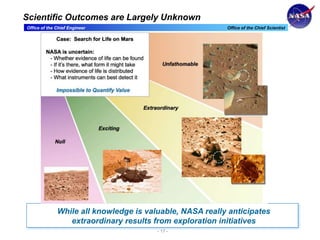
Scientific Outcomes are Largely Unknown
While all knowledge is valuable, NASA really anticipates
extraordinary results from exploration initiatives
Office of the Chief Engineer Office of the Chief Scientist
- 18 -
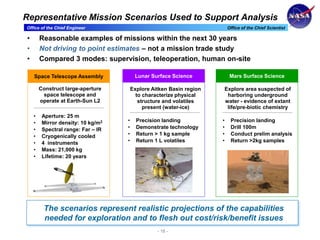
Representative Mission Scenarios Used to Support Analysis
• Reasonable examples of missions within the next 30 years
• Not driving to point estimates – not a mission trade study
• Compared 3 modes: supervision, teleoperation, human on-site
The scenarios represent realistic projections of the capabilities
needed for exploration and to flesh out cost/risk/benefit issues
Construct large-aperture
space telescope and
operate at Earth-Sun L2
• Aperture: 25 m
• Mirror density: 10 kg/m2
• Spectral range: Far – IR
• Cryogenically cooled
• 4 instruments
• Mass: 21,000 kg
• Lifetime: 20 years
Space Telescope Assembly Lunar Surface Science Mars Surface Science
Explore Aitken Basin region
to characterize physical
structure and volatiles
present (water-ice)
Explore area suspected of
harboring underground
water - evidence of extant
life/pre-biotic chemistry
• Precision landing
• Demonstrate technology
• Return > 1 kg sample
• Return 1 L volatiles
• Precision landing
• Drill 100m
• Conduct prelim analysis
• Return >2kg samples
Office of the Chief Engineer Office of the Chief Scientist
- 19 -
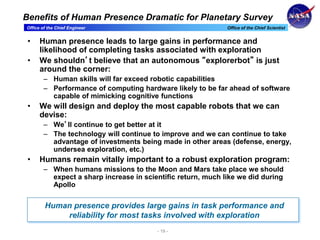
Benefits of Human Presence Dramatic for Planetary Survey
• Human presence leads to large gains in performance and
likelihood of completing tasks associated with exploration
• We shouldn’t believe that an autonomous “explorerbot” is just
around the corner:
– Human skills will far exceed robotic capabilities
– Performance of computing hardware likely to be far ahead of software
capable of mimicking cognitive functions
• We will design and deploy the most capable robots that we can
devise:
– We’ll continue to get better at it
– The technology will continue to improve and we can continue to take
advantage of investments being made in other areas (defense, energy,
undersea exploration, etc.)
• Humans remain vitally important to a robust exploration program:
– When humans missions to the Moon and Mars take place we should
expect a sharp increase in scientific return, much like we did during
Apollo
Human presence provides large gains in task performance and
reliability for most tasks involved with exploration
Essential Conclusion:
When considering total return,
a fully robotic mission costs
about the same as a human
mission if the metric is
cost/benefit
XKCD
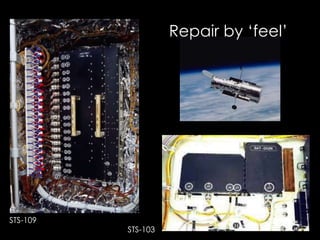
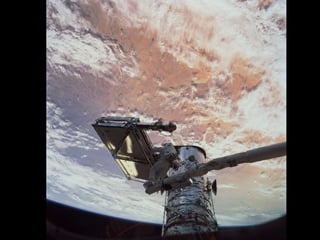
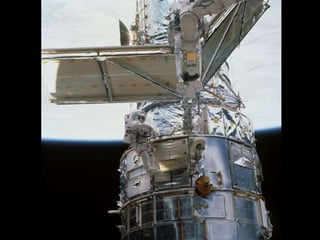
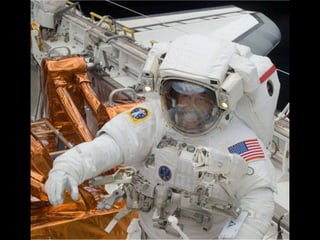
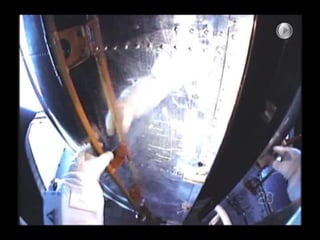
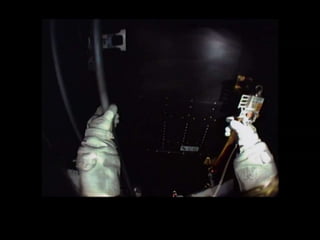
Repair by ‘feel’
STS-109
STS-103
2009
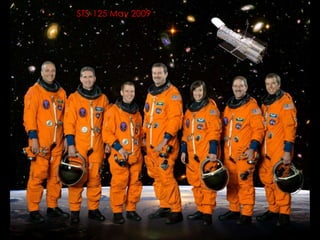
STS-125 May 2009
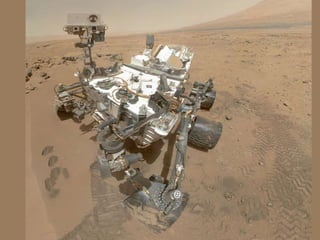
Today
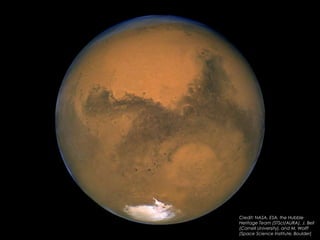
Credit: NASA, ESA, the Hubble
Heritage Team (STScI/AURA), J. Bell
(Cornell University), and M. Wolff
(Space Science Institute, Boulder)
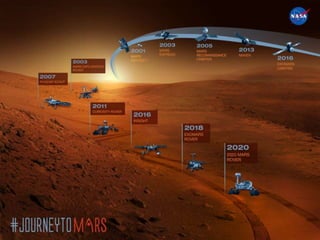
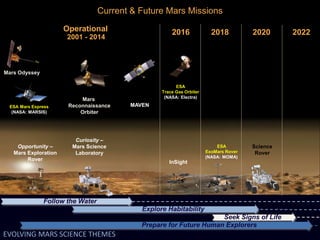
Mars
Reconnaissance
Orbiter
Mars Odyssey
Operational
2001 - 2014
MAVEN
2016 2018 2020
Curiosity –
Mars Science
Laboratory
Science
Rover
2022
Opportunity –
Mars Exploration
Rover
Explore Habitability
Current & Future Mars Missions
Follow the Water
EVOLVING MARS SCIENCE THEMES
Seek Signs of Life
Prepare for Future Human Explorers
ESA
ExoMars Rover
(NASA: MOMA)
InSight
ESA
Trace Gas Orbiter
(NASA: Electra)
ESA Mars Express
(NASA: MARSIS)
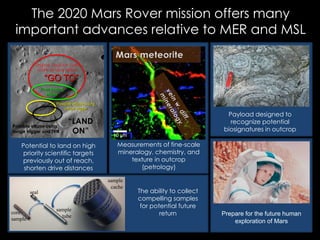
The 2020 Mars Rover mission offers many
important advances relative to MER and MSL
Potential to land on high
priority scientific targets
previously out of reach,
shorten drive distances
Payload designed to
recognize potential
biosignatures in outcrop
Measurements of fine-scale
mineralogy, chemistry, and
texture in outcrop
(petrology)
The ability to collect
compelling samples for
potential future return
Possible ellipse using
range trigger
Final landing
ellipse
“GO TO”
core
sample
seal
sample
tube
sample
cache
The ability to collect
compelling samples
for potential future
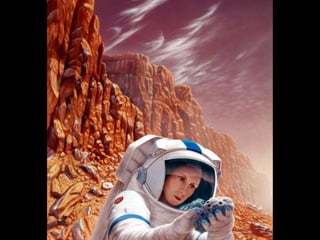
return Prepare for the future human
exploration of Mars
Possible ellipse using
range trigger and TRN
Original 25x20 km Gale
crater landing ellipse
“LAND
ON”
It takes about a decade for each
linear advance in robotics to the
surface of Mars
NASA Astrobiology
Program and
Extreme Environments
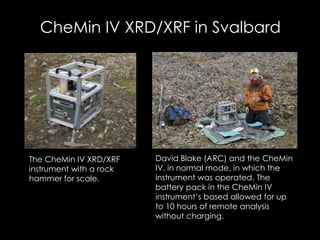
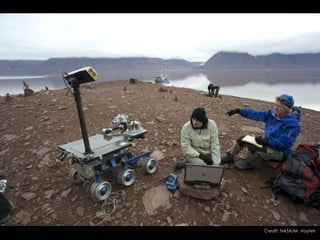
CheMin IV XRD/XRF in Svalbard
The CheMin IV XRD/XRF
instrument with a rock
hammer for scale.
David Blake (ARC) and the CheMin
IV, in normal mode, in which the
instrument was operated. The
battery pack in the CheMin IV
instrument’s based allowed for up
to 10 hours of remote analysis
without charging.
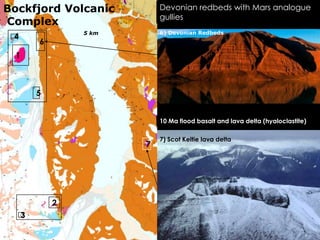
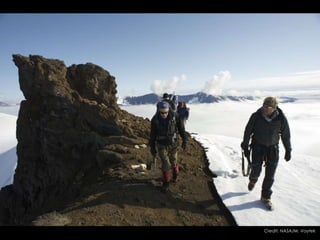
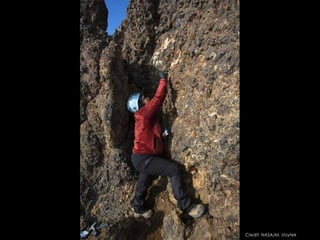
Bockfjord Volcanic Complex
5
4
1
6
2
7
Bockfjord Volcanic
Complex
3
6) Devonian Redbeds
2) Gygre Subglacial Hot Spring
10 Ma flood basalt and lava delta (hyaloclastite)
7) Scot Keltie lava delta
5 km
Devonian redbeds with Mars analogue
gullies
Credit: NASA/M. Voytek
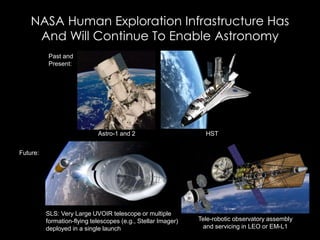
NASA Human Exploration Infrastructure Has
And Will Continue To Enable Astronomy
Past and
Present:
Future:
Astro-1 and 2 HST
SLS: Very Large UVOIR telescope or multiple
formation-flying telescopes (e.g., Stellar Imager)
deployed in a single launch
Tele-robotic observatory assembly
and servicing in LEO or EM-L1
To Mars:
Humans and Robots
Together!

Astronauts and Robots 2015: John Grunsfeld, NASA

  • 1.
    John M. Grunsfeld AssociateAdministrator Science Mission Directorate @SciAstro Journey to Mars Humans and Robots
  • 2.
  • 3.
    NASA Science isInterconnected
  • 4.
    Question: Does theincrease in dexterity and intelligence merit the cost of being onsite for science exploration, and if so how do we best combine the strengths of humans and robots?
  • 5.
  • 7.
    Section 2 CB/John Grunsfeld ExplorationBlueprint NASA Internal use only 29-Oct-02 Creativity Decision making Which rock to collect Connection to humans/home, vicarious space travel Feedback and redirection Adaptability in real time Human intuition/insight Intelligent exploration Outreach Inspiration Human Advantage
  • 8.
    Section 2 CB/John Grunsfeld ExplorationBlueprint NASA Internal use only 29-Oct-02 Human Advantage Situation awareness Communicate in human language Dexterity and adaptable dexterity Upgrading Repairing Survival Pattern recognition Expect the unexpected Human anticipation
  • 9.
    Section 2 CB/John Grunsfeld ExplorationBlueprint NASA Internal use only 29-Oct-02 Who is going to repair the robots? Tele-robotic control w/minimal latency Multi-sensor, non-linear, adaptable processing Self-healing Current robotic technology limited to simple tasks, or combinations of simple tasks Human Advantage
  • 10.
    Section 2 CB/John Grunsfeld ExplorationBlueprint NASA Internal use only 29-Oct-02 Human Advantage People enable technology to go and collect data (Greenland ice cores) Adaptability to real, potentially dynamic, field conditions Sampling: getting the ‘right stuff’ Gaining new vantage points, nimbly, and rapidly, and most interesting Human(in-situ)/Human (extended) interaction
  • 11.
    Human Advantage: Amplifying ScienceValue Science Driven Science Steered Science Enabling All 3 Approaches Deliver Science Results but each at Different Times ISS Apollo 17, STS SRL, STS Spacelab Apollo 11 HST. Servicing Jim Garvin/NASA
  • 12.
  • 13.
    January 2004 Opportunity landson Mars 90 DAYS 20 minutes
  • 14.
    Analysis of theBenefits and Costs Associated with Human Space Flight • A Review of Findings • March 4, 2004 John Grunsfeld Office of the Chief Scientist Results and Findings from a Recent Study March 19, 2004 Liam Sarsfield Office of the Chief Engineer DRAFT: EYES ONLY – DO NOT PRINT OR REPRODUCE
  • 15.
    Office of theChief Engineer Office of the Chief Scientist - 15 - The Initial Question Problem Statement • NASA was asked to examine the costs and benefits associated with the human space flight program: – Senator Wyden: “...initiate a cost-benefit analysis to get at the matter of manned space flight.” Approach • Hire an independent contractor to perform supporting cost and benefit assessment: – Center for Naval Analysis (CNA) used for this purpose • Provide as much quantitative analysis as possible along a 30 year horizon • Assemble senior working group to support contractor effort and additional internal NASA analysis • Produce summary brief The most challenging aspect of this study is the classic problem of assessing “benefits” in such a way to yield meaningful cost benefit comparisons
  • 16.
    Office of theChief Engineer Office of the Chief Scientist - 16 - Three Parameters Must be Evaluated • Senator Wyden: “...initiate a cost-benefit analysis to get at the matter of manned space flight.” Measuring “benefits” presents the greatest challenge – we applied multiple ways of getting at this issue
  • 17.
    Office of theChief Engineer Office of the Chief Scientist - 17 - Scientific Outcomes are Largely Unknown While all knowledge is valuable, NASA really anticipates extraordinary results from exploration initiatives
  • 18.
    Office of theChief Engineer Office of the Chief Scientist - 18 - Representative Mission Scenarios Used to Support Analysis • Reasonable examples of missions within the next 30 years • Not driving to point estimates – not a mission trade study • Compared 3 modes: supervision, teleoperation, human on-site The scenarios represent realistic projections of the capabilities needed for exploration and to flesh out cost/risk/benefit issues Construct large-aperture space telescope and operate at Earth-Sun L2 • Aperture: 25 m • Mirror density: 10 kg/m2 • Spectral range: Far – IR • Cryogenically cooled • 4 instruments • Mass: 21,000 kg • Lifetime: 20 years Space Telescope Assembly Lunar Surface Science Mars Surface Science Explore Aitken Basin region to characterize physical structure and volatiles present (water-ice) Explore area suspected of harboring underground water - evidence of extant life/pre-biotic chemistry • Precision landing • Demonstrate technology • Return > 1 kg sample • Return 1 L volatiles • Precision landing • Drill 100m • Conduct prelim analysis • Return >2kg samples
  • 19.
    Office of theChief Engineer Office of the Chief Scientist - 19 - Benefits of Human Presence Dramatic for Planetary Survey • Human presence leads to large gains in performance and likelihood of completing tasks associated with exploration • We shouldn’t believe that an autonomous “explorerbot” is just around the corner: – Human skills will far exceed robotic capabilities – Performance of computing hardware likely to be far ahead of software capable of mimicking cognitive functions • We will design and deploy the most capable robots that we can devise: – We’ll continue to get better at it – The technology will continue to improve and we can continue to take advantage of investments being made in other areas (defense, energy, undersea exploration, etc.) • Humans remain vitally important to a robust exploration program: – When humans missions to the Moon and Mars take place we should expect a sharp increase in scientific return, much like we did during Apollo Human presence provides large gains in task performance and reliability for most tasks involved with exploration
  • 20.
    Essential Conclusion: When consideringtotal return, a fully robotic mission costs about the same as a human mission if the metric is cost/benefit
  • 21.
  • 23.
  • 26.
  • 27.
  • 31.
  • 32.
    Credit: NASA, ESA,the Hubble Heritage Team (STScI/AURA), J. Bell (Cornell University), and M. Wolff (Space Science Institute, Boulder)
  • 34.
    Mars Reconnaissance Orbiter Mars Odyssey Operational 2001 -2014 MAVEN 2016 2018 2020 Curiosity – Mars Science Laboratory Science Rover 2022 Opportunity – Mars Exploration Rover Explore Habitability Current & Future Mars Missions Follow the Water EVOLVING MARS SCIENCE THEMES Seek Signs of Life Prepare for Future Human Explorers ESA ExoMars Rover (NASA: MOMA) InSight ESA Trace Gas Orbiter (NASA: Electra) ESA Mars Express (NASA: MARSIS)
  • 37.
    The 2020 MarsRover mission offers many important advances relative to MER and MSL Potential to land on high priority scientific targets previously out of reach, shorten drive distances Payload designed to recognize potential biosignatures in outcrop Measurements of fine-scale mineralogy, chemistry, and texture in outcrop (petrology) The ability to collect compelling samples for potential future return Possible ellipse using range trigger Final landing ellipse “GO TO” core sample seal sample tube sample cache The ability to collect compelling samples for potential future return Prepare for the future human exploration of Mars Possible ellipse using range trigger and TRN Original 25x20 km Gale crater landing ellipse “LAND ON”
  • 38.
    It takes abouta decade for each linear advance in robotics to the surface of Mars
  • 39.
  • 40.
    CheMin IV XRD/XRFin Svalbard The CheMin IV XRD/XRF instrument with a rock hammer for scale. David Blake (ARC) and the CheMin IV, in normal mode, in which the instrument was operated. The battery pack in the CheMin IV instrument’s based allowed for up to 10 hours of remote analysis without charging.
  • 41.
    Bockfjord Volcanic Complex 5 4 1 6 2 7 BockfjordVolcanic Complex 3 6) Devonian Redbeds 2) Gygre Subglacial Hot Spring 10 Ma flood basalt and lava delta (hyaloclastite) 7) Scot Keltie lava delta 5 km Devonian redbeds with Mars analogue gullies
  • 42.
  • 43.
  • 44.
  • 45.
  • 46.
  • 48.
    NASA Human ExplorationInfrastructure Has And Will Continue To Enable Astronomy Past and Present: Future: Astro-1 and 2 HST SLS: Very Large UVOIR telescope or multiple formation-flying telescopes (e.g., Stellar Imager) deployed in a single launch Tele-robotic observatory assembly and servicing in LEO or EM-L1
  • 50.
    To Mars: Humans andRobots Together!