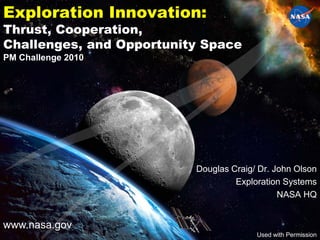
Exploration Innovation:
Thrust, Cooperation,
Challenges, and Opportunity Space
PM Challenge 2010


                          Douglas Craig/ Dr. John Olson
                                   Exploration Systems
                                              NASA HQ


www.nasa.gov
                                        Used with Permission
Primary Thrust

Exploration is an Engine for Innovation for NASA & the Nation


                Innovation in Programs,
               Paradigms, People, Plans,
                       Processes,
               Procurements, Products,
                    Public Outreach,
               Participatory Exploration,
                 Protection & Payloads
Cosmic Challenges: Capability, Resources, Complexity


                                        The further we
                                        go…the more
                                       Technology and
                                     Innovation become
                                     a critical enabler &
                                         risk reducer
Global Exploration Themes: Inspiration for Innovation


           Human Civilization        Scientific Knowledge


         Exploration Preparation     Global Partnerships


          Economic Expansion         Public Engagement

                                                            4
Trade Space for Future Exploration Capabilities
            Deep Space                                                 Asteroids and
             Robotics                                                Near-Earth Objects


Commercial
and Civil LEO                                                                                      Mars Surface,
                                                                                                  Phobos, Deimos


                                                   ISS and Other LEO Destinations/Servicing

                                                                                         Lunar Orbit,
                                                                                     Lunar Surface (Global)


                                                Expanding America’s Reach                                      5
National Aeronautics and Space Administration
Agency Opportunities That Drive Innovative
     Technology, Process, and Culture Developments
Extended Human                    Mars Direct
  Presence and
Assembling Large
Systems in Deep
       Space
 (i.e., Lagrange
      Points)                                                      Human Missions
                                                                      to Mars
                             Human Missions to Human Mission to
                             Near Earth Objects Mars Moon Phobos
     Future                    (i.e., Apophis)
      Path
     Options


                      Human Missions to
                       Explore the Moon


      The Mission Drives Innovation and Innovation Enables the Mission
Complex Challenges, Constrained Optimization &
Integrated Systems Engineering Opportunities

• Supporting the President’s Agenda and the “National Mission”

• Executing a Challenging & Complex Human Space Exploration Mission

• Operating within Constrained Resources (Budget, Personnel, Facilities)

• Demonstrating Best Value for Taxpayer Dollars in a Tough Budget Climate

• Achieving Robust Progress Early and Often in Inspiring Endeavors

• Engaging in International, Commercial & Intergovernmental partnerships

• Creating Lean New Processes that Optimize ROI, Safety, Interoperability

      For Exploration, Necessity is the Mother of Innovation,
            Invention, and Improvement in Every Area
Innovation Across All Areas in the “Exploration Universe”


Transportation System, Mission Support Infrastructure, Operations, Technologies
Innovation and Concept Validation:
     Agility to Enable Dynamic Options – LER Pathfinder
•   Broad Area Announcements
•   Blue Sky Innovation Forums
•   Game-Changing Technologies         BAA Habitat Design by
                                       University of Maryland
•   “Partnerships for Progress”
                                                                Lunar Electric Rover and
•   Space Act Agreements                                           Suitport Concepts
                                                                 Developed by Blue Sky

•   Centennial Challenges                                                                  Lithium-sulfur batteries


    Concept Formulation              System and Operational Concept Validation


                              Oct 2008, LER accomplished                    LER to performed a
    Architecture Enabled by          3-day mission                            14-day mission
         LER Concept          (supported Inaugural Parade)                   (Aug 28- Sept 18)                   9
Insertion of Innovative Concepts in a Flexible
     Architecture Development Process
                   Innovative System Concepts Development Sources


        NASA          Blue Sky      Broad Area    Game-Changing
      Tech. Dev.      Concepts    Announcements    Technologies


                                                       Lithium-sulfur
                                                          batteries


           Lunar Architecture Point of Departure / Mars DRA
           (System and Operational Concepts)


Architecture System & Conops Validation using Rapid Prototype Development/Analog Tests
Expanding NASA Partnerships to Enable Exploration

• International Partnerships (IPs)
 – Global Exploration Strategy (GES): 14 Int’l Space Agencies
 – Canada, Europe, and Japan = most progress; dialogue with
   Russia, China and India still immature
 – International Architecture Working Group established by
   ISECG members to develop Global Point of Departure
   Architecture (gPOD) in June 2010
 – Strong IP interest/collaboration in analog field tests
• Commercial: Traditional & Non-, NewSpace
 – Robust interest in surface systems: cargo/logistics, power,
   comm/nav, robotics, habitation and surface mobility
   (e.g. Google, Caterpillar, GM)
• Intergovernmental, Academia & Technology
 – Leveraging other government programs and technologies
   to minimize costs & maximize efficiency and innovation
   (e.g. DoD, DOE, DARPA, NOAA, NSF)
• Science                                                        The Global
                                                                 Exploration
                                                                 Strategy
 – Synergy, Human and Robotic, OSEWG, External Groups            A Framework
                                                                 for
   (e,g. NLSI, LSI, LEAG, ILEWG)                                 Coordination

                                                                 May 2007
CONOPS Validation using Analog Field Tests:
         Highly Integrated Innovation


                                                       Architecture Element Concept
                                                  (Rover, Habitat, Robotic Assistants, Power, etc.)

      Partner Infusion
        International, Commercial,                         Lunar Science Concepts
       Other Government Agencies
                                                 (Site Survey’s, Geological Sampling/Curation, etc.)


                                                       Surface Operations Concepts
                                 Analog Field
                                Tests Validate        (Outpost Maintenance, Exploration, etc.)
                                      Key
                                  Integrated
                                 Architecture                         Training
                                Requirements
                                and Concepts
                                                     (Crew, Science Ops, Exploration Ops, etc.)


                                                          Participatory Exploration
                                                     (Web 2.0, Virtual Reality, Simulations, etc.)
Analog field tests
emphasize collaboration                                   Technology Development
between ESMD, SMD, & IPs
                                                  (Energy Storage, Robotics, Human Factors, etc.)
                                                                         12                           12
Tightly Coupled Integration: Completing the
    “Circle of Innovation”


                       Exploration & Science Objectives
                                                            Surface
         Mission
                                                          Architecture
        Operations
                                                          Development


     Leveraged
Communications                    Analog                       Technology
   & Simulation                  Activities                    Requirements
    Capabilities


       Participatory                                       Technology
       Exploration                                        Development


                                                                          13
Expanding on an Innovative Architecture Design Philosophy

  • Primary tenets of architecture design philosophy applied at the
    Systems, Operations, and Component Level:
      •   Reduce – Design systems and optimize operations to minimize resources
      •   Reuse – Use for the original purpose multiple times
      •   Re-purpose – Use for a different purpose without significant modification
      •   Recycle – Use for a different purpose with significant modification
      •   Commonality – Uniform, common systems & components
      •   Interoperability – Joint standards, open/evolutionary architectures
  Architecture Game-Changing Technologies (Spin-in) & Architecture Required
     Technologies with Large impact on Terrestrial Applications (Spin-off)
  • In addition to resource conservation, some of the objectives of the
    Human Space Exploration Architecture are the following:
      • Provide technologies and systems that improve life on Earth
      • Enhance sustainability, affordability, robustness, and reliability
      • Minimize the impact to the both the Earth’s and space environment
Exploration Benefits our Economy, Energy, Environment, Healthcare & Education
                                                                                      14
Game-Changing Technology: Stellar Opportunities &
   Energy Example
    Emerging technology area, if infused into exploration architecture, would
    provide benefits that ripple beyond its adopted system area. These
    technologies benefit architecture elements beyond their own, and foster
    NASA's leadership in innovative technology use/application.
  Transformational technologies -- System
  level technologies that cause major changes in the
  accepted way of doing things causing a fundamental
  change in the way a technology solution is
  approached
  – Require a system change
  – Example: Change power systems from energy storage to
    power beaming

• Revolutionary technologies -- Component
  level technologies with highly improved performance
  or capability, which eventually replace currently
  dominant technologies
  – Require significant modifications at the component level
  – Example: Change from batteries to fuel cells


  Rapidly-evolving technologies -- Technologies
  with rapid incremental improvements in performance
  of established products
  – The technology is the same but will have far superior
    performance to current technologies
  – Example: Solar cells with increased efficiency
                                                                                15
Space Exploration Innovation & Evolution Solutions
Technology Development / Maturation
• Advanced Batteries & Energy Storage
• Advanced Flywheels
• Regenerative Fuel Cells
• Hydrogen Storage              Enabling Human   Missions
• Thermal Energy Storage
• Fission Power Systems
• Stirling Power Converters
• High Efficiency Photovoltaics
• Advanced Solar Power Generation
• Intelligent Power Management & Distribution
• Wireless Power Transmission
• Space Solar Power Systems
• Embedded Power Technologies
• Electric Vehicles for Surface Mobility
                                                            Terrestrial Applications
                                                            • Electric vehicles
                                                            • Green buildings
                                                            • Facility backup power systems
                                                            • Compact power sources for
                                                               consumer electronics
                                                            • Solar power generation
                                                            • Power generation from waste heat
                                                            • Smart power grid
                                                            • Small nuclear power systems

                                                                                                 16
Putting it All Together for Continual Refinement:
    Innovation in the Development of the Exploration Architecture

           Key Strategic Analysis Areas                                    Integrated Exploration
                                                                                 Architecture
Science                                         Partnerships
Surface Scenarios                           •   Internationals
•   Outpost operations                      •   Commercial
                                            •   Other government      Science Surface             Partnerships
•   Local site operations                       agencies
•   Extend range
                                                                         Scenarios
    operations

                                                                                   Exploration
                                                                                      POD
                         Exploration POD                                           Architecture
                           Architecture                                                       Innovations
                                                                      DIO Technology          and Concept
                                                                       Review Panel            Validation
DIO Technology
                                             Innovations and
 Review Panel
•   Integrated Architecture
                                           Concept Validation
    needs/technology list          •   Innovations (BAAs, Blue Sky,
    (ETDP and HRP)                     Concept Tiger Team)
•   Customer agreements            •   Concept Validation (Lunar
•   Technology white papers            Surface Ops Sim, Analog
                                       missions & field Tests)


                   Refinement of Exploration Point of Departure Architecture to
                   Increase Satisfaction of Space Exploration Policy Objectives
                                                                                                                 17
Exploration Innovation Summary
• Innovation across all NASA exploration elements will enable a
  more sustainable, yet aggressive future mission portfolio while
  addressing broader national needs in health, energy and climate,
  national security, STEM education
• Real exploration constraints, challenges, and opportunities are
  driving vital innovation for sustainability, affordability, reliability,
  recyclability/repurposing, commonality, and interoperability

• A bold space exploration future must realize and leverage key
  innovation opportunities in the near term and going forward

• Innovation is a fundamental element in the development of the
  Exploration Architecture and will continue to expand.

• ESMD is committed to “institutionalizing innovation” – a culture
  to invite, capture, implement, recognize and reward employees
  for innovative solutions – both the successes and smart failures.
                                                                             18
Questions?


 www.nasa.gov/exploration

John.olson

  • 1.
    Exploration Innovation: Thrust, Cooperation, Challenges,and Opportunity Space PM Challenge 2010 Douglas Craig/ Dr. John Olson Exploration Systems NASA HQ www.nasa.gov Used with Permission
  • 2.
    Primary Thrust Exploration isan Engine for Innovation for NASA & the Nation Innovation in Programs, Paradigms, People, Plans, Processes, Procurements, Products, Public Outreach, Participatory Exploration, Protection & Payloads
  • 3.
    Cosmic Challenges: Capability,Resources, Complexity The further we go…the more Technology and Innovation become a critical enabler & risk reducer
  • 4.
    Global Exploration Themes:Inspiration for Innovation Human Civilization Scientific Knowledge Exploration Preparation Global Partnerships Economic Expansion Public Engagement 4
  • 5.
    Trade Space forFuture Exploration Capabilities Deep Space Asteroids and Robotics Near-Earth Objects Commercial and Civil LEO Mars Surface, Phobos, Deimos ISS and Other LEO Destinations/Servicing Lunar Orbit, Lunar Surface (Global) Expanding America’s Reach 5 National Aeronautics and Space Administration
  • 6.
    Agency Opportunities ThatDrive Innovative Technology, Process, and Culture Developments Extended Human Mars Direct Presence and Assembling Large Systems in Deep Space (i.e., Lagrange Points) Human Missions to Mars Human Missions to Human Mission to Near Earth Objects Mars Moon Phobos Future (i.e., Apophis) Path Options Human Missions to Explore the Moon The Mission Drives Innovation and Innovation Enables the Mission
  • 7.
    Complex Challenges, ConstrainedOptimization & Integrated Systems Engineering Opportunities • Supporting the President’s Agenda and the “National Mission” • Executing a Challenging & Complex Human Space Exploration Mission • Operating within Constrained Resources (Budget, Personnel, Facilities) • Demonstrating Best Value for Taxpayer Dollars in a Tough Budget Climate • Achieving Robust Progress Early and Often in Inspiring Endeavors • Engaging in International, Commercial & Intergovernmental partnerships • Creating Lean New Processes that Optimize ROI, Safety, Interoperability For Exploration, Necessity is the Mother of Innovation, Invention, and Improvement in Every Area
  • 8.
    Innovation Across AllAreas in the “Exploration Universe” Transportation System, Mission Support Infrastructure, Operations, Technologies
  • 9.
    Innovation and ConceptValidation: Agility to Enable Dynamic Options – LER Pathfinder • Broad Area Announcements • Blue Sky Innovation Forums • Game-Changing Technologies BAA Habitat Design by University of Maryland • “Partnerships for Progress” Lunar Electric Rover and • Space Act Agreements Suitport Concepts Developed by Blue Sky • Centennial Challenges Lithium-sulfur batteries Concept Formulation System and Operational Concept Validation Oct 2008, LER accomplished LER to performed a Architecture Enabled by 3-day mission 14-day mission LER Concept (supported Inaugural Parade) (Aug 28- Sept 18) 9
  • 10.
    Insertion of InnovativeConcepts in a Flexible Architecture Development Process Innovative System Concepts Development Sources NASA Blue Sky Broad Area Game-Changing Tech. Dev. Concepts Announcements Technologies Lithium-sulfur batteries Lunar Architecture Point of Departure / Mars DRA (System and Operational Concepts) Architecture System & Conops Validation using Rapid Prototype Development/Analog Tests
  • 11.
    Expanding NASA Partnershipsto Enable Exploration • International Partnerships (IPs) – Global Exploration Strategy (GES): 14 Int’l Space Agencies – Canada, Europe, and Japan = most progress; dialogue with Russia, China and India still immature – International Architecture Working Group established by ISECG members to develop Global Point of Departure Architecture (gPOD) in June 2010 – Strong IP interest/collaboration in analog field tests • Commercial: Traditional & Non-, NewSpace – Robust interest in surface systems: cargo/logistics, power, comm/nav, robotics, habitation and surface mobility (e.g. Google, Caterpillar, GM) • Intergovernmental, Academia & Technology – Leveraging other government programs and technologies to minimize costs & maximize efficiency and innovation (e.g. DoD, DOE, DARPA, NOAA, NSF) • Science The Global Exploration Strategy – Synergy, Human and Robotic, OSEWG, External Groups A Framework for (e,g. NLSI, LSI, LEAG, ILEWG) Coordination May 2007
  • 12.
    CONOPS Validation usingAnalog Field Tests: Highly Integrated Innovation Architecture Element Concept (Rover, Habitat, Robotic Assistants, Power, etc.) Partner Infusion International, Commercial, Lunar Science Concepts Other Government Agencies (Site Survey’s, Geological Sampling/Curation, etc.) Surface Operations Concepts Analog Field Tests Validate (Outpost Maintenance, Exploration, etc.) Key Integrated Architecture Training Requirements and Concepts (Crew, Science Ops, Exploration Ops, etc.) Participatory Exploration (Web 2.0, Virtual Reality, Simulations, etc.) Analog field tests emphasize collaboration Technology Development between ESMD, SMD, & IPs (Energy Storage, Robotics, Human Factors, etc.) 12 12
  • 13.
    Tightly Coupled Integration:Completing the “Circle of Innovation” Exploration & Science Objectives Surface Mission Architecture Operations Development Leveraged Communications Analog Technology & Simulation Activities Requirements Capabilities Participatory Technology Exploration Development 13
  • 14.
    Expanding on anInnovative Architecture Design Philosophy • Primary tenets of architecture design philosophy applied at the Systems, Operations, and Component Level: • Reduce – Design systems and optimize operations to minimize resources • Reuse – Use for the original purpose multiple times • Re-purpose – Use for a different purpose without significant modification • Recycle – Use for a different purpose with significant modification • Commonality – Uniform, common systems & components • Interoperability – Joint standards, open/evolutionary architectures Architecture Game-Changing Technologies (Spin-in) & Architecture Required Technologies with Large impact on Terrestrial Applications (Spin-off) • In addition to resource conservation, some of the objectives of the Human Space Exploration Architecture are the following: • Provide technologies and systems that improve life on Earth • Enhance sustainability, affordability, robustness, and reliability • Minimize the impact to the both the Earth’s and space environment Exploration Benefits our Economy, Energy, Environment, Healthcare & Education 14
  • 15.
    Game-Changing Technology: StellarOpportunities & Energy Example Emerging technology area, if infused into exploration architecture, would provide benefits that ripple beyond its adopted system area. These technologies benefit architecture elements beyond their own, and foster NASA's leadership in innovative technology use/application. Transformational technologies -- System level technologies that cause major changes in the accepted way of doing things causing a fundamental change in the way a technology solution is approached – Require a system change – Example: Change power systems from energy storage to power beaming • Revolutionary technologies -- Component level technologies with highly improved performance or capability, which eventually replace currently dominant technologies – Require significant modifications at the component level – Example: Change from batteries to fuel cells Rapidly-evolving technologies -- Technologies with rapid incremental improvements in performance of established products – The technology is the same but will have far superior performance to current technologies – Example: Solar cells with increased efficiency 15
  • 16.
    Space Exploration Innovation& Evolution Solutions Technology Development / Maturation • Advanced Batteries & Energy Storage • Advanced Flywheels • Regenerative Fuel Cells • Hydrogen Storage Enabling Human Missions • Thermal Energy Storage • Fission Power Systems • Stirling Power Converters • High Efficiency Photovoltaics • Advanced Solar Power Generation • Intelligent Power Management & Distribution • Wireless Power Transmission • Space Solar Power Systems • Embedded Power Technologies • Electric Vehicles for Surface Mobility Terrestrial Applications • Electric vehicles • Green buildings • Facility backup power systems • Compact power sources for consumer electronics • Solar power generation • Power generation from waste heat • Smart power grid • Small nuclear power systems 16
  • 17.
    Putting it AllTogether for Continual Refinement: Innovation in the Development of the Exploration Architecture Key Strategic Analysis Areas Integrated Exploration Architecture Science Partnerships Surface Scenarios • Internationals • Outpost operations • Commercial • Other government Science Surface Partnerships • Local site operations agencies • Extend range Scenarios operations Exploration POD Exploration POD Architecture Architecture Innovations DIO Technology and Concept Review Panel Validation DIO Technology Innovations and Review Panel • Integrated Architecture Concept Validation needs/technology list • Innovations (BAAs, Blue Sky, (ETDP and HRP) Concept Tiger Team) • Customer agreements • Concept Validation (Lunar • Technology white papers Surface Ops Sim, Analog missions & field Tests) Refinement of Exploration Point of Departure Architecture to Increase Satisfaction of Space Exploration Policy Objectives 17
  • 18.
    Exploration Innovation Summary •Innovation across all NASA exploration elements will enable a more sustainable, yet aggressive future mission portfolio while addressing broader national needs in health, energy and climate, national security, STEM education • Real exploration constraints, challenges, and opportunities are driving vital innovation for sustainability, affordability, reliability, recyclability/repurposing, commonality, and interoperability • A bold space exploration future must realize and leverage key innovation opportunities in the near term and going forward • Innovation is a fundamental element in the development of the Exploration Architecture and will continue to expand. • ESMD is committed to “institutionalizing innovation” – a culture to invite, capture, implement, recognize and reward employees for innovative solutions – both the successes and smart failures. 18
  • 19.