National Aeronautics and Space Administration


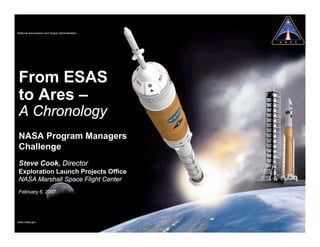
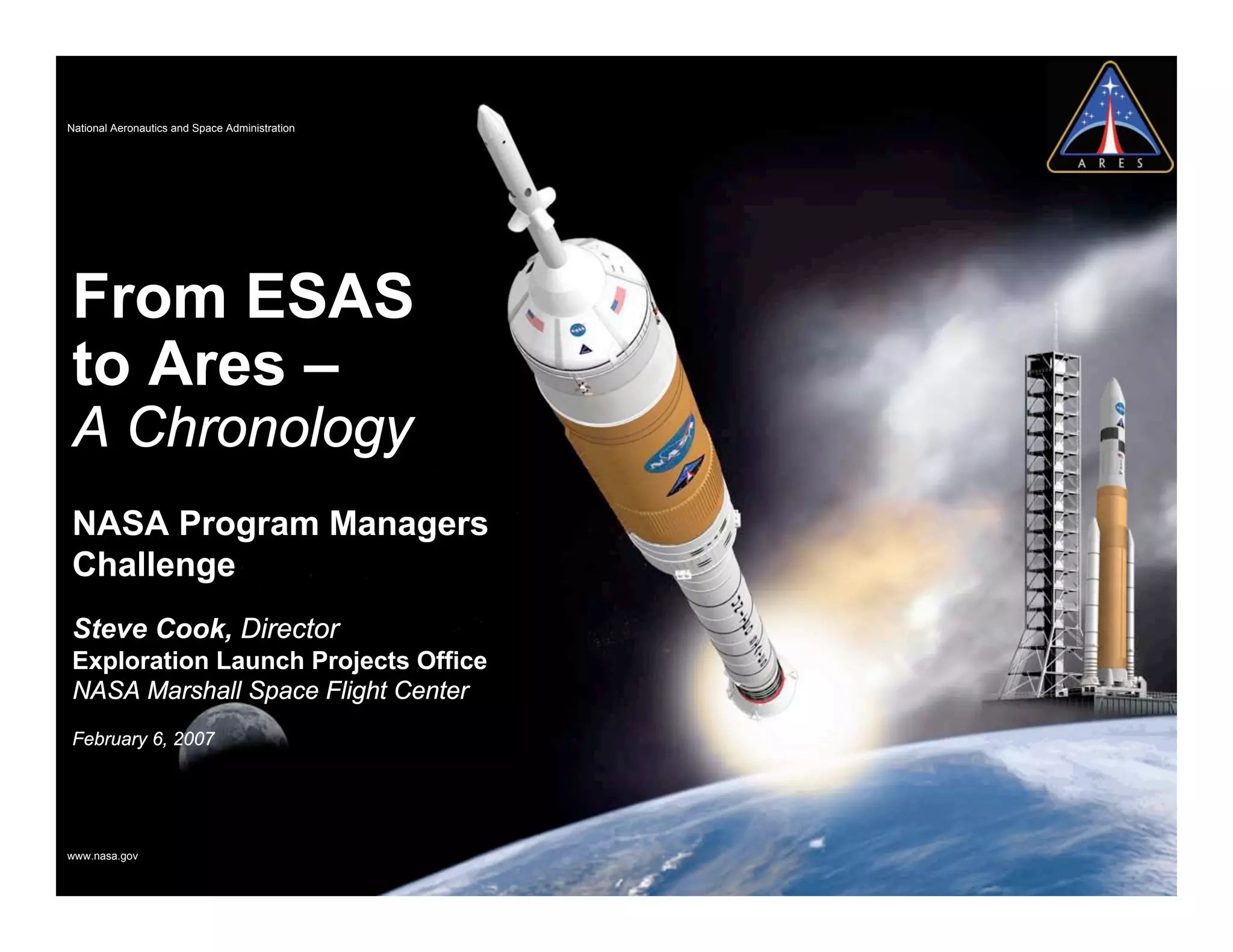
From ESAS
to Ares –
A Chronology
NASA Program Managers
Challenge
Steve Cook, Director
Exploration Launch Projects Office
NASA Marshall Space Flight Center
February 6, 2007


www.nasa.gov
Ares: The Right Vehicle for NASA’s
                                                       Exploration Mission

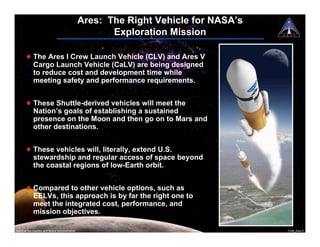
       ! The Ares I Crew Launch Vehicle (CLV) and Ares V
         Cargo Launch Vehicle (CaLV) are being designed
         to reduce cost and development time while
         meeting safety and performance requirements.


       ! These Shuttle-derived vehicles will meet the
         Nation’s goals of establishing a sustained
         presence on the Moon and then go on to Mars and
         other destinations.


       ! These vehicles will, literally, extend U.S.
         stewardship and regular access of space beyond
         the coastal regions of low-Earth orbit.


       ! Compared to other vehicle options, such as
         EELVs, this approach is by far the right one to
         meet the integrated cost, performance, and
         mission objectives.

National Aeronautics and Space Administration                                        7108_Ares.2
An Architecture Selection
                                                       Grounded in Analysis
                        Several recent studies demonstrate that a Shuttle-derived
                        architecture makes the most sense for NASA from a life-
                              cycle cost, safety, and reliability perspective.
     ! NASA Exploration Systems Architecture Study (ESAS) in 2005
       recommended this approach based on significant analysis.
     ! Supported in Law through the NASA Authorization Act of
       2005 (Section 502).
     ! Department of Defense (DoD) validated this conclusion in
       August, 2005 (letter to John Marburger* from Ronald Sega**
       and Michael Griffin***).
     ! The October 2006 Congressional Budget Office report entitled
       “Alternatives for Future U.S. Space-Launch Capabilities” is
       consistent with NASA’s analysis and decisions.


                         * Director, White House Office of Science and Technology Policy
                         ** Under Secretary of the Air Force
                         *** NASA Administrator


National Aeronautics and Space Administration                                              7108_Ares.3
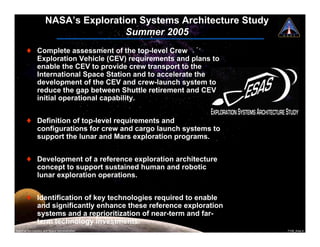
NASA’s Exploration Systems Architecture Study
                                      Summer 2005
       ! Complete assessment of the top-level Crew
         Exploration Vehicle (CEV) requirements and plans to
         enable the CEV to provide crew transport to the
         International Space Station and to accelerate the
         development of the CEV and crew-launch system to
         reduce the gap between Shuttle retirement and CEV
         initial operational capability.


       ! Definition of top-level requirements and
         configurations for crew and cargo launch systems to
         support the lunar and Mars exploration programs.


       ! Development of a reference exploration architecture
         concept to support sustained human and robotic
         lunar exploration operations.


       ! Identification of key technologies required to enable
         and significantly enhance these reference exploration
         systems and a reprioritization of near-term and far-
         term technology investments.
National Aeronautics and Space Administration                         7108_Ares.4
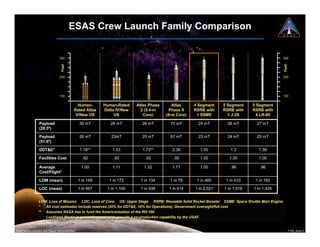
ESAS Crew Launch Family Comparison


                                 300                                                                                                          300
                                  Feet


                                                                                                                                              Feet
                                 200                                                                                                          200


                                 100                                                                                                          100

                                              Human-       Human-Rated    Atlas Phase      Atlas     4 Segment    5 Segment    5 Segment
                                            Rated Atlas    Delta IV/New     2 (5.4-m     Phase X     RSRB with    RSRB with    RSRB with
                                             V/New US           US           Core)      (8-m Core)    1 SSME        1 J-2S       4 LR-85

                 Payload                        30 mT         28 mT         26 mT         70 mT       25 mT         26 mT       27 mT
                 (28.5º)

                 Payload                        26 mT         23mT          25 mT         67 mT       23 mT         24 mT       25 mT
                 (51.6º)

                 DDT&E*                         1.18**         1.03         1.73**         2.36        1.00          1.3         1.39

                 Facilities Cost                  .92          .92            .92          .92         1.00         1.00         1.00

                 Average                         1.00          1.11          1.32          1.71        1.00          .96          .96
                 Cost/Flight*

                 LOM (mean)                     1 in 149     1 in 172       1 in 134      1 in 79     1 in 460     1 in 433     1 in 182

                 LOC (mean)                     1 in 957    1 in 1,100      1 in 939     1 in 614    1 in 2,021   1 in 1,918   1 in 1,429


                 LOM: Loss of Mission LOC: Loss of Crew US: Upper Stage RSRB: Reusable Solid Rocket Booster SSME: Space Shuttle Main Engine
                 *  All cost estimates include reserves (20% for DDT&E, 10% for Operations), Government oversight/full cost
                 ** Assumes NASA has to fund the Americanization of the RD-180.
                    Lockheed Martin is currently required to provide a co-production capability by the USAF.


National Aeronautics and Space Administration                                                                                                        7108_Ares.5
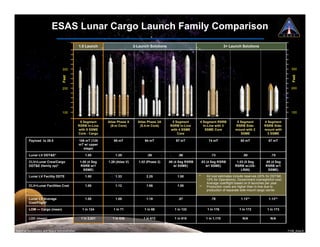
ESAS Lunar Cargo Launch Family Comparison
                                                1.5 Launch                      2-Launch Solutions                                         3+ Launch Solutions


                                   300                                                                                                                                                 300


                                                                                                                                                                                        Feet
                                   Feet


                                   200                                                                                                                                                 200


                                   100                                                                                                                                                 100

                                                 5 Segment     Atlas Phase X      Atlas Phase 3A       5 Segment       4 Segment RSRB             5 Segment          4 Segment
                                                RSRB In-Line    (8-m Core)         (5.4-m Core)       RSRB In-Line       In-Line with 3          RSRB Side-          RSRB Side-
                                                with 5 SSME                                           with 4 SSME         SSME Core              mount with 2        mount with
                                                Core - Cargo                                              Core                                      SSME               3 SSME

         Payload to 28.5                        106 mT (125       95 mT               94 mT              97 mT                 74 mT                 80 mT              67 mT
                                                mT w/ upper
                                                  stage)

         Lunar LV DDT&E*                            1.00           1.29                 .59                .96                   .73                   .80                .75

         CLV+Lunar Crew/Cargo                    1.00 (4 Seg   1.26 (Atlas V)      1.02 (Phase 2)    .98 (4 Seg RSRB       .83 (4 Seg RSRB        1.03 (5 Seg         .85 (4 Seg
         DDT&E (family op)*                      RSRB w/1                                                w/ SSME)             w1 SSME)           RSRB w/J2S-          RSRB w/1
                                                   SSME)                                                                                             LR85)              SSME)

         Lunar LV Facility DDTE                     1.00           1.33                2.25               1.00         *      All cost estimates include reserves (20% for DDT&E,
                                                                                                                              10% for Operations), Government oversight/full cost;
                                                                                                                              Average cost/flight based on 6 launches per year.
         CLV+Lunar Facilities Cost                  1.00           1.12                1.56               1.00         **     Production costs are higher than in-line due to
                                                                                                                              production of separate side-mount cargo carrier.

         Lunar LV Average                           1.00           1.08                1.19                .87                   .78                 1.13**             1.13**
         Cost/Flight*

         LOM — Cargo (mean)                       1 in 124        1 in 71             1 in 88           1 in 133              1 in 176              1 in 172           1 in 173

         LOC (mean)                              1 in 2,021      1 in 536             1 in 612          1 in 915              1 in 1,170              N/A                N/A


National Aeronautics and Space Administration                                                                                                                                        7108_Ares.6
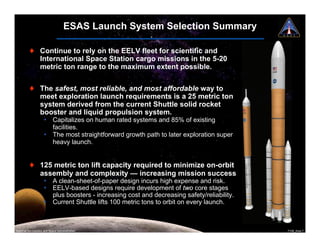
ESAS Launch System Selection Summary

         ! Continue to rely on the EELV fleet for scientific and
           International Space Station cargo missions in the 5-20
           metric ton range to the maximum extent possible.


         ! The safest, most reliable, and most affordable way to
           meet exploration launch requirements is a 25 metric ton
           system derived from the current Shuttle solid rocket
           booster and liquid propulsion system.
                     ¥ Capitalizes on human rated systems and 85% of existing
                       facilities.
                     ¥ The most straightforward growth path to later exploration super
                       heavy launch.


         ! 125 metric ton lift capacity required to minimize on-orbit
           assembly and complexity — increasing mission success
                     ¥ A clean-sheet-of-paper design incurs high expense and risk.
                     ¥ EELV-based designs require development of two core stages
                       plus boosters - increasing cost and decreasing safety/reliability.
                     ¥ Current Shuttle lifts 100 metric tons to orbit on every launch.


National Aeronautics and Space Administration                                               7108_Ares.7
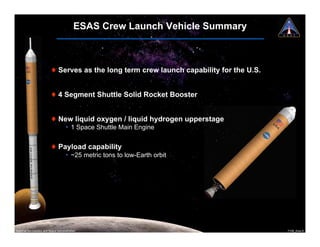
ESAS Crew Launch Vehicle Summary


                          ! Serves as the long term crew launch capability for the U.S.


                          ! 4 Segment Shuttle Solid Rocket Booster


                          ! New liquid oxygen / liquid hydrogen upperstage
                                     ¥ 1 Space Shuttle Main Engine


                          ! Payload capability
                                     ¥ ~25 metric tons to low-Earth orbit


National Aeronautics and Space Administration                                             7108_Ares.8
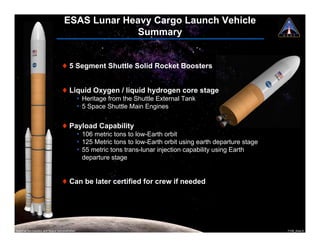
ESAS Lunar Heavy Cargo Launch Vehicle
                                                  Summary


                                  ! 5 Segment Shuttle Solid Rocket Boosters


                                  ! Liquid Oxygen / liquid hydrogen core stage
                                                ¥ Heritage from the Shuttle External Tank
                                                ¥ 5 Space Shuttle Main Engines


                                  ! Payload Capability
                                                ¥ 106 metric tons to low-Earth orbit
                                                ¥ 125 Metric tons to low-Earth orbit using earth departure stage
                                                ¥ 55 metric tons trans-lunar injection capability using Earth
                                                  departure stage


                                  ! Can be later certified for crew if needed


National Aeronautics and Space Administration                                                                      7108_Ares.9
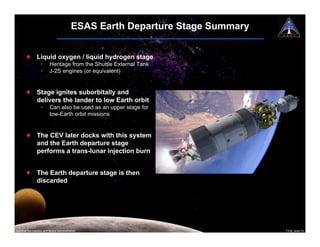
ESAS Earth Departure Stage Summary


       ! Liquid oxygen / liquid hydrogen stage
                  ¥      Heritage from the Shuttle External Tank
                  ¥      J-2S engines (or equivalent)


       ! Stage ignites suborbitally and
         delivers the lander to low Earth orbit
                  ¥      Can also be used as an upper stage for
                         low-Earth orbit missions


       ! The CEV later docks with this system
         and the Earth departure stage
         performs a trans-lunar injection burn


       ! The Earth departure stage is then
         discarded


National Aeronautics and Space Administration                                 7108_Ares.10
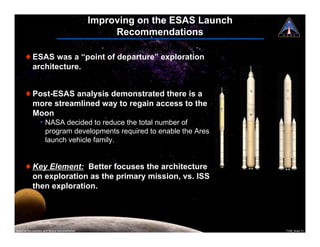
Improving on the ESAS Launch
                                                     Recommendations

       ! ESAS was a “point of departure” exploration
         architecture.


       ! Post-ESAS analysis demonstrated there is a
         more streamlined way to regain access to the
         Moon
                  ¥ NASA decided to reduce the total number of
                    program developments required to enable the Ares
                    launch vehicle family.


       ! Key Element: Better focuses the architecture
         on exploration as the primary mission, vs. ISS
         then exploration.


National Aeronautics and Space Administration                                  7108_Ares.11
Improving on the ESAS Launch
                                                     Recommendations
       ! This approach focuses on developing key technologies sooner.
         For example:

                  ¥ 5 segment stage for Ares I and V
                          " Saves hundreds of millions of dollars

                  ¥ J-2X as the common upper stage engine for both Ares I and Ares V
                          " Saves hundreds of millions of dollars

                  ¥ Use of the commercially developed RS-68 engine
                    as the core engine for Ares V
                          " Saves billions of dollars over the life cycle


                      Progress made on the Ares I is now a significant and direct “down
                        payment” on the Ares V. Selecting common hardware reduces
                      cost and gets us closer to enabling a lunar transportation system.


National Aeronautics and Space Administration                                              7108_Ares.12
Ares: Building on Proven Capabilities

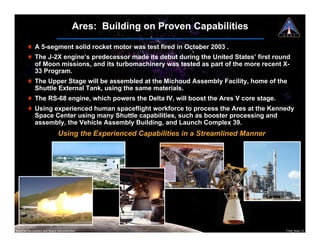
        ! A 5-segment solid rocket motor was test fired in October 2003 .
        ! The J-2X engine’s predecessor made its debut during the United States’ first round
          of Moon missions, and its turbomachinery was tested as part of the more recent X-
          33 Program.
        ! The Upper Stage will be assembled at the Michoud Assembly Facility, home of the
          Shuttle External Tank, using the same materials.
        ! The RS-68 engine, which powers the Delta IV, will boost the Ares V core stage.
        ! Using experienced human spaceflight workforce to process the Ares at the Kennedy
          Space Center using many Shuttle capabilities, such as booster processing and
          assembly, the Vehicle Assembly Building, and Launch Complex 39.
                               Using the Experienced Capabilities in a Streamlined Manner


National Aeronautics and Space Administration                                               7108_Ares.13
A Robust Development Approach

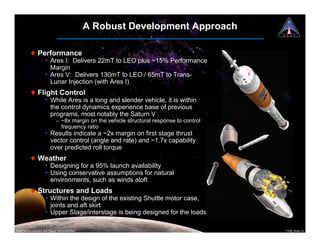
          ! Performance
                      ¥ Ares I: Delivers 22mT to LEO plus ~15% Performance
                        Margin
                      ¥ Ares V: Delivers 130mT to LEO / 65mT to Trans-
                        Lunar Injection (with Ares I)
          ! Flight Control
                      ¥ While Ares is a long and slender vehicle, it is within
                        the control dynamics experience base of previous
                        programs, most notably the Saturn V
                              " ~8x margin on the vehicle structural response to control
                                frequency ratio
                      ¥ Results indicate a ~2x margin on first stage thrust
                        vector control (angle and rate) and ~1.7x capability
                        over predicted roll torque
          ! Weather
                      ¥ Designing for a 95% launch availability
                      ¥ Using conservative assumptions for natural
                        environments, such as winds aloft
          ! Structures and Loads
                      ¥ Within the design of the existing Shuttle motor case,
                        joints and aft skirt
                      ¥ Upper Stage/interstage is being designed for the loads

National Aeronautics and Space Administration                                              7108_Ares.14
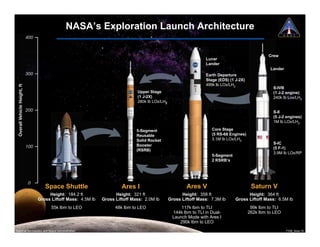
NASA’s Exploration Launch Architecture

                                                                                                                                    Crew
                                                                                                    L
                                                                                                    Lunar
                                                                                                    L
                                                                                                    Lander
                                                                                                                                     Lander
                                                                                                    E
                                                                                                    Earth Departure
                                                                                                    S
                                                                                                    Stage (EDS) (1 J-2X)
                                                                                                    499k
                                                                                                    499k lb LOx/LH2
                                                                                                                                      S-IVB
                                                                U
                                                                Upper Stage
                                                                       St                                                             (1 J-2 engine)
                                                                (1 J-2X)                                                              240k lb Lox/LH2
                                                                280k lb LOx/LH2

                                                                                                                                      S-II
                                                                                                                                      (5 J-2 engines)
                                                                                                                                      1M lb LOx/LH2

                                                                5-Segment                              Core Stage
                                                                Reusable                               (5 RS-68 Engines)
                                                                Solid Rocket                           3.1M lb LOx/LH2
                                                                                                                                      S-IC
                                                                Booster
                                                                                                                                      (5 F-1)
                                                                (RSRB)
                                                                                                                                      3.9M lb LOx/RP
                                                                                                       5-Segment
                                                                                                       2 RSRB’s


                      Space Shuttle                      Ares I                           Ares V                            Saturn V
                     Height: 184.2 ft                 Height: 321 ft                    Height: 358 ft                   Height: 364 ft
                Gross Liftoff Mass: 4.5M lb     Gross Liftoff Mass: 2.0M lb       Gross Liftoff Mass: 7.3M lb      Gross Liftoff Mass: 6.5M lb
                          55k lbm to LEO              48k lbm to LEO                    117k lbm to TLI                     99k lbm to TLI
                                                                                    144k lbm to TLI in Dual-               262k lbm to LEO
                                                                                    Launch Mode with Ares I
                                                                                       290k lbm to LEO
National Aeronautics and Space Administration                                                                                                 7108_Ares.15
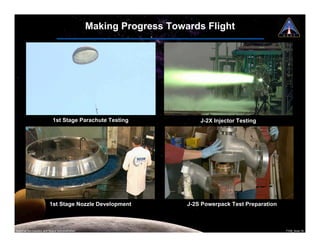
Making Progress Towards Flight


                           1st Stage Parachute Testing                  J-2X Injector Testing


                         1st Stage Nozzle Development               J-2S Powerpack Test Preparation


National Aeronautics and Space Administration                                                         7108_Ares.16
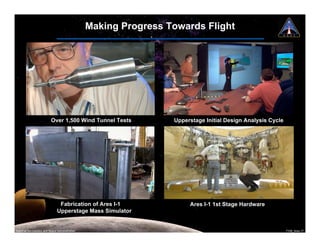
Making Progress Towards Flight


                          Over 1,500 Wind Tunnel Tests           Upperstage Initial Design Analysis Cycle


                                Fabrication of Ares I-1               Ares I-1 1st Stage Hardware
                               Upperstage Mass Simulator


National Aeronautics and Space Administration                                                               7108_Ares.17
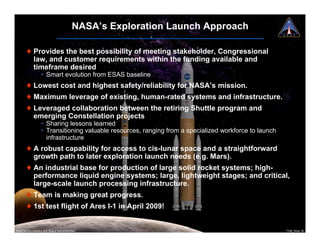
NASA’s Exploration Launch Approach

       ! Provides the best possibility of meeting stakeholder, Congressional
         law, and customer requirements within the funding available and
         timeframe desired
                  ¥ Smart evolution from ESAS baseline
       ! Lowest cost and highest safety/reliability for NASA’s mission.
       ! Maximum leverage of existing, human-rated systems and infrastructure.
       ! Leveraged collaboration between the retiring Shuttle program and
         emerging Constellation projects
                  ¥ Sharing lessons learned
                  ¥ Transitioning valuable resources, ranging from a specialized workforce to launch
                    infrastructure
       ! A robust capability for access to cis-lunar space and a straightforward
         growth path to later exploration launch needs (e.g. Mars).
       ! An industrial base for production of large solid rocket systems; high-
         performance liquid engine systems; large, lightweight stages; and critical,
         large-scale launch processing infrastructure.
       ! Team is making great progress.
       ! 1st test flight of Ares I-1 in April 2009!


National Aeronautics and Space Administration                                                          7108_Ares.18

Cook steve

  • 1.
    National Aeronautics andSpace Administration From ESAS to Ares – A Chronology NASA Program Managers Challenge Steve Cook, Director Exploration Launch Projects Office NASA Marshall Space Flight Center February 6, 2007 www.nasa.gov
  • 2.
    Ares: The RightVehicle for NASA’s Exploration Mission ! The Ares I Crew Launch Vehicle (CLV) and Ares V Cargo Launch Vehicle (CaLV) are being designed to reduce cost and development time while meeting safety and performance requirements. ! These Shuttle-derived vehicles will meet the Nation’s goals of establishing a sustained presence on the Moon and then go on to Mars and other destinations. ! These vehicles will, literally, extend U.S. stewardship and regular access of space beyond the coastal regions of low-Earth orbit. ! Compared to other vehicle options, such as EELVs, this approach is by far the right one to meet the integrated cost, performance, and mission objectives. National Aeronautics and Space Administration 7108_Ares.2
  • 3.
    An Architecture Selection Grounded in Analysis Several recent studies demonstrate that a Shuttle-derived architecture makes the most sense for NASA from a life- cycle cost, safety, and reliability perspective. ! NASA Exploration Systems Architecture Study (ESAS) in 2005 recommended this approach based on significant analysis. ! Supported in Law through the NASA Authorization Act of 2005 (Section 502). ! Department of Defense (DoD) validated this conclusion in August, 2005 (letter to John Marburger* from Ronald Sega** and Michael Griffin***). ! The October 2006 Congressional Budget Office report entitled “Alternatives for Future U.S. Space-Launch Capabilities” is consistent with NASA’s analysis and decisions. * Director, White House Office of Science and Technology Policy ** Under Secretary of the Air Force *** NASA Administrator National Aeronautics and Space Administration 7108_Ares.3
  • 4.
    NASA’s Exploration SystemsArchitecture Study Summer 2005 ! Complete assessment of the top-level Crew Exploration Vehicle (CEV) requirements and plans to enable the CEV to provide crew transport to the International Space Station and to accelerate the development of the CEV and crew-launch system to reduce the gap between Shuttle retirement and CEV initial operational capability. ! Definition of top-level requirements and configurations for crew and cargo launch systems to support the lunar and Mars exploration programs. ! Development of a reference exploration architecture concept to support sustained human and robotic lunar exploration operations. ! Identification of key technologies required to enable and significantly enhance these reference exploration systems and a reprioritization of near-term and far- term technology investments. National Aeronautics and Space Administration 7108_Ares.4
  • 5.
    ESAS Crew LaunchFamily Comparison 300 300 Feet Feet 200 200 100 100 Human- Human-Rated Atlas Phase Atlas 4 Segment 5 Segment 5 Segment Rated Atlas Delta IV/New 2 (5.4-m Phase X RSRB with RSRB with RSRB with V/New US US Core) (8-m Core) 1 SSME 1 J-2S 4 LR-85 Payload 30 mT 28 mT 26 mT 70 mT 25 mT 26 mT 27 mT (28.5º) Payload 26 mT 23mT 25 mT 67 mT 23 mT 24 mT 25 mT (51.6º) DDT&E* 1.18** 1.03 1.73** 2.36 1.00 1.3 1.39 Facilities Cost .92 .92 .92 .92 1.00 1.00 1.00 Average 1.00 1.11 1.32 1.71 1.00 .96 .96 Cost/Flight* LOM (mean) 1 in 149 1 in 172 1 in 134 1 in 79 1 in 460 1 in 433 1 in 182 LOC (mean) 1 in 957 1 in 1,100 1 in 939 1 in 614 1 in 2,021 1 in 1,918 1 in 1,429 LOM: Loss of Mission LOC: Loss of Crew US: Upper Stage RSRB: Reusable Solid Rocket Booster SSME: Space Shuttle Main Engine * All cost estimates include reserves (20% for DDT&E, 10% for Operations), Government oversight/full cost ** Assumes NASA has to fund the Americanization of the RD-180. Lockheed Martin is currently required to provide a co-production capability by the USAF. National Aeronautics and Space Administration 7108_Ares.5
  • 6.
    ESAS Lunar CargoLaunch Family Comparison 1.5 Launch 2-Launch Solutions 3+ Launch Solutions 300 300 Feet Feet 200 200 100 100 5 Segment Atlas Phase X Atlas Phase 3A 5 Segment 4 Segment RSRB 5 Segment 4 Segment RSRB In-Line (8-m Core) (5.4-m Core) RSRB In-Line In-Line with 3 RSRB Side- RSRB Side- with 5 SSME with 4 SSME SSME Core mount with 2 mount with Core - Cargo Core SSME 3 SSME Payload to 28.5 106 mT (125 95 mT 94 mT 97 mT 74 mT 80 mT 67 mT mT w/ upper stage) Lunar LV DDT&E* 1.00 1.29 .59 .96 .73 .80 .75 CLV+Lunar Crew/Cargo 1.00 (4 Seg 1.26 (Atlas V) 1.02 (Phase 2) .98 (4 Seg RSRB .83 (4 Seg RSRB 1.03 (5 Seg .85 (4 Seg DDT&E (family op)* RSRB w/1 w/ SSME) w1 SSME) RSRB w/J2S- RSRB w/1 SSME) LR85) SSME) Lunar LV Facility DDTE 1.00 1.33 2.25 1.00 * All cost estimates include reserves (20% for DDT&E, 10% for Operations), Government oversight/full cost; Average cost/flight based on 6 launches per year. CLV+Lunar Facilities Cost 1.00 1.12 1.56 1.00 ** Production costs are higher than in-line due to production of separate side-mount cargo carrier. Lunar LV Average 1.00 1.08 1.19 .87 .78 1.13** 1.13** Cost/Flight* LOM — Cargo (mean) 1 in 124 1 in 71 1 in 88 1 in 133 1 in 176 1 in 172 1 in 173 LOC (mean) 1 in 2,021 1 in 536 1 in 612 1 in 915 1 in 1,170 N/A N/A National Aeronautics and Space Administration 7108_Ares.6
  • 7.
    ESAS Launch SystemSelection Summary ! Continue to rely on the EELV fleet for scientific and International Space Station cargo missions in the 5-20 metric ton range to the maximum extent possible. ! The safest, most reliable, and most affordable way to meet exploration launch requirements is a 25 metric ton system derived from the current Shuttle solid rocket booster and liquid propulsion system. ¥ Capitalizes on human rated systems and 85% of existing facilities. ¥ The most straightforward growth path to later exploration super heavy launch. ! 125 metric ton lift capacity required to minimize on-orbit assembly and complexity — increasing mission success ¥ A clean-sheet-of-paper design incurs high expense and risk. ¥ EELV-based designs require development of two core stages plus boosters - increasing cost and decreasing safety/reliability. ¥ Current Shuttle lifts 100 metric tons to orbit on every launch. National Aeronautics and Space Administration 7108_Ares.7
  • 8.
    ESAS Crew LaunchVehicle Summary ! Serves as the long term crew launch capability for the U.S. ! 4 Segment Shuttle Solid Rocket Booster ! New liquid oxygen / liquid hydrogen upperstage ¥ 1 Space Shuttle Main Engine ! Payload capability ¥ ~25 metric tons to low-Earth orbit National Aeronautics and Space Administration 7108_Ares.8
  • 9.
    ESAS Lunar HeavyCargo Launch Vehicle Summary ! 5 Segment Shuttle Solid Rocket Boosters ! Liquid Oxygen / liquid hydrogen core stage ¥ Heritage from the Shuttle External Tank ¥ 5 Space Shuttle Main Engines ! Payload Capability ¥ 106 metric tons to low-Earth orbit ¥ 125 Metric tons to low-Earth orbit using earth departure stage ¥ 55 metric tons trans-lunar injection capability using Earth departure stage ! Can be later certified for crew if needed National Aeronautics and Space Administration 7108_Ares.9
  • 10.
    ESAS Earth DepartureStage Summary ! Liquid oxygen / liquid hydrogen stage ¥ Heritage from the Shuttle External Tank ¥ J-2S engines (or equivalent) ! Stage ignites suborbitally and delivers the lander to low Earth orbit ¥ Can also be used as an upper stage for low-Earth orbit missions ! The CEV later docks with this system and the Earth departure stage performs a trans-lunar injection burn ! The Earth departure stage is then discarded National Aeronautics and Space Administration 7108_Ares.10
  • 11.
    Improving on theESAS Launch Recommendations ! ESAS was a “point of departure” exploration architecture. ! Post-ESAS analysis demonstrated there is a more streamlined way to regain access to the Moon ¥ NASA decided to reduce the total number of program developments required to enable the Ares launch vehicle family. ! Key Element: Better focuses the architecture on exploration as the primary mission, vs. ISS then exploration. National Aeronautics and Space Administration 7108_Ares.11
  • 12.
    Improving on theESAS Launch Recommendations ! This approach focuses on developing key technologies sooner. For example: ¥ 5 segment stage for Ares I and V " Saves hundreds of millions of dollars ¥ J-2X as the common upper stage engine for both Ares I and Ares V " Saves hundreds of millions of dollars ¥ Use of the commercially developed RS-68 engine as the core engine for Ares V " Saves billions of dollars over the life cycle Progress made on the Ares I is now a significant and direct “down payment” on the Ares V. Selecting common hardware reduces cost and gets us closer to enabling a lunar transportation system. National Aeronautics and Space Administration 7108_Ares.12
  • 13.
    Ares: Building onProven Capabilities ! A 5-segment solid rocket motor was test fired in October 2003 . ! The J-2X engine’s predecessor made its debut during the United States’ first round of Moon missions, and its turbomachinery was tested as part of the more recent X- 33 Program. ! The Upper Stage will be assembled at the Michoud Assembly Facility, home of the Shuttle External Tank, using the same materials. ! The RS-68 engine, which powers the Delta IV, will boost the Ares V core stage. ! Using experienced human spaceflight workforce to process the Ares at the Kennedy Space Center using many Shuttle capabilities, such as booster processing and assembly, the Vehicle Assembly Building, and Launch Complex 39. Using the Experienced Capabilities in a Streamlined Manner National Aeronautics and Space Administration 7108_Ares.13
  • 14.
    A Robust DevelopmentApproach ! Performance ¥ Ares I: Delivers 22mT to LEO plus ~15% Performance Margin ¥ Ares V: Delivers 130mT to LEO / 65mT to Trans- Lunar Injection (with Ares I) ! Flight Control ¥ While Ares is a long and slender vehicle, it is within the control dynamics experience base of previous programs, most notably the Saturn V " ~8x margin on the vehicle structural response to control frequency ratio ¥ Results indicate a ~2x margin on first stage thrust vector control (angle and rate) and ~1.7x capability over predicted roll torque ! Weather ¥ Designing for a 95% launch availability ¥ Using conservative assumptions for natural environments, such as winds aloft ! Structures and Loads ¥ Within the design of the existing Shuttle motor case, joints and aft skirt ¥ Upper Stage/interstage is being designed for the loads National Aeronautics and Space Administration 7108_Ares.14
  • 15.
    NASA’s Exploration LaunchArchitecture Crew L Lunar L Lander Lander E Earth Departure S Stage (EDS) (1 J-2X) 499k 499k lb LOx/LH2 S-IVB U Upper Stage St (1 J-2 engine) (1 J-2X) 240k lb Lox/LH2 280k lb LOx/LH2 S-II (5 J-2 engines) 1M lb LOx/LH2 5-Segment Core Stage Reusable (5 RS-68 Engines) Solid Rocket 3.1M lb LOx/LH2 S-IC Booster (5 F-1) (RSRB) 3.9M lb LOx/RP 5-Segment 2 RSRB’s Space Shuttle Ares I Ares V Saturn V Height: 184.2 ft Height: 321 ft Height: 358 ft Height: 364 ft Gross Liftoff Mass: 4.5M lb Gross Liftoff Mass: 2.0M lb Gross Liftoff Mass: 7.3M lb Gross Liftoff Mass: 6.5M lb 55k lbm to LEO 48k lbm to LEO 117k lbm to TLI 99k lbm to TLI 144k lbm to TLI in Dual- 262k lbm to LEO Launch Mode with Ares I 290k lbm to LEO National Aeronautics and Space Administration 7108_Ares.15
  • 16.
    Making Progress TowardsFlight 1st Stage Parachute Testing J-2X Injector Testing 1st Stage Nozzle Development J-2S Powerpack Test Preparation National Aeronautics and Space Administration 7108_Ares.16
  • 17.
    Making Progress TowardsFlight Over 1,500 Wind Tunnel Tests Upperstage Initial Design Analysis Cycle Fabrication of Ares I-1 Ares I-1 1st Stage Hardware Upperstage Mass Simulator National Aeronautics and Space Administration 7108_Ares.17
  • 18.
    NASA’s Exploration LaunchApproach ! Provides the best possibility of meeting stakeholder, Congressional law, and customer requirements within the funding available and timeframe desired ¥ Smart evolution from ESAS baseline ! Lowest cost and highest safety/reliability for NASA’s mission. ! Maximum leverage of existing, human-rated systems and infrastructure. ! Leveraged collaboration between the retiring Shuttle program and emerging Constellation projects ¥ Sharing lessons learned ¥ Transitioning valuable resources, ranging from a specialized workforce to launch infrastructure ! A robust capability for access to cis-lunar space and a straightforward growth path to later exploration launch needs (e.g. Mars). ! An industrial base for production of large solid rocket systems; high- performance liquid engine systems; large, lightweight stages; and critical, large-scale launch processing infrastructure. ! Team is making great progress. ! 1st test flight of Ares I-1 in April 2009! National Aeronautics and Space Administration 7108_Ares.18