Spaceflight Project Security:
Terrestrial and On-Orbit/Mission


           PM Challenge 2007

     Randy Seftas and Joshua Krage
    NASA Goddard Space Flight Center
            Greenbelt, MD
Agenda
Highlights from:
– National Space Policy Protection
– GSFC Space Asset Protection
Cyber:
– Attacks, Impacts, and Issues
– Threat Sources/Adversaries
Trends


                                     2
National Space Policy Protection Highlights
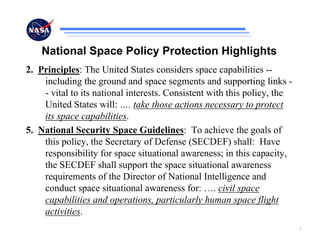
2. Principles: The United States considers space capabilities --
    including the ground and space segments and supporting links -
    - vital to its national interests. Consistent with this policy, the
    United States will: …. take those actions necessary to protect
    its space capabilities.
5. National Security Space Guidelines: To achieve the goals of
    this policy, the Secretary of Defense (SECDEF) shall: Have
    responsibility for space situational awareness; in this capacity,
    the SECDEF shall support the space situational awareness
    requirements of the Director of National Intelligence and
    conduct space situational awareness for: …. civil space
    capabilities and operations, particularly human space flight
    activities.
                                                                          3
National Space Policy Protection Highlights
                      (cont)
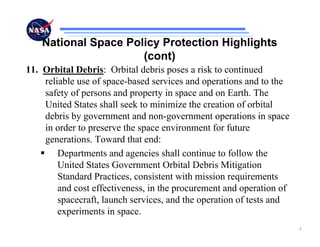
11. Orbital Debris: Orbital debris poses a risk to continued
    reliable use of space-based services and operations and to the
    safety of persons and property in space and on Earth. The
    United States shall seek to minimize the creation of orbital
    debris by government and non-government operations in space
    in order to preserve the space environment for future
    generations. Toward that end:
        Departments and agencies shall continue to follow the
        United States Government Orbital Debris Mitigation
        Standard Practices, consistent with mission requirements
        and cost effectiveness, in the procurement and operation of
        spacecraft, launch services, and the operation of tests and
        experiments in space.
                                                                      4
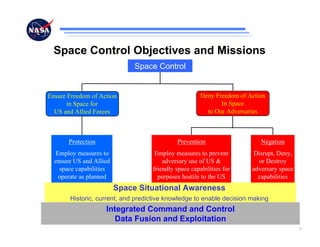
Space Control Objectives and Missions
                              Space Control


Ensure Freedom of Action                              Deny Freedom of Action
      in Space for                                           In Space
  US and Allied Forces                                  to Our Adversaries


       Protection                           Prevention                    Negation
  Employ measures to                Employ measures to prevent          Disrupt, Deny,
  ensure US and Allied                 adversary use of US &             or Destroy
    space capabilities             friendly space capabilities for     adversary space
   operate as planned                purposes hostile to the US          capabilities
                         Space Situational Awareness
       Historic, current, and predictive knowledge to enable decision making
                    Integrated Command and Control
                       Data Fusion and Exploitation
                                                                                         5
Goddard’s Space Asset Protection Highlights
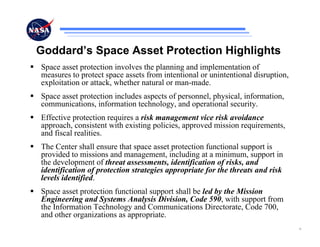
Space asset protection involves the planning and implementation of
measures to protect space assets from intentional or unintentional disruption,
exploitation or attack, whether natural or man-made.
Space asset protection includes aspects of personnel, physical, information,
communications, information technology, and operational security.
Effective protection requires a risk management vice risk avoidance
approach, consistent with existing policies, approved mission requirements,
and fiscal realities.
The Center shall ensure that space asset protection functional support is
provided to missions and management, including at a minimum, support in
the development of threat assessments, identification of risks, and
identification of protection strategies appropriate for the threats and risk
levels identified.
Space asset protection functional support shall be led by the Mission
Engineering and Systems Analysis Division, Code 590, with support from
the Information Technology and Communications Directorate, Code 700,
and other organizations as appropriate.
                                                                                 6
Goal / Objectives / Approach
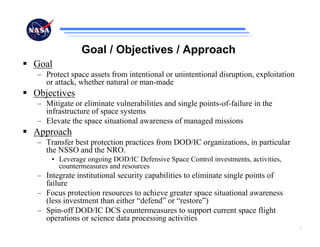
Goal
– Protect space assets from intentional or unintentional disruption, exploitation
  or attack, whether natural or man-made
Objectives
– Mitigate or eliminate vulnerabilities and single points-of-failure in the
  infrastructure of space systems
– Elevate the space situational awareness of managed missions
Approach
– Transfer best protection practices from DOD/IC organizations, in particular
  the NSSO and the NRO.
    • Leverage ongoing DOD/IC Defensive Space Control investments, activities,
      countermeasures and resources
– Integrate institutional security capabilities to eliminate single points of
  failure
– Focus protection resources to achieve greater space situational awareness
  (less investment than either “defend” or “restore”)
– Spin-off DOD/IC DCS countermeasures to support current space flight
  operations or science data processing activities
                                                                                    7
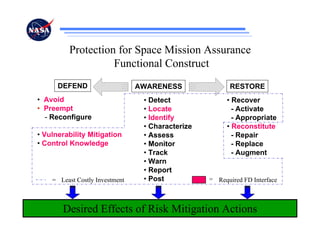
Protection for Space Mission Assurance
                   Functional Construct
      DEFEND                    AWARENESS               RESTORE
• Avoid                          • Detect              • Recover
• Preempt                        • Locate                - Activate
  - Reconfigure                  • Identify              - Appropriate
                                 • Characterize        • Reconstitute
• Vulnerability Mitigation       • Assess                - Repair
• Control Knowledge              • Monitor               - Replace
                                 • Track                 - Augment
                                 • Warn
                                 • Report
    = Least Costly Investment    • Post           = Required FD Interface


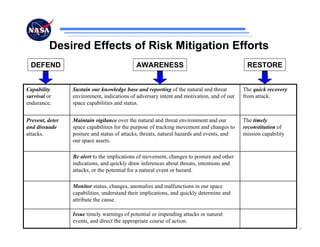
       Desired Effects of Risk Mitigation Actions
Desired Effects of Risk Mitigation Efforts
  DEFEND                                     AWARENESS                                      RESTORE


Capability       Sustain our knowledge base and reporting of the natural and threat        The quick recovery
survival or      environment, indications of adversary intent and motivation, and of our   from attack.
endurance.       space capabilities and status.


Prevent, deter   Maintain vigilance over the natural and threat environment and our        The timely
and dissuade     space capabilities for the purpose of tracking movement and changes to    reconstitution of
attacks.         posture and status of attacks, threats, natural hazards and events, and   mission capability
                 our space assets.

                 Be alert to the implications of movement, changes to posture and other
                 indications, and quickly draw inferences about threats, intentions and
                 attacks, or the potential for a natural event or hazard.

                 Monitor status, changes, anomalies and malfunctions in our space
                 capabilities, understand their implications, and quickly determine and
                 attribute the cause.

                 Issue timely warnings of potential or impending attacks or natural
                 events, and direct the appropriate course of action.
                                                                                                                9
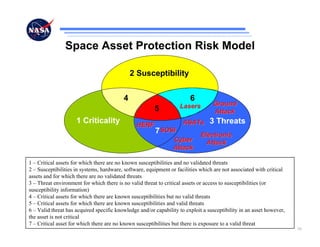
Space Asset Protection Risk Model

                                              2 Susceptibility


                                          4                             6
                                                                   Lasers         Ground
                                                        5                         Attack
                     1 Criticality              HERF                 ASATs       3 Threats
                                                        7SOSI                Electronic
                                                                Cyber          Attack
                                                                Attack

1 – Critical assets for which there are no known susceptibilities and no validated threats
2 – Susceptibilities in systems, hardware, software, equipment or facilities which are not associated with critical
assets and for which there are no validated threats
3 – Threat environment for which there is no valid threat to critical assets or access to susceptibilities (or
susceptibility information)
4 – Critical assets for which there are known susceptibilities but no valid threats
5 – Critical assets for which there are known susceptibilities and valid threats
6 – Valid threat has acquired specific knowledge and/or capability to exploit a susceptibility in an asset however,
the asset is not critical
7 – Critical asset for which there are no known susceptibilities but there is exposure to a valid threat
                                                                                                                      10
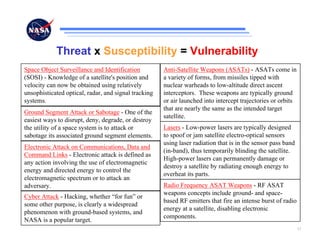
Threat x Susceptibility = Vulnerability
Space Object Surveillance and Identification          Anti-Satellite Weapons (ASATs) - ASATs come in
(SOSI) - Knowledge of a satellite's position and      a variety of forms, from missiles tipped with
velocity can now be obtained using relatively         nuclear warheads to low-altitude direct ascent
unsophisticated optical, radar, and signal tracking   interceptors. These weapons are typically ground
systems.                                              or air launched into intercept trajectories or orbits
                                                      that are nearly the same as the intended target
Ground Segment Attack or Sabotage - One of the
                                                      satellite.
easiest ways to disrupt, deny, degrade, or destroy
the utility of a space system is to attack or         Lasers - Low-power lasers are typically designed
sabotage its associated ground segment elements.      to spoof or jam satellite electro-optical sensors
                                                      using laser radiation that is in the sensor pass band
Electronic Attack on Communications, Data and
                                                      (in-band), thus temporarily blinding the satellite.
Command Links - Electronic attack is defined as
                                                      High-power lasers can permanently damage or
any action involving the use of electromagnetic
                                                      destroy a satellite by radiating enough energy to
energy and directed energy to control the
                                                      overheat its parts.
electromagnetic spectrum or to attack an
adversary.                                            Radio Frequency ASAT Weapons - RF ASAT
                                                      weapons concepts include ground- and space-
Cyber Attack - Hacking, whether “for fun” or
                                                      based RF emitters that fire an intense burst of radio
some other purpose, is clearly a widespread
                                                      energy at a satellite, disabling electronic
phenomenon with ground-based systems, and
                                                      components.
NASA is a popular target.
                                                                                                              11
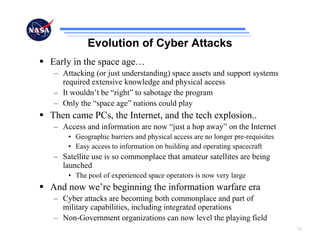
Evolution of Cyber Attacks
Early in the space age…
– Attacking (or just understanding) space assets and support systems
  required extensive knowledge and physical access
– It wouldn’t be “right” to sabotage the program
– Only the “space age” nations could play
Then came PCs, the Internet, and the tech explosion..
– Access and information are now “just a hop away” on the Internet
    • Geographic barriers and physical access are no longer pre-requisites
    • Easy access to information on building and operating spacecraft
– Satellite use is so commonplace that amateur satellites are being
  launched
    • The pool of experienced space operators is now very large
And now we’re beginning the information warfare era
– Cyber attacks are becoming both commonplace and part of
  military capabilities, including integrated operations
– Non-Government organizations can now level the playing field
                                                                             12
The Potential Cyber Impact
Several studies have been conducted around the “survivability” of
unprotected Internet systems
 – The average time is currently measured in minutes and continues to
   diminish and new systems on the Internet are probed or attacked within
   seconds of becoming active
     • Its akin to keeping air contained while in a vacuum -- any unchecked damage
       can become a breach
 – Attacks are so cheap and easy to launch, they have become omnipresent
   and impossible to avoid -- everyone is being attacked at all times
The sheer number of different types of attacks poses defensive
challenges
 – New vulnerabilities are identified routinely
 – Miss one vulnerability, or be slow in responding, and an attacker can
   breach the system
 – Internet systems are constantly being breached


     Support systems on the Internet can quickly
          become the project’s weakest link
                                                                                     13
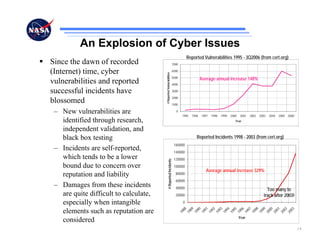
An Explosion of Cyber Issues
                                                                                Reported Vulnerabilities 1995 - 3Q2006 (from cert.org)
Since the dawn of recorded                                           7000

(Internet) time, cyber                                               6000


                                       # Reported Vulnerabilities
                                                                     5000
                                                                                          Average annual increase 148%
vulnerabilities and reported                                         4000

successful incidents have                                            3000

                                                                     2000
blossomed                                                            1000

 – New vulnerabilities are                                              0
                                                                            1995   1996   1997   1998   1999   2000   2001   2002   2003   2004   2005 2006*
   identified through research,                                                                                   Year

   independent validation, and
   black box testing                                                                  Reported Incidents 1998 - 2003 (from cert.org)
                                                                      160000
 – Incidents are self-reported,                                       140000
   which tends to be a lower                                          120000

                                              # Reported Incidents
   bound due to concern over                                          100000
                                                                                             Average annual increase 329%
   reputation and liability                                            80000
                                                                       60000
 – Damages from these incidents                                        40000                                                            Too many to
   are quite difficult to calculate,                                   20000                                                          track after 2003!
   especially when intangible                                               0

   elements such as reputation are
                                                                              88
                                                                              89
                                                                              90
                                                                              91
                                                                              92
                                                                              93
                                                                              94
                                                                              95
                                                                              96
                                                                              97
                                                                              98
                                                                              99
                                                                              00
                                                                              01
                                                                              02
                                                                              03
                                                                            19
                                                                            19
                                                                            19
                                                                            19
                                                                            19
                                                                            19
                                                                            19
                                                                            19
                                                                            19
                                                                            19
                                                                            19
                                                                            19
                                                                            20
                                                                            20
                                                                            20
                                                                            20
                                                                                                                      Year
   considered
                                                                                                                                                               14
Additional Challenges
 Every space asset has associated terrestrial support
 systems that are increasingly:
 –   Challenged to do more with less
 –   Dependent on information systems
 –   Dependent on external resources
 –   Connected to partners at other organizations
 –   Complex
 –   Remaining operating beyond completion of the mission
     objectives
At the same time, adversaries are significantly
increasing the knowledge and resources focusing on
understanding and exploiting space assets and
support systems.
                                                            15
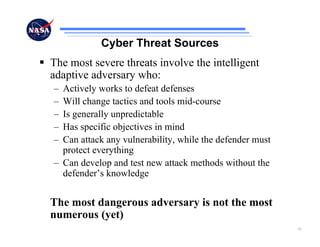
Cyber Threat Sources
The most severe threats involve the intelligent
adaptive adversary who:
– Actively works to defeat defenses
– Will change tactics and tools mid-course
– Is generally unpredictable
– Has specific objectives in mind
– Can attack any vulnerability, while the defender must
  protect everything
– Can develop and test new attack methods without the
  defender’s knowledge


The most dangerous adversary is not the most
numerous (yet)
                                                          16
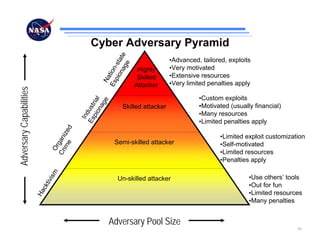
Cyber Adversary Pyramid
Adversary Capabilities

                                 m


                                                                 •Use others’ tools
                                  is


                                           Un-skilled attacker
                              tiv


                                                                 •Out for fun
                           ck
                         Ha


                                                                 •Limited resources
                                                                 •Many penalties


                                         Adversary Pool Size
                                                                                 17
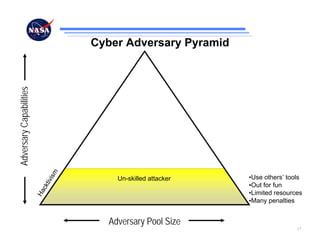
Cyber Adversary Pyramid
Adversary Capabilities


                                         d
                                   im ize


                                                                        •Limited exploit customization
                                 Cr gan


                                                Semi-skilled attacker
                                     e


                                                                        •Self-motivated
                                  Or


                                                                        •Limited resources
                                                                        •Penalties apply
                                 m


                                                                                  •Use others’ tools
                                  is


                                                 Un-skilled attacker
                              tiv


                                                                                  •Out for fun
                           ck
                         Ha


                                                                                  •Limited resources
                                                                                  •Many penalties


                                               Adversary Pool Size
                                                                                                   18
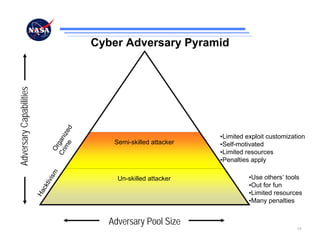
Cyber Adversary Pyramid
Adversary Capabilities


                                                  na l                            •Custom exploits
                                                    ge
                                               pio ria

                                                            Skilled attacker      •Motivated (usually financial)
                                             Es ust


                                                                                  •Many resources
                                              Ind


                                                                                  •Limited penalties apply
                                         d
                                   im ize


                                                                                         •Limited exploit customization
                                 Cr gan


                                                          Semi-skilled attacker
                                     e


                                                                                         •Self-motivated
                                  Or


                                                                                         •Limited resources
                                                                                         •Penalties apply
                                 m


                                                                                                    •Use others’ tools
                                  is


                                                           Un-skilled attacker
                              tiv


                                                                                                    •Out for fun
                           ck
                         Ha


                                                                                                    •Limited resources
                                                                                                    •Many penalties


                                                         Adversary Pool Size
                                                                                                                    19
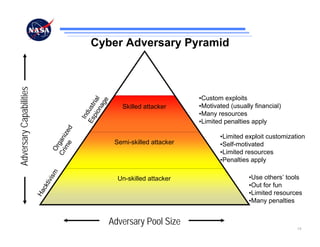
Cyber Adversary Pyramid


                                                         na ate
                                                                               •Advanced, tailored, exploits


                                                      pio -st
                                                           ge
                                                                   Highly      •Very motivated


                                                    Es tion
                                                                   Skilled     •Extensive resources


                                                     Na
                                                                  Attacker     •Very limited penalties apply
Adversary Capabilities


                                                  na l                                   •Custom exploits
                                                    ge
                                               pio ria

                                                            Skilled attacker             •Motivated (usually financial)
                                             Es ust


                                                                                         •Many resources
                                              Ind


                                                                                         •Limited penalties apply
                                         d
                                   im ize


                                                                                                 •Limited exploit customization
                                 Cr gan


                                                          Semi-skilled attacker
                                     e


                                                                                                 •Self-motivated
                                  Or


                                                                                                 •Limited resources
                                                                                                 •Penalties apply
                                 m


                                                                                                           •Use others’ tools
                                  is


                                                           Un-skilled attacker
                              tiv


                                                                                                           •Out for fun
                           ck
                         Ha


                                                                                                           •Limited resources
                                                                                                           •Many penalties


                                                         Adversary Pool Size
                                                                                                                            20
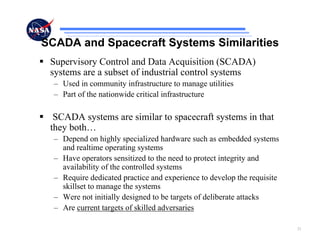
SCADA and Spacecraft Systems Similarities
 Supervisory Control and Data Acquisition (SCADA)
 systems are a subset of industrial control systems
  – Used in community infrastructure to manage utilities
  – Part of the nationwide critical infrastructure

  SCADA systems are similar to spacecraft systems in that
 they both…
  – Depend on highly specialized hardware such as embedded systems
    and realtime operating systems
  – Have operators sensitized to the need to protect integrity and
    availability of the controlled systems
  – Require dedicated practice and experience to develop the requisite
    skillset to manage the systems
  – Were not initially designed to be targets of deliberate attacks
  – Are current targets of skilled adversaries

                                                                         21
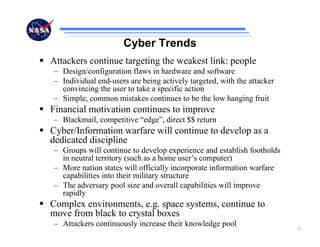
Cyber Trends
Attackers continue targeting the weakest link: people
– Design/configuration flaws in hardware and software
– Individual end-users are being actively targeted, with the attacker
  convincing the user to take a specific action
– Simple, common mistakes continues to be the low hanging fruit
Financial motivation continues to improve
– Blackmail, competitive “edge”, direct $$ return
Cyber/Information warfare will continue to develop as a
dedicated discipline
– Groups will continue to develop experience and establish footholds
  in neutral territory (such as a home user’s computer)
– More nation states will officially incorporate information warfare
  capabilities into their military structure
– The adversary pool size and overall capabilities will improve
  rapidly
Complex environments, e.g. space systems, continue to
move from black to crystal boxes
– Attackers continuously increase their knowledge pool                  22
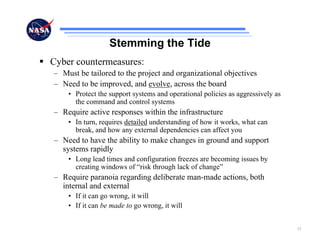
Stemming the Tide
Cyber countermeasures:
– Must be tailored to the project and organizational objectives
– Need to be improved, and evolve, across the board
    • Protect the support systems and operational policies as aggressively as
      the command and control systems
– Require active responses within the infrastructure
    • In turn, requires detailed understanding of how it works, what can
      break, and how any external dependencies can affect you
– Need to have the ability to make changes in ground and support
  systems rapidly
    • Long lead times and configuration freezes are becoming issues by
      creating windows of “risk through lack of change”
– Require paranoia regarding deliberate man-made actions, both
  internal and external
    • If it can go wrong, it will
    • If it can be made to go wrong, it will


                                                                                23
Space Asset Protection Trends
The nation’s defense and economic dependence on space
derived information will continue to increase.
Current trends in technology proliferation, accessibility to
space, globalization of space programs and industries,
commercialization of space systems and services, and
foreign knowledge about U.S. space systems increases the
likelihood that vulnerable U.S. space systems will come
under attack.
The ability to restrict or deny freedom of access to and
operations in space is no longer limited to global military
powers.
Knowledge of U.S. space systems functions, locations and
physical characteristics, as well as the means to conduct
counter-space operations is increasingly more available on
the international market


                                                               24
Questions?
Contact information:
– Randy Seftas      Space Asset Protection
  George.R.Seftas@nasa.gov
  +1 301 614 5122

– Joshua Krage     Information Security
  Joshua.Krage@nasa.gov


                                             25
Backup Slides


                26
Space Situational Awareness Tasks
Environmental Information
 – Monitor, characterize, predict and report on the space related
   environment, i.e, terrestrial weather; atmospheric, ionospheric,
   magnetospheric, solar and interplanetary conditions.
       Significant “Push” and “Pull”
Orbital and Network Information
 – Detect, track, identify and catalog man-made objects in space
       “Push” state vectors for operational missions from LEO out to GEO
       “Pull” catalog data from archive to support in-house collision avoidance
 – Provide battle-space information and services
       “Pull” signal/laser de-confliction and space network nodal analysis
Event Information
 – Detect, process and report space events, i.e, launches, orbital
   maneuvers, break-ups, reentries, orbital decay, dockings, etc.
       “Push” state vectors for operational missions after maneuvering
       “Pull” catalog data from archive to support in-house collision avoidance

                                                                                  27
Space Situational Awareness Tasks (cont)
Event Information (cont)
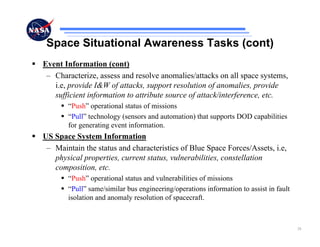
 – Characterize, assess and resolve anomalies/attacks on all space systems,
   i.e, provide I&W of attacks, support resolution of anomalies, provide
   sufficient information to attribute source of attack/interference, etc.
       “Push” operational status of missions
       “Pull” technology (sensors and automation) that supports DOD capabilities
       for generating event information.
US Space System Information
 – Maintain the status and characteristics of Blue Space Forces/Assets, i.e,
   physical properties, current status, vulnerabilities, constellation
   composition, etc.
       “Push” operational status and vulnerabilities of missions
       “Pull” same/similar bus engineering/operations information to assist in fault
       isolation and anomaly resolution of spacecraft.


                                                                                       28
Space Situational Awareness Tasks (cont)
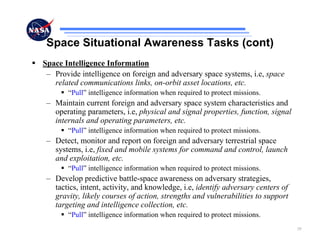
Space Intelligence Information
 – Provide intelligence on foreign and adversary space systems, i.e, space
   related communications links, on-orbit asset locations, etc.
        “Pull” intelligence information when required to protect missions.
 – Maintain current foreign and adversary space system characteristics and
   operating parameters, i.e, physical and signal properties, function, signal
   internals and operating parameters, etc.
        “Pull” intelligence information when required to protect missions.
 – Detect, monitor and report on foreign and adversary terrestrial space
   systems, i.e, fixed and mobile systems for command and control, launch
   and exploitation, etc.
        “Pull” intelligence information when required to protect missions.
 – Develop predictive battle-space awareness on adversary strategies,
   tactics, intent, activity, and knowledge, i.e, identify adversary centers of
   gravity, likely courses of action, strengths and vulnerabilities to support
   targeting and intelligence collection, etc.
        “Pull” intelligence information when required to protect missions.
                                                                                  29
Space Asset Vulnerability References
China Attempted To Blind U.S. Satellites With Laser
http://www.defensenews.com/story.php?F=2121111&C=america
China a Major Cyberthreat, Commission Warns
http://www.fcw.com/article96975-12-01-06-Web
Combating Satellite Terrorism, DIY Style
http://www.popularmechanics.com/technology/military_law/4205155.html
US Warns of threat to satellites
http://www.centredaily.com/mld/centredaily/news/16231120.htm
The Increased Threat to Satellite Communications
http://satjournal.tcom.ohiou.edu/Issue6/overview2.html
Hacker Infiltrates Military Satellite [UK, never substantiated]
http://www.theregister.com/1999/03/01/hacker_infiltrates_military_satellite/
http://www.interesting-people.org/archives/interesting-
people/199902/msg00087.html
The Great Satellite Caper
http://www.time.com/time/magazine/article/0,9171,1048422,00.html
Another Suspected NASA Hacker Indicted
http://news.zdnet.com/2100-1009_22-6140001.html
Unpatched PCs Compromised in 20 Minutes
http://news.com.com/2100-7349_3-5313402.html
                                                                               30

Seftas krage

  • 1.
    Spaceflight Project Security: Terrestrialand On-Orbit/Mission PM Challenge 2007 Randy Seftas and Joshua Krage NASA Goddard Space Flight Center Greenbelt, MD
  • 2.
    Agenda Highlights from: – NationalSpace Policy Protection – GSFC Space Asset Protection Cyber: – Attacks, Impacts, and Issues – Threat Sources/Adversaries Trends 2
  • 3.
    National Space PolicyProtection Highlights 2. Principles: The United States considers space capabilities -- including the ground and space segments and supporting links - - vital to its national interests. Consistent with this policy, the United States will: …. take those actions necessary to protect its space capabilities. 5. National Security Space Guidelines: To achieve the goals of this policy, the Secretary of Defense (SECDEF) shall: Have responsibility for space situational awareness; in this capacity, the SECDEF shall support the space situational awareness requirements of the Director of National Intelligence and conduct space situational awareness for: …. civil space capabilities and operations, particularly human space flight activities. 3
  • 4.
    National Space PolicyProtection Highlights (cont) 11. Orbital Debris: Orbital debris poses a risk to continued reliable use of space-based services and operations and to the safety of persons and property in space and on Earth. The United States shall seek to minimize the creation of orbital debris by government and non-government operations in space in order to preserve the space environment for future generations. Toward that end: Departments and agencies shall continue to follow the United States Government Orbital Debris Mitigation Standard Practices, consistent with mission requirements and cost effectiveness, in the procurement and operation of spacecraft, launch services, and the operation of tests and experiments in space. 4
  • 5.
    Space Control Objectivesand Missions Space Control Ensure Freedom of Action Deny Freedom of Action in Space for In Space US and Allied Forces to Our Adversaries Protection Prevention Negation Employ measures to Employ measures to prevent Disrupt, Deny, ensure US and Allied adversary use of US & or Destroy space capabilities friendly space capabilities for adversary space operate as planned purposes hostile to the US capabilities Space Situational Awareness Historic, current, and predictive knowledge to enable decision making Integrated Command and Control Data Fusion and Exploitation 5
  • 6.
    Goddard’s Space AssetProtection Highlights Space asset protection involves the planning and implementation of measures to protect space assets from intentional or unintentional disruption, exploitation or attack, whether natural or man-made. Space asset protection includes aspects of personnel, physical, information, communications, information technology, and operational security. Effective protection requires a risk management vice risk avoidance approach, consistent with existing policies, approved mission requirements, and fiscal realities. The Center shall ensure that space asset protection functional support is provided to missions and management, including at a minimum, support in the development of threat assessments, identification of risks, and identification of protection strategies appropriate for the threats and risk levels identified. Space asset protection functional support shall be led by the Mission Engineering and Systems Analysis Division, Code 590, with support from the Information Technology and Communications Directorate, Code 700, and other organizations as appropriate. 6
  • 7.
    Goal / Objectives/ Approach Goal – Protect space assets from intentional or unintentional disruption, exploitation or attack, whether natural or man-made Objectives – Mitigate or eliminate vulnerabilities and single points-of-failure in the infrastructure of space systems – Elevate the space situational awareness of managed missions Approach – Transfer best protection practices from DOD/IC organizations, in particular the NSSO and the NRO. • Leverage ongoing DOD/IC Defensive Space Control investments, activities, countermeasures and resources – Integrate institutional security capabilities to eliminate single points of failure – Focus protection resources to achieve greater space situational awareness (less investment than either “defend” or “restore”) – Spin-off DOD/IC DCS countermeasures to support current space flight operations or science data processing activities 7
  • 8.
    Protection for SpaceMission Assurance Functional Construct DEFEND AWARENESS RESTORE • Avoid • Detect • Recover • Preempt • Locate - Activate - Reconfigure • Identify - Appropriate • Characterize • Reconstitute • Vulnerability Mitigation • Assess - Repair • Control Knowledge • Monitor - Replace • Track - Augment • Warn • Report = Least Costly Investment • Post = Required FD Interface Desired Effects of Risk Mitigation Actions
  • 9.
    Desired Effects ofRisk Mitigation Efforts DEFEND AWARENESS RESTORE Capability Sustain our knowledge base and reporting of the natural and threat The quick recovery survival or environment, indications of adversary intent and motivation, and of our from attack. endurance. space capabilities and status. Prevent, deter Maintain vigilance over the natural and threat environment and our The timely and dissuade space capabilities for the purpose of tracking movement and changes to reconstitution of attacks. posture and status of attacks, threats, natural hazards and events, and mission capability our space assets. Be alert to the implications of movement, changes to posture and other indications, and quickly draw inferences about threats, intentions and attacks, or the potential for a natural event or hazard. Monitor status, changes, anomalies and malfunctions in our space capabilities, understand their implications, and quickly determine and attribute the cause. Issue timely warnings of potential or impending attacks or natural events, and direct the appropriate course of action. 9
  • 10.
    Space Asset ProtectionRisk Model 2 Susceptibility 4 6 Lasers Ground 5 Attack 1 Criticality HERF ASATs 3 Threats 7SOSI Electronic Cyber Attack Attack 1 – Critical assets for which there are no known susceptibilities and no validated threats 2 – Susceptibilities in systems, hardware, software, equipment or facilities which are not associated with critical assets and for which there are no validated threats 3 – Threat environment for which there is no valid threat to critical assets or access to susceptibilities (or susceptibility information) 4 – Critical assets for which there are known susceptibilities but no valid threats 5 – Critical assets for which there are known susceptibilities and valid threats 6 – Valid threat has acquired specific knowledge and/or capability to exploit a susceptibility in an asset however, the asset is not critical 7 – Critical asset for which there are no known susceptibilities but there is exposure to a valid threat 10
  • 11.
    Threat x Susceptibility= Vulnerability Space Object Surveillance and Identification Anti-Satellite Weapons (ASATs) - ASATs come in (SOSI) - Knowledge of a satellite's position and a variety of forms, from missiles tipped with velocity can now be obtained using relatively nuclear warheads to low-altitude direct ascent unsophisticated optical, radar, and signal tracking interceptors. These weapons are typically ground systems. or air launched into intercept trajectories or orbits that are nearly the same as the intended target Ground Segment Attack or Sabotage - One of the satellite. easiest ways to disrupt, deny, degrade, or destroy the utility of a space system is to attack or Lasers - Low-power lasers are typically designed sabotage its associated ground segment elements. to spoof or jam satellite electro-optical sensors using laser radiation that is in the sensor pass band Electronic Attack on Communications, Data and (in-band), thus temporarily blinding the satellite. Command Links - Electronic attack is defined as High-power lasers can permanently damage or any action involving the use of electromagnetic destroy a satellite by radiating enough energy to energy and directed energy to control the overheat its parts. electromagnetic spectrum or to attack an adversary. Radio Frequency ASAT Weapons - RF ASAT weapons concepts include ground- and space- Cyber Attack - Hacking, whether “for fun” or based RF emitters that fire an intense burst of radio some other purpose, is clearly a widespread energy at a satellite, disabling electronic phenomenon with ground-based systems, and components. NASA is a popular target. 11
  • 12.
    Evolution of CyberAttacks Early in the space age… – Attacking (or just understanding) space assets and support systems required extensive knowledge and physical access – It wouldn’t be “right” to sabotage the program – Only the “space age” nations could play Then came PCs, the Internet, and the tech explosion.. – Access and information are now “just a hop away” on the Internet • Geographic barriers and physical access are no longer pre-requisites • Easy access to information on building and operating spacecraft – Satellite use is so commonplace that amateur satellites are being launched • The pool of experienced space operators is now very large And now we’re beginning the information warfare era – Cyber attacks are becoming both commonplace and part of military capabilities, including integrated operations – Non-Government organizations can now level the playing field 12
  • 13.
    The Potential CyberImpact Several studies have been conducted around the “survivability” of unprotected Internet systems – The average time is currently measured in minutes and continues to diminish and new systems on the Internet are probed or attacked within seconds of becoming active • Its akin to keeping air contained while in a vacuum -- any unchecked damage can become a breach – Attacks are so cheap and easy to launch, they have become omnipresent and impossible to avoid -- everyone is being attacked at all times The sheer number of different types of attacks poses defensive challenges – New vulnerabilities are identified routinely – Miss one vulnerability, or be slow in responding, and an attacker can breach the system – Internet systems are constantly being breached Support systems on the Internet can quickly become the project’s weakest link 13
  • 14.
    An Explosion ofCyber Issues Reported Vulnerabilities 1995 - 3Q2006 (from cert.org) Since the dawn of recorded 7000 (Internet) time, cyber 6000 # Reported Vulnerabilities 5000 Average annual increase 148% vulnerabilities and reported 4000 successful incidents have 3000 2000 blossomed 1000 – New vulnerabilities are 0 1995 1996 1997 1998 1999 2000 2001 2002 2003 2004 2005 2006* identified through research, Year independent validation, and black box testing Reported Incidents 1998 - 2003 (from cert.org) 160000 – Incidents are self-reported, 140000 which tends to be a lower 120000 # Reported Incidents bound due to concern over 100000 Average annual increase 329% reputation and liability 80000 60000 – Damages from these incidents 40000 Too many to are quite difficult to calculate, 20000 track after 2003! especially when intangible 0 elements such as reputation are 88 89 90 91 92 93 94 95 96 97 98 99 00 01 02 03 19 19 19 19 19 19 19 19 19 19 19 19 20 20 20 20 Year considered 14
  • 15.
    Additional Challenges Everyspace asset has associated terrestrial support systems that are increasingly: – Challenged to do more with less – Dependent on information systems – Dependent on external resources – Connected to partners at other organizations – Complex – Remaining operating beyond completion of the mission objectives At the same time, adversaries are significantly increasing the knowledge and resources focusing on understanding and exploiting space assets and support systems. 15
  • 16.
    Cyber Threat Sources Themost severe threats involve the intelligent adaptive adversary who: – Actively works to defeat defenses – Will change tactics and tools mid-course – Is generally unpredictable – Has specific objectives in mind – Can attack any vulnerability, while the defender must protect everything – Can develop and test new attack methods without the defender’s knowledge The most dangerous adversary is not the most numerous (yet) 16
  • 17.
    Cyber Adversary Pyramid AdversaryCapabilities m •Use others’ tools is Un-skilled attacker tiv •Out for fun ck Ha •Limited resources •Many penalties Adversary Pool Size 17
  • 18.
    Cyber Adversary Pyramid AdversaryCapabilities d im ize •Limited exploit customization Cr gan Semi-skilled attacker e •Self-motivated Or •Limited resources •Penalties apply m •Use others’ tools is Un-skilled attacker tiv •Out for fun ck Ha •Limited resources •Many penalties Adversary Pool Size 18
  • 19.
    Cyber Adversary Pyramid AdversaryCapabilities na l •Custom exploits ge pio ria Skilled attacker •Motivated (usually financial) Es ust •Many resources Ind •Limited penalties apply d im ize •Limited exploit customization Cr gan Semi-skilled attacker e •Self-motivated Or •Limited resources •Penalties apply m •Use others’ tools is Un-skilled attacker tiv •Out for fun ck Ha •Limited resources •Many penalties Adversary Pool Size 19
  • 20.
    Cyber Adversary Pyramid na ate •Advanced, tailored, exploits pio -st ge Highly •Very motivated Es tion Skilled •Extensive resources Na Attacker •Very limited penalties apply Adversary Capabilities na l •Custom exploits ge pio ria Skilled attacker •Motivated (usually financial) Es ust •Many resources Ind •Limited penalties apply d im ize •Limited exploit customization Cr gan Semi-skilled attacker e •Self-motivated Or •Limited resources •Penalties apply m •Use others’ tools is Un-skilled attacker tiv •Out for fun ck Ha •Limited resources •Many penalties Adversary Pool Size 20
  • 21.
    SCADA and SpacecraftSystems Similarities Supervisory Control and Data Acquisition (SCADA) systems are a subset of industrial control systems – Used in community infrastructure to manage utilities – Part of the nationwide critical infrastructure SCADA systems are similar to spacecraft systems in that they both… – Depend on highly specialized hardware such as embedded systems and realtime operating systems – Have operators sensitized to the need to protect integrity and availability of the controlled systems – Require dedicated practice and experience to develop the requisite skillset to manage the systems – Were not initially designed to be targets of deliberate attacks – Are current targets of skilled adversaries 21
  • 22.
    Cyber Trends Attackers continuetargeting the weakest link: people – Design/configuration flaws in hardware and software – Individual end-users are being actively targeted, with the attacker convincing the user to take a specific action – Simple, common mistakes continues to be the low hanging fruit Financial motivation continues to improve – Blackmail, competitive “edge”, direct $$ return Cyber/Information warfare will continue to develop as a dedicated discipline – Groups will continue to develop experience and establish footholds in neutral territory (such as a home user’s computer) – More nation states will officially incorporate information warfare capabilities into their military structure – The adversary pool size and overall capabilities will improve rapidly Complex environments, e.g. space systems, continue to move from black to crystal boxes – Attackers continuously increase their knowledge pool 22
  • 23.
    Stemming the Tide Cybercountermeasures: – Must be tailored to the project and organizational objectives – Need to be improved, and evolve, across the board • Protect the support systems and operational policies as aggressively as the command and control systems – Require active responses within the infrastructure • In turn, requires detailed understanding of how it works, what can break, and how any external dependencies can affect you – Need to have the ability to make changes in ground and support systems rapidly • Long lead times and configuration freezes are becoming issues by creating windows of “risk through lack of change” – Require paranoia regarding deliberate man-made actions, both internal and external • If it can go wrong, it will • If it can be made to go wrong, it will 23
  • 24.
    Space Asset ProtectionTrends The nation’s defense and economic dependence on space derived information will continue to increase. Current trends in technology proliferation, accessibility to space, globalization of space programs and industries, commercialization of space systems and services, and foreign knowledge about U.S. space systems increases the likelihood that vulnerable U.S. space systems will come under attack. The ability to restrict or deny freedom of access to and operations in space is no longer limited to global military powers. Knowledge of U.S. space systems functions, locations and physical characteristics, as well as the means to conduct counter-space operations is increasingly more available on the international market 24
  • 25.
    Questions? Contact information: – RandySeftas Space Asset Protection George.R.Seftas@nasa.gov +1 301 614 5122 – Joshua Krage Information Security Joshua.Krage@nasa.gov 25
  • 26.
  • 27.
    Space Situational AwarenessTasks Environmental Information – Monitor, characterize, predict and report on the space related environment, i.e, terrestrial weather; atmospheric, ionospheric, magnetospheric, solar and interplanetary conditions. Significant “Push” and “Pull” Orbital and Network Information – Detect, track, identify and catalog man-made objects in space “Push” state vectors for operational missions from LEO out to GEO “Pull” catalog data from archive to support in-house collision avoidance – Provide battle-space information and services “Pull” signal/laser de-confliction and space network nodal analysis Event Information – Detect, process and report space events, i.e, launches, orbital maneuvers, break-ups, reentries, orbital decay, dockings, etc. “Push” state vectors for operational missions after maneuvering “Pull” catalog data from archive to support in-house collision avoidance 27
  • 28.
    Space Situational AwarenessTasks (cont) Event Information (cont) – Characterize, assess and resolve anomalies/attacks on all space systems, i.e, provide I&W of attacks, support resolution of anomalies, provide sufficient information to attribute source of attack/interference, etc. “Push” operational status of missions “Pull” technology (sensors and automation) that supports DOD capabilities for generating event information. US Space System Information – Maintain the status and characteristics of Blue Space Forces/Assets, i.e, physical properties, current status, vulnerabilities, constellation composition, etc. “Push” operational status and vulnerabilities of missions “Pull” same/similar bus engineering/operations information to assist in fault isolation and anomaly resolution of spacecraft. 28
  • 29.
    Space Situational AwarenessTasks (cont) Space Intelligence Information – Provide intelligence on foreign and adversary space systems, i.e, space related communications links, on-orbit asset locations, etc. “Pull” intelligence information when required to protect missions. – Maintain current foreign and adversary space system characteristics and operating parameters, i.e, physical and signal properties, function, signal internals and operating parameters, etc. “Pull” intelligence information when required to protect missions. – Detect, monitor and report on foreign and adversary terrestrial space systems, i.e, fixed and mobile systems for command and control, launch and exploitation, etc. “Pull” intelligence information when required to protect missions. – Develop predictive battle-space awareness on adversary strategies, tactics, intent, activity, and knowledge, i.e, identify adversary centers of gravity, likely courses of action, strengths and vulnerabilities to support targeting and intelligence collection, etc. “Pull” intelligence information when required to protect missions. 29
  • 30.
    Space Asset VulnerabilityReferences China Attempted To Blind U.S. Satellites With Laser http://www.defensenews.com/story.php?F=2121111&C=america China a Major Cyberthreat, Commission Warns http://www.fcw.com/article96975-12-01-06-Web Combating Satellite Terrorism, DIY Style http://www.popularmechanics.com/technology/military_law/4205155.html US Warns of threat to satellites http://www.centredaily.com/mld/centredaily/news/16231120.htm The Increased Threat to Satellite Communications http://satjournal.tcom.ohiou.edu/Issue6/overview2.html Hacker Infiltrates Military Satellite [UK, never substantiated] http://www.theregister.com/1999/03/01/hacker_infiltrates_military_satellite/ http://www.interesting-people.org/archives/interesting- people/199902/msg00087.html The Great Satellite Caper http://www.time.com/time/magazine/article/0,9171,1048422,00.html Another Suspected NASA Hacker Indicted http://news.zdnet.com/2100-1009_22-6140001.html Unpatched PCs Compromised in 20 Minutes http://news.com.com/2100-7349_3-5313402.html 30