Landmap GeoSpatial Education
        Resources

                             Bharti Gupta
                             Kamie Kitmitto
                             Gail Millin-Chalabi
    Conference 2012          Mimas, University of Manchester


        Open Mic Session, 23 February 2012
Mimas - Who are we?
•  A nationally designated data-centre

•  A Centre of Excellence at the University of Manchester


 Our	
  Mission?	
  
      To power world-class research and teaching
Session Objectives
•  What is Landmap?
•  Awareness of geospatial datasets
•  Learning Zone
  –  Structure
  –  Level and applications
  –  Technological Framework
  –  Pedagogic Framework
•  Future Plans/Projects
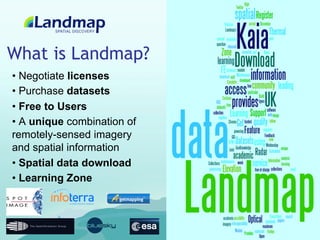
What is Landmap?
•  Negotiate licenses
•  Purchase datasets
•  Free to Users
•  A unique combination of
remotely-sensed imagery
and spatial information
•  Spatial data download
•  Learning Zone
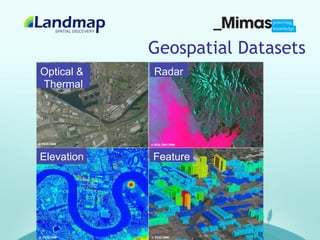
Geospatial Datasets
Optical &   Radar
Thermal


Elevation   Feature
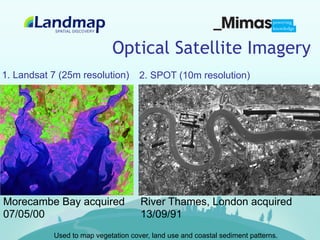
Optical Satellite Imagery
1. Landsat 7 (25m resolution)        2. SPOT (10m resolution)


Morecambe Bay acquired               River Thames, London acquired
07/05/00                             13/09/91
           Used to map vegetation cover, land use and coastal sediment patterns.
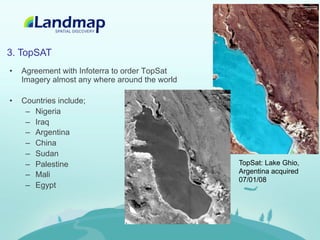
3. TopSAT
•    Agreement with Infoterra to order TopSat
     Imagery almost any where around the world

•    Countries include;
      –  Nigeria
      –  Iraq
      –  Argentina
      –  China
      –  Sudan
      –  Palestine                               TopSat: Lake Ghio,
      –  Mali                                    Argentina acquired
                                                 07/01/08
      –  Egypt
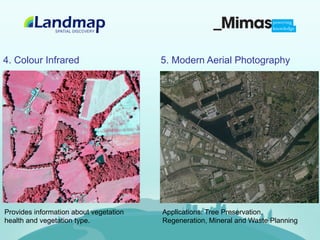
4. Colour Infrared                      5. Modern Aerial Photography


Provides information about vegetation   Applications: Tree Preservation,
health and vegetation type.             Regeneration, Mineral and Waste Planning
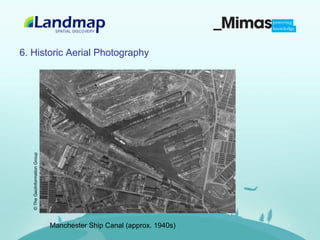
6. Historic Aerial Photography
   © The GeoInformation Group


                                Manchester Ship Canal (approx. 1940s)
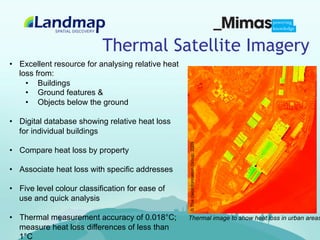
Thermal Satellite Imagery
•  Excellent resource for analysing relative heat
   loss from:
     •  Buildings
     •  Ground features &
     •  Objects below the ground

•  Digital database showing relative heat loss
   for individual buildings


                                                    © The GeoInformation Group, 2009
•  Compare heat loss by property

•  Associate heat loss with specific addresses

•  Five level colour classification for ease of
   use and quick analysis

•  Thermal measurement accuracy of 0.018°C;         Thermal image to show heat loss in urban areas
   measure heat loss differences of less than
   1°C
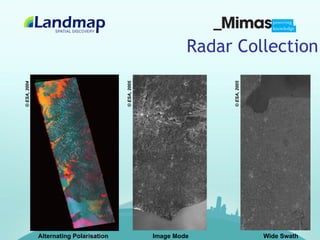
Radar Collection


                                                                     © ESA, 2005
                                         © ESA, 2005
© ESA, 2004


              Alternating Polarisation                 Image Mode                  Wide Swath
Elevation Collection
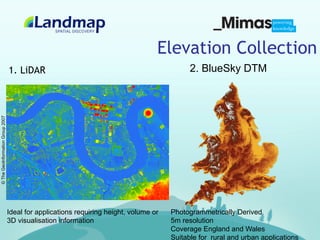
                                  1. LiDAR                                                   2. BlueSky DTM
© The GeoInformation Group 2007


                                  Ideal for applications requiring height, volume or   Photogrammetrically Derived
                                  3D visualisation information                         5m resolution
                                                                                       Coverage England and Wales
                                                                                       Suitable for rural and urban applications
Feature Collection
 1. Building Class Data
•  Identification of residential properties by age & type of structure for many
   conurbations
•  Applications:
     •  Estate management
     •  Direct marketing
     •  Crime analysis
     •  Fire prevention schemes

 2. Building Heights Data
•  Detailed height info for individual building block
•  Applications
    •  Telecom network planning
    •  Property management
    •  CCTV location
    •  Noise pollution modelling
    •  Air pollution modelling
    •  Emergency planning
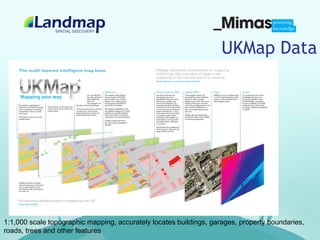
UKMap Data


1:1,000 scale topographic mapping, accurately locates buildings, garages, property boundaries,
roads, trees and other features
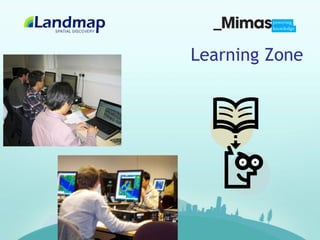
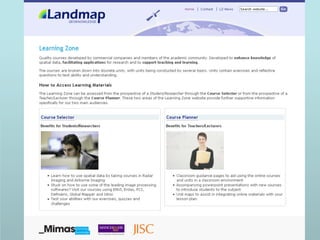
Learning Zone
Way to cover the linkage between

      - satellite data,

      - software(s) used to process those data, and

      - theory
Learning Zone Structure
•  The new Learning Zone (LZ) contains 15 courses 68%
   being new and 32% reworked.
•  Semantic structure of LZ
    –  Course (15)
    –  Units (70+)
    –  Topics (100 +)
•  Each unit is characterised by four attribute types
    –  Software
    –  Data
    –  Knowledge (theory, practice or application)
    –  Workflow (work processes used in image handling)
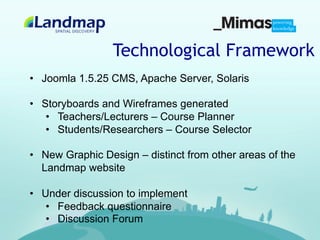
Level & Applications
•  Airborne Imaging – Basic
    –  Urban sociologist looking at the change in the urban landscape with time using
       historic aerial photography
•  Applying Heights – Basic/Intermediate
    –  Planning and landscape student wanting to create a basic 3D model of an urban
       area in Google Sketch-Up or Global Mapper
    –  Archaeologist wanting to understand how to use LiDAR for getting height values
       of an archaeological site
•  UKMap & Landuse – Basic/Intermediate
    –  Geography student wanting to gain the skills to assess land use change for an
       undergraduate dissertation
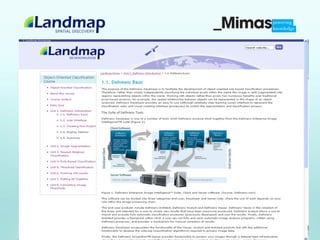
•  Image Processing – Intermediate
    –  Masters students wanting to gain essential image processing skills to incorporate
       satellite data into their research
•  Radar Imaging – Basic/Intermediate
    –  Ecology Masters/PhD students wanting to learn Radar for the first time and use
       the data for assessing the phenology of vegetation
•  Classification Methods – Advanced
    –  Environmental scientists wanting to create a vegetation map using an object
       oriented approach
Technological Framework
•  Joomla 1.5.25 CMS, Apache Server, Solaris

•  Storyboards and Wireframes generated
    •  Teachers/Lecturers – Course Planner
    •  Students/Researchers – Course Selector

•  New Graphic Design – distinct from other areas of the
   Landmap website

•  Under discussion to implement
    •  Feedback questionnaire
    •  Discussion Forum
Pedagogic Framework
•    Structure content into ‘small chunks’ easily digestible on the web.
•    Provide a basis for searching of resources and designing activities, feedback and
     assessment
•    Telaman Ltd advised to follow a 6 part Educational Model (Pask, 1975) for each
     course:

      –  Context – overview of learning unit, learning objectives, wider context and
         pre-requisites
      –  Explanation – Theory and workflows for improving students understanding
      –  Demonstration – step by step instructions of how to undertake a task.
      –  Challenge – put theory and tasks completed together and put into practice
         with an exercise (not guided).
      –  Feedback – provides possible outcomes for the activities and suggestions for
         revision
      –  Summary – summarise the content and intended learning outcomes and
         suggestions for further units to take.
Future Plans/Projects
•  Currently the learning resources at Landmap can be accessed using
   institution authentication and look forward to making them open under
   Creative Commons license in near future.
•  Learning Zone for Schools project is almost complete, target launch in 2012
•  Covering the range from A-Levels to specialist/PhD level
•  Looking forward to launch new content in the following areas:
    –  Image Processing for GRASS
    –  Introduction to OGC Standards
•  We buy data, create learning and teaching resources around that data, but
   not enough in context of L&T and Research work.
•  Looking forward to work on engaging more collaborators, researchers and
   authors
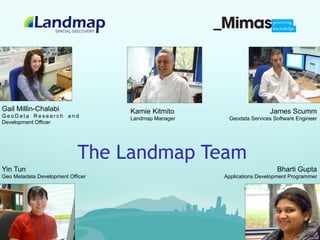
Gail Millin-Chalabi                Kamie Kitmito                      James Scumm
GeoData Research and               Landmap Manager    Geodata Services Software Engineer
Development Officer


                            The Landmap Team
Yin Tun                                                                 Bharti Gupta
Geo Metadata Development Officer                     Applications Development Programmer
Thanks for Listening
  Helpdesk: spatial@mimas.ac.uk
  Website: http://landmap.mimas.ac.uk
  Follow us on Twitter: @Landmap

Landmap CETIS 2012

  • 1.
    Landmap GeoSpatial Education Resources Bharti Gupta Kamie Kitmitto Gail Millin-Chalabi Conference 2012 Mimas, University of Manchester Open Mic Session, 23 February 2012
  • 2.
    Mimas - Whoare we? •  A nationally designated data-centre •  A Centre of Excellence at the University of Manchester Our  Mission?   To power world-class research and teaching
  • 3.
    Session Objectives •  Whatis Landmap? •  Awareness of geospatial datasets •  Learning Zone –  Structure –  Level and applications –  Technological Framework –  Pedagogic Framework •  Future Plans/Projects
  • 4.
    What is Landmap? • Negotiate licenses •  Purchase datasets •  Free to Users •  A unique combination of remotely-sensed imagery and spatial information •  Spatial data download •  Learning Zone
  • 5.
    Geospatial Datasets Optical & Radar Thermal Elevation Feature
  • 6.
    Optical Satellite Imagery 1.Landsat 7 (25m resolution) 2. SPOT (10m resolution) Morecambe Bay acquired River Thames, London acquired 07/05/00 13/09/91 Used to map vegetation cover, land use and coastal sediment patterns.
  • 7.
    3. TopSAT •  Agreement with Infoterra to order TopSat Imagery almost any where around the world •  Countries include; –  Nigeria –  Iraq –  Argentina –  China –  Sudan –  Palestine TopSat: Lake Ghio, –  Mali Argentina acquired 07/01/08 –  Egypt
  • 8.
    4. Colour Infrared 5. Modern Aerial Photography Provides information about vegetation Applications: Tree Preservation, health and vegetation type. Regeneration, Mineral and Waste Planning
  • 9.
    6. Historic AerialPhotography © The GeoInformation Group Manchester Ship Canal (approx. 1940s)
  • 10.
    Thermal Satellite Imagery • Excellent resource for analysing relative heat loss from: •  Buildings •  Ground features & •  Objects below the ground •  Digital database showing relative heat loss for individual buildings © The GeoInformation Group, 2009 •  Compare heat loss by property •  Associate heat loss with specific addresses •  Five level colour classification for ease of use and quick analysis •  Thermal measurement accuracy of 0.018°C; Thermal image to show heat loss in urban areas measure heat loss differences of less than 1°C
  • 11.
    Radar Collection © ESA, 2005 © ESA, 2005 © ESA, 2004 Alternating Polarisation Image Mode Wide Swath
  • 13.
    Elevation Collection 1. LiDAR 2. BlueSky DTM © The GeoInformation Group 2007 Ideal for applications requiring height, volume or Photogrammetrically Derived 3D visualisation information 5m resolution Coverage England and Wales Suitable for rural and urban applications
  • 14.
    Feature Collection 1.Building Class Data •  Identification of residential properties by age & type of structure for many conurbations •  Applications: •  Estate management •  Direct marketing •  Crime analysis •  Fire prevention schemes 2. Building Heights Data •  Detailed height info for individual building block •  Applications •  Telecom network planning •  Property management •  CCTV location •  Noise pollution modelling •  Air pollution modelling •  Emergency planning
  • 15.
    UKMap Data 1:1,000 scaletopographic mapping, accurately locates buildings, garages, property boundaries, roads, trees and other features
  • 16.
  • 17.
    Way to coverthe linkage between - satellite data, - software(s) used to process those data, and - theory
  • 20.
    Learning Zone Structure • The new Learning Zone (LZ) contains 15 courses 68% being new and 32% reworked. •  Semantic structure of LZ –  Course (15) –  Units (70+) –  Topics (100 +) •  Each unit is characterised by four attribute types –  Software –  Data –  Knowledge (theory, practice or application) –  Workflow (work processes used in image handling)
  • 21.
    Level & Applications • Airborne Imaging – Basic –  Urban sociologist looking at the change in the urban landscape with time using historic aerial photography •  Applying Heights – Basic/Intermediate –  Planning and landscape student wanting to create a basic 3D model of an urban area in Google Sketch-Up or Global Mapper –  Archaeologist wanting to understand how to use LiDAR for getting height values of an archaeological site •  UKMap & Landuse – Basic/Intermediate –  Geography student wanting to gain the skills to assess land use change for an undergraduate dissertation •  Image Processing – Intermediate –  Masters students wanting to gain essential image processing skills to incorporate satellite data into their research •  Radar Imaging – Basic/Intermediate –  Ecology Masters/PhD students wanting to learn Radar for the first time and use the data for assessing the phenology of vegetation •  Classification Methods – Advanced –  Environmental scientists wanting to create a vegetation map using an object oriented approach
  • 22.
    Technological Framework •  Joomla1.5.25 CMS, Apache Server, Solaris •  Storyboards and Wireframes generated •  Teachers/Lecturers – Course Planner •  Students/Researchers – Course Selector •  New Graphic Design – distinct from other areas of the Landmap website •  Under discussion to implement •  Feedback questionnaire •  Discussion Forum
  • 23.
    Pedagogic Framework •  Structure content into ‘small chunks’ easily digestible on the web. •  Provide a basis for searching of resources and designing activities, feedback and assessment •  Telaman Ltd advised to follow a 6 part Educational Model (Pask, 1975) for each course: –  Context – overview of learning unit, learning objectives, wider context and pre-requisites –  Explanation – Theory and workflows for improving students understanding –  Demonstration – step by step instructions of how to undertake a task. –  Challenge – put theory and tasks completed together and put into practice with an exercise (not guided). –  Feedback – provides possible outcomes for the activities and suggestions for revision –  Summary – summarise the content and intended learning outcomes and suggestions for further units to take.
  • 24.
    Future Plans/Projects •  Currentlythe learning resources at Landmap can be accessed using institution authentication and look forward to making them open under Creative Commons license in near future. •  Learning Zone for Schools project is almost complete, target launch in 2012 •  Covering the range from A-Levels to specialist/PhD level •  Looking forward to launch new content in the following areas: –  Image Processing for GRASS –  Introduction to OGC Standards •  We buy data, create learning and teaching resources around that data, but not enough in context of L&T and Research work. •  Looking forward to work on engaging more collaborators, researchers and authors
  • 25.
    Gail Millin-Chalabi Kamie Kitmito James Scumm GeoData Research and Landmap Manager Geodata Services Software Engineer Development Officer The Landmap Team Yin Tun Bharti Gupta Geo Metadata Development Officer Applications Development Programmer
  • 26.
    Thanks for Listening Helpdesk: spatial@mimas.ac.uk Website: http://landmap.mimas.ac.uk Follow us on Twitter: @Landmap