National Aeronautics and Space Administration


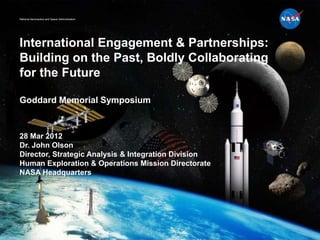
International Engagement & Partnerships:
Building on the Past, Boldly Collaborating
for the Future

Goddard Memorial Symposium


28 Mar 2012
Dr. John Olson
Director, Strategic Analysis & Integration Division
Human Exploration & Operations Mission Directorate
NASA Headquarters
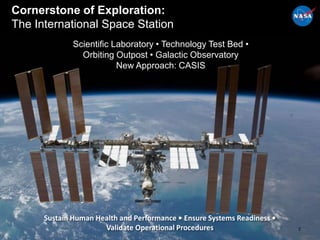
Cornerstone of Exploration:
The International Space Station
              Scientific Laboratory • Technology Test Bed •
                Orbiting Outpost • Galactic Observatory
                          New Approach: CASIS


      Sustain Human Health and Performance • Ensure Systems Readiness •
                      Validate Operational Procedures                     2
International Space Station:
    Research and Technology Applications & Demo Testbed
1,200 experiments supporting 1,600 scientists in 63 counties


        Improving Life Support:          Improving Zero-G Health:                        Observing Planet Earth:
         70-80% water and air              Bone loss prevention                  Documenting global change and geographic
           recycling on ISS             through exercise and space                    events; aiding in disaster relief
                                                 medicine


                   Leveraging a Materials Testbed:                     Teaching 30+ million students from ISS:
              Improving satellite component development                 Students participate in downlinks and
                        and spacecraft design                        interactive experiments with ISS astronauts

     ISS Research and Developmental Technologies: Closed-loop life support • Advanced monitoring & control • In-
    space assembly • Maintainability • supportability and logistics • Solar panels and batteries • EVA technologies 3
                                                                                                                    •
                        Automated systems • Exercise systems • Medical care • Food systems
A History of Collaboration and Cooperation:
ISS as a Stepping-Stone for Deep-Space Exploration


             International Cooperation = Vital       4
International Space Exploration Coordination Group:
ISECGTerms of Reference
• Work collectively in a non-binding, consensus-driven
  manner toward advancing the Global Exploration
  Strategy
   – Provide a forum for discussion of interests, objectives and
     plans
   – Provide a forum for development of conceptual products
   – Enable the multilateral or bilateral partnerships necessary to
     accomplish complex exploration missions
   – Promote interest and engagement in space exploration
     among citizens and society
• ISECG operating principles
   – Open and inclusive, flexible and evolutionary, effective,
     mutual interest
• ISECG chairmanship rotates approximately once per
  year


                                                                      5
The ISECG Global Exploration Roadmap


 The first iteration of the Global Exploration
  Roadmap (GER) was released by ISECG in
  September 2011
    Second iteration planned end 2012/early 2013


 The GER reflects the international effort to
  collaboratively define technically feasible and
  programmatically implementable exploration
  mission scenarios with the common goal of
  humans on the surface of Mars
    Asteroid Next, Moon Next


 GER serves as a non-binding reference for
  agencies to inform near-term decisions related
  to exploration preparatory activities

                                                    6
ISECG Global Exploration Roadmap:
  Two Exploration Pathways in a Common Strategy


                                                                                    Mars: Ultimate
                           Deep Space Habitat at
                                                                                       Goal for All
                           Earth-Moon Lagrange Point1                                   Scenarios
                     ①          Lunar
   ISS LEO
                                                        Asteroid
                               Surface
       &
   (LEO)ISS
                                                                               Lunar               Mars
                                                                              Surface             Surface
                              Earth-Moon
                     ②                                  Astreroid     or
                              Lagrange L1
                                                                           Mars
                                                                           Orbit
                             Next Steps
        Near-term Focus on Guiding Capabilities,             Long-term Focus is Discovery Driven and Enhanced
                                                                                                                7
            Technologies and Leveraging ISS                             by Emerging Technologies

            Given their broad-based benefits, International Partnerships are essential.
The Global Exploration Roadmap is consistent with NASA’s Capability-Driven Framework for Human
                                       Space Exploration.
ISECG Global Exploration Roadmap
Iteration 1: Sept 2011

Olson aas 2012 goddard v briefed

  • 1.
    National Aeronautics andSpace Administration International Engagement & Partnerships: Building on the Past, Boldly Collaborating for the Future Goddard Memorial Symposium 28 Mar 2012 Dr. John Olson Director, Strategic Analysis & Integration Division Human Exploration & Operations Mission Directorate NASA Headquarters
  • 2.
    Cornerstone of Exploration: TheInternational Space Station Scientific Laboratory • Technology Test Bed • Orbiting Outpost • Galactic Observatory New Approach: CASIS Sustain Human Health and Performance • Ensure Systems Readiness • Validate Operational Procedures 2
  • 3.
    International Space Station: Research and Technology Applications & Demo Testbed 1,200 experiments supporting 1,600 scientists in 63 counties Improving Life Support: Improving Zero-G Health: Observing Planet Earth: 70-80% water and air Bone loss prevention Documenting global change and geographic recycling on ISS through exercise and space events; aiding in disaster relief medicine Leveraging a Materials Testbed: Teaching 30+ million students from ISS: Improving satellite component development Students participate in downlinks and and spacecraft design interactive experiments with ISS astronauts ISS Research and Developmental Technologies: Closed-loop life support • Advanced monitoring & control • In- space assembly • Maintainability • supportability and logistics • Solar panels and batteries • EVA technologies 3 • Automated systems • Exercise systems • Medical care • Food systems
  • 4.
    A History ofCollaboration and Cooperation: ISS as a Stepping-Stone for Deep-Space Exploration International Cooperation = Vital 4
  • 5.
    International Space ExplorationCoordination Group: ISECGTerms of Reference • Work collectively in a non-binding, consensus-driven manner toward advancing the Global Exploration Strategy – Provide a forum for discussion of interests, objectives and plans – Provide a forum for development of conceptual products – Enable the multilateral or bilateral partnerships necessary to accomplish complex exploration missions – Promote interest and engagement in space exploration among citizens and society • ISECG operating principles – Open and inclusive, flexible and evolutionary, effective, mutual interest • ISECG chairmanship rotates approximately once per year 5
  • 6.
    The ISECG GlobalExploration Roadmap  The first iteration of the Global Exploration Roadmap (GER) was released by ISECG in September 2011  Second iteration planned end 2012/early 2013  The GER reflects the international effort to collaboratively define technically feasible and programmatically implementable exploration mission scenarios with the common goal of humans on the surface of Mars  Asteroid Next, Moon Next  GER serves as a non-binding reference for agencies to inform near-term decisions related to exploration preparatory activities 6
  • 7.
    ISECG Global ExplorationRoadmap: Two Exploration Pathways in a Common Strategy Mars: Ultimate Deep Space Habitat at Goal for All Earth-Moon Lagrange Point1 Scenarios ① Lunar ISS LEO Asteroid Surface & (LEO)ISS Lunar Mars Surface Surface Earth-Moon ② Astreroid or Lagrange L1 Mars Orbit Next Steps Near-term Focus on Guiding Capabilities, Long-term Focus is Discovery Driven and Enhanced 7 Technologies and Leveraging ISS by Emerging Technologies Given their broad-based benefits, International Partnerships are essential. The Global Exploration Roadmap is consistent with NASA’s Capability-Driven Framework for Human Space Exploration.
  • 8.
    ISECG Global ExplorationRoadmap Iteration 1: Sept 2011

Editor's Notes

  • #3 The International Space Station is now fully assembled and serves as the cornerstone of NASA’s Human Space Flight Operations and serve as a national laboratory. A six-member crew will continue to live and work aboard the International Space Station 24/7 until at least 2020. Station will be the centerpiece of our human spaceflight activities for the coming years, and the research and technology breakthroughs aboard Station will facilitate our travel to destinations beyond low Earth orbit. 1,200 experiment supporting 1,600 scientists in 59 countiesECLSS (environmental control and life support systems) – Achieved 70-80% water and air recycling on ISS; on the way to reducing logistics to support humans in space by 85% Human Research – Advancing knowledge needed to send humans on exploration missions beyond Earth and improve human health on EarthMaterials Testbed– Better understanding of materials properties has shortened satellite component development time by as much as 50% and is important to future spacecraft designEarth Observations – Daily ISS passes over 95% of population centers documenting global change & geographic eventsReaching Students –30+ million students have participated in human space flight though communication downlinks and interactive experiments with the ISS astronauts ISS Research and Developmental Technologies: Closed-loop life support, Advanced monitoring & control, In-space assembly, Maintainability, supportability and logistics, Solar panels and batteries, EVA technologies, Automated systems, Exercise systems, Medical care, Food systems
  • #4 ECLSS (environmental control and life support systems) – Achieved 70-80% water and air recycling on ISS; on the way to reducing logistics to support humans in space by 85% Human Research – Advancing knowledge needed to send humans on exploration missions beyond Earth and improve human health on Earth**Materials Testbed– Better understanding of materials properties has shortened satellite component development time by as much as 50% and is important to future spacecraft designEarth Observations – Daily ISS passes over 95% of population centers documenting global change & geographic eventsReaching Students –30+ million students have participated in human space flight though communication downlinks and interactive experiments with the ISS astronauts **ISS028-E-016111 (12 July 2011) --- This close-up image, recorded during a July 12 spacewalk, shows the Materials on International Space Station Experiment - 8 (MISSE-8).  The experiment package is a test bed for materials and computing elements attached to the outside of the orbiting complex. These materials and computing elements are being evaluated for the effects of atomic oxygen, ultraviolet, direct sunlight, radiation, and extremes of heat and cold. This experiment allows the development and testing of new materials and computing elements that can better withstand the rigors of space environments. Results will provide a better understanding of the durability of various materials and computing elements when they are exposed to the space environment, with applications in the design of future spacecraft.