Conceptual Art
By: Elizabeth Travis
What is Conceptual Art?
Art that is intended to convey an idea or concept to the
perceiver and doesn’t involve the creation or appreciation
of a traditional art object such as a painting or sculpture.
The commercial or communal aspect of the “work” is often
a set of instructions for what exists in the artist’s mind.
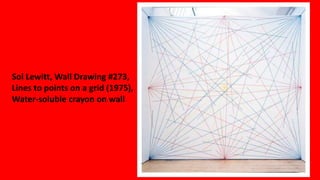
Sol Lewitt, Wall Drawing #273,
Lines to points on a grid (1975),
Water-soluble crayon on wall
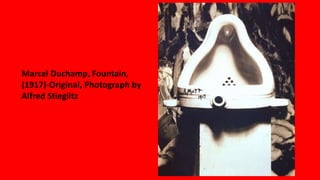
Marcel Duchamp, Fountain,
(1917)-Original, Photograph by
Alfred Stieglitz
 French artist Marcel Duchamp paved the way for the conceptualists,
providing them with examples of early conceptual works — the readymades.
 Conceptual art emerged as a recognized art movement in the 1960s.
 The term 'Conceptual art' wasn't coined until the 1950s. The term was
first used by Edward Kienholz.
Where did Conceptual Art Originate?
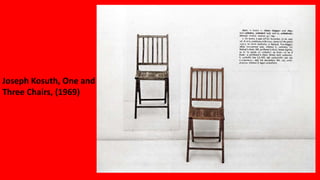
Joseph Kosuth, One and
Three Chairs, (1969)
The Conceptual Art Movement
 The conceptual art movement began in 1966 in the United States,
Latin America, and Europe and ended in 1972.
 This movement focuses on Marcel Duchamp's notion that ANYTHING
can be art be a work of art.
 For advocates of this movement, the idea of a work matters more than
its physical identity.
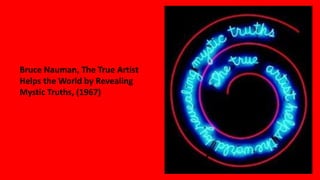
Bruce Nauman, The True Artist
Helps the World by Revealing
Mystic Truths, (1967)
The Conceptual Art Movement
 Conceptual art was seen to act as a reaction against formalism and
commodification. This group believed that the art object was not an end
in itself and saw artistic knowledge as equal to artistic production.
 The first exhibition specifically devoted to Conceptual Art took
place in 1970 at the New York Cultural Centre.
 The term “Conceptual Art" came to encapsulate all forms of
contemporary art that did not utilize the traditional skills of painting and
sculpture.
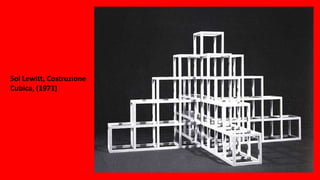
Sol Lewitt, Costruzione
Cubica, (1971)
Conflicts with Conceptual Art
 Some have argued that conceptual art continued the "dematerialization"
of art by removing the need for objects altogether, while others saw conceptual
art as a radical break with formalist Modernism.
 When Marcel Duchamp submitted his piece, “Fountain”, in the exhibit
Society of Independent Artists in New York, it was rejected. A commonplace
object such as a urinal cannot be art because it is not made by an artist or
with any intention of being art, nor is it unique or hand-crafted.
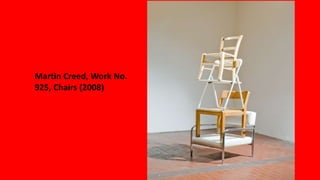
Martin Creed, Work No.
925, Chairs (2008)
Important Facts
 Most conceptual art actively sets out to be controversial.
 The job of conceptual artists is to encourage a revisionary understanding
of art, artist, and artistic experience
 Because Conceptual Art is so dependent upon the text surrounding it, it
is strongly related to numerous other movements of the last century.
Tracey Emin,
Unmade Bed,
(1999)
Conceptual Art & Language
 The Art & Language group was founded in 1967 and is a collaboration of
important conceptual artist influences.
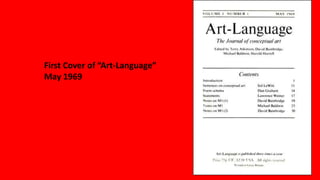
 The first Art & Language journal was released in 1969 and was regarded
as an important influence on conceptual art in the United States and United
Kingdom.
 Sol Lewitt was a huge contributor to the Art & Language group when he
first published an article in the magazine called Sentences on Conceptual Art
in 1969.
First Cover of “Art-Language”
May 1969
Conceptual Art and Skill
 An important difference between conceptual art and more "traditional"
forms of art goes to the question of artistic skill.
 It is difficult to argue that no skill is required to make conceptual works, or
that skill is always absent from them.
 It is not so much an absence of skill that defines conceptual art as an
evident disregard for conventional, modern notions of authorial presence and
individual artistic expression.
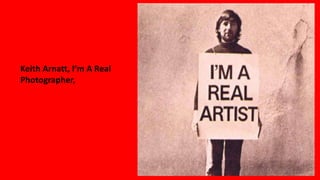
Keith Arnatt, I’m A Real
Photographer,
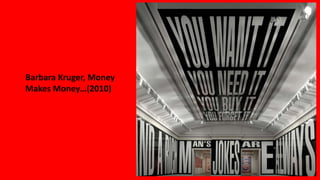
Barbara Kruger, Money
Makes Money…(2010)
Conceptual Artist’s
 Joseph Kosuth
 Lawrence Weiner
 Sol Lewitt
 Betye Saar
 Judy Chicago
 Yoko Ono
 Barbara Krueger
 Martin Creed
 Jenny Holzer
 Andy Warhol
Sources
www.slideshare.net/ArtsyRosemarie/conceptual-art-grade-12-art-history
www.diaart.org/exhibitions/main/3
www.britannica.com/EBchecked/topic/131001/conceptual-art
www.allbuyart.com/art-movement-conceptual-art.asp
www.moma.org/interactives/exhibitions/2010/originalcopy/intro05.html
en.wikipedia.org/wiki/File:Kosuth_OneAndThreeChairs.jpg
conceptualartdebate.wikispaces.com/
http://oberlin.edu/amam/images/LeWitt_1972.77.jpg
Lucy Lippard & John Chandler, "The Dematerialization of Art",
Art International 12:2, February 1968. p. 218

Conceptual art

  • 1.
  • 2.
    What is ConceptualArt? Art that is intended to convey an idea or concept to the perceiver and doesn’t involve the creation or appreciation of a traditional art object such as a painting or sculpture. The commercial or communal aspect of the “work” is often a set of instructions for what exists in the artist’s mind.
  • 3.
    Sol Lewitt, WallDrawing #273, Lines to points on a grid (1975), Water-soluble crayon on wall
  • 4.
    Marcel Duchamp, Fountain, (1917)-Original,Photograph by Alfred Stieglitz
  • 5.
     French artistMarcel Duchamp paved the way for the conceptualists, providing them with examples of early conceptual works — the readymades.  Conceptual art emerged as a recognized art movement in the 1960s.  The term 'Conceptual art' wasn't coined until the 1950s. The term was first used by Edward Kienholz. Where did Conceptual Art Originate?
  • 6.
    Joseph Kosuth, Oneand Three Chairs, (1969)
  • 7.
    The Conceptual ArtMovement  The conceptual art movement began in 1966 in the United States, Latin America, and Europe and ended in 1972.  This movement focuses on Marcel Duchamp's notion that ANYTHING can be art be a work of art.  For advocates of this movement, the idea of a work matters more than its physical identity.
  • 8.
    Bruce Nauman, TheTrue Artist Helps the World by Revealing Mystic Truths, (1967)
  • 9.
    The Conceptual ArtMovement  Conceptual art was seen to act as a reaction against formalism and commodification. This group believed that the art object was not an end in itself and saw artistic knowledge as equal to artistic production.  The first exhibition specifically devoted to Conceptual Art took place in 1970 at the New York Cultural Centre.  The term “Conceptual Art" came to encapsulate all forms of contemporary art that did not utilize the traditional skills of painting and sculpture.
  • 10.
  • 11.
    Conflicts with ConceptualArt  Some have argued that conceptual art continued the "dematerialization" of art by removing the need for objects altogether, while others saw conceptual art as a radical break with formalist Modernism.  When Marcel Duchamp submitted his piece, “Fountain”, in the exhibit Society of Independent Artists in New York, it was rejected. A commonplace object such as a urinal cannot be art because it is not made by an artist or with any intention of being art, nor is it unique or hand-crafted.
  • 12.
    Martin Creed, WorkNo. 925, Chairs (2008)
  • 13.
    Important Facts  Mostconceptual art actively sets out to be controversial.  The job of conceptual artists is to encourage a revisionary understanding of art, artist, and artistic experience  Because Conceptual Art is so dependent upon the text surrounding it, it is strongly related to numerous other movements of the last century.
  • 14.
  • 15.
    Conceptual Art &Language  The Art & Language group was founded in 1967 and is a collaboration of important conceptual artist influences.  The first Art & Language journal was released in 1969 and was regarded as an important influence on conceptual art in the United States and United Kingdom.  Sol Lewitt was a huge contributor to the Art & Language group when he first published an article in the magazine called Sentences on Conceptual Art in 1969.
  • 16.
    First Cover of“Art-Language” May 1969
  • 17.
    Conceptual Art andSkill  An important difference between conceptual art and more "traditional" forms of art goes to the question of artistic skill.  It is difficult to argue that no skill is required to make conceptual works, or that skill is always absent from them.  It is not so much an absence of skill that defines conceptual art as an evident disregard for conventional, modern notions of authorial presence and individual artistic expression.
  • 18.
    Keith Arnatt, I’mA Real Photographer,
  • 19.
  • 20.
    Conceptual Artist’s  JosephKosuth  Lawrence Weiner  Sol Lewitt  Betye Saar  Judy Chicago  Yoko Ono  Barbara Krueger  Martin Creed  Jenny Holzer  Andy Warhol
  • 21.