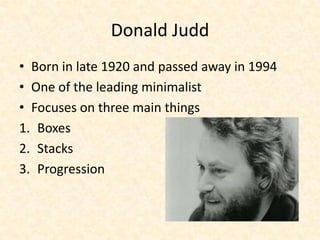
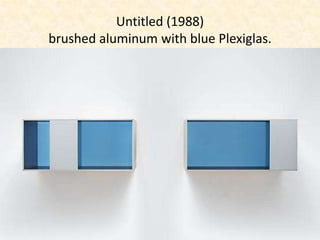
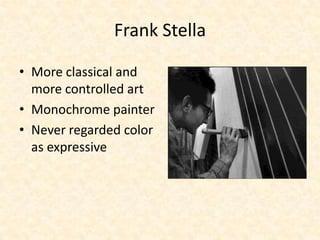
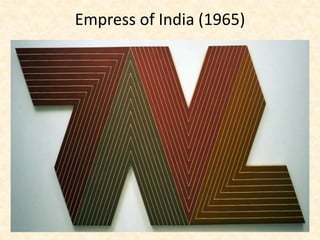
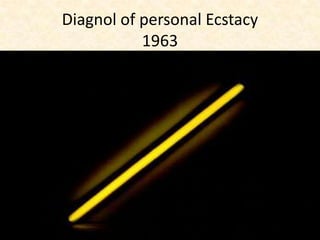
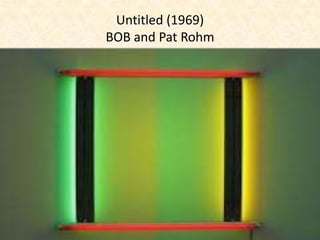
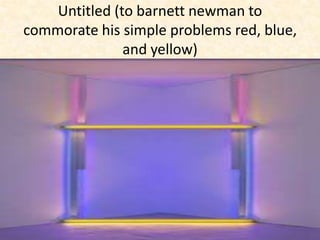
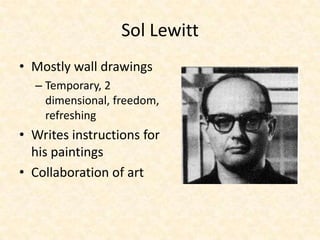
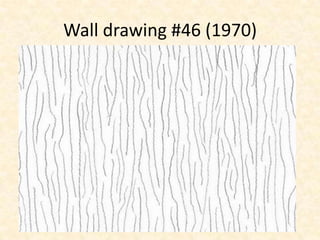
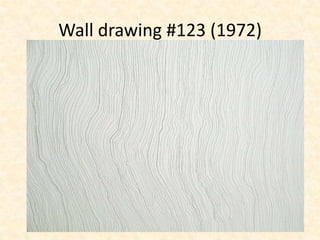
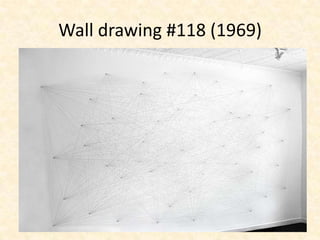
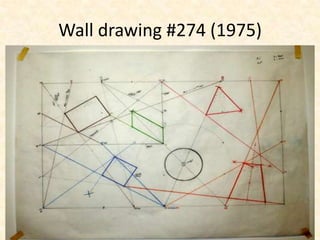
Minimalism began in the 1950s and 1970s as an art movement that used simple geometric shapes and repeated patterns to strip art down to its most fundamental form. It was influenced by abstract expressionism and constructivism. Key minimalist artists discussed include Donald Judd, who focused on boxes, stacks, and progression in his work; Frank Stella, known for his monochrome and controlled paintings; Dan Flavin, who used colored fluorescent lights; and Sol LeWitt, who primarily made wall drawings and wrote instructions for collaborators to create his art.