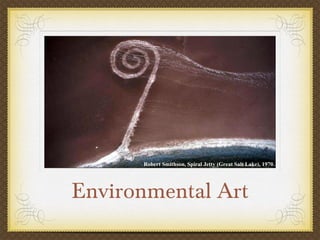
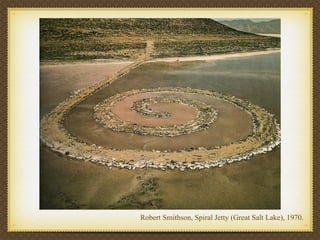
Robert Smithson, Spiral Jetty (Great Salt Lake), 1970.


Environmental Art
What is Environmental Art?

• Art that examines and improves our relationship with
   nature.
     Examines nature and its processes, or educates us about
     environmental problems
  • Artworks affected or powered by wind, water, lightning,
     even earthquakes
  • Re-envisions our relationship to nature, proposing new
     ways for us to co-exist with our environment
  • Reclaims damaged environments, restoring ecosystems in
     artistic and often aesthetic ways
                                         http://www.greenmuseum.org/what_is_ea.php
When did it Originate?

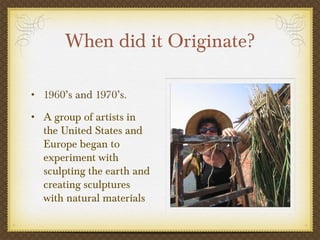
• 1960’s and 1970’s.

• A group of artists in
   the United States and
   Europe began to
   experiment with
   sculpting the earth and
   creating sculptures
   with natural materials
Materials
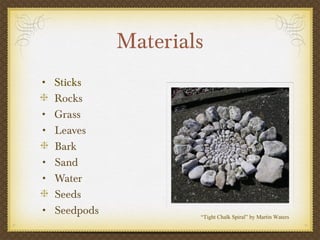
• Sticks
    Rocks
•   Grass
•   Leaves
    Bark
•   Sand
•   Water
    Seeds
•   Seedpods           “Tight Chalk Spiral” by Martin Waters
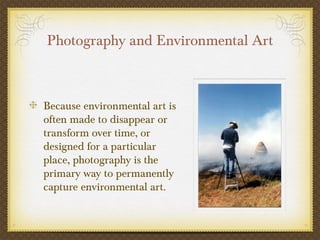
Photography and Environmental Art


Because environmental art is
often made to disappear or
transform over time, or
designed for a particular
place, photography is the
primary way to permanently
capture environmental art.
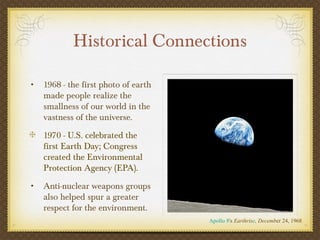
Historical Connections

• 1968 - the first photo of earth
   made people realize the
   smallness of our world in the
   vastness of the universe.
   1970 - U.S. celebrated the
   first Earth Day; Congress
   created the Environmental
   Protection Agency (EPA).
• Anti-nuclear weapons groups
   also helped spur a greater
   respect for the environment.
                                    Apollo 8's Earthrise, December 24, 1968
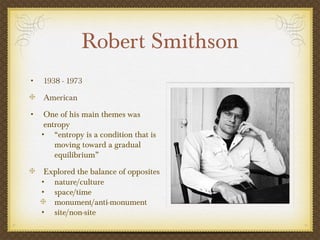
Robert Smithson
•   1938 - 1973
    American
•    One of his main themes was
     entropy
    • “entropy is a condition that is
        moving toward a gradual
        equilibrium”
     Explored the balance of opposites
    • nature/culture
    • space/time
       monument/anti-monument
    • site/non-site
Robert Smithson, Spiral Jetty (Great Salt Lake), 1970.
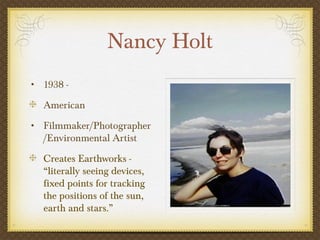
Nancy Holt
• 1938 -

  American
• Filmmaker/Photographer
  /Environmental Artist
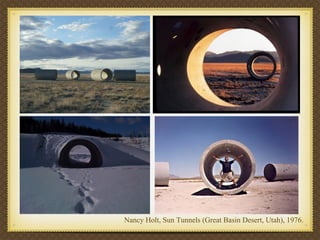
  Creates Earthworks -
  “literally seeing devices,
  fixed points for tracking
  the positions of the sun,
  earth and stars.”
Nancy Holt, Sun Tunnels (Great Basin Desert, Utah), 1976.
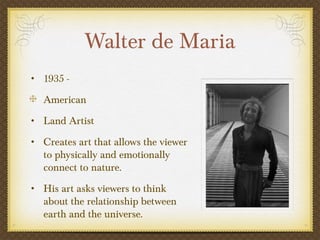
Walter de Maria
• 1935 -

   American
• Land Artist

• Creates art that allows the viewer
   to physically and emotionally
   connect to nature.
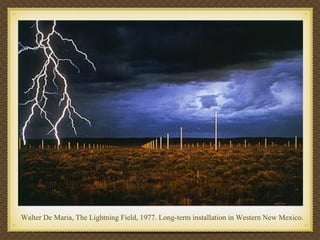
• His art asks viewers to think
   about the relationship between
   earth and the universe.
Walter De Maria, The Lightning Field, 1977. Long-term installation in Western New Mexico.
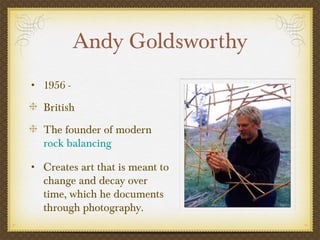
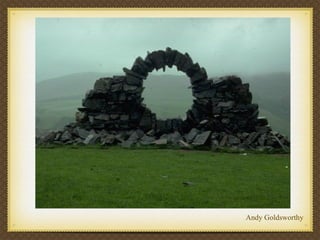
Andy Goldsworthy
• 1956 -

   British
   The founder of modern
   rock balancing

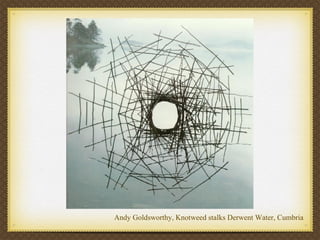
• Creates art that is meant to
   change and decay over
   time, which he documents
   through photography.
Andy Goldsworthy
Andy Goldsworthy, Knotweed stalks Derwent Water, Cumbria
The Link to environmentalism

• Environmentalists are concerned with issues such as
  pollution, preserving the natural habitat of animals,
  global warming, disease, endangered species, and
  technologies that are harmful to the environment.
  Not all environmental art is environmentally friendly,
  or carries an environmentalist message.
  • Some environmental works actually harm the
     surrounding environment, or hurt the habitat of
     the native animals, plants, and other organisms.
Text


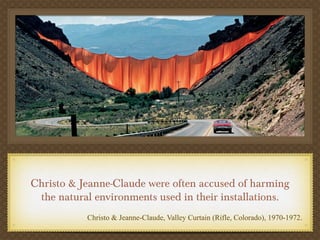
Christo & Jeanne-Claude were often accused of harming
 the natural environments used in their installations.
           Christo & Jeanne-Claude, Valley Curtain (Rifle, Colorado), 1970-1972.
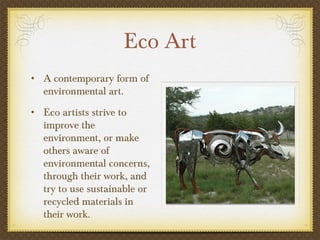
Eco Art
• A contemporary form of
   environmental art.
• Eco artists strive to
   improve the
   environment, or make
   others aware of
   environmental concerns,
   through their work, and
   try to use sustainable or
   recycled materials in
   their work.
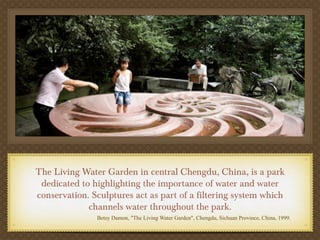
The Living Water Garden in central Chengdu, China, is a park
 dedicated to highlighting the importance of water and water
conservation. Sculptures act as part of a filtering system which
             channels water throughout the park.
               Betsy Damon, "The Living Water Garden", Chengdu, Sichuan Province, China, 1999.
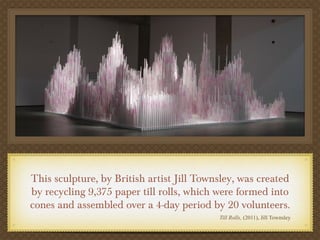
This sculpture, by British artist Jill Townsley, was created
by recycling 9,375 paper till rolls, which were formed into
cones and assembled over a 4-day period by 20 volunteers.
                                           Till Rolls, (2011), Jill Townsley

Environmental Art

  • 1.
    Robert Smithson, SpiralJetty (Great Salt Lake), 1970. Environmental Art
  • 2.
    What is EnvironmentalArt? • Art that examines and improves our relationship with nature. Examines nature and its processes, or educates us about environmental problems • Artworks affected or powered by wind, water, lightning, even earthquakes • Re-envisions our relationship to nature, proposing new ways for us to co-exist with our environment • Reclaims damaged environments, restoring ecosystems in artistic and often aesthetic ways http://www.greenmuseum.org/what_is_ea.php
  • 3.
    When did itOriginate? • 1960’s and 1970’s. • A group of artists in the United States and Europe began to experiment with sculpting the earth and creating sculptures with natural materials
  • 4.
    Materials • Sticks Rocks • Grass • Leaves Bark • Sand • Water Seeds • Seedpods “Tight Chalk Spiral” by Martin Waters
  • 5.
    Photography and EnvironmentalArt Because environmental art is often made to disappear or transform over time, or designed for a particular place, photography is the primary way to permanently capture environmental art.
  • 6.
    Historical Connections • 1968- the first photo of earth made people realize the smallness of our world in the vastness of the universe. 1970 - U.S. celebrated the first Earth Day; Congress created the Environmental Protection Agency (EPA). • Anti-nuclear weapons groups also helped spur a greater respect for the environment. Apollo 8's Earthrise, December 24, 1968
  • 7.
    Robert Smithson • 1938 - 1973 American • One of his main themes was entropy • “entropy is a condition that is moving toward a gradual equilibrium” Explored the balance of opposites • nature/culture • space/time monument/anti-monument • site/non-site
  • 8.
    Robert Smithson, SpiralJetty (Great Salt Lake), 1970.
  • 9.
    Nancy Holt • 1938- American • Filmmaker/Photographer /Environmental Artist Creates Earthworks - “literally seeing devices, fixed points for tracking the positions of the sun, earth and stars.”
  • 10.
    Nancy Holt, SunTunnels (Great Basin Desert, Utah), 1976.
  • 11.
    Walter de Maria •1935 - American • Land Artist • Creates art that allows the viewer to physically and emotionally connect to nature. • His art asks viewers to think about the relationship between earth and the universe.
  • 12.
    Walter De Maria,The Lightning Field, 1977. Long-term installation in Western New Mexico.
  • 13.
    Andy Goldsworthy • 1956- British The founder of modern rock balancing • Creates art that is meant to change and decay over time, which he documents through photography.
  • 14.
  • 15.
    Andy Goldsworthy, Knotweedstalks Derwent Water, Cumbria
  • 16.
    The Link toenvironmentalism • Environmentalists are concerned with issues such as pollution, preserving the natural habitat of animals, global warming, disease, endangered species, and technologies that are harmful to the environment. Not all environmental art is environmentally friendly, or carries an environmentalist message. • Some environmental works actually harm the surrounding environment, or hurt the habitat of the native animals, plants, and other organisms.
  • 17.
    Text Christo & Jeanne-Claudewere often accused of harming the natural environments used in their installations. Christo & Jeanne-Claude, Valley Curtain (Rifle, Colorado), 1970-1972.
  • 18.
    Eco Art • Acontemporary form of environmental art. • Eco artists strive to improve the environment, or make others aware of environmental concerns, through their work, and try to use sustainable or recycled materials in their work.
  • 19.
    The Living WaterGarden in central Chengdu, China, is a park dedicated to highlighting the importance of water and water conservation. Sculptures act as part of a filtering system which channels water throughout the park. Betsy Damon, "The Living Water Garden", Chengdu, Sichuan Province, China, 1999.
  • 20.
    This sculpture, byBritish artist Jill Townsley, was created by recycling 9,375 paper till rolls, which were formed into cones and assembled over a 4-day period by 20 volunteers. Till Rolls, (2011), Jill Townsley