Minimalism
Basics of Minimalists:
• Tried to eliminate composition from their work
• Were focused on creating a purely visual piece, not
concerned with hidden or deeper meanings
• Were primarily a reaction against abstract
expressionism
Basics of Minimalists (cont.):
• Believed that 2-D art had a limited number of
possible different works
• Objectified their pieces/ wanted people to see the
piece for what it is, not what it represents
• Spawned Post-Painterly Abstraction- a movement
that was less energetic and more colorful than
previous movements, still nonrepresentational
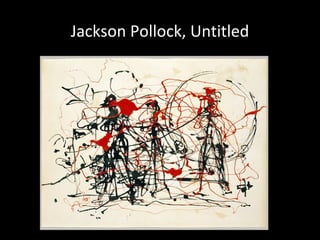
Jackson Pollock, Untitled
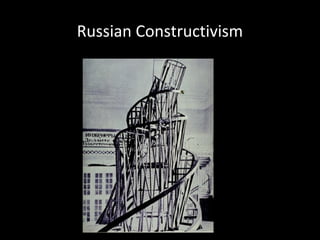
Russian Constructivism
What does that mean?
• It means that they didn’t want their work to look
assembled out of parts/elements
• They completely did away with symbols and
characters in their works
• They blurred the line between 2-D and 3-D with
shaped canvasses
• Often, works were completely 3-D
• Pieces were meant to be seen as literally what they
are, not as metaphors
Who Inspired Them?
• Minimalism was primarily a reaction against the
individualism/ individual worship of abstract
expressionism
• The drew on the techniques of earlier artists and
movements like the Constructivist movement, Ad
Reinhardt, and Barnett Newman
What are their works known for?
• Works are very ordered
• No thought is given as to symmetry, but works are
often symmetrical due to the artists’ drive for order
• Works are often sculptures or at least semi 3-D
• Finally, works are very simplistic in nature
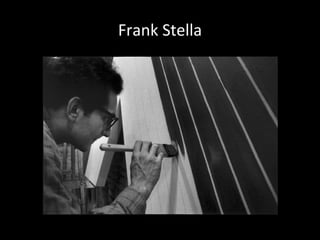
Frank Stella
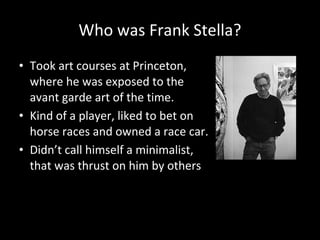
Who was Frank Stella?
• Took art courses at Princeton,
where he was exposed to the
avant garde art of the time.
• Kind of a player, liked to bet on
horse races and owned a race car.
• Didn’t call himself a minimalist,
that was thrust on him by others
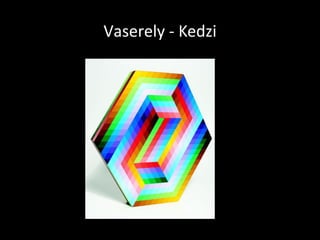
Vaserely - Kedzi
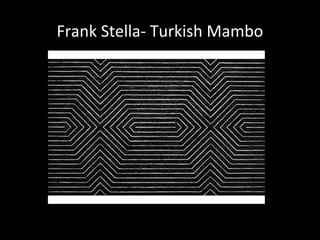
Frank Stella- Turkish Mambo
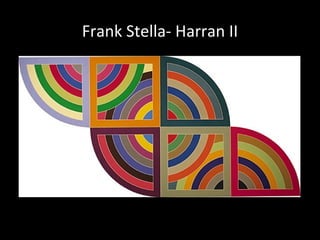
Frank Stella- Harran II
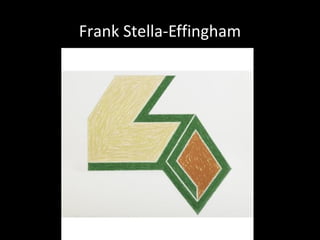
Frank Stella-Effingham
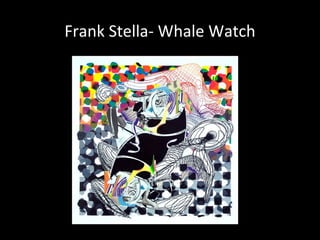
Frank Stella- Whale Watch
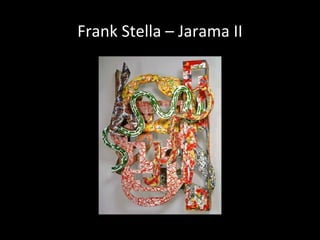
Frank Stella – Jarama II
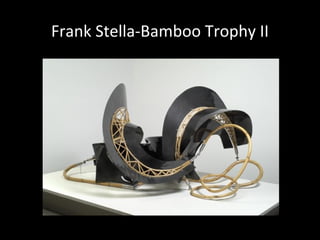
Frank Stella-Bamboo Trophy II
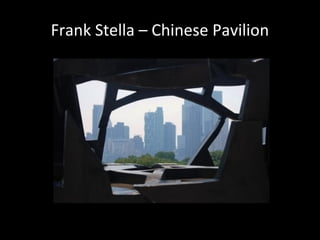
Frank Stella – Chinese Pavilion
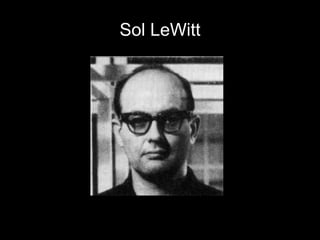
Sol LeWitt
Sol LeWitt's Life
●Was drafted in the Korean War in 1959
●Took a job at the Museum of Modern Art in 1960
●Influenced by the work of Frank Stella
●Developed interest in Russian Constructivism
●Later Life
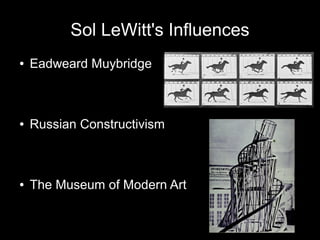
Sol LeWitt's Influences
● Eadweard Muybridge
● Russian Constructivism
● The Museum of Modern Art
Sol LeWitt's Style
● The initial idea for the work is crucial
● Creation of the works-Sol LeWitt designed them, and
had others build/execute the work
● Sol LeWitt's Influences
● Wall drawings and installations
● The importance of color and shape
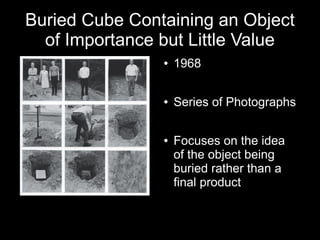
Buried Cube Containing an Object
of Importance but Little Value
● 1968
● Series of Photographs
● Focuses on the idea
of the object being
buried rather than a
final product
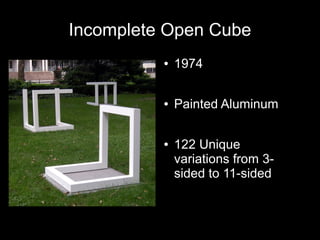
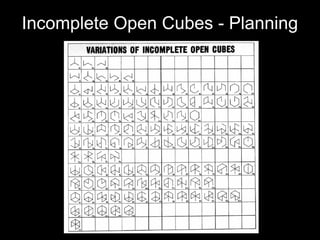
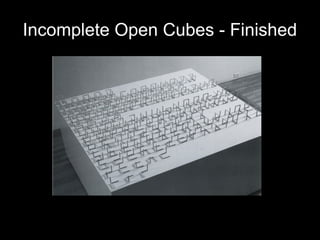
Incomplete Open Cube
● 1974
● Painted Aluminum
● 122 Unique
variations from 3-
sided to 11-sided
Incomplete Open Cubes - Planning
Incomplete Open Cubes - Finished
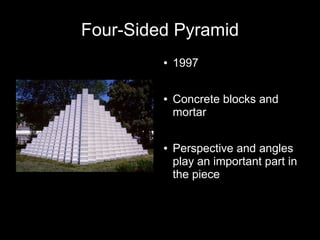
Four-Sided Pyramid
● 1997
● Concrete blocks and
mortar
● Perspective and angles
play an important part in
the piece
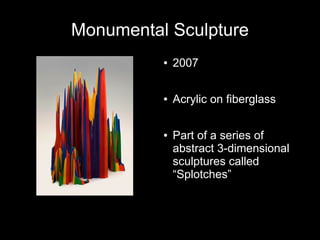
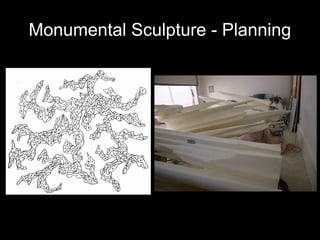
Monumental Sculpture
● 2007
● Acrylic on fiberglass
● Part of a series of
abstract 3-dimensional
sculptures called
“Splotches”
Monumental Sculpture - Planning
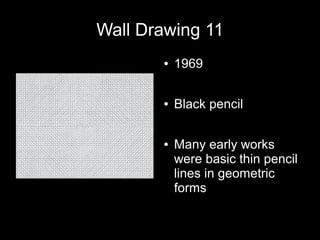
Wall Drawing 11
● 1969
● Black pencil
● Many early works
were basic thin pencil
lines in geometric
forms
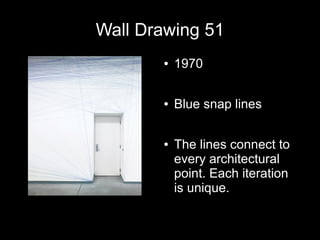
Wall Drawing 51
● 1970
● Blue snap lines
● The lines connect to
every architectural
point. Each iteration
is unique.
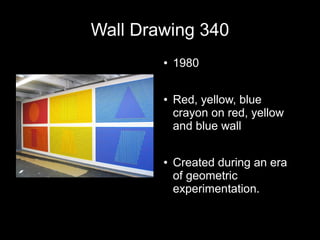
Wall Drawing 340
● 1980
● Red, yellow, blue
crayon on red, yellow
and blue wall
● Created during an era
of geometric
experimentation.
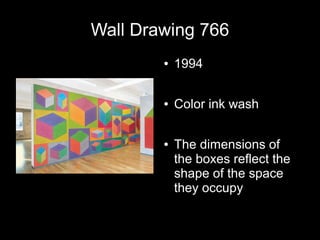
Wall Drawing 766
● 1994
● Color ink wash
● The dimensions of
the boxes reflect the
shape of the space
they occupy
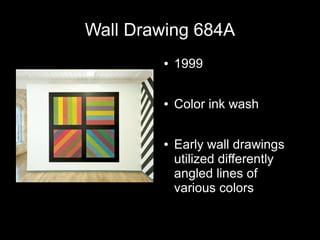
Wall Drawing 684A
● 1999
● Color ink wash
● Early wall drawings
utilized differently
angled lines of
various colors
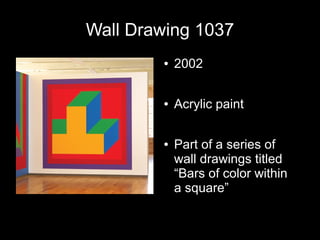
Wall Drawing 1037
● 2002
● Acrylic paint
● Part of a series of
wall drawings titled
“Bars of color within
a square”
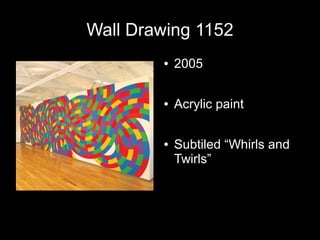
Wall Drawing 1152
● 2005
● Acrylic paint
● Subtiled “Whirls and
Twirls”
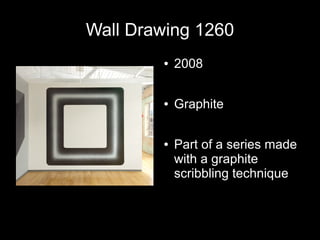
Wall Drawing 1260
● 2008
● Graphite
● Part of a series made
with a graphite
scribbling technique
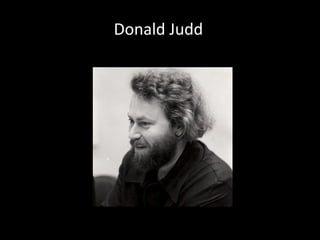
Donald Judd
Donald Judd – As a person
•Was a Philosophy Major at Columbia, so very
intelligent.
•Is a self proclaimed Empiricist. (Philosophical
standing)
•Very Anti-war. (Vietnam and gulf war) And is a firm
believer in preserving the environment.
http://www.youtube.com/watch?v=t0stpkzsNDU
Judd’s Reliefs and Works
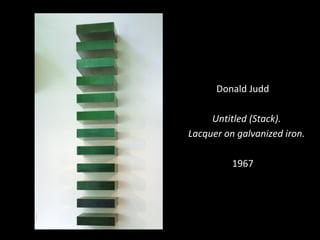
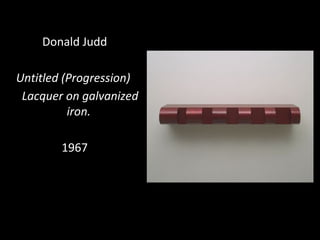
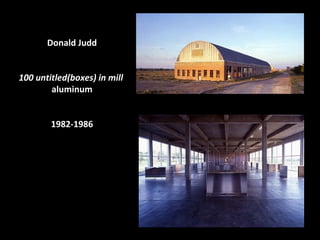
• Key Works Include: ‘Stacks’, ‘Boxes’, and
‘Progressions.
• Works are Symmetrical and made of Industrial
Materials.
• Wants his works to be permanently installed. He
states that are is ‘fragile’.
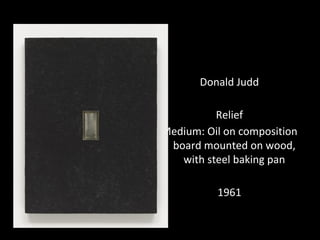
Donald Judd
Relief
Medium: Oil on composition
board mounted on wood,
with steel baking pan
1961
Donald Judd
Untitled (Stack).
Lacquer on galvanized iron.
1967
Donald Judd
Untitled (Progression)
Lacquer on galvanized
iron.
1967
Donald Judd
100 untitled(boxes) in mill
aluminum
1982-1986
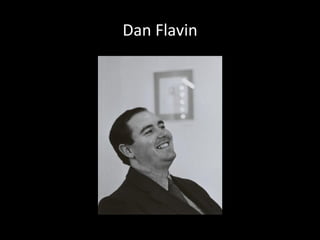
Dan Flavin
Dan Flavin – As a person
• Had a religious catholic upbringing, Served in
Military
• Attended Columbia University and studied painting
and drawing
• Worked in Museums such as the Guggenheim and
Museum of Modern Art before pursuing work.
Flavin’s Works
• “It is was it is and it ain’t nothin’ else” – Dan Flavin
• Key characteristic: Used Fluorescent Lights, called his works
“Propositions”, liked Corners and Diagonals
• All the lights used in his work were mass produced
• He often ‘dedicates’ his art work to other people.
• What is unique about his art from other minimalists is that
the fluorescent lights only stay lit for a short while, making
his art perishable.
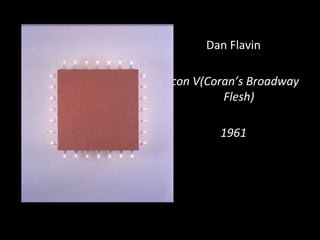
Dan Flavin
Icon V(Coran’s Broadway
Flesh)
1961
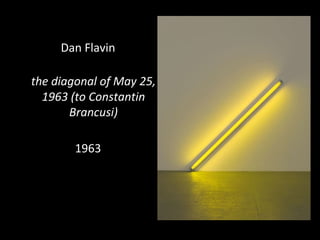
Dan Flavin
the diagonal of May 25,
1963 (to Constantin
Brancusi)
1963
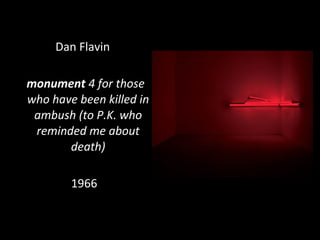
Dan Flavin
monument 4 for those
who have been killed in
ambush (to P.K. who
reminded me about
death)
1966
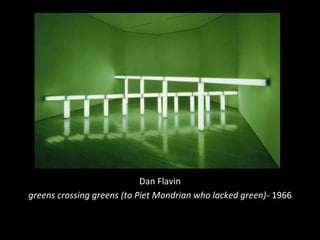
Dan Flavin
greens crossing greens (to Piet Mondrian who lacked green)- 1966
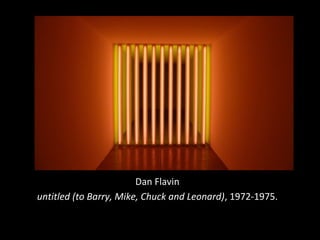
Dan Flavin
untitled (to Barry, Mike, Chuck and Leonard), 1972-1975.
Sources
• JUDD
• http://www.moma.org/collection/browse_results.php?criteria=O
• http://www.moma.org/modernteachers/large_image.php?id=20
• http://www.chinati.org/visit/collection/donaldjudd.php
• FLAVIN
• http://www.nga.gov/exhibitions/2004/flavin/early/early_p3.shtm
• http://www.nga.gov/exhibitions/2004/flavin/light/light.shtm
• http://www.davidzwirner.com/artists/dan-flavin/exhibitions/solo
• http://www.nga.gov/exhibitions/2004/flavin/early/golddiagonal_
• http://www.nga.gov/exhibitions/2004/flavin/monuments/monum

Minimalism powerpoint

  • 1.
  • 2.
    Basics of Minimalists: •Tried to eliminate composition from their work • Were focused on creating a purely visual piece, not concerned with hidden or deeper meanings • Were primarily a reaction against abstract expressionism
  • 3.
    Basics of Minimalists(cont.): • Believed that 2-D art had a limited number of possible different works • Objectified their pieces/ wanted people to see the piece for what it is, not what it represents • Spawned Post-Painterly Abstraction- a movement that was less energetic and more colorful than previous movements, still nonrepresentational
  • 4.
  • 5.
  • 6.
    What does thatmean? • It means that they didn’t want their work to look assembled out of parts/elements • They completely did away with symbols and characters in their works • They blurred the line between 2-D and 3-D with shaped canvasses • Often, works were completely 3-D • Pieces were meant to be seen as literally what they are, not as metaphors
  • 7.
    Who Inspired Them? •Minimalism was primarily a reaction against the individualism/ individual worship of abstract expressionism • The drew on the techniques of earlier artists and movements like the Constructivist movement, Ad Reinhardt, and Barnett Newman
  • 8.
    What are theirworks known for? • Works are very ordered • No thought is given as to symmetry, but works are often symmetrical due to the artists’ drive for order • Works are often sculptures or at least semi 3-D • Finally, works are very simplistic in nature
  • 9.
  • 10.
    Who was FrankStella? • Took art courses at Princeton, where he was exposed to the avant garde art of the time. • Kind of a player, liked to bet on horse races and owned a race car. • Didn’t call himself a minimalist, that was thrust on him by others
  • 11.
  • 12.
  • 13.
  • 14.
  • 15.
  • 16.
  • 17.
  • 18.
    Frank Stella –Chinese Pavilion
  • 19.
  • 20.
    Sol LeWitt's Life ●Wasdrafted in the Korean War in 1959 ●Took a job at the Museum of Modern Art in 1960 ●Influenced by the work of Frank Stella ●Developed interest in Russian Constructivism ●Later Life
  • 21.
    Sol LeWitt's Influences ●Eadweard Muybridge ● Russian Constructivism ● The Museum of Modern Art
  • 22.
    Sol LeWitt's Style ●The initial idea for the work is crucial ● Creation of the works-Sol LeWitt designed them, and had others build/execute the work ● Sol LeWitt's Influences ● Wall drawings and installations ● The importance of color and shape
  • 23.
    Buried Cube Containingan Object of Importance but Little Value ● 1968 ● Series of Photographs ● Focuses on the idea of the object being buried rather than a final product
  • 24.
    Incomplete Open Cube ●1974 ● Painted Aluminum ● 122 Unique variations from 3- sided to 11-sided
  • 25.
  • 26.
  • 27.
    Four-Sided Pyramid ● 1997 ●Concrete blocks and mortar ● Perspective and angles play an important part in the piece
  • 28.
    Monumental Sculpture ● 2007 ●Acrylic on fiberglass ● Part of a series of abstract 3-dimensional sculptures called “Splotches”
  • 29.
  • 30.
    Wall Drawing 11 ●1969 ● Black pencil ● Many early works were basic thin pencil lines in geometric forms
  • 31.
    Wall Drawing 51 ●1970 ● Blue snap lines ● The lines connect to every architectural point. Each iteration is unique.
  • 32.
    Wall Drawing 340 ●1980 ● Red, yellow, blue crayon on red, yellow and blue wall ● Created during an era of geometric experimentation.
  • 33.
    Wall Drawing 766 ●1994 ● Color ink wash ● The dimensions of the boxes reflect the shape of the space they occupy
  • 34.
    Wall Drawing 684A ●1999 ● Color ink wash ● Early wall drawings utilized differently angled lines of various colors
  • 35.
    Wall Drawing 1037 ●2002 ● Acrylic paint ● Part of a series of wall drawings titled “Bars of color within a square”
  • 36.
    Wall Drawing 1152 ●2005 ● Acrylic paint ● Subtiled “Whirls and Twirls”
  • 37.
    Wall Drawing 1260 ●2008 ● Graphite ● Part of a series made with a graphite scribbling technique
  • 38.
  • 39.
    Donald Judd –As a person •Was a Philosophy Major at Columbia, so very intelligent. •Is a self proclaimed Empiricist. (Philosophical standing) •Very Anti-war. (Vietnam and gulf war) And is a firm believer in preserving the environment. http://www.youtube.com/watch?v=t0stpkzsNDU
  • 40.
    Judd’s Reliefs andWorks • Key Works Include: ‘Stacks’, ‘Boxes’, and ‘Progressions. • Works are Symmetrical and made of Industrial Materials. • Wants his works to be permanently installed. He states that are is ‘fragile’.
  • 41.
    Donald Judd Relief Medium: Oilon composition board mounted on wood, with steel baking pan 1961
  • 42.
    Donald Judd Untitled (Stack). Lacqueron galvanized iron. 1967
  • 43.
  • 44.
    Donald Judd 100 untitled(boxes)in mill aluminum 1982-1986
  • 45.
  • 46.
    Dan Flavin –As a person • Had a religious catholic upbringing, Served in Military • Attended Columbia University and studied painting and drawing • Worked in Museums such as the Guggenheim and Museum of Modern Art before pursuing work.
  • 47.
    Flavin’s Works • “Itis was it is and it ain’t nothin’ else” – Dan Flavin • Key characteristic: Used Fluorescent Lights, called his works “Propositions”, liked Corners and Diagonals • All the lights used in his work were mass produced • He often ‘dedicates’ his art work to other people. • What is unique about his art from other minimalists is that the fluorescent lights only stay lit for a short while, making his art perishable.
  • 48.
    Dan Flavin Icon V(Coran’sBroadway Flesh) 1961
  • 49.
    Dan Flavin the diagonalof May 25, 1963 (to Constantin Brancusi) 1963
  • 50.
    Dan Flavin monument 4for those who have been killed in ambush (to P.K. who reminded me about death) 1966
  • 51.
    Dan Flavin greens crossinggreens (to Piet Mondrian who lacked green)- 1966
  • 52.
    Dan Flavin untitled (toBarry, Mike, Chuck and Leonard), 1972-1975.
  • 53.
    Sources • JUDD • http://www.moma.org/collection/browse_results.php?criteria=O •http://www.moma.org/modernteachers/large_image.php?id=20 • http://www.chinati.org/visit/collection/donaldjudd.php • FLAVIN • http://www.nga.gov/exhibitions/2004/flavin/early/early_p3.shtm • http://www.nga.gov/exhibitions/2004/flavin/light/light.shtm • http://www.davidzwirner.com/artists/dan-flavin/exhibitions/solo • http://www.nga.gov/exhibitions/2004/flavin/early/golddiagonal_ • http://www.nga.gov/exhibitions/2004/flavin/monuments/monum