Introduction
Mineralogy
Textures
Mode of occurrences
Types
Occurrences
Reference
conclusion
 The word "granite" comes from the Latin granum,
 Granite is a common type of
plutonic intrusive, felsic, igneous rock which is granular
and phaneritic in texture.
 This rock consists mainly of quartz, mica, and feldspar.
 By definition, granite is an igneous rock with at least 20% quartz by
volume. Outcrops of granite tend to form rounded massifs. Granites
sometimes occur in circular depressions surrounded by a range of
hills.
 Granite is nearly always massive ,hard and tough, and therefore it has
gained widespread use as a construction stone. The
average density of granite is between 2.65 and 2.75 g/cm3,Melting
temperature is 1215 - 1260 °C.
Essential minerals
 Feldspar and quartz are the most important mierals
 Quartz makes up about 10-30%
it is anhedral and occur as phenocryst
 Feldspar-alkali feldspar,orthoclase,microcline
Quartz
Orthoclase
Feldspar
Accessory minerals
 Biotite –common mafic mineral in granites.colour varies with fe
content.
 Hornblende-green hornblende seen in calcalkali granites
 amphibole
 Pyroxene
 Hedenbergite
Minor accessories
 Tourmaline,(schorl rock)
topaz,epidote,garnet(almandine,spessartine),apatite,epidote
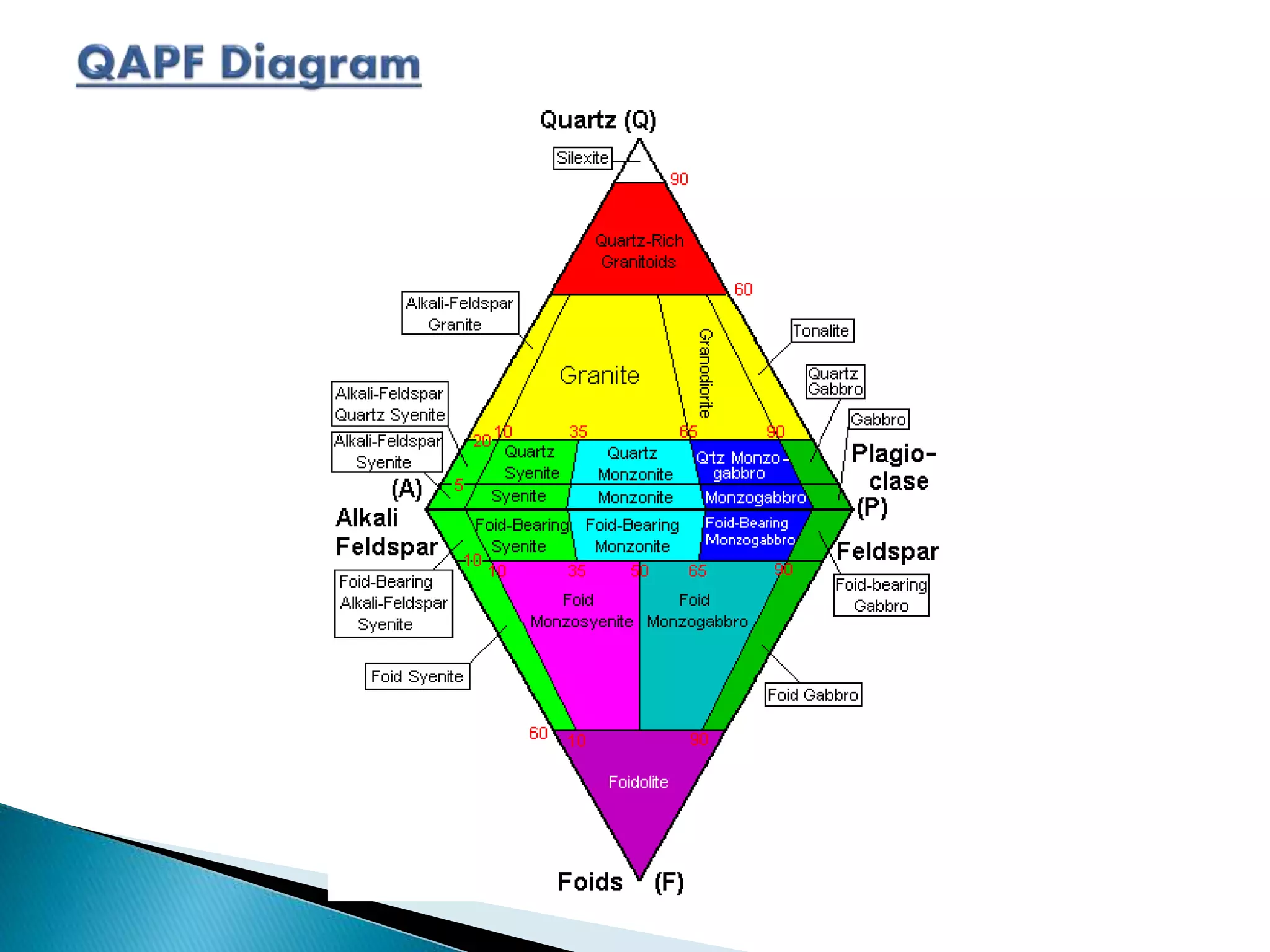
 Granite is classified according to the QAPF diagram for coarse
grained plutonic rocks and is named according to the percentage
ofquartz, alkali feldspar (orthoclase, sanidine, or microcline)
and plagioclase feldspar.
 Granite differs from granodiorite in that at least 35% of the feldspar in
granite is alkali feldspar as opposed to plagioclase; it is the alkali
feldspar that gives many granites a distinctive pink color.
 When a granitoid contains less than 10% orthoclase, it is
called tonalite; pyroxeneand amphibole are common in tonalite. A
granite containing both muscovite and biotite micas is called a binary
or two-mica granite. Two-mica granites are typically high
in potassium and low in plagioclase, and are usually S-type granites
or A-type granites. The volcanic equivalent of granite is rhyolite and
hypabyssal is granophyre(Tyrrell’s classification)
 Granite is a phanerocrystalline rock which is
medium to coarse grained.
 They also in holocrystaline, hypidiomorphic,
granular rocks
 Some granites exhibit porphyritic
texture(phenocryst-feldspar), orbicular texture,
graphic(qtz & fldspr), granophyric texture
 Occasionally some individual crystals (phenocrysts)
are larger than the groundmass, in which case the
texture is known as porphyritic. A granitic rock
with a porphyritic texture is sometimes known as
a porphyry. Granites can be pink to gray in color,
depending on their chemistry and mineralogy.
 Granites occur as huge batholiths of great dimensions usually
occuring in the cores of mountain
ranges(stocks,bosses,laccoliths)
 The huge bodies does not show any peculiar structure
 Moral jointing is common and rift and grain is also present in
most varieties.
 The basic minerals like biotite,amphibole occur as
seggregations and patches in the granite body.sometimes
parallel arrangement of minerals(foliation) may be seen
 Mica granite –the micas,muscovite and biotite together make up
10% of the rock. other accessory minerals are allanite, sphene,
apatite, magnetite and guorite. It is the most abundant type of
granite.
 Biotite hornblende granite – these are next in abundance. These
rocks are somewhat more basic. A few of them carry pyroxenes.
 Pyroxene granite- this type is rare. Biotite and hornblende are
entirely absent here or make up only vary small
amount.clinopyroxene is the chief mafic minerals. Orbicular
granite – it exhibits orbicular structure. The orbicules are made
up of layers of biotite and quartz.
 Granite, pegmatites and aplites – these are very common in
and around a granitic body. The pegmatites have the intergrowth
texture and are very coarse grained. They are store house of a
number of valuable minerals. The aplites are finegrained,
equigranular, allotriomorphic rocks. They occur as contact facies
in a granitic body.
 Alkali granite – this is a granite marked by the occurrence of
amphibole and puroxene rich in Na and Fe. The rock is
usuallymade up of sodic and potassic feldspars(75%).perthite
is common. Aegerine and riebeckite are the common mafics.
Accessories are apatite,sphene,zircon,iron ore etc.
 Porphyritic granite – exhibits the porphyritic texture.
Phenocrysts are orthoclase, microcline, perthite.
 Granite and granite gneiss are too common in peninsular
India and cover vast areas in Indian geology.
 Typical granite occurrences are Singhbhum granite(Bihar),
Bundelkhand granite(Rajasthan), Erinpura granite, Idar
granite, Closepet granite, Chamundi granite(Karnataka).
 Granites of North arcot and Sankaridrug in Tamilnadu and
granites of Himalayas.alkali granite are seen in Siwana and
Tatanagar.
 It is a coarse-grained structure of such a crystalline rock.
 Granite is usually found in the continental plates of the
Earth's crust(magma).
 This rock consists mainly of quartz, feldspar, mica etc
 (Curling) another name for a granite stone.
 A common, coarse-grained, light-colored, hard igneous rock
consisting chiefly of quartz, orthoclase or microcline, and
mica, used in monuments and for building.
 Igneous and metamorphic petrology(1962), Francis
J.Turner,McGraw-Hill book company.
 http://en.wikipedia.org/wiki/Granite
 http://www.thefreedictionary.com/granite
Granite

Granite

  • 2.
  • 3.
     The word"granite" comes from the Latin granum,  Granite is a common type of plutonic intrusive, felsic, igneous rock which is granular and phaneritic in texture.  This rock consists mainly of quartz, mica, and feldspar.  By definition, granite is an igneous rock with at least 20% quartz by volume. Outcrops of granite tend to form rounded massifs. Granites sometimes occur in circular depressions surrounded by a range of hills.  Granite is nearly always massive ,hard and tough, and therefore it has gained widespread use as a construction stone. The average density of granite is between 2.65 and 2.75 g/cm3,Melting temperature is 1215 - 1260 °C.
  • 4.
    Essential minerals  Feldsparand quartz are the most important mierals  Quartz makes up about 10-30% it is anhedral and occur as phenocryst  Feldspar-alkali feldspar,orthoclase,microcline Quartz Orthoclase Feldspar
  • 5.
    Accessory minerals  Biotite–common mafic mineral in granites.colour varies with fe content.  Hornblende-green hornblende seen in calcalkali granites  amphibole  Pyroxene  Hedenbergite Minor accessories  Tourmaline,(schorl rock) topaz,epidote,garnet(almandine,spessartine),apatite,epidote
  • 7.
     Granite isclassified according to the QAPF diagram for coarse grained plutonic rocks and is named according to the percentage ofquartz, alkali feldspar (orthoclase, sanidine, or microcline) and plagioclase feldspar.  Granite differs from granodiorite in that at least 35% of the feldspar in granite is alkali feldspar as opposed to plagioclase; it is the alkali feldspar that gives many granites a distinctive pink color.  When a granitoid contains less than 10% orthoclase, it is called tonalite; pyroxeneand amphibole are common in tonalite. A granite containing both muscovite and biotite micas is called a binary or two-mica granite. Two-mica granites are typically high in potassium and low in plagioclase, and are usually S-type granites or A-type granites. The volcanic equivalent of granite is rhyolite and hypabyssal is granophyre(Tyrrell’s classification)
  • 8.
     Granite isa phanerocrystalline rock which is medium to coarse grained.  They also in holocrystaline, hypidiomorphic, granular rocks  Some granites exhibit porphyritic texture(phenocryst-feldspar), orbicular texture, graphic(qtz & fldspr), granophyric texture  Occasionally some individual crystals (phenocrysts) are larger than the groundmass, in which case the texture is known as porphyritic. A granitic rock with a porphyritic texture is sometimes known as a porphyry. Granites can be pink to gray in color, depending on their chemistry and mineralogy.
  • 9.
     Granites occuras huge batholiths of great dimensions usually occuring in the cores of mountain ranges(stocks,bosses,laccoliths)  The huge bodies does not show any peculiar structure  Moral jointing is common and rift and grain is also present in most varieties.  The basic minerals like biotite,amphibole occur as seggregations and patches in the granite body.sometimes parallel arrangement of minerals(foliation) may be seen
  • 10.
     Mica granite–the micas,muscovite and biotite together make up 10% of the rock. other accessory minerals are allanite, sphene, apatite, magnetite and guorite. It is the most abundant type of granite.  Biotite hornblende granite – these are next in abundance. These rocks are somewhat more basic. A few of them carry pyroxenes.  Pyroxene granite- this type is rare. Biotite and hornblende are entirely absent here or make up only vary small amount.clinopyroxene is the chief mafic minerals. Orbicular granite – it exhibits orbicular structure. The orbicules are made up of layers of biotite and quartz.  Granite, pegmatites and aplites – these are very common in and around a granitic body. The pegmatites have the intergrowth texture and are very coarse grained. They are store house of a number of valuable minerals. The aplites are finegrained, equigranular, allotriomorphic rocks. They occur as contact facies in a granitic body.
  • 11.
     Alkali granite– this is a granite marked by the occurrence of amphibole and puroxene rich in Na and Fe. The rock is usuallymade up of sodic and potassic feldspars(75%).perthite is common. Aegerine and riebeckite are the common mafics. Accessories are apatite,sphene,zircon,iron ore etc.  Porphyritic granite – exhibits the porphyritic texture. Phenocrysts are orthoclase, microcline, perthite.
  • 12.
     Granite andgranite gneiss are too common in peninsular India and cover vast areas in Indian geology.  Typical granite occurrences are Singhbhum granite(Bihar), Bundelkhand granite(Rajasthan), Erinpura granite, Idar granite, Closepet granite, Chamundi granite(Karnataka).  Granites of North arcot and Sankaridrug in Tamilnadu and granites of Himalayas.alkali granite are seen in Siwana and Tatanagar.
  • 14.
     It isa coarse-grained structure of such a crystalline rock.  Granite is usually found in the continental plates of the Earth's crust(magma).  This rock consists mainly of quartz, feldspar, mica etc  (Curling) another name for a granite stone.  A common, coarse-grained, light-colored, hard igneous rock consisting chiefly of quartz, orthoclase or microcline, and mica, used in monuments and for building.
  • 15.
     Igneous andmetamorphic petrology(1962), Francis J.Turner,McGraw-Hill book company.  http://en.wikipedia.org/wiki/Granite  http://www.thefreedictionary.com/granite