EARTH & LIFE SCIENCE:
ROCK FORMING
MINERALS
At the of the lesson,
I would be able to
identify common
rock-forming
minerals using
their physical and
chemical
properties.
LESSON
OBJECTIVES:
MINERALS...
a naturally occurring
inorganic element or
compound having an;
• orderly internal
structure and
characteristic chemical
composition
• crystal form
• physical properties.
MINERALS...
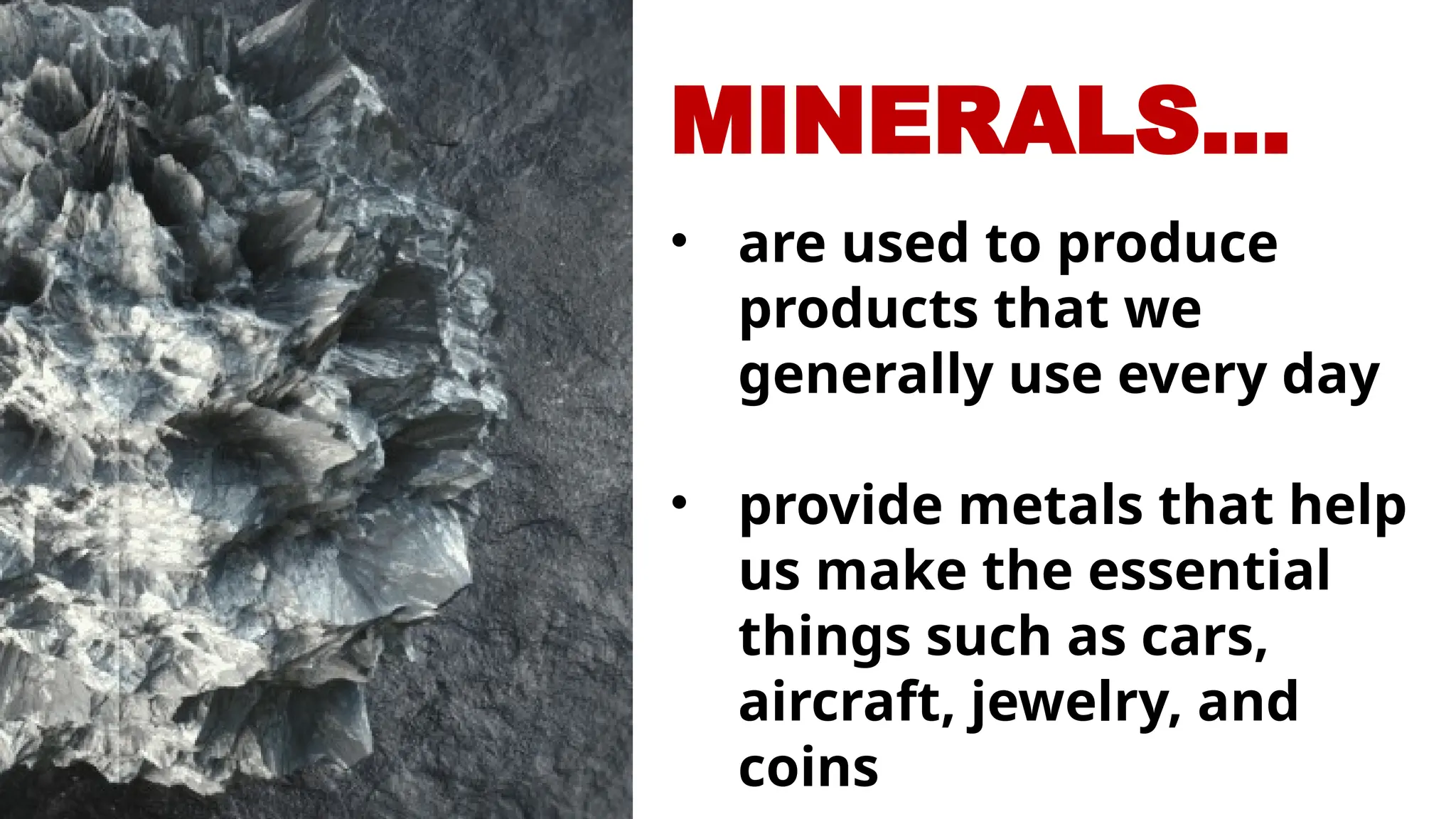
• are used to produce
products that we
generally use every day
• provide metals that help
us make the essential
things such as cars,
aircraft, jewelry, and
coins
MINERALS...
Common minerals include:
• quartz
• feldspar
• mica
• amphibole
• olivine
• calcite.
ROCKS...
• rock is an aggregate
of one or more
minerals, or a body of
undifferentiated
mineral matter.
ROCKS...
Common rocks include:
• granite
• basalt
• limestone
• sandstone.
LET’S MIX
AND
MATCH!!!
MECHANICS:
• The class is divided into 6
groups.
• Each group will be given a
set of words that are
scrambled.
• The group will arranged
the scrambled letter word
in the shortest amount of
time.
MECHANICS:
• Each correct word is worth
5 points
• The group who completes
the word in the shortest
time and with the most
correct answer wins.
MINERALS
MINERALS...
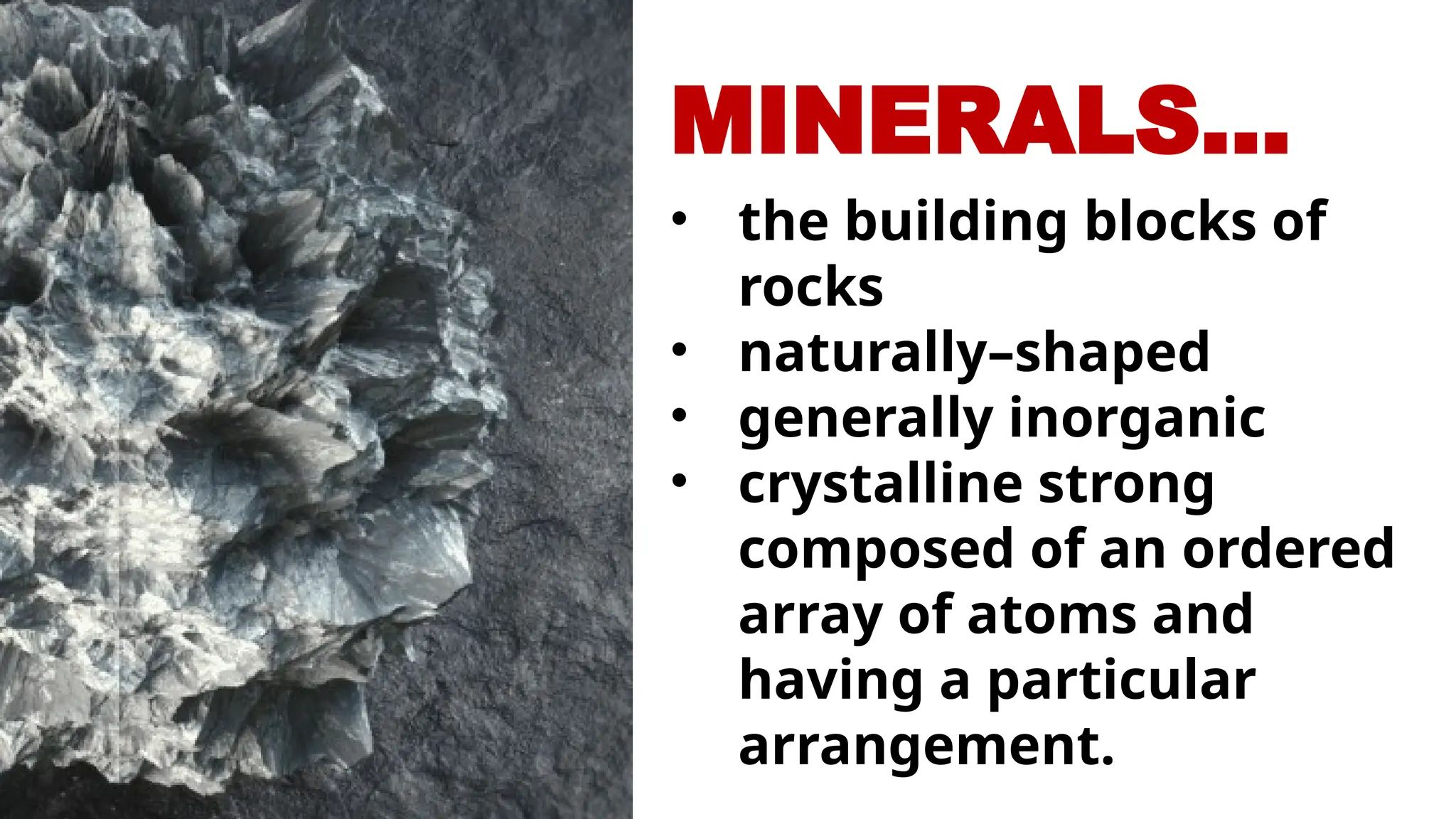
• the building blocks of
rocks
• naturally–shaped
• generally inorganic
• crystalline strong
composed of an ordered
array of atoms and
having a particular
arrangement.
MINERALS...
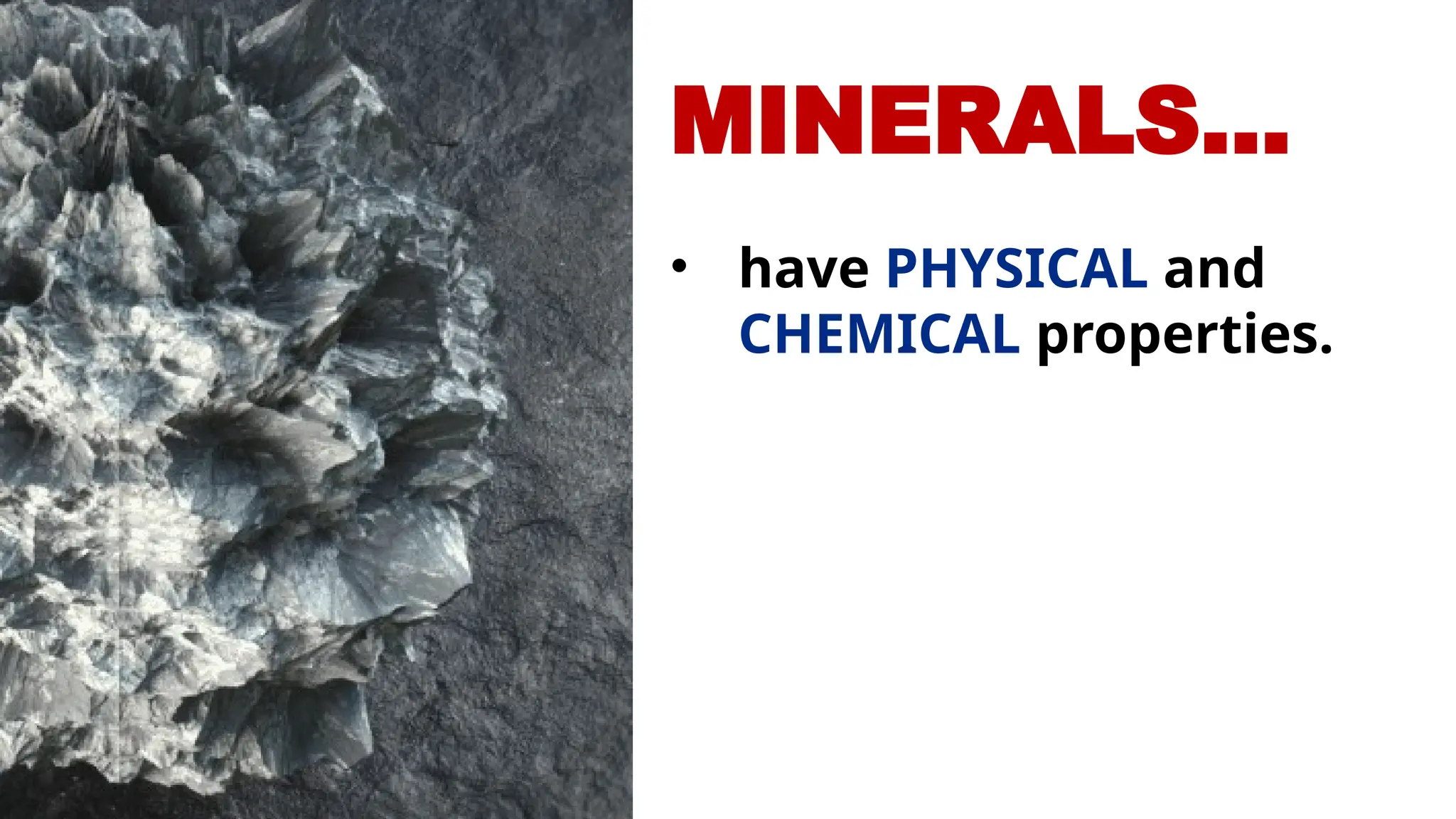
• have PHYSICAL and
CHEMICAL properties.
THE PHYSICAL PROPERTIES
OF MINERALS
THE PHYSICAL PROPERTIES OF MINERALS:
• physical properties of minerals include name, crystal
system, color as it appears to the naked eye, streak
by rubbing on streak plate, luster, hardness on the
Mohs scale, and average specific gravity.
A. LUSTER
• is the way light interacts with
the surface of a crystal, rock, or
mineral.
• the word traces its origins back
to the Latin lux, meaning
"light", and generally implies
radiance, gloss, or brilliance.
A. LUSTER
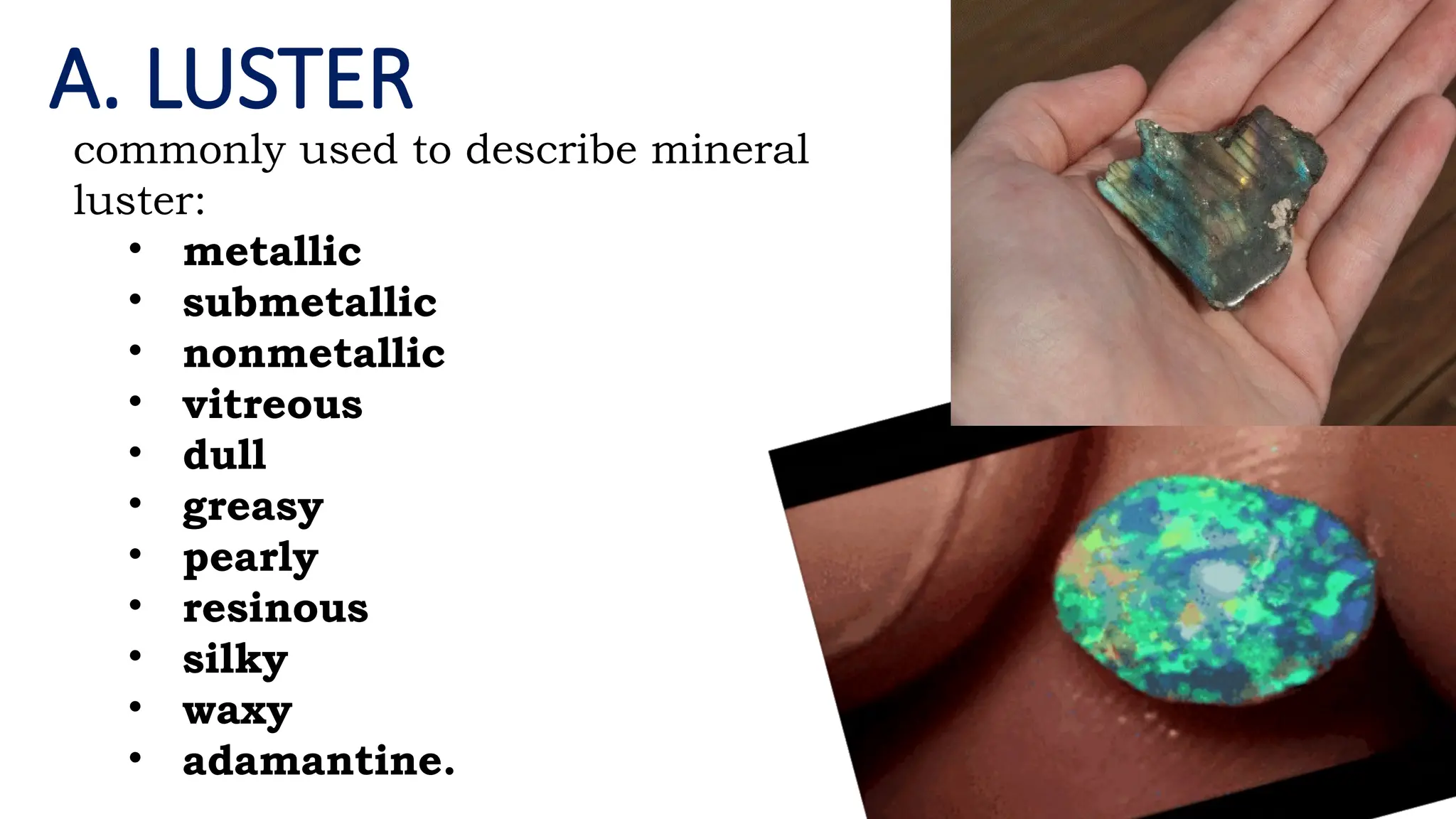
commonly used to describe mineral
luster:
• metallic
• submetallic
• nonmetallic
• vitreous
• dull
• greasy
• pearly
• resinous
• silky
• waxy
• adamantine.
A. LUSTER
A. LUSTER
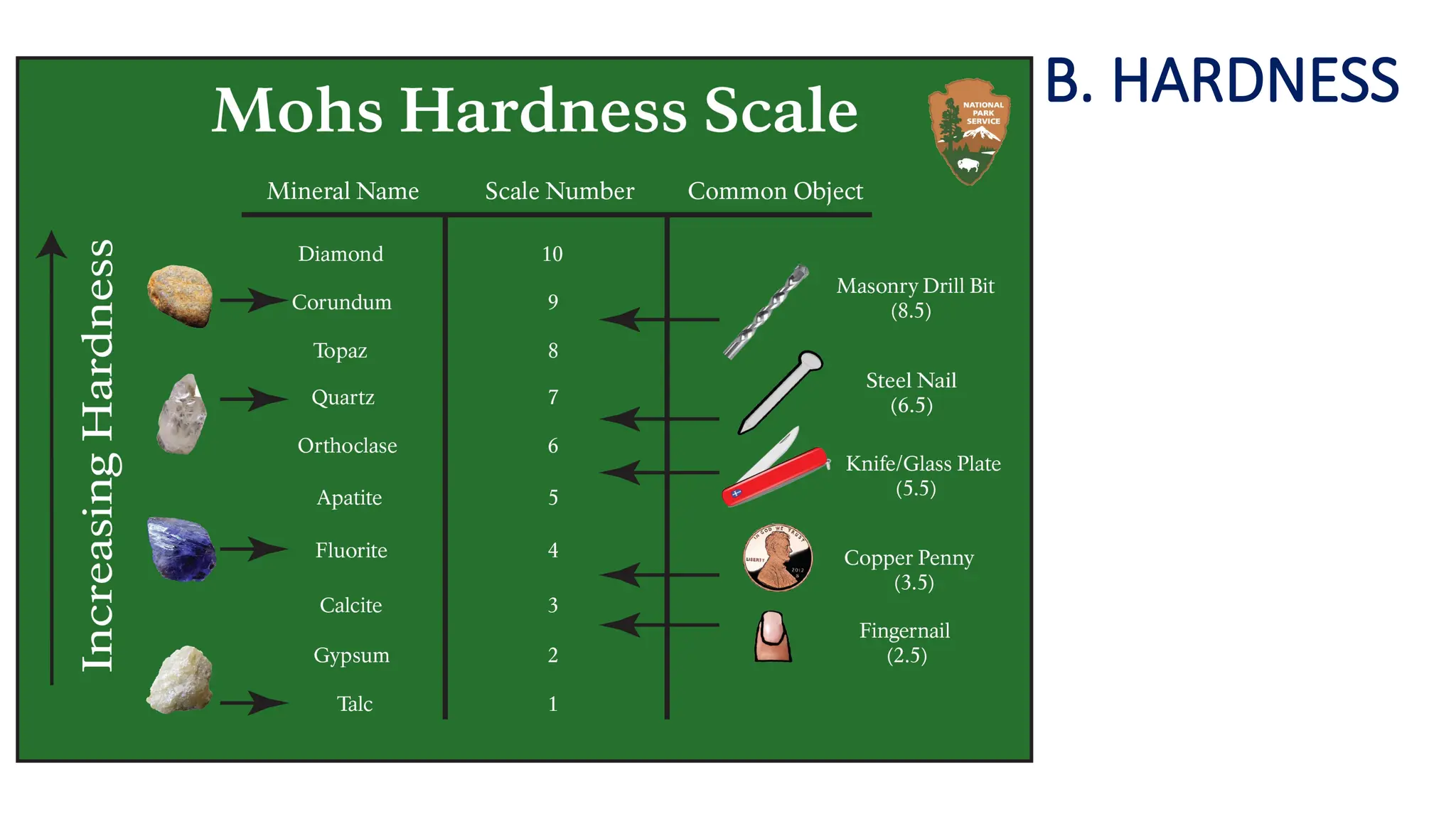
B. HARDNESS
• refers to the
minerals’resistance to
being scratched, the
harder ones are
difficult to scratch; the
softer ones are less
resistant to scratches.
B. HARDNESS
• Mohs hardness, rough
measure of the resistance
of a smooth surface to
scratching or abrasion,
expressed in terms of a
scale devised (1812) by
the German mineralogist
Friedrich Mohs.
B. HARDNESS
• Mohs hardness of a
mineral is
determined by
observing whether
its surface is
scratched by a
substance of known
or defined hardness.
B. HARDNESS
C. COLOR
• Minerals are colored
because certain wave
lengths of light are
absorbed, and the color
results from a
combination of those
wave lengths that
reach the eye.
C. COLOR
• Minerals are colored
because certain wave
lengths of light are
absorbed, and the color
results from a
combination of those
wave lengths that
reach the eye.
C. COLOR
Major factors responsible for the
production of color in minerals
fall into five categories:
1. The presence of an element
essential to the mineral
composition
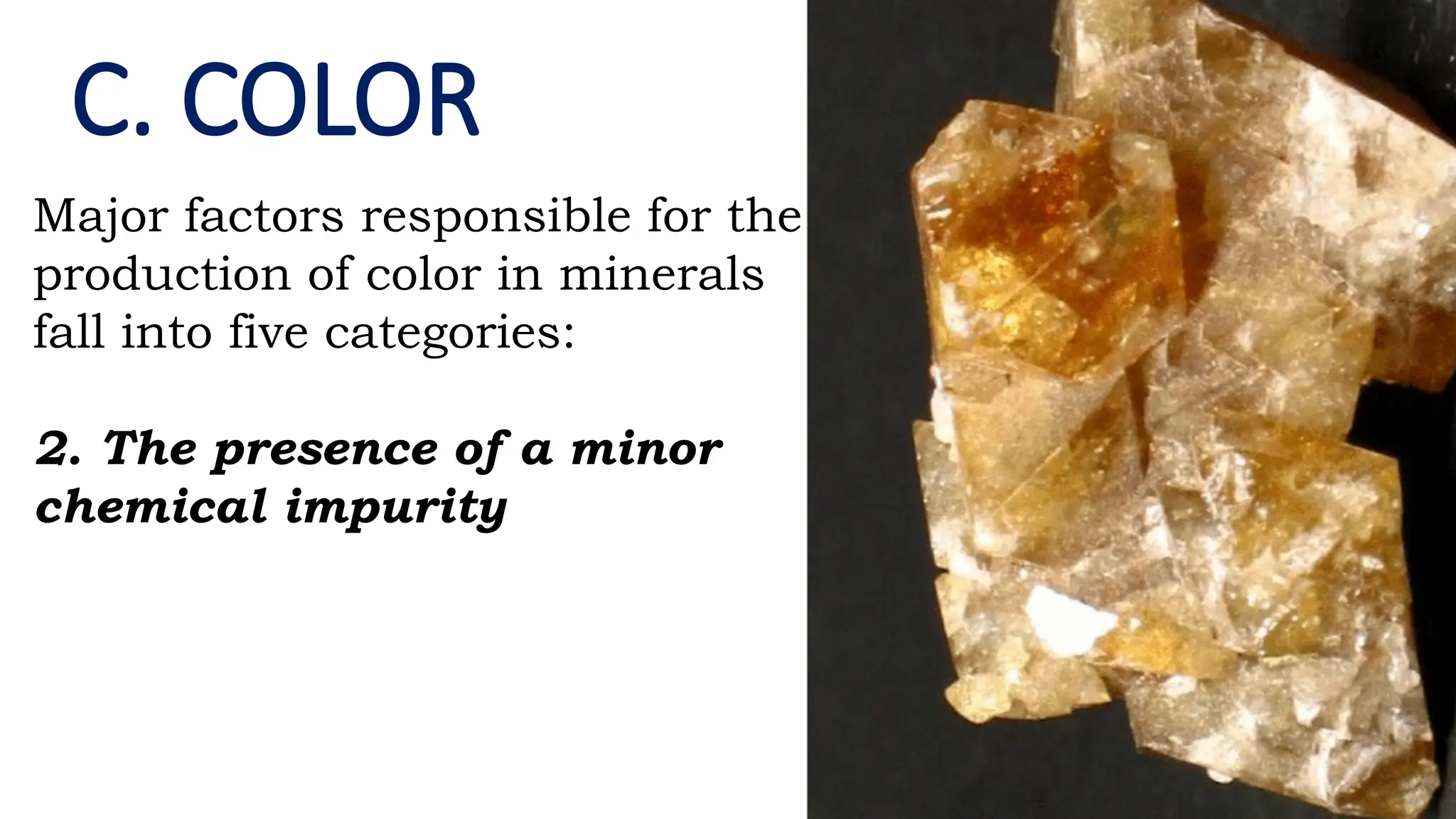
C. COLOR
Major factors responsible for the
production of color in minerals
fall into five categories:
2. The presence of a minor
chemical impurity
C. COLOR
Major factors responsible for the
production of color in minerals
fall into five categories:
3. Physical defects in the
crystal structure
C. COLOR
Major factors responsible for the
production of color in minerals
fall into five categories:
4. The mechanical mixture of
very fine impurities
C. COLOR
Major factors responsible for the
production of color in minerals
fall into five categories:
5. The presence of finely-
spaced structures in the
mineral
C. COLOR
• It is therefore NOT
advisable to rely on
color alone to identify a
mineral.
D. STREAK
• is the color of a
mineral's powder.
• the color of the mark
it leaves behind after
being rubbed against
a piece of unglazed
porcelain
D. STREAK
• streak can be used
only for minerals
with a Mohs
hardness of 7 or
less
D. STREAK
• Streak is a more
reliable property
than color
because streak
does not vary.
E. CLEAVAGE
• the property of a mineral
that allows it to break
smoothly along specific
internal planes (called
cleavage planes) when the
mineral is struck sharply
with a hammer.
E. CLEAVAGE
• It is described by the
number of planes
exhibited and the
angles at which they
meet.
E. CLEAVAGE
E. CLEAVAGE
• Fracture is the
property of a mineral
breaking in a more or
less random pattern
with no smooth
planar surfaces.
THE CHEMICAL PROPERTIES
OF MINERALS
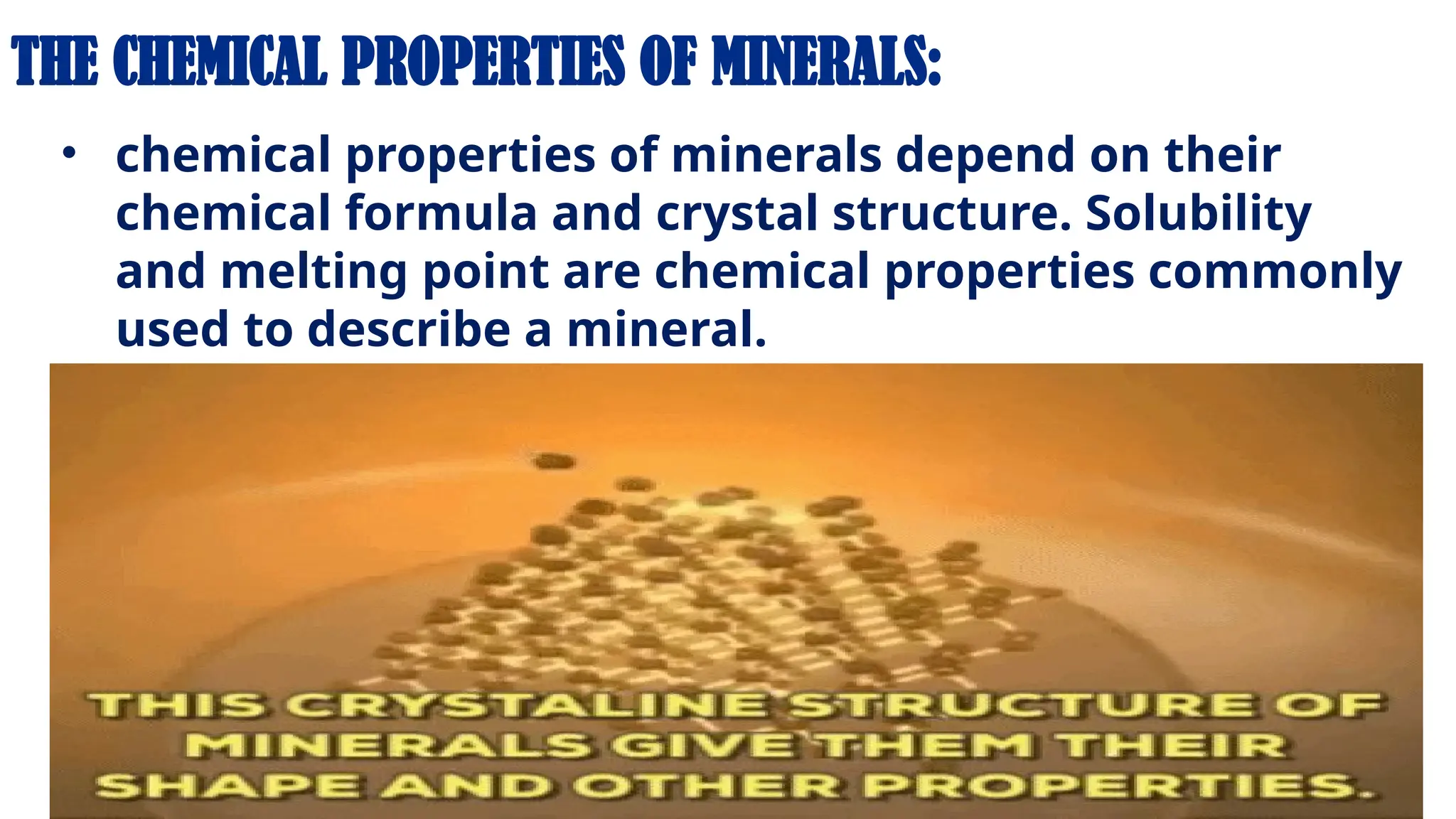
THE CHEMICAL PROPERTIES OF MINERALS:
• chemical properties of minerals depend on their
chemical formula and crystal structure. Solubility
and melting point are chemical properties commonly
used to describe a mineral.
A. ELEMENTS
• Occurs in nature in
an uncombined
state.
Example:
• sulfur
• graphite
• gold
B. SULFIDES
• Combinations of
various metallic
elements with
sulfur.
Example:
• Pyrite (iron sulfide,
FeS2)
C. OXIDES
• Metal element in
combination with
oxygen.
Example:
• Hematite and
Magnetite
• Chromite
• Manganite
D. HALIDES
• any of a group of naturally occurring inorganic
ompounds that are salts of the halogen acids
(e.g., hydrochloric acid).
D. HALIDES
Example:
• halite (rock salt)
• fluorite.
E. SILICATES
• Largest group of
minerals. Contain
various elements in
combination with
silicon and oxygen.
E. SILICATES
• bout 95% of the
earth's crust is
composed of
silicate minerals,
aluminosilicate
clays or silica.
E. SILICATES
BRAIN
EXERCISE!
QUIZ BOWL!
• A SERIES OF MULTIPLE CHOICES
QUESTIONS.
• EACH CORRECT ANSWER IS WORTH
5 POINTS
• THE TEAM WITH THE MOST POINTS
WIN.
• THE GROUP/S WITH THE LOWEST
SCORES WILL A CONSEQUENCE
AFTER THE CLASS.
QUIZ BOWL!
• TO ANSWER, EACH GROUP WILL
SELECT A REPRESENTATIVE TO
ANSWER EACH QUESTION.
• EVERY QUESTION SHOULD HAVE A
DIFFERENT GROUP REPRESENTATIVE.
• AFTER EVERY GROUP MEMBER IS
ABLE TO ANSWER, ONLY THEN A
MEMBER CAN REPEAT BEING A
REPRESENTATIVE.
QUIZ BOWL!
ARE YOU
READY?!
Question 1:
Which of the following
is NOT a physical
property of minerals?
a) Color
b) Hardness
c) Luster
d) Reactivity
Question 2:
Which mineral property
describes the way light
reflects off the surface of
a mineral?
a) Cleavage
b) Streak
c) Luster
d) Fracture
Question 3:
Which mineral property
refers to the color of a
mineral when it is
powdered?
a) Cleavage
b) Streak
c) Luster
d) Fracture
Question 4:
Which of the following
minerals has a hardness
of 10 on the Mohs scale?
a) Quartz
b) Talc
c) Calcite
d) Diamond
Question 5:
Which mineral property refers
to the way a mineral breaks
when it is not along a
cleavage plane?
a) Cleavage
b) Streak
c) Luster
d) Fracture
Question 6:
Which mineral property refers
to the tendency of a mineral
to break along flat, even
surfaces?
a) Cleavage
b) Streak
c) Luster
d) Fracture
Question 7:
Which of the following
minerals has a metallic
luster?
a) Quartz
b) Feldspar
c) Galena
d) Gypsum
Question 8:
Which mineral property refers
to the resistance of a mineral
to being scratched?
a) Cleavage
b) Streak
c) Luster
d) Hardness
Question 9:
Which of the following
minerals has a white streak?
a) Hematite
b) Magnetite
c) Calcite
d) Talc
Question 10:
Which mineral property refers
to the way a mineral breaks
along smooth, flat surfaces?
a) Cleavage
b) Streak
c) Luster
d) Fracture
ROCK FORMING
MINERALS
ROCK FORMING
MINERALS
• any mineral that forms
igneous, sedimentary,
or metamorphic rocks
and that typically, or
solely, forms as an
intimate part of rock-
making processes.
ROCK FORMING
MINERALS
rock-forming minerals
are:
• feldspars
• quartz
• amphiboles
• micas
• olivine
• garnet
• calcite
• pyroxenes.
A. QUARTZ
• is made of the two most
abundant chemical elements
on Earth: oxygen and silicon.
A. QUARTZ
• PHYSICAL PROPERTY:
• Mohs hardness of 7
• clear and transparent
(pure)
• CHEMICAL PROPERTY
• Atoms of oxygen and
silicon join together as
tetrahedrons (three sided
pyramids).
A. QUARTZ
• USES:
• Concrete
• paint
• adhesives
• watches and clocks
• kitchen countertops
• electronics in radios,
GPS and computers
• toothpaste
B. FELDSPAR
• group of naturally occurring
alumino-silicate minerals
containing varying amounts of
potassium, sodium, calcium,
and/or lithium.
• the most abundant group of
minerals in the Earth's crust,
making up about 50% of all
rocks
B. FELDSPAR
• PHYSICAL PROPERTY:
• Mohs hardness of 6
• glassy luster
• rectangular crystals that break
• along flat faces
• usually white, have shades of
• red and green
B. FELDSPAR
• CHEMICAL PROPERTY
• Silicate (contains silicon, and
oxygen with some aluminum,
magnesium, iron and calcium
B. FELDSPAR
• USES
• Glassmaking
• Ceramic tiles
C. PYROXENE
• most significant and abundant
group of rock-forming
ferromagnesium silicates
• Augite is the most common of this
group
• found in almost every variety of
igneous rock
• form under conditions of regional
and contact metamorphism
C. PYROXENE
• PHYSICAL PROPERTY:
• Mohs hardness ranging from 5
to 6 (harder than glass)
• glassy luster with streaks of
white, light green, or light brown
C. PYROXENE
• CHEMICAL PROPERTY
• Silicate (contains silicon, and
oxygen with some aluminum,
magnesium, iron and calcium
C. PYROXENE
• USES
• source of lithium
• used in heat-resistant
ceramics
• medication
• batteries
• gemstones
D. AMPHIBOLE
• minerals of either igneous or
metamorphic origin
• common in intermediate to
felsic igneous rocks than in
mafic igneous rocks, because
the higher silica and dissolved
water content
D. AMPHIBOLE
• PHYSICAL PROPERTY:
• Mohs hardness ranging from 5
to 6
• glassy luster and an opaque
characteristic
• very long and very thin
D. AMPHIBOLE
• CHEMICAL PROPERTY
• Silicate (contains silicon, and
oxygen with some aluminum,
magnesium, iron and calcium
D. AMPHIBOLE
• USES
• construction
• paving
• facing of buildings
E. OLIVINE
• Magnesium-rich olivines
are abundant in low-silica
mafic and ultramafic
igneous rocks and are
believed to be the most
abundant constituent of
the Earth's upper mantle.
E. OLIVINE
• also occurs in
high-temperature
metamorphic
rocks, lunar
basalts, and some
meteorites.
E. OLIVINE
• PHYSICAL PROPERTY:
• Mohs hardness ranging from 6
to 7.5
• glassy looking and transparent
• granular shape
E. OLIVINE
• CHEMICAL PROPERTY
• Magnesium-iron
silicate
E. OLIVINE
• USES
• refractories,
• gems (peridot)
F. MICA
• a mineral name given to a
group of minerals that are
physically and chemically
similar
• are fairly light and relatively
soft, and the sheets and
flakes of mica are flexible.
F. MICA
• PHYSICAL PROPERTY:
• Mohs hardness ranging from 2
to 2.5
• Clear, black
• shiny and glittery
• easily identified by its perfect
cleavage
F. MICA
• CHEMICAL PROPERTY
• Hydrous potassium
aluminum silicate
F. MICA
• USES
• pigment extender in paints
and electrical insulators
• cosmetics and food to add
shimmer or frost
BE A
GEOLOGIST!
BE A GEOLOGIST!
• DOWNLOAD THE FOLLOWING
APPLICATION BELOW:
• ROCK IDENTIFIER
• ROAST MY ROCK IDENTIFIER
• GO AROUND THE CAMPUS
• LOOK AND RESEARCH FOR AT LEAST
6 ROCKS THAT CONTAINS THE
DIFFERENT ROCK-FORMING
MINERALS
BE A GEOLOGIST!
• PASTE IT IN A 1/8 ILLUSTRATION
BOARD
• IDENTIFY EACH ROCK INCLUDING
THE FOLLOWING:
• PHYSICAL PROPERTIES (LUSTER,
STREAK, HARDNESS, CLEAVAGE,
& COLOR)
• CHEMICAL PROPERTIES (WHAT IS
THE CHEMICAL COMPOSITION OF
THE ROCK)
• USES
BE A GEOLOGIST!
• PRESENT YOUR FINDINGS IN THE
CLASS!
• THE GROUP WITH THE MOST
UNIQUE ROCKS AND PRESENTATION
WILL GET A HIGH SCORE ON THIS
ACTIVITY.

Rock Forming Minerals Earth and Life Science.pptx

  • 1.
    EARTH & LIFESCIENCE: ROCK FORMING MINERALS
  • 2.
    At the ofthe lesson, I would be able to identify common rock-forming minerals using their physical and chemical properties. LESSON OBJECTIVES:
  • 3.
    MINERALS... a naturally occurring inorganicelement or compound having an; • orderly internal structure and characteristic chemical composition • crystal form • physical properties.
  • 4.
    MINERALS... • are usedto produce products that we generally use every day • provide metals that help us make the essential things such as cars, aircraft, jewelry, and coins
  • 5.
    MINERALS... Common minerals include: •quartz • feldspar • mica • amphibole • olivine • calcite.
  • 6.
    ROCKS... • rock isan aggregate of one or more minerals, or a body of undifferentiated mineral matter.
  • 7.
    ROCKS... Common rocks include: •granite • basalt • limestone • sandstone.
  • 8.
  • 9.
    MECHANICS: • The classis divided into 6 groups. • Each group will be given a set of words that are scrambled. • The group will arranged the scrambled letter word in the shortest amount of time.
  • 10.
    MECHANICS: • Each correctword is worth 5 points • The group who completes the word in the shortest time and with the most correct answer wins.
  • 11.
  • 12.
    MINERALS... • the buildingblocks of rocks • naturally–shaped • generally inorganic • crystalline strong composed of an ordered array of atoms and having a particular arrangement.
  • 13.
    MINERALS... • have PHYSICALand CHEMICAL properties.
  • 14.
  • 15.
    THE PHYSICAL PROPERTIESOF MINERALS: • physical properties of minerals include name, crystal system, color as it appears to the naked eye, streak by rubbing on streak plate, luster, hardness on the Mohs scale, and average specific gravity.
  • 16.
    A. LUSTER • isthe way light interacts with the surface of a crystal, rock, or mineral. • the word traces its origins back to the Latin lux, meaning "light", and generally implies radiance, gloss, or brilliance.
  • 17.
    A. LUSTER commonly usedto describe mineral luster: • metallic • submetallic • nonmetallic • vitreous • dull • greasy • pearly • resinous • silky • waxy • adamantine.
  • 18.
  • 19.
  • 20.
    B. HARDNESS • refersto the minerals’resistance to being scratched, the harder ones are difficult to scratch; the softer ones are less resistant to scratches.
  • 21.
    B. HARDNESS • Mohshardness, rough measure of the resistance of a smooth surface to scratching or abrasion, expressed in terms of a scale devised (1812) by the German mineralogist Friedrich Mohs.
  • 22.
    B. HARDNESS • Mohshardness of a mineral is determined by observing whether its surface is scratched by a substance of known or defined hardness.
  • 23.
  • 24.
    C. COLOR • Mineralsare colored because certain wave lengths of light are absorbed, and the color results from a combination of those wave lengths that reach the eye.
  • 25.
    C. COLOR • Mineralsare colored because certain wave lengths of light are absorbed, and the color results from a combination of those wave lengths that reach the eye.
  • 26.
    C. COLOR Major factorsresponsible for the production of color in minerals fall into five categories: 1. The presence of an element essential to the mineral composition
  • 27.
    C. COLOR Major factorsresponsible for the production of color in minerals fall into five categories: 2. The presence of a minor chemical impurity
  • 28.
    C. COLOR Major factorsresponsible for the production of color in minerals fall into five categories: 3. Physical defects in the crystal structure
  • 29.
    C. COLOR Major factorsresponsible for the production of color in minerals fall into five categories: 4. The mechanical mixture of very fine impurities
  • 30.
    C. COLOR Major factorsresponsible for the production of color in minerals fall into five categories: 5. The presence of finely- spaced structures in the mineral
  • 31.
    C. COLOR • Itis therefore NOT advisable to rely on color alone to identify a mineral.
  • 32.
    D. STREAK • isthe color of a mineral's powder. • the color of the mark it leaves behind after being rubbed against a piece of unglazed porcelain
  • 33.
    D. STREAK • streakcan be used only for minerals with a Mohs hardness of 7 or less
  • 34.
    D. STREAK • Streakis a more reliable property than color because streak does not vary.
  • 35.
    E. CLEAVAGE • theproperty of a mineral that allows it to break smoothly along specific internal planes (called cleavage planes) when the mineral is struck sharply with a hammer.
  • 36.
    E. CLEAVAGE • Itis described by the number of planes exhibited and the angles at which they meet.
  • 37.
  • 38.
    E. CLEAVAGE • Fractureis the property of a mineral breaking in a more or less random pattern with no smooth planar surfaces.
  • 39.
  • 40.
    THE CHEMICAL PROPERTIESOF MINERALS: • chemical properties of minerals depend on their chemical formula and crystal structure. Solubility and melting point are chemical properties commonly used to describe a mineral.
  • 41.
    A. ELEMENTS • Occursin nature in an uncombined state. Example: • sulfur • graphite • gold
  • 42.
    B. SULFIDES • Combinationsof various metallic elements with sulfur. Example: • Pyrite (iron sulfide, FeS2)
  • 43.
    C. OXIDES • Metalelement in combination with oxygen. Example: • Hematite and Magnetite • Chromite • Manganite
  • 44.
    D. HALIDES • anyof a group of naturally occurring inorganic ompounds that are salts of the halogen acids (e.g., hydrochloric acid).
  • 45.
    D. HALIDES Example: • halite(rock salt) • fluorite.
  • 46.
    E. SILICATES • Largestgroup of minerals. Contain various elements in combination with silicon and oxygen.
  • 47.
    E. SILICATES • bout95% of the earth's crust is composed of silicate minerals, aluminosilicate clays or silica.
  • 48.
  • 49.
  • 50.
    QUIZ BOWL! • ASERIES OF MULTIPLE CHOICES QUESTIONS. • EACH CORRECT ANSWER IS WORTH 5 POINTS • THE TEAM WITH THE MOST POINTS WIN. • THE GROUP/S WITH THE LOWEST SCORES WILL A CONSEQUENCE AFTER THE CLASS.
  • 51.
    QUIZ BOWL! • TOANSWER, EACH GROUP WILL SELECT A REPRESENTATIVE TO ANSWER EACH QUESTION. • EVERY QUESTION SHOULD HAVE A DIFFERENT GROUP REPRESENTATIVE. • AFTER EVERY GROUP MEMBER IS ABLE TO ANSWER, ONLY THEN A MEMBER CAN REPEAT BEING A REPRESENTATIVE.
  • 52.
  • 53.
    Question 1: Which ofthe following is NOT a physical property of minerals? a) Color b) Hardness c) Luster d) Reactivity
  • 54.
    Question 2: Which mineralproperty describes the way light reflects off the surface of a mineral? a) Cleavage b) Streak c) Luster d) Fracture
  • 55.
    Question 3: Which mineralproperty refers to the color of a mineral when it is powdered? a) Cleavage b) Streak c) Luster d) Fracture
  • 56.
    Question 4: Which ofthe following minerals has a hardness of 10 on the Mohs scale? a) Quartz b) Talc c) Calcite d) Diamond
  • 57.
    Question 5: Which mineralproperty refers to the way a mineral breaks when it is not along a cleavage plane? a) Cleavage b) Streak c) Luster d) Fracture
  • 58.
    Question 6: Which mineralproperty refers to the tendency of a mineral to break along flat, even surfaces? a) Cleavage b) Streak c) Luster d) Fracture
  • 59.
    Question 7: Which ofthe following minerals has a metallic luster? a) Quartz b) Feldspar c) Galena d) Gypsum
  • 60.
    Question 8: Which mineralproperty refers to the resistance of a mineral to being scratched? a) Cleavage b) Streak c) Luster d) Hardness
  • 61.
    Question 9: Which ofthe following minerals has a white streak? a) Hematite b) Magnetite c) Calcite d) Talc
  • 62.
    Question 10: Which mineralproperty refers to the way a mineral breaks along smooth, flat surfaces? a) Cleavage b) Streak c) Luster d) Fracture
  • 63.
  • 64.
    ROCK FORMING MINERALS • anymineral that forms igneous, sedimentary, or metamorphic rocks and that typically, or solely, forms as an intimate part of rock- making processes.
  • 65.
    ROCK FORMING MINERALS rock-forming minerals are: •feldspars • quartz • amphiboles • micas • olivine • garnet • calcite • pyroxenes.
  • 66.
    A. QUARTZ • ismade of the two most abundant chemical elements on Earth: oxygen and silicon.
  • 67.
    A. QUARTZ • PHYSICALPROPERTY: • Mohs hardness of 7 • clear and transparent (pure) • CHEMICAL PROPERTY • Atoms of oxygen and silicon join together as tetrahedrons (three sided pyramids).
  • 68.
    A. QUARTZ • USES: •Concrete • paint • adhesives • watches and clocks • kitchen countertops • electronics in radios, GPS and computers • toothpaste
  • 69.
    B. FELDSPAR • groupof naturally occurring alumino-silicate minerals containing varying amounts of potassium, sodium, calcium, and/or lithium. • the most abundant group of minerals in the Earth's crust, making up about 50% of all rocks
  • 70.
    B. FELDSPAR • PHYSICALPROPERTY: • Mohs hardness of 6 • glassy luster • rectangular crystals that break • along flat faces • usually white, have shades of • red and green
  • 71.
    B. FELDSPAR • CHEMICALPROPERTY • Silicate (contains silicon, and oxygen with some aluminum, magnesium, iron and calcium
  • 72.
    B. FELDSPAR • USES •Glassmaking • Ceramic tiles
  • 73.
    C. PYROXENE • mostsignificant and abundant group of rock-forming ferromagnesium silicates • Augite is the most common of this group • found in almost every variety of igneous rock • form under conditions of regional and contact metamorphism
  • 74.
    C. PYROXENE • PHYSICALPROPERTY: • Mohs hardness ranging from 5 to 6 (harder than glass) • glassy luster with streaks of white, light green, or light brown
  • 75.
    C. PYROXENE • CHEMICALPROPERTY • Silicate (contains silicon, and oxygen with some aluminum, magnesium, iron and calcium
  • 76.
    C. PYROXENE • USES •source of lithium • used in heat-resistant ceramics • medication • batteries • gemstones
  • 77.
    D. AMPHIBOLE • mineralsof either igneous or metamorphic origin • common in intermediate to felsic igneous rocks than in mafic igneous rocks, because the higher silica and dissolved water content
  • 78.
    D. AMPHIBOLE • PHYSICALPROPERTY: • Mohs hardness ranging from 5 to 6 • glassy luster and an opaque characteristic • very long and very thin
  • 79.
    D. AMPHIBOLE • CHEMICALPROPERTY • Silicate (contains silicon, and oxygen with some aluminum, magnesium, iron and calcium
  • 80.
    D. AMPHIBOLE • USES •construction • paving • facing of buildings
  • 81.
    E. OLIVINE • Magnesium-richolivines are abundant in low-silica mafic and ultramafic igneous rocks and are believed to be the most abundant constituent of the Earth's upper mantle.
  • 82.
    E. OLIVINE • alsooccurs in high-temperature metamorphic rocks, lunar basalts, and some meteorites.
  • 83.
    E. OLIVINE • PHYSICALPROPERTY: • Mohs hardness ranging from 6 to 7.5 • glassy looking and transparent • granular shape
  • 84.
    E. OLIVINE • CHEMICALPROPERTY • Magnesium-iron silicate
  • 85.
    E. OLIVINE • USES •refractories, • gems (peridot)
  • 86.
    F. MICA • amineral name given to a group of minerals that are physically and chemically similar • are fairly light and relatively soft, and the sheets and flakes of mica are flexible.
  • 87.
    F. MICA • PHYSICALPROPERTY: • Mohs hardness ranging from 2 to 2.5 • Clear, black • shiny and glittery • easily identified by its perfect cleavage
  • 88.
    F. MICA • CHEMICALPROPERTY • Hydrous potassium aluminum silicate
  • 89.
    F. MICA • USES •pigment extender in paints and electrical insulators • cosmetics and food to add shimmer or frost
  • 90.
  • 91.
    BE A GEOLOGIST! •DOWNLOAD THE FOLLOWING APPLICATION BELOW: • ROCK IDENTIFIER • ROAST MY ROCK IDENTIFIER • GO AROUND THE CAMPUS • LOOK AND RESEARCH FOR AT LEAST 6 ROCKS THAT CONTAINS THE DIFFERENT ROCK-FORMING MINERALS
  • 92.
    BE A GEOLOGIST! •PASTE IT IN A 1/8 ILLUSTRATION BOARD • IDENTIFY EACH ROCK INCLUDING THE FOLLOWING: • PHYSICAL PROPERTIES (LUSTER, STREAK, HARDNESS, CLEAVAGE, & COLOR) • CHEMICAL PROPERTIES (WHAT IS THE CHEMICAL COMPOSITION OF THE ROCK) • USES
  • 93.
    BE A GEOLOGIST! •PRESENT YOUR FINDINGS IN THE CLASS! • THE GROUP WITH THE MOST UNIQUE ROCKS AND PRESENTATION WILL GET A HIGH SCORE ON THIS ACTIVITY.