Mineralogical Properties for Mineral
Identification
Guided By Presented By
Dr. Narendra Joshi Deependra Jhamele
Class-M.Sc.(I Sem.)
Govt. Holkar Science College Indore (M.P.)
Content
 Chemical properties-
 Non-silicates
 Silicates
 Physical properties-
 Lustre
 Color
 Streak
 Hardness
 Crystal shape
 Cleavage and Fracture
 Specific gravity
 Optical properties-
 Color
 Pleochroism
 Habit
 Relief
 Extinction
 Twinning
Chemical Properties of minerals
 Definition of Mineral- Minerals are naturally occuring, inorganic, solid with a definite
chemical composition and atomic structure.
 Chemical property shows the presence and arrangement of atoms in minerals. Using
their chemical properties, minerals are identified by how they react to certain
substance.
 Elements combine to form Minerals.
 Two or more chemically bound elements may form a compound; most substances
are compounds rather than pure elemtents.
Composition and Structure of Minerals
 Minerals are divided into classes on the basis of chemical type. Each class is divided
into families by structural similarity.
 Minerals are divided into:-
1.Silicates-
(a)Silicate Mineral structure
 2.Non-silicates-
(a)Native elements.
(b)Carbonates.
(c)Oxide.
(d)sulfide.
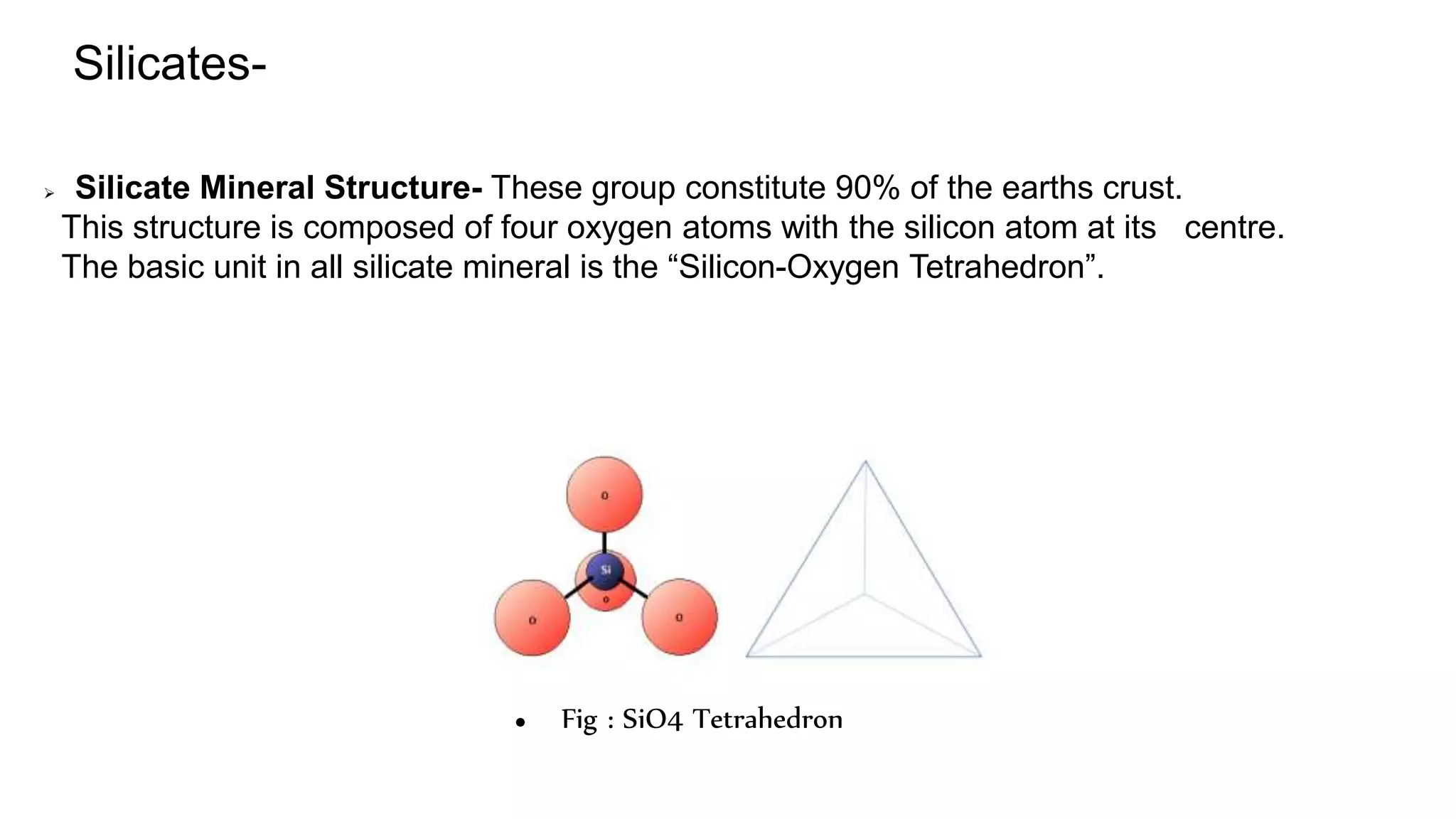
 Fig : SiO4 Tetrahedron
 Silicate Mineral Structure- These group constitute 90% of the earths crust.
This structure is composed of four oxygen atoms with the silicon atom at its centre.
The basic unit in all silicate mineral is the “Silicon-Oxygen Tetrahedron”.
Silicates-
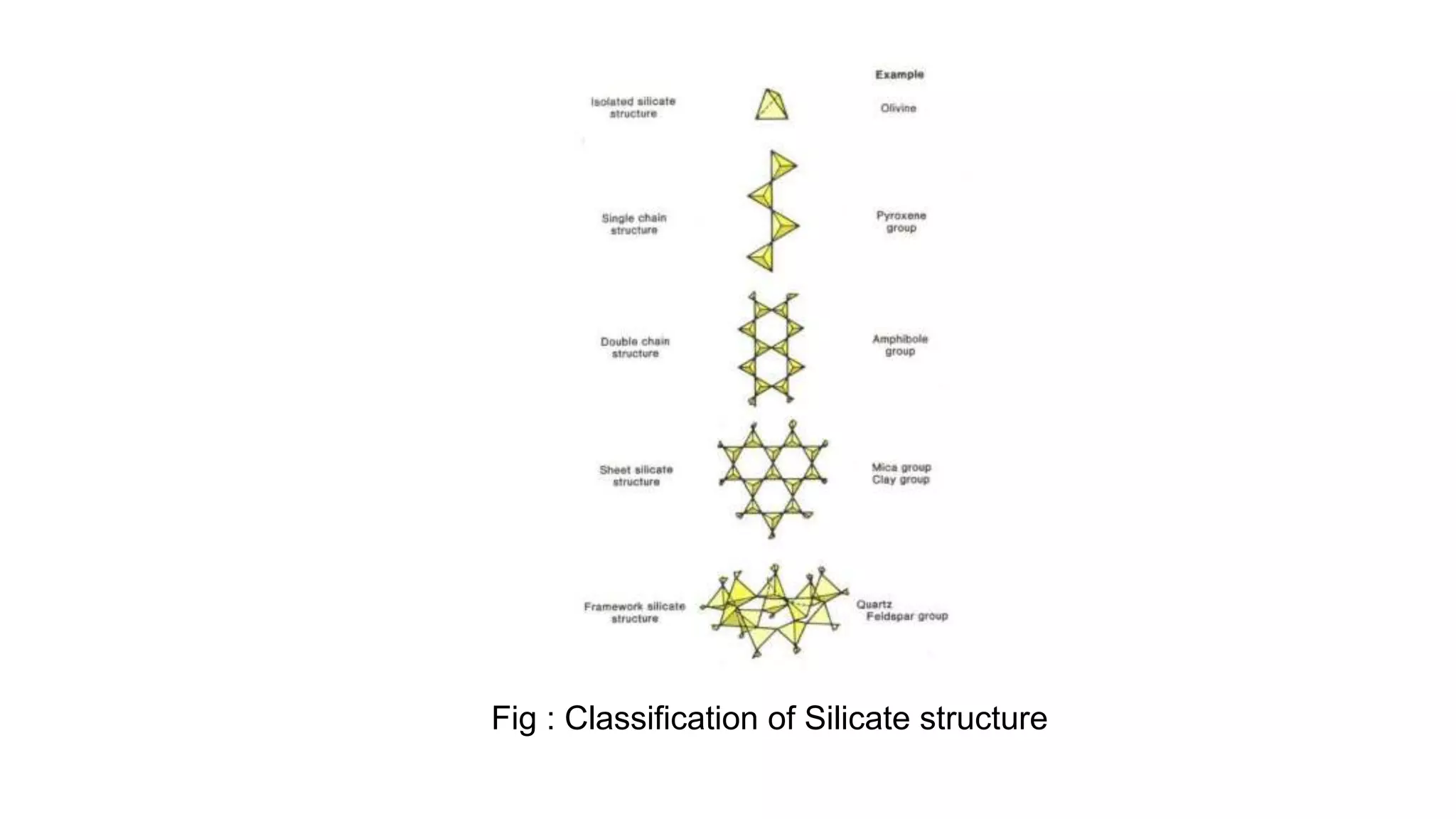
Fig : Classification of Silicate structure
Non-silicates
Native Minerals- Pure form of element in
nature.
Gold(Au)
Copper(Cu)
Graphite(C)
Diamond(C)
Platinum(Pt)
Silver(Ag)
Sulfur(S)
 Minerals can have same chemical
composition but can be of different
physical properties.
 For example- Diamond and graphite
share same elemet(carbon) but have
different physical property.
 Carbonate Group- The Carbonates group of minerals is made of negatively charged
carbonate ions bonded to postive metal ions(CO3)2-.
Calcite(CaCO3) is the most abundant mineral of this group.
 Oxide Group- The oxide group of minerals is composed of oxygen and a metal.Most
common iron oxide is Hematite and Magnetite.
 Sulfide Group- The sulfide group of minerals is composed of a metal element and
sulfur.
 Pyrite and Galena are most common sulfide minerals.
Physical properties of Minerals
 Primary techniques-
 1.Lusture
 2.Colour
 3.Streak
 4.Cleavage and fracture
 5.Hardness
 6.Crystal Shape
 7.Specific Gravity
 Secondary Techniques-
 1.Taste
 2.Feel
 3.Smell
Colour
 The most significant control on colour is a minerals chemical composition. Elemnets
that give a mineral its colour are called Chromophores.
 Play of Colors- An appearance of several prismatic colors in rapid succession on
turning the mineral. This property belong in perfection to diamond; it is also observed in
precious opal.
 Irisdescene- Presenting prismatic colors in the interior of crystals.
 Tarnish- A metallic surface is tarnished, when its color differs from that obtained by
fracture.
 Change of colors- Each particular color appears to pervade a larger space than in the
play of colors, and the succession produced by turning the mineral is less rapid.
Fig(b) : Play of colors and internal reflection due
to internal fracture.
Fig(a) : Labrodorite showing change of
colors.
Streak
 The streak of a mineral is the colour of the powder left on a streak plate when the
mineral is craped over it.
 Streak in some cases can be diagonistic property for identifying non silicates but
is especially useful for distinguishing oxide and sulfide minerals.
Fig : Streak of Hematite gives red powder.
Lusture
 The lusture of minerals varies with the nature of their surfaces. A variation in the quantity of light reflected,
produces different degrees of intensity of lustre; a variation in the nature of the reflecting surface,
produces different kinds of lusture.
Fig(a) : Metallic Lustre. Fig (b): Dull Lustre.
The kinds of Lustre Recognized
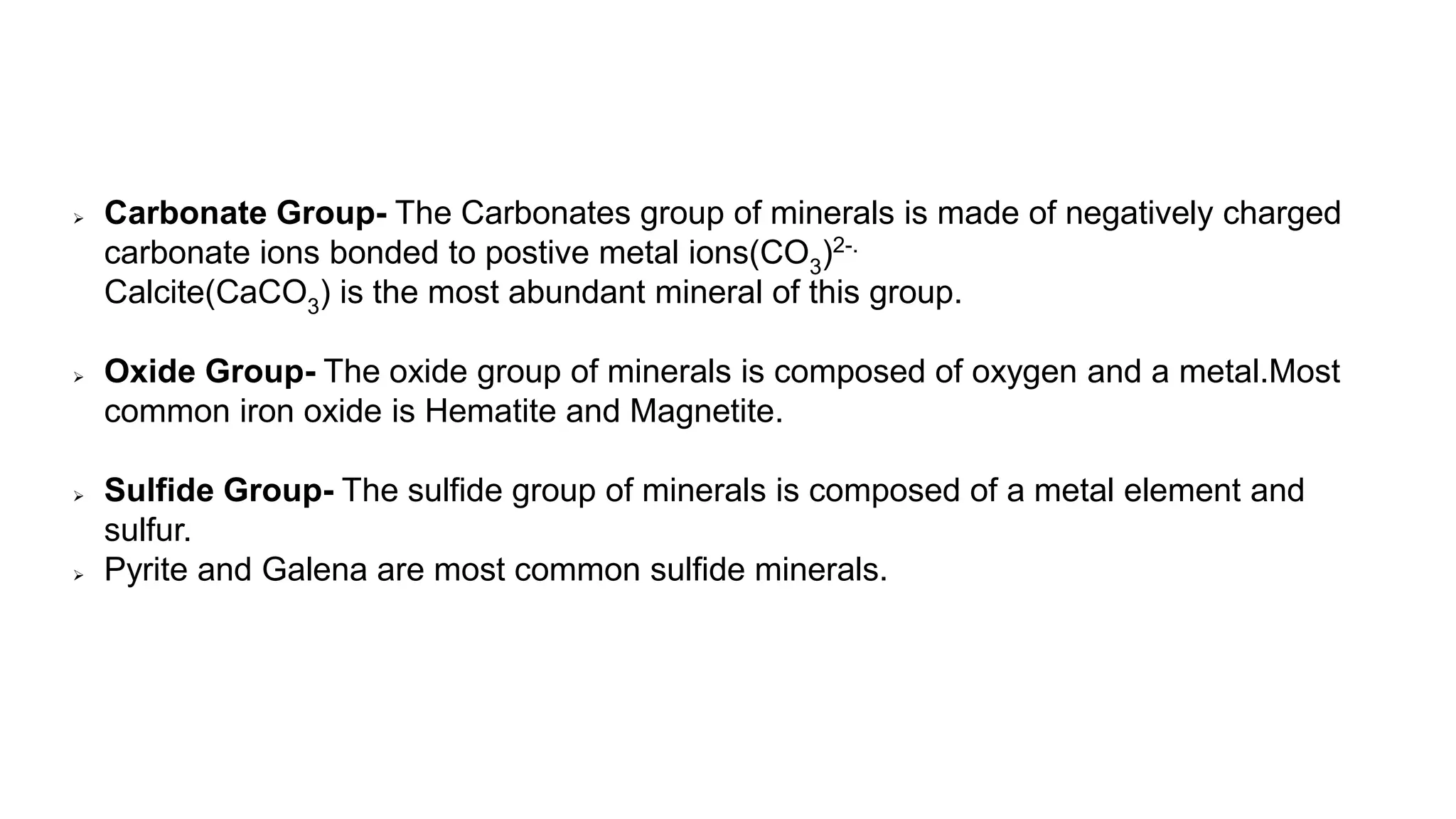
 Metallic Lustre- The lustre of metals, imperfect metallic lusture is expressed by the
term Sub-metallic.
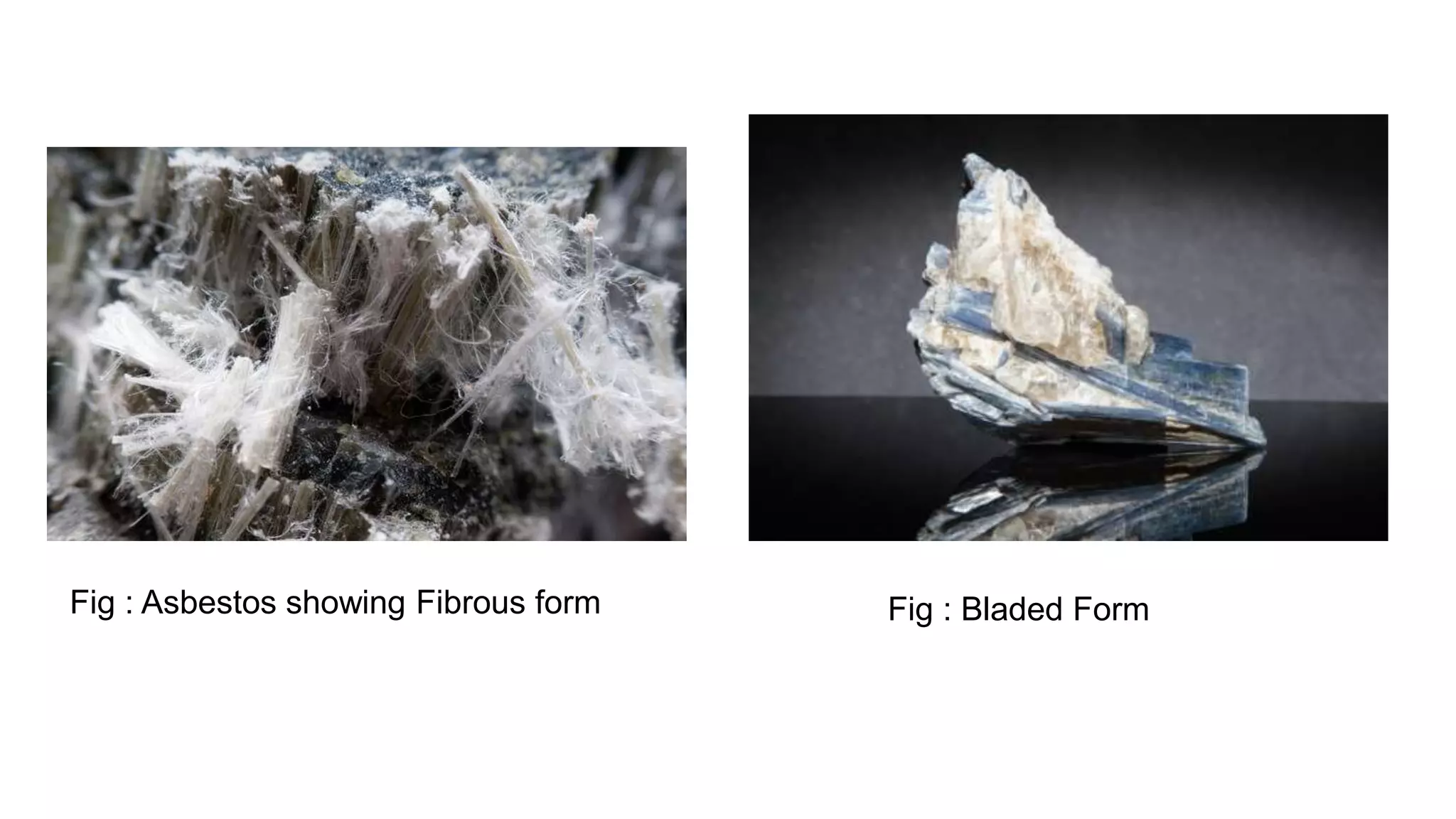
 Vitrous- The lusture of broken glass. An imperfectly vitrous lustre is termed Sub-
vitrous. The vitrous and sub-vitrous lustre are the most common in the mineral
kingdom.
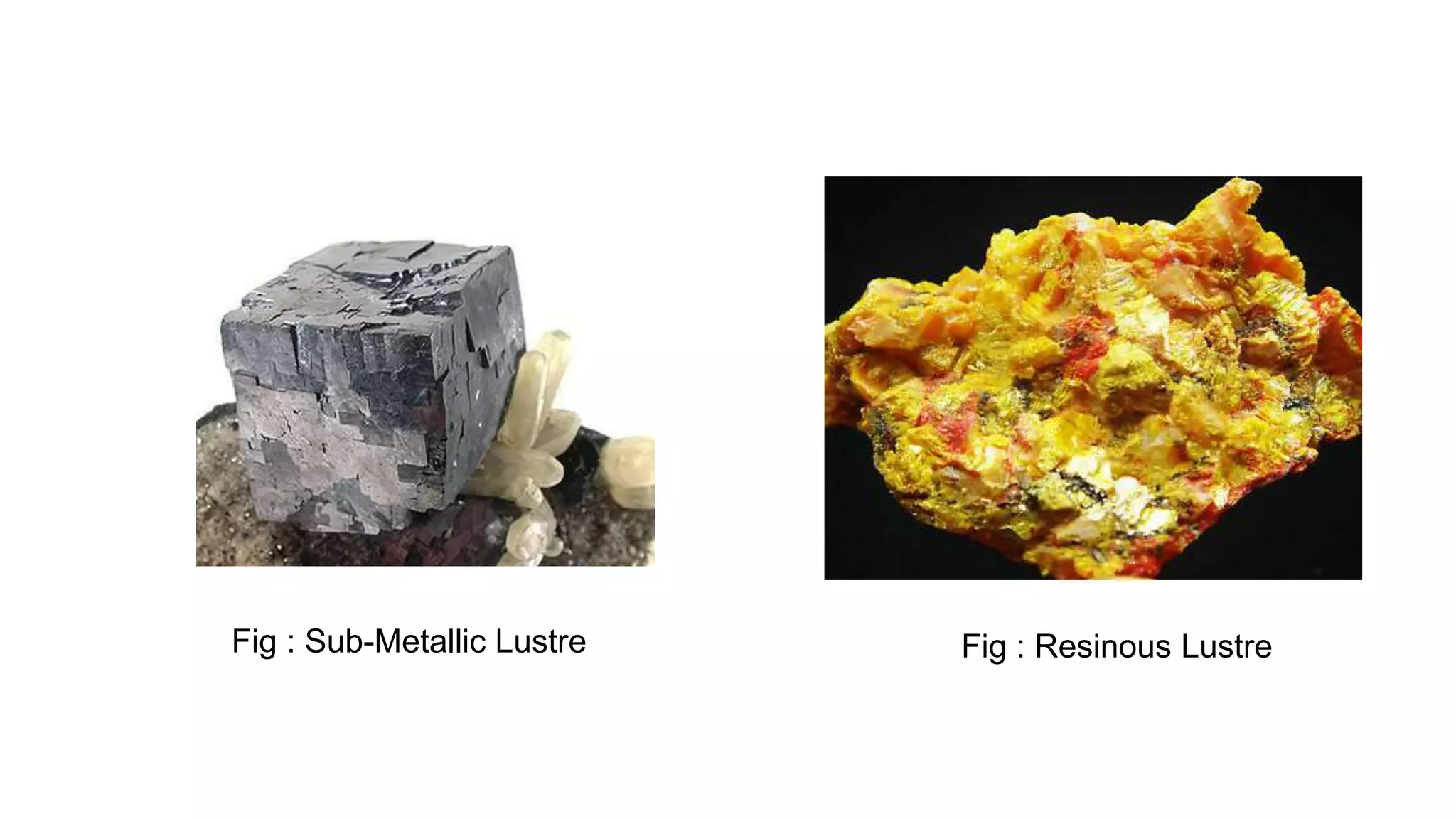
 Resinous- Lustre of yellow resins e.g. sphalarite.
 Pearly- like pearl e.g. muscovite, calcite.
 Silky- like silk fibres. Minerals which crystallize in fibrous habit commonly shows silky
lustre e.g. asbestos and fibrous gypsum.
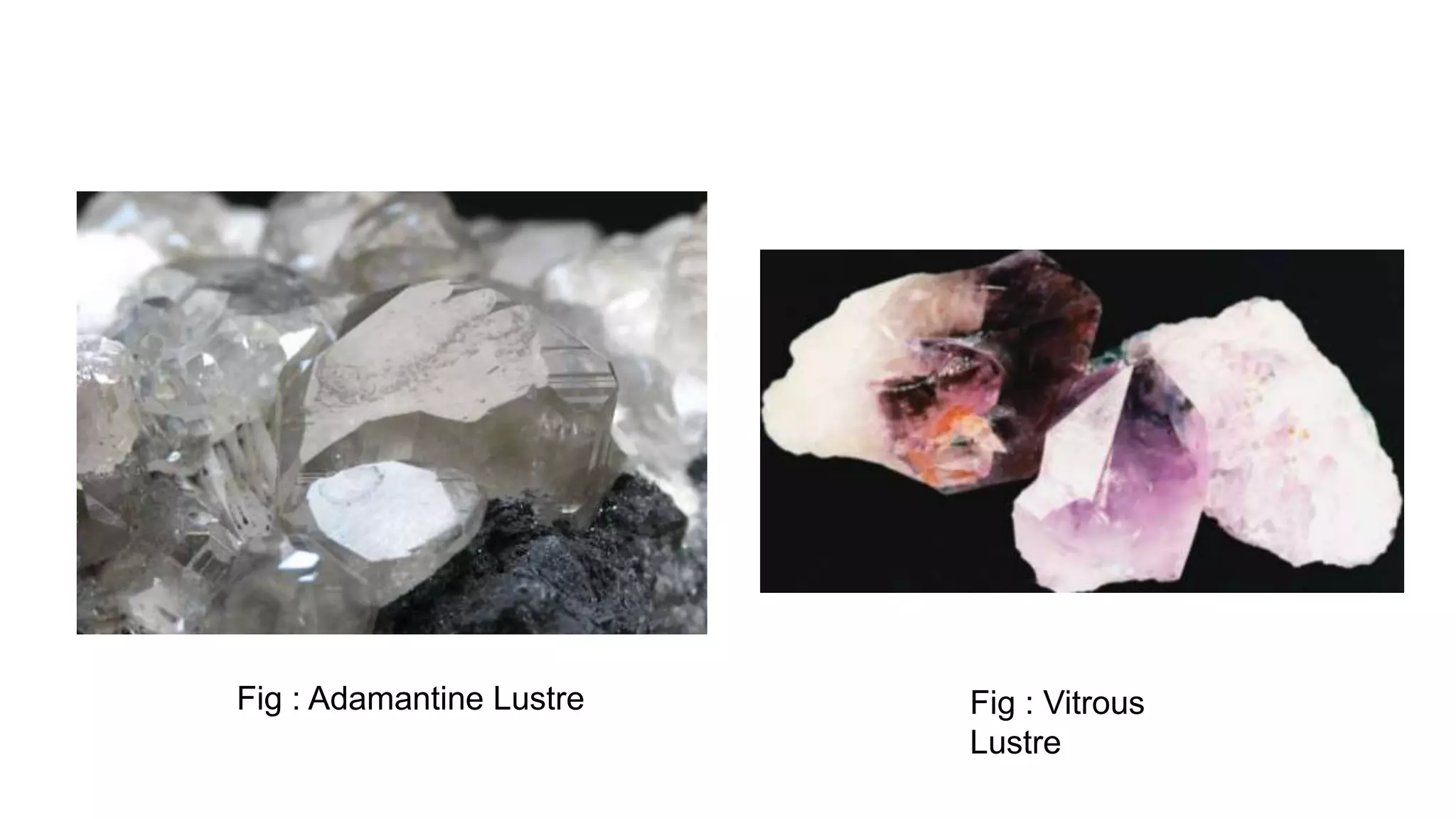
 Adamnatine- The lustre of diamond.
Fig : Sub-Metallic Lustre Fig : Resinous Lustre
Fig : Vitrous
Lustre
Fig : Adamantine Lustre
Crystal Habit (Form)
 Habit of a mineral may be defined as the size and shape of the crystals, and the
structure or form shown by the crystal aggregates.
 Acicular- Minerals showing needle like crystals e.g. Natrolite
 Fibrous- Minerals showing an aggregate of long thin fibres e.g. asbestos
 Foliated- Minerals with platy habit containing thin separable sheets e.g Muscovite and
Biotite.
 Bladed- Minerals showing bladed habit occur as small knife blades e.g. Kyanite
 Tabular- Minerals showing broad flat surface e.g. felspar
 Columnar- Minerals showing columnar crystals e.g. Tourmaline.
 Granular- Minerals which occur as aggregate of eqiudimensional grains e.g. Chromite.
 Massive- When minerals occur as structureless mass e.g. Flint
Fig : Chromite showing Massive form Fig : Acicular Form
Fig : Asbestos showing Fibrous form Fig : Bladed Form
Fig : Columnar joints Fig : Foliated
form
Hardness
Hardness is one of the useful diagonistic properties of minerals. A harder body is
distinguished from a softer, either by attempting to scratch the one with other. A numerical
value is obtained by using the “Mohs scale of hardness”
Fig : Mohs scale of hardness.
Fracture
 Fracture is a general term used to describe the way a mineral breaks or cracks. Terms
used to describe fracture include even, conchoidal, splintery. Because atomic structure
is not the same in all directions and chemical bonds are not all the same strength, most
crystals break along preferred directions.
 Even- Breaking to prduce smooth planar surfaces.
 Uneven or Irregular- Breaking to produce rough and irregular surfaces.
 Hackly- When the elevation are sharp and jagged
 Conchoidal- Breaking with curved surfaces or in the manner of glass(quartz)
Cleavage
The orientation and manner of breaking are important clues to crystal structure. If the
fractures are planar and smooth, the mineral is said to have good Cleavage.
If a mineral cleaves along one particular plane, a nearly infinite number of parallel planes
are equally prone to cleavage. This is due to the repetitive arrangement of atoms in
atomic structures.
Fig : Book of Biotite
Specific gravity is a number which represents the ratio of the weight of a mineral to the
weight of an equal volume of water. Thus a mineral with specific gravity 4.0 is four times
as heavy as water.
Tenacity- It denotes the degree or character of cohesion.
1. Brittle- When parts of mineral separate in powder or grains on attempting to cut it.
2. Sectile- Minerals which may be cut with knife but slices are not malleable.
3. Malleable- Which flatten under hammer.
4. Flexible- When the mineral is bent, and remain back bent after thebending force is
removed.
5. Elastic- When after being bent, it wil spring back to its original position.
Optical Properties of Minerals
 Characteristics of minerals-Some minerals are colorless and transparent (quartz,
calcite, feldspar, muscovite, etc.), while others are yellow or brown (rutile, tourmaline,
biotite), green (diopside, hornblende, chlorite), blue (glaucophane), pink (garnet), etc.
 The same mineral may present a variety of colors, in the same or different rocks, and
these colors may be arranged in zones parallel to the surfaces of the crystal.
If the mineral has one or more good cleavages, they will be indicated by systems of
cracks.
Color
Minerals show widerange of colour ranging from colourless minerals (e.g.quartz and
feldspar) to colored minerals(e.g.brown biotite, green Hornblende).
With colorless minerals in thin section (e.g.quartz), whit light passes unaffected through
the mineral and none of its wavelength is absorbed, whereas with opaque minerals
(such as metallic ores) all wavelength are absorbed, and the minerals appear black.
Fig (b): Quartz under Crossed polarized light
Fig (a): Quartz under Plane polarized light
Pleochroism
 Some coloured mineral change colour between two extremes when the microscope
stage is rotated. The two extremes in color are each seen twice during a complete
(360) rotation. Such minerals are said to be pleocgroic, and ferromagnesium minerals
such as the amphiboles, biotite and staurolite of the common rock forming minerl
silicates possess this property.
Hornblende showing change in color and quantity
Habit
 Habit- This refers to the shape that a particular mineral exhibits rock types. A mineral may appear euhedral, with
well defined crystal faces present, such as when it crystallizes into gaps left left between crystals formed earlier.
Other descriptive terms include prismatic, when the crystals is elongated in one direction, or acicular when the
crystals is needle like, or fibrous, when the crystal resembles fibres.
Fig : (a)well formed tabular grains of biotite (b)Prismatic grains of apatite
Relief
The surface relief of a mineral is essentially constant and depends on the differnce
between RI of the mineral and the RI of the enclosing resin, The greater the differnce
between the RI of the mineral and the resin, the rougher the appearnce of the surface of
the mineral. This is because the surfaces of the mineral in thin section are made up of tiny
elevations and depressions, which reflect and refract the light.
Fig : Plagioclase showing Low relief and Olivine showing High relief.
Extinction Angle
 When vibration direction of an anistropic mineral coincide with those of the polarizer
and analyser , the mineral appears dark. Anistropic minerals go into extinction four
times during acomplete 360 rotation of a mineral section.
Fig(a) : Parallel
Extinction.
Fig(b) : Inclined
extinction.
Twinning
 This property is present when areas with different orientations within the same mineral
grain have planar contacts. Often only a single twin plane is seen but in some minerals
(partcularly plagioclase feldspar) multiple or lamellar twinning occurs with parallel
twins.
Fig: Showing Twinning in Hornblende Thin Section
Reference
 Books
DEXTER PERKINS – Mineralogy (Page no. 67-74)
JAMES WIGHT DANA- Textbook of Mineralogy(page no.174-184)
GEORGE ALLEN & UNWIM- A practical introduction to Optical Mineralogy (Page no.241-249)
 Websites
 http://www.science.smith.edu (27.09.2019)
 https://geology.com/minerals/ (27.09.2019)
THANK YOU!

Mineral properties

  • 1.
    Mineralogical Properties forMineral Identification Guided By Presented By Dr. Narendra Joshi Deependra Jhamele Class-M.Sc.(I Sem.) Govt. Holkar Science College Indore (M.P.)
  • 2.
    Content  Chemical properties- Non-silicates  Silicates  Physical properties-  Lustre  Color  Streak  Hardness  Crystal shape  Cleavage and Fracture  Specific gravity  Optical properties-  Color  Pleochroism  Habit  Relief  Extinction  Twinning
  • 3.
    Chemical Properties ofminerals  Definition of Mineral- Minerals are naturally occuring, inorganic, solid with a definite chemical composition and atomic structure.  Chemical property shows the presence and arrangement of atoms in minerals. Using their chemical properties, minerals are identified by how they react to certain substance.  Elements combine to form Minerals.  Two or more chemically bound elements may form a compound; most substances are compounds rather than pure elemtents.
  • 4.
    Composition and Structureof Minerals  Minerals are divided into classes on the basis of chemical type. Each class is divided into families by structural similarity.  Minerals are divided into:- 1.Silicates- (a)Silicate Mineral structure  2.Non-silicates- (a)Native elements. (b)Carbonates. (c)Oxide. (d)sulfide.
  • 5.
     Fig :SiO4 Tetrahedron  Silicate Mineral Structure- These group constitute 90% of the earths crust. This structure is composed of four oxygen atoms with the silicon atom at its centre. The basic unit in all silicate mineral is the “Silicon-Oxygen Tetrahedron”. Silicates-
  • 6.
    Fig : Classificationof Silicate structure
  • 7.
    Non-silicates Native Minerals- Pureform of element in nature. Gold(Au) Copper(Cu) Graphite(C) Diamond(C) Platinum(Pt) Silver(Ag) Sulfur(S)
  • 8.
     Minerals canhave same chemical composition but can be of different physical properties.  For example- Diamond and graphite share same elemet(carbon) but have different physical property.
  • 9.
     Carbonate Group-The Carbonates group of minerals is made of negatively charged carbonate ions bonded to postive metal ions(CO3)2-. Calcite(CaCO3) is the most abundant mineral of this group.  Oxide Group- The oxide group of minerals is composed of oxygen and a metal.Most common iron oxide is Hematite and Magnetite.  Sulfide Group- The sulfide group of minerals is composed of a metal element and sulfur.  Pyrite and Galena are most common sulfide minerals.
  • 10.
    Physical properties ofMinerals  Primary techniques-  1.Lusture  2.Colour  3.Streak  4.Cleavage and fracture  5.Hardness  6.Crystal Shape  7.Specific Gravity  Secondary Techniques-  1.Taste  2.Feel  3.Smell
  • 11.
    Colour  The mostsignificant control on colour is a minerals chemical composition. Elemnets that give a mineral its colour are called Chromophores.  Play of Colors- An appearance of several prismatic colors in rapid succession on turning the mineral. This property belong in perfection to diamond; it is also observed in precious opal.  Irisdescene- Presenting prismatic colors in the interior of crystals.  Tarnish- A metallic surface is tarnished, when its color differs from that obtained by fracture.  Change of colors- Each particular color appears to pervade a larger space than in the play of colors, and the succession produced by turning the mineral is less rapid.
  • 12.
    Fig(b) : Playof colors and internal reflection due to internal fracture. Fig(a) : Labrodorite showing change of colors.
  • 13.
    Streak  The streakof a mineral is the colour of the powder left on a streak plate when the mineral is craped over it.  Streak in some cases can be diagonistic property for identifying non silicates but is especially useful for distinguishing oxide and sulfide minerals. Fig : Streak of Hematite gives red powder.
  • 14.
    Lusture  The lustureof minerals varies with the nature of their surfaces. A variation in the quantity of light reflected, produces different degrees of intensity of lustre; a variation in the nature of the reflecting surface, produces different kinds of lusture. Fig(a) : Metallic Lustre. Fig (b): Dull Lustre.
  • 15.
    The kinds ofLustre Recognized  Metallic Lustre- The lustre of metals, imperfect metallic lusture is expressed by the term Sub-metallic.  Vitrous- The lusture of broken glass. An imperfectly vitrous lustre is termed Sub- vitrous. The vitrous and sub-vitrous lustre are the most common in the mineral kingdom.  Resinous- Lustre of yellow resins e.g. sphalarite.  Pearly- like pearl e.g. muscovite, calcite.  Silky- like silk fibres. Minerals which crystallize in fibrous habit commonly shows silky lustre e.g. asbestos and fibrous gypsum.  Adamnatine- The lustre of diamond.
  • 16.
    Fig : Sub-MetallicLustre Fig : Resinous Lustre
  • 17.
    Fig : Vitrous Lustre Fig: Adamantine Lustre
  • 18.
    Crystal Habit (Form) Habit of a mineral may be defined as the size and shape of the crystals, and the structure or form shown by the crystal aggregates.  Acicular- Minerals showing needle like crystals e.g. Natrolite  Fibrous- Minerals showing an aggregate of long thin fibres e.g. asbestos  Foliated- Minerals with platy habit containing thin separable sheets e.g Muscovite and Biotite.  Bladed- Minerals showing bladed habit occur as small knife blades e.g. Kyanite  Tabular- Minerals showing broad flat surface e.g. felspar  Columnar- Minerals showing columnar crystals e.g. Tourmaline.  Granular- Minerals which occur as aggregate of eqiudimensional grains e.g. Chromite.  Massive- When minerals occur as structureless mass e.g. Flint
  • 19.
    Fig : Chromiteshowing Massive form Fig : Acicular Form
  • 20.
    Fig : Asbestosshowing Fibrous form Fig : Bladed Form
  • 21.
    Fig : Columnarjoints Fig : Foliated form
  • 22.
    Hardness Hardness is oneof the useful diagonistic properties of minerals. A harder body is distinguished from a softer, either by attempting to scratch the one with other. A numerical value is obtained by using the “Mohs scale of hardness” Fig : Mohs scale of hardness.
  • 23.
    Fracture  Fracture isa general term used to describe the way a mineral breaks or cracks. Terms used to describe fracture include even, conchoidal, splintery. Because atomic structure is not the same in all directions and chemical bonds are not all the same strength, most crystals break along preferred directions.  Even- Breaking to prduce smooth planar surfaces.  Uneven or Irregular- Breaking to produce rough and irregular surfaces.  Hackly- When the elevation are sharp and jagged  Conchoidal- Breaking with curved surfaces or in the manner of glass(quartz)
  • 24.
    Cleavage The orientation andmanner of breaking are important clues to crystal structure. If the fractures are planar and smooth, the mineral is said to have good Cleavage. If a mineral cleaves along one particular plane, a nearly infinite number of parallel planes are equally prone to cleavage. This is due to the repetitive arrangement of atoms in atomic structures. Fig : Book of Biotite
  • 26.
    Specific gravity isa number which represents the ratio of the weight of a mineral to the weight of an equal volume of water. Thus a mineral with specific gravity 4.0 is four times as heavy as water. Tenacity- It denotes the degree or character of cohesion. 1. Brittle- When parts of mineral separate in powder or grains on attempting to cut it. 2. Sectile- Minerals which may be cut with knife but slices are not malleable. 3. Malleable- Which flatten under hammer. 4. Flexible- When the mineral is bent, and remain back bent after thebending force is removed. 5. Elastic- When after being bent, it wil spring back to its original position.
  • 27.
    Optical Properties ofMinerals  Characteristics of minerals-Some minerals are colorless and transparent (quartz, calcite, feldspar, muscovite, etc.), while others are yellow or brown (rutile, tourmaline, biotite), green (diopside, hornblende, chlorite), blue (glaucophane), pink (garnet), etc.  The same mineral may present a variety of colors, in the same or different rocks, and these colors may be arranged in zones parallel to the surfaces of the crystal. If the mineral has one or more good cleavages, they will be indicated by systems of cracks.
  • 28.
    Color Minerals show widerangeof colour ranging from colourless minerals (e.g.quartz and feldspar) to colored minerals(e.g.brown biotite, green Hornblende). With colorless minerals in thin section (e.g.quartz), whit light passes unaffected through the mineral and none of its wavelength is absorbed, whereas with opaque minerals (such as metallic ores) all wavelength are absorbed, and the minerals appear black. Fig (b): Quartz under Crossed polarized light Fig (a): Quartz under Plane polarized light
  • 29.
    Pleochroism  Some colouredmineral change colour between two extremes when the microscope stage is rotated. The two extremes in color are each seen twice during a complete (360) rotation. Such minerals are said to be pleocgroic, and ferromagnesium minerals such as the amphiboles, biotite and staurolite of the common rock forming minerl silicates possess this property. Hornblende showing change in color and quantity
  • 30.
    Habit  Habit- Thisrefers to the shape that a particular mineral exhibits rock types. A mineral may appear euhedral, with well defined crystal faces present, such as when it crystallizes into gaps left left between crystals formed earlier. Other descriptive terms include prismatic, when the crystals is elongated in one direction, or acicular when the crystals is needle like, or fibrous, when the crystal resembles fibres. Fig : (a)well formed tabular grains of biotite (b)Prismatic grains of apatite
  • 31.
    Relief The surface reliefof a mineral is essentially constant and depends on the differnce between RI of the mineral and the RI of the enclosing resin, The greater the differnce between the RI of the mineral and the resin, the rougher the appearnce of the surface of the mineral. This is because the surfaces of the mineral in thin section are made up of tiny elevations and depressions, which reflect and refract the light. Fig : Plagioclase showing Low relief and Olivine showing High relief.
  • 32.
    Extinction Angle  Whenvibration direction of an anistropic mineral coincide with those of the polarizer and analyser , the mineral appears dark. Anistropic minerals go into extinction four times during acomplete 360 rotation of a mineral section. Fig(a) : Parallel Extinction. Fig(b) : Inclined extinction.
  • 33.
    Twinning  This propertyis present when areas with different orientations within the same mineral grain have planar contacts. Often only a single twin plane is seen but in some minerals (partcularly plagioclase feldspar) multiple or lamellar twinning occurs with parallel twins. Fig: Showing Twinning in Hornblende Thin Section
  • 34.
    Reference  Books DEXTER PERKINS– Mineralogy (Page no. 67-74) JAMES WIGHT DANA- Textbook of Mineralogy(page no.174-184) GEORGE ALLEN & UNWIM- A practical introduction to Optical Mineralogy (Page no.241-249)  Websites  http://www.science.smith.edu (27.09.2019)  https://geology.com/minerals/ (27.09.2019)
  • 35.