Presented by
Haritha . A
GEOLOGICAL MAPPING
A geological map is a graphical presentation of
geological observations and interpretations on a
horizontal plane.
A geological section is identical in nature to
a map except that data are recorded and interpreted
on a vertical rather than a horizontal surface.
Maps and sections are essential tools in visualizing
spatial, three dimensional, geological relationships.
A geological map first step in any
mineral exploration programme
It remains an important control document for
all subsequent stages of exploration and
mining, (drilling, geochemistry,geophysics,
geostatistics and mine planning).
The proportion between the
distance on the ground and the
corresponding distance on the map.
•Large scale maps
•Small scale maps
•A small-scale map – 1:25,000 or smaller – shows
broad regional patterns of rock distribution and
major structures.
•From an exploration point of view ,this is the
scale at which the prospectivity of a basin, fold
belt, tectonic unit or other large geological
subdivision might be determined.
. Explorationists do not often make maps at
these small scales
Maps with intermediate-range scales
between 1:25,000 and1:5,000 can
bedescribed as detailed regional maps
some of the larger features which might have
had an effect on the localization of ore (the
outline of an ore deposit itself) are capable of
being shown
The intermediate range of map scales is
therefore suitable for the control and
development of new prospect generation
more detailed than 1:5,000, individual outcrops and
the surface expression of significant areas of
mineralization can showing the features that directly
control and localize ore.
Maps at these scales are often called outcrop maps
and the need to make them generally arises after a
prospect has been defined.
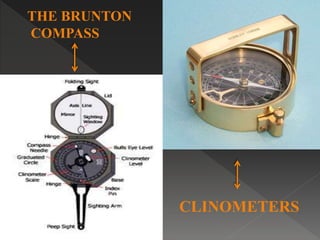
The brunton compass
clinometers
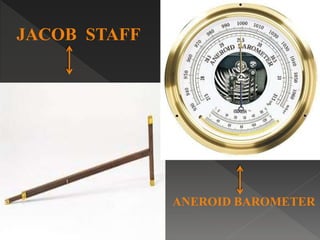
Jacob staff
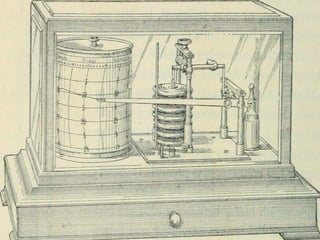
Aneroid barometer
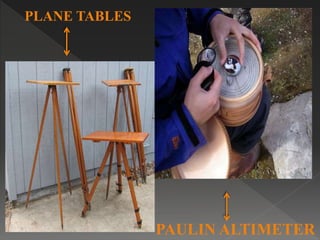
Paulin altimeter
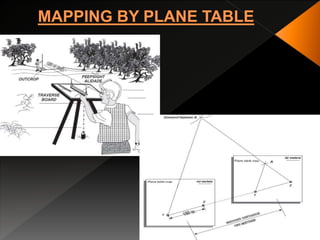
Plane tables
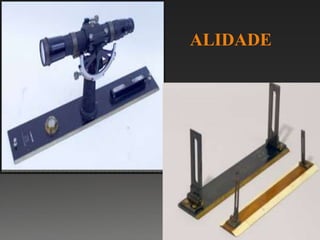
Alidade
THE BRUNTON
COMPASS
CLINOMETERS
JACOB STAFF
ANEROID BAROMETER
PAULIN ALTIMETER
PLANE TABLES
ALIDADE
Barograph
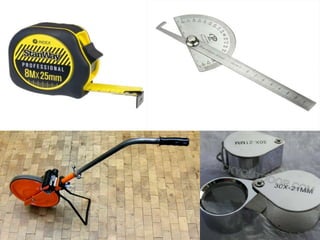
Protractor
Steel tape
Odometer
Camera
Base map
Additional eqipments
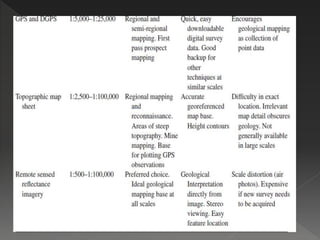
GPS ideal for regional geological mapping onto published
map bases or for regional prospecting and regional and detailed
geochemical and geophysical data collection.
In theUnited States -WAAS system (Wide Area Augmentation
Service)
in Europe - EGNOS (Euro Geostationary Navigation Overlay
Service)
Japan -MSAS (Multifunctional Satellite Augmentation System).
India – IRNSS (Indian regional Navigation Satellite System)
Any system which can record the intensity and wavelengths of
the reflected light and reproduce the data as an image, is
known as reflectance imagery
instrument can be mounted on either an aircraft or satellite
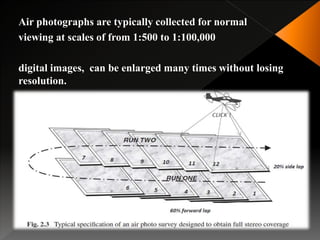
In air photography, a camera mounted in an aircraft takes a
series of photographs as the plane flies in regular parallel
passes over the terrain.
Overlapping adjacent photographs along the flight path
enables subsequent stereoscopic (3-dimensional) viewing
Air photographs are typically collected for normal
viewing at scales of from 1:500 to 1:100,000
digital images, can be enlarged many times without losing
resolution.
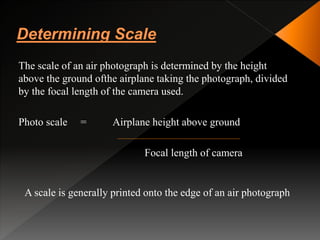
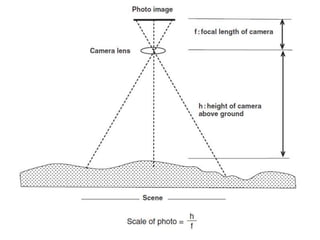
The scale of an air photograph is determined by the height
above the ground ofthe airplane taking the photograph, divided
by the focal length of the camera used.
Photo scale = Airplane height above ground
Focal length of camera
A scale is generally printed onto the edge of an air photograph
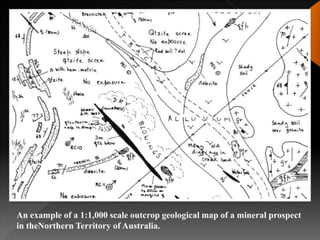
An example of a 1:1,000 scale outcrop geological map of a mineral prospect
in theNorthern Territory of Australia.
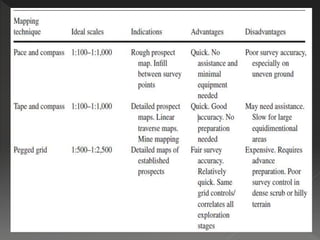
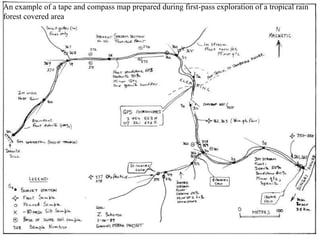
An example of a tape and compass map prepared during first-pass exploration of a tropical rain
forest covered area
Drilling into the subsurface yeild information
regarding structure , lithology of a rock column in
three dimension
Depth at which specific rock formation encounter
become the basis for the constructing structural
contour
Elevation value corresponding to the top of the
formation are used as reference datum
Isopaches are contour maps that describe
formation thickness.
Thickness are compiled on the basis of geological
mapping, mining and subsurface drilling
GEOPHYSICAL METHODS which uses physical methods, such as seismic,
gravitational, magnetic, electrical and electromagnetic at the surface of
the Earth to measure the physical properties of the subsurface, along with the
anomalies in those properties.
Exploration geophysics is also used to map the subsurface structure of a region,
to elucidate the underlying structures, spatial distribution of rock units, and to
detect structures such as faults, folds and intrusive rocks and economic mineral
deposits
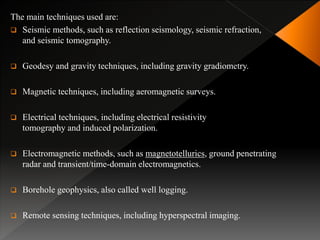
The main techniques used are:
 Seismic methods, such as reflection seismology, seismic refraction,
and seismic tomography.
 Geodesy and gravity techniques, including gravity gradiometry.
 Magnetic techniques, including aeromagnetic surveys.
 Electrical techniques, including electrical resistivity
tomography and induced polarization.
 Electromagnetic methods, such as magnetotellurics, ground penetrating
radar and transient/time-domain electromagnetics.
 Borehole geophysics, also called well logging.
 Remote sensing techniques, including hyperspectral imaging.

Geological mapping in Exploration Geology( surface and subsurface)

  • 1.
  • 2.
  • 3.
    A geological mapis a graphical presentation of geological observations and interpretations on a horizontal plane. A geological section is identical in nature to a map except that data are recorded and interpreted on a vertical rather than a horizontal surface. Maps and sections are essential tools in visualizing spatial, three dimensional, geological relationships.
  • 4.
    A geological mapfirst step in any mineral exploration programme It remains an important control document for all subsequent stages of exploration and mining, (drilling, geochemistry,geophysics, geostatistics and mine planning).
  • 5.
    The proportion betweenthe distance on the ground and the corresponding distance on the map. •Large scale maps •Small scale maps
  • 6.
    •A small-scale map– 1:25,000 or smaller – shows broad regional patterns of rock distribution and major structures. •From an exploration point of view ,this is the scale at which the prospectivity of a basin, fold belt, tectonic unit or other large geological subdivision might be determined.
  • 7.
    . Explorationists donot often make maps at these small scales Maps with intermediate-range scales between 1:25,000 and1:5,000 can bedescribed as detailed regional maps
  • 8.
    some of thelarger features which might have had an effect on the localization of ore (the outline of an ore deposit itself) are capable of being shown The intermediate range of map scales is therefore suitable for the control and development of new prospect generation
  • 9.
    more detailed than1:5,000, individual outcrops and the surface expression of significant areas of mineralization can showing the features that directly control and localize ore. Maps at these scales are often called outcrop maps and the need to make them generally arises after a prospect has been defined.
  • 10.
    The brunton compass clinometers Jacobstaff Aneroid barometer Paulin altimeter Plane tables Alidade
  • 11.
  • 12.
  • 13.
  • 14.
  • 15.
  • 22.
    GPS ideal forregional geological mapping onto published map bases or for regional prospecting and regional and detailed geochemical and geophysical data collection. In theUnited States -WAAS system (Wide Area Augmentation Service) in Europe - EGNOS (Euro Geostationary Navigation Overlay Service) Japan -MSAS (Multifunctional Satellite Augmentation System). India – IRNSS (Indian regional Navigation Satellite System)
  • 23.
    Any system whichcan record the intensity and wavelengths of the reflected light and reproduce the data as an image, is known as reflectance imagery instrument can be mounted on either an aircraft or satellite In air photography, a camera mounted in an aircraft takes a series of photographs as the plane flies in regular parallel passes over the terrain. Overlapping adjacent photographs along the flight path enables subsequent stereoscopic (3-dimensional) viewing
  • 24.
    Air photographs aretypically collected for normal viewing at scales of from 1:500 to 1:100,000 digital images, can be enlarged many times without losing resolution.
  • 25.
    The scale ofan air photograph is determined by the height above the ground ofthe airplane taking the photograph, divided by the focal length of the camera used. Photo scale = Airplane height above ground Focal length of camera A scale is generally printed onto the edge of an air photograph
  • 27.
    An example ofa 1:1,000 scale outcrop geological map of a mineral prospect in theNorthern Territory of Australia.
  • 28.
    An example ofa tape and compass map prepared during first-pass exploration of a tropical rain forest covered area
  • 29.
    Drilling into thesubsurface yeild information regarding structure , lithology of a rock column in three dimension Depth at which specific rock formation encounter become the basis for the constructing structural contour Elevation value corresponding to the top of the formation are used as reference datum
  • 30.
    Isopaches are contourmaps that describe formation thickness. Thickness are compiled on the basis of geological mapping, mining and subsurface drilling
  • 31.
    GEOPHYSICAL METHODS whichuses physical methods, such as seismic, gravitational, magnetic, electrical and electromagnetic at the surface of the Earth to measure the physical properties of the subsurface, along with the anomalies in those properties. Exploration geophysics is also used to map the subsurface structure of a region, to elucidate the underlying structures, spatial distribution of rock units, and to detect structures such as faults, folds and intrusive rocks and economic mineral deposits
  • 32.
    The main techniquesused are:  Seismic methods, such as reflection seismology, seismic refraction, and seismic tomography.  Geodesy and gravity techniques, including gravity gradiometry.  Magnetic techniques, including aeromagnetic surveys.  Electrical techniques, including electrical resistivity tomography and induced polarization.  Electromagnetic methods, such as magnetotellurics, ground penetrating radar and transient/time-domain electromagnetics.  Borehole geophysics, also called well logging.  Remote sensing techniques, including hyperspectral imaging.