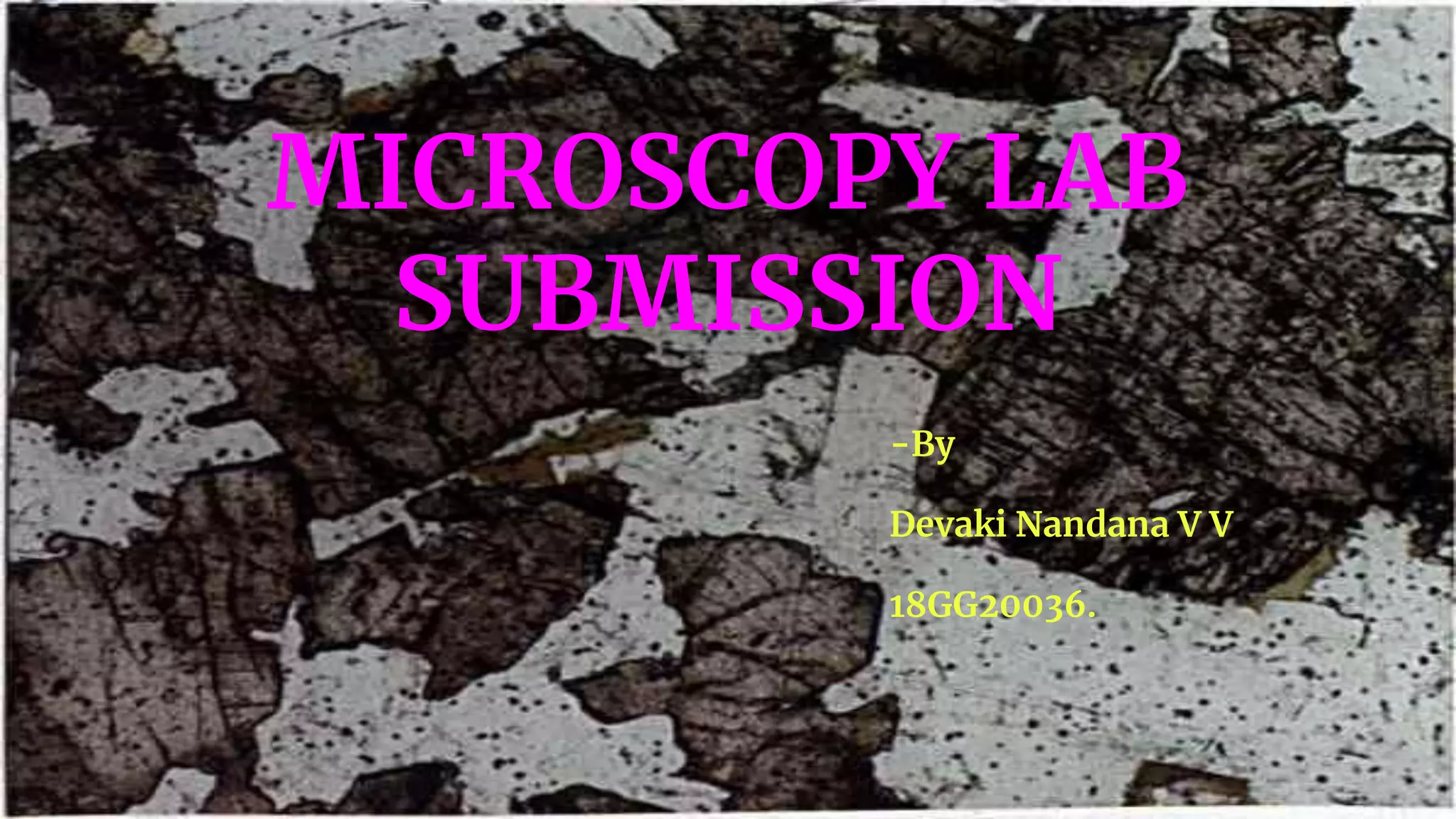
MICROSCOPY LAB
SUBMISSION
-By
Devaki Nandana V V
18GG20036.
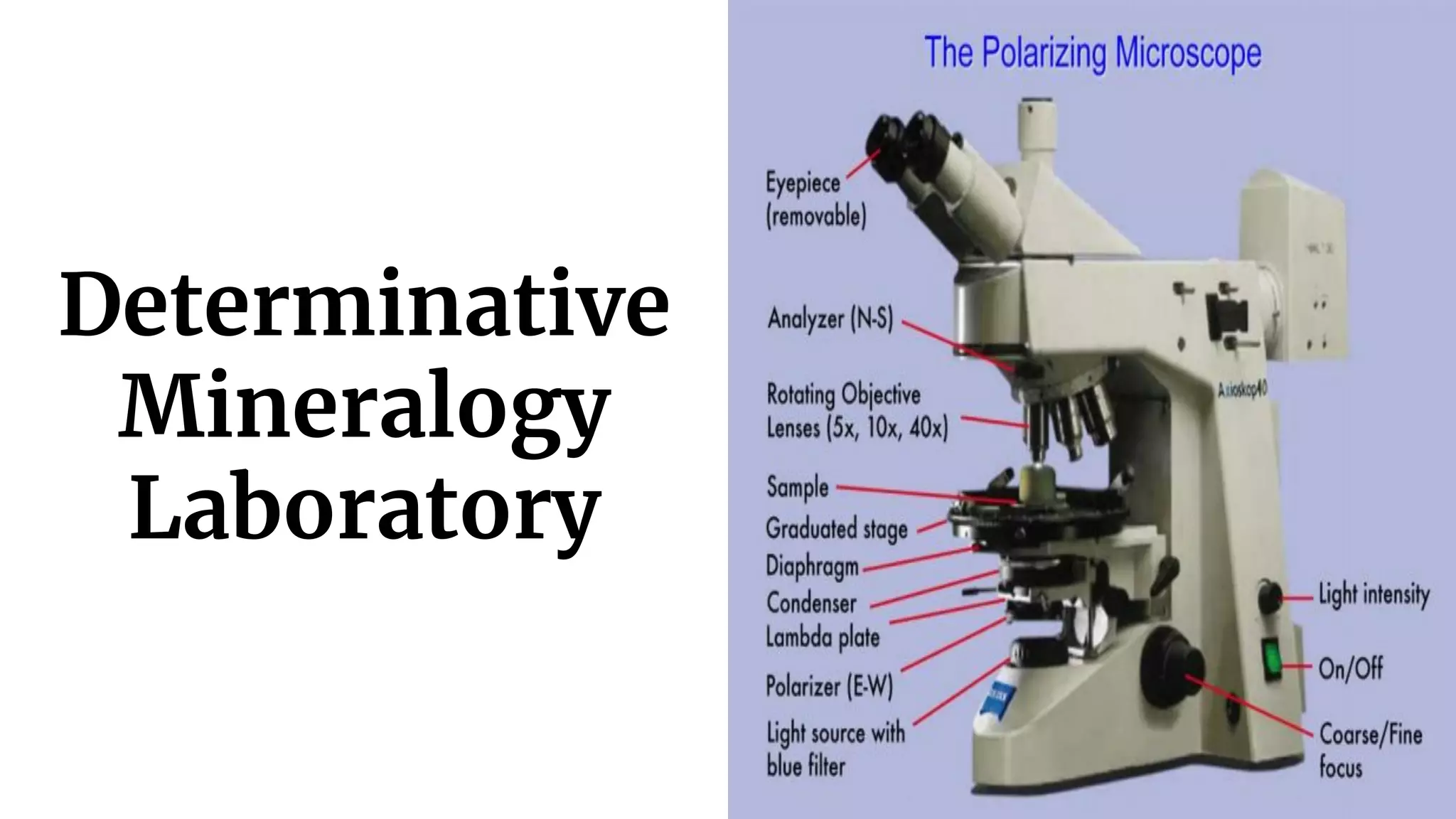
Determinative
Mineralogy
Laboratory
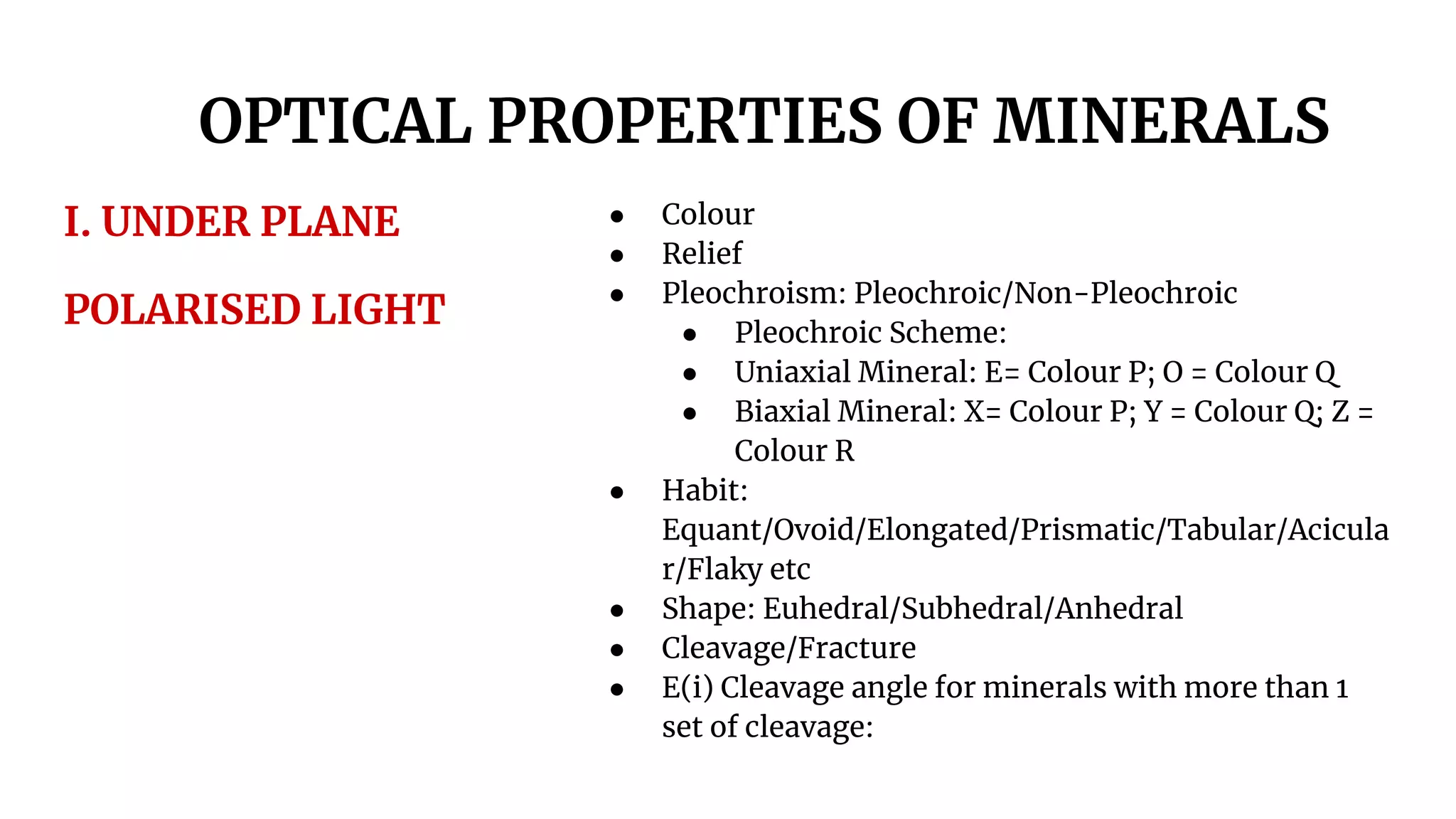
OPTICAL PROPERTIES OF MINERALS
I. UNDER PLANE
POLARISED LIGHT
● Colour
● Relief
● Pleochroism: Pleochroic/Non-Pleochroic
● Pleochroic Scheme:
● Uniaxial Mineral: E= Colour P; O = Colour Q
● Biaxial Mineral: X= Colour P; Y = Colour Q; Z =
Colour R
● Habit:
Equant/Ovoid/Elongated/Prismatic/Tabular/Acicula
r/Flaky etc
● Shape: Euhedral/Subhedral/Anhedral
● Cleavage/Fracture
● E(i) Cleavage angle for minerals with more than 1
set of cleavage:
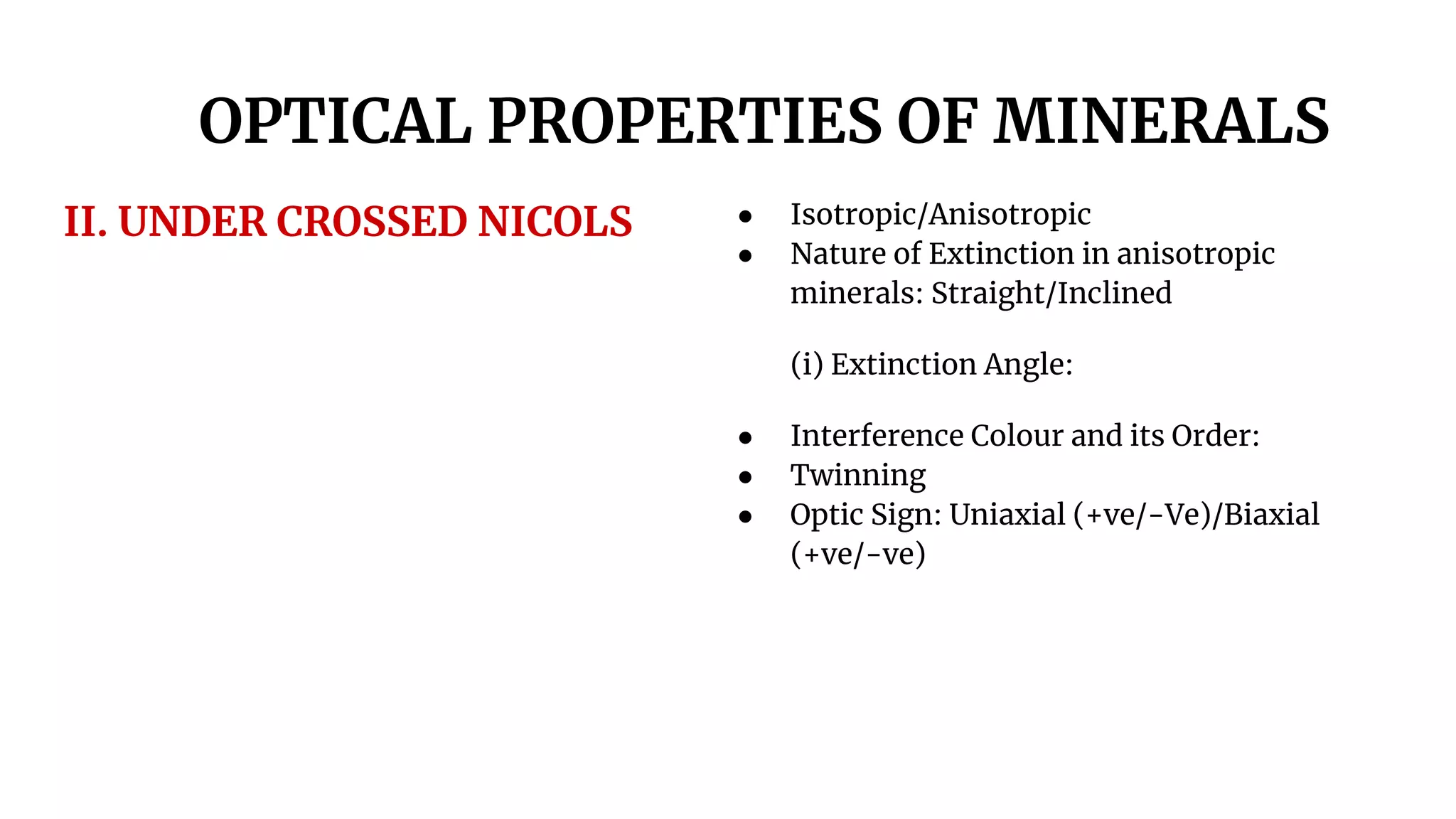
OPTICAL PROPERTIES OF MINERALS
II. UNDER CROSSED NICOLS ● Isotropic/Anisotropic
● Nature of Extinction in anisotropic
minerals: Straight/Inclined
(i) Extinction Angle:
● Interference Colour and its Order:
● Twinning
● Optic Sign: Uniaxial (+ve/-Ve)/Biaxial
(+ve/-ve)
Minerals to be studied:-
30 Quartz (I/M) Chloritoid(M) Apatite(I)
Microcline(I) Orthopyroxene(I/M) Sphene(I/M)
Orthoclase(I/M) Clinopyroxene(I) Rutile(M)
Plagioclase(I/M) Olivine(I/M) Cordierite(M)
Tourmaline Staurolite(M) Epidote(M/I)
Biotite(M/I) Garnet(M) Zircon(I/M)
Chlorite(M) Green Spinel(M) Scapolite(M)
Muscovite(M/I) Tremolite/Actinolite(M) Calcite(M/I)
Kyanite(M) Hornblende(M) Monazite(M)
Sillimanite(M) Glaucophane Nepheline(I)
Sialic Minerals Accessory Minerals
Feldspars Apatite
Nepheline Monazite
Quartz Zircon
Rare Accessory Minerals
Femic Minerals Calcite
Amphiboles Cordierite
Biotite Garnet
Olivine Muscovite
Pyroxene Rutile
Scapolite
Alteration products Sphene
Chlorite Tourmaline
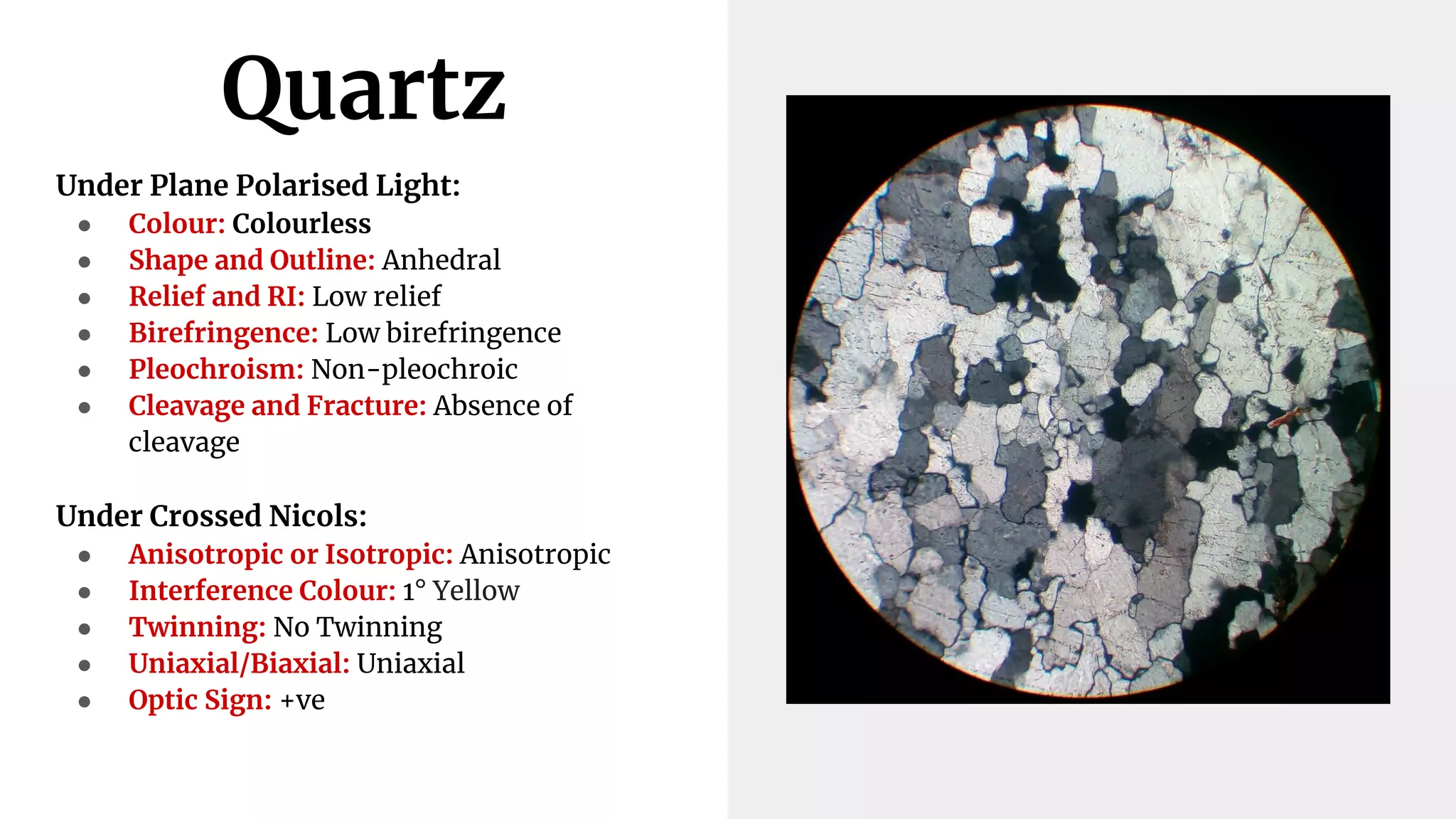
Quartz
Under Plane Polarised Light:
● Colour: Colourless
● Shape and Outline: Anhedral
● Relief and RI: Low relief
● Birefringence: Low birefringence
● Pleochroism: Non-pleochroic
● Cleavage and Fracture: Absence of
cleavage
Under Crossed Nicols:
● Anisotropic or Isotropic: Anisotropic
● Interference Colour: 1° Yellow
● Twinning: No Twinning
● Uniaxial/Biaxial: Uniaxial
● Optic Sign: +ve
Microcline
Under Plane Polarised Light
● Colour: Colourless
● Habit: Irregular, equant
● Shape and Outline: Anhedral to subhedral
● Relief and RI: Low relief (<Qtz)
● Pleochroism: Non-pleochroic
● Cleavage and Fracture: Present
Under Crossed Nicols:
● Anisotropic or Isotropic: Anisotropic
● Interference Colour: 1° Grey
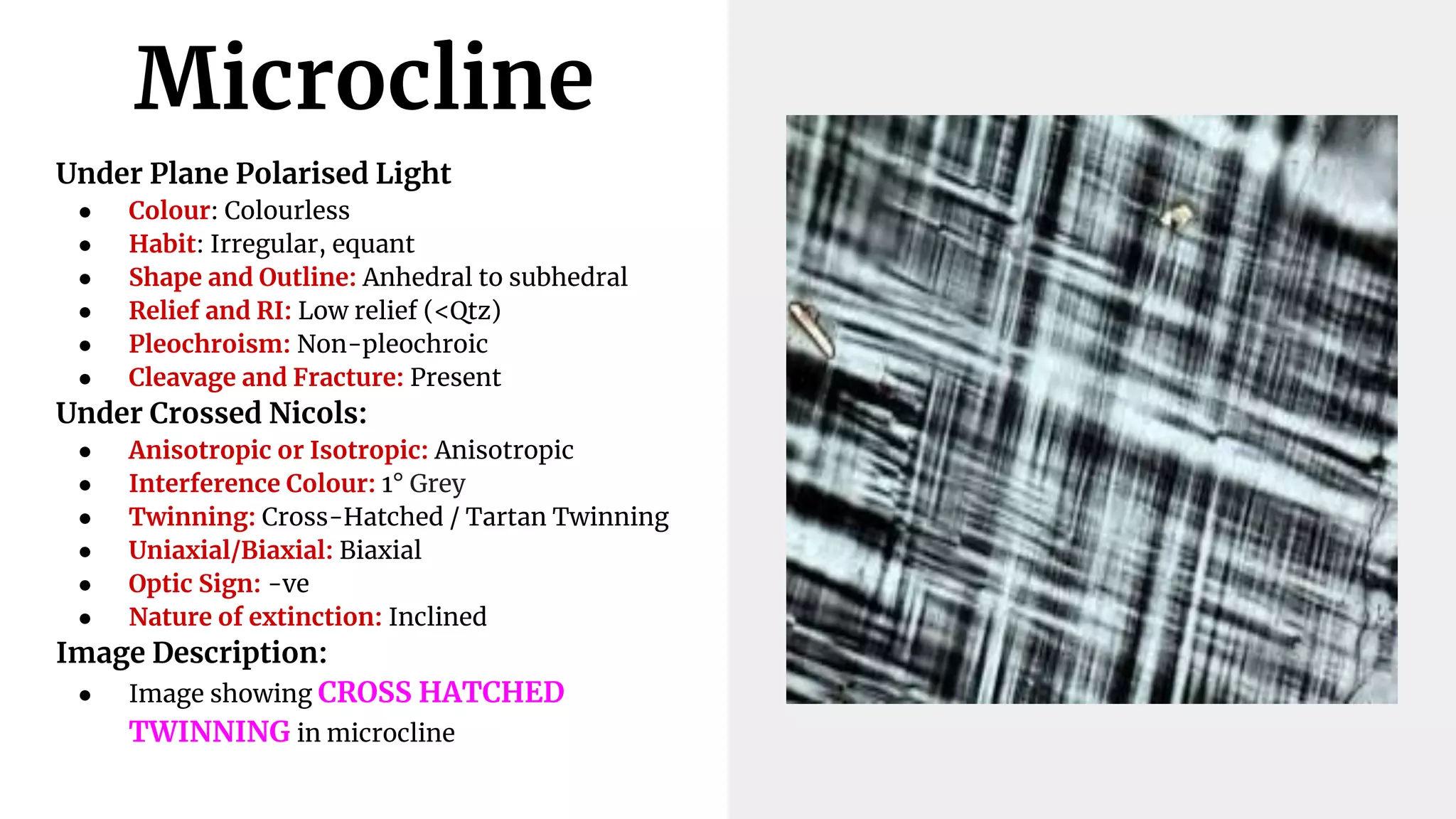
● Twinning: Cross-Hatched / Tartan Twinning
● Uniaxial/Biaxial: Biaxial
● Optic Sign: -ve
● Nature of extinction: Inclined
Image Description:
● Image showing CROSS HATCHED
TWINNING in microcline
Orthoclase
Under Plane Polarised Light:
● Colour: Colourless
● Habit: Elongated tabular grains
● Crystal system: Monoclinic
● Shape and Outline: Anhedral to subhedral
● Relief and RI: Low relief (<Qtz)
● Pleochroism: Non-pleochroic
● Cleavage and Fracture: Present
Under Crossed Nicols:
● Anisotropic or Isotropic: Anisotropic
● Interference Colour: 1° Grey
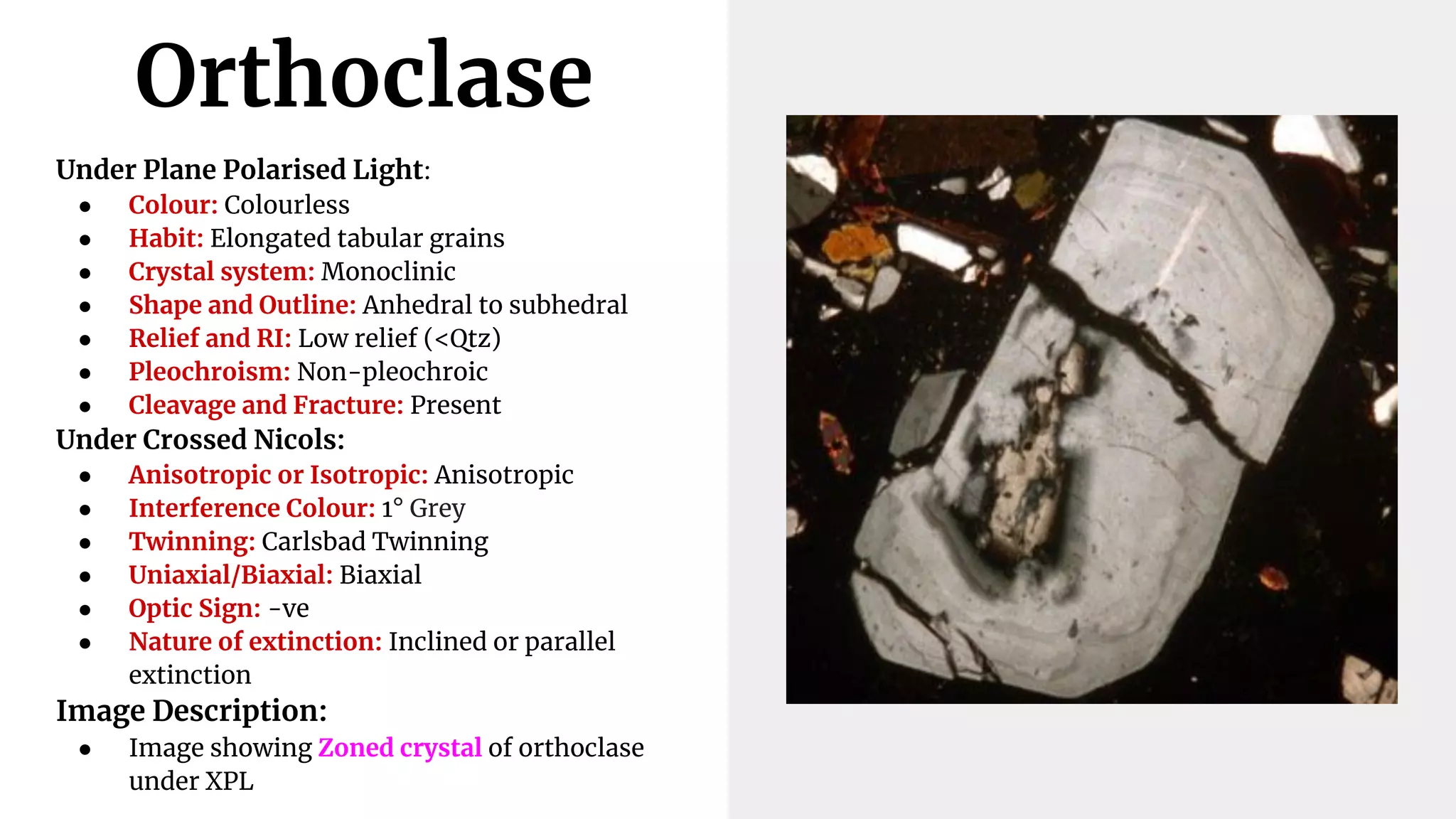
● Twinning: Carlsbad Twinning
● Uniaxial/Biaxial: Biaxial
● Optic Sign: -ve
● Nature of extinction: Inclined or parallel
extinction
Image Description:
● Image showing Zoned crystal of orthoclase
under XPL
Plagioclase
Under Plane Polarised Light:
● Colour: Colourless
● Shape and Outline: Lath shaped
● Relief and RI: Low relief
● Pleochroism: Non-pleochroic
● Cleavage and Fracture: Cleavage present
Under Crossed Nicols:
● Anisotropic or Isotropic: Isotropic
● Interference Colour: 1° Grey
● Twinning: Lamellar Twinning
● Uniaxial/Biaxial: Biaxial
● Optic Sign: -ve/+ve
Image Description:
● In the figure, plagioclase is identified by
low relief and lamellar twinning.
Tourmaline
Under Plane Polarised Light:
● Colour: Green to Dark Green to Brown
● Habit: Acicular
● Shape and Outline: Prismatic crystals with
striations
● Relief and RI: Moderately high relief
● Pleochroism: Strongly dichroic
● E-Light green/light pink
● O-Dark Green
● Cleavage and Fracture: Transverse fracture
present, no cleavage.
Under Crossed Nicols:
● Anisotropic or Isotropic: Anisotropic
● Nature of extinction: Straight extinction
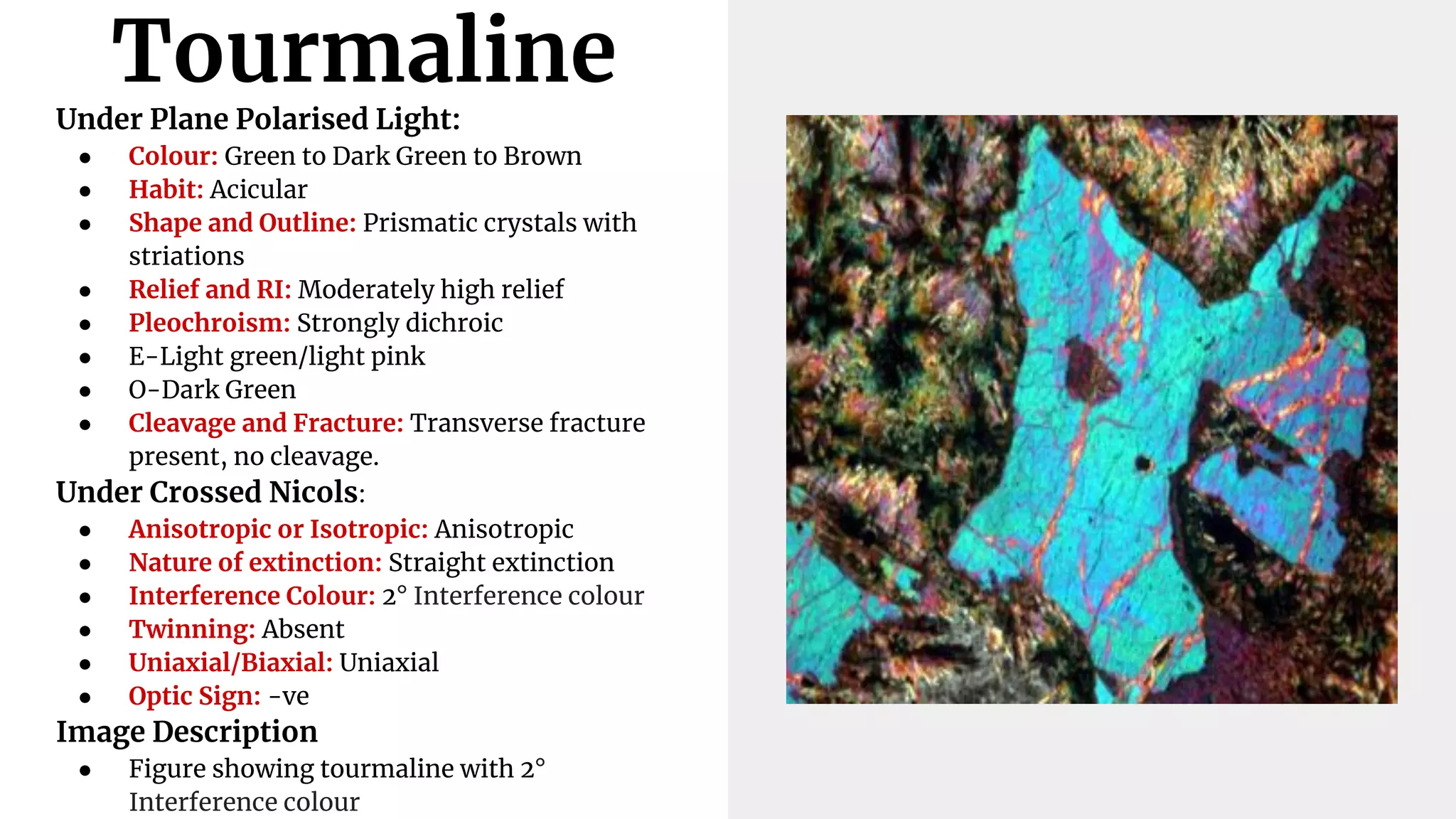
● Interference Colour: 2° Interference colour
● Twinning: Absent
● Uniaxial/Biaxial: Uniaxial
● Optic Sign: -ve
Image Description
● Figure showing tourmaline with 2°
Interference colour
Biotite
Under Plane Polarised Light:
● Colour: Yellow to Dark Brown
● Habit: Flaky habit
● Shape: Tabular to prismatic
● Crystal system: Monoclinic
● Relief and RI: Moderate relief
● Pleochroism: Strongly pleochroic
● Cleavage and Fracture: 1 set of Basal cleavage
Under Crossed Nicols:
● Anisotropic or Isotropic: Isotropic
● Nature of extinction: Straight extinction
● Interference Colour: High order interference
colour
● Twinning: None, Twin axis[310]
● Uniaxial/Biaxial: Biaxial
● Optic Sign: -ve
Image Description:
● Image showing Zircon inclusions in Biotite
sample
ChloriteUnder Plane Polarised Light:
● Colour: Pale Green to Green
● Habit: Tabular
● Shape and Outline: Found as scales or plates
similar to micas
● Relief and RI: Moderate relief
● Pleochroism: Strongly pleochroic
● Cleavage and Fracture: 1 set of perfect
cleavage
Under Crossed Nicols:
● Anisotropic or Isotropic: Anisotropic
● Nature of extinction: Straight Extinction
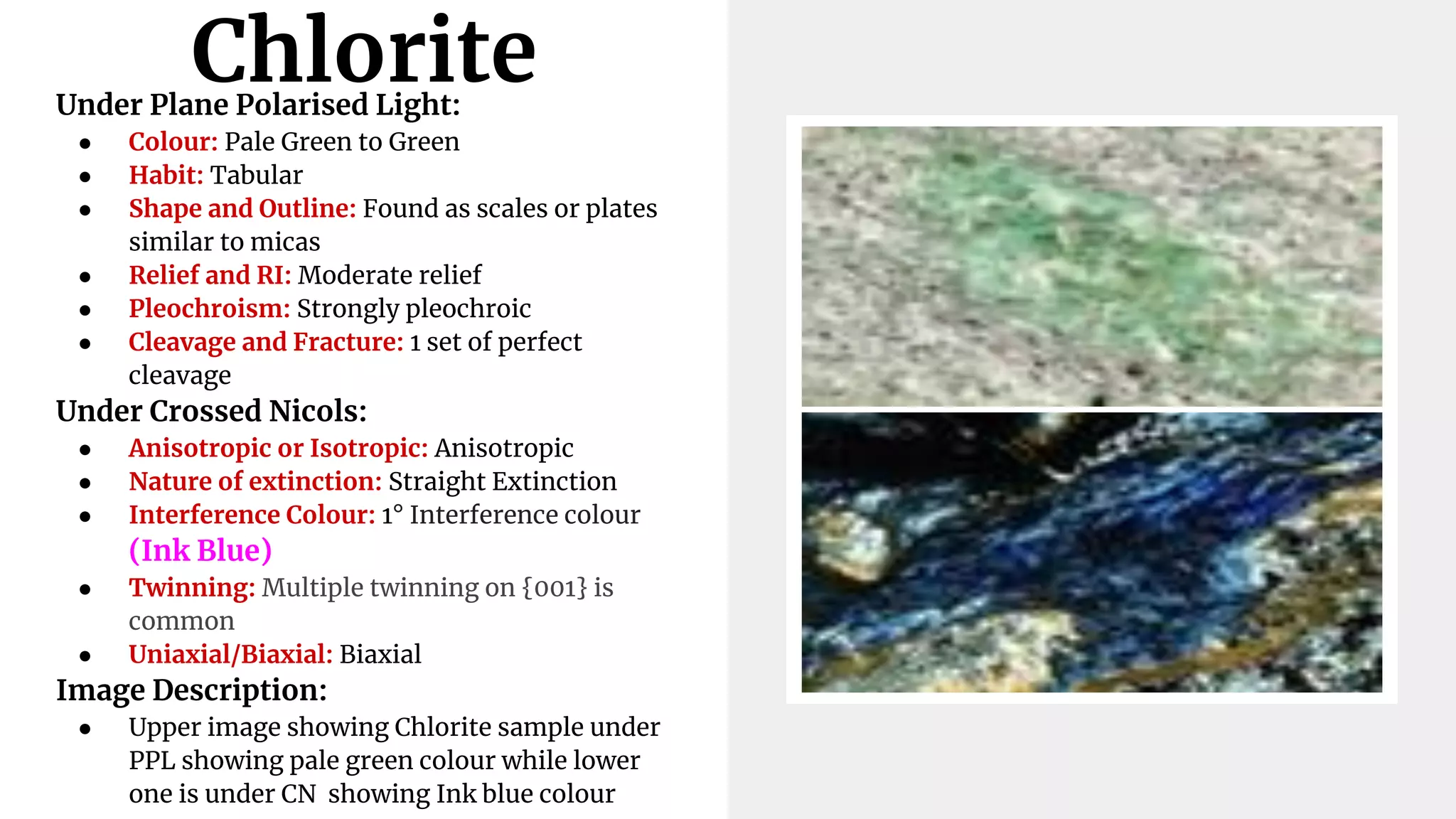
● Interference Colour: 1° Interference colour
(Ink Blue)
● Twinning: Multiple twinning on {001} is
common
● Uniaxial/Biaxial: Biaxial
Image Description:
● Upper image showing Chlorite sample under
PPL showing pale green colour while lower
one is under CN showing Ink blue colour
Muscovite
Under Plane Polarised Light:
● Colour: Colourless
● Habit: Flaky habit
● Relief and RI: Moderate Relief
● Pleochroism: Non-pleochroic
● Shades of yellow and brown
● Cleavage and Fracture: 1 set perfect basal
cleavage
Under Crossed Nicols:
● Anisotropic or Isotropic: Anisotropic
● Nature of extinction: Straight extinction
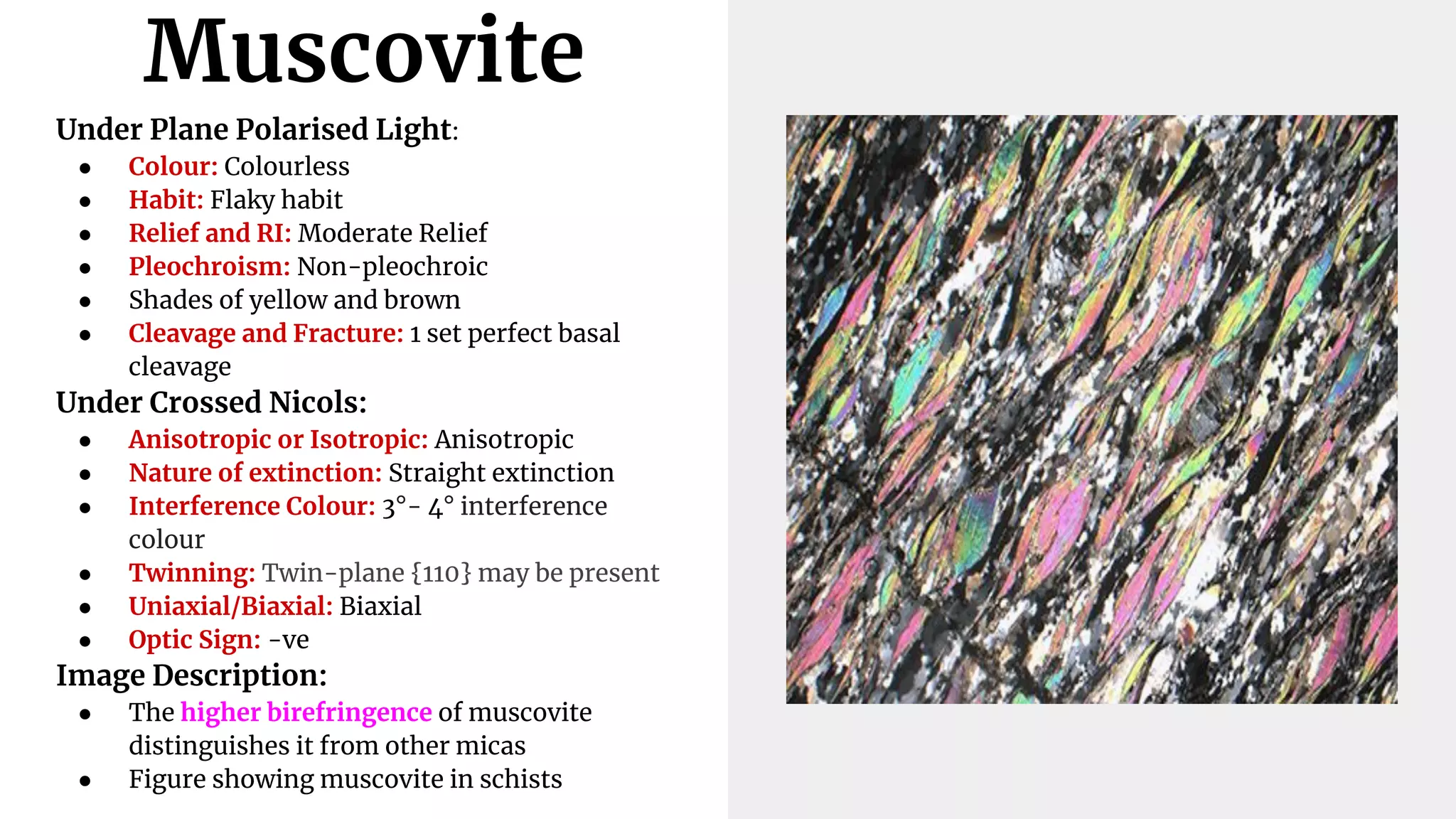
● Interference Colour: 3°- 4° interference
colour
● Twinning: Twin-plane {110} may be present
● Uniaxial/Biaxial: Biaxial
● Optic Sign: -ve
Image Description:
● The higher birefringence of muscovite
distinguishes it from other micas
● Figure showing muscovite in schists
Kyanite
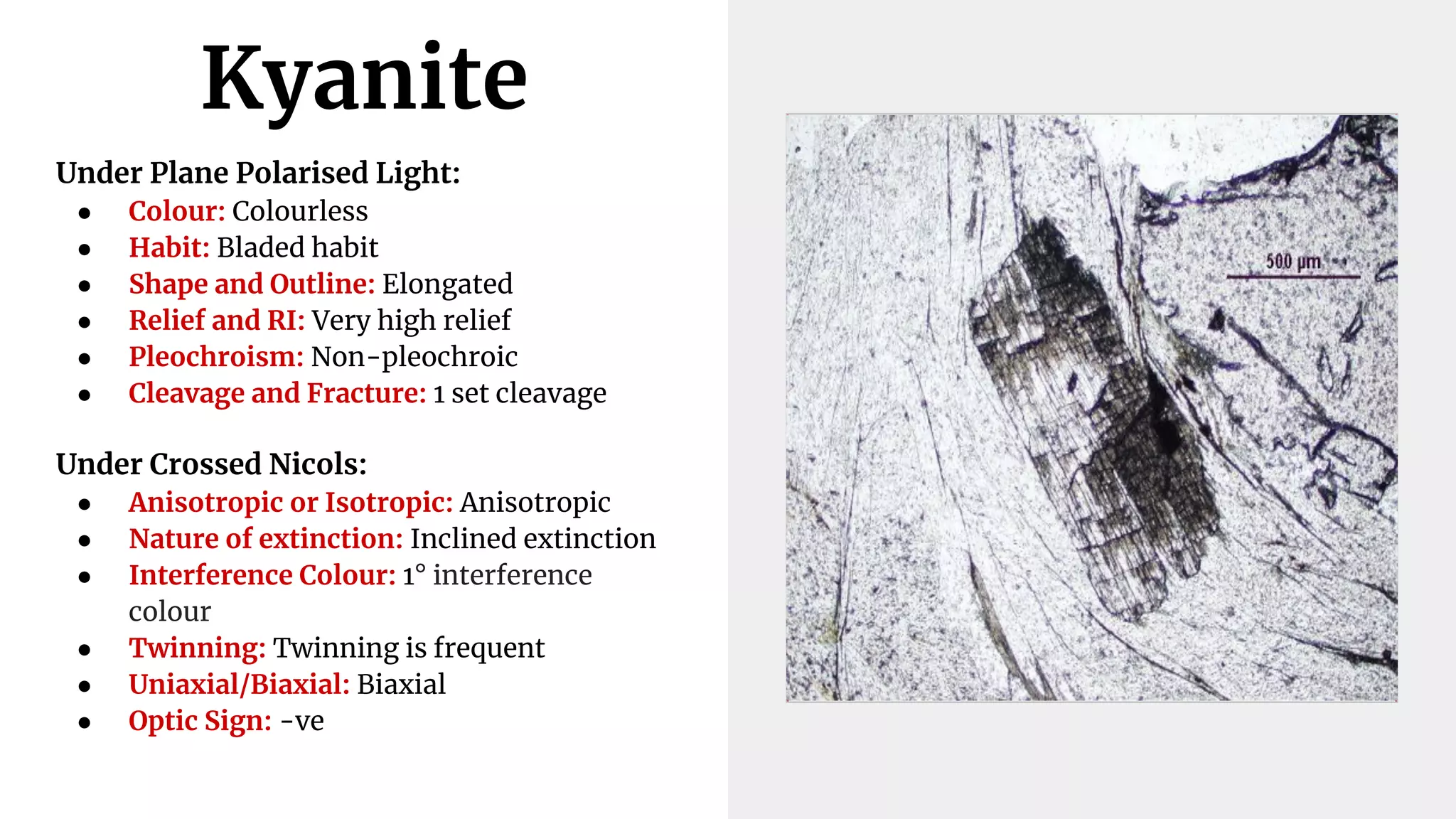
Under Plane Polarised Light:
● Colour: Colourless
● Habit: Bladed habit
● Shape and Outline: Elongated
● Relief and RI: Very high relief
● Pleochroism: Non-pleochroic
● Cleavage and Fracture: 1 set cleavage
Under Crossed Nicols:
● Anisotropic or Isotropic: Anisotropic
● Nature of extinction: Inclined extinction
● Interference Colour: 1° interference
colour
● Twinning: Twinning is frequent
● Uniaxial/Biaxial: Biaxial
● Optic Sign: -ve
Sillimanite
Under Plane Polarised Light:
● Colour: Colourless
● Habit: Acicular
● Shape and Outline: Elongated
● Relief and RI: Moderately high relief
● Pleochroism: Non-pleochroic
● Cleavage and Fracture: 1 set Basal
cleavage
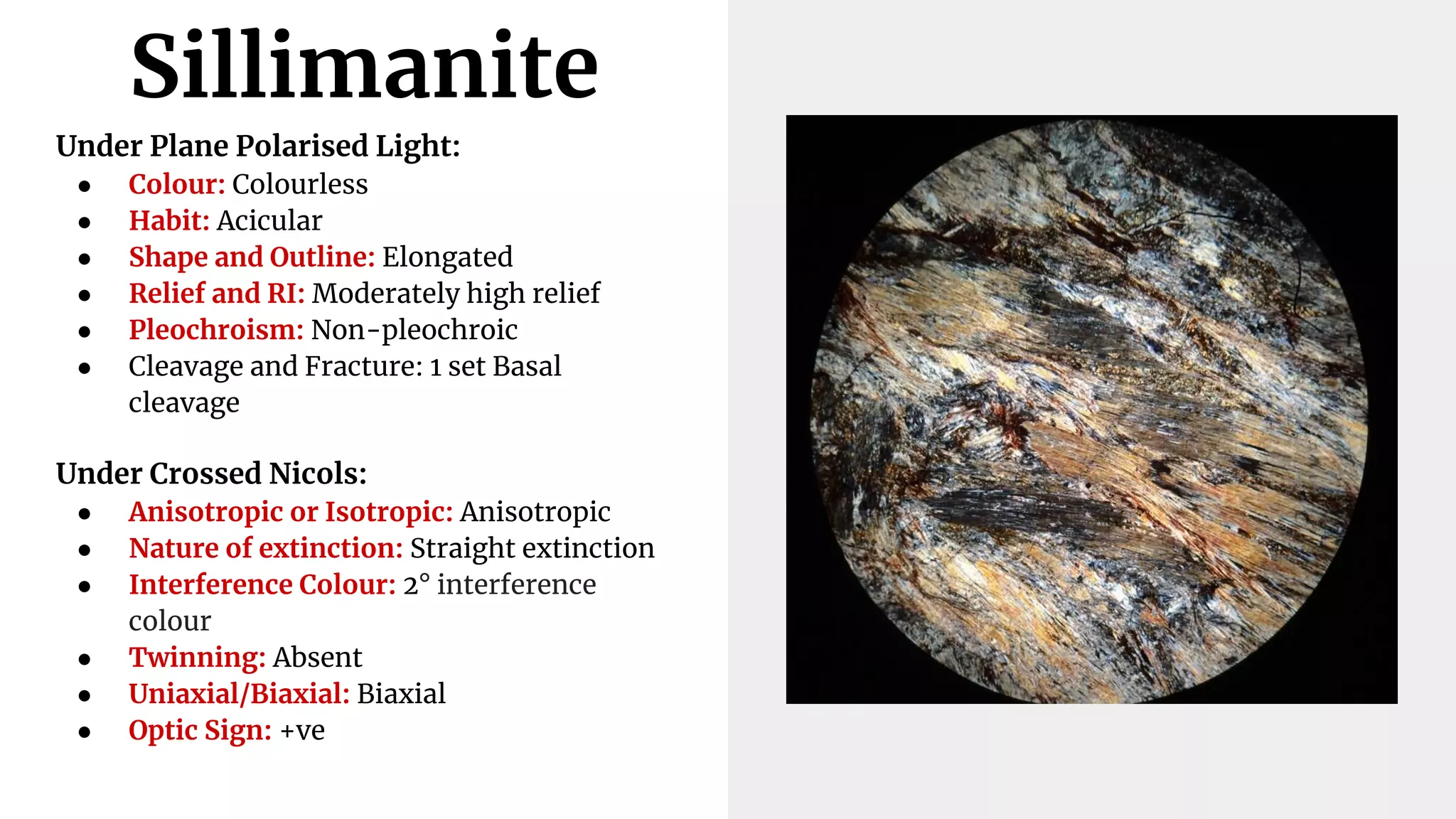
Under Crossed Nicols:
● Anisotropic or Isotropic: Anisotropic
● Nature of extinction: Straight extinction
● Interference Colour: 2° interference
colour
● Twinning: Absent
● Uniaxial/Biaxial: Biaxial
● Optic Sign: +ve
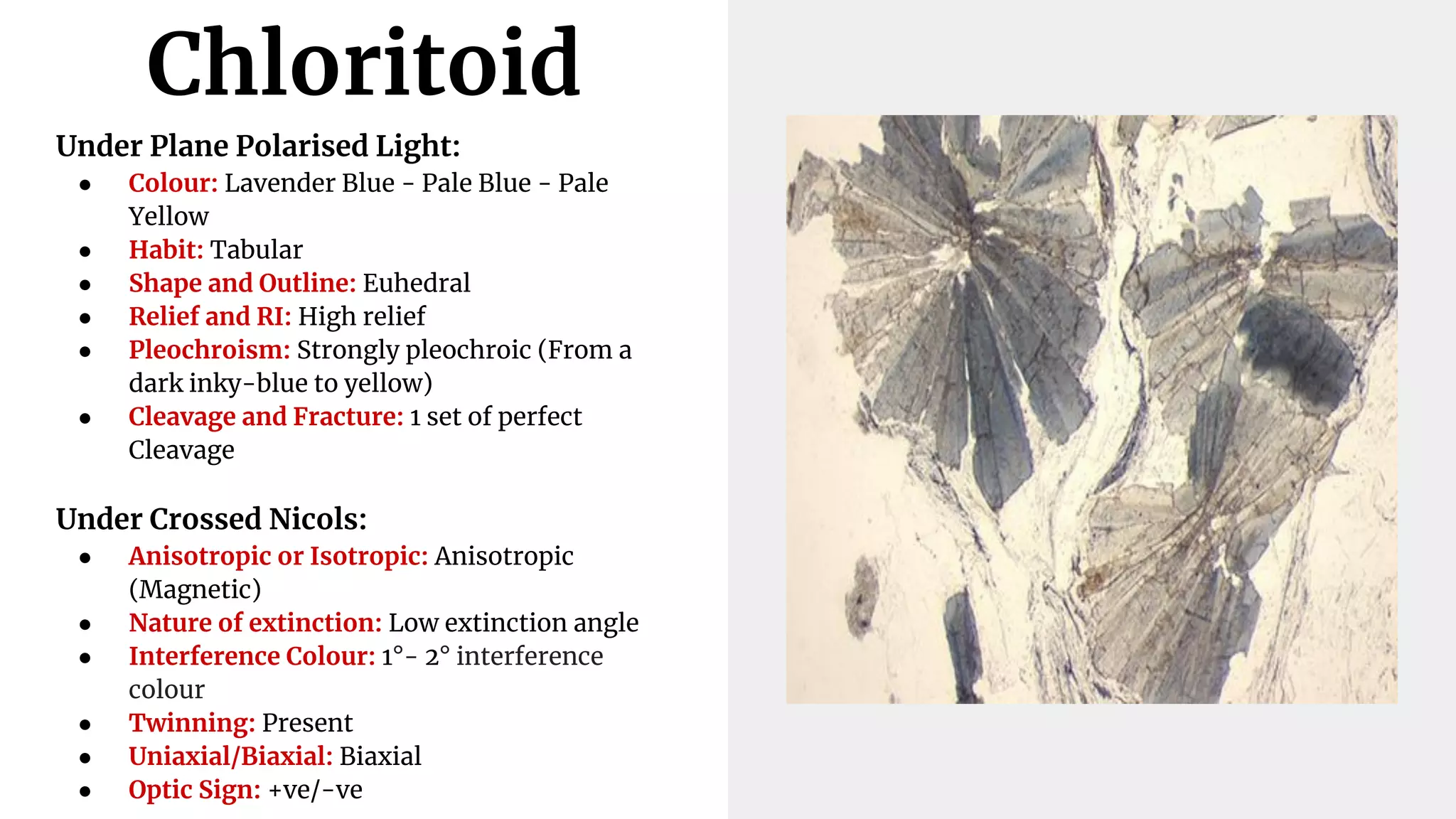
Chloritoid
Under Plane Polarised Light:
● Colour: Lavender Blue - Pale Blue - Pale
Yellow
● Habit: Tabular
● Shape and Outline: Euhedral
● Relief and RI: High relief
● Pleochroism: Strongly pleochroic (From a
dark inky-blue to yellow)
● Cleavage and Fracture: 1 set of perfect
Cleavage
Under Crossed Nicols:
● Anisotropic or Isotropic: Anisotropic
(Magnetic)
● Nature of extinction: Low extinction angle
● Interference Colour: 1°- 2° interference
colour
● Twinning: Present
● Uniaxial/Biaxial: Biaxial
● Optic Sign: +ve/-ve
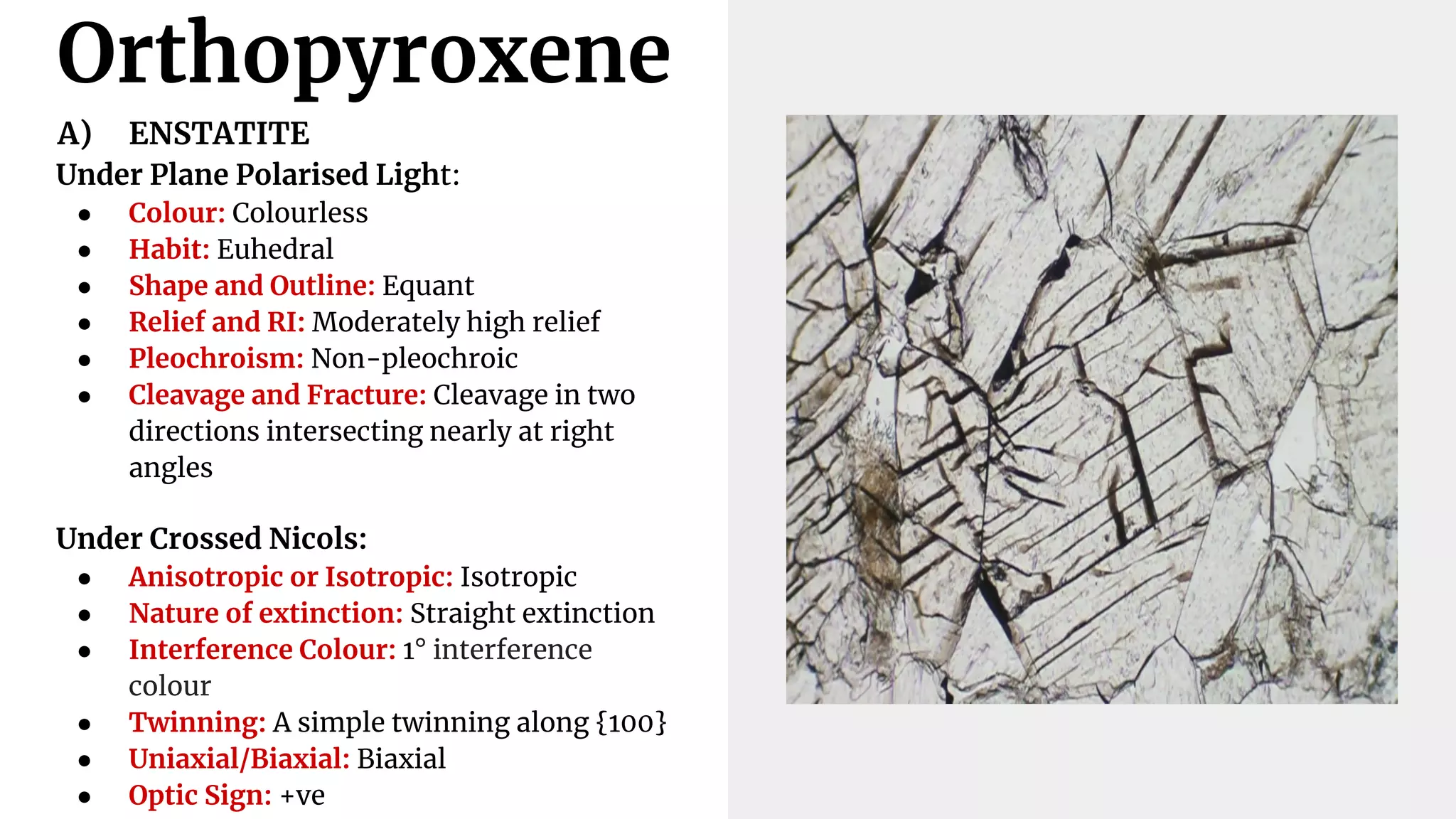
Orthopyroxene
A) ENSTATITE
Under Plane Polarised Light:
● Colour: Colourless
● Habit: Euhedral
● Shape and Outline: Equant
● Relief and RI: Moderately high relief
● Pleochroism: Non-pleochroic
● Cleavage and Fracture: Cleavage in two
directions intersecting nearly at right
angles
Under Crossed Nicols:
● Anisotropic or Isotropic: Isotropic
● Nature of extinction: Straight extinction
● Interference Colour: 1° interference
colour
● Twinning: A simple twinning along {100}
● Uniaxial/Biaxial: Biaxial
● Optic Sign: +ve
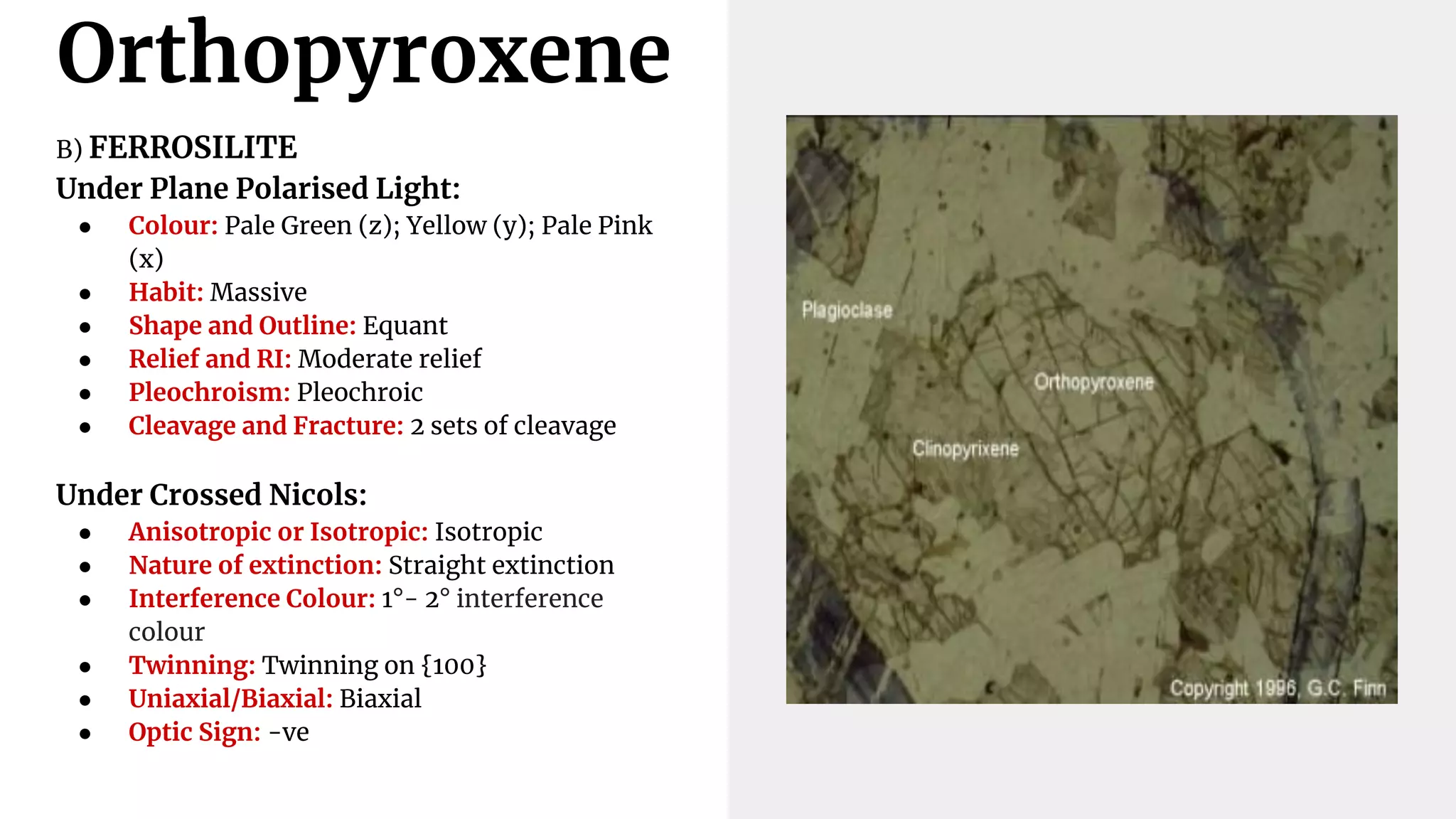
Orthopyroxene
B) FERROSILITE
Under Plane Polarised Light:
● Colour: Pale Green (z); Yellow (y); Pale Pink
(x)
● Habit: Massive
● Shape and Outline: Equant
● Relief and RI: Moderate relief
● Pleochroism: Pleochroic
● Cleavage and Fracture: 2 sets of cleavage
Under Crossed Nicols:
● Anisotropic or Isotropic: Isotropic
● Nature of extinction: Straight extinction
● Interference Colour: 1°- 2° interference
colour
● Twinning: Twinning on {100}
● Uniaxial/Biaxial: Biaxial
● Optic Sign: -ve
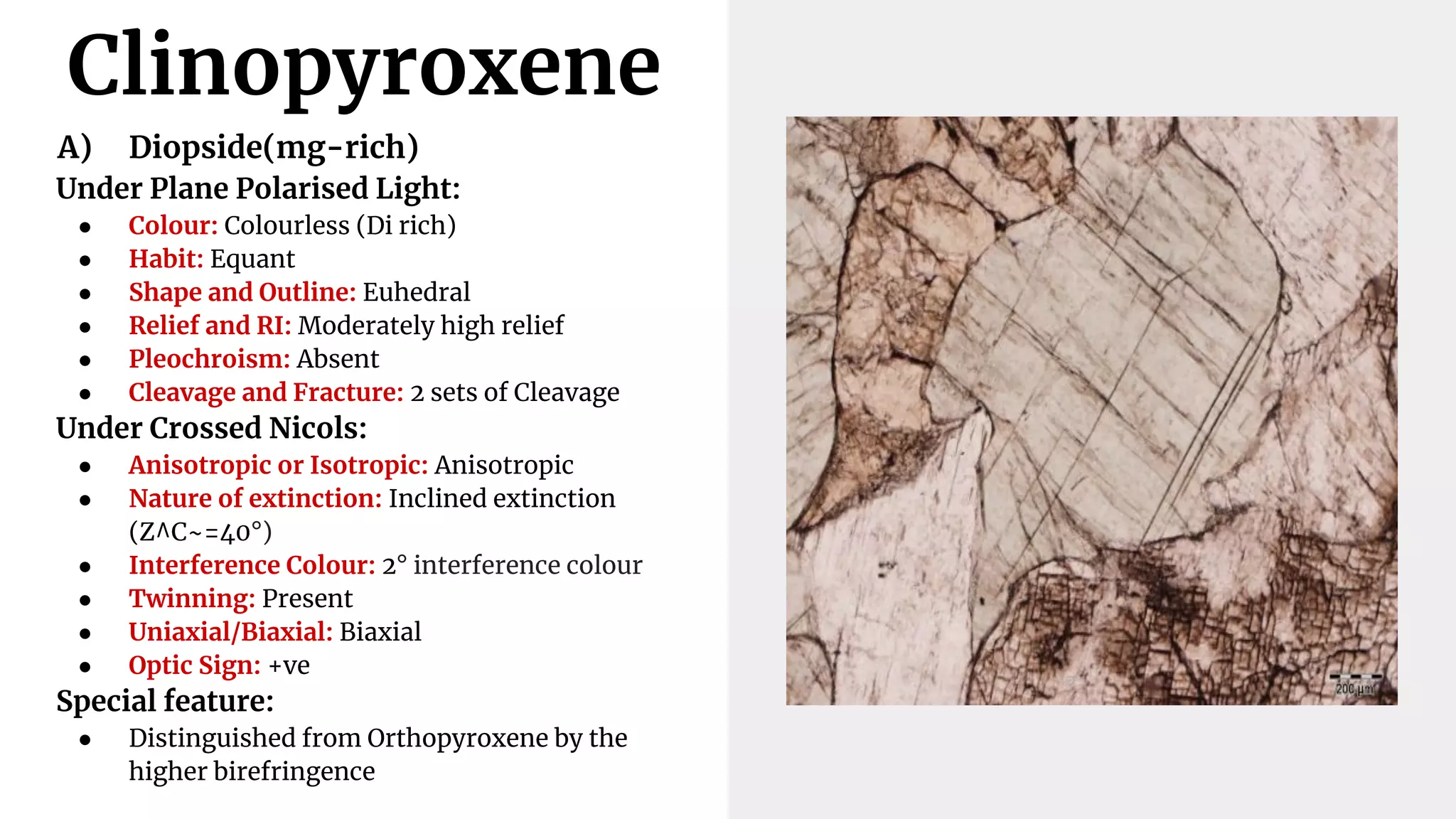
Clinopyroxene
A) Diopside(mg-rich)
Under Plane Polarised Light:
● Colour: Colourless (Di rich)
● Habit: Equant
● Shape and Outline: Euhedral
● Relief and RI: Moderately high relief
● Pleochroism: Absent
● Cleavage and Fracture: 2 sets of Cleavage
Under Crossed Nicols:
● Anisotropic or Isotropic: Anisotropic
● Nature of extinction: Inclined extinction
(Z^C~=40°)
● Interference Colour: 2° interference colour
● Twinning: Present
● Uniaxial/Biaxial: Biaxial
● Optic Sign: +ve
Special feature:
● Distinguished from Orthopyroxene by the
higher birefringence
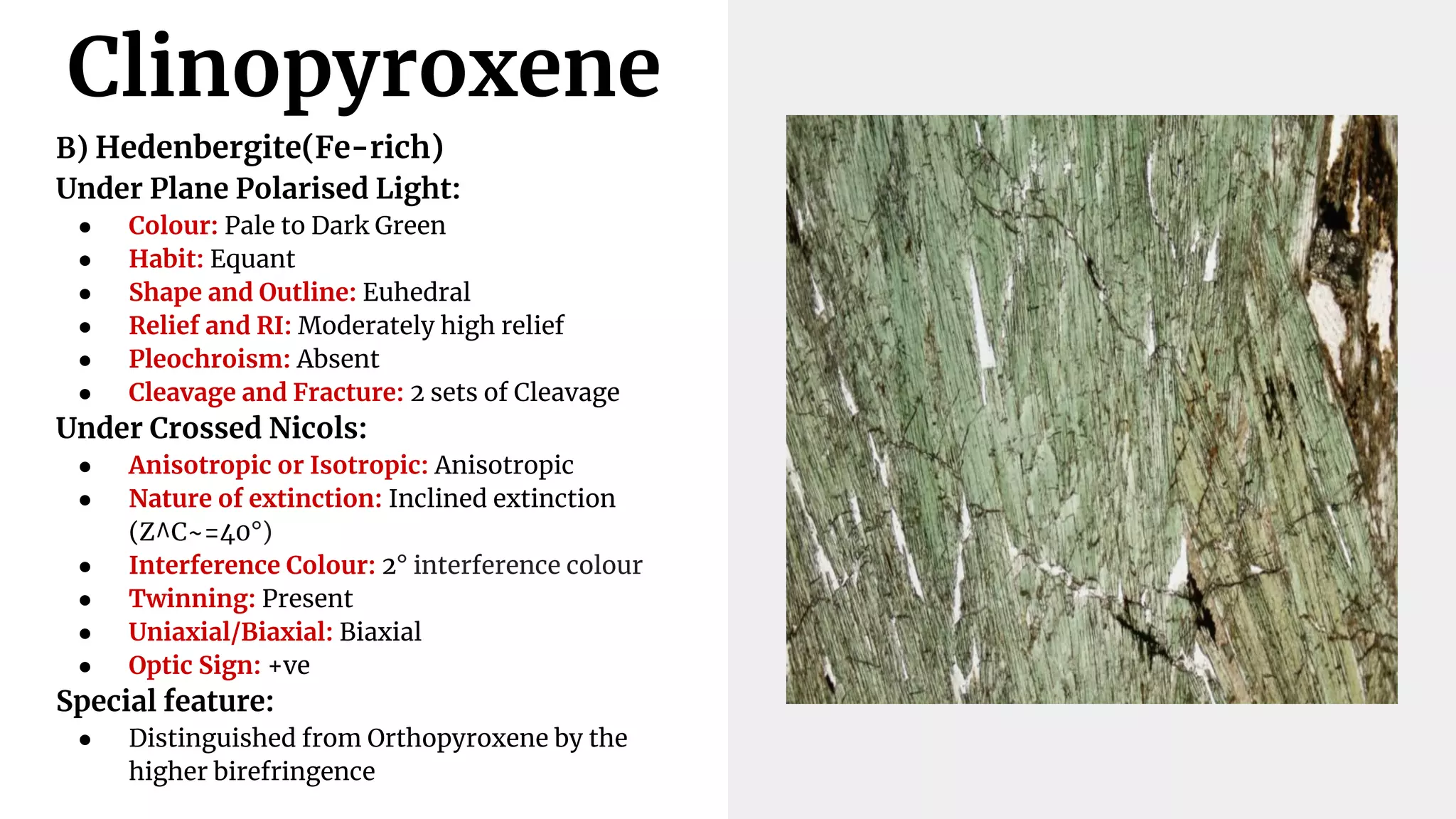
Clinopyroxene
B) Hedenbergite(Fe-rich)
Under Plane Polarised Light:
● Colour: Pale to Dark Green
● Habit: Equant
● Shape and Outline: Euhedral
● Relief and RI: Moderately high relief
● Pleochroism: Absent
● Cleavage and Fracture: 2 sets of Cleavage
Under Crossed Nicols:
● Anisotropic or Isotropic: Anisotropic
● Nature of extinction: Inclined extinction
(Z^C~=40°)
● Interference Colour: 2° interference colour
● Twinning: Present
● Uniaxial/Biaxial: Biaxial
● Optic Sign: +ve
Special feature:
● Distinguished from Orthopyroxene by the
higher birefringence
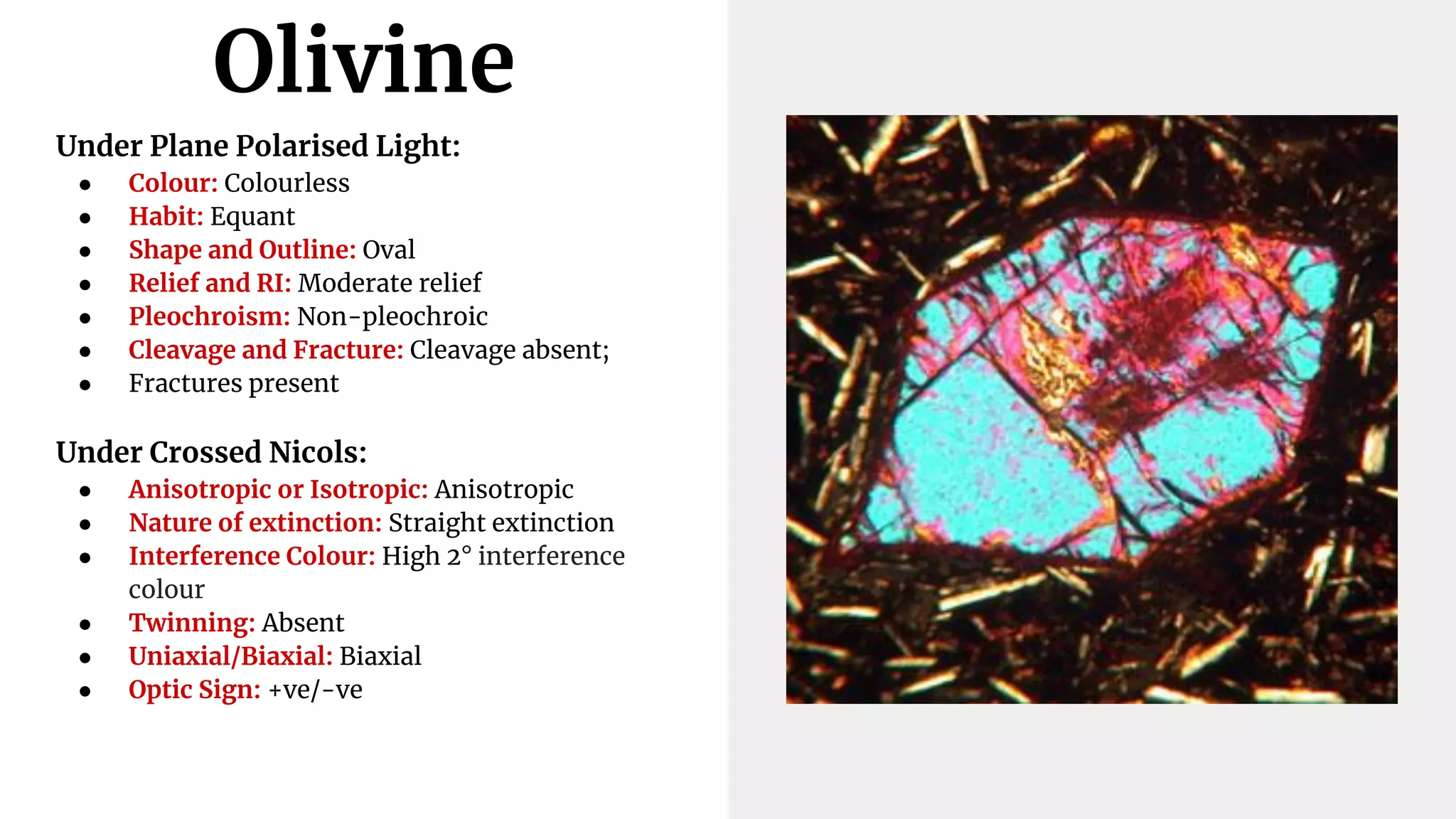
Olivine
Under Plane Polarised Light:
● Colour: Colourless
● Habit: Equant
● Shape and Outline: Oval
● Relief and RI: Moderate relief
● Pleochroism: Non-pleochroic
● Cleavage and Fracture: Cleavage absent;
● Fractures present
Under Crossed Nicols:
● Anisotropic or Isotropic: Anisotropic
● Nature of extinction: Straight extinction
● Interference Colour: High 2° interference
colour
● Twinning: Absent
● Uniaxial/Biaxial: Biaxial
● Optic Sign: +ve/-ve
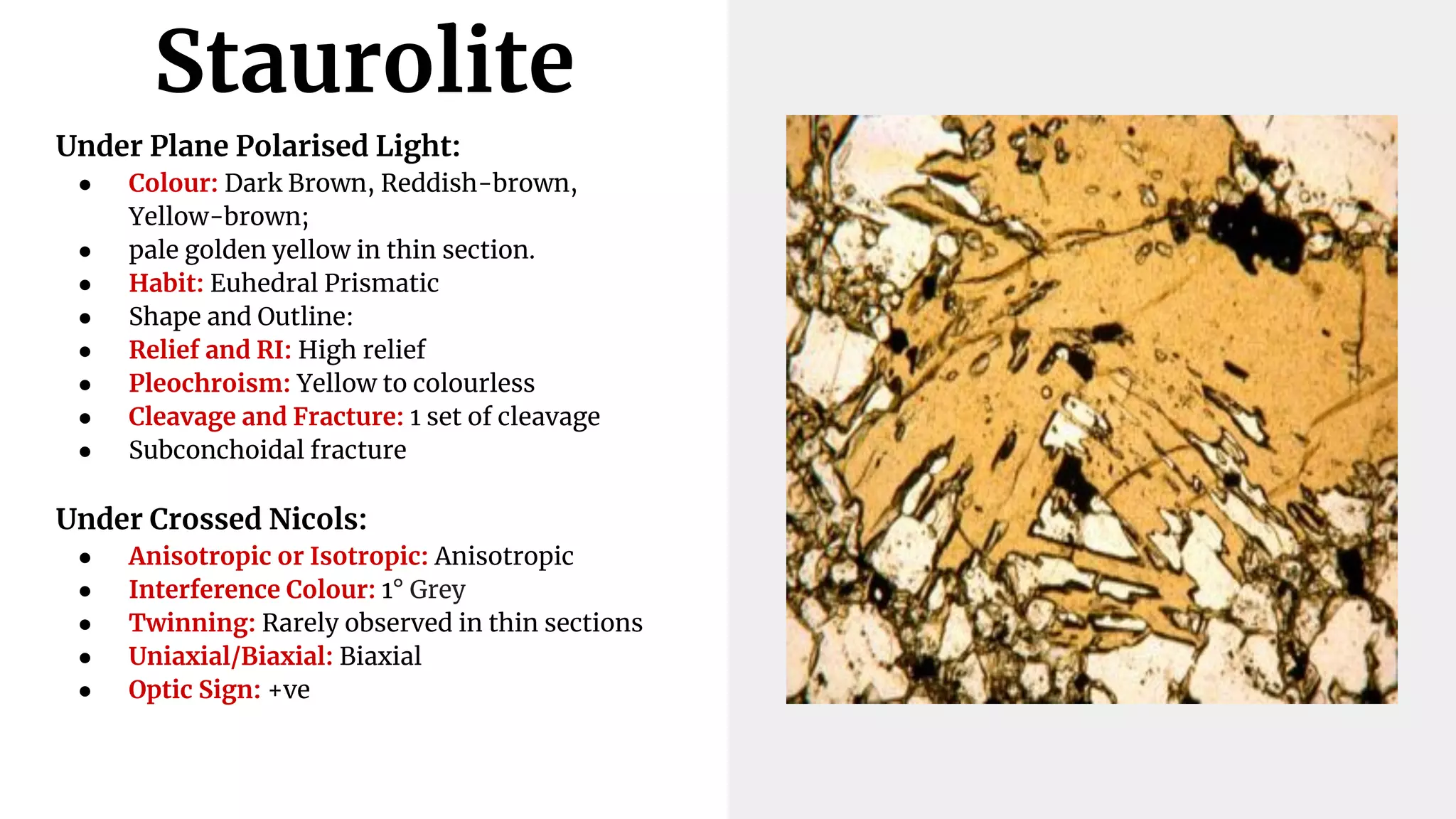
Staurolite
Under Plane Polarised Light:
● Colour: Dark Brown, Reddish-brown,
Yellow-brown;
● pale golden yellow in thin section.
● Habit: Euhedral Prismatic
● Shape and Outline:
● Relief and RI: High relief
● Pleochroism: Yellow to colourless
● Cleavage and Fracture: 1 set of cleavage
● Subconchoidal fracture
Under Crossed Nicols:
● Anisotropic or Isotropic: Anisotropic
● Interference Colour: 1° Grey
● Twinning: Rarely observed in thin sections
● Uniaxial/Biaxial: Biaxial
● Optic Sign: +ve
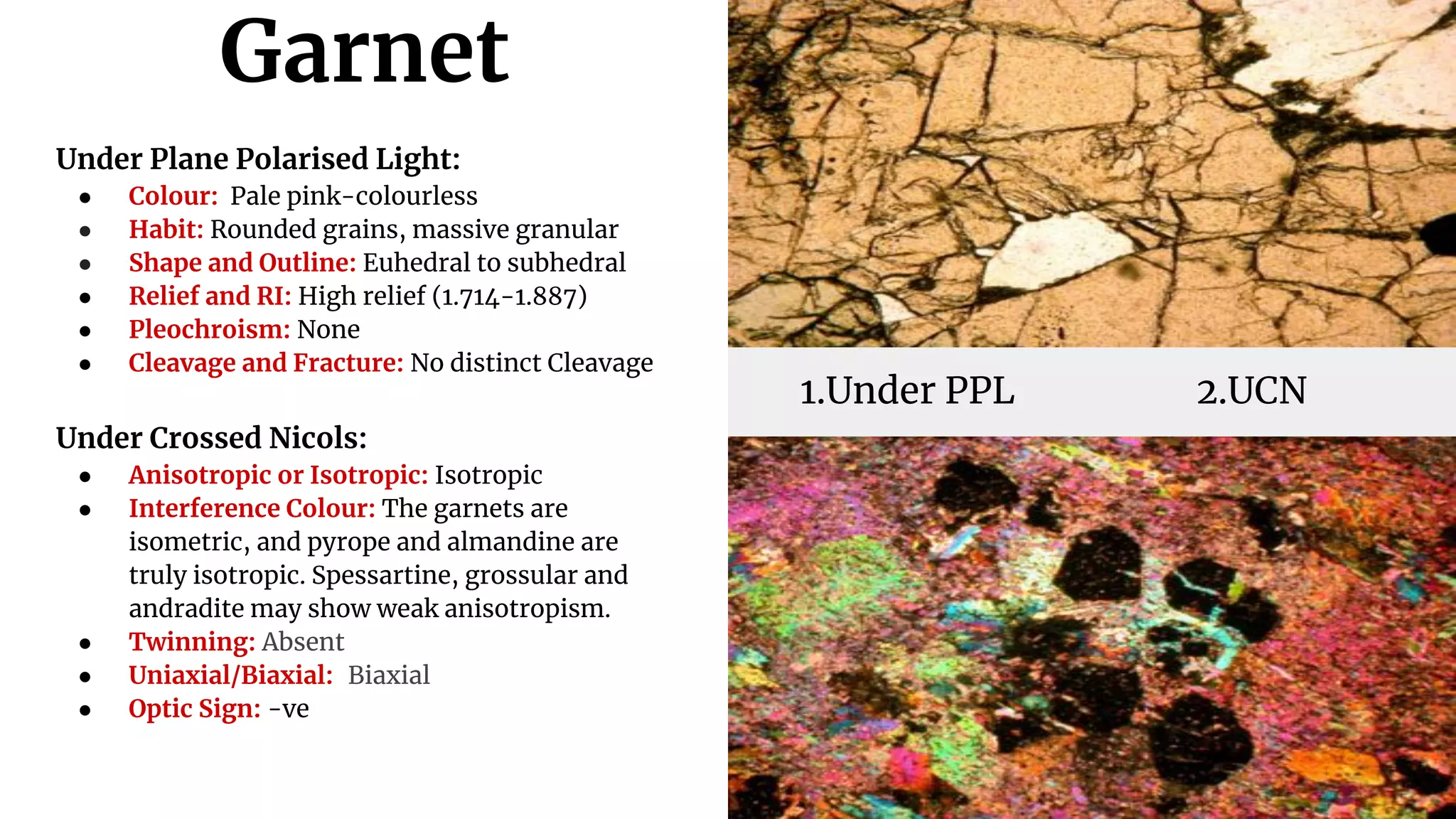
Garnet
Under Plane Polarised Light:
● Colour: Pale pink-colourless
● Habit: Rounded grains, massive granular
● Shape and Outline: Euhedral to subhedral
● Relief and RI: High relief (1.714-1.887)
● Pleochroism: None
● Cleavage and Fracture: No distinct Cleavage
Under Crossed Nicols:
● Anisotropic or Isotropic: Isotropic
● Interference Colour: The garnets are
isometric, and pyrope and almandine are
truly isotropic. Spessartine, grossular and
andradite may show weak anisotropism.
● Twinning: Absent
● Uniaxial/Biaxial: Biaxial
● Optic Sign: -ve
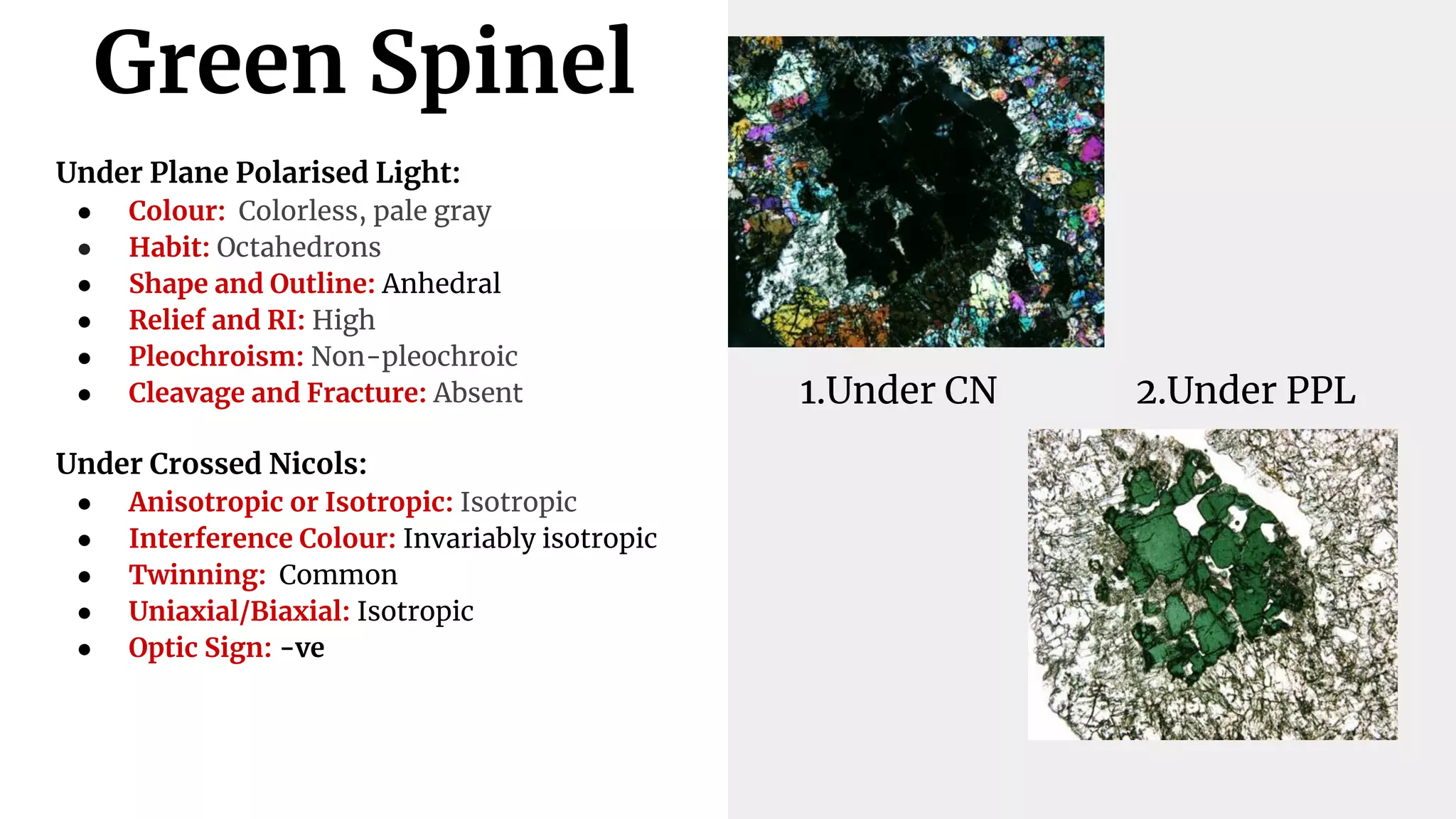
1.Under PPL 2.UCN
Green Spinel
Under Plane Polarised Light:
● Colour: Colorless, pale gray
● Habit: Octahedrons
● Shape and Outline: Anhedral
● Relief and RI: High
● Pleochroism: Non-pleochroic
● Cleavage and Fracture: Absent
Under Crossed Nicols:
● Anisotropic or Isotropic: Isotropic
● Interference Colour: Invariably isotropic
● Twinning: Common
● Uniaxial/Biaxial: Isotropic
● Optic Sign: -ve
1.Under CN 2.Under PPL
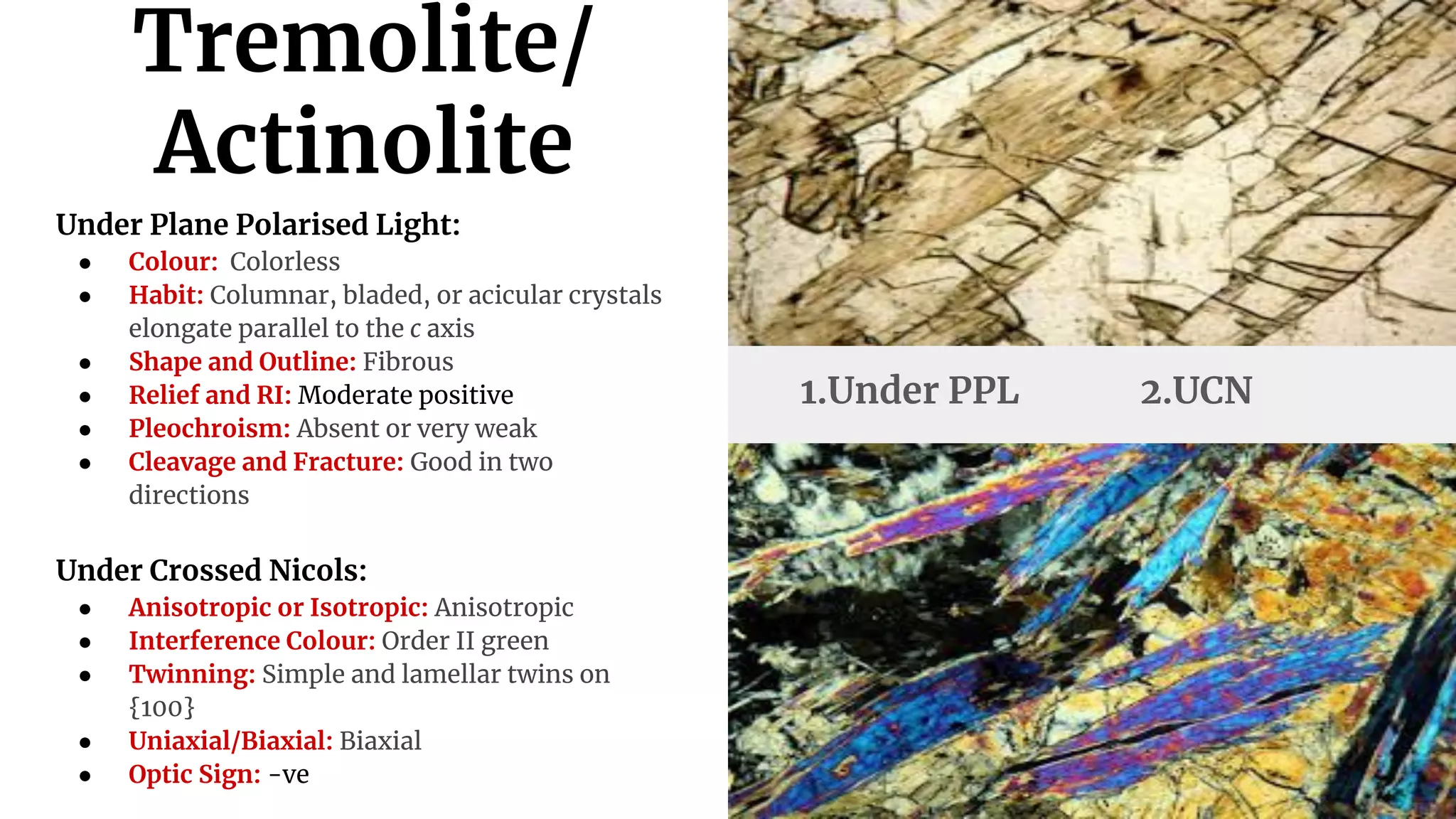
Tremolite/
Actinolite
Under Plane Polarised Light:
● Colour: Colorless
● Habit: Columnar, bladed, or acicular crystals
elongate parallel to the c axis
● Shape and Outline: Fibrous
● Relief and RI: Moderate positive
● Pleochroism: Absent or very weak
● Cleavage and Fracture: Good in two
directions
Under Crossed Nicols:
● Anisotropic or Isotropic: Anisotropic
● Interference Colour: Order II green
● Twinning: Simple and lamellar twins on
{100}
● Uniaxial/Biaxial: Biaxial
● Optic Sign: -ve
1.Under PPL 2.UCN
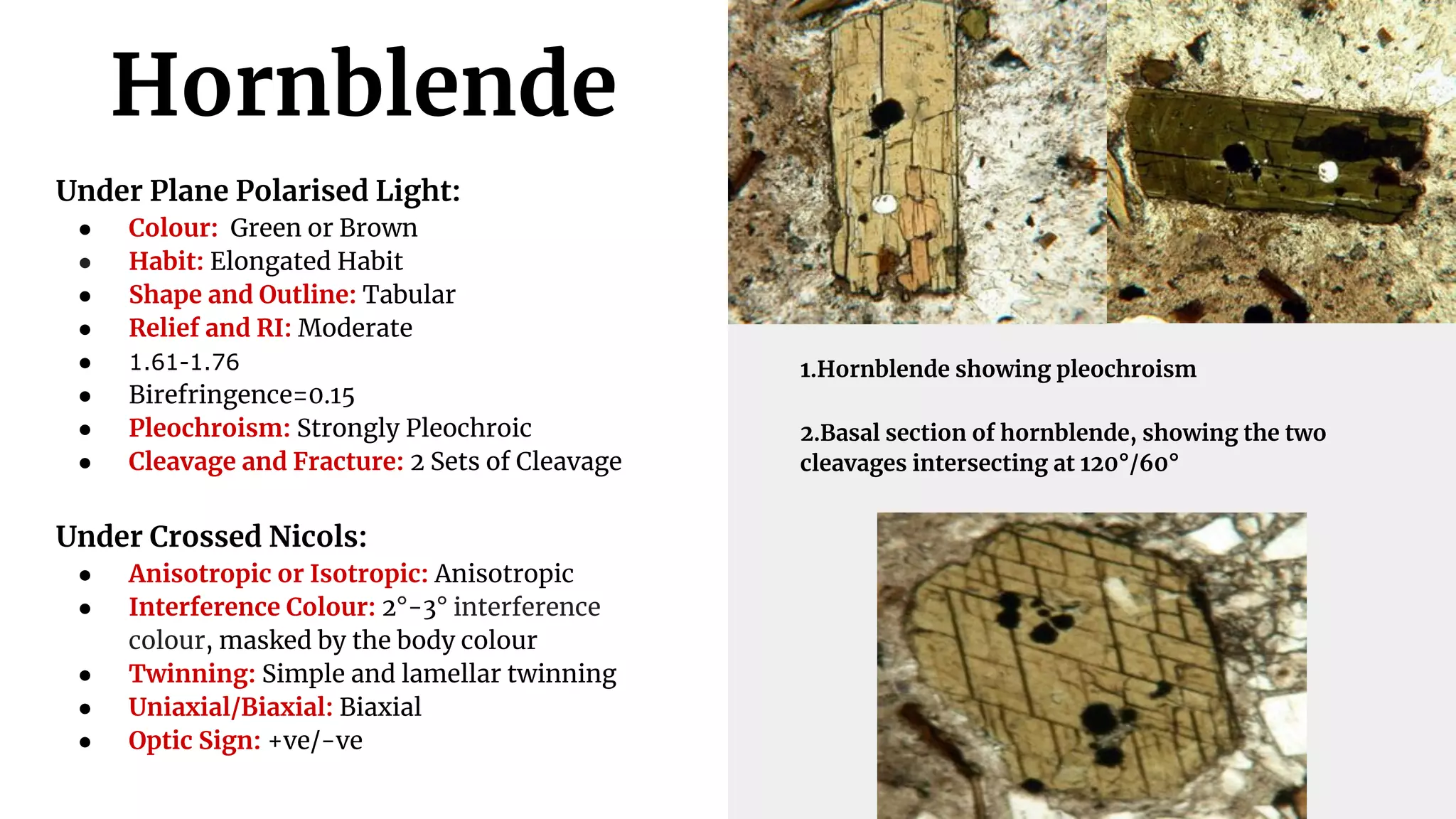
Hornblende
Under Plane Polarised Light:
● Colour: Green or Brown
● Habit: Elongated Habit
● Shape and Outline: Tabular
● Relief and RI: Moderate
● 1.61-1.76
● Birefringence=0.15
● Pleochroism: Strongly Pleochroic
● Cleavage and Fracture: 2 Sets of Cleavage
Under Crossed Nicols:
● Anisotropic or Isotropic: Anisotropic
● Interference Colour: 2°-3° interference
colour, masked by the body colour
● Twinning: Simple and lamellar twinning
● Uniaxial/Biaxial: Biaxial
● Optic Sign: +ve/-ve
1.Hornblende showing pleochroism
2.Basal section of hornblende, showing the two
cleavages intersecting at 120°/60°
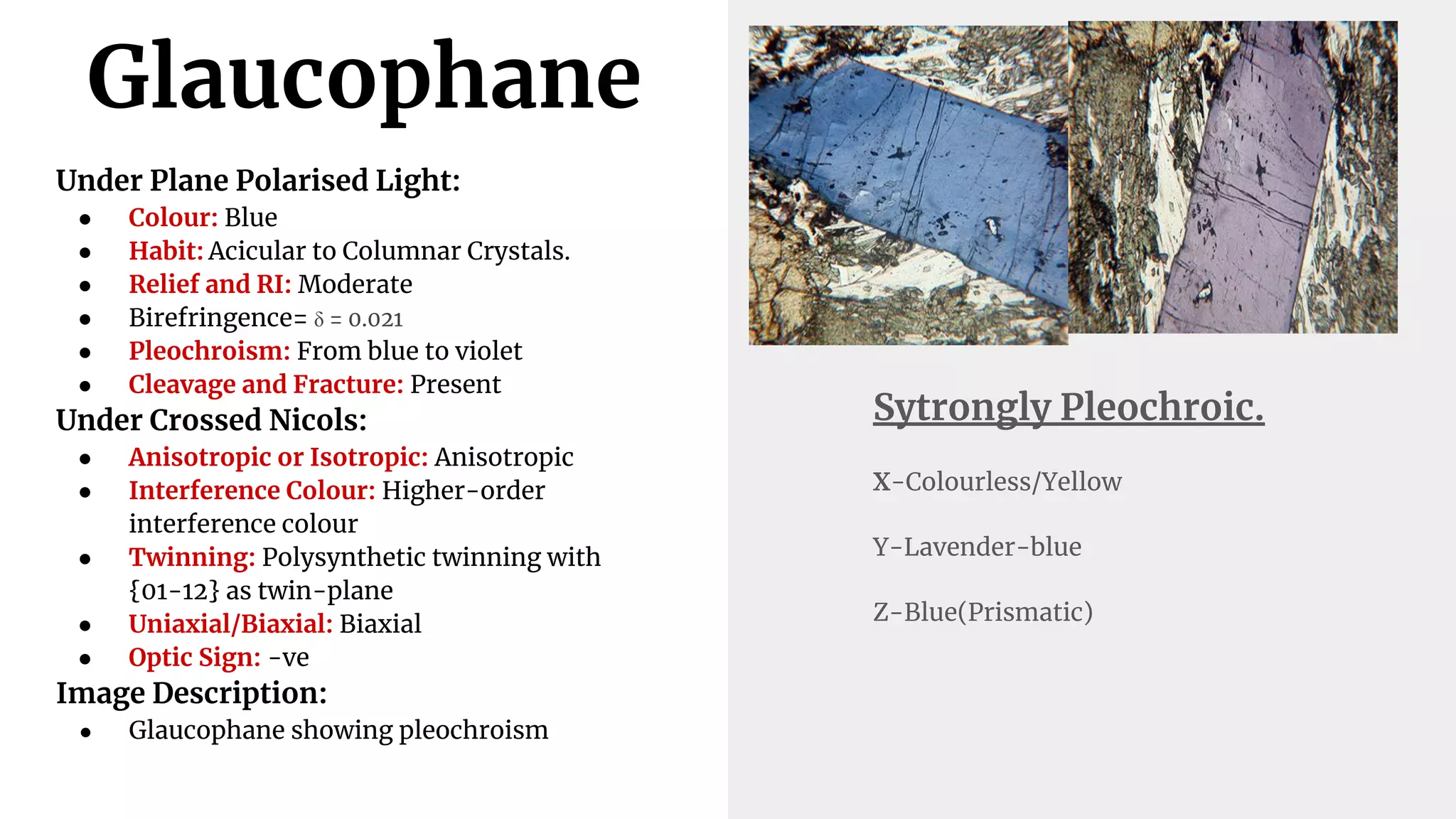
Glaucophane
Under Plane Polarised Light:
● Colour: Blue
● Habit: Acicular to Columnar Crystals.
● Relief and RI: Moderate
● Birefringence= δ = 0.021
● Pleochroism: From blue to violet
● Cleavage and Fracture: Present
Under Crossed Nicols:
● Anisotropic or Isotropic: Anisotropic
● Interference Colour: Higher-order
interference colour
● Twinning: Polysynthetic twinning with
{01-12} as twin-plane
● Uniaxial/Biaxial: Biaxial
● Optic Sign: -ve
Image Description:
● Glaucophane showing pleochroism
Sytrongly Pleochroic.
X-Colourless/Yellow
Y-Lavender-blue
Z-Blue(Prismatic)
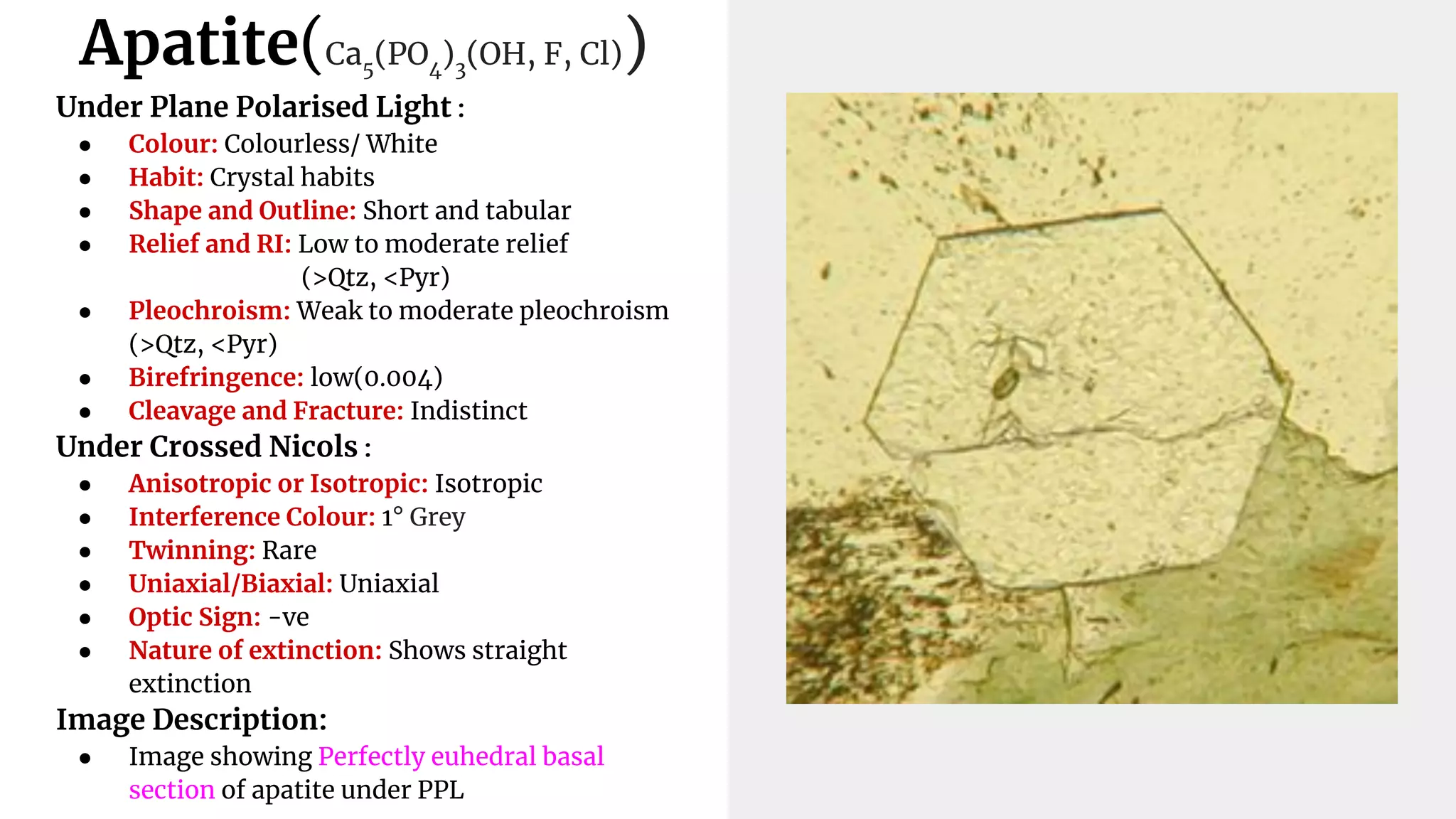
Apatite(Ca5
(PO4
)3
(OH, F, Cl))
Under Plane Polarised Light :
● Colour: Colourless/ White
● Habit: Crystal habits
● Shape and Outline: Short and tabular
● Relief and RI: Low to moderate relief
(>Qtz, <Pyr)
● Pleochroism: Weak to moderate pleochroism
(>Qtz, <Pyr)
● Birefringence: low(0.004)
● Cleavage and Fracture: Indistinct
Under Crossed Nicols :
● Anisotropic or Isotropic: Isotropic
● Interference Colour: 1° Grey
● Twinning: Rare
● Uniaxial/Biaxial: Uniaxial
● Optic Sign: -ve
● Nature of extinction: Shows straight
extinction
Image Description:
● Image showing Perfectly euhedral basal
section of apatite under PPL
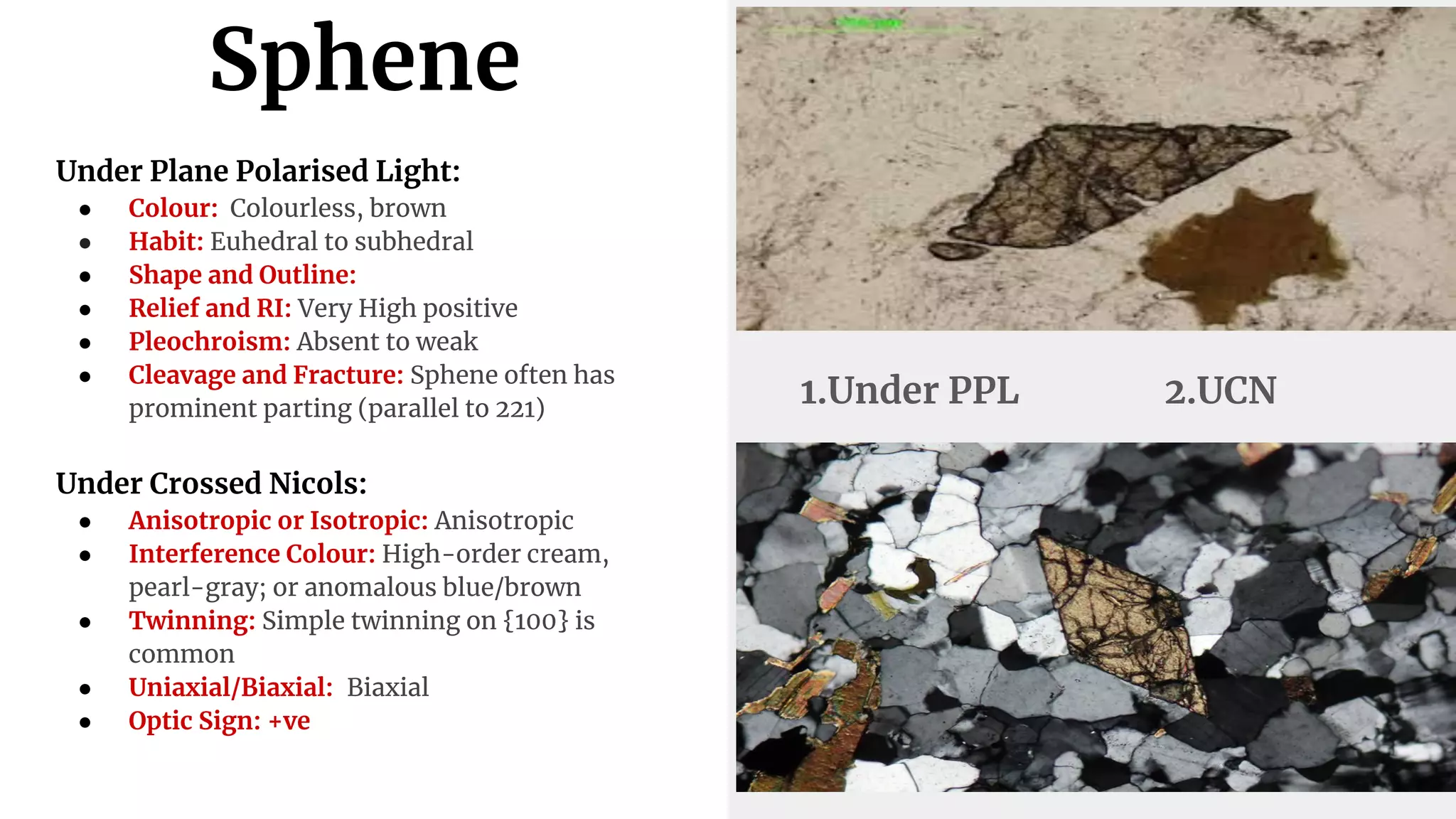
Sphene
Under Plane Polarised Light:
● Colour: Colourless, brown
● Habit: Euhedral to subhedral
● Shape and Outline:
● Relief and RI: Very High positive
● Pleochroism: Absent to weak
● Cleavage and Fracture: Sphene often has
prominent parting (parallel to 221)
Under Crossed Nicols:
● Anisotropic or Isotropic: Anisotropic
● Interference Colour: High-order cream,
pearl-gray; or anomalous blue/brown
● Twinning: Simple twinning on {100} is
common
● Uniaxial/Biaxial: Biaxial
● Optic Sign: +ve
1.Under PPL 2.UCN
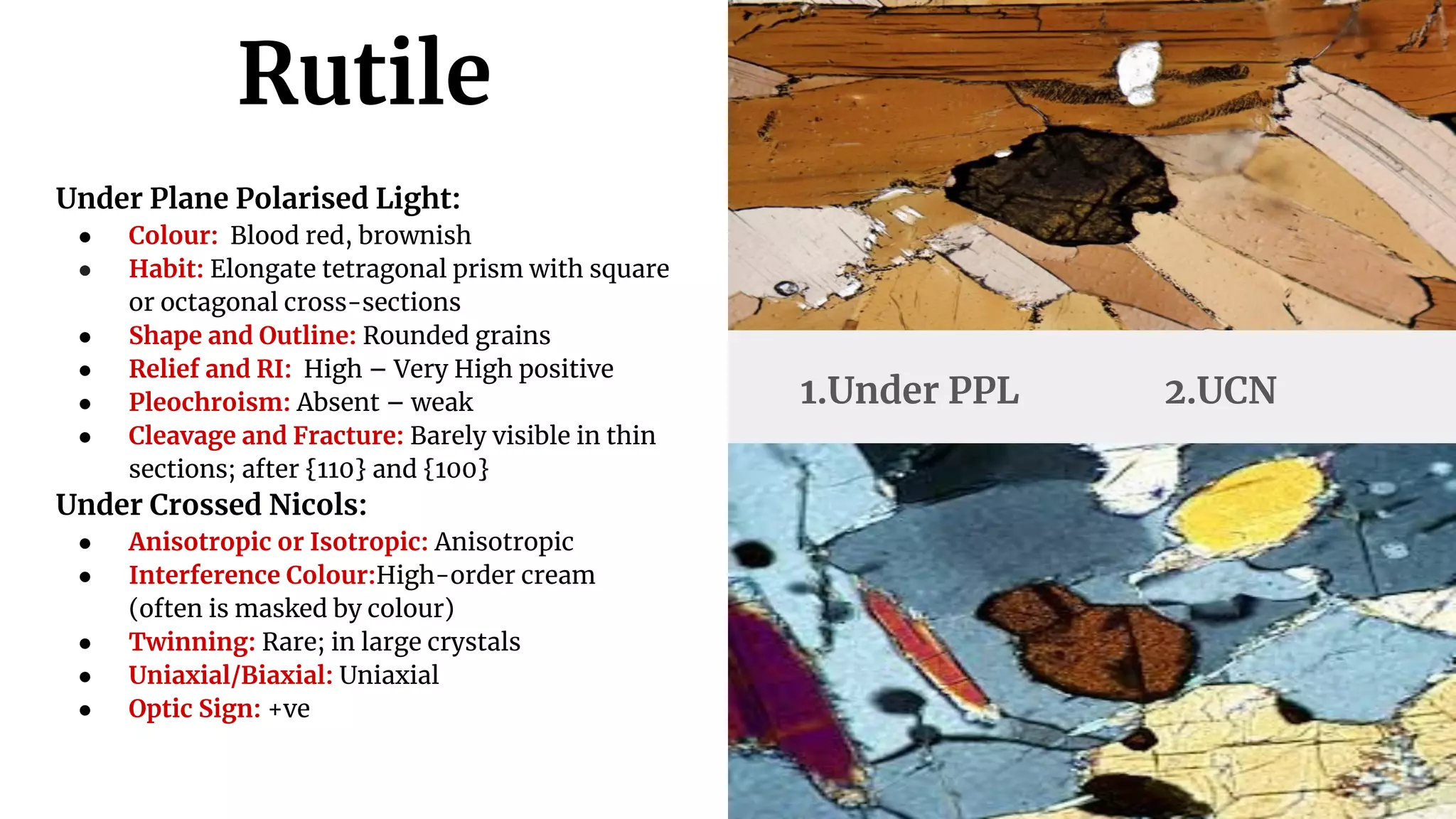
Rutile
Under Plane Polarised Light:
● Colour: Blood red, brownish
● Habit: Elongate tetragonal prism with square
or octagonal cross-sections
● Shape and Outline: Rounded grains
● Relief and RI: High – Very High positive
● Pleochroism: Absent – weak
● Cleavage and Fracture: Barely visible in thin
sections; after {110} and {100}
Under Crossed Nicols:
● Anisotropic or Isotropic: Anisotropic
● Interference Colour:High-order cream
(often is masked by colour)
● Twinning: Rare; in large crystals
● Uniaxial/Biaxial: Uniaxial
● Optic Sign: +ve
1.Under PPL 2.UCN
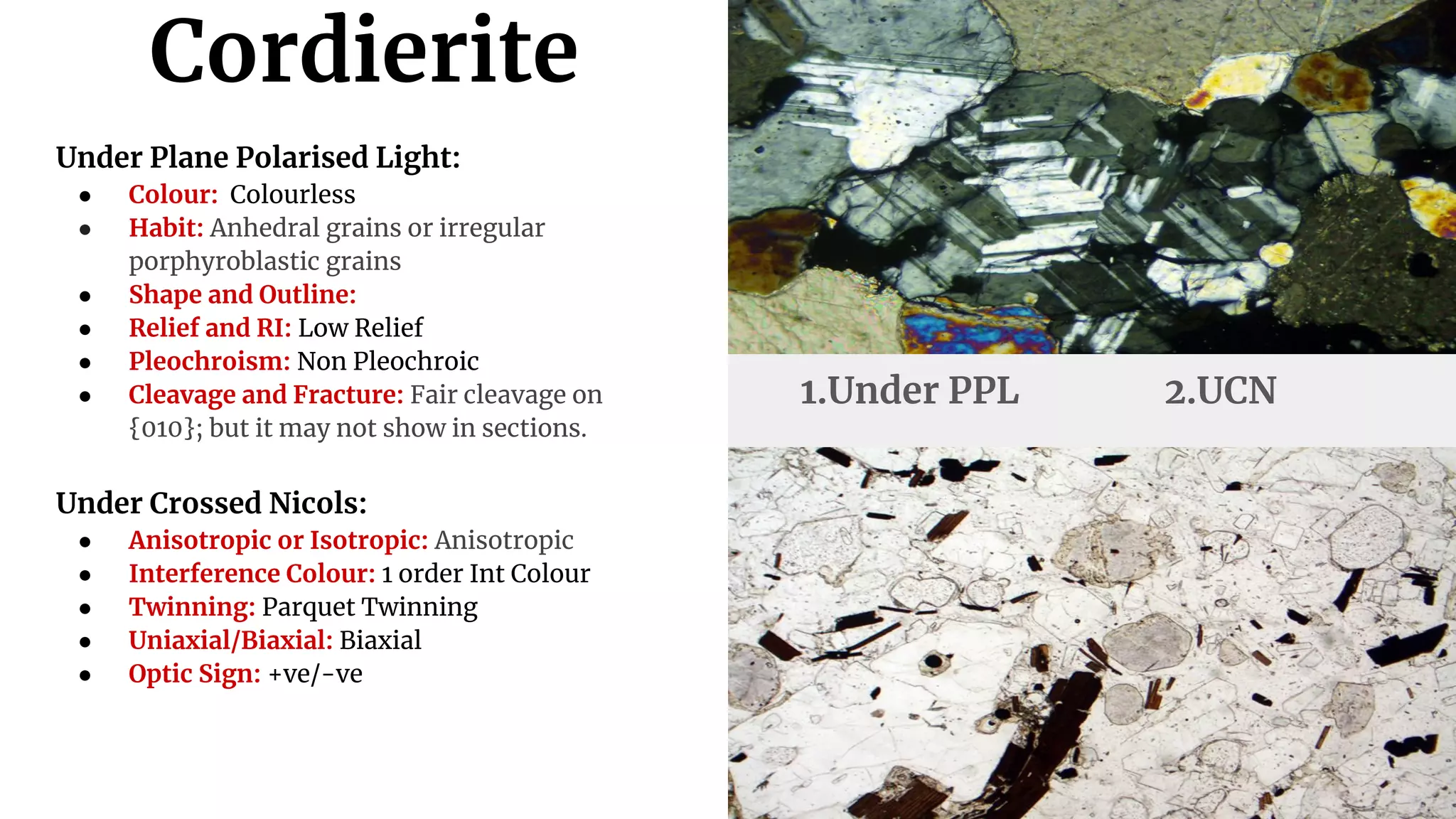
Cordierite
Under Plane Polarised Light:
● Colour: Colourless
● Habit: Anhedral grains or irregular
porphyroblastic grains
● Shape and Outline:
● Relief and RI: Low Relief
● Pleochroism: Non Pleochroic
● Cleavage and Fracture: Fair cleavage on
{010}; but it may not show in sections.
Under Crossed Nicols:
● Anisotropic or Isotropic: Anisotropic
● Interference Colour: 1 order Int Colour
● Twinning: Parquet Twinning
● Uniaxial/Biaxial: Biaxial
● Optic Sign: +ve/-ve
1.Under PPL 2.UCN
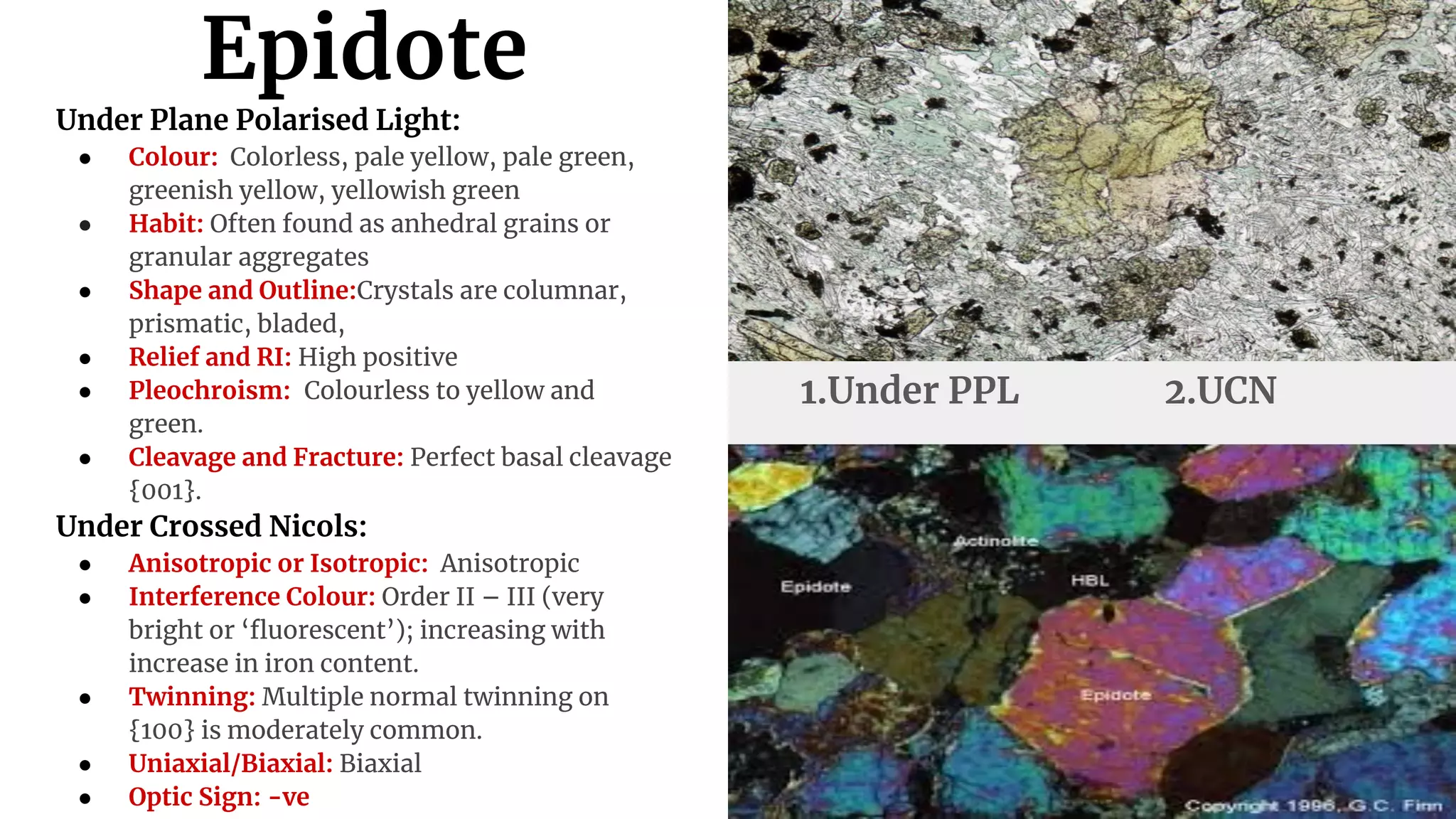
Epidote
Under Plane Polarised Light:
● Colour: Colorless, pale yellow, pale green,
greenish yellow, yellowish green
● Habit: Often found as anhedral grains or
granular aggregates
● Shape and Outline:Crystals are columnar,
prismatic, bladed,
● Relief and RI: High positive
● Pleochroism: Colourless to yellow and
green.
● Cleavage and Fracture: Perfect basal cleavage
{001}.
Under Crossed Nicols:
● Anisotropic or Isotropic: Anisotropic
● Interference Colour: Order II – III (very
bright or ‘fluorescent’); increasing with
increase in iron content.
● Twinning: Multiple normal twinning on
{100} is moderately common.
● Uniaxial/Biaxial: Biaxial
● Optic Sign: -ve
1.Under PPL 2.UCN
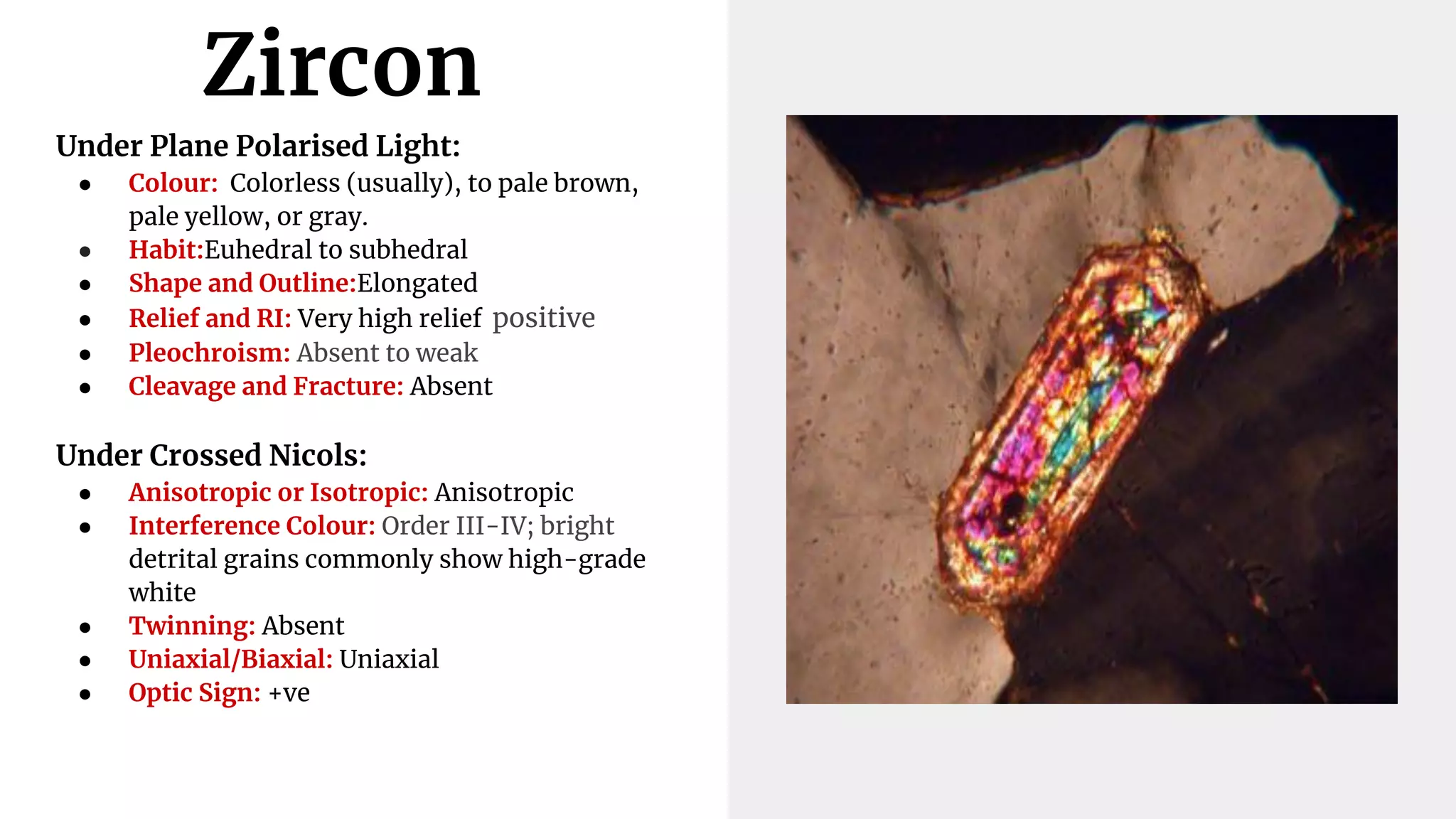
Zircon
Under Plane Polarised Light:
● Colour: Colorless (usually), to pale brown,
pale yellow, or gray.
● Habit:Euhedral to subhedral
● Shape and Outline:Elongated
● Relief and RI: Very high relief positive
● Pleochroism: Absent to weak
● Cleavage and Fracture: Absent
Under Crossed Nicols:
● Anisotropic or Isotropic: Anisotropic
● Interference Colour: Order III-IV; bright
detrital grains commonly show high-grade
white
● Twinning: Absent
● Uniaxial/Biaxial: Uniaxial
● Optic Sign: +ve
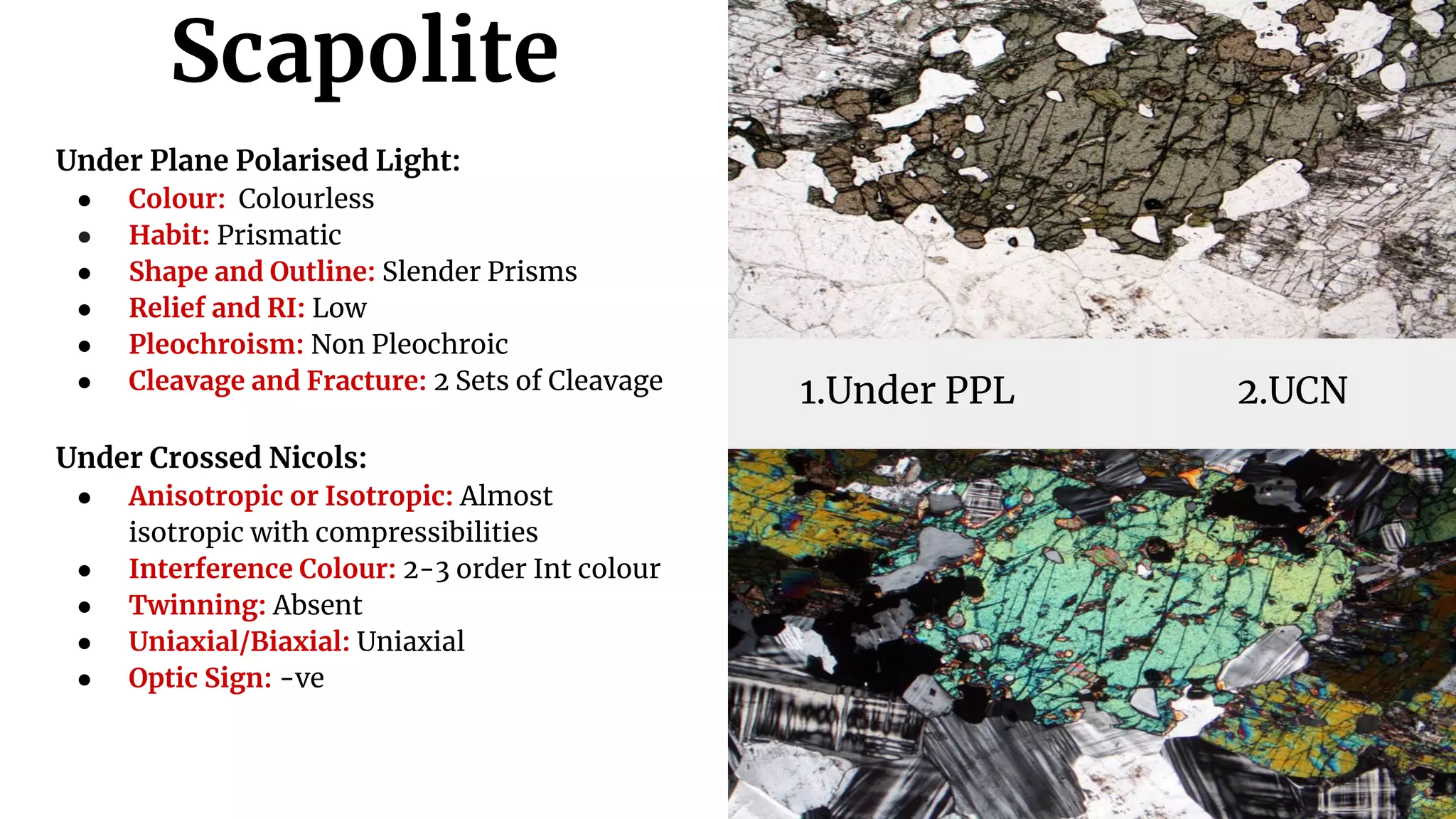
Scapolite
Under Plane Polarised Light:
● Colour: Colourless
● Habit: Prismatic
● Shape and Outline: Slender Prisms
● Relief and RI: Low
● Pleochroism: Non Pleochroic
● Cleavage and Fracture: 2 Sets of Cleavage
Under Crossed Nicols:
● Anisotropic or Isotropic: Almost
isotropic with compressibilities
● Interference Colour: 2-3 order Int colour
● Twinning: Absent
● Uniaxial/Biaxial: Uniaxial
● Optic Sign: -ve
1.Under PPL 2.UCN
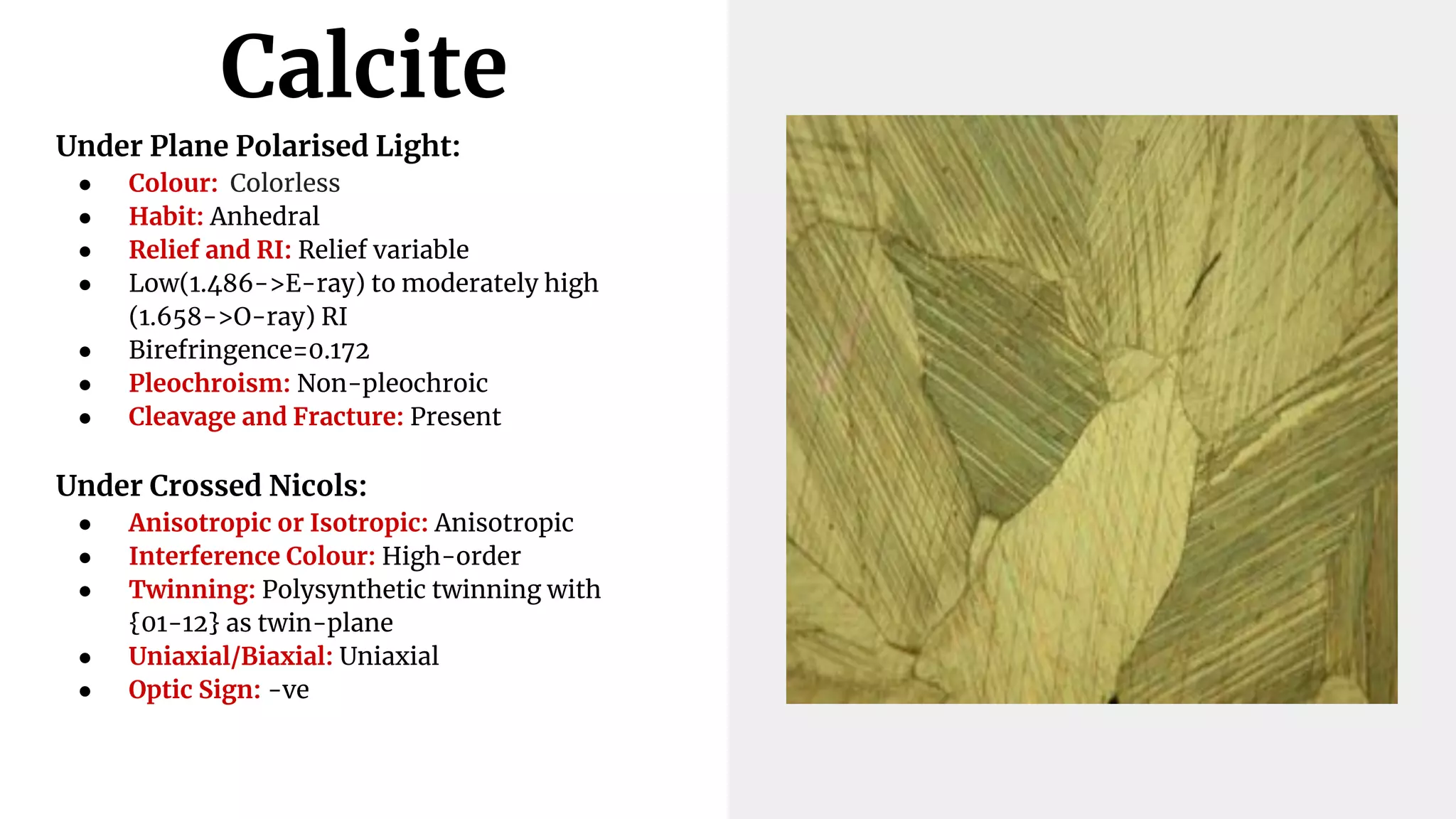
Calcite
Under Plane Polarised Light:
● Colour: Colorless
● Habit: Anhedral
● Relief and RI: Relief variable
● Low(1.486->E-ray) to moderately high
(1.658->O-ray) RI
● Birefringence=0.172
● Pleochroism: Non-pleochroic
● Cleavage and Fracture: Present
Under Crossed Nicols:
● Anisotropic or Isotropic: Anisotropic
● Interference Colour: High-order
● Twinning: Polysynthetic twinning with
{01-12} as twin-plane
● Uniaxial/Biaxial: Uniaxial
● Optic Sign: -ve
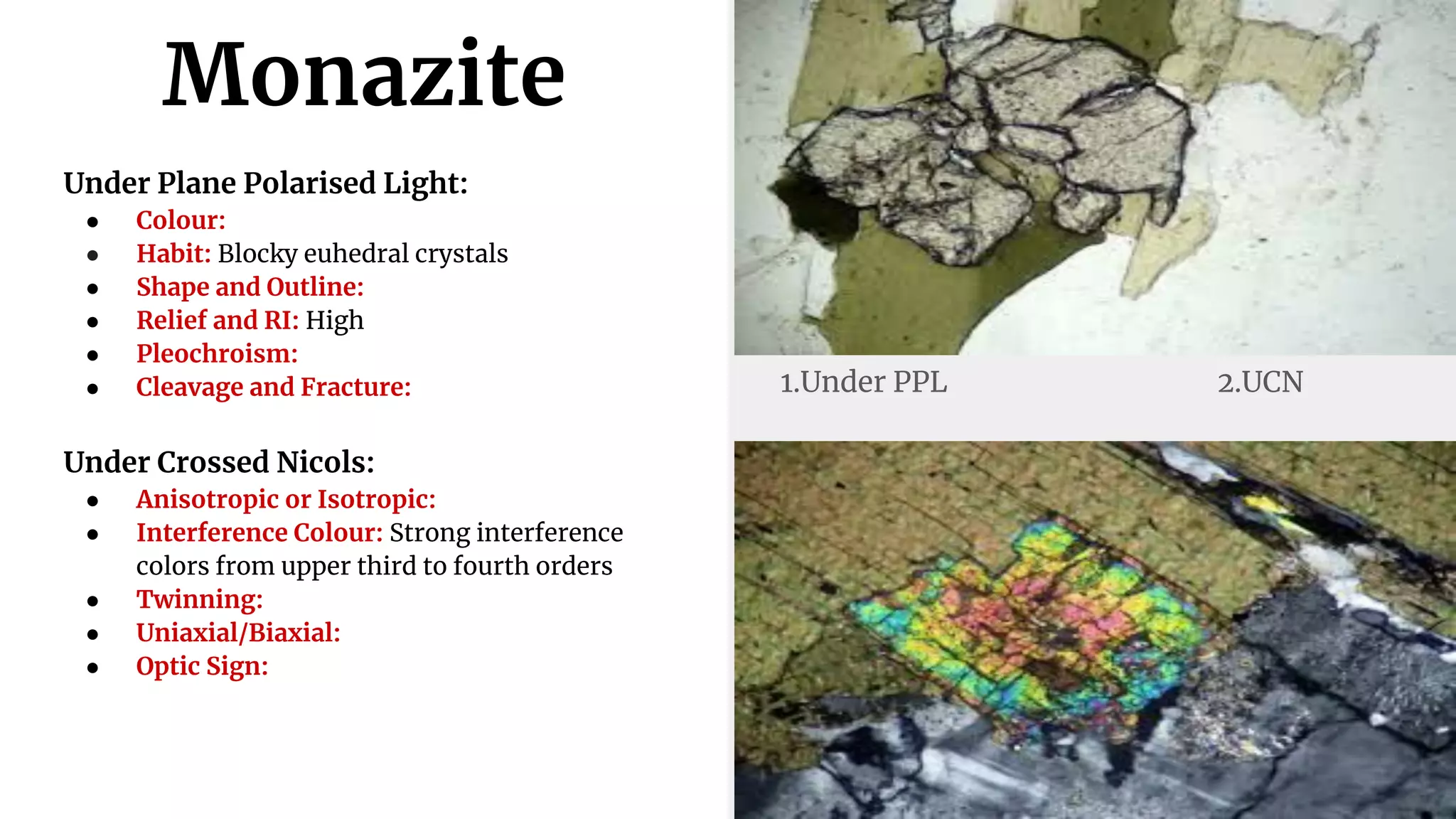
Monazite
Under Plane Polarised Light:
● Colour:
● Habit: Blocky euhedral crystals
● Shape and Outline:
● Relief and RI: High
● Pleochroism:
● Cleavage and Fracture:
Under Crossed Nicols:
● Anisotropic or Isotropic:
● Interference Colour: Strong interference
colors from upper third to fourth orders
● Twinning:
● Uniaxial/Biaxial:
● Optic Sign:
1.Under PPL 2.UCN
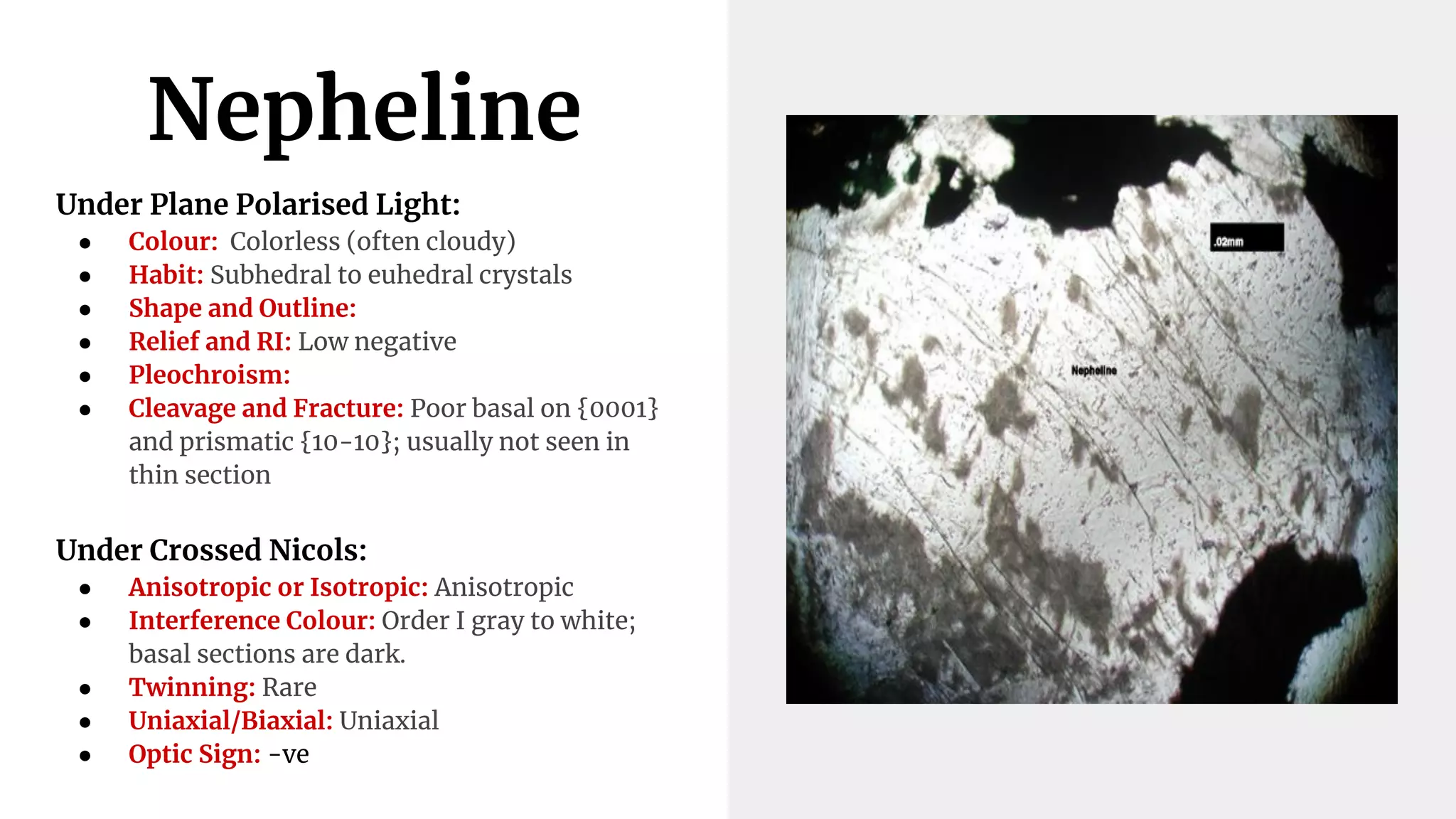
Nepheline
Under Plane Polarised Light:
● Colour: Colorless (often cloudy)
● Habit: Subhedral to euhedral crystals
● Shape and Outline:
● Relief and RI: Low negative
● Pleochroism:
● Cleavage and Fracture: Poor basal on {0001}
and prismatic {10-10}; usually not seen in
thin section
Under Crossed Nicols:
● Anisotropic or Isotropic: Anisotropic
● Interference Colour: Order I gray to white;
basal sections are dark.
● Twinning: Rare
● Uniaxial/Biaxial: Uniaxial
● Optic Sign: -ve

Microscopic Mineralogy- the study of minerals under microscope

  • 1.
  • 2.
  • 3.
    OPTICAL PROPERTIES OFMINERALS I. UNDER PLANE POLARISED LIGHT ● Colour ● Relief ● Pleochroism: Pleochroic/Non-Pleochroic ● Pleochroic Scheme: ● Uniaxial Mineral: E= Colour P; O = Colour Q ● Biaxial Mineral: X= Colour P; Y = Colour Q; Z = Colour R ● Habit: Equant/Ovoid/Elongated/Prismatic/Tabular/Acicula r/Flaky etc ● Shape: Euhedral/Subhedral/Anhedral ● Cleavage/Fracture ● E(i) Cleavage angle for minerals with more than 1 set of cleavage:
  • 4.
    OPTICAL PROPERTIES OFMINERALS II. UNDER CROSSED NICOLS ● Isotropic/Anisotropic ● Nature of Extinction in anisotropic minerals: Straight/Inclined (i) Extinction Angle: ● Interference Colour and its Order: ● Twinning ● Optic Sign: Uniaxial (+ve/-Ve)/Biaxial (+ve/-ve)
  • 5.
    Minerals to bestudied:- 30 Quartz (I/M) Chloritoid(M) Apatite(I) Microcline(I) Orthopyroxene(I/M) Sphene(I/M) Orthoclase(I/M) Clinopyroxene(I) Rutile(M) Plagioclase(I/M) Olivine(I/M) Cordierite(M) Tourmaline Staurolite(M) Epidote(M/I) Biotite(M/I) Garnet(M) Zircon(I/M) Chlorite(M) Green Spinel(M) Scapolite(M) Muscovite(M/I) Tremolite/Actinolite(M) Calcite(M/I) Kyanite(M) Hornblende(M) Monazite(M) Sillimanite(M) Glaucophane Nepheline(I)
  • 6.
    Sialic Minerals AccessoryMinerals Feldspars Apatite Nepheline Monazite Quartz Zircon Rare Accessory Minerals Femic Minerals Calcite Amphiboles Cordierite Biotite Garnet Olivine Muscovite Pyroxene Rutile Scapolite Alteration products Sphene Chlorite Tourmaline
  • 7.
    Quartz Under Plane PolarisedLight: ● Colour: Colourless ● Shape and Outline: Anhedral ● Relief and RI: Low relief ● Birefringence: Low birefringence ● Pleochroism: Non-pleochroic ● Cleavage and Fracture: Absence of cleavage Under Crossed Nicols: ● Anisotropic or Isotropic: Anisotropic ● Interference Colour: 1° Yellow ● Twinning: No Twinning ● Uniaxial/Biaxial: Uniaxial ● Optic Sign: +ve
  • 8.
    Microcline Under Plane PolarisedLight ● Colour: Colourless ● Habit: Irregular, equant ● Shape and Outline: Anhedral to subhedral ● Relief and RI: Low relief (<Qtz) ● Pleochroism: Non-pleochroic ● Cleavage and Fracture: Present Under Crossed Nicols: ● Anisotropic or Isotropic: Anisotropic ● Interference Colour: 1° Grey ● Twinning: Cross-Hatched / Tartan Twinning ● Uniaxial/Biaxial: Biaxial ● Optic Sign: -ve ● Nature of extinction: Inclined Image Description: ● Image showing CROSS HATCHED TWINNING in microcline
  • 9.
    Orthoclase Under Plane PolarisedLight: ● Colour: Colourless ● Habit: Elongated tabular grains ● Crystal system: Monoclinic ● Shape and Outline: Anhedral to subhedral ● Relief and RI: Low relief (<Qtz) ● Pleochroism: Non-pleochroic ● Cleavage and Fracture: Present Under Crossed Nicols: ● Anisotropic or Isotropic: Anisotropic ● Interference Colour: 1° Grey ● Twinning: Carlsbad Twinning ● Uniaxial/Biaxial: Biaxial ● Optic Sign: -ve ● Nature of extinction: Inclined or parallel extinction Image Description: ● Image showing Zoned crystal of orthoclase under XPL
  • 10.
    Plagioclase Under Plane PolarisedLight: ● Colour: Colourless ● Shape and Outline: Lath shaped ● Relief and RI: Low relief ● Pleochroism: Non-pleochroic ● Cleavage and Fracture: Cleavage present Under Crossed Nicols: ● Anisotropic or Isotropic: Isotropic ● Interference Colour: 1° Grey ● Twinning: Lamellar Twinning ● Uniaxial/Biaxial: Biaxial ● Optic Sign: -ve/+ve Image Description: ● In the figure, plagioclase is identified by low relief and lamellar twinning.
  • 11.
    Tourmaline Under Plane PolarisedLight: ● Colour: Green to Dark Green to Brown ● Habit: Acicular ● Shape and Outline: Prismatic crystals with striations ● Relief and RI: Moderately high relief ● Pleochroism: Strongly dichroic ● E-Light green/light pink ● O-Dark Green ● Cleavage and Fracture: Transverse fracture present, no cleavage. Under Crossed Nicols: ● Anisotropic or Isotropic: Anisotropic ● Nature of extinction: Straight extinction ● Interference Colour: 2° Interference colour ● Twinning: Absent ● Uniaxial/Biaxial: Uniaxial ● Optic Sign: -ve Image Description ● Figure showing tourmaline with 2° Interference colour
  • 12.
    Biotite Under Plane PolarisedLight: ● Colour: Yellow to Dark Brown ● Habit: Flaky habit ● Shape: Tabular to prismatic ● Crystal system: Monoclinic ● Relief and RI: Moderate relief ● Pleochroism: Strongly pleochroic ● Cleavage and Fracture: 1 set of Basal cleavage Under Crossed Nicols: ● Anisotropic or Isotropic: Isotropic ● Nature of extinction: Straight extinction ● Interference Colour: High order interference colour ● Twinning: None, Twin axis[310] ● Uniaxial/Biaxial: Biaxial ● Optic Sign: -ve Image Description: ● Image showing Zircon inclusions in Biotite sample
  • 13.
    ChloriteUnder Plane PolarisedLight: ● Colour: Pale Green to Green ● Habit: Tabular ● Shape and Outline: Found as scales or plates similar to micas ● Relief and RI: Moderate relief ● Pleochroism: Strongly pleochroic ● Cleavage and Fracture: 1 set of perfect cleavage Under Crossed Nicols: ● Anisotropic or Isotropic: Anisotropic ● Nature of extinction: Straight Extinction ● Interference Colour: 1° Interference colour (Ink Blue) ● Twinning: Multiple twinning on {001} is common ● Uniaxial/Biaxial: Biaxial Image Description: ● Upper image showing Chlorite sample under PPL showing pale green colour while lower one is under CN showing Ink blue colour
  • 14.
    Muscovite Under Plane PolarisedLight: ● Colour: Colourless ● Habit: Flaky habit ● Relief and RI: Moderate Relief ● Pleochroism: Non-pleochroic ● Shades of yellow and brown ● Cleavage and Fracture: 1 set perfect basal cleavage Under Crossed Nicols: ● Anisotropic or Isotropic: Anisotropic ● Nature of extinction: Straight extinction ● Interference Colour: 3°- 4° interference colour ● Twinning: Twin-plane {110} may be present ● Uniaxial/Biaxial: Biaxial ● Optic Sign: -ve Image Description: ● The higher birefringence of muscovite distinguishes it from other micas ● Figure showing muscovite in schists
  • 15.
    Kyanite Under Plane PolarisedLight: ● Colour: Colourless ● Habit: Bladed habit ● Shape and Outline: Elongated ● Relief and RI: Very high relief ● Pleochroism: Non-pleochroic ● Cleavage and Fracture: 1 set cleavage Under Crossed Nicols: ● Anisotropic or Isotropic: Anisotropic ● Nature of extinction: Inclined extinction ● Interference Colour: 1° interference colour ● Twinning: Twinning is frequent ● Uniaxial/Biaxial: Biaxial ● Optic Sign: -ve
  • 16.
    Sillimanite Under Plane PolarisedLight: ● Colour: Colourless ● Habit: Acicular ● Shape and Outline: Elongated ● Relief and RI: Moderately high relief ● Pleochroism: Non-pleochroic ● Cleavage and Fracture: 1 set Basal cleavage Under Crossed Nicols: ● Anisotropic or Isotropic: Anisotropic ● Nature of extinction: Straight extinction ● Interference Colour: 2° interference colour ● Twinning: Absent ● Uniaxial/Biaxial: Biaxial ● Optic Sign: +ve
  • 17.
    Chloritoid Under Plane PolarisedLight: ● Colour: Lavender Blue - Pale Blue - Pale Yellow ● Habit: Tabular ● Shape and Outline: Euhedral ● Relief and RI: High relief ● Pleochroism: Strongly pleochroic (From a dark inky-blue to yellow) ● Cleavage and Fracture: 1 set of perfect Cleavage Under Crossed Nicols: ● Anisotropic or Isotropic: Anisotropic (Magnetic) ● Nature of extinction: Low extinction angle ● Interference Colour: 1°- 2° interference colour ● Twinning: Present ● Uniaxial/Biaxial: Biaxial ● Optic Sign: +ve/-ve
  • 18.
    Orthopyroxene A) ENSTATITE Under PlanePolarised Light: ● Colour: Colourless ● Habit: Euhedral ● Shape and Outline: Equant ● Relief and RI: Moderately high relief ● Pleochroism: Non-pleochroic ● Cleavage and Fracture: Cleavage in two directions intersecting nearly at right angles Under Crossed Nicols: ● Anisotropic or Isotropic: Isotropic ● Nature of extinction: Straight extinction ● Interference Colour: 1° interference colour ● Twinning: A simple twinning along {100} ● Uniaxial/Biaxial: Biaxial ● Optic Sign: +ve
  • 19.
    Orthopyroxene B) FERROSILITE Under PlanePolarised Light: ● Colour: Pale Green (z); Yellow (y); Pale Pink (x) ● Habit: Massive ● Shape and Outline: Equant ● Relief and RI: Moderate relief ● Pleochroism: Pleochroic ● Cleavage and Fracture: 2 sets of cleavage Under Crossed Nicols: ● Anisotropic or Isotropic: Isotropic ● Nature of extinction: Straight extinction ● Interference Colour: 1°- 2° interference colour ● Twinning: Twinning on {100} ● Uniaxial/Biaxial: Biaxial ● Optic Sign: -ve
  • 20.
    Clinopyroxene A) Diopside(mg-rich) Under PlanePolarised Light: ● Colour: Colourless (Di rich) ● Habit: Equant ● Shape and Outline: Euhedral ● Relief and RI: Moderately high relief ● Pleochroism: Absent ● Cleavage and Fracture: 2 sets of Cleavage Under Crossed Nicols: ● Anisotropic or Isotropic: Anisotropic ● Nature of extinction: Inclined extinction (Z^C~=40°) ● Interference Colour: 2° interference colour ● Twinning: Present ● Uniaxial/Biaxial: Biaxial ● Optic Sign: +ve Special feature: ● Distinguished from Orthopyroxene by the higher birefringence
  • 21.
    Clinopyroxene B) Hedenbergite(Fe-rich) Under PlanePolarised Light: ● Colour: Pale to Dark Green ● Habit: Equant ● Shape and Outline: Euhedral ● Relief and RI: Moderately high relief ● Pleochroism: Absent ● Cleavage and Fracture: 2 sets of Cleavage Under Crossed Nicols: ● Anisotropic or Isotropic: Anisotropic ● Nature of extinction: Inclined extinction (Z^C~=40°) ● Interference Colour: 2° interference colour ● Twinning: Present ● Uniaxial/Biaxial: Biaxial ● Optic Sign: +ve Special feature: ● Distinguished from Orthopyroxene by the higher birefringence
  • 22.
    Olivine Under Plane PolarisedLight: ● Colour: Colourless ● Habit: Equant ● Shape and Outline: Oval ● Relief and RI: Moderate relief ● Pleochroism: Non-pleochroic ● Cleavage and Fracture: Cleavage absent; ● Fractures present Under Crossed Nicols: ● Anisotropic or Isotropic: Anisotropic ● Nature of extinction: Straight extinction ● Interference Colour: High 2° interference colour ● Twinning: Absent ● Uniaxial/Biaxial: Biaxial ● Optic Sign: +ve/-ve
  • 23.
    Staurolite Under Plane PolarisedLight: ● Colour: Dark Brown, Reddish-brown, Yellow-brown; ● pale golden yellow in thin section. ● Habit: Euhedral Prismatic ● Shape and Outline: ● Relief and RI: High relief ● Pleochroism: Yellow to colourless ● Cleavage and Fracture: 1 set of cleavage ● Subconchoidal fracture Under Crossed Nicols: ● Anisotropic or Isotropic: Anisotropic ● Interference Colour: 1° Grey ● Twinning: Rarely observed in thin sections ● Uniaxial/Biaxial: Biaxial ● Optic Sign: +ve
  • 24.
    Garnet Under Plane PolarisedLight: ● Colour: Pale pink-colourless ● Habit: Rounded grains, massive granular ● Shape and Outline: Euhedral to subhedral ● Relief and RI: High relief (1.714-1.887) ● Pleochroism: None ● Cleavage and Fracture: No distinct Cleavage Under Crossed Nicols: ● Anisotropic or Isotropic: Isotropic ● Interference Colour: The garnets are isometric, and pyrope and almandine are truly isotropic. Spessartine, grossular and andradite may show weak anisotropism. ● Twinning: Absent ● Uniaxial/Biaxial: Biaxial ● Optic Sign: -ve 1.Under PPL 2.UCN
  • 25.
    Green Spinel Under PlanePolarised Light: ● Colour: Colorless, pale gray ● Habit: Octahedrons ● Shape and Outline: Anhedral ● Relief and RI: High ● Pleochroism: Non-pleochroic ● Cleavage and Fracture: Absent Under Crossed Nicols: ● Anisotropic or Isotropic: Isotropic ● Interference Colour: Invariably isotropic ● Twinning: Common ● Uniaxial/Biaxial: Isotropic ● Optic Sign: -ve 1.Under CN 2.Under PPL
  • 26.
    Tremolite/ Actinolite Under Plane PolarisedLight: ● Colour: Colorless ● Habit: Columnar, bladed, or acicular crystals elongate parallel to the c axis ● Shape and Outline: Fibrous ● Relief and RI: Moderate positive ● Pleochroism: Absent or very weak ● Cleavage and Fracture: Good in two directions Under Crossed Nicols: ● Anisotropic or Isotropic: Anisotropic ● Interference Colour: Order II green ● Twinning: Simple and lamellar twins on {100} ● Uniaxial/Biaxial: Biaxial ● Optic Sign: -ve 1.Under PPL 2.UCN
  • 27.
    Hornblende Under Plane PolarisedLight: ● Colour: Green or Brown ● Habit: Elongated Habit ● Shape and Outline: Tabular ● Relief and RI: Moderate ● 1.61-1.76 ● Birefringence=0.15 ● Pleochroism: Strongly Pleochroic ● Cleavage and Fracture: 2 Sets of Cleavage Under Crossed Nicols: ● Anisotropic or Isotropic: Anisotropic ● Interference Colour: 2°-3° interference colour, masked by the body colour ● Twinning: Simple and lamellar twinning ● Uniaxial/Biaxial: Biaxial ● Optic Sign: +ve/-ve 1.Hornblende showing pleochroism 2.Basal section of hornblende, showing the two cleavages intersecting at 120°/60°
  • 28.
    Glaucophane Under Plane PolarisedLight: ● Colour: Blue ● Habit: Acicular to Columnar Crystals. ● Relief and RI: Moderate ● Birefringence= δ = 0.021 ● Pleochroism: From blue to violet ● Cleavage and Fracture: Present Under Crossed Nicols: ● Anisotropic or Isotropic: Anisotropic ● Interference Colour: Higher-order interference colour ● Twinning: Polysynthetic twinning with {01-12} as twin-plane ● Uniaxial/Biaxial: Biaxial ● Optic Sign: -ve Image Description: ● Glaucophane showing pleochroism Sytrongly Pleochroic. X-Colourless/Yellow Y-Lavender-blue Z-Blue(Prismatic)
  • 29.
    Apatite(Ca5 (PO4 )3 (OH, F, Cl)) UnderPlane Polarised Light : ● Colour: Colourless/ White ● Habit: Crystal habits ● Shape and Outline: Short and tabular ● Relief and RI: Low to moderate relief (>Qtz, <Pyr) ● Pleochroism: Weak to moderate pleochroism (>Qtz, <Pyr) ● Birefringence: low(0.004) ● Cleavage and Fracture: Indistinct Under Crossed Nicols : ● Anisotropic or Isotropic: Isotropic ● Interference Colour: 1° Grey ● Twinning: Rare ● Uniaxial/Biaxial: Uniaxial ● Optic Sign: -ve ● Nature of extinction: Shows straight extinction Image Description: ● Image showing Perfectly euhedral basal section of apatite under PPL
  • 30.
    Sphene Under Plane PolarisedLight: ● Colour: Colourless, brown ● Habit: Euhedral to subhedral ● Shape and Outline: ● Relief and RI: Very High positive ● Pleochroism: Absent to weak ● Cleavage and Fracture: Sphene often has prominent parting (parallel to 221) Under Crossed Nicols: ● Anisotropic or Isotropic: Anisotropic ● Interference Colour: High-order cream, pearl-gray; or anomalous blue/brown ● Twinning: Simple twinning on {100} is common ● Uniaxial/Biaxial: Biaxial ● Optic Sign: +ve 1.Under PPL 2.UCN
  • 31.
    Rutile Under Plane PolarisedLight: ● Colour: Blood red, brownish ● Habit: Elongate tetragonal prism with square or octagonal cross-sections ● Shape and Outline: Rounded grains ● Relief and RI: High – Very High positive ● Pleochroism: Absent – weak ● Cleavage and Fracture: Barely visible in thin sections; after {110} and {100} Under Crossed Nicols: ● Anisotropic or Isotropic: Anisotropic ● Interference Colour:High-order cream (often is masked by colour) ● Twinning: Rare; in large crystals ● Uniaxial/Biaxial: Uniaxial ● Optic Sign: +ve 1.Under PPL 2.UCN
  • 32.
    Cordierite Under Plane PolarisedLight: ● Colour: Colourless ● Habit: Anhedral grains or irregular porphyroblastic grains ● Shape and Outline: ● Relief and RI: Low Relief ● Pleochroism: Non Pleochroic ● Cleavage and Fracture: Fair cleavage on {010}; but it may not show in sections. Under Crossed Nicols: ● Anisotropic or Isotropic: Anisotropic ● Interference Colour: 1 order Int Colour ● Twinning: Parquet Twinning ● Uniaxial/Biaxial: Biaxial ● Optic Sign: +ve/-ve 1.Under PPL 2.UCN
  • 33.
    Epidote Under Plane PolarisedLight: ● Colour: Colorless, pale yellow, pale green, greenish yellow, yellowish green ● Habit: Often found as anhedral grains or granular aggregates ● Shape and Outline:Crystals are columnar, prismatic, bladed, ● Relief and RI: High positive ● Pleochroism: Colourless to yellow and green. ● Cleavage and Fracture: Perfect basal cleavage {001}. Under Crossed Nicols: ● Anisotropic or Isotropic: Anisotropic ● Interference Colour: Order II – III (very bright or ‘fluorescent’); increasing with increase in iron content. ● Twinning: Multiple normal twinning on {100} is moderately common. ● Uniaxial/Biaxial: Biaxial ● Optic Sign: -ve 1.Under PPL 2.UCN
  • 34.
    Zircon Under Plane PolarisedLight: ● Colour: Colorless (usually), to pale brown, pale yellow, or gray. ● Habit:Euhedral to subhedral ● Shape and Outline:Elongated ● Relief and RI: Very high relief positive ● Pleochroism: Absent to weak ● Cleavage and Fracture: Absent Under Crossed Nicols: ● Anisotropic or Isotropic: Anisotropic ● Interference Colour: Order III-IV; bright detrital grains commonly show high-grade white ● Twinning: Absent ● Uniaxial/Biaxial: Uniaxial ● Optic Sign: +ve
  • 35.
    Scapolite Under Plane PolarisedLight: ● Colour: Colourless ● Habit: Prismatic ● Shape and Outline: Slender Prisms ● Relief and RI: Low ● Pleochroism: Non Pleochroic ● Cleavage and Fracture: 2 Sets of Cleavage Under Crossed Nicols: ● Anisotropic or Isotropic: Almost isotropic with compressibilities ● Interference Colour: 2-3 order Int colour ● Twinning: Absent ● Uniaxial/Biaxial: Uniaxial ● Optic Sign: -ve 1.Under PPL 2.UCN
  • 36.
    Calcite Under Plane PolarisedLight: ● Colour: Colorless ● Habit: Anhedral ● Relief and RI: Relief variable ● Low(1.486->E-ray) to moderately high (1.658->O-ray) RI ● Birefringence=0.172 ● Pleochroism: Non-pleochroic ● Cleavage and Fracture: Present Under Crossed Nicols: ● Anisotropic or Isotropic: Anisotropic ● Interference Colour: High-order ● Twinning: Polysynthetic twinning with {01-12} as twin-plane ● Uniaxial/Biaxial: Uniaxial ● Optic Sign: -ve
  • 37.
    Monazite Under Plane PolarisedLight: ● Colour: ● Habit: Blocky euhedral crystals ● Shape and Outline: ● Relief and RI: High ● Pleochroism: ● Cleavage and Fracture: Under Crossed Nicols: ● Anisotropic or Isotropic: ● Interference Colour: Strong interference colors from upper third to fourth orders ● Twinning: ● Uniaxial/Biaxial: ● Optic Sign: 1.Under PPL 2.UCN
  • 38.
    Nepheline Under Plane PolarisedLight: ● Colour: Colorless (often cloudy) ● Habit: Subhedral to euhedral crystals ● Shape and Outline: ● Relief and RI: Low negative ● Pleochroism: ● Cleavage and Fracture: Poor basal on {0001} and prismatic {10-10}; usually not seen in thin section Under Crossed Nicols: ● Anisotropic or Isotropic: Anisotropic ● Interference Colour: Order I gray to white; basal sections are dark. ● Twinning: Rare ● Uniaxial/Biaxial: Uniaxial ● Optic Sign: -ve