Minerals

By : Kornelis Eko Patty
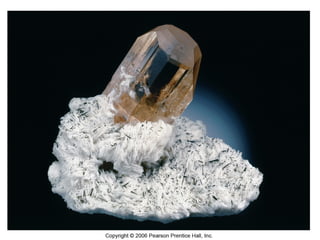
Chapter 2 Opening Figure
Figure 2.1
Minerals: Building blocks of rocks
• Definition of a mineral:
     • Naturally occurring
     • Inorganic solid
     • Ordered internal molecular structure
     • Definite chemical composition
• Definition of a rock:
     • A solid aggregate or mass of minerals
Physical properties of minerals
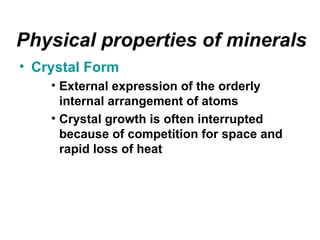
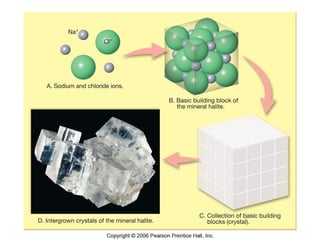
• Crystal Form
    • External expression of the orderly
      internal arrangement of atoms
    • Crystal growth is often interrupted
      because of competition for space and
      rapid loss of heat
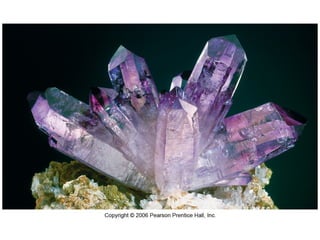
Figure 2.2
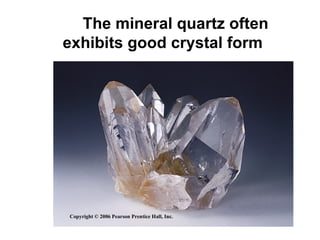
The mineral quartz often
exhibits good crystal form


Copyright © 2006 Pearson Prentice Hall, Inc.
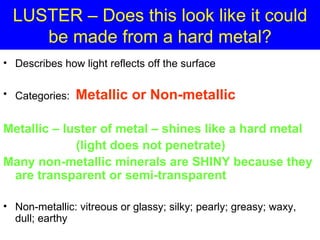
LUSTER – Does this look like it could
     be made from a hard metal?
• Describes how light reflects off the surface

• Categories:   Metallic or Non-metallic

Metallic – luster of metal – shines like a hard metal
             (light does not penetrate)
Many non-metallic minerals are SHINY because they
 are transparent or semi-transparent

• Non-metallic: vitreous or glassy; silky; pearly; greasy; waxy,
  dull; earthy
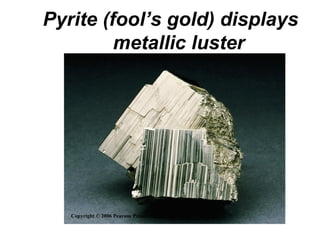
Pyrite (fool’s gold) displays
         metallic luster


   Copyright © 2006 Pearson Prentice Hall, Inc.
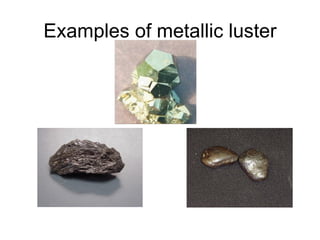
Examples of metallic luster
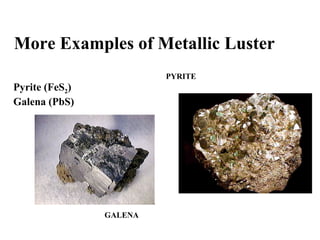
More Examples of Metallic Luster
                         PYRITE
Pyrite (FeS2)
Galena (PbS)


                GALENA
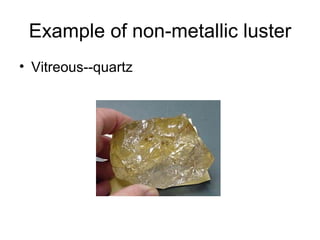
Example of non-metallic luster
• Vitreous--quartz
Example of non-metallic luster
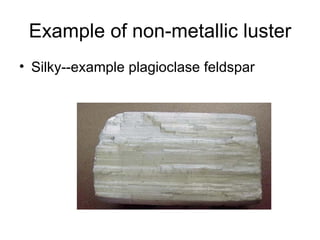
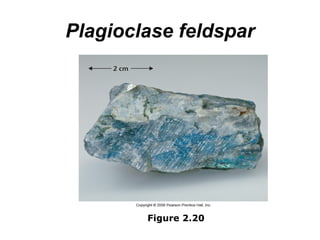
• Silky--example plagioclase feldspar
Non-metallic and metallic luster –
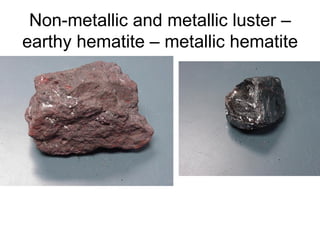
earthy hematite – metallic hematite
Physical properties of minerals
• Color
    • Generally an unreliable diagnostic
      property to use for mineral identification
    • Often highly variable for a given mineral
      due to slight changes in mineral
      chemistry
    • Exotic colorations of some minerals
      produce gemstones
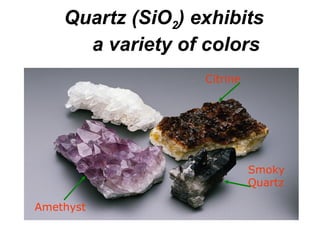
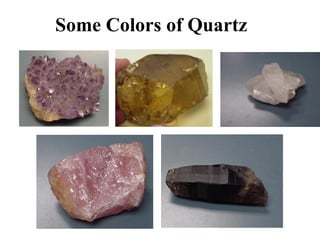
Quartz (SiO2) exhibits
      a variety of colors
                   Citrine


                             Smoky
                             Quartz

Amethyst
Some Colors of Quartz
Physical   properties of minerals
• Streak
    • Color of a mineral in its powdered form
    • Helpful in distinguishing different forms
      of the same mineral
• Hardness
    • Resistance of a mineral to abrasion or
      scratching
    • All minerals are compared to a standard
      scale called the Mohs scale of hardness
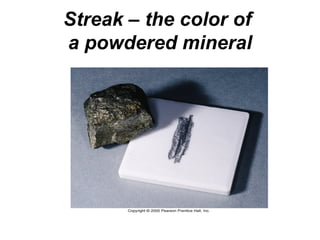
Streak – the color of
a powdered mineral
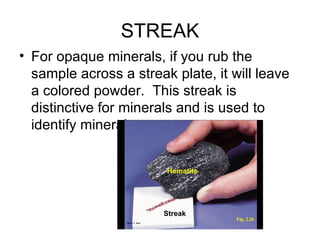
STREAK
• For opaque minerals, if you rub the
  sample across a streak plate, it will leave
  a colored powder. This streak is
  distinctive for minerals and is used to
  identify minerals.
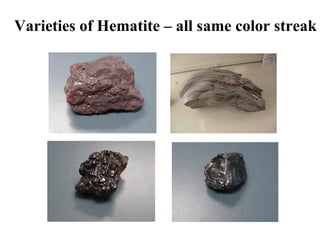
Varieties of Hematite – all same color streak
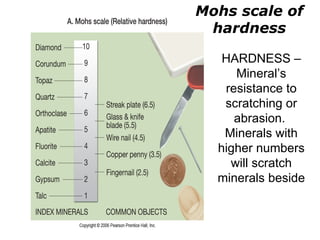
Mohs scale of
 hardness

   HARDNESS –
     Mineral’s
   resistance to
   scratching or
     abrasion.
   Minerals with
  higher numbers
    will scratch
  minerals beside
Physical properties of minerals
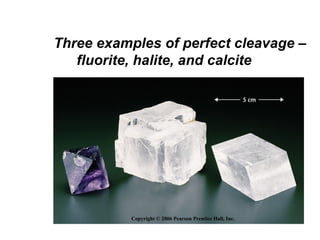
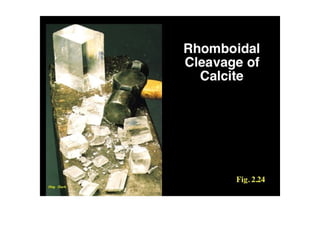
• Cleavage
    • Tendency to break along planes of weak
      bonding
    • Produces flat, shiny surfaces
    • Described by resulting geometric
      shapes
      – Number of planes
      – Angles between adjacent planes
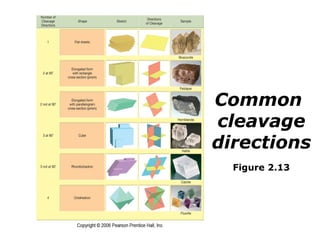
Common
cleavage
directions
  Figure 2.13
Three examples of perfect cleavage –
   fluorite, halite, and calcite


           Copyright © 2006 Pearson Prentice Hall, Inc.
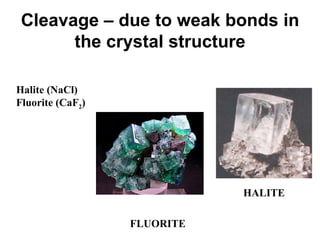
Cleavage – due to weak bonds in
       the crystal structure

Halite (NaCl)
Fluorite (CaF2)


                             HALITE

                  FLUORITE
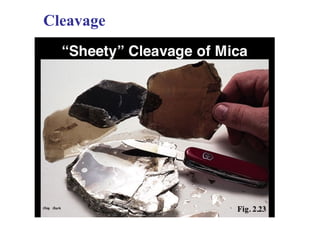
Cleavage


           MUSCOVITE
 BIOTITE
Physical properties of minerals
• Fracture
    • Absence of cleavage when a mineral is
      broken
• Specific Gravity
    • Ratio of the weight of a mineral to the
      weight of an equal volume of water
    • Average value is approximately 2.7
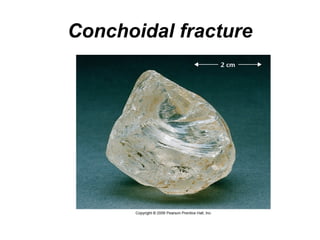
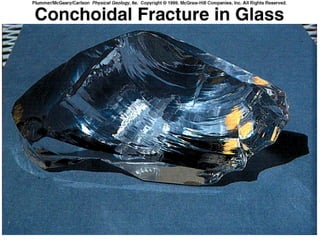
Conchoidal fracture
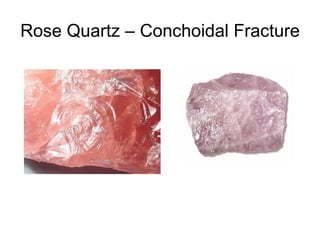
Rose Quartz – Conchoidal Fracture
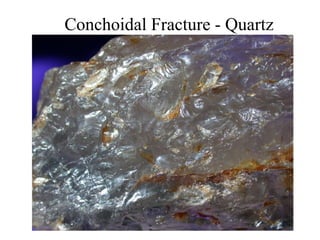
Conchoidal Fracture - Quartz


                       Obsidian
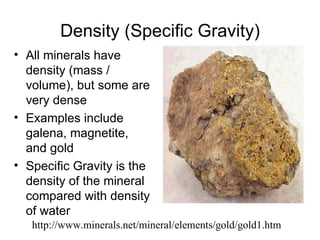
Density (Specific Gravity)
• All minerals have
  density (mass /
  volume), but some are
  very dense
• Examples include
  galena, magnetite,
  and gold
• Specific Gravity is the
  density of the mineral
  compared with density
  of water
   http://www.minerals.net/mineral/elements/gold/gold1.htm
Physical properties of minerals

• Other properties
    • Magnetism
    • Reaction to hydrochloric acid
    • Malleability
    • Double refraction
    • Taste
    • Smell
    • Elasticity
    • Striations
Other Properties
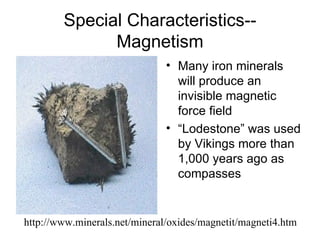
• Magnetism - Property of a substance such
  that it will spontaneous orient itself within a
  magnetic field. Magnetite (Fe3O4) has this
  property and it can be used to distinguish it
  from other non-magnetite iron oxides, such
  as hematite (Fe2O3).
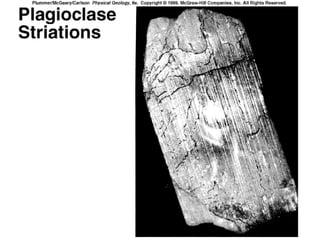
• Straitions - Commonly found on plagioclase
  feldspar. Straight, parallel lines on one or
  more of the cleavage planes caused by
  mineral twinning.
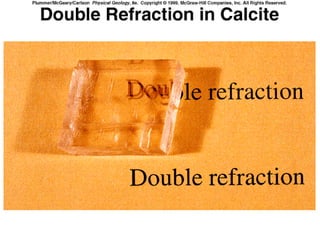
• Double Refraction - Seen in calcite crystals.
   Light is split or refracted into two
  components giving rise to two distinct
  images.
Special Characteristics--
              Magnetism
                               • Many iron minerals
                                 will produce an
                                 invisible magnetic
                                 force field
                               • “Lodestone” was used
                                 by Vikings more than
                                 1,000 years ago as
                                 compasses


http://www.minerals.net/mineral/oxides/magnetit/magneti4.htm
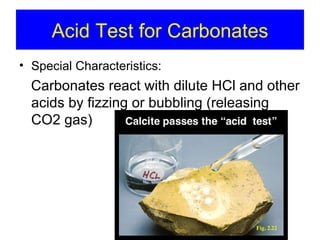
Acid Test for Carbonates
• Special Characteristics:
  Carbonates react with dilute HCl and other
  acids by fizzing or bubbling (releasing
  CO2 gas)
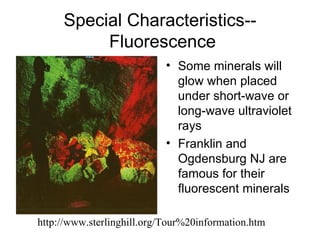
Special Characteristics--
          Fluorescence
                            • Some minerals will
                              glow when placed
                              under short-wave or
                              long-wave ultraviolet
                              rays
                            • Franklin and
                              Ogdensburg NJ are
                              famous for their
                              fluorescent minerals

http://www.sterlinghill.org/Tour%20information.htm
Special Characteristics--
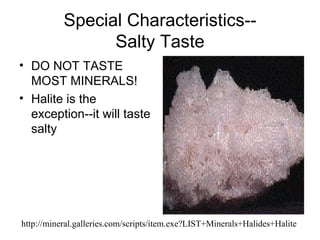
                 Salty Taste
• DO NOT TASTE
  MOST MINERALS!
• Halite is the
  exception--it will taste
  salty


http://mineral.galleries.com/scripts/item.exe?LIST+Minerals+Halides+Halite
Classification of Minerals
• Over 4000 minerals identified.
• Classification based on the key ion or
  element that makes up the “building
  block” of the mineral.
• An ion is an atom or molecule with an
  unbalanced electrical charge.
• Most important group is the Silicate
  Minerals, which form the majority of the
  rock-forming minerals.
Classification of Minerals
Rock-forming minerals
    • Common minerals that make up most of
      the rocks of Earth’s crust
    • Only a few dozen members
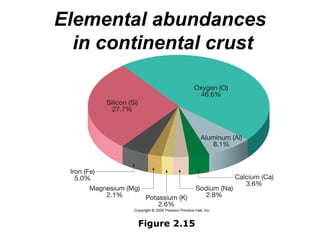
    • Composed mainly of the 8 elements that
      make up over 98% of the continental
      crust
Elemental abundances
  in continental crust


        Figure 2.15
Classification of Minerals
• Silicates
     • Most important mineral group
       – Comprise most of the rock-forming minerals
       – Very abundant due to large amounts of
         silicon and oxygen in Earth’s crust
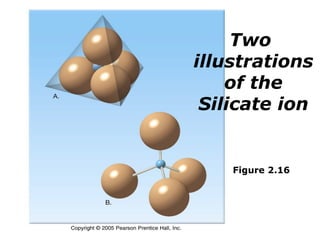
     • Basic building block is the silicate ion
       (aka the silicon-oxygen tetrahedron)
       – Four oxygen ions surrounding a much
         smaller silicon ion
Two
illustrations
    of the
 Silicate ion


    Figure 2.16
Classification of Minerals
• Silicate structures
    • Single silicate ions are linked together
      to form various structures including
       – Isolated ions
       – Ring structures
       – Single and double chain structures
       – Sheet or layered structures
       – Complex 3-dimensional structures
Classification of Minerals
• Common Silicate minerals
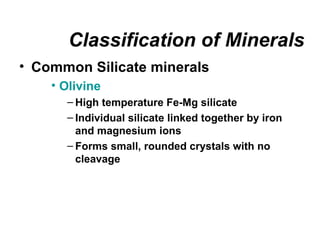
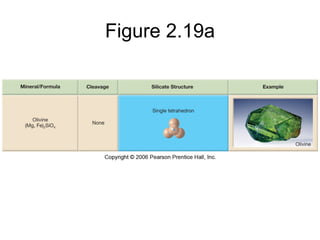
    • Olivine
      – High temperature Fe-Mg silicate
      – Individual silicate linked together by iron
        and magnesium ions
      – Forms small, rounded crystals with no
        cleavage
Figure 2.19a
Classification of Minerals
• Common Silicate minerals
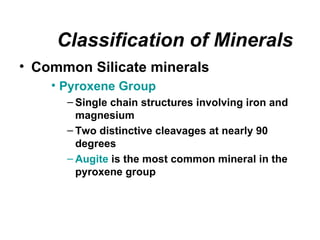
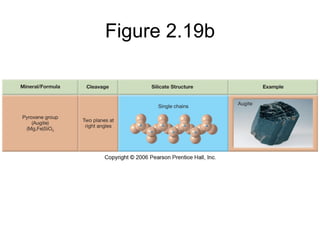
    • Pyroxene Group
      – Single chain structures involving iron and
        magnesium
      – Two distinctive cleavages at nearly 90
        degrees
      – Augite is the most common mineral in the
        pyroxene group
Figure 2.19b
Classification of Minerals
• Common Silicate minerals
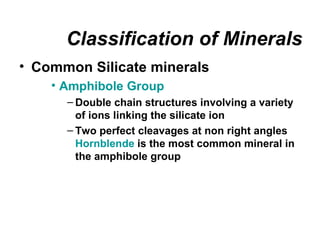
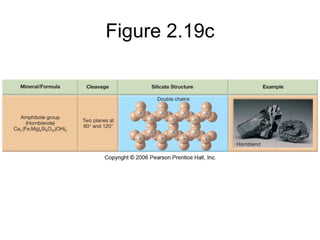
    • Amphibole Group
      – Double chain structures involving a variety
        of ions linking the silicate ion
      – Two perfect cleavages at non right angles
        Hornblende is the most common mineral in
        the amphibole group
Figure 2.19c
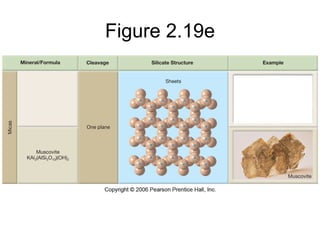
Classification of Minerals
• Common Silicate minerals
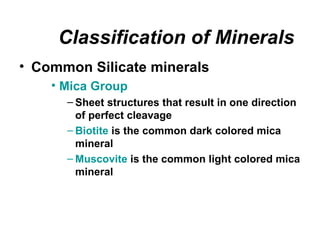
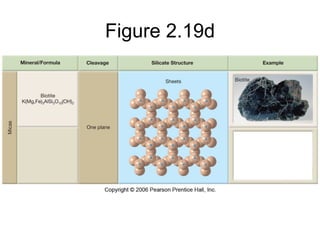
    • Mica Group
      – Sheet structures that result in one direction
        of perfect cleavage
      – Biotite is the common dark colored mica
        mineral
      – Muscovite is the common light colored mica
        mineral
Figure 2.19d
Figure 2.19e
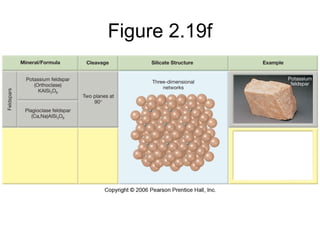
Classification of Minerals
• Common Silicate minerals
    • Feldspar Group
      – Most common mineral group
      – 3-dimensional framework that exhibits two
        directions of cleavage at 90 degrees
      – Orthoclase (potassium feldspar) and
        Plagioclase (sodium and calcium feldspar)
        are the two most common members
Figure 2.19f
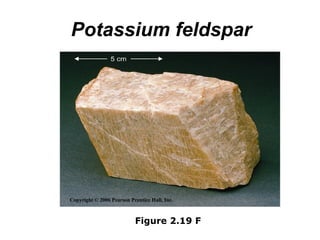
Potassium feldspar


Copyright © 2006 Pearson Prentice Hall, Inc.


                           Figure 2.19 F
Plagioclase feldspar


        Figure 2.20
Classification of Minerals
• Common Silicate minerals
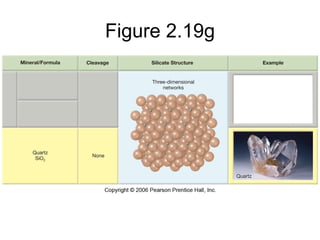
    • Quartz
      – Consists entirely of silicon and oxygen
        (SiO2). This is a material called silica.
      – Strong bonds in all directions – cleavage
        absent.
      – Naturally clear, but impurities cause colors.
Figure 2.19g
Classification of Minerals
• Important nonsilicate minerals
    • Several major groups exist including
       – Oxides
       – Sulfides
       – Sulfates
       – Native Elements
       – Carbonates
       – Halides
       – Phosphates
Classification of Minerals
• Important nonsilicate minerals
    • Carbonates
       Primary constituents in limestone; an
        abundant marine sedimentary rock.
       Calcite (calcium carbonate) and Dolomite
        (calcium-magnesium carbonate) are the two
        most important carbonate minerals.

Mineral

  • 1.
  • 2.
  • 3.
  • 4.
    Minerals: Building blocksof rocks • Definition of a mineral: • Naturally occurring • Inorganic solid • Ordered internal molecular structure • Definite chemical composition • Definition of a rock: • A solid aggregate or mass of minerals
  • 5.
    Physical properties ofminerals • Crystal Form • External expression of the orderly internal arrangement of atoms • Crystal growth is often interrupted because of competition for space and rapid loss of heat
  • 6.
  • 7.
    The mineral quartzoften exhibits good crystal form Copyright © 2006 Pearson Prentice Hall, Inc.
  • 8.
    LUSTER – Doesthis look like it could be made from a hard metal? • Describes how light reflects off the surface • Categories: Metallic or Non-metallic Metallic – luster of metal – shines like a hard metal (light does not penetrate) Many non-metallic minerals are SHINY because they are transparent or semi-transparent • Non-metallic: vitreous or glassy; silky; pearly; greasy; waxy, dull; earthy
  • 9.
    Pyrite (fool’s gold)displays metallic luster Copyright © 2006 Pearson Prentice Hall, Inc.
  • 10.
  • 11.
    More Examples ofMetallic Luster PYRITE Pyrite (FeS2) Galena (PbS) GALENA
  • 12.
    Example of non-metallicluster • Vitreous--quartz
  • 13.
    Example of non-metallicluster • Silky--example plagioclase feldspar
  • 14.
    Non-metallic and metallicluster – earthy hematite – metallic hematite
  • 15.
    Physical properties ofminerals • Color • Generally an unreliable diagnostic property to use for mineral identification • Often highly variable for a given mineral due to slight changes in mineral chemistry • Exotic colorations of some minerals produce gemstones
  • 16.
    Quartz (SiO2) exhibits a variety of colors Citrine Smoky Quartz Amethyst
  • 17.
  • 18.
    Physical properties of minerals • Streak • Color of a mineral in its powdered form • Helpful in distinguishing different forms of the same mineral • Hardness • Resistance of a mineral to abrasion or scratching • All minerals are compared to a standard scale called the Mohs scale of hardness
  • 19.
    Streak – thecolor of a powdered mineral
  • 20.
    STREAK • For opaqueminerals, if you rub the sample across a streak plate, it will leave a colored powder. This streak is distinctive for minerals and is used to identify minerals.
  • 21.
    Varieties of Hematite– all same color streak
  • 22.
    Mohs scale of hardness HARDNESS – Mineral’s resistance to scratching or abrasion. Minerals with higher numbers will scratch minerals beside
  • 23.
    Physical properties ofminerals • Cleavage • Tendency to break along planes of weak bonding • Produces flat, shiny surfaces • Described by resulting geometric shapes – Number of planes – Angles between adjacent planes
  • 24.
  • 25.
    Three examples ofperfect cleavage – fluorite, halite, and calcite Copyright © 2006 Pearson Prentice Hall, Inc.
  • 26.
    Cleavage – dueto weak bonds in the crystal structure Halite (NaCl) Fluorite (CaF2) HALITE FLUORITE
  • 28.
    Cleavage MUSCOVITE BIOTITE
  • 29.
    Physical properties ofminerals • Fracture • Absence of cleavage when a mineral is broken • Specific Gravity • Ratio of the weight of a mineral to the weight of an equal volume of water • Average value is approximately 2.7
  • 30.
  • 31.
    Rose Quartz –Conchoidal Fracture
  • 32.
    Conchoidal Fracture -Quartz Obsidian
  • 34.
    Density (Specific Gravity) •All minerals have density (mass / volume), but some are very dense • Examples include galena, magnetite, and gold • Specific Gravity is the density of the mineral compared with density of water http://www.minerals.net/mineral/elements/gold/gold1.htm
  • 35.
    Physical properties ofminerals • Other properties • Magnetism • Reaction to hydrochloric acid • Malleability • Double refraction • Taste • Smell • Elasticity • Striations
  • 36.
    Other Properties • Magnetism- Property of a substance such that it will spontaneous orient itself within a magnetic field. Magnetite (Fe3O4) has this property and it can be used to distinguish it from other non-magnetite iron oxides, such as hematite (Fe2O3). • Straitions - Commonly found on plagioclase feldspar. Straight, parallel lines on one or more of the cleavage planes caused by mineral twinning. • Double Refraction - Seen in calcite crystals. Light is split or refracted into two components giving rise to two distinct images.
  • 37.
    Special Characteristics-- Magnetism • Many iron minerals will produce an invisible magnetic force field • “Lodestone” was used by Vikings more than 1,000 years ago as compasses http://www.minerals.net/mineral/oxides/magnetit/magneti4.htm
  • 38.
    Acid Test forCarbonates • Special Characteristics: Carbonates react with dilute HCl and other acids by fizzing or bubbling (releasing CO2 gas)
  • 39.
    Special Characteristics-- Fluorescence • Some minerals will glow when placed under short-wave or long-wave ultraviolet rays • Franklin and Ogdensburg NJ are famous for their fluorescent minerals http://www.sterlinghill.org/Tour%20information.htm
  • 41.
    Special Characteristics-- Salty Taste • DO NOT TASTE MOST MINERALS! • Halite is the exception--it will taste salty http://mineral.galleries.com/scripts/item.exe?LIST+Minerals+Halides+Halite
  • 43.
    Classification of Minerals •Over 4000 minerals identified. • Classification based on the key ion or element that makes up the “building block” of the mineral. • An ion is an atom or molecule with an unbalanced electrical charge. • Most important group is the Silicate Minerals, which form the majority of the rock-forming minerals.
  • 44.
    Classification of Minerals Rock-formingminerals • Common minerals that make up most of the rocks of Earth’s crust • Only a few dozen members • Composed mainly of the 8 elements that make up over 98% of the continental crust
  • 45.
    Elemental abundances in continental crust Figure 2.15
  • 46.
    Classification of Minerals •Silicates • Most important mineral group – Comprise most of the rock-forming minerals – Very abundant due to large amounts of silicon and oxygen in Earth’s crust • Basic building block is the silicate ion (aka the silicon-oxygen tetrahedron) – Four oxygen ions surrounding a much smaller silicon ion
  • 47.
    Two illustrations of the Silicate ion Figure 2.16
  • 48.
    Classification of Minerals •Silicate structures • Single silicate ions are linked together to form various structures including – Isolated ions – Ring structures – Single and double chain structures – Sheet or layered structures – Complex 3-dimensional structures
  • 49.
    Classification of Minerals •Common Silicate minerals • Olivine – High temperature Fe-Mg silicate – Individual silicate linked together by iron and magnesium ions – Forms small, rounded crystals with no cleavage
  • 50.
  • 51.
    Classification of Minerals •Common Silicate minerals • Pyroxene Group – Single chain structures involving iron and magnesium – Two distinctive cleavages at nearly 90 degrees – Augite is the most common mineral in the pyroxene group
  • 52.
  • 53.
    Classification of Minerals •Common Silicate minerals • Amphibole Group – Double chain structures involving a variety of ions linking the silicate ion – Two perfect cleavages at non right angles Hornblende is the most common mineral in the amphibole group
  • 54.
  • 55.
    Classification of Minerals •Common Silicate minerals • Mica Group – Sheet structures that result in one direction of perfect cleavage – Biotite is the common dark colored mica mineral – Muscovite is the common light colored mica mineral
  • 56.
  • 57.
  • 58.
    Classification of Minerals •Common Silicate minerals • Feldspar Group – Most common mineral group – 3-dimensional framework that exhibits two directions of cleavage at 90 degrees – Orthoclase (potassium feldspar) and Plagioclase (sodium and calcium feldspar) are the two most common members
  • 59.
  • 60.
    Potassium feldspar Copyright ©2006 Pearson Prentice Hall, Inc. Figure 2.19 F
  • 61.
  • 62.
    Classification of Minerals •Common Silicate minerals • Quartz – Consists entirely of silicon and oxygen (SiO2). This is a material called silica. – Strong bonds in all directions – cleavage absent. – Naturally clear, but impurities cause colors.
  • 63.
  • 64.
    Classification of Minerals •Important nonsilicate minerals • Several major groups exist including – Oxides – Sulfides – Sulfates – Native Elements – Carbonates – Halides – Phosphates
  • 65.
    Classification of Minerals •Important nonsilicate minerals • Carbonates Primary constituents in limestone; an abundant marine sedimentary rock. Calcite (calcium carbonate) and Dolomite (calcium-magnesium carbonate) are the two most important carbonate minerals.

Editor's Notes

  • #21 Hematite can be brown, black, metallic gray and earthy but in all cases it gives a red-brown streak.