Migration – Why Do Cities GrowAS Geography
Thinking of the DTM...At What stage do you feel people began to migrate to cities?Why Do cities grow?
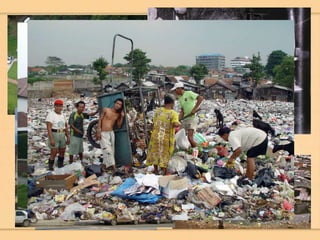
Why did cities grow?Increase in natural population growthNet migration from rural areasRural depopulationIndustrialisationSo why do people move to cities?
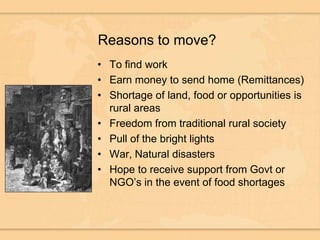
Reasons to move?To find workEarn money to send home (Remittances)Shortage of land, food or opportunities is rural areasFreedom from traditional rural societyPull of the bright lightsWar, Natural disastersHope to receive support from Govt or NGO’s in the event of food shortages
You can categorise migration into Push and pull factorsPhysicalDemographicEconomicSocialPolitical
Birth Rates always fall when people migrate to cities... WHY?Education levels are higher especially for girlsChildren are less economically advantageousLarge families can be a drag on economic progress for newcomersGenerally not the same extended family structure
How are Death Rates affected then?Housing – often poor quality when under rapid growth but generally improves laterWater – Has a similar issueSewage Treatment – Again is poor but improvesFood Supply – Often better than rural areas because cities are centre for storage and distributionHealth Care – Can be better than rural areas
Cities Depend on WealthOften huge ranges of income in cities and access to services.This is still apparent today in many societies around the globeCan you think of areas where wealth plays a part?
Types of Migration
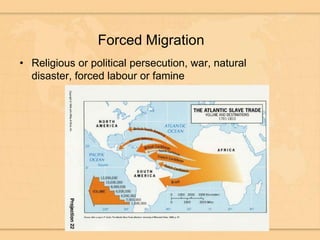
Forced MigrationReligious or political persecution, war, natural disaster, forced labour or famine
VoluntaryClimateEmploymentFamilyBetter services
Internal MigrationMigration within countriesMoving houseUrban to urbanUrban to ruralRural to urbanSuch as Pioneer advances across USA 1800’s +
International MigrationVoluntaryColonisation of countries such as the USA upto around 1924Most is now forced due to the tightening of immigrant policy
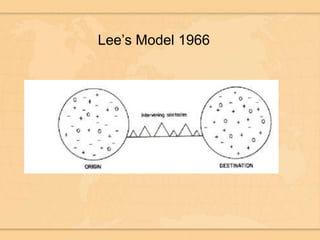
Lee’s Model 1966
Does not isolate push pull factorsLooks at attributes for each place Decisions based on personal factors reliant on AgeGenderMarital StatusEducationSocio-economic classSome are positive factors some are seen as negative others as neutral all this influences personal decision making process
Lee’s model introduces a refinement to push pull factorsIntervening Obstacles  Both real or perceived International boundaries, language, anxieties etc.
Consequences of Migration Overview
Demographic ConsequencesChanges in the numbers and distribution of people within a region are changed. Intermarriages are created, leading to a new group of people.
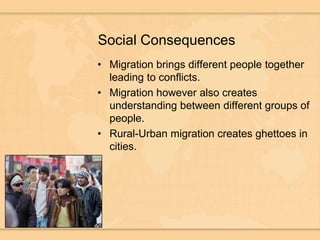
Social ConsequencesMigration brings different people together leading to conflicts. Migration however also creates understanding between different groups of people. Rural-Urban migration creates ghettoes in cities.
Economic ConsequencesThis depends on the "quality" of the migrants and the economic needs of the origin and destination. Quality refers to skills, age, educational attainment, health etc. In overpopulated areas, emigration is beneficial because it reduces the pressure on the land. In under populated areas, emigration may slow down development.
Class Work‘Most migrants travel short distances, with increased distance the number of migrants decrease’‘The major direction of migration is from agricultural to areas of industry and commerce’‘Most migrants are adults and families rarely migrate out of their own countries of birth.’These remarks were made 150yrs ago how well do they stand up today, write notes on your own and then discuss in small groups

Migration – Why Do Cities Grow

  • 1.
    Migration – WhyDo Cities GrowAS Geography
  • 2.
    Thinking of theDTM...At What stage do you feel people began to migrate to cities?Why Do cities grow?
  • 3.
    Why did citiesgrow?Increase in natural population growthNet migration from rural areasRural depopulationIndustrialisationSo why do people move to cities?
  • 4.
    Reasons to move?Tofind workEarn money to send home (Remittances)Shortage of land, food or opportunities is rural areasFreedom from traditional rural societyPull of the bright lightsWar, Natural disastersHope to receive support from Govt or NGO’s in the event of food shortages
  • 5.
    You can categorisemigration into Push and pull factorsPhysicalDemographicEconomicSocialPolitical
  • 6.
    Birth Rates alwaysfall when people migrate to cities... WHY?Education levels are higher especially for girlsChildren are less economically advantageousLarge families can be a drag on economic progress for newcomersGenerally not the same extended family structure
  • 7.
    How are DeathRates affected then?Housing – often poor quality when under rapid growth but generally improves laterWater – Has a similar issueSewage Treatment – Again is poor but improvesFood Supply – Often better than rural areas because cities are centre for storage and distributionHealth Care – Can be better than rural areas
  • 8.
    Cities Depend onWealthOften huge ranges of income in cities and access to services.This is still apparent today in many societies around the globeCan you think of areas where wealth plays a part?
  • 10.
  • 11.
    Forced MigrationReligious orpolitical persecution, war, natural disaster, forced labour or famine
  • 12.
  • 13.
    Internal MigrationMigration withincountriesMoving houseUrban to urbanUrban to ruralRural to urbanSuch as Pioneer advances across USA 1800’s +
  • 14.
    International MigrationVoluntaryColonisation ofcountries such as the USA upto around 1924Most is now forced due to the tightening of immigrant policy
  • 15.
  • 16.
    Does not isolatepush pull factorsLooks at attributes for each place Decisions based on personal factors reliant on AgeGenderMarital StatusEducationSocio-economic classSome are positive factors some are seen as negative others as neutral all this influences personal decision making process
  • 17.
    Lee’s model introducesa refinement to push pull factorsIntervening Obstacles Both real or perceived International boundaries, language, anxieties etc.
  • 18.
  • 19.
    Demographic ConsequencesChanges inthe numbers and distribution of people within a region are changed. Intermarriages are created, leading to a new group of people.
  • 20.
    Social ConsequencesMigration bringsdifferent people together leading to conflicts. Migration however also creates understanding between different groups of people. Rural-Urban migration creates ghettoes in cities.
  • 21.
    Economic ConsequencesThis dependson the "quality" of the migrants and the economic needs of the origin and destination. Quality refers to skills, age, educational attainment, health etc. In overpopulated areas, emigration is beneficial because it reduces the pressure on the land. In under populated areas, emigration may slow down development.
  • 22.
    Class Work‘Most migrantstravel short distances, with increased distance the number of migrants decrease’‘The major direction of migration is from agricultural to areas of industry and commerce’‘Most migrants are adults and families rarely migrate out of their own countries of birth.’These remarks were made 150yrs ago how well do they stand up today, write notes on your own and then discuss in small groups