NAME ROLL
SUMAYA MEHJABIN B-140402059
SONIA KHATUN SHILA B-140402051
ARIFUL ISLAM B-140402056
TANZILA BIPLABEE B-140402012
MERAJ-UL-ISLAM B-140402025
GROUP MEMBERS
Presentation on
The life event of “Haki Doku”( an Albanian Immigrant)
This Example expresses some basic reason of Contemporary migration.
 Mature economical Opportunities
 National Dignity
 Change the dynamics of life
 Fulfilled the dream of life
INTRODUCTION
“Haki Doku is
the first
Albanian
athlete in
history of
Paralympics.
Now live in
Italy”
Haki Doku
Source: www.associaziooneintegrra.eu
Migration is defined as people moving for various reasons to a
country from their usual residence.
It may be internal or international, Short term or long term,
Individually or in a large group.
What is Migration?
Place
A
Place
B
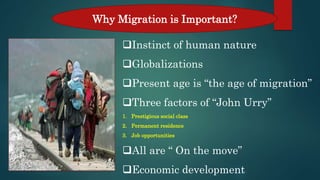
Why Migration is Important?
Instinct of human nature
Globalizations
Present age is “the age of migration”
Three factors of “John Urry”
1. Prestigious social class
2. Permanent residence
3. Job opportunities
All are “ On the move”
Economic development
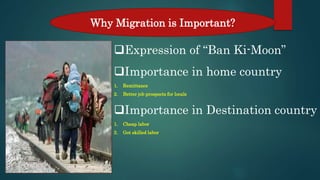
Expression of “Ban Ki-Moon”
Importance in home country
1. Remittance
2. Better job prospects for locals
Importance in Destination country
1. Cheap labor
2. Got skilled labor
Why Migration is Important?
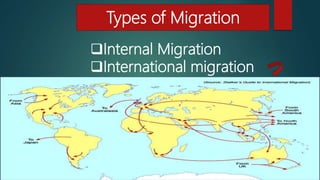
Types of Migration
Internal Migration
International migration
Types of Migration
Forced Migration
Voluntary Migration
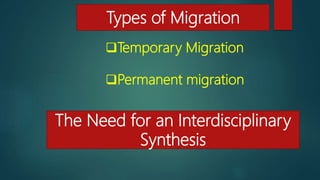
Types of Migration
Temporary Migration
Permanent migration
The Need for an Interdisciplinary
Synthesis
Based on wage difference
Neoclassical Economics Theory
Capital flows
Migration flows
Low wage region High wage region
 Both net labor migration and net capital flows will be equal to zero when a new equilibrium is
achieved. Thus in this view, net international labor migration is a temporal phenomenon.
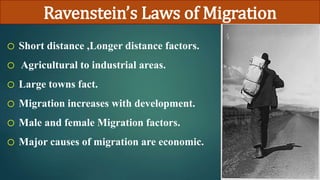
o Short distance ,Longer distance factors.
o Agricultural to industrial areas.
o Large towns fact.
o Migration increases with development.
o Male and female Migration factors.
o Major causes of migration are economic.
Ravenstein’s Laws of Migration
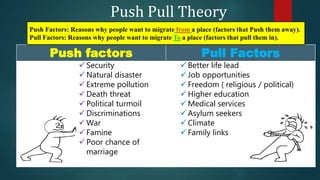
Push factors Pull Factors
 Security
 Natural disaster
 Extreme pollution
 Death threat
 Political turmoil
 Discriminations
 War
 Famine
 Poor chance of
marriage
 Better life lead
 Job opportunities
 Freedom ( religious / political)
 Higher education
 Medical services
 Asylum seekers
 Climate
 Family links
Push Factors: Reasons why people want to migrate from a place (factors that Push them away).
Pull Factors: Reasons why people want to migrate To a place (factors that pull them in).
Push Pull Theory
Example
Push Factors Pull Factors
Poor medical facilities $1800 per
doctor
Excellent medical facilities $400 per
doctor
Low paid jobs (GNP= $3750) Well paid jobs (GNP=$ 24,750)
Adult literacy rate 55% (poor
education prospects)
Adult literacy rate 99% (Good
education prospects)
Life expectancy 72 years Life expectancy 76 years
40% unemployed Many jobs available
Two Models of Migration
 Wilbur Zelinsky’s ‘hypothesis of the mobility transition’
 W.W. Rostow’s ‘stages of growth’
Pre-modern traditional society
Advanced society
Late transitional society
Early transitional society
Future super advanced society
Very limited migration
migration to attractive foreign destinations
Rural-urban replaced by inter-urban migration
Possibility of strict controls over immigration.
Mass rural-urban migration
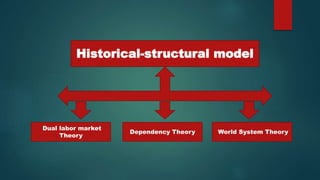
Historical-structural model
Dual labor market
Theory
Dependency Theory World System Theory
Dual labor market Theory
Primary Market Secondary Market
PrimaryMarket
Secure
High skilled
Well-paid
SecondaryLaborMarket
Insecure
Low wage
Low skilled
Dual labor market Theory
Dependency Theory
Self perpetuating
Reproducing
Inequality
A part of Global
Development
World System Theory
 Mainly connect with trade and
capital
.
The
dominant
capitalist
powers
Center
Periphery
 Developing or under developed
country like Bangladesh
NELM Theory
Oded Stark
Recognize That decision
Rational choice Making
Criticism of NELM
 Limited to the Supply Side
 Applied for the Poor Country
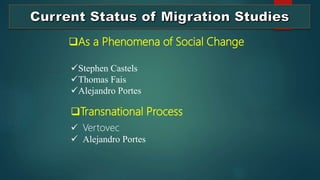
Stephen Castels
Thomas Fais
Alejandro Portes
As a Phenomena of Social Change
 Vertovec
 Alejandro Portes
Transnational Process
THANK
YOU
FOR
YOUR
PATIENCE
ANY QUESTION ?
 Please introduce yourself before presenting the question.

Theories of migration

  • 2.
    NAME ROLL SUMAYA MEHJABINB-140402059 SONIA KHATUN SHILA B-140402051 ARIFUL ISLAM B-140402056 TANZILA BIPLABEE B-140402012 MERAJ-UL-ISLAM B-140402025 GROUP MEMBERS
  • 3.
  • 4.
    The life eventof “Haki Doku”( an Albanian Immigrant) This Example expresses some basic reason of Contemporary migration.  Mature economical Opportunities  National Dignity  Change the dynamics of life  Fulfilled the dream of life INTRODUCTION “Haki Doku is the first Albanian athlete in history of Paralympics. Now live in Italy” Haki Doku Source: www.associaziooneintegrra.eu
  • 5.
    Migration is definedas people moving for various reasons to a country from their usual residence. It may be internal or international, Short term or long term, Individually or in a large group. What is Migration? Place A Place B
  • 6.
    Why Migration isImportant? Instinct of human nature Globalizations Present age is “the age of migration” Three factors of “John Urry” 1. Prestigious social class 2. Permanent residence 3. Job opportunities All are “ On the move” Economic development
  • 7.
    Expression of “BanKi-Moon” Importance in home country 1. Remittance 2. Better job prospects for locals Importance in Destination country 1. Cheap labor 2. Got skilled labor Why Migration is Important?
  • 8.
    Types of Migration InternalMigration International migration
  • 9.
    Types of Migration ForcedMigration Voluntary Migration
  • 10.
    Types of Migration TemporaryMigration Permanent migration The Need for an Interdisciplinary Synthesis
  • 11.
    Based on wagedifference Neoclassical Economics Theory Capital flows Migration flows Low wage region High wage region  Both net labor migration and net capital flows will be equal to zero when a new equilibrium is achieved. Thus in this view, net international labor migration is a temporal phenomenon.
  • 12.
    o Short distance,Longer distance factors. o Agricultural to industrial areas. o Large towns fact. o Migration increases with development. o Male and female Migration factors. o Major causes of migration are economic. Ravenstein’s Laws of Migration
  • 13.
    Push factors PullFactors  Security  Natural disaster  Extreme pollution  Death threat  Political turmoil  Discriminations  War  Famine  Poor chance of marriage  Better life lead  Job opportunities  Freedom ( religious / political)  Higher education  Medical services  Asylum seekers  Climate  Family links Push Factors: Reasons why people want to migrate from a place (factors that Push them away). Pull Factors: Reasons why people want to migrate To a place (factors that pull them in). Push Pull Theory
  • 14.
    Example Push Factors PullFactors Poor medical facilities $1800 per doctor Excellent medical facilities $400 per doctor Low paid jobs (GNP= $3750) Well paid jobs (GNP=$ 24,750) Adult literacy rate 55% (poor education prospects) Adult literacy rate 99% (Good education prospects) Life expectancy 72 years Life expectancy 76 years 40% unemployed Many jobs available
  • 15.
    Two Models ofMigration  Wilbur Zelinsky’s ‘hypothesis of the mobility transition’  W.W. Rostow’s ‘stages of growth’ Pre-modern traditional society Advanced society Late transitional society Early transitional society Future super advanced society Very limited migration migration to attractive foreign destinations Rural-urban replaced by inter-urban migration Possibility of strict controls over immigration. Mass rural-urban migration
  • 16.
    Historical-structural model Dual labormarket Theory Dependency Theory World System Theory
  • 17.
    Dual labor marketTheory Primary Market Secondary Market PrimaryMarket Secure High skilled Well-paid
  • 18.
  • 19.
  • 20.
    World System Theory Mainly connect with trade and capital . The dominant capitalist powers Center Periphery  Developing or under developed country like Bangladesh
  • 21.
    NELM Theory Oded Stark RecognizeThat decision Rational choice Making
  • 22.
    Criticism of NELM Limited to the Supply Side  Applied for the Poor Country
  • 23.
    Stephen Castels Thomas Fais AlejandroPortes As a Phenomena of Social Change  Vertovec  Alejandro Portes Transnational Process
  • 24.
  • 25.
    ANY QUESTION ? Please introduce yourself before presenting the question.