Lee's Migration Model
Peyton Howell and Suvan Paturi
What is it About?
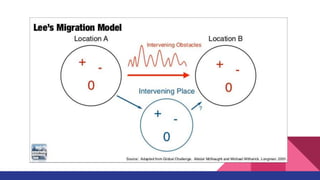
Lee’s migration model is a model that accounts for push/pull factors and
intervening obstacles in order to predict migration patterns.
It advocates the idea that intervening obstacles can block migration to certain
areas, while push and pull factors can promote migration out of an old area to
a new one.
The model is used alongside Ravenstein’s “Laws” of Migration, the Migration
Transition Model, and other models in order to show migratory patterns
What is a Push Factor?
Definition: Factor that induces people to leave old residences
A Push Factor in simpler terms is anything that forces people to move out of a
certain area
The three main types of push factors are economic, cultural and environmental
push factors
Within these three groups there are a variety of push factors but some notable
ones are few opportunities, discrimination, loss of wealth, war, etc.
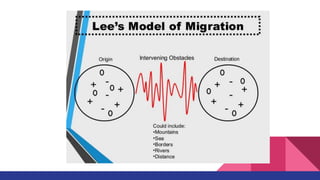
As shown in the model, the push factors are what drive people out of Location A
What is a Pull Factor?
Definition: Factor that induces people to move to a new location
In other words it it is the things that cause a group to migrate to a certain area.
Similar to push factors it is divided into economic, cultural, and environmental factors, but
unlike push factors which deals with the reason for leaving, pull factors deal with the
reasons for moving to certain place
There are many pull factors but a couple include job opportunities, better living conditions,
attractive climate, security, etc.
Pull factors are an integral part of Lee’s migration model as they show why certain groups
desire to go to certain locations (In the model, reasons for going to Location B).
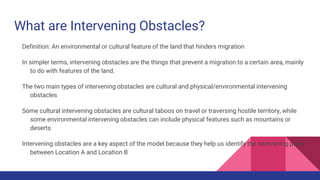
What are Intervening Obstacles?
Definition: An environmental or cultural feature of the land that hinders migration
In simpler terms, intervening obstacles are the things that prevent a migration to a certain area, mainly
to do with features of the land.
The two main types of intervening obstacles are cultural and physical/environmental intervening
obstacles
Some cultural intervening obstacles are cultural taboos on travel or traversing hostile territory, while
some environmental intervening obstacles can include physical features such as mountains or
deserts
Intervening obstacles are a key aspect of the model because they help us identify the intervening place
between Location A and Location B
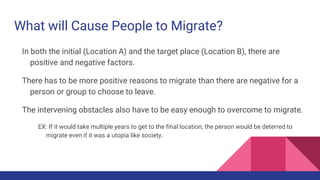
What will Cause People to Migrate?
In both the initial (Location A) and the target place (Location B), there are
positive and negative factors.
There has to be more positive reasons to migrate than there are negative for a
person or group to choose to leave.
The intervening obstacles also have to be easy enough to overcome to migrate.
EX: If it would take multiple years to get to the final location, the person would be deterred to
migrate even if it was a utopia like society.
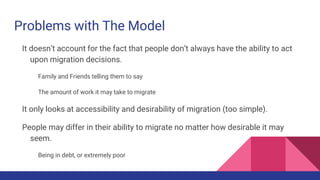
Problems with The Model
It doesn’t account for the fact that people don’t always have the ability to act
upon migration decisions.
Family and Friends telling them to say
The amount of work it may take to migrate
It only looks at accessibility and desirability of migration (too simple).
People may differ in their ability to migrate no matter how desirable it may
seem.
Being in debt, or extremely poor
How it Works in the Real World
In the real world, Lee’s model works similar to the theory.
Overall, people are less likely to migrate than Lee’s model suggests.
In principle, it works, but not as perfectly as it could.
Example:
Tom wants to move to an ideal utopian country from the US
Push factors: not perfect society
Intervening Obstacles: Family and friends can't come, high cost of leaving, possibility of failing and having to stay if denied
entrance
Pull Factors: ideal utopian society (peace, prosperity, everyone gets along)
Tom ends up migrating
Conclusion
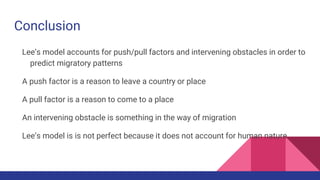
Lee’s model accounts for push/pull factors and intervening obstacles in order to
predict migratory patterns
A push factor is a reason to leave a country or place
A pull factor is a reason to come to a place
An intervening obstacle is something in the way of migration
Lee’s model is is not perfect because it does not account for human nature

Lees-Migration-Model.pptx

  • 1.
    Lee's Migration Model PeytonHowell and Suvan Paturi
  • 3.
    What is itAbout? Lee’s migration model is a model that accounts for push/pull factors and intervening obstacles in order to predict migration patterns. It advocates the idea that intervening obstacles can block migration to certain areas, while push and pull factors can promote migration out of an old area to a new one. The model is used alongside Ravenstein’s “Laws” of Migration, the Migration Transition Model, and other models in order to show migratory patterns
  • 4.
    What is aPush Factor? Definition: Factor that induces people to leave old residences A Push Factor in simpler terms is anything that forces people to move out of a certain area The three main types of push factors are economic, cultural and environmental push factors Within these three groups there are a variety of push factors but some notable ones are few opportunities, discrimination, loss of wealth, war, etc. As shown in the model, the push factors are what drive people out of Location A
  • 5.
    What is aPull Factor? Definition: Factor that induces people to move to a new location In other words it it is the things that cause a group to migrate to a certain area. Similar to push factors it is divided into economic, cultural, and environmental factors, but unlike push factors which deals with the reason for leaving, pull factors deal with the reasons for moving to certain place There are many pull factors but a couple include job opportunities, better living conditions, attractive climate, security, etc. Pull factors are an integral part of Lee’s migration model as they show why certain groups desire to go to certain locations (In the model, reasons for going to Location B).
  • 6.
    What are InterveningObstacles? Definition: An environmental or cultural feature of the land that hinders migration In simpler terms, intervening obstacles are the things that prevent a migration to a certain area, mainly to do with features of the land. The two main types of intervening obstacles are cultural and physical/environmental intervening obstacles Some cultural intervening obstacles are cultural taboos on travel or traversing hostile territory, while some environmental intervening obstacles can include physical features such as mountains or deserts Intervening obstacles are a key aspect of the model because they help us identify the intervening place between Location A and Location B
  • 7.
    What will CausePeople to Migrate? In both the initial (Location A) and the target place (Location B), there are positive and negative factors. There has to be more positive reasons to migrate than there are negative for a person or group to choose to leave. The intervening obstacles also have to be easy enough to overcome to migrate. EX: If it would take multiple years to get to the final location, the person would be deterred to migrate even if it was a utopia like society.
  • 8.
    Problems with TheModel It doesn’t account for the fact that people don’t always have the ability to act upon migration decisions. Family and Friends telling them to say The amount of work it may take to migrate It only looks at accessibility and desirability of migration (too simple). People may differ in their ability to migrate no matter how desirable it may seem. Being in debt, or extremely poor
  • 10.
    How it Worksin the Real World In the real world, Lee’s model works similar to the theory. Overall, people are less likely to migrate than Lee’s model suggests. In principle, it works, but not as perfectly as it could. Example: Tom wants to move to an ideal utopian country from the US Push factors: not perfect society Intervening Obstacles: Family and friends can't come, high cost of leaving, possibility of failing and having to stay if denied entrance Pull Factors: ideal utopian society (peace, prosperity, everyone gets along) Tom ends up migrating
  • 11.
    Conclusion Lee’s model accountsfor push/pull factors and intervening obstacles in order to predict migratory patterns A push factor is a reason to leave a country or place A pull factor is a reason to come to a place An intervening obstacle is something in the way of migration Lee’s model is is not perfect because it does not account for human nature