IGCSE GEOGRAPHY
2. MIGRATION
POPULATION MIGRATION
CASE STUDIES
COUNTER-URBANISATION IN EDINBURGH
MIGRATION FROM SENEGAL TO EUROPE
Recap key words ‘migration’,
‘emigration’, ‘immigration’ and ‘net
migration balance’.
Learners describe a key word and the
other learner has to define it.
Learners define ‘international
migration’.
Introduce a classification of
migration and complete appropriate
definitions with examples to
illustrate.
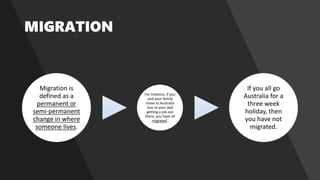
Migration is
defined as a
permanent or
semi-permanent
change in where
someone lives.
For instance, if you
and your family
move to Australia
due to your dad
getting a job out
there, you have all
migrated.
If you all go
Australia for a
three week
holiday, then
you have not
migrated.
Some people migrate only for a short
period.
Turkish immigrant workers to Germany
may only go there for a period of
months.
They have made a semi-permanent move
so can be classified as migrants.
People working as chalet-maids in a ski
resort for the winter also could be
classified as having made a semi-
permanent migration.
Migrations fall into two groups, they can
be voluntary (where the migrant decides
to move) or forced (where the migrant
has little choice but to move).
Emigration is the act of leaving one's own country to settle permanently in another; moving abroad.
Immigrate is to come into another country to live permanently or when someone
enters a country.
REMEMBER:
Emigrate means to leave one's country to live in another.
Immigrate is to come into another country to live permanently.
Migrate is to move, like bird in the winter.
The choice between emigrate, immigrate, and migrate depends on the sentence's
point of view.
Net migration rate is the difference of
immigrants and emigrants of an area in a
period of time, divided per 1,000
inhabitants.
International migration is when people
migrate from one country to another -
for example, moving from Mexico to the
USA.
People migrate for many different
reasons. These reasons can be classified
as economic, social, political or
environmental:
• economic migration - moving to find
work or follow a particular career path
• social migration - moving somewhere
for a better quality of life or to be
closer to family or friends
• political migration - moving to escape
political persecution or war
• environmental causes of migration -
include natural disasters such as
flooding
Some people choose to migrate,
eg. someone who moves to
another country to enhance their
career opportunities.
Some people are forced to
migrate, eg. someone who moves
due to war or famine.
A refugee is someone who has left
their home and does not have a
new home to go to.
Often refugees do not carry many
possessions with them and do not
have a clear idea of where they
may finally settle.
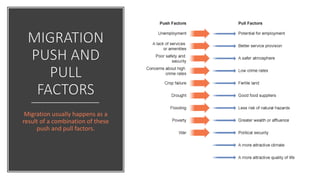
Push factors are the reasons why people leave an
area. They include:
• lack of services
• lack of safety
• high crime
• crop failure
• drought
• flooding
• poverty
• war
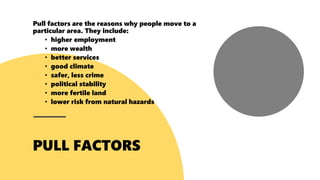
Pull factors are the reasons why people move to a
particular area. They include:
• higher employment
• more wealth
• better services
• good climate
• safer, less crime
• political stability
• more fertile land
• lower risk from natural hazards
Migration usually happens as a
result of a combination of these
push and pull factors.
People migrate all the time...
Within the EU
Since the EU was formed, it is easier to migrate
between countries. Within the EU migrants may
come:
• from different countries in the EU
• from outside of the EU
In 2004 Poland, and seven other Eastern European
countries joined the EU.
This increased migration into the UK.
The largest group of migrants were from Poland.
Migration from outside the EU
Immigrants after the world wars mainly came
from commonwealth countries.
Immigration was encouraged by the government.
Many immigrants provided labour for textile
factories, transport, health or steelworks.
The UK tightened migration controls in the 1970s.
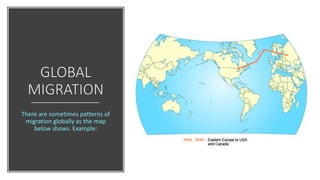
There are sometimes patterns of
migration globally as the map
below shows. Example:
The number of migrants a country receives
is influenced by the countries migration
policy.
Countries such as the UK operate a points
based system. People are awarded points
depending on their skills, previous income,
and age.
This has system gives some people visas to
allow them entry into the UK for work -
especially where there is a shortage of
labour in that sector.
Migration laws are complex, and change in
different countries, even within the EU.
Counter-urbanisation in the capital of Scotland
Movement of wealthier families to surrounding
rural areas of Edinburgh.
They use local services and they save them from
being closed down.
Migration can also cause problems for small rural
towns that they moved to (North Berwick).
Senegal is a small country in West Africa.
Population is around 13 million, growing 2% per year.
Senegal use to have a stable government and opportunities
for immigrants from all over Africa.
The economic crisis from 1990 saw a huge drop in living
standards.
There was a big increase in unemployment and a lack of jobs.
Rapid population growth has meant
competition for the few jobs available.
Put pressure on resources, especially food.
Study the migration from Senegal to Europe
(France) and answer the following question:
What would be the possible impacts in France
and European countries of many people from
Senegal migrating to them? (15 minutes).
Migration is the movement of people from one place to
another.
Internal migration is when people migrate within the same
country or region.
International migration is when people migrate from one
country to another.
Emigration is when someone leaves a country.
Immigration is when someone enters a country.
Economic migration could mean moving to find work.
Social migration is moving to be near family.
Political migration can be moving to escape war.
Environmental migration is to escape natural
disasters.
Push factors are the reasons people leave an area
like lack of services, high crime, crop failure,
flooding, poverty and war.
Pull factors are the reasons people move to a
particular area, like high employment, wealth,
better services, good climate and fertile land.

GEOGRAPHY IGCSE: MIGRATION

  • 1.
    IGCSE GEOGRAPHY 2. MIGRATION POPULATIONMIGRATION CASE STUDIES COUNTER-URBANISATION IN EDINBURGH MIGRATION FROM SENEGAL TO EUROPE
  • 2.
    Recap key words‘migration’, ‘emigration’, ‘immigration’ and ‘net migration balance’. Learners describe a key word and the other learner has to define it. Learners define ‘international migration’. Introduce a classification of migration and complete appropriate definitions with examples to illustrate.
  • 3.
    Migration is defined asa permanent or semi-permanent change in where someone lives. For instance, if you and your family move to Australia due to your dad getting a job out there, you have all migrated. If you all go Australia for a three week holiday, then you have not migrated.
  • 4.
    Some people migrateonly for a short period. Turkish immigrant workers to Germany may only go there for a period of months. They have made a semi-permanent move so can be classified as migrants. People working as chalet-maids in a ski resort for the winter also could be classified as having made a semi- permanent migration.
  • 5.
    Migrations fall intotwo groups, they can be voluntary (where the migrant decides to move) or forced (where the migrant has little choice but to move).
  • 6.
    Emigration is theact of leaving one's own country to settle permanently in another; moving abroad.
  • 7.
    Immigrate is tocome into another country to live permanently or when someone enters a country. REMEMBER: Emigrate means to leave one's country to live in another. Immigrate is to come into another country to live permanently. Migrate is to move, like bird in the winter. The choice between emigrate, immigrate, and migrate depends on the sentence's point of view.
  • 8.
    Net migration rateis the difference of immigrants and emigrants of an area in a period of time, divided per 1,000 inhabitants.
  • 9.
    International migration iswhen people migrate from one country to another - for example, moving from Mexico to the USA.
  • 10.
    People migrate formany different reasons. These reasons can be classified as economic, social, political or environmental: • economic migration - moving to find work or follow a particular career path • social migration - moving somewhere for a better quality of life or to be closer to family or friends • political migration - moving to escape political persecution or war • environmental causes of migration - include natural disasters such as flooding
  • 11.
    Some people chooseto migrate, eg. someone who moves to another country to enhance their career opportunities. Some people are forced to migrate, eg. someone who moves due to war or famine. A refugee is someone who has left their home and does not have a new home to go to. Often refugees do not carry many possessions with them and do not have a clear idea of where they may finally settle.
  • 12.
    Push factors arethe reasons why people leave an area. They include: • lack of services • lack of safety • high crime • crop failure • drought • flooding • poverty • war
  • 13.
    Pull factors arethe reasons why people move to a particular area. They include: • higher employment • more wealth • better services • good climate • safer, less crime • political stability • more fertile land • lower risk from natural hazards
  • 14.
    Migration usually happensas a result of a combination of these push and pull factors.
  • 15.
    People migrate allthe time... Within the EU Since the EU was formed, it is easier to migrate between countries. Within the EU migrants may come: • from different countries in the EU • from outside of the EU In 2004 Poland, and seven other Eastern European countries joined the EU. This increased migration into the UK. The largest group of migrants were from Poland.
  • 16.
    Migration from outsidethe EU Immigrants after the world wars mainly came from commonwealth countries. Immigration was encouraged by the government. Many immigrants provided labour for textile factories, transport, health or steelworks. The UK tightened migration controls in the 1970s.
  • 17.
    There are sometimespatterns of migration globally as the map below shows. Example:
  • 18.
    The number ofmigrants a country receives is influenced by the countries migration policy. Countries such as the UK operate a points based system. People are awarded points depending on their skills, previous income, and age. This has system gives some people visas to allow them entry into the UK for work - especially where there is a shortage of labour in that sector. Migration laws are complex, and change in different countries, even within the EU.
  • 19.
    Counter-urbanisation in thecapital of Scotland Movement of wealthier families to surrounding rural areas of Edinburgh. They use local services and they save them from being closed down. Migration can also cause problems for small rural towns that they moved to (North Berwick).
  • 20.
    Senegal is asmall country in West Africa. Population is around 13 million, growing 2% per year. Senegal use to have a stable government and opportunities for immigrants from all over Africa. The economic crisis from 1990 saw a huge drop in living standards. There was a big increase in unemployment and a lack of jobs.
  • 21.
    Rapid population growthhas meant competition for the few jobs available. Put pressure on resources, especially food. Study the migration from Senegal to Europe (France) and answer the following question: What would be the possible impacts in France and European countries of many people from Senegal migrating to them? (15 minutes).
  • 22.
    Migration is themovement of people from one place to another. Internal migration is when people migrate within the same country or region. International migration is when people migrate from one country to another. Emigration is when someone leaves a country. Immigration is when someone enters a country. Economic migration could mean moving to find work. Social migration is moving to be near family.
  • 23.
    Political migration canbe moving to escape war. Environmental migration is to escape natural disasters. Push factors are the reasons people leave an area like lack of services, high crime, crop failure, flooding, poverty and war. Pull factors are the reasons people move to a particular area, like high employment, wealth, better services, good climate and fertile land.