Dhrita Roy
Population Distribution
Introduction
• Distribution of population is the spatial arrangement of the population of
a definite region in a certain population (Kumar, 2015). At first, a
distinction must be made between population distribution and density for
better understanding. Population distribution is a locational property
where density is proportional (Chandna 1994).
• In most countries of the world the geographic distribution of the
population is not even with varying degrees of concentration of
population giving rise to varying densities in the different parts of the
world. The main factors determining population distribution are : climate,
landforms, topography, soil, energy and mineral resources, accessibility
like distance from sea coast, natural harbors, navigable rivers or canals,
cultural factors, political boundaries, controls on migration and trade,
government policies, types of economic activities, technology including
type of farming and transportation facilities, social organization and but
not the least, demographic factors like changes in natural increase and
migration.
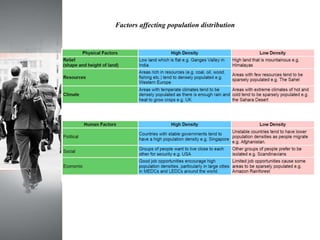
Factors affecting population distribution
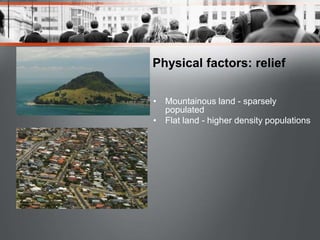
Physical factors: relief
• Mountainous land - sparsely
populated
• Flat land - higher density populations
Physical factors: resources
• Water, fertile soil, fish,
wood, coal, oil....
Physical factors: climate
• Temperate climates - more densely
populated than extreme climates
Human factors
• Political factors – government stability
• Social factors - desire of people to live
close to one another
• Economic factors - job opportunities
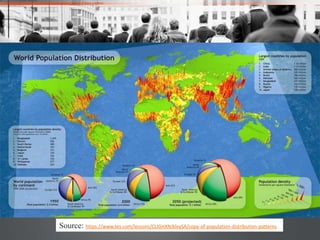
Source: https://www.tes.com/lessons/CLlGHXNJklvySA/copy-of-population-distribution-patterns
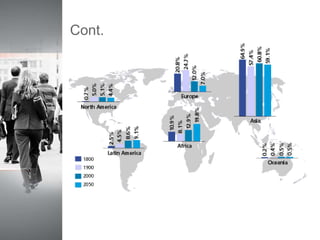
Cont.
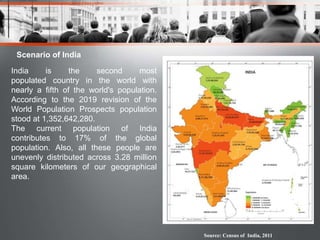
Scenario of India
India is the second most
populated country in the world with
nearly a fifth of the world's population.
According to the 2019 revision of the
World Population Prospects population
stood at 1,352,642,280.
The current population of India
contributes to 17% of the global
population. Also, all these people are
unevenly distributed across 3.28 million
square kilometers of our geographical
area.
Source: Census of India, 2011
Conclusion
It is important to understand how and where the population is distributed
throughout the world since populations are not uniformly distributed on Earth’s
landmass and neither are physical environments. It is also important to understand
the effects of different changes in population on the world. It is useful to
understand spatially where the population is located presently and where it may
move in the future, since the future of population of the world is difficult to predict.
By understanding certain patterns and understanding which factors have the
heaviest impact on population density and total population, it is possible to predict
the future growth or possible decline in global population, and also locate them
spatially throughout the world. Then it will be possible to develop policies that can
protect the environment, allow for sustainability of the planet, and allow the
continued change of global population. The results of the study did not go as
expected, as it was assumed that there would be a greater correlation between the
distributions of population to the variables of environmental factors
References
Kumar, M. (2015). A Study of Population Distribution. IV(Iii), 24–28.
Chandna, R.C., (1994): A Geography of Population – Concepts,
Determinants and Patterns, Kalyani Publishers, New Delhi. 3.
nguyễn hồ quốc linh “Population Distribution”
www.linhgeography.blogspot.in/2010/04/population-distribution.html
Jahidul Islam Nahid’s “World pattern of population distribution”
https://www.academia.edu/12602831/World_pattern_of_population_distri
bution
https://www.tes.com/lessons/CLlGHXNJklvySA/copy-of-population-
distribution-patterns
https://en.wikipedia.org/wiki/Demographics_of_India
Population Distribution

Population Distribution

  • 1.
  • 2.
    Introduction • Distribution ofpopulation is the spatial arrangement of the population of a definite region in a certain population (Kumar, 2015). At first, a distinction must be made between population distribution and density for better understanding. Population distribution is a locational property where density is proportional (Chandna 1994). • In most countries of the world the geographic distribution of the population is not even with varying degrees of concentration of population giving rise to varying densities in the different parts of the world. The main factors determining population distribution are : climate, landforms, topography, soil, energy and mineral resources, accessibility like distance from sea coast, natural harbors, navigable rivers or canals, cultural factors, political boundaries, controls on migration and trade, government policies, types of economic activities, technology including type of farming and transportation facilities, social organization and but not the least, demographic factors like changes in natural increase and migration.
  • 3.
  • 4.
    Physical factors: relief •Mountainous land - sparsely populated • Flat land - higher density populations
  • 5.
    Physical factors: resources •Water, fertile soil, fish, wood, coal, oil....
  • 6.
    Physical factors: climate •Temperate climates - more densely populated than extreme climates
  • 7.
    Human factors • Politicalfactors – government stability • Social factors - desire of people to live close to one another • Economic factors - job opportunities
  • 8.
  • 9.
  • 10.
    Scenario of India Indiais the second most populated country in the world with nearly a fifth of the world's population. According to the 2019 revision of the World Population Prospects population stood at 1,352,642,280. The current population of India contributes to 17% of the global population. Also, all these people are unevenly distributed across 3.28 million square kilometers of our geographical area. Source: Census of India, 2011
  • 12.
    Conclusion It is importantto understand how and where the population is distributed throughout the world since populations are not uniformly distributed on Earth’s landmass and neither are physical environments. It is also important to understand the effects of different changes in population on the world. It is useful to understand spatially where the population is located presently and where it may move in the future, since the future of population of the world is difficult to predict. By understanding certain patterns and understanding which factors have the heaviest impact on population density and total population, it is possible to predict the future growth or possible decline in global population, and also locate them spatially throughout the world. Then it will be possible to develop policies that can protect the environment, allow for sustainability of the planet, and allow the continued change of global population. The results of the study did not go as expected, as it was assumed that there would be a greater correlation between the distributions of population to the variables of environmental factors
  • 13.
    References Kumar, M. (2015).A Study of Population Distribution. IV(Iii), 24–28. Chandna, R.C., (1994): A Geography of Population – Concepts, Determinants and Patterns, Kalyani Publishers, New Delhi. 3. nguyễn hồ quốc linh “Population Distribution” www.linhgeography.blogspot.in/2010/04/population-distribution.html Jahidul Islam Nahid’s “World pattern of population distribution” https://www.academia.edu/12602831/World_pattern_of_population_distri bution https://www.tes.com/lessons/CLlGHXNJklvySA/copy-of-population- distribution-patterns https://en.wikipedia.org/wiki/Demographics_of_India