MIGRATION
Population & Census Geography - 306
Kazi Mahir Tajwar
Department of Geography And Environment,
Jahangirnagar University.
What is Migration?
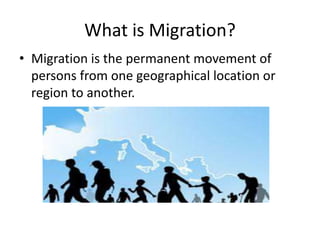
• Migration is the permanent movement of
persons from one geographical location or
region to another.
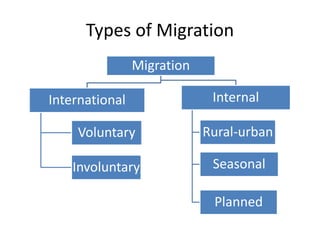
Types of Migration
Migration
International
Voluntary
Involuntary
Internal
Rural-urban
Seasonal
Planned
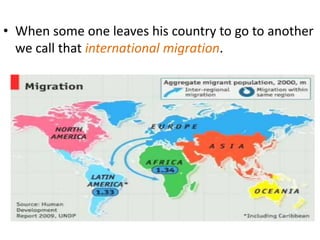
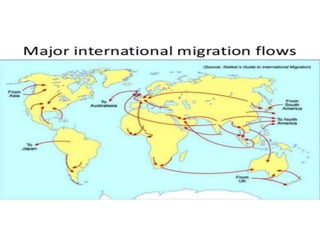
• When some one leaves his country to go to another
we call that international migration.
International Migration
• Involuntary Migration-
Movement of people caused by events which
force people to move against their will.
• Voluntary Migration-
Movement of people by choice or one’s own
free will.
Causes of International Migration
• Lower living cost
• Political persecution
• Lack of skills and education
• Slaves or forced labor
• Lack of food & famine
• Natural disaster
• Overpopulation
• Territorial expansion
Impacts of International Migration
Socio-economic impact:
• A possible disadvantages of emigration is the ‘brain drain’, so
called because areas/countries can lose their best workers.
• Social assimilation is related to socio-political maturity of the
host & source societies.
Cultural Impact:
• Old colonial powers have relatively cosmopolitan populations
compared to non-colonial nations
• In such countries there is also a significant different between the
ethnic composition between urban & rural areas.
Political Impact:
• In many countries with high numbers of established/legal immigrants-
they are more likely to vote for political parties sympathetic to their
beliefs/needs.
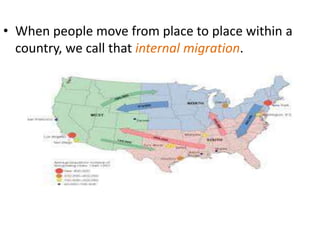
• When people move from place to place within a
country, we call that internal migration.
Internal Migration
• Rural to Urban Migration:
Movement of people away from the rural region (countryside,
farms) to an urban (town, city) area.
• Seasonal Migration:
It refers to the movement of people away from their homes to
find a livelihood, usually on a temporary basis.
• Planned Migration:
It refers to large-scale migration of people within the country
usually carried out by the government.
Trends in Migration Flows from Bangladesh
• Overseas employment contributes significantly to the
economic development of the country.
• From the inception of manpower export in 1976 to
2008, manpower having strength of about 6.57 million
has been exported.
• Including first seven months of 2009, total number of
manpower exported to foreign countries was about 6.8
million (BMET, 2009).
• Only in 2008 about 0.88 million people have migrated
for foreign employment.
• With a few exceptions, manpower export has been
increasing every year.
Trends in Migration Flows from Bangladesh (Cont’d)
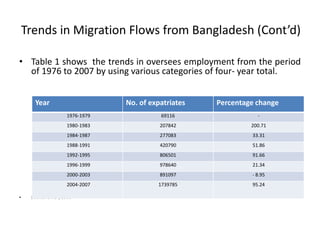
• Table 1 shows the trends in oversees employment from the period
of 1976 to 2007 by using various categories of four- year total.
• Source: BMET, 2008
Year No. of expatriates Percentage change
1976-1979 69116 -
1980-1983 207842 200.71
1984-1987 277083 33.31
1988-1991 420790 51.86
1992-1995 806501 91.66
1996-1999 978640 21.34
2000-2003 891097 - 8.95
2004-2007 1739785 95.24
Female migration from Bangladesh
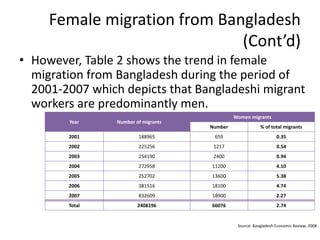
• However, Table 2 shows the trend in female migration
from Bangladesh during the period of 2001-2007 which
depicts that Bangladeshi migrant workers are
predominantly men.
• Female migrants constitute only 66076, among a total
of 2408196 migrants from 2001-2007, which is less
than 3 per cent of the total migrants of Bangladesh.
• Female migrants constitute only 66076, among a total
of 2408196 migrants from 2001-2007, which is less
than 3 per cent of the total migrants of Bangladesh.
Female migration from Bangladesh
(Cont’d)
• However, Table 2 shows the trend in female
migration from Bangladesh during the period of
2001-2007 which depicts that Bangladeshi migrant
workers are predominantly men.
Source: Bangladesh Economic Review, 2008
Year Number of migrants
Women migrants
Number % of total migrants
2001 188965 659 0.35
2002 225256 1217 0.54
2003 254190 2400 0.94
2004 272958 11200 4.10
2005 252702 13600 5.38
2006 381516 18100 4.74
2007 832609 18900 2.27
Total 2408196 66076 2.74
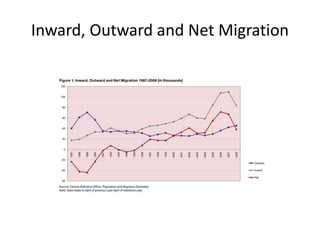
Inward, Outward and Net Migration
Impact of Internal Migration
• Socio-economic Impact:
Remittances from internal migration are even more difficult to
estimate than those arising from international migration.
• Political Impact:
Where migration results in depopulation, the reduced number of people
in a region can reduce the ‘political voice’ of the community. A lower
population can also result in decreased funding from central
government.
• Environmental Impact:
Deforestation due to the increasing demand for firewood.
Increasing demands on regional water supplies & other resources
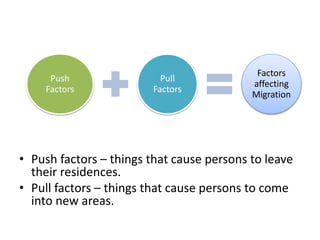
• Push factors – things that cause persons to leave
their residences.
• Pull factors – things that cause persons to come
into new areas.
Push
Factors
Pull
Factors
Factors
affecting
Migration
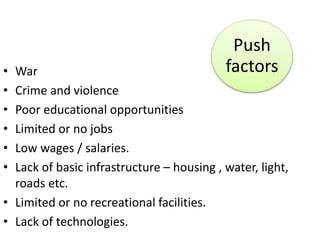
• War
• Crime and violence
• Poor educational opportunities
• Limited or no jobs
• Low wages / salaries.
• Lack of basic infrastructure – housing , water, light,
roads etc.
• Limited or no recreational facilities.
• Lack of technologies.
Push
factors
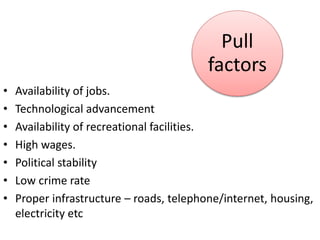
• Availability of jobs.
• Technological advancement
• Availability of recreational facilities.
• High wages.
• Political stability
• Low crime rate
• Proper infrastructure – roads, telephone/internet, housing,
electricity etc
Pull
factors
Consequences Of Migration On The Country Of
Origin
• Economic Impact:
• Positive
 The area benefits from remittances sent home.
 Upon return, migrants bring new skills to the country such as the ability to speak
foreign languages. These new skills can help to improve the economy in the country
of origin.
 There is less pressure on resources such as food & social services such as health
care.
• Negative
 Loss of young workforce; those with skills & those with entrepreneurial talents
move, slowing economic development.
 Loss of labor may reduce inward investment by private companies, increasing
dependencies on government initiatives.
• Social Impacts
• Positives
 Population density is reduced & birth rate falls, as it’s the younger population who
migrates. These can help ease overpopulation.
 Remittances sent home by economic migrants can be used finance improved
education & health service.
 Returning migrants increased social expectations for communities, for example
increasing demand for better leisure facilities.
• Negatives
 Marriage rates fall & family structures break down as men migrate producing a
generation of single mums.
 Lost of young people migrating out of the country can increase the dependency
ratio.
 Returning retired migrants may increase social costs on the community as supports
mechanisms aren’t in place for them.
 Migration of men & young families can cause a loss of cultural leadership &
traditions.
Consequences Of Migration On The Host Country
• Economic Impacts
• Positives
 Migrants take up less desirable, menial jobs which natives would not take
but need filling.
 The host country can gain skilled labor for cheap.
 There is a labor surplus, those with skills & education fuel the economy.
 The “skill gap” in many host countries can be filled by migrants.
 Costs of retirement can be transferred to the country of origin.
• Negatives
 Migrant children must be educated, they won’t necessarily speak native language of
the host country.
 There is an over dependency in some industries on migrant labor, leading to a lack
of jobs for people native to the host country.
 Much of the money earned by the migrants isn’t spent in the host country & is
instead sent back to the country of origin.
 More people increased the pressure on resources & services such as health care
system.
• Social Impacts
• Positives
 The creation of a multiethnic society increases understanding & tolerance of
other cultures.
 There is an influx of new or revitalized services e.g, Kebab shops & Turkish
baths.
 People from other countries can encourage the learning of new languages,
helping people develop skills for working internationally.
• Negatives
 The dominance of males is reinforced (due to large number of male
migrants) especially in cultures where women already have a low status.
 Aspects of cultural identity are lost, especially in second generation children.
 Segregated ethnic areas are created e.g, China Town. Schools become
dominated by migrant children.
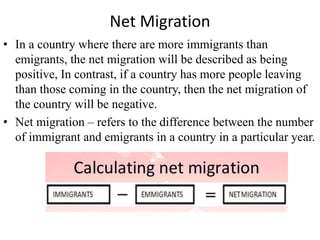
Net Migration
• In a country where there are more immigrants than
emigrants, the net migration will be described as being
positive, In contrast, if a country has more people leaving
than those coming in the country, then the net migration of
the country will be negative.
• Net migration – refers to the difference between the number
of immigrant and emigrants in a country in a particular year.
Ravenstein’s Migration Theory 1885
• The model is based on a series of predictive statements.
Number One:
Most migrants have only relatively short distances. There is an
inverse relationship between the number of migrants & distance
levels.
Number Two:
People who do move long distances are largely unaware of the
opportunities that are available at their destination. So they tend
to move to large urban centers.
Number Three:
Migration occurs in stages.
Ravenstein’s Migration Theory
Number Four:
People in rural areas are much more likely to migrate than
those in urban centers. Based on the exponential growth
of cities ( natural increase + rural-urban migration)
Number Five:
A typical migrant-
Women are more likely to migrant within their country then men.
Men are more likely to emigrant than women.
Most migrants are adult.
Lee’s Migration Model
What is it About?
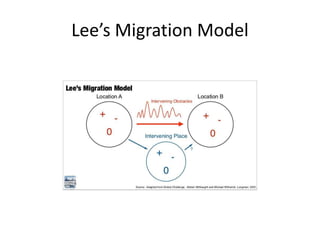
Lee’s migration model is a model that accounts for push/pull
factors, intervening obstacles, in order to project migratory
patterns
It advocated the idea that intervening obstacles can block
migration to certain areas, while push and pull can promote the
migration out of an old area to a new one
The model is used alongside Ravenstein’s “Laws” of Migration,
the Migration Transition Model, and other models in order to
show migratory patterns
What is a Push Factor?
Definition: Factor that induces people to leave old residences.
A Push Factor in simpler terms is any thing the forces people to
move out of a certain area.
The three main types of push factors are economic, cultural and
environmental push factors.
Within these three groups there are a variety of push factors but
some notable ones are few opportunities, discrimination, loss of
wealth, war, etc.
As shown in the model, the push factors are what drive people
out of Location A.
What is a Pull Factor?
Definition: Factor that induces people to move to a new location
In other words it it is the reason that an individual or group migrates
to a certain area.
Similar to push factors it is divided into economic, cultural, and
environmental factors, but unlike push factors which deals with
the reason for leaving, pull factors deal with the reasons for
moving to certain place.
There are many pull factors but a couple include job opportunities,
better living conditions, attractive climate, security, etc.
Pull factors are an integral part of Lee’s migration model as they
show why certain groups desire to go to certain locations.
What is an Intervening Obstacles?
Definition: An environmental or cultural feature of the land that
hinders migration.
In simpler terms, intervening obstacles are the things that prevent a
migration to a certain area mainly to do with features of the land.
The two main types of intervening obstacles are cultural and
physical/environmental intervening obstacles.
Some cultural intervening obstacles are cultural taboos on travel or
traversing hostile territory, while some environmental intervening
obstacles can include physical features such as mountains or
deserts.
Intervening obstacles are a key aspect of the model because they
help us identify the intervening place between Location A and
Location B.
What will Cause People to Migrate?
• In both the initial and the target place, there are both
positive and negative factors
• There has to be more positive reasons to migrate then
there are negative for a person to choose to leave
• The intervening obstacles also have to be easy enough
to overcome to migrate
– EX: If it would take multiple years to get to the final
location, the person would be deterred to migrate even if
it was a utopia like society.
Problems with The Model
• It doesn’t account that people have less ability to act
upon migration decisions
– Family and Friends telling them to say
– The amount of work it may take to migrate
• It only looks at people’s desire to migrate by the
accessibility and desirability
• People may differ in their ability to migrate no matter
how desirable it may seem.
– Being in debt, or extremely poor
How it Works in the Real World
• In the real world, Lee’s model works similar to in theory
• Overall, people are less likely to migrate than Lee’s model
suggests
• In principle, works but not as perfectly as it could.
• Examples
– Tom wants to move to a utopian country from the US
• Push factors: not perfect society
• Intervening Obstacles: Family and friends can't come, high
cost of leaving, possibility of failing and having to stay if
denied entrance
• Pull Factors: literally utopia
• Tom ends up migrating

Migration

  • 1.
    MIGRATION Population & CensusGeography - 306 Kazi Mahir Tajwar Department of Geography And Environment, Jahangirnagar University.
  • 2.
    What is Migration? •Migration is the permanent movement of persons from one geographical location or region to another.
  • 3.
  • 4.
    • When someone leaves his country to go to another we call that international migration.
  • 5.
    International Migration • InvoluntaryMigration- Movement of people caused by events which force people to move against their will. • Voluntary Migration- Movement of people by choice or one’s own free will.
  • 6.
    Causes of InternationalMigration • Lower living cost • Political persecution • Lack of skills and education • Slaves or forced labor • Lack of food & famine • Natural disaster • Overpopulation • Territorial expansion
  • 8.
    Impacts of InternationalMigration Socio-economic impact: • A possible disadvantages of emigration is the ‘brain drain’, so called because areas/countries can lose their best workers. • Social assimilation is related to socio-political maturity of the host & source societies. Cultural Impact: • Old colonial powers have relatively cosmopolitan populations compared to non-colonial nations • In such countries there is also a significant different between the ethnic composition between urban & rural areas. Political Impact: • In many countries with high numbers of established/legal immigrants- they are more likely to vote for political parties sympathetic to their beliefs/needs.
  • 9.
    • When peoplemove from place to place within a country, we call that internal migration.
  • 10.
    Internal Migration • Ruralto Urban Migration: Movement of people away from the rural region (countryside, farms) to an urban (town, city) area. • Seasonal Migration: It refers to the movement of people away from their homes to find a livelihood, usually on a temporary basis. • Planned Migration: It refers to large-scale migration of people within the country usually carried out by the government.
  • 11.
    Trends in MigrationFlows from Bangladesh • Overseas employment contributes significantly to the economic development of the country. • From the inception of manpower export in 1976 to 2008, manpower having strength of about 6.57 million has been exported. • Including first seven months of 2009, total number of manpower exported to foreign countries was about 6.8 million (BMET, 2009). • Only in 2008 about 0.88 million people have migrated for foreign employment. • With a few exceptions, manpower export has been increasing every year.
  • 12.
    Trends in MigrationFlows from Bangladesh (Cont’d) • Table 1 shows the trends in oversees employment from the period of 1976 to 2007 by using various categories of four- year total. • Source: BMET, 2008 Year No. of expatriates Percentage change 1976-1979 69116 - 1980-1983 207842 200.71 1984-1987 277083 33.31 1988-1991 420790 51.86 1992-1995 806501 91.66 1996-1999 978640 21.34 2000-2003 891097 - 8.95 2004-2007 1739785 95.24
  • 13.
    Female migration fromBangladesh • However, Table 2 shows the trend in female migration from Bangladesh during the period of 2001-2007 which depicts that Bangladeshi migrant workers are predominantly men. • Female migrants constitute only 66076, among a total of 2408196 migrants from 2001-2007, which is less than 3 per cent of the total migrants of Bangladesh. • Female migrants constitute only 66076, among a total of 2408196 migrants from 2001-2007, which is less than 3 per cent of the total migrants of Bangladesh.
  • 14.
    Female migration fromBangladesh (Cont’d) • However, Table 2 shows the trend in female migration from Bangladesh during the period of 2001-2007 which depicts that Bangladeshi migrant workers are predominantly men. Source: Bangladesh Economic Review, 2008 Year Number of migrants Women migrants Number % of total migrants 2001 188965 659 0.35 2002 225256 1217 0.54 2003 254190 2400 0.94 2004 272958 11200 4.10 2005 252702 13600 5.38 2006 381516 18100 4.74 2007 832609 18900 2.27 Total 2408196 66076 2.74
  • 15.
    Inward, Outward andNet Migration
  • 16.
    Impact of InternalMigration • Socio-economic Impact: Remittances from internal migration are even more difficult to estimate than those arising from international migration. • Political Impact: Where migration results in depopulation, the reduced number of people in a region can reduce the ‘political voice’ of the community. A lower population can also result in decreased funding from central government. • Environmental Impact: Deforestation due to the increasing demand for firewood. Increasing demands on regional water supplies & other resources
  • 17.
    • Push factors– things that cause persons to leave their residences. • Pull factors – things that cause persons to come into new areas. Push Factors Pull Factors Factors affecting Migration
  • 18.
    • War • Crimeand violence • Poor educational opportunities • Limited or no jobs • Low wages / salaries. • Lack of basic infrastructure – housing , water, light, roads etc. • Limited or no recreational facilities. • Lack of technologies. Push factors
  • 19.
    • Availability ofjobs. • Technological advancement • Availability of recreational facilities. • High wages. • Political stability • Low crime rate • Proper infrastructure – roads, telephone/internet, housing, electricity etc Pull factors
  • 20.
    Consequences Of MigrationOn The Country Of Origin • Economic Impact: • Positive  The area benefits from remittances sent home.  Upon return, migrants bring new skills to the country such as the ability to speak foreign languages. These new skills can help to improve the economy in the country of origin.  There is less pressure on resources such as food & social services such as health care. • Negative  Loss of young workforce; those with skills & those with entrepreneurial talents move, slowing economic development.  Loss of labor may reduce inward investment by private companies, increasing dependencies on government initiatives.
  • 21.
    • Social Impacts •Positives  Population density is reduced & birth rate falls, as it’s the younger population who migrates. These can help ease overpopulation.  Remittances sent home by economic migrants can be used finance improved education & health service.  Returning migrants increased social expectations for communities, for example increasing demand for better leisure facilities. • Negatives  Marriage rates fall & family structures break down as men migrate producing a generation of single mums.  Lost of young people migrating out of the country can increase the dependency ratio.  Returning retired migrants may increase social costs on the community as supports mechanisms aren’t in place for them.  Migration of men & young families can cause a loss of cultural leadership & traditions.
  • 22.
    Consequences Of MigrationOn The Host Country • Economic Impacts • Positives  Migrants take up less desirable, menial jobs which natives would not take but need filling.  The host country can gain skilled labor for cheap.  There is a labor surplus, those with skills & education fuel the economy.  The “skill gap” in many host countries can be filled by migrants.  Costs of retirement can be transferred to the country of origin. • Negatives  Migrant children must be educated, they won’t necessarily speak native language of the host country.  There is an over dependency in some industries on migrant labor, leading to a lack of jobs for people native to the host country.  Much of the money earned by the migrants isn’t spent in the host country & is instead sent back to the country of origin.  More people increased the pressure on resources & services such as health care system.
  • 23.
    • Social Impacts •Positives  The creation of a multiethnic society increases understanding & tolerance of other cultures.  There is an influx of new or revitalized services e.g, Kebab shops & Turkish baths.  People from other countries can encourage the learning of new languages, helping people develop skills for working internationally. • Negatives  The dominance of males is reinforced (due to large number of male migrants) especially in cultures where women already have a low status.  Aspects of cultural identity are lost, especially in second generation children.  Segregated ethnic areas are created e.g, China Town. Schools become dominated by migrant children.
  • 24.
    Net Migration • Ina country where there are more immigrants than emigrants, the net migration will be described as being positive, In contrast, if a country has more people leaving than those coming in the country, then the net migration of the country will be negative. • Net migration – refers to the difference between the number of immigrant and emigrants in a country in a particular year.
  • 25.
    Ravenstein’s Migration Theory1885 • The model is based on a series of predictive statements. Number One: Most migrants have only relatively short distances. There is an inverse relationship between the number of migrants & distance levels. Number Two: People who do move long distances are largely unaware of the opportunities that are available at their destination. So they tend to move to large urban centers. Number Three: Migration occurs in stages.
  • 26.
    Ravenstein’s Migration Theory NumberFour: People in rural areas are much more likely to migrate than those in urban centers. Based on the exponential growth of cities ( natural increase + rural-urban migration) Number Five: A typical migrant- Women are more likely to migrant within their country then men. Men are more likely to emigrant than women. Most migrants are adult.
  • 27.
  • 28.
    What is itAbout? Lee’s migration model is a model that accounts for push/pull factors, intervening obstacles, in order to project migratory patterns It advocated the idea that intervening obstacles can block migration to certain areas, while push and pull can promote the migration out of an old area to a new one The model is used alongside Ravenstein’s “Laws” of Migration, the Migration Transition Model, and other models in order to show migratory patterns
  • 29.
    What is aPush Factor? Definition: Factor that induces people to leave old residences. A Push Factor in simpler terms is any thing the forces people to move out of a certain area. The three main types of push factors are economic, cultural and environmental push factors. Within these three groups there are a variety of push factors but some notable ones are few opportunities, discrimination, loss of wealth, war, etc. As shown in the model, the push factors are what drive people out of Location A.
  • 30.
    What is aPull Factor? Definition: Factor that induces people to move to a new location In other words it it is the reason that an individual or group migrates to a certain area. Similar to push factors it is divided into economic, cultural, and environmental factors, but unlike push factors which deals with the reason for leaving, pull factors deal with the reasons for moving to certain place. There are many pull factors but a couple include job opportunities, better living conditions, attractive climate, security, etc. Pull factors are an integral part of Lee’s migration model as they show why certain groups desire to go to certain locations.
  • 31.
    What is anIntervening Obstacles? Definition: An environmental or cultural feature of the land that hinders migration. In simpler terms, intervening obstacles are the things that prevent a migration to a certain area mainly to do with features of the land. The two main types of intervening obstacles are cultural and physical/environmental intervening obstacles. Some cultural intervening obstacles are cultural taboos on travel or traversing hostile territory, while some environmental intervening obstacles can include physical features such as mountains or deserts. Intervening obstacles are a key aspect of the model because they help us identify the intervening place between Location A and Location B.
  • 32.
    What will CausePeople to Migrate? • In both the initial and the target place, there are both positive and negative factors • There has to be more positive reasons to migrate then there are negative for a person to choose to leave • The intervening obstacles also have to be easy enough to overcome to migrate – EX: If it would take multiple years to get to the final location, the person would be deterred to migrate even if it was a utopia like society.
  • 33.
    Problems with TheModel • It doesn’t account that people have less ability to act upon migration decisions – Family and Friends telling them to say – The amount of work it may take to migrate • It only looks at people’s desire to migrate by the accessibility and desirability • People may differ in their ability to migrate no matter how desirable it may seem. – Being in debt, or extremely poor
  • 34.
    How it Worksin the Real World • In the real world, Lee’s model works similar to in theory • Overall, people are less likely to migrate than Lee’s model suggests • In principle, works but not as perfectly as it could. • Examples – Tom wants to move to a utopian country from the US • Push factors: not perfect society • Intervening Obstacles: Family and friends can't come, high cost of leaving, possibility of failing and having to stay if denied entrance • Pull Factors: literally utopia • Tom ends up migrating