GEOG 102 – Population, Resources, and the Environment
Professor: Dr. Jean-Paul Rodrigue
Topic 5 – Migration and Urbanization
A – Migration Issues
B – Migration Theory
C – Refugees
D – Urbanization
Migration Issues
■ 1. Types of Migration
• What are the major forms of migration?
■ 2. Selective Migration
• Why migration can be considered as a selective process?
■ 3. Brain Drain
• What is the extent of movements of skilled labor?
A
Types of Migration
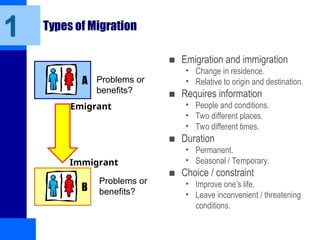
■ Emigration and immigration
• Change in residence.
• Relative to origin and destination.
■ Requires information
• People and conditions.
• Two different places.
• Two different times.
■ Duration
• Permanent.
• Seasonal / Temporary.
■ Choice / constraint
• Improve one’s life.
• Leave inconvenient / threatening
conditions.
1
A
B
Problems or
benefits?
Problems or
benefits?
Emigrant
Immigrant
Types of Migration
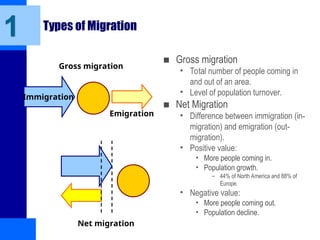
■ Gross migration
• Total number of people coming in
and out of an area.
• Level of population turnover.
■ Net Migration
• Difference between immigration (in-
migration) and emigration (out-
migration).
• Positive value:
• More people coming in.
• Population growth.
– 44% of North America and 88% of
Europe.
• Negative value:
• More people coming out.
• Population decline.
1
Emigration
Immigration
Net migration
Gross migration
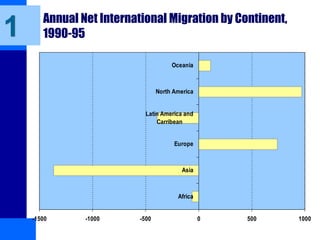
Annual Net International Migration by Continent,
1990-95
-1500 -1000 -500 0 500 1000
Africa
Asia
Europe
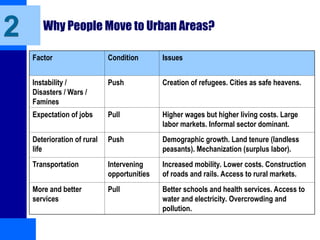
Latin America and
Carribean
North America
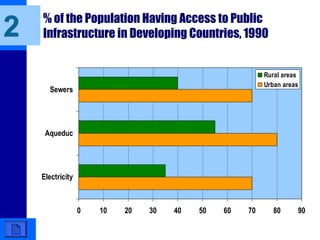
Oceania
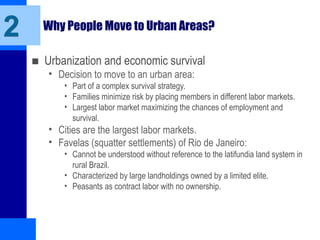
1
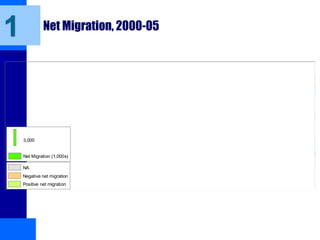
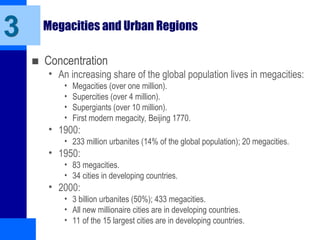
Net Migration, 2000-05
1
3,000
Net Migration (1,000s)
NA
Negative net migration
Positive net migration
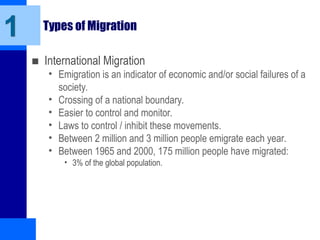
Types of Migration
■ International Migration
• Emigration is an indicator of economic and/or social failures of a
society.
• Crossing of a national boundary.
• Easier to control and monitor.
• Laws to control / inhibit these movements.
• Between 2 million and 3 million people emigrate each year.
• Between 1965 and 2000, 175 million people have migrated:
• 3% of the global population.
1
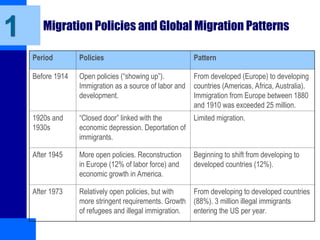
Migration Policies and Global Migration Patterns
Period Policies Pattern
Before 1914 Open policies (“showing up”).
Immigration as a source of labor and
development.
From developed (Europe) to developing
countries (Americas, Africa, Australia).
Immigration from Europe between 1880
and 1910 was exceeded 25 million.
1920s and
1930s
“Closed door” linked with the
economic depression. Deportation of
immigrants.
Limited migration.
After 1945 More open policies. Reconstruction
in Europe (12% of labor force) and
economic growth in America.
Beginning to shift from developing to
developed countries (12%).
After 1973 Relatively open policies, but with
more stringent requirements. Growth
of refugees and illegal immigration.
From developing to developed countries
(88%). 3 million illegal immigrants
entering the US per year.
1
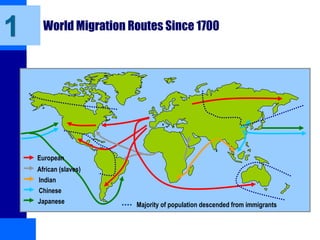
World Migration Routes Since 1700
European
African (slaves)
Indian
Chinese
Japanese Majority of population descended from immigrants
1
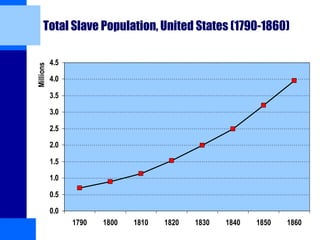
Total Slave Population, United States (1790-1860)
0.0
0.5
1.0
1.5
2.0
2.5
3.0
3.5
4.0
4.5
1790 1800 1810 1820 1830 1840 1850 1860
Millions
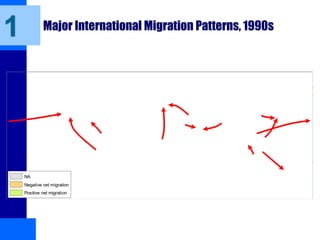
Major International Migration Patterns, 1990s
NA
Negative net migration
Positive net migration
1
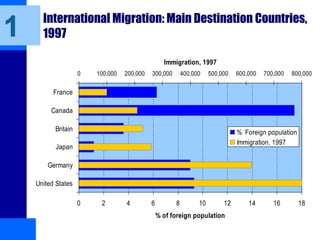
International Migration: Main Destination Countries,
1997
0 2 4 6 8 10 12 14 16 18
United States
Germany
Japan
Britain
Canada
France
% of foreign population
0 100,000 200,000 300,000 400,000 500,000 600,000 700,000 800,000
Immigration, 1997
% Foreign population
Immigration, 1997
1
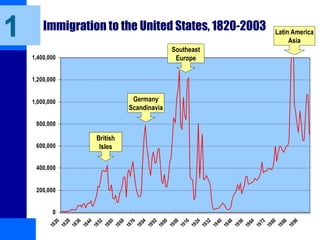
Immigration to the United States, 1820-2003
0
200,000
400,000
600,000
800,000
1,000,000
1,200,000
1,400,000
1
8
2
0
1
8
2
8
1
8
3
6
1
8
4
4
1
8
5
2
1
8
6
0
1
8
6
8
1
8
7
6
1
8
8
4
1
8
9
2
1
9
0
0
1
9
0
8
1
9
1
6
1
9
2
4
1
9
3
2
1
9
4
0
1
9
4
8
1
9
5
6
1
9
6
4
1
9
7
2
1
9
8
0
1
9
8
8
1
9
9
6
1
British
Isles
Germany
Scandinavia
Southeast
Europe
Latin America
Asia
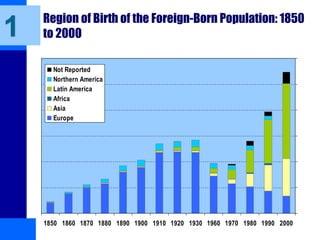
Region of Birth of the Foreign-Born Population: 1850
to 2000
2000
1990
1980
1970
1960
1930
1920
1910
1900
1890
1880
1870
1860
1850
.
Not Reported
Northern America
Latin America
Africa
Asia
Europe
1
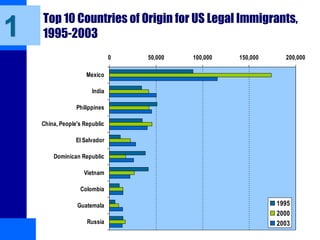
Top 10 Countries of Origin for US Legal Immigrants,
1995-2003
0 50,000 100,000 150,000 200,000
Mexico
India
Philippines
China, People's Republic
El Salvador
Dominican Republic
Vietnam
Colombia
Guatemala
Russia
1995
2000
2003
1
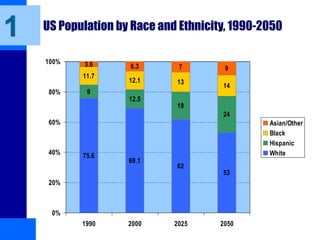
US Population by Race and Ethnicity, 1990-2050
75.6
69.1
62
53
9
12.5
18
24
11.7
12.1 13
14
3.6 6.3 7 9
0%
20%
40%
60%
80%
100%
1990 2000 2025 2050
Asian/Other
Black
Hispanic
White
1
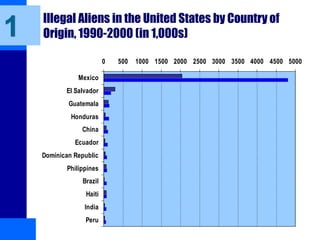
Illegal Aliens in the United States by Country of
Origin, 1990-2000 (in 1,000s)
0 500 1000 1500 2000 2500 3000 3500 4000 4500 5000
Mexico
El Salvador
Guatemala
Honduras
China
Ecuador
Dominican Republic
Philippines
Brazil
Haiti
India
Peru
1
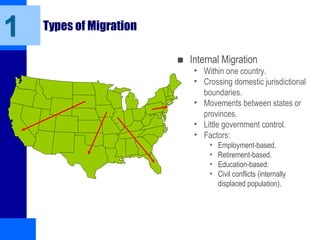
Types of Migration
■ Internal Migration
• Within one country.
• Crossing domestic jurisdictional
boundaries.
• Movements between states or
provinces.
• Little government control.
• Factors:
• Employment-based.
• Retirement-based.
• Education-based.
• Civil conflicts (internally
displaced population).
1
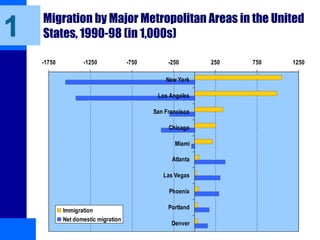
Migration by Major Metropolitan Areas in the United
States, 1990-98 (in 1,000s)
-1750 -1250 -750 -250 250 750 1250
New York
Los Angeles
San Francisco
Chicago
Miami
Atlanta
Las Vegas
Phoenix
Portland
Denver
Immigration
Net domestic migration
1
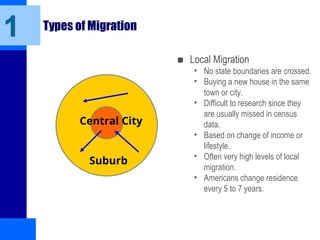
Types of Migration
■ Local Migration
• No state boundaries are crossed.
• Buying a new house in the same
town or city.
• Difficult to research since they
are usually missed in census
data.
• Based on change of income or
lifestyle.
• Often very high levels of local
migration.
• Americans change residence
every 5 to 7 years.
1
Central City
Suburb
Types of Migration
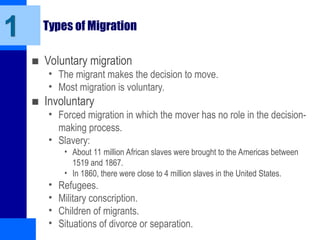
■ Voluntary migration
• The migrant makes the decision to move.
• Most migration is voluntary.
■ Involuntary
• Forced migration in which the mover has no role in the decision-
making process.
• Slavery:
• About 11 million African slaves were brought to the Americas between
1519 and 1867.
• In 1860, there were close to 4 million slaves in the United States.
• Refugees.
• Military conscription.
• Children of migrants.
• Situations of divorce or separation.
1
Types of Migration
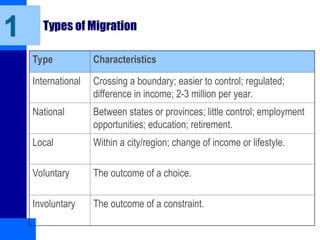
Type Characteristics
International Crossing a boundary; easier to control; regulated;
difference in income; 2-3 million per year.
National Between states or provinces; little control; employment
opportunities; education; retirement.
Local Within a city/region; change of income or lifestyle.
Voluntary The outcome of a choice.
Involuntary The outcome of a constraint.
1
2 Selective Migration
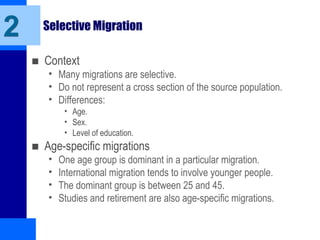
■ Context
• Many migrations are selective.
• Do not represent a cross section of the source population.
• Differences:
• Age.
• Sex.
• Level of education.
■ Age-specific migrations
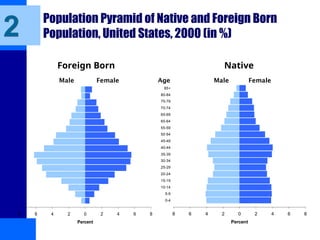
• One age group is dominant in a particular migration.
• International migration tends to involve younger people.
• The dominant group is between 25 and 45.
• Studies and retirement are also age-specific migrations.
Population Pyramid of Native and Foreign Born
Population, United States, 2000 (in %)
8 6 4 2 0 2 4 6 8
Percent
Male Female Female
Male
Foreign Born Native
8 6 4 2 0 2 4 6 8
0-4
5-9
10-14
15-19
20-24
25-29
30-34
35-39
40-44
45-49
50-54
55-59
60-64
65-69
70-74
75-79
80-84
85+
Percent
Age
2
Selective Migration
■ Sex-specific migrations
• Males:
• Often dominant international migrations.
• Once established, try to bring in a wife.
• Females:
• Often dominate rural to urban migrations.
• Find jobs as domestic help or in new factories.
• Send remittances back home.
• Filipino females 17-30 to Hong Kong and Japan.
• “Mail-order bride”:
• 100,000 – 150,000 women a year advertise themselves for marriage.
• About 10,000 available on the Internet at any time.
• Mainly from Southeast Asia and Russia.
• Come from places in which jobs and educational opportunities for women
are scarce and wages are low.
2
Selective Migration
■ Education-specific migrations
• May characterize some migrations (having or lacking of).
• High level of education attained by most contemporary Asian
immigrants to the USA and Canada.
• Educational differences:
• 21% of all legal immigrants have at least 17 years of education.
• 8% for native-born Americans.
• 20% of all immigrants do not have 9 years of schooling.
• Foreign students:
• Often do not return to their home countries after their education.
• Often cannot utilize what they have learned.
• Since 1978 some 130,000 Chinese overseas students have returned
while some 250,000 have remained abroad.
• Most research-oriented graduate institutions have around 40% foreign
students.
2
Selective Migration
■ Immigration and jobs
• Related to the economic sector.
• High level:
• Filling high skilled position in science, technology and education.
• Not enough highly trained personnel in the US.
• Result in recruiting abroad (see brain drain).
• Low level:
• Filling low paid jobs (minimum wage) that most people do not want
(agriculture and low level services).
• Maintain low wages in low skilled jobs.
• Possibility of an informal economy.
2
Brain Drain
■ Definition
• Relates to educationally specific selective migrations.
• Some countries are losing the most educated segment of their
population.
• Can be both a benefit for the receiving country and a problem to
the country of origin.
■ Receiving country
• Getting highly qualified labor contributing to the economy right
away.
• Promotes economic growth in strategic sectors: science and
technology.
• Not having to pay education and health costs.
• 30% of Mexicans with a PhD are in the US.
3
Brain Drain
■ Country of origin
• Education and health costs not paid back.
• Losing potential leaders and talent:
• Between 15 and 40% of a graduating class in Canada will move to the
US.
• Long term impact on economic growth.
• Possibility of remittances.
• Many brain drain migrants have skills which they can’t use at
home:
• The resources and technology may not be available there.
• The specific labor market is not big enough.
• May eventually come back with skills and connections:
• Korea, Taiwan, China and India.
3
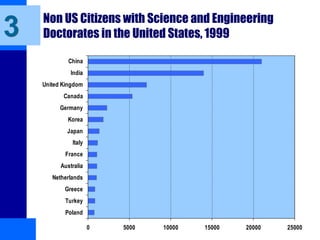
Non US Citizens with Science and Engineering
Doctorates in the United States, 1999
0 5000 10000 15000 20000 25000
Poland
Turkey
Greece
Netherlands
Australia
France
Italy
Japan
Korea
Germany
Canada
United Kingdom
India
China
3
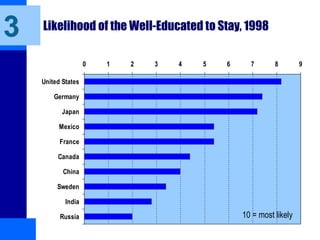
Likelihood of the Well-Educated to Stay, 1998
0 1 2 3 4 5 6 7 8 9
United States
Germany
Japan
Mexico
France
Canada
China
Sweden
India
Russia
3
10 = most likely
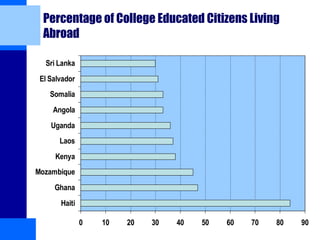
Percentage of College Educated Citizens Living
Abroad
0 10 20 30 40 50 60 70 80 90
Haiti
Ghana
Mozambique
Kenya
Laos
Uganda
Angola
Somalia
El Salvador
Sri Lanka
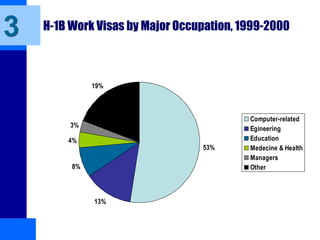
H-1B Work Visas by Major Occupation, 1999-2000
53%
13%
8%
4%
3%
19%
Computer-related
Egineering
Education
Medecine & Health
Managers
Other
3
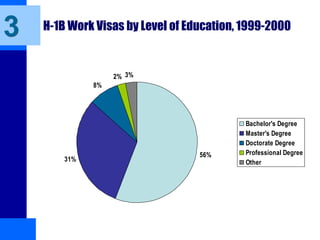
H-1B Work Visas by Level of Education, 1999-2000
56%
31%
8%
2% 3%
Bachelor's Degree
Master's Degree
Doctorate Degree
Professional Degree
Other
3
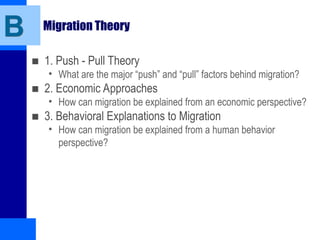
B Migration Theory
■ 1. Push - Pull Theory
• What are the major “push” and “pull” factors behind migration?
■ 2. Economic Approaches
• How can migration be explained from an economic perspective?
■ 3. Behavioral Explanations to Migration
• How can migration be explained from a human behavior
perspective?
Push - Pull Theory
■ Context
• Migrations as the response of individual decision-makers.
• Negative or push factors in his current area of residence:
• High unemployment and little opportunity.
• Great poverty.
• High crime.
• Repression or a recent disaster (e.g., drought or earthquake).
• Positive or pull factors in the potential destination:
• High job availability and higher wages.
• More exciting lifestyle.
• Political freedom, greater safety and security, etc.
1
Push - Pull Theory
■ Intervening obstacles
• Migration costs / transportation.
• Immigration laws and policies of the destination country.
■ The problem of perception
• Assumes rational behavior on the part of the migrant:
• Not necessarily true since a migrant cannot be truly informed.
• The key word is perception of the pull factors.
• Information is never complete.
• Decisions are made based upon perceptions of reality at the destination
relative to the known reality at the source.
• When the migrant’s information is highly inaccurate, a return
migration may be one possible outcome.

1
Push - Pull Theory
1
Positive factors
Neutral factors
Negative factors
Origin Destination
Intervening obstacles
Push-Pull Factors for Chinese Students Deciding to
Say in the United States, 1997
Chinese Push Factors
28%
14%
13%
11%
8%
7%
19%
Political instability
Lack of academic freedom
Improve learning
Lower standards of living
Complicated human relations
Crowding and pollution
Other
1
US Pull Factors
36%
20%
16%
13%
11%
3%
1%
Academic freedom
Job opportunities
High standards of living
Work environment
Learning and information
Simpler human relations
Other
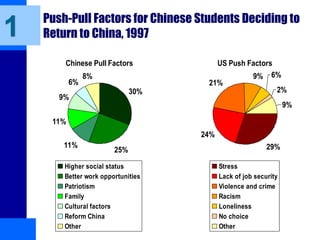
Push-Pull Factors for Chinese Students Deciding to
Return to China, 1997
Chinese Pull Factors
30%
25%
11%
11%
9%
6%
8%
Higher social status
Better work opportunities
Patriotism
Family
Cultural factors
Reform China
Other
1
US Push Factors
29%
24%
21%
9% 6%
2%
9%
Stress
Lack of job security
Violence and crime
Racism
Loneliness
No choice
Other
Economic Approaches
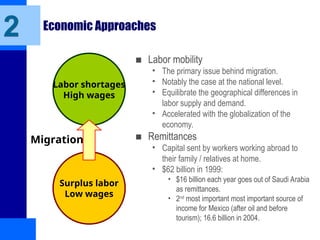
■ Labor mobility
• The primary issue behind migration.
• Notably the case at the national level.
• Equilibrate the geographical differences in
labor supply and demand.
• Accelerated with the globalization of the
economy.
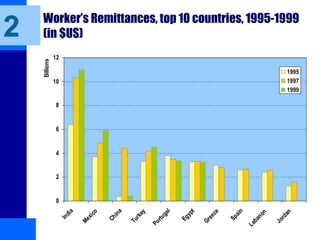
■ Remittances
• Capital sent by workers working abroad to
their family / relatives at home.
• $62 billion in 1999:
• $16 billion each year goes out of Saudi Arabia
as remittances.
• 2nd
most important most important source of
income for Mexico (after oil and before
tourism); 16.6 billion in 2004.
2
Labor shortages
High wages
Surplus labor
Low wages
Migration
Worker’s Remittances, top 10 countries, 1995-1999
(in $US)
0
2
4
6
8
10
12
I
n
d
i
a
M
e
x
i
c
o
C
h
i
n
a
T
u
r
k
e
y
P
o
r
t
u
g
a
l
E
g
y
p
t
G
r
e
e
c
e
S
p
a
i
n
L
e
b
a
n
o
n
J
o
r
d
a
n
Billions
1995
1997
1999
2
3 Behavioral Explanations of Migration
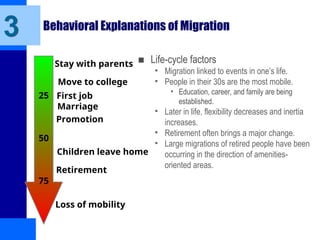
■ Life-cycle factors
• Migration linked to events in one’s life.
• People in their 30s are the most mobile.
• Education, career, and family are being
established.
• Later in life, flexibility decreases and inertia
increases.
• Retirement often brings a major change.
• Large migrations of retired people have been
occurring in the direction of amenities-
oriented areas.
25
50
75
Stay with parents
Move to college
First job
Promotion
Marriage
Retirement
Children leave home
Loss of mobility
Behavioral Explanations of Migration
■ Migrants as risk-takers
• Why, among a population in the same environment (the same
push factors), some leave and some stay?
• Migrants tend to be greater risk-takers, more motivated, more
innovative and more adaptable.
• Non-migrants tend to be more cautious and conservative.
• Can be used to explain the relative dynamism in some societies,
like the USA since the 1800s.
■ Summary
• No one theory of migration can adequately explain this huge
worldwide phenomenon.
• Each brings a contribution to the understanding of why people
move.
3
Refugees
■ 1. Definition
• What is a refugee and how one qualifies for this status?
■ 2. Contemporary Evolution
• How the refugee situation has evolved in time?
C
1 Definition
■ The United Nations definition
• The 1951 Convention Regarding the Status of Refugees and the
1967 Protocol on the Status of Refugees:
• “..... any person who, owing to a well-founded fear of being persecuted for
any reasons of race, religion, nationality, member of a particular social
group or political opinion, is outside the country of his nationality, and is
unable or, owing to such fear, is unwilling to avail himself of the protection
of that country.…” .
• The problem lies in the definition of who is a refugee.
• There are no international agreements to protect people who
cross boundaries for their economic survival.
Definition
■ Conditions to qualify for refugee status
• Political persecution must be demonstrated.
• An international boundary must be crossed:
• Domestically displaced persons do not qualify.
• Protection by one’s government is not seen an alternative:
• The government may be the persecutor.
• Could be incapable of protecting its citizens from persecution.
1
Definition
■ Environmental and economic refugees
• People who can no longer gain a secure livelihood in their
homelands because of what are primarily environmental or
economic factors of unusual scope.
• Sources:
• Natural disaster.
• Human alterations to the environment; climate change.
• Contamination (pollution) of the environment.
• Lack of development and opportunities.
• Render continued residence in that particular location
unsustainable.
• Mozambique, February 2000:
• Floods made 1 million people homeless.
• Destroyed agricultural land and cattle.
1
Contemporary Evolution
■ Origins
• The first recorded refugees were the Protestant Huguenots who
left France to avoid religious persecution.
• About 200,000 at the end of the 17th
century.
• Went to England, Germany, the Netherlands, Switzerland, and
the English colonies in North America.
■ Pre-WW II and during WW II
• Primarily political elites:
• Fleeing repression from the new government, which overthrew them.
• Usually small in number and often had substantial resources available to
them.
• War-driven refugees:
• About 12% of the European population displaced.
• Usually could be expected to repatriate after the war ended.
2
Contemporary Evolution
■ Post WW II
• Change in the patterns of refugee flows:
• The majority of refugees are now coming from the developing world.
• De-colonization in Asia, Africa, and the Caribbean:
• Political unrest in many newly independent states.
• Multi-ethnic nature of those states.
• The result of the drawing of colonial boundary lines by Europeans.
• The Cold War also increased political instability in a number of
countries.
• Political instability in Latin America increased due to the vast
social inequalities existing in that region.
• New kind of refugee flow:
• Large and of long (or permanent) duration.
2
Contemporary Evolution
■ Current issues
• Refugees are a controversial issue:
• Especially in the developed world.
• Only a small share of the asylum seekers are granted the refugee status.
• Less than 20% for the European Union.
• Increasingly, refugees are no longer accepted.
• Economic refugees resorting to asylum as the only way to get a legal
status.
• 1996 amendment to US immigration law:
• Enforcing detention for all refugees entering the United States.
• INS can summarily deport those who arrive without valid travel
documents.
• 4,000 detained on any given day.
2
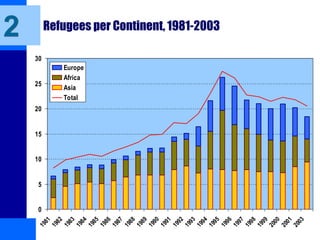
Refugees per Continent, 1981-2003
0
5
10
15
20
25
30
1
9
8
1
1
9
8
2
1
9
8
3
1
9
8
4
1
9
8
5
1
9
8
6
1
9
8
7
1
9
8
8
1
9
8
9
1
9
9
0
1
9
9
1
1
9
9
2
1
9
9
3
1
9
9
4
1
9
9
5
1
9
9
6
1
9
9
7
1
9
9
8
1
9
9
9
2
0
0
0
2
0
0
1
2
0
0
3
Europe
Africa
Asia
Total
2
Origins and Destinations of Refugees, 2003
2
10,000
100,000
1,000,000
Red = Origin
Green = Destination
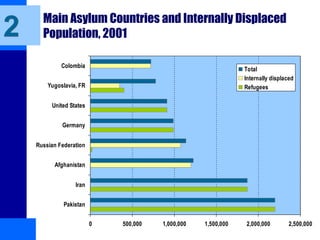
Main Asylum Countries and Internally Displaced
Population, 2001
0 500,000 1,000,000 1,500,000 2,000,000 2,500,000
Pakistan
Iran
Afghanistan
Russian Federation
Germany
United States
Yugoslavia, FR
Colombia
Total
Internally displaced
Refugees
2
Urbanization
■ 1. Context and Issues
• What is urbanization and what are its causes?
■ 2. Why People Move to Urban Areas?
■ 3. Megacities and Urban Regions
• What is the current state of global urbanization?
■ 4. Shantytowns
• What characterizes the prevailing urban environment?
D
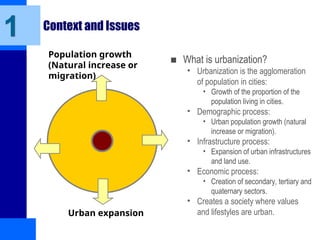
Context and Issues
■ What is urbanization?
• Urbanization is the agglomeration
of population in cities:
• Growth of the proportion of the
population living in cities.
• Demographic process:
• Urban population growth (natural
increase or migration).
• Infrastructure process:
• Expansion of urban infrastructures
and land use.
• Economic process:
• Creation of secondary, tertiary and
quaternary sectors.
• Creates a society where values
and lifestyles are urban.
1
Population growth
(Natural increase or
migration)
Urban expansion
Context and Issues
■ Causes of urbanization
• Historical:
• Defense.
• Trade routes.
• Social:
• Increased social interactions.
• Institutions representing a society (government, religion & education).
• Economic:
• Linked with agricultural surpluses.
• Increased economic opportunities.
• Access to labor.
• Specialization.
• Economies of scale and of agglomeration.
1
Context and Issues
■ The urban explosion
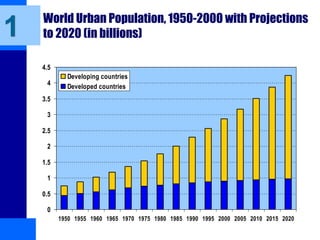
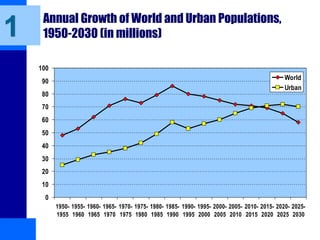
• Urban population growth is the most important change in
population geography.
• About 50% of the global population, 3 billions, lives in cities.
• Almost all the population growth between 2000 and 2030 will
occur in cities.
• By 2050, 6.2 billion people will live in cities, more than the current
(2000) population.
• Much of this growth will come in the world’s poorest countries.
1
World Urban Population, 1950-2000 with Projections
to 2020 (in billions)
0
0.5
1
1.5
2
2.5
3
3.5
4
4.5
1950 1955 1960 1965 1970 1975 1980 1985 1990 1995 2000 2005 2010 2015 2020
Developing countries
Developed countries
1
Annual Growth of World and Urban Populations,
1950-2030 (in millions)
0
10
20
30
40
50
60
70
80
90
100
1950-
1955
1955-
1960
1960-
1965
1965-
1970
1970-
1975
1975-
1980
1980-
1985
1985-
1990
1990-
1995
1995-
2000
2000-
2005
2005-
2010
2010-
2015
2015-
2020
2020-
2025
2025-
2030
World
Urban
1
Context and Issues
■ Developed countries
• Developed countries are already urbanized.
• Passed through the rural - urban migration process.
• Concurrent with demographic transition and industrialization.
■ Developing countries
• Going through a major phase of urbanization.
• Urbanization mainly occurs in developing countries:
• Will account for 93% of the 2 billion increase in the global urban
population between 2000 and 2030.
• Latin America and East Asia is farthest along.
• The rest of Asia is a little further behind.
• Africa is urbanizing more slowly than the other world regions.
1
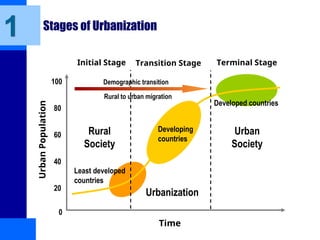
Stages of Urbanization
1
Time
Urban
Population
0
20
40
60
80
100
Developed countries
Terminal Stage
Transition Stage
Initial Stage
Developing
countries
Least developed
countries
Rural to urban migration
Demographic transition
Rural
Society
Urban
Society
Urbanization
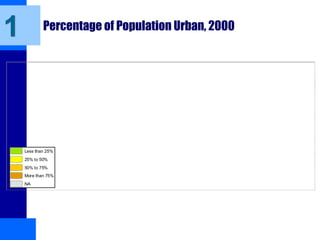
Percentage of Population Urban, 2000
1
Less than 25%
25% to 50%
50% to 75%
More than 75%
NA
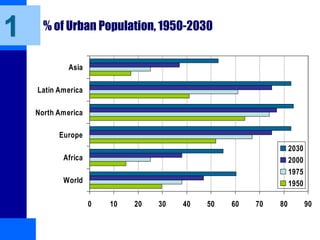
% of Urban Population, 1950-2030
0 10 20 30 40 50 60 70 80 90
World
Africa
Europe
North America
Latin America
Asia
2030
2000
1975
1950
1
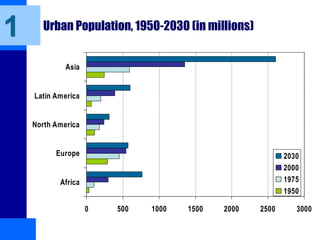
Urban Population, 1950-2030 (in millions)
0 500 1000 1500 2000 2500 3000
Africa
Europe
North America
Latin America
Asia
2030
2000
1975
1950
1
2 Why People Move to Urban Areas?
■ Context
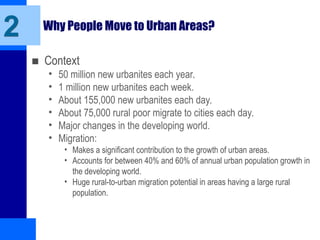
• 50 million new urbanites each year.
• 1 million new urbanites each week.
• About 155,000 new urbanites each day.
• About 75,000 rural poor migrate to cities each day.
• Major changes in the developing world.
• Migration:
• Makes a significant contribution to the growth of urban areas.
• Accounts for between 40% and 60% of annual urban population growth in
the developing world.
• Huge rural-to-urban migration potential in areas having a large rural
population.
Why People Move to Urban Areas?
■ Push-Pull considerations
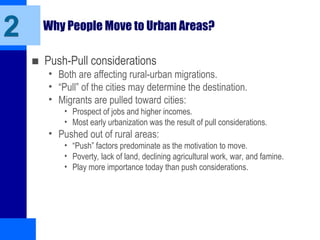
• Both are affecting rural-urban migrations.
• “Pull” of the cities may determine the destination.
• Migrants are pulled toward cities:
• Prospect of jobs and higher incomes.
• Most early urbanization was the result of pull considerations.
• Pushed out of rural areas:
• “Push” factors predominate as the motivation to move.
• Poverty, lack of land, declining agricultural work, war, and famine.
• Play more importance today than push considerations.
2
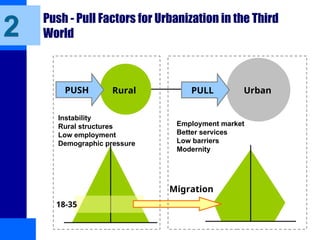
Push - Pull Factors for Urbanization in the Third
World
PUSH PULL
Instability
Rural structures
Low employment
Demographic pressure
Employment market
Better services
Low barriers
Modernity
2
Migration
18-35
Rural Urban
Why People Move to Urban Areas?
Factor Condition Issues
Instability /
Disasters / Wars /
Famines
Push Creation of refugees. Cities as safe heavens.
Expectation of jobs Pull Higher wages but higher living costs. Large
labor markets. Informal sector dominant.
Deterioration of rural
life
Push Demographic growth. Land tenure (landless
peasants). Mechanization (surplus labor).
Transportation Intervening
opportunities
Increased mobility. Lower costs. Construction
of roads and rails. Access to rural markets.
More and better
services
Pull Better schools and health services. Access to
water and electricity. Overcrowding and
pollution.
2
% of the Population Having Access to Public
Infrastructure in Developing Countries, 1990
0 10 20 30 40 50 60 70 80 90
Electricity
Aqueduc
Sewers
Rural areas
Urban areas
2
Why People Move to Urban Areas?
■ Urbanization and economic survival
• Decision to move to an urban area:
• Part of a complex survival strategy.
• Families minimize risk by placing members in different labor markets.
• Largest labor market maximizing the chances of employment and
survival.
• Cities are the largest labor markets.
• Favelas (squatter settlements) of Rio de Janeiro:
• Cannot be understood without reference to the latifundia land system in
rural Brazil.
• Characterized by large landholdings owned by a limited elite.
• Peasants as contract labor with no ownership.
2
Megacities and Urban Regions
■ Concentration
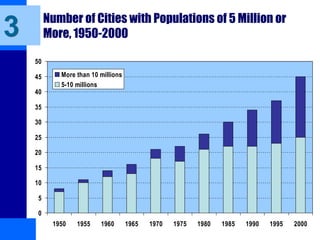
• An increasing share of the global population lives in megacities:
• Megacities (over one million).
• Supercities (over 4 million).
• Supergiants (over 10 million).
• First modern megacity, Beijing 1770.
• 1900:
• 233 million urbanites (14% of the global population); 20 megacities.
• 1950:
• 83 megacities.
• 34 cities in developing countries.
• 2000:
• 3 billion urbanites (50%); 433 megacities.
• All new millionaire cities are in developing countries.
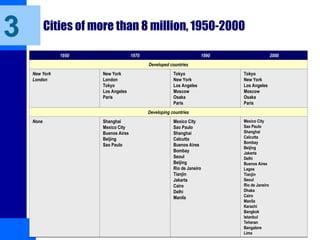
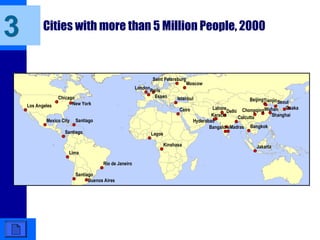
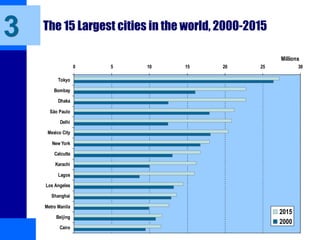
• 11 of the 15 largest cities are in developing countries.
3
Number of Cities with Populations of 5 Million or
More, 1950-2000
0
5
10
15
20
25
30
35
40
45
50
1950 1955 1960 1965 1970 1975 1980 1985 1990 1995 2000
More than 10 millions
5-10 millions
3
Cities of more than 8 million, 1950-2000
1950 1970 1990 2000
Developed countries
New York
London
New York
London
Tokyo
Los Angeles
Paris
Tokyo
New York
Los Angeles
Moscow
Osaka
Paris
Tokyo
New York
Los Angeles
Moscow
Osaka
Paris
Developing countries
None Shanghai
Mexico City
Buenos Aires
Beijing
Sao Paulo
Mexico City
Sao Paulo
Shanghai
Calcutta
Buenos Aires
Bombay
Seoul
Beijing
Rio de Janeiro
Tianjin
Jakarta
Cairo
Delhi
Manila
Mexico City
Sao Paulo
Shanghai
Calcutta
Bombay
Beijing
Jakarta
Delhi
Buenos Aires
Lagos
Tianjin
Seoul
Rio de Janeiro
Dhaka
Cairo
Manila
Karachi
Bangkok
Istanbul
Teheran
Bangalore
Lima
3
Cities with more than 5 Million People, 2000
Lima
Seoul
Lagos
Delhi
Cairo Wuhan Osaka
Paris
Essen
Madras
Lahore
London
Moscow
Jakarta
Bangkok
Karachi
Tianjin
Beijing
Chicago
Kinshasa
Santiago
Santiago
Santiago
Calcutta Shanghai
New York
Istanbul
Bangalore
Hyderabad
Chongqing
Mexico City
Los Angeles
Buenos Aires
Rio de Janeiro
Saint Petersburg
3
The 15 Largest cities in the world, 2000-2015
0 5 10 15 20 25 30
Tokyo
Bombay
Dhaka
São Paulo
Delhi
Mexico City
New York
Calcutta
Karachi
Lagos
Los Angeles
Shanghai
Metro Manila
Beijing
Cairo
Millions
2015
2000
3
4 Shantytowns
■ Context
• Many of the new urban dwellers, particularly women and their
children, are among the poorest people in the world.
• Difficulty to access housing:
• Economic costs.
• Availability.
• 100 million people are homeless.
• 928 million live in precarious housing conditions (slums).
• Shantytowns; informal habitat or squatter housing:
• Favelas (Brazil).
• Pueblos jovenes (Young towns).
• Asentamiento irregulares (Irregular settlements).
• Villas miserias (Miserable villages, Argentina).
• Jughi Jopri (India).
Shantytowns
■ Definition
• Dwellings are built by the current or original occupant:
• Rudimentary construction materials.
• Did not receive a construction permit.
• Do not follow norms in terms of housing and sanitation.
• Inhabitants have no legal title to the land:
• Most are located in areas being declared inhabitable.
• Own by the municipality.
• Abandoned private land.
• Exploiting a legal vacuum of land ownership.
• Lack of urban services:
• Generally not serviced by public utilities such as tap water, electricity,
roads, public transportation and sewage.
4
Shantytowns
■ Setting
• Shantytowns are constructed
over the least desirable land.
• Put the population at risk.
• Caracas, Venezuela, 1999:
• Mudslides killed 50,000
inhabitants.
• Created 400,000 homeless.
• 500,000 of the 6 million
inhabitants were considered at
high risk.
• Bhopal, India, 1984:
• Union Carbide release of toxic
cocktail.
• 500,000 people exposed.
• 16,000 deaths.
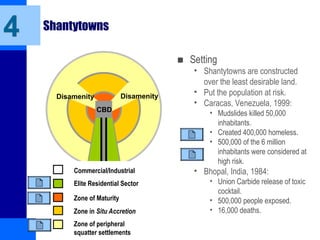
4
CBD
Disamenity Disamenity
Commercial/Industrial
Elite Residential Sector
Zone of Maturity
Zone in Situ Accretion
Zone of peripheral
squatter settlements
Shantytowns
■ Habitat
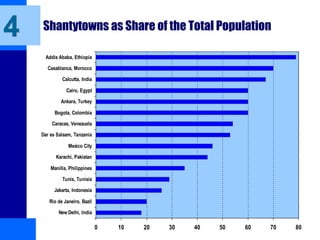
• Informal settlements:
• Perhaps the most visible sign of widespread poverty.
• About 25% of the surface of cities in developing countries is covered by
shantytowns.
• 30-60% of the urban population.
• Emerged in all Third World cities:
• Following the demographic explosion.
• Now the norm more than the exception.
• Incapacity of private and public instances:
• Provide low price housing for the majority of the population.
• The State more concerned about providing housing for its public servants
and its middle class.
• Housing crisis that could not be solved.
4
Shantytowns
■ Growth process
• People expelled from gentrification in downtown areas.
• Inflow of people expelled from poverty in rural areas.
• In several cases, rightful owners of land have divided it in small
lots and sold it in order to have a higher profit.
• In some instances, land was illegally sold to dwellers being
framed.
■ Is there any hope?
• Housing has always been a priority for investment.
• As the population of Third World cities gets higher incomes, the
priority will be improving their housing conditions.
• On the long run, shantytowns are likely to disappear (or at least
become less significant).
4
Shantytowns as Share of the Total Population
0 10 20 30 40 50 60 70 80
New Delhi, India
Rio de Janeiro, Bazil
Jakarta, Indonesia
Tunis, Tunisia
Manilla, Philippines
Karachi, Pakistan
Mexico City
Dar es Salaam, Tanzania
Caracas, Venezuela
Bogota, Colombia
Ankara, Turkey
Cairo, Egypt
Calcutta, India
Casablanca, Morocco
Addis Ababa, Ethiopia
4

Geog 102 Topic 5 water management systems.ppt

  • 1.
    GEOG 102 –Population, Resources, and the Environment Professor: Dr. Jean-Paul Rodrigue Topic 5 – Migration and Urbanization A – Migration Issues B – Migration Theory C – Refugees D – Urbanization
  • 2.
    Migration Issues ■ 1.Types of Migration • What are the major forms of migration? ■ 2. Selective Migration • Why migration can be considered as a selective process? ■ 3. Brain Drain • What is the extent of movements of skilled labor? A
  • 3.
    Types of Migration ■Emigration and immigration • Change in residence. • Relative to origin and destination. ■ Requires information • People and conditions. • Two different places. • Two different times. ■ Duration • Permanent. • Seasonal / Temporary. ■ Choice / constraint • Improve one’s life. • Leave inconvenient / threatening conditions. 1 A B Problems or benefits? Problems or benefits? Emigrant Immigrant
  • 4.
    Types of Migration ■Gross migration • Total number of people coming in and out of an area. • Level of population turnover. ■ Net Migration • Difference between immigration (in- migration) and emigration (out- migration). • Positive value: • More people coming in. • Population growth. – 44% of North America and 88% of Europe. • Negative value: • More people coming out. • Population decline. 1 Emigration Immigration Net migration Gross migration
  • 5.
    Annual Net InternationalMigration by Continent, 1990-95 -1500 -1000 -500 0 500 1000 Africa Asia Europe Latin America and Carribean North America Oceania 1
  • 6.
    Net Migration, 2000-05 1 3,000 NetMigration (1,000s) NA Negative net migration Positive net migration
  • 7.
    Types of Migration ■International Migration • Emigration is an indicator of economic and/or social failures of a society. • Crossing of a national boundary. • Easier to control and monitor. • Laws to control / inhibit these movements. • Between 2 million and 3 million people emigrate each year. • Between 1965 and 2000, 175 million people have migrated: • 3% of the global population. 1
  • 8.
    Migration Policies andGlobal Migration Patterns Period Policies Pattern Before 1914 Open policies (“showing up”). Immigration as a source of labor and development. From developed (Europe) to developing countries (Americas, Africa, Australia). Immigration from Europe between 1880 and 1910 was exceeded 25 million. 1920s and 1930s “Closed door” linked with the economic depression. Deportation of immigrants. Limited migration. After 1945 More open policies. Reconstruction in Europe (12% of labor force) and economic growth in America. Beginning to shift from developing to developed countries (12%). After 1973 Relatively open policies, but with more stringent requirements. Growth of refugees and illegal immigration. From developing to developed countries (88%). 3 million illegal immigrants entering the US per year. 1
  • 9.
    World Migration RoutesSince 1700 European African (slaves) Indian Chinese Japanese Majority of population descended from immigrants 1
  • 10.
    Total Slave Population,United States (1790-1860) 0.0 0.5 1.0 1.5 2.0 2.5 3.0 3.5 4.0 4.5 1790 1800 1810 1820 1830 1840 1850 1860 Millions
  • 11.
    Major International MigrationPatterns, 1990s NA Negative net migration Positive net migration 1
  • 12.
    International Migration: MainDestination Countries, 1997 0 2 4 6 8 10 12 14 16 18 United States Germany Japan Britain Canada France % of foreign population 0 100,000 200,000 300,000 400,000 500,000 600,000 700,000 800,000 Immigration, 1997 % Foreign population Immigration, 1997 1
  • 13.
    Immigration to theUnited States, 1820-2003 0 200,000 400,000 600,000 800,000 1,000,000 1,200,000 1,400,000 1 8 2 0 1 8 2 8 1 8 3 6 1 8 4 4 1 8 5 2 1 8 6 0 1 8 6 8 1 8 7 6 1 8 8 4 1 8 9 2 1 9 0 0 1 9 0 8 1 9 1 6 1 9 2 4 1 9 3 2 1 9 4 0 1 9 4 8 1 9 5 6 1 9 6 4 1 9 7 2 1 9 8 0 1 9 8 8 1 9 9 6 1 British Isles Germany Scandinavia Southeast Europe Latin America Asia
  • 14.
    Region of Birthof the Foreign-Born Population: 1850 to 2000 2000 1990 1980 1970 1960 1930 1920 1910 1900 1890 1880 1870 1860 1850 . Not Reported Northern America Latin America Africa Asia Europe 1
  • 15.
    Top 10 Countriesof Origin for US Legal Immigrants, 1995-2003 0 50,000 100,000 150,000 200,000 Mexico India Philippines China, People's Republic El Salvador Dominican Republic Vietnam Colombia Guatemala Russia 1995 2000 2003 1
  • 16.
    US Population byRace and Ethnicity, 1990-2050 75.6 69.1 62 53 9 12.5 18 24 11.7 12.1 13 14 3.6 6.3 7 9 0% 20% 40% 60% 80% 100% 1990 2000 2025 2050 Asian/Other Black Hispanic White 1
  • 17.
    Illegal Aliens inthe United States by Country of Origin, 1990-2000 (in 1,000s) 0 500 1000 1500 2000 2500 3000 3500 4000 4500 5000 Mexico El Salvador Guatemala Honduras China Ecuador Dominican Republic Philippines Brazil Haiti India Peru 1
  • 18.
    Types of Migration ■Internal Migration • Within one country. • Crossing domestic jurisdictional boundaries. • Movements between states or provinces. • Little government control. • Factors: • Employment-based. • Retirement-based. • Education-based. • Civil conflicts (internally displaced population). 1
  • 19.
    Migration by MajorMetropolitan Areas in the United States, 1990-98 (in 1,000s) -1750 -1250 -750 -250 250 750 1250 New York Los Angeles San Francisco Chicago Miami Atlanta Las Vegas Phoenix Portland Denver Immigration Net domestic migration 1
  • 20.
    Types of Migration ■Local Migration • No state boundaries are crossed. • Buying a new house in the same town or city. • Difficult to research since they are usually missed in census data. • Based on change of income or lifestyle. • Often very high levels of local migration. • Americans change residence every 5 to 7 years. 1 Central City Suburb
  • 21.
    Types of Migration ■Voluntary migration • The migrant makes the decision to move. • Most migration is voluntary. ■ Involuntary • Forced migration in which the mover has no role in the decision- making process. • Slavery: • About 11 million African slaves were brought to the Americas between 1519 and 1867. • In 1860, there were close to 4 million slaves in the United States. • Refugees. • Military conscription. • Children of migrants. • Situations of divorce or separation. 1
  • 22.
    Types of Migration TypeCharacteristics International Crossing a boundary; easier to control; regulated; difference in income; 2-3 million per year. National Between states or provinces; little control; employment opportunities; education; retirement. Local Within a city/region; change of income or lifestyle. Voluntary The outcome of a choice. Involuntary The outcome of a constraint. 1
  • 23.
    2 Selective Migration ■Context • Many migrations are selective. • Do not represent a cross section of the source population. • Differences: • Age. • Sex. • Level of education. ■ Age-specific migrations • One age group is dominant in a particular migration. • International migration tends to involve younger people. • The dominant group is between 25 and 45. • Studies and retirement are also age-specific migrations.
  • 24.
    Population Pyramid ofNative and Foreign Born Population, United States, 2000 (in %) 8 6 4 2 0 2 4 6 8 Percent Male Female Female Male Foreign Born Native 8 6 4 2 0 2 4 6 8 0-4 5-9 10-14 15-19 20-24 25-29 30-34 35-39 40-44 45-49 50-54 55-59 60-64 65-69 70-74 75-79 80-84 85+ Percent Age 2
  • 25.
    Selective Migration ■ Sex-specificmigrations • Males: • Often dominant international migrations. • Once established, try to bring in a wife. • Females: • Often dominate rural to urban migrations. • Find jobs as domestic help or in new factories. • Send remittances back home. • Filipino females 17-30 to Hong Kong and Japan. • “Mail-order bride”: • 100,000 – 150,000 women a year advertise themselves for marriage. • About 10,000 available on the Internet at any time. • Mainly from Southeast Asia and Russia. • Come from places in which jobs and educational opportunities for women are scarce and wages are low. 2
  • 26.
    Selective Migration ■ Education-specificmigrations • May characterize some migrations (having or lacking of). • High level of education attained by most contemporary Asian immigrants to the USA and Canada. • Educational differences: • 21% of all legal immigrants have at least 17 years of education. • 8% for native-born Americans. • 20% of all immigrants do not have 9 years of schooling. • Foreign students: • Often do not return to their home countries after their education. • Often cannot utilize what they have learned. • Since 1978 some 130,000 Chinese overseas students have returned while some 250,000 have remained abroad. • Most research-oriented graduate institutions have around 40% foreign students. 2
  • 27.
    Selective Migration ■ Immigrationand jobs • Related to the economic sector. • High level: • Filling high skilled position in science, technology and education. • Not enough highly trained personnel in the US. • Result in recruiting abroad (see brain drain). • Low level: • Filling low paid jobs (minimum wage) that most people do not want (agriculture and low level services). • Maintain low wages in low skilled jobs. • Possibility of an informal economy. 2
  • 28.
    Brain Drain ■ Definition •Relates to educationally specific selective migrations. • Some countries are losing the most educated segment of their population. • Can be both a benefit for the receiving country and a problem to the country of origin. ■ Receiving country • Getting highly qualified labor contributing to the economy right away. • Promotes economic growth in strategic sectors: science and technology. • Not having to pay education and health costs. • 30% of Mexicans with a PhD are in the US. 3
  • 29.
    Brain Drain ■ Countryof origin • Education and health costs not paid back. • Losing potential leaders and talent: • Between 15 and 40% of a graduating class in Canada will move to the US. • Long term impact on economic growth. • Possibility of remittances. • Many brain drain migrants have skills which they can’t use at home: • The resources and technology may not be available there. • The specific labor market is not big enough. • May eventually come back with skills and connections: • Korea, Taiwan, China and India. 3
  • 30.
    Non US Citizenswith Science and Engineering Doctorates in the United States, 1999 0 5000 10000 15000 20000 25000 Poland Turkey Greece Netherlands Australia France Italy Japan Korea Germany Canada United Kingdom India China 3
  • 31.
    Likelihood of theWell-Educated to Stay, 1998 0 1 2 3 4 5 6 7 8 9 United States Germany Japan Mexico France Canada China Sweden India Russia 3 10 = most likely
  • 32.
    Percentage of CollegeEducated Citizens Living Abroad 0 10 20 30 40 50 60 70 80 90 Haiti Ghana Mozambique Kenya Laos Uganda Angola Somalia El Salvador Sri Lanka
  • 33.
    H-1B Work Visasby Major Occupation, 1999-2000 53% 13% 8% 4% 3% 19% Computer-related Egineering Education Medecine & Health Managers Other 3
  • 34.
    H-1B Work Visasby Level of Education, 1999-2000 56% 31% 8% 2% 3% Bachelor's Degree Master's Degree Doctorate Degree Professional Degree Other 3
  • 35.
    B Migration Theory ■1. Push - Pull Theory • What are the major “push” and “pull” factors behind migration? ■ 2. Economic Approaches • How can migration be explained from an economic perspective? ■ 3. Behavioral Explanations to Migration • How can migration be explained from a human behavior perspective?
  • 36.
    Push - PullTheory ■ Context • Migrations as the response of individual decision-makers. • Negative or push factors in his current area of residence: • High unemployment and little opportunity. • Great poverty. • High crime. • Repression or a recent disaster (e.g., drought or earthquake). • Positive or pull factors in the potential destination: • High job availability and higher wages. • More exciting lifestyle. • Political freedom, greater safety and security, etc. 1
  • 37.
    Push - PullTheory ■ Intervening obstacles • Migration costs / transportation. • Immigration laws and policies of the destination country. ■ The problem of perception • Assumes rational behavior on the part of the migrant: • Not necessarily true since a migrant cannot be truly informed. • The key word is perception of the pull factors. • Information is never complete. • Decisions are made based upon perceptions of reality at the destination relative to the known reality at the source. • When the migrant’s information is highly inaccurate, a return migration may be one possible outcome. 1
  • 38.
    Push - PullTheory 1 Positive factors Neutral factors Negative factors Origin Destination Intervening obstacles
  • 39.
    Push-Pull Factors forChinese Students Deciding to Say in the United States, 1997 Chinese Push Factors 28% 14% 13% 11% 8% 7% 19% Political instability Lack of academic freedom Improve learning Lower standards of living Complicated human relations Crowding and pollution Other 1 US Pull Factors 36% 20% 16% 13% 11% 3% 1% Academic freedom Job opportunities High standards of living Work environment Learning and information Simpler human relations Other
  • 40.
    Push-Pull Factors forChinese Students Deciding to Return to China, 1997 Chinese Pull Factors 30% 25% 11% 11% 9% 6% 8% Higher social status Better work opportunities Patriotism Family Cultural factors Reform China Other 1 US Push Factors 29% 24% 21% 9% 6% 2% 9% Stress Lack of job security Violence and crime Racism Loneliness No choice Other
  • 41.
    Economic Approaches ■ Labormobility • The primary issue behind migration. • Notably the case at the national level. • Equilibrate the geographical differences in labor supply and demand. • Accelerated with the globalization of the economy. ■ Remittances • Capital sent by workers working abroad to their family / relatives at home. • $62 billion in 1999: • $16 billion each year goes out of Saudi Arabia as remittances. • 2nd most important most important source of income for Mexico (after oil and before tourism); 16.6 billion in 2004. 2 Labor shortages High wages Surplus labor Low wages Migration
  • 42.
    Worker’s Remittances, top10 countries, 1995-1999 (in $US) 0 2 4 6 8 10 12 I n d i a M e x i c o C h i n a T u r k e y P o r t u g a l E g y p t G r e e c e S p a i n L e b a n o n J o r d a n Billions 1995 1997 1999 2
  • 43.
    3 Behavioral Explanationsof Migration ■ Life-cycle factors • Migration linked to events in one’s life. • People in their 30s are the most mobile. • Education, career, and family are being established. • Later in life, flexibility decreases and inertia increases. • Retirement often brings a major change. • Large migrations of retired people have been occurring in the direction of amenities- oriented areas. 25 50 75 Stay with parents Move to college First job Promotion Marriage Retirement Children leave home Loss of mobility
  • 44.
    Behavioral Explanations ofMigration ■ Migrants as risk-takers • Why, among a population in the same environment (the same push factors), some leave and some stay? • Migrants tend to be greater risk-takers, more motivated, more innovative and more adaptable. • Non-migrants tend to be more cautious and conservative. • Can be used to explain the relative dynamism in some societies, like the USA since the 1800s. ■ Summary • No one theory of migration can adequately explain this huge worldwide phenomenon. • Each brings a contribution to the understanding of why people move. 3
  • 45.
    Refugees ■ 1. Definition •What is a refugee and how one qualifies for this status? ■ 2. Contemporary Evolution • How the refugee situation has evolved in time? C
  • 46.
    1 Definition ■ TheUnited Nations definition • The 1951 Convention Regarding the Status of Refugees and the 1967 Protocol on the Status of Refugees: • “..... any person who, owing to a well-founded fear of being persecuted for any reasons of race, religion, nationality, member of a particular social group or political opinion, is outside the country of his nationality, and is unable or, owing to such fear, is unwilling to avail himself of the protection of that country.…” . • The problem lies in the definition of who is a refugee. • There are no international agreements to protect people who cross boundaries for their economic survival.
  • 47.
    Definition ■ Conditions toqualify for refugee status • Political persecution must be demonstrated. • An international boundary must be crossed: • Domestically displaced persons do not qualify. • Protection by one’s government is not seen an alternative: • The government may be the persecutor. • Could be incapable of protecting its citizens from persecution. 1
  • 48.
    Definition ■ Environmental andeconomic refugees • People who can no longer gain a secure livelihood in their homelands because of what are primarily environmental or economic factors of unusual scope. • Sources: • Natural disaster. • Human alterations to the environment; climate change. • Contamination (pollution) of the environment. • Lack of development and opportunities. • Render continued residence in that particular location unsustainable. • Mozambique, February 2000: • Floods made 1 million people homeless. • Destroyed agricultural land and cattle. 1
  • 49.
    Contemporary Evolution ■ Origins •The first recorded refugees were the Protestant Huguenots who left France to avoid religious persecution. • About 200,000 at the end of the 17th century. • Went to England, Germany, the Netherlands, Switzerland, and the English colonies in North America. ■ Pre-WW II and during WW II • Primarily political elites: • Fleeing repression from the new government, which overthrew them. • Usually small in number and often had substantial resources available to them. • War-driven refugees: • About 12% of the European population displaced. • Usually could be expected to repatriate after the war ended. 2
  • 50.
    Contemporary Evolution ■ PostWW II • Change in the patterns of refugee flows: • The majority of refugees are now coming from the developing world. • De-colonization in Asia, Africa, and the Caribbean: • Political unrest in many newly independent states. • Multi-ethnic nature of those states. • The result of the drawing of colonial boundary lines by Europeans. • The Cold War also increased political instability in a number of countries. • Political instability in Latin America increased due to the vast social inequalities existing in that region. • New kind of refugee flow: • Large and of long (or permanent) duration. 2
  • 51.
    Contemporary Evolution ■ Currentissues • Refugees are a controversial issue: • Especially in the developed world. • Only a small share of the asylum seekers are granted the refugee status. • Less than 20% for the European Union. • Increasingly, refugees are no longer accepted. • Economic refugees resorting to asylum as the only way to get a legal status. • 1996 amendment to US immigration law: • Enforcing detention for all refugees entering the United States. • INS can summarily deport those who arrive without valid travel documents. • 4,000 detained on any given day. 2
  • 52.
    Refugees per Continent,1981-2003 0 5 10 15 20 25 30 1 9 8 1 1 9 8 2 1 9 8 3 1 9 8 4 1 9 8 5 1 9 8 6 1 9 8 7 1 9 8 8 1 9 8 9 1 9 9 0 1 9 9 1 1 9 9 2 1 9 9 3 1 9 9 4 1 9 9 5 1 9 9 6 1 9 9 7 1 9 9 8 1 9 9 9 2 0 0 0 2 0 0 1 2 0 0 3 Europe Africa Asia Total 2
  • 53.
    Origins and Destinationsof Refugees, 2003 2 10,000 100,000 1,000,000 Red = Origin Green = Destination
  • 54.
    Main Asylum Countriesand Internally Displaced Population, 2001 0 500,000 1,000,000 1,500,000 2,000,000 2,500,000 Pakistan Iran Afghanistan Russian Federation Germany United States Yugoslavia, FR Colombia Total Internally displaced Refugees 2
  • 55.
    Urbanization ■ 1. Contextand Issues • What is urbanization and what are its causes? ■ 2. Why People Move to Urban Areas? ■ 3. Megacities and Urban Regions • What is the current state of global urbanization? ■ 4. Shantytowns • What characterizes the prevailing urban environment? D
  • 56.
    Context and Issues ■What is urbanization? • Urbanization is the agglomeration of population in cities: • Growth of the proportion of the population living in cities. • Demographic process: • Urban population growth (natural increase or migration). • Infrastructure process: • Expansion of urban infrastructures and land use. • Economic process: • Creation of secondary, tertiary and quaternary sectors. • Creates a society where values and lifestyles are urban. 1 Population growth (Natural increase or migration) Urban expansion
  • 57.
    Context and Issues ■Causes of urbanization • Historical: • Defense. • Trade routes. • Social: • Increased social interactions. • Institutions representing a society (government, religion & education). • Economic: • Linked with agricultural surpluses. • Increased economic opportunities. • Access to labor. • Specialization. • Economies of scale and of agglomeration. 1
  • 58.
    Context and Issues ■The urban explosion • Urban population growth is the most important change in population geography. • About 50% of the global population, 3 billions, lives in cities. • Almost all the population growth between 2000 and 2030 will occur in cities. • By 2050, 6.2 billion people will live in cities, more than the current (2000) population. • Much of this growth will come in the world’s poorest countries. 1
  • 59.
    World Urban Population,1950-2000 with Projections to 2020 (in billions) 0 0.5 1 1.5 2 2.5 3 3.5 4 4.5 1950 1955 1960 1965 1970 1975 1980 1985 1990 1995 2000 2005 2010 2015 2020 Developing countries Developed countries 1
  • 60.
    Annual Growth ofWorld and Urban Populations, 1950-2030 (in millions) 0 10 20 30 40 50 60 70 80 90 100 1950- 1955 1955- 1960 1960- 1965 1965- 1970 1970- 1975 1975- 1980 1980- 1985 1985- 1990 1990- 1995 1995- 2000 2000- 2005 2005- 2010 2010- 2015 2015- 2020 2020- 2025 2025- 2030 World Urban 1
  • 61.
    Context and Issues ■Developed countries • Developed countries are already urbanized. • Passed through the rural - urban migration process. • Concurrent with demographic transition and industrialization. ■ Developing countries • Going through a major phase of urbanization. • Urbanization mainly occurs in developing countries: • Will account for 93% of the 2 billion increase in the global urban population between 2000 and 2030. • Latin America and East Asia is farthest along. • The rest of Asia is a little further behind. • Africa is urbanizing more slowly than the other world regions. 1
  • 62.
    Stages of Urbanization 1 Time Urban Population 0 20 40 60 80 100 Developedcountries Terminal Stage Transition Stage Initial Stage Developing countries Least developed countries Rural to urban migration Demographic transition Rural Society Urban Society Urbanization
  • 63.
    Percentage of PopulationUrban, 2000 1 Less than 25% 25% to 50% 50% to 75% More than 75% NA
  • 64.
    % of UrbanPopulation, 1950-2030 0 10 20 30 40 50 60 70 80 90 World Africa Europe North America Latin America Asia 2030 2000 1975 1950 1
  • 65.
    Urban Population, 1950-2030(in millions) 0 500 1000 1500 2000 2500 3000 Africa Europe North America Latin America Asia 2030 2000 1975 1950 1
  • 66.
    2 Why PeopleMove to Urban Areas? ■ Context • 50 million new urbanites each year. • 1 million new urbanites each week. • About 155,000 new urbanites each day. • About 75,000 rural poor migrate to cities each day. • Major changes in the developing world. • Migration: • Makes a significant contribution to the growth of urban areas. • Accounts for between 40% and 60% of annual urban population growth in the developing world. • Huge rural-to-urban migration potential in areas having a large rural population.
  • 67.
    Why People Moveto Urban Areas? ■ Push-Pull considerations • Both are affecting rural-urban migrations. • “Pull” of the cities may determine the destination. • Migrants are pulled toward cities: • Prospect of jobs and higher incomes. • Most early urbanization was the result of pull considerations. • Pushed out of rural areas: • “Push” factors predominate as the motivation to move. • Poverty, lack of land, declining agricultural work, war, and famine. • Play more importance today than push considerations. 2
  • 68.
    Push - PullFactors for Urbanization in the Third World PUSH PULL Instability Rural structures Low employment Demographic pressure Employment market Better services Low barriers Modernity 2 Migration 18-35 Rural Urban
  • 69.
    Why People Moveto Urban Areas? Factor Condition Issues Instability / Disasters / Wars / Famines Push Creation of refugees. Cities as safe heavens. Expectation of jobs Pull Higher wages but higher living costs. Large labor markets. Informal sector dominant. Deterioration of rural life Push Demographic growth. Land tenure (landless peasants). Mechanization (surplus labor). Transportation Intervening opportunities Increased mobility. Lower costs. Construction of roads and rails. Access to rural markets. More and better services Pull Better schools and health services. Access to water and electricity. Overcrowding and pollution. 2
  • 70.
    % of thePopulation Having Access to Public Infrastructure in Developing Countries, 1990 0 10 20 30 40 50 60 70 80 90 Electricity Aqueduc Sewers Rural areas Urban areas 2
  • 71.
    Why People Moveto Urban Areas? ■ Urbanization and economic survival • Decision to move to an urban area: • Part of a complex survival strategy. • Families minimize risk by placing members in different labor markets. • Largest labor market maximizing the chances of employment and survival. • Cities are the largest labor markets. • Favelas (squatter settlements) of Rio de Janeiro: • Cannot be understood without reference to the latifundia land system in rural Brazil. • Characterized by large landholdings owned by a limited elite. • Peasants as contract labor with no ownership. 2
  • 72.
    Megacities and UrbanRegions ■ Concentration • An increasing share of the global population lives in megacities: • Megacities (over one million). • Supercities (over 4 million). • Supergiants (over 10 million). • First modern megacity, Beijing 1770. • 1900: • 233 million urbanites (14% of the global population); 20 megacities. • 1950: • 83 megacities. • 34 cities in developing countries. • 2000: • 3 billion urbanites (50%); 433 megacities. • All new millionaire cities are in developing countries. • 11 of the 15 largest cities are in developing countries. 3
  • 73.
    Number of Citieswith Populations of 5 Million or More, 1950-2000 0 5 10 15 20 25 30 35 40 45 50 1950 1955 1960 1965 1970 1975 1980 1985 1990 1995 2000 More than 10 millions 5-10 millions 3
  • 74.
    Cities of morethan 8 million, 1950-2000 1950 1970 1990 2000 Developed countries New York London New York London Tokyo Los Angeles Paris Tokyo New York Los Angeles Moscow Osaka Paris Tokyo New York Los Angeles Moscow Osaka Paris Developing countries None Shanghai Mexico City Buenos Aires Beijing Sao Paulo Mexico City Sao Paulo Shanghai Calcutta Buenos Aires Bombay Seoul Beijing Rio de Janeiro Tianjin Jakarta Cairo Delhi Manila Mexico City Sao Paulo Shanghai Calcutta Bombay Beijing Jakarta Delhi Buenos Aires Lagos Tianjin Seoul Rio de Janeiro Dhaka Cairo Manila Karachi Bangkok Istanbul Teheran Bangalore Lima 3
  • 75.
    Cities with morethan 5 Million People, 2000 Lima Seoul Lagos Delhi Cairo Wuhan Osaka Paris Essen Madras Lahore London Moscow Jakarta Bangkok Karachi Tianjin Beijing Chicago Kinshasa Santiago Santiago Santiago Calcutta Shanghai New York Istanbul Bangalore Hyderabad Chongqing Mexico City Los Angeles Buenos Aires Rio de Janeiro Saint Petersburg 3
  • 76.
    The 15 Largestcities in the world, 2000-2015 0 5 10 15 20 25 30 Tokyo Bombay Dhaka São Paulo Delhi Mexico City New York Calcutta Karachi Lagos Los Angeles Shanghai Metro Manila Beijing Cairo Millions 2015 2000 3
  • 77.
    4 Shantytowns ■ Context •Many of the new urban dwellers, particularly women and their children, are among the poorest people in the world. • Difficulty to access housing: • Economic costs. • Availability. • 100 million people are homeless. • 928 million live in precarious housing conditions (slums). • Shantytowns; informal habitat or squatter housing: • Favelas (Brazil). • Pueblos jovenes (Young towns). • Asentamiento irregulares (Irregular settlements). • Villas miserias (Miserable villages, Argentina). • Jughi Jopri (India).
  • 78.
    Shantytowns ■ Definition • Dwellingsare built by the current or original occupant: • Rudimentary construction materials. • Did not receive a construction permit. • Do not follow norms in terms of housing and sanitation. • Inhabitants have no legal title to the land: • Most are located in areas being declared inhabitable. • Own by the municipality. • Abandoned private land. • Exploiting a legal vacuum of land ownership. • Lack of urban services: • Generally not serviced by public utilities such as tap water, electricity, roads, public transportation and sewage. 4
  • 79.
    Shantytowns ■ Setting • Shantytownsare constructed over the least desirable land. • Put the population at risk. • Caracas, Venezuela, 1999: • Mudslides killed 50,000 inhabitants. • Created 400,000 homeless. • 500,000 of the 6 million inhabitants were considered at high risk. • Bhopal, India, 1984: • Union Carbide release of toxic cocktail. • 500,000 people exposed. • 16,000 deaths. 4 CBD Disamenity Disamenity Commercial/Industrial Elite Residential Sector Zone of Maturity Zone in Situ Accretion Zone of peripheral squatter settlements
  • 80.
    Shantytowns ■ Habitat • Informalsettlements: • Perhaps the most visible sign of widespread poverty. • About 25% of the surface of cities in developing countries is covered by shantytowns. • 30-60% of the urban population. • Emerged in all Third World cities: • Following the demographic explosion. • Now the norm more than the exception. • Incapacity of private and public instances: • Provide low price housing for the majority of the population. • The State more concerned about providing housing for its public servants and its middle class. • Housing crisis that could not be solved. 4
  • 81.
    Shantytowns ■ Growth process •People expelled from gentrification in downtown areas. • Inflow of people expelled from poverty in rural areas. • In several cases, rightful owners of land have divided it in small lots and sold it in order to have a higher profit. • In some instances, land was illegally sold to dwellers being framed. ■ Is there any hope? • Housing has always been a priority for investment. • As the population of Third World cities gets higher incomes, the priority will be improving their housing conditions. • On the long run, shantytowns are likely to disappear (or at least become less significant). 4
  • 82.
    Shantytowns as Shareof the Total Population 0 10 20 30 40 50 60 70 80 New Delhi, India Rio de Janeiro, Bazil Jakarta, Indonesia Tunis, Tunisia Manilla, Philippines Karachi, Pakistan Mexico City Dar es Salaam, Tanzania Caracas, Venezuela Bogota, Colombia Ankara, Turkey Cairo, Egypt Calcutta, India Casablanca, Morocco Addis Ababa, Ethiopia 4

Editor's Notes

  • #5 Between 1990 and 1995, 45 percent of overall population growth in developed countries was due to immigration; in Europe the proportion was 88 percent. For more information see http://www.wri.org/wri/trends/migratio.html. Source: United Nations (U.N.) Population Division, International Migration Policies 1995 (U.N., New York, 1996).
  • #9 Source: adapted from Getis et al. (1991) “Introduction to Geography”. 3rd edition.
  • #12 Source: OECD.
  • #13 Source: Bureau of Citizenship and Immigration Services, http://www.bcis.gov/
  • #14 Source: US Census Bureau, 1999, INS, 2000. Note: incomplete data for 2000.
  • #15 Country Estimated population Growth, Percent of total population of origin 2000 1990 1990-2000 2000 1990 (1) (2) (3)=(1)-(2) (4) (5) All countries Mexico El Salvador Guatemala Colombia Hondurasa China Ecuador Dominican RepublicPhilippinesBrazil Haiti India Peru Korea Canada All other countries 7,000 3,500 3,500 100.0% 100.0% 4,808 2,040 2,768 68.7% 58.3% 189 298 -109 2.7% 8.5% 144 118 26 2.1% 3.4% 141 51 91 2.0% 1.4% 138 42 96 2.0% 1.2% 115 70 45 1.6% 2.0% 108 37 71 1.5% 1.0% 91 46 45 1.3% 1.3% 85 70 14 1.2% 2.0% 77 20 58 1.1% 0.6% 76 67 8 1.1% 1.9% 70 28 41 1.0% 0.8% 61 27 34 0.9% 0.8% 55 24 31 0.8% 0.7% 47 25 22 0.7% 0.7% Source: USCIS.
  • #16 Source: US Census Bureau.
  • #17 Source: USCIS. 10 million illegal immigrants are estimated to be in the US.
  • #19 Source: The Economist, March 11th 2000.
  • #24 Source: US Census Bureau, 2000.
  • #30 Source: OECD (2001). International mobility of human capital.
  • #31 Source: The Economist, July 10th 1999
  • #32 Source: World Bank
  • #33 Source: INS
  • #34 Source: INS.
  • #38 Source: adapted from Peters and Larkin (1999), p. 199.
  • #39 Source: US China Embassy. http://www.usembassy-china.org.cn/english/sandt/prcstbk2.htm
  • #40 Source: US China Embassy. http://www.usembassy-china.org.cn/english/sandt/prcstbk2.htm
  • #42 Source: United Nations.
  • #52 Source: Worldwatch Institute. United Nations. www.unhcr.ch
  • #53 Source: UNHCR.
  • #54 Refugee population includes asylum seekers (refugee status pending). Internally displaced include forced migrants (Russia) Source: UNHCR, 2002
  • #59 Source: United Nations, World Urbanization Prospects: The 2001 Revision. http://www.un.org/popin/
  • #60 Source: United Nations, World Urbanization Prospects (1999).
  • #62 Source: Adapted from Peters and Larkin, 1999.
  • #64 Source: United Nations Population Program.
  • #65 Source: United Nations Population Program.
  • #73 Source: Worldwatch Institute.
  • #76 Source: United Nations. http://www.un.org/esa/population/unpop.htm
  • #79 Bophal, India: 1984, Union Carbide release of toxic cocktail. 500,000 people exposed. 16,000 deaths.
  • #82 Source: World Population Crisis Committee, Washington