Migration
Introduction:
Movement of people from their
home to another country or a city
or a state for a job or shelter is
called Migration.
It is a way to move from one
place to another to live and work
in better surroundings.
Migration is influenced by the social,
cultural, economic and political
factors.
A few examples of migration -
between 1846 and 1940, mass
migration occurred world wide. Some
55 million of migrants moved from
Europe to America and nearly 2.5
million moved from Asia to America.
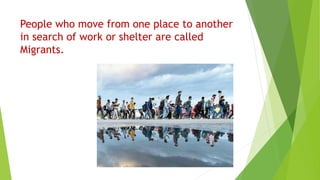
People who move from one place to another
in search of work or shelter are called
Migrants.
Causes of migration
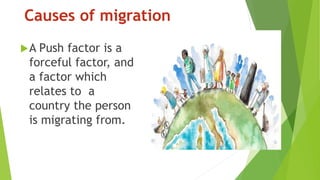
A Push factor is a
forceful factor, and
a factor which
relates to a
country the person
is migrating from.
Push factors:
 Poor medical care
 Not enough jobs
 Droughts / natural disasters
 Loss of wealth
 Fear of crime and lack of safety
 Political fear
 Religious factors
A pull factor is
something
concerning the
country a person
migrates to.
Pull factors:
 Chances of getting a better job,
 Better living conditions,
 Comfortable climatic conditions,
 Better educational opportunities,
 Better medical care,
 Better infrastructure of transport and social
benefits.
Effects of migration
 A. Economic effects – when people migrate
from rural areas, it reduces the pressure of
population.
 Poor family can improve their standards
through remittance from their family
members.
 On the other hand we have less labours to
work in agriculture, leads to less
production of crops.
Social effects
 The migrants may bring
new values and
attitudes which
gradually change the
old customs.
 It weakens the Joint
family system if
migrants permanently
settle in urban areas.
Types of migration
1. Immigration
2. Emigration
3. Domestic or internal migration
4. Urban – Urban migration
5. International or external migration
1. Immigration
It is the international movement
of people into a destination
country of which they are not
natives.
2. Emigration
Emigration means leaving one’s
resident country with the intention
to settle down elsewhere.
3. Domestic or internal migration
This involves movement of people
from rural areas to urban areas of
the same country.
4. Urban – Urban migration
It is a type of internal migration of
people within a country moving to
another location within its borders.
5. International or external
migration
It involves crossing international
borders. This is generally considered
as a permanent action, because people
settle there for long periods of time.
Homework
Complete Google form.

Migration

  • 1.
  • 2.
    Introduction: Movement of peoplefrom their home to another country or a city or a state for a job or shelter is called Migration. It is a way to move from one place to another to live and work in better surroundings.
  • 3.
    Migration is influencedby the social, cultural, economic and political factors. A few examples of migration - between 1846 and 1940, mass migration occurred world wide. Some 55 million of migrants moved from Europe to America and nearly 2.5 million moved from Asia to America.
  • 4.
    People who movefrom one place to another in search of work or shelter are called Migrants.
  • 5.
    Causes of migration APush factor is a forceful factor, and a factor which relates to a country the person is migrating from.
  • 6.
    Push factors:  Poormedical care  Not enough jobs  Droughts / natural disasters  Loss of wealth  Fear of crime and lack of safety  Political fear  Religious factors
  • 7.
    A pull factoris something concerning the country a person migrates to.
  • 8.
    Pull factors:  Chancesof getting a better job,  Better living conditions,  Comfortable climatic conditions,  Better educational opportunities,  Better medical care,  Better infrastructure of transport and social benefits.
  • 9.
    Effects of migration A. Economic effects – when people migrate from rural areas, it reduces the pressure of population.  Poor family can improve their standards through remittance from their family members.  On the other hand we have less labours to work in agriculture, leads to less production of crops.
  • 10.
    Social effects  Themigrants may bring new values and attitudes which gradually change the old customs.  It weakens the Joint family system if migrants permanently settle in urban areas.
  • 11.
    Types of migration 1.Immigration 2. Emigration 3. Domestic or internal migration 4. Urban – Urban migration 5. International or external migration
  • 12.
    1. Immigration It isthe international movement of people into a destination country of which they are not natives.
  • 13.
    2. Emigration Emigration meansleaving one’s resident country with the intention to settle down elsewhere.
  • 14.
    3. Domestic orinternal migration This involves movement of people from rural areas to urban areas of the same country.
  • 15.
    4. Urban –Urban migration It is a type of internal migration of people within a country moving to another location within its borders.
  • 16.
    5. International orexternal migration It involves crossing international borders. This is generally considered as a permanent action, because people settle there for long periods of time.
  • 17.