MIGRATION
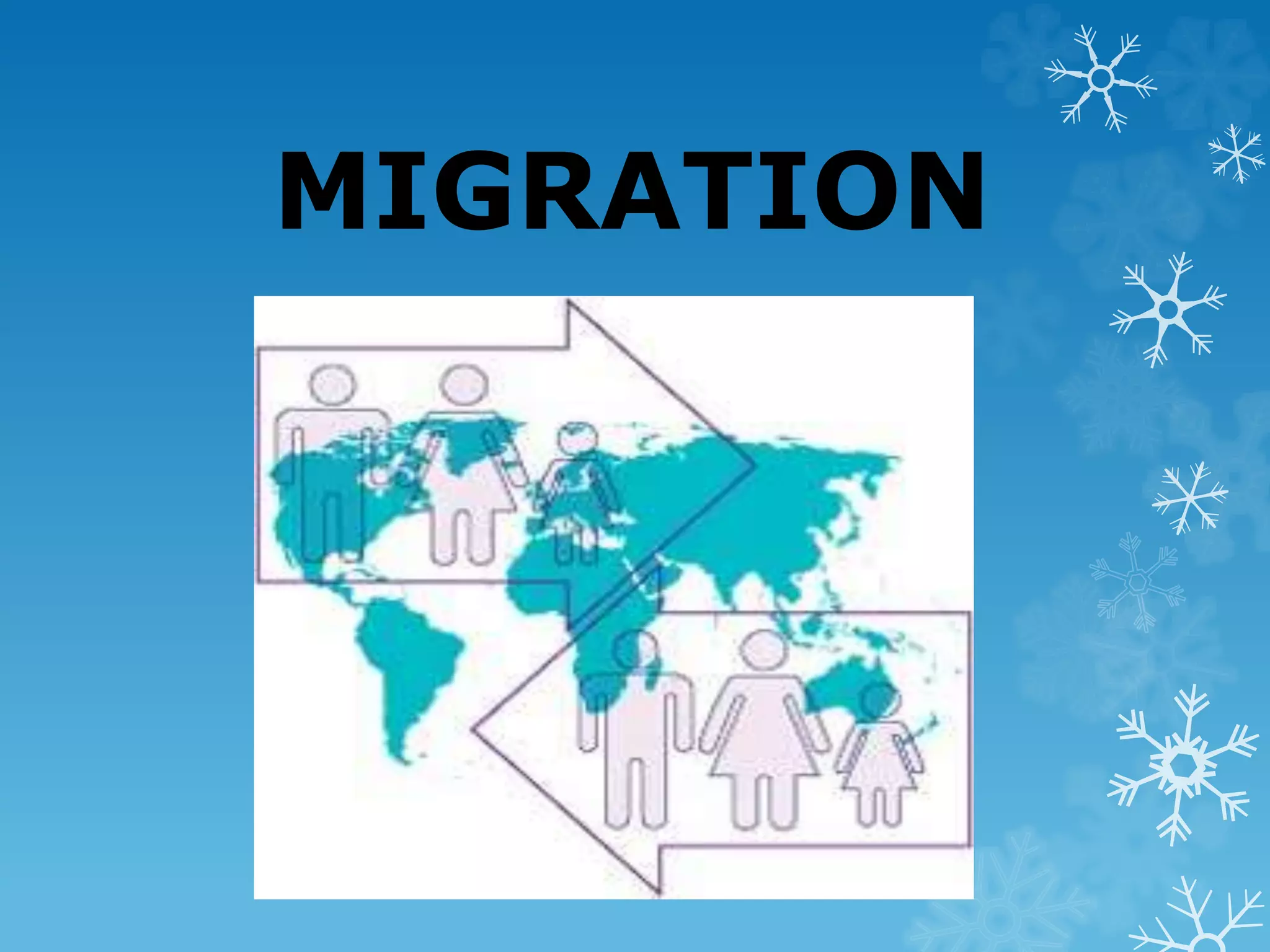
Migration is the movement of people from one
place to another.
Migration impacts on both the place left
behind, and on the place where migrants
settle.
The reasons for migration can be divided into
push and pull factors.
Why do people migrate?
People migrate for many different reasons. These reasons can be
classified as economic, social, political or environmental:
Economic migration - moving to find work or follow a particular
career path
Social migration - moving somewhere for a better quality of life
or to be closer to family or friends
Political migration - moving to escape political persecution or
war
Environmental causes of migration include natural disasters such
as flooding
Some people choose to migrate, eg someone who moves to
another country to enhance their career opportunities. Some
people are forced to migrate, eg someone who moves due to war
or famine
Push Factors
These are things about the origin that encourage, or force people
to leave:
(i) not enough jobs
(ii) natural disasters
(iii) war
(iv) drought
(v) famine
(vi) lack of services
(vii) lack of safety
(viii) high crime
(ix) crop failure
(x) flooding
(xi)poverty
Pull Factors
These are things about the destination that
attract people:
(i) higher standard of living
(ii) better paid jobs
(iii) better education
(iv) family
(v) attractive environment
Migration can be classified into different
categories.
Immigration is the movement of people into a
country.
Emigration is the movement of people out of a
country.
International migration is controlled by
governments. They may encourage or dis
courage migration into their country.
Illegal migrants will be returned to their
country of origin(deported).
Rural to urban migration
This is the movement of people from the country side to
cities. This process is called urbanisation. Today
urbanisation is happening mainly in LEDC’s.
Push factors- few jobs, poor wages, poor health care and
few education opportunities.
Pull factors- formal and informal jobs, higher wages,
clinics, more schools and excitement of city life.
Impacts
City- life for migrants is tough, jobs are hard to find,
services are over stretched, many live in squatter
settlements.
Countryside-becomes depopulated: fewer farmers so
food production declines, unbalanced population
dominated by women, children, sick and elderly.
Urban to rural migration
This is the movement of people from cities back to the
countryside. This process is called counter-
urbanisation. Counter- urbanisation is happening
mainly in MEDC’s.
Push factors- lack of open space, noise, air pollution,,
traffic congestion, fear of crime.
Pull factors- attractive countryside , safer for children,
larger houses, improved transport makes commuting
possible.
Impacts
Inner city- becomes depopulated : housing empty and
boarded up: services decline.
Countryside- under pressure for new housing
developments: friction between locals and new comers
International migration
International migration is the movement
of people from one country to another
Most international migrants are moving
for economic or social reasons.
They are seeking a better standard of
living, or wish to be with relatives
Case study-USA and Mexico
2000km border between USA and Mexico
1 Million+ Mexicans migrate to USA each year
Illegal migration is a huge problem for USA and
Mexico
Push and pull factors
(i) The USA needs seasonal workers for farms and
food processing factories
(ii) Wages are much higher in the USA- workers can
earn 10 times more than Mexico
(iiii) Education in the USA is free for children of legal,
and illegal, migrants
(iv) Quality of life is lower in Mexico
Case study-USA and Mexico
Impacts
(i)Mexican migrants benefit the US economy by
working for low wages
(ii)Mexican culture has enriched the US border
states- food, music, language
(iii) illegal migration cost_ Border Patrols,
prisons
(iv) Mexican countryside has a shortage of
economically active people.
Refugees
Refugees are people who have been
forced to leave their home country
because of war, persecution or natural
disasters.
The united Nations estimate there are
over 13 million refugees spread
throughout 140 countries.
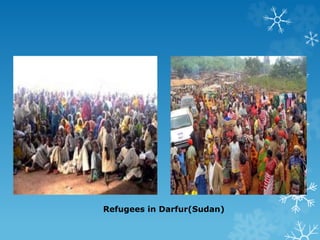
Refugees in Darfur(Sudan)
Asylum seekers- These are people who have
left their home country, have applied to another
country for recognition as a refugee and are
waiting a decision on their application.
Illegal immigrants-These are individuals who
enter a country without the right
documentations and papers.
Economic migrants- These are people who
make a conscious choice to leave their home
country knowing that they can return there if
they wish without problems at a later date. E.g
migrants workers.
Case Study: Rwanda Situation(LEDC’s)
 Rwanda is a small country in Central Africa
 Population divided into two ethnic groups- Hutu and Tutsi
 In 1994 over 2 million Hutus fled Rwanda and became
refugees
Push and pull factors
(i) Tension between the Hutu and Tutsi ethnic groups
(ii)April 1994 – Hutu people began massacre of 800,000
Tutsis
(iii) July 1994- Tutsis formed army and began to fight back
(iv) Hutus fled to safety in neighboring countries
Case Study: Rwanda Situation
Impact
Refugee camps in Zaire, Tanzania and
Burundi.
Overcrowding in camps- crime and violence
Environmental damage- deforestation for
firewood and shelters
Case study-Dafur Sudan(LEDC’s)
Many refugees from the Darfur region of Sudan have
migrated to the neighbouring country Chad, because
of the civil war. Many have also stayed in Sudan, but
live in refugee camps.
Refugees are living in cramped and unsanitary
conditions, and many have lost family members in the
conflict or from disease.
Water is scarce and most people rely on aid agencies
for food, shelter and medicine.
However, the aid efforts are being hampered by the
Sudanese government and refugees are dying of
disease, starvation and malnutrition. Chad is one of
the poorest countries in the world, and the refugees
from Sudan are putting a strain on already scarce
resources.
Assignment
(i) What is emigration
(ii) What is urbanization
(iii) What is counter urbanisation
(iv) What are the main reasons for
international migration
(v)Why do people become refugees
Name a country you have studied where internal
migration has occurred.
Explain the reasons for this migration.
Name of country: Nigeria
 Answers are likely to refer to:
 Employment
 health care,
 education,
 drought,
 food supplies,
 political issues,
 war,
 wages,
 standard of living etc.
 (Using Nigeria as an example points given should include:
Employment, Healthcare, Education, Standard of living and Wages
The size and structure of the population in a country may
change as a result of international migration.
Choose any example of international migration which you
have studied and name the countries between which people
moved.
Explain why many people made the decision to
migrate. You should refer both to pull and to push factors
Mexico to USA
 jobs/employment
 service provision or examples
 food supply
 natural hazards
 war

Migration IGCSE

  • 1.
  • 2.
    Migration is themovement of people from one place to another. Migration impacts on both the place left behind, and on the place where migrants settle. The reasons for migration can be divided into push and pull factors.
  • 3.
    Why do peoplemigrate? People migrate for many different reasons. These reasons can be classified as economic, social, political or environmental: Economic migration - moving to find work or follow a particular career path Social migration - moving somewhere for a better quality of life or to be closer to family or friends Political migration - moving to escape political persecution or war Environmental causes of migration include natural disasters such as flooding Some people choose to migrate, eg someone who moves to another country to enhance their career opportunities. Some people are forced to migrate, eg someone who moves due to war or famine
  • 4.
    Push Factors These arethings about the origin that encourage, or force people to leave: (i) not enough jobs (ii) natural disasters (iii) war (iv) drought (v) famine (vi) lack of services (vii) lack of safety (viii) high crime (ix) crop failure (x) flooding (xi)poverty
  • 5.
    Pull Factors These arethings about the destination that attract people: (i) higher standard of living (ii) better paid jobs (iii) better education (iv) family (v) attractive environment
  • 6.
    Migration can beclassified into different categories. Immigration is the movement of people into a country. Emigration is the movement of people out of a country. International migration is controlled by governments. They may encourage or dis courage migration into their country. Illegal migrants will be returned to their country of origin(deported).
  • 7.
    Rural to urbanmigration This is the movement of people from the country side to cities. This process is called urbanisation. Today urbanisation is happening mainly in LEDC’s. Push factors- few jobs, poor wages, poor health care and few education opportunities. Pull factors- formal and informal jobs, higher wages, clinics, more schools and excitement of city life. Impacts City- life for migrants is tough, jobs are hard to find, services are over stretched, many live in squatter settlements. Countryside-becomes depopulated: fewer farmers so food production declines, unbalanced population dominated by women, children, sick and elderly.
  • 8.
    Urban to ruralmigration This is the movement of people from cities back to the countryside. This process is called counter- urbanisation. Counter- urbanisation is happening mainly in MEDC’s. Push factors- lack of open space, noise, air pollution,, traffic congestion, fear of crime. Pull factors- attractive countryside , safer for children, larger houses, improved transport makes commuting possible. Impacts Inner city- becomes depopulated : housing empty and boarded up: services decline. Countryside- under pressure for new housing developments: friction between locals and new comers
  • 9.
    International migration International migrationis the movement of people from one country to another Most international migrants are moving for economic or social reasons. They are seeking a better standard of living, or wish to be with relatives
  • 10.
    Case study-USA andMexico 2000km border between USA and Mexico 1 Million+ Mexicans migrate to USA each year Illegal migration is a huge problem for USA and Mexico Push and pull factors (i) The USA needs seasonal workers for farms and food processing factories (ii) Wages are much higher in the USA- workers can earn 10 times more than Mexico (iiii) Education in the USA is free for children of legal, and illegal, migrants (iv) Quality of life is lower in Mexico
  • 11.
    Case study-USA andMexico Impacts (i)Mexican migrants benefit the US economy by working for low wages (ii)Mexican culture has enriched the US border states- food, music, language (iii) illegal migration cost_ Border Patrols, prisons (iv) Mexican countryside has a shortage of economically active people.
  • 12.
    Refugees Refugees are peoplewho have been forced to leave their home country because of war, persecution or natural disasters. The united Nations estimate there are over 13 million refugees spread throughout 140 countries.
  • 13.
  • 14.
    Asylum seekers- Theseare people who have left their home country, have applied to another country for recognition as a refugee and are waiting a decision on their application. Illegal immigrants-These are individuals who enter a country without the right documentations and papers. Economic migrants- These are people who make a conscious choice to leave their home country knowing that they can return there if they wish without problems at a later date. E.g migrants workers.
  • 15.
    Case Study: RwandaSituation(LEDC’s)  Rwanda is a small country in Central Africa  Population divided into two ethnic groups- Hutu and Tutsi  In 1994 over 2 million Hutus fled Rwanda and became refugees Push and pull factors (i) Tension between the Hutu and Tutsi ethnic groups (ii)April 1994 – Hutu people began massacre of 800,000 Tutsis (iii) July 1994- Tutsis formed army and began to fight back (iv) Hutus fled to safety in neighboring countries
  • 16.
    Case Study: RwandaSituation Impact Refugee camps in Zaire, Tanzania and Burundi. Overcrowding in camps- crime and violence Environmental damage- deforestation for firewood and shelters
  • 17.
    Case study-Dafur Sudan(LEDC’s) Manyrefugees from the Darfur region of Sudan have migrated to the neighbouring country Chad, because of the civil war. Many have also stayed in Sudan, but live in refugee camps. Refugees are living in cramped and unsanitary conditions, and many have lost family members in the conflict or from disease. Water is scarce and most people rely on aid agencies for food, shelter and medicine. However, the aid efforts are being hampered by the Sudanese government and refugees are dying of disease, starvation and malnutrition. Chad is one of the poorest countries in the world, and the refugees from Sudan are putting a strain on already scarce resources.
  • 18.
    Assignment (i) What isemigration (ii) What is urbanization (iii) What is counter urbanisation (iv) What are the main reasons for international migration (v)Why do people become refugees
  • 19.
    Name a countryyou have studied where internal migration has occurred. Explain the reasons for this migration. Name of country: Nigeria  Answers are likely to refer to:  Employment  health care,  education,  drought,  food supplies,  political issues,  war,  wages,  standard of living etc.  (Using Nigeria as an example points given should include: Employment, Healthcare, Education, Standard of living and Wages
  • 20.
    The size andstructure of the population in a country may change as a result of international migration. Choose any example of international migration which you have studied and name the countries between which people moved. Explain why many people made the decision to migrate. You should refer both to pull and to push factors Mexico to USA  jobs/employment  service provision or examples  food supply  natural hazards  war