MIGRATION AND ITS
DETERMINANTS
SUBMITTED BY:RAFIUL ALAM(2013135006)
MIGRATION
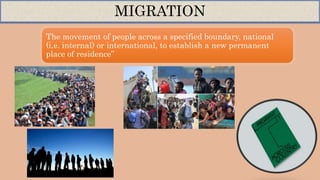
The movement of people across a specified boundary, national
(i.e. internal) or international, to establish a new permanent
place of residence”
MIGRATION
“Human Migration is the permanent change of residence by
an individual or groups,excluding such movements as
nomadism and migrant labour”.
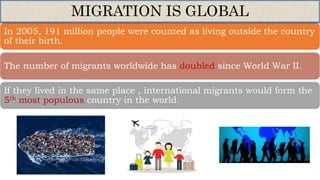
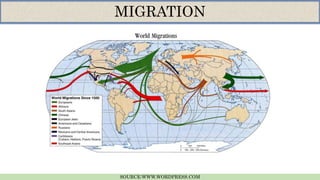
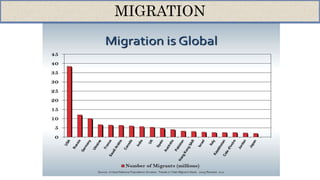
In 2005, 191 million people were counted as living outside the country
of their birth.
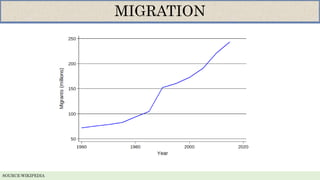
The number of migrants worldwide has doubled since World War II.
If they lived in the same place , international migrants would form the
5th most populous country in the world.
MIGRATION IS GLOBAL
SOURCE:WWW.WORDPRESS.COM
MIGRATION
MIGRATION
SOURCE:WIKIPEDIA
MIGRATION
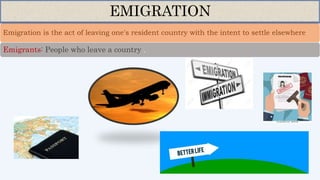
Emigration is the act of leaving one's resident country with the intent to settle elsewhere
EMIGRATION
Emigrants: People who leave a country .
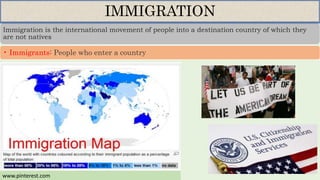
Immigration is the international movement of people into a destination country of which they
are not natives
IMMIGRATION
www.pinterest.com
• Immigrants: People who enter a country
The top ten
immigration
countries

are
the United States
the Russian Federation
Germany
Saudi Arabia
Canada
the UK
France
Australia
India
MIGRATION
The top
ten
countries
of origin
are
Mexico
Spain
China
Ukraine
Bangladesh
Pakistan
the UK
the Philippines
Turkey
MIGRATION
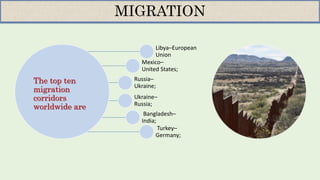
The top ten
migration
corridors
worldwide are
Libya–European
Union
Mexico–
United States;
Russia–
Ukraine;
Ukraine–
Russia;
Bangladesh–
India;
Turkey–
Germany;
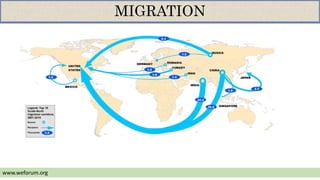
MIGRATION
www.weforum.org
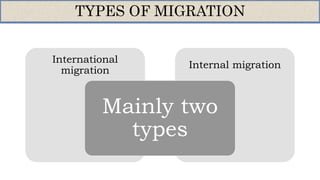
Internal migration
International
migration
Mainly two
types
TYPES OF MIGRATION
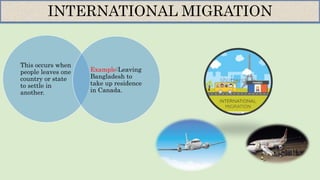
This occurs when
people leaves one
country or state
to settle in
another.
Example:Leaving
Bangladesh to
take up residence
in Canada.
INTERNATIONAL MIGRATION
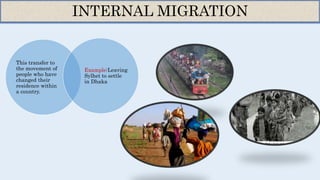
This transfer to
the movement of
people who have
changed their
residence within
a country.
Example:Leaving
Sylhet to settle
in Dhaka
INTERNAL MIGRATION
internal or local migration includes:
Rural-urban migration in which large numbers of people leave rural areas to seek jobs
in urban areas.
Regional migration in which people leave certain regions and move to other regions for
a higher amount of rainfall and better soils.
Seasonal movements like when people temporary move in one season to the lands to
grow crops and back to the villages after harvest.
Daily movements which includes rural to rural daily movements from homesteads to
fields or grazing areas and urban to urban commuting to work places.
Urban to rural e.g. people in towns retiring from work, going back to their original
villages.
INTERNAL MIGRATION
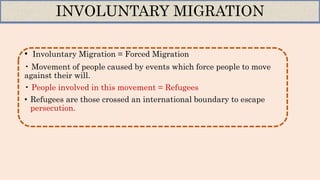
• Involuntary Migration = Forced Migration
• Movement of people caused by events which force people to move
against their will.
• People involved in this movement = Refugees
• Refugees are those crossed an international boundary to escape
persecution.
INVOLUNTARY MIGRATION
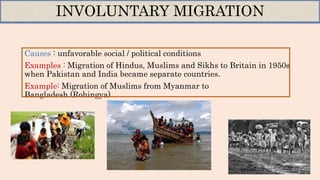
Causes : unfavorable social / political conditions
Examples : Migration of Hindus, Muslims and Sikhs to Britain in 1950s
when Pakistan and India became separate countries.
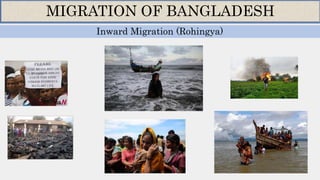
Example: Migration of Muslims from Myanmar to
Bangladesh.(Rohingya)
INVOLUNTARY MIGRATION
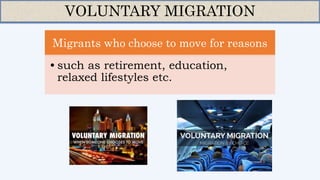
Migrants who choose to move for reasons
• such as retirement, education,
relaxed lifestyles etc.
VOLUNTARY MIGRATION
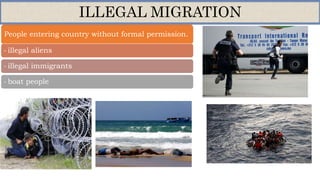
People entering country without formal permission.
- illegal aliens
- illegal immigrants
- boat people
ILLEGAL MIGRATION
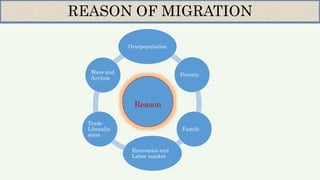
REASON OF MIGRATION
Reason
Overpopulation
Poverty
Family
Economics and
Labor market
Trade
Liberaliz
ation
Wars and
Asylum
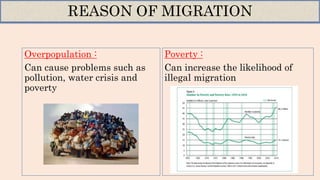
Overpopulation :
Can cause problems such as
pollution, water crisis and
poverty
Poverty :
Can increase the likelihood of
illegal migration
REASON OF MIGRATION
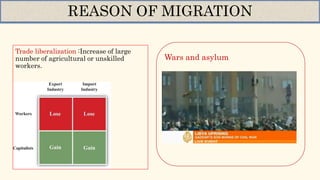
Trade liberalization :Increase of large
number of agricultural or unskilled
workers.
Wars and asylum
REASON OF MIGRATION
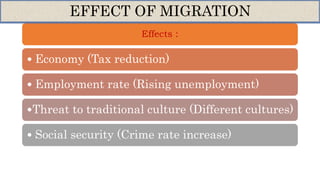
Effects :
• Economy (Tax reduction)
• Employment rate (Rising unemployment)
•Threat to traditional culture (Different cultures)
• Social security (Crime rate increase)
EFFECT OF MIGRATION
Policy: Assignment of deposit money to a bank as security for a loan
Repatriation: send back to original country
SOLUTION
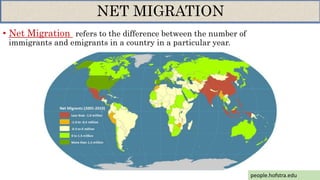
• Net Migration refers to the difference between the number of
immigrants and emigrants in a country in a particular year.
NET MIGRATION
people.hofstra.edu
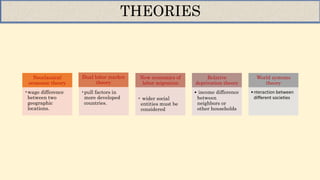
Neoclassical
economic theory
•wage difference
between two
geographic
locations.
Dual labor market
theory
•pull factors in
more developed
countries.
New economics of
labor migration
• wider social
entities must be
considered
Relative
deprivation theory
• income difference
between
neighbors or
other households
World systems
theory
•nteraction between
different societies
THEORIES
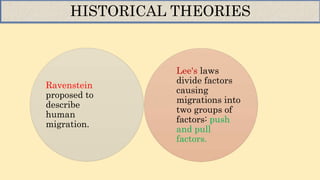
Ravenstein
proposed to
describe
human
migration.
Lee's laws
divide factors
causing
migrations into
two groups of
factors: push
and pull
factors.
HISTORICAL THEORIES
Push factors –
things that
cause persons
to leave their
residences.
Pull factors –
things that
cause persons
to come into
new areas.
PUSH & PULL FACTORS
PUSH & PULL FACTORS
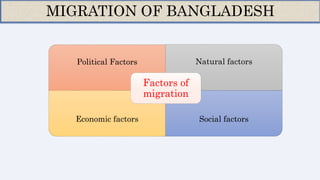
Political Factors Natural factors
Economic factors Social factors
Factors of
migration
MIGRATION OF BANGLADESH
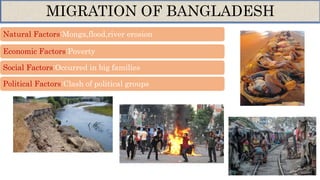
Natural Factors:Monga,flood,river erosion
Economic Factors:Poverty
Social Factors:Occurred in big families
Political Factors:Clash of political groups
MIGRATION OF BANGLADESH
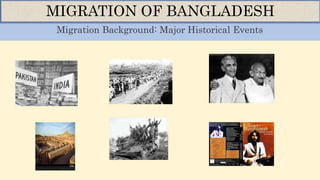
Migration Background: Major Historical Events
MIGRATION OF BANGLADESH
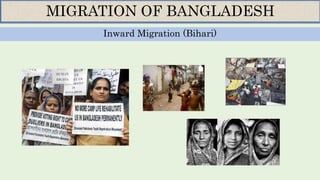
Inward Migration (Bihari)
MIGRATION OF BANGLADESH
Inward Migration (Rohingya)
MIGRATION OF BANGLADESH
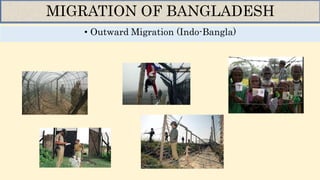
• Outward Migration (Indo-Bangla)
MIGRATION OF BANGLADESH
THANK YOU

Migration

  • 1.
    MIGRATION AND ITS DETERMINANTS SUBMITTEDBY:RAFIUL ALAM(2013135006)
  • 2.
    MIGRATION The movement ofpeople across a specified boundary, national (i.e. internal) or international, to establish a new permanent place of residence”
  • 3.
    MIGRATION “Human Migration isthe permanent change of residence by an individual or groups,excluding such movements as nomadism and migrant labour”.
  • 4.
    In 2005, 191million people were counted as living outside the country of their birth. The number of migrants worldwide has doubled since World War II. If they lived in the same place , international migrants would form the 5th most populous country in the world. MIGRATION IS GLOBAL
  • 5.
  • 6.
  • 7.
  • 8.
    Emigration is theact of leaving one's resident country with the intent to settle elsewhere EMIGRATION Emigrants: People who leave a country .
  • 9.
    Immigration is theinternational movement of people into a destination country of which they are not natives IMMIGRATION www.pinterest.com • Immigrants: People who enter a country
  • 10.
    The top ten immigration countries are theUnited States the Russian Federation Germany Saudi Arabia Canada the UK France Australia India MIGRATION The top ten countries of origin are Mexico Spain China Ukraine Bangladesh Pakistan the UK the Philippines Turkey
  • 11.
    MIGRATION The top ten migration corridors worldwideare Libya–European Union Mexico– United States; Russia– Ukraine; Ukraine– Russia; Bangladesh– India; Turkey– Germany;
  • 12.
  • 13.
  • 14.
    This occurs when peopleleaves one country or state to settle in another. Example:Leaving Bangladesh to take up residence in Canada. INTERNATIONAL MIGRATION
  • 15.
    This transfer to themovement of people who have changed their residence within a country. Example:Leaving Sylhet to settle in Dhaka INTERNAL MIGRATION
  • 16.
    internal or localmigration includes: Rural-urban migration in which large numbers of people leave rural areas to seek jobs in urban areas. Regional migration in which people leave certain regions and move to other regions for a higher amount of rainfall and better soils. Seasonal movements like when people temporary move in one season to the lands to grow crops and back to the villages after harvest. Daily movements which includes rural to rural daily movements from homesteads to fields or grazing areas and urban to urban commuting to work places. Urban to rural e.g. people in towns retiring from work, going back to their original villages. INTERNAL MIGRATION
  • 17.
    • Involuntary Migration= Forced Migration • Movement of people caused by events which force people to move against their will. • People involved in this movement = Refugees • Refugees are those crossed an international boundary to escape persecution. INVOLUNTARY MIGRATION
  • 18.
    Causes : unfavorablesocial / political conditions Examples : Migration of Hindus, Muslims and Sikhs to Britain in 1950s when Pakistan and India became separate countries. Example: Migration of Muslims from Myanmar to Bangladesh.(Rohingya) INVOLUNTARY MIGRATION
  • 19.
    Migrants who chooseto move for reasons • such as retirement, education, relaxed lifestyles etc. VOLUNTARY MIGRATION
  • 20.
    People entering countrywithout formal permission. - illegal aliens - illegal immigrants - boat people ILLEGAL MIGRATION
  • 21.
    REASON OF MIGRATION Reason Overpopulation Poverty Family Economicsand Labor market Trade Liberaliz ation Wars and Asylum
  • 22.
    Overpopulation : Can causeproblems such as pollution, water crisis and poverty Poverty : Can increase the likelihood of illegal migration REASON OF MIGRATION
  • 23.
    Trade liberalization :Increaseof large number of agricultural or unskilled workers. Wars and asylum REASON OF MIGRATION
  • 24.
    Effects : • Economy(Tax reduction) • Employment rate (Rising unemployment) •Threat to traditional culture (Different cultures) • Social security (Crime rate increase) EFFECT OF MIGRATION
  • 25.
    Policy: Assignment ofdeposit money to a bank as security for a loan Repatriation: send back to original country SOLUTION
  • 26.
    • Net Migrationrefers to the difference between the number of immigrants and emigrants in a country in a particular year. NET MIGRATION people.hofstra.edu
  • 27.
    Neoclassical economic theory •wage difference betweentwo geographic locations. Dual labor market theory •pull factors in more developed countries. New economics of labor migration • wider social entities must be considered Relative deprivation theory • income difference between neighbors or other households World systems theory •nteraction between different societies THEORIES
  • 28.
    Ravenstein proposed to describe human migration. Lee's laws dividefactors causing migrations into two groups of factors: push and pull factors. HISTORICAL THEORIES
  • 29.
    Push factors – thingsthat cause persons to leave their residences. Pull factors – things that cause persons to come into new areas. PUSH & PULL FACTORS
  • 30.
    PUSH & PULLFACTORS
  • 31.
    Political Factors Naturalfactors Economic factors Social factors Factors of migration MIGRATION OF BANGLADESH
  • 32.
    Natural Factors:Monga,flood,river erosion EconomicFactors:Poverty Social Factors:Occurred in big families Political Factors:Clash of political groups MIGRATION OF BANGLADESH
  • 33.
  • 34.
    Migration Background: MajorHistorical Events MIGRATION OF BANGLADESH
  • 35.
  • 36.
  • 37.
    • Outward Migration(Indo-Bangla) MIGRATION OF BANGLADESH
  • 38.