Migration
 The United Nations defines migration as the
movement of a person or persons from one
place to another, involving a permanent move
of home for over 1 year.
 “Human Migration is the permanent change
of residence by an individual or groups,
excluding such movements as nomadism
and migrant labour”.
- Encyclopedia Britannica
Migration is Global
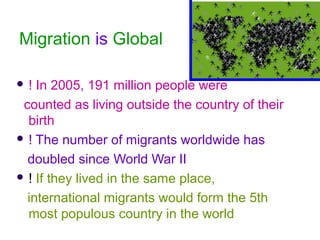
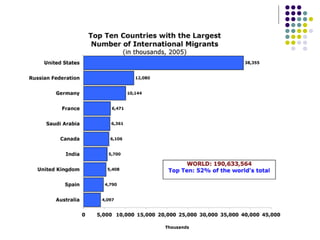
 ! In 2005, 191 million people were
counted as living outside the country of their
birth
 ! The number of migrants worldwide has
doubled since World War II
 ! If they lived in the same place,
international migrants would form the 5th
most populous country in the world
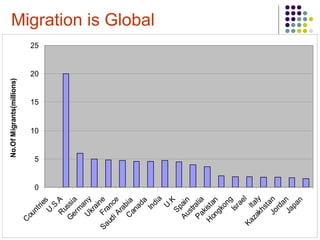
Migration is Global
0
5
10
15
20
25
C
ountriesU
.S.AR
ussia
G
erm
anyU
kraineFrance
SaudiArabiaC
anada
India
U
.K
SpainAustraliaPakistan
H
ongkong
Israel
Italy
KazakhstanJordanJapan
No.OfMigrants(millions)
0
5
10
15
20
25
C
ountriesU
.S.AR
ussia
G
erm
anyU
kraineFrance
SaudiArabiaC
anada
India
U
.K
SpainAustraliaPakistan
H
ongkong
Israel
Italy
KazakhstanJordanJapan
No.OfMigrants(millions)
Types of Migration
Internal migration:- This refers to a change of residence within national 
boundaries, such as between states, provinces, cities, or municipalities.
International migration:- This refers to change of residence over national 
boundaries. An international migrant is someone who moves to a different 
country.
International migrants are further classified
1. Legal immigrants are those who moved with the legal permission of the
receiver nation
2. Illegal immigrants are those who moved without legal permission
,
3. Refugees are those crossed an international boundary to escape
persecution.
Trends in Migration
1. During colonial period (British period) millions of Indians
labourers were sent to countries such as Mauritius, Caribbean
islands, Fiji and South Africa by British from Uttar Pradesh and
Bihar to work as plantation workers
2. In the 20th century semi-skilled Indians migrated to the
neighbouring countries such as Thailand, Malaysia, Singapore,
Indonesia, Brunei and African countries as artisans, traders and
factory workers
3. In recent times, professionals like doctors, engineers, software
engineers, management consultants, financial experts, media
persons, migrated to countries such management consultants,
financial experts, media persons, migrated to countries such as
USA, Canada, UK, Australia, New Zealand and Germany, etc.
These professional are highly educated, the highest paid
The census of India records four types of
information on:
 i. Place of birth i.e. village or town
 ii. Duration of residence (stay) at the place of
enumeration.
 iii. Place of last residence.
 iv. Reasons for migration from place of last
residence.
The two bases of enumeration of
migration in the census of India
 (i) Life-time migrant: OR (place of birth) if the place
of birth is different from the place of enumeration.
(30% of total population).
 (ii) Migrant by place of last residence OR (Place
of residence): if the place of last residence is
different from the place of enumeration. (31% of
total pop.)
SPATIAL VARIATION IN MIGRATION
The internal migration varies from state to state.
1. Maharashtra, Delhi, Gujarat and Haryana have largest numbers
of net in-migrants.
(These states attract migrants from other states).
2. Largest numbers of out-migrants are from states such as Uttar
Pradesh and Bihar.
3. Among the urban agglomeration (UA), Greater Mumbai received
the higher number of in-migrants.
4. Intra-state in-migrants are largest in Greater Mumbai.
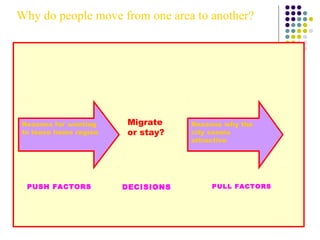
Reasons for wanting
to leave home region
Reasons why the
city seems
attractive
Migrate
or stay?
PUSH FACTORS DECISIONS PULL FACTORS
Why do people move from one area to another?
Economic Causes of Migration
 ! Migration in search of better economic conditions, employment
• urbanization (moving to the cities because of poor economic conditions
in rural areas)
! Migration to escape overpopulation and its effects
 migration to the suburbs in order to secure better living conditions—
especially better school districts, less crowded living conditions
 ! Migration to escape poor climate conditions such as drought
 ! Migration to escape natural disasters
 the “tent cities” erected in Turkey after the 1999 earthquake—some of
them are still there, and in other cases the residents have moved away
to live with relatives and haven’t come back;
Political Causes of Migration
 ! Migration as punishment for crimes committed
 ! Migration as a result of enslavement
 ! Forced migration, with or without political
Agreement
 Migration to escape war, invasion, military takeover,
etc
E.g.. Exiles from Cuba in Castro years;
Tamils from Sri Lanka during the civil war
Tibetans to India after Chinese takeover.
Social Causes of Migration
 ! Migration to spread a religion
 ! Migration to reunite with family, friends,
etc.who have previously migrated
 ! Migration to spread a political philosophy,
such as Marxism, democracy, etc.
 ! Migration to find personal freedom, to live a
certain lifestyle, or to hold certain beliefs.
STREAMS OF MIGRATION
Four streams are identified under the internal migration:
(a) Rural to rural (R-R);
(b) Rural to urban (R-U);
(c) Urban to urban (U-U); and
(d) Urban to rural (U-R).
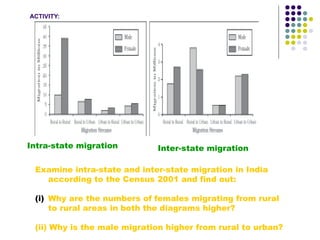
(1) Intra-state migrants are larger than inter-state migrants, i.e.
people prefer to migrate within the state
(ii) Intra-state migration is dominated by female migrants whereas
inter-state migration is dominated by male migrants
.
(iii) Female migrates due to the reasons of marriage whereas male
migrates due to the economic reasons
(iv) Females prefer short distance rural to rural migration whereas
male migrate to long distance rural to urban regions
CONSEQUENCES OF MIGRATION
Economic consequences:-
1. Positive consequences:
i. The remittance (payments) sent by migrants to their homes
help in the growth of economy of the region. This money is
mainly used by the family for repayment of debts, medical
treatment, marriages, children’s education, purchasing
agricultural inputs, construction of houses, etc.
ii. Similarly remittances from the international Indian migrants are
one of the major sources of foreign exchange in India.
.
iii. States such as Punjab, Kerala and Tamil Nadu receive very large
amount of money from their international migrants.
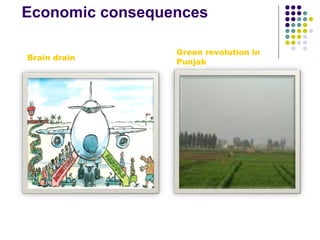
iv. Migration of people from Uttar Pradesh, Bihar, to the rural areas
of Punjab, Haryana, has resulted in the success of green
revolution.
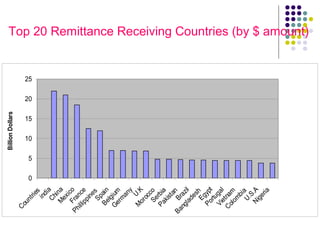
Top 20 Remittance Receiving Countries (by $ amount)
0
5
10
15
20
25
Countries
indiaChinaM
exicoFrance
PhillippinesSpainBelgiumGerm
any
U.KM
oroccoSerbiaPakistanBrazil
BangladeshEgypt
Portugal
Vietnam
Colom
biaU.S.ANigeria
BillionDollars
2. Negative consequences:
a. Unregulated migration to the metropolitan
cities of India has caused overcrowding.
b. Development of slums in industrially
developed states such as Maharashtra,
Gujarat, and Delhi is the result of
unregulated migration.
c. The under-development gets even worse due
to out migration of skilled people
Economic consequences
Brain drain
Green revolution in
Punjab
overcrowding Slums and squatters
Demographic consequences
1. Positive consequences:
a. Migration leads to the redistribution of the population within a country.
b. It results in balanced distribution of people according to resources
.
c. Rural-urban migration is one of the important factors contributing to the
population growth of cities.
2. Negative consequences:
a. It results in imbalances in sex composition due to selective male or female
migration. Large cities have unfavourable sex ratio as compared to rural areas
due to high male immigration.
b. Rural areas face shortage of skilled people because most of skilled and semiskilled
people migrate to urban areas.
Social consequences
1. Positive consequences:
a. Migrants act as agents of social change. The new ideas related to new
technologies, family planning, girl’s education, etc. get spread from urban to
rural areas through them.
b. Migration also leads to intermixing of people from diverse cultures and results in
the evolution of composite culture
.
c. The mind set of people changes. They start thinking broadly and the narrow
views changes.
2. Negative consequences:
a. It also causes anonymity, which creates social vacuum and sense of dejection
among individuals
.
b. Continued feeling of dejection may motivate people to fall in the trap of antisocial
activities like crime and drug abuse.
c. Migration affects the women more. In the rural areas, male selective out
migration leaving their wives behind puts extra physical as well mental pressure
on the women which increases their vulnerability.
Environmental consequences
a. Overcrowding of people due to rural-urban migration
has put pressure on the existing social and physical
infrastructure in the urban areas
b. This ultimately leads to unplanned growth of urban
settlement and formation of slums shanty colonies
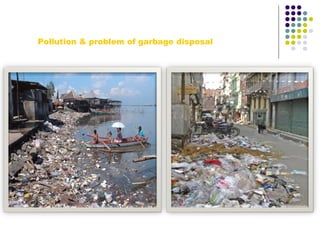
c. Apart from this, due to over-exploitation of natural
resources, cities are facing the acute problem of
depletion of ground water, air pollution, and disposal of
sewage and management of solid wastes
Pollution & problem of garbage disposal
ACTIVITY:
Examine intra-state and inter-state migration in India
according to the Census 2001 and find out:
(i) Why are the numbers of females migrating from rural
to rural areas in both the diagrams higher?
(ii) Why is the male migration higher from rural to urban?
Intra-state migration Inter-state migration
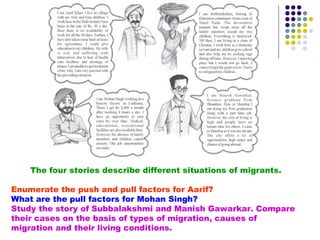
The four stories describe different situations of migrants.
Enumerate the push and pull factors for Aarif?
What are the pull factors for Mohan Singh?
Study the story of Subbalakshmi and Manish Gawarkar. Compare
their cases on the basis of types of migration, causes of
migration and their living conditions.
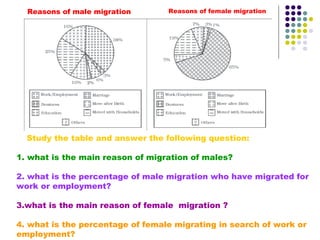
Study the table and answer the following question:
1. what is the main reason of migration of males?
2. what is the percentage of male migration who have migrated for
work or employment?
3.what is the main reason of female migration ?
4. what is the percentage of female migrating in search of work or
employment?
Reasons of male migration Reasons of female migration
Home assignment:
1. Choose the right answers of the following from the given options.
(i) Which one of the following is the main reason for male migration in India?
(a) Education (c) Work and employment
(b) Business (d) Marriage
(ii) Which one of the following states receives maximum number of
immigrants?
(a) Uttar Pradesh (c) Maharashtra
(b) Delhi (d) Bihar
(iii) Which one of the following streams is dominated by male migrants in
India?
(a) Rural-rural (c) Rural-urban
(b) Urban-rural (d) Urban-Urban
(iv) Which one of the following urban agglomeration has the highest share of
in migrant population?
(a) Mumbai UA (c) Bangalore UA
(b) Delhi UA (d) Chennai UA
Home assignment
 Which are the two bases of enumeration of migration in the census
of India?
 State the difference between the streams of intra state & inter state
migration?
 Describe the spatial variation in migration in india?
 Explain the pull and push factors of migration in india?
 Explain the economic consequences of migration in india?
.

Migration

  • 3.
    Migration  The UnitedNations defines migration as the movement of a person or persons from one place to another, involving a permanent move of home for over 1 year.  “Human Migration is the permanent change of residence by an individual or groups, excluding such movements as nomadism and migrant labour”. - Encyclopedia Britannica
  • 4.
    Migration is Global ! In 2005, 191 million people were counted as living outside the country of their birth  ! The number of migrants worldwide has doubled since World War II  ! If they lived in the same place, international migrants would form the 5th most populous country in the world
  • 5.
  • 7.
    Types of Migration Internalmigration:- This refers to a change of residence within national  boundaries, such as between states, provinces, cities, or municipalities. International migration:- This refers to change of residence over national  boundaries. An international migrant is someone who moves to a different  country. International migrants are further classified 1. Legal immigrants are those who moved with the legal permission of the receiver nation 2. Illegal immigrants are those who moved without legal permission , 3. Refugees are those crossed an international boundary to escape persecution.
  • 8.
    Trends in Migration 1.During colonial period (British period) millions of Indians labourers were sent to countries such as Mauritius, Caribbean islands, Fiji and South Africa by British from Uttar Pradesh and Bihar to work as plantation workers 2. In the 20th century semi-skilled Indians migrated to the neighbouring countries such as Thailand, Malaysia, Singapore, Indonesia, Brunei and African countries as artisans, traders and factory workers 3. In recent times, professionals like doctors, engineers, software engineers, management consultants, financial experts, media persons, migrated to countries such management consultants, financial experts, media persons, migrated to countries such as USA, Canada, UK, Australia, New Zealand and Germany, etc. These professional are highly educated, the highest paid
  • 9.
    The census ofIndia records four types of information on:  i. Place of birth i.e. village or town  ii. Duration of residence (stay) at the place of enumeration.  iii. Place of last residence.  iv. Reasons for migration from place of last residence.
  • 10.
    The two basesof enumeration of migration in the census of India  (i) Life-time migrant: OR (place of birth) if the place of birth is different from the place of enumeration. (30% of total population).  (ii) Migrant by place of last residence OR (Place of residence): if the place of last residence is different from the place of enumeration. (31% of total pop.)
  • 11.
    SPATIAL VARIATION INMIGRATION The internal migration varies from state to state. 1. Maharashtra, Delhi, Gujarat and Haryana have largest numbers of net in-migrants. (These states attract migrants from other states). 2. Largest numbers of out-migrants are from states such as Uttar Pradesh and Bihar. 3. Among the urban agglomeration (UA), Greater Mumbai received the higher number of in-migrants. 4. Intra-state in-migrants are largest in Greater Mumbai.
  • 12.
    Reasons for wanting toleave home region Reasons why the city seems attractive Migrate or stay? PUSH FACTORS DECISIONS PULL FACTORS Why do people move from one area to another?
  • 13.
    Economic Causes ofMigration  ! Migration in search of better economic conditions, employment • urbanization (moving to the cities because of poor economic conditions in rural areas) ! Migration to escape overpopulation and its effects  migration to the suburbs in order to secure better living conditions— especially better school districts, less crowded living conditions  ! Migration to escape poor climate conditions such as drought  ! Migration to escape natural disasters  the “tent cities” erected in Turkey after the 1999 earthquake—some of them are still there, and in other cases the residents have moved away to live with relatives and haven’t come back;
  • 14.
    Political Causes ofMigration  ! Migration as punishment for crimes committed  ! Migration as a result of enslavement  ! Forced migration, with or without political Agreement  Migration to escape war, invasion, military takeover, etc E.g.. Exiles from Cuba in Castro years; Tamils from Sri Lanka during the civil war Tibetans to India after Chinese takeover.
  • 15.
    Social Causes ofMigration  ! Migration to spread a religion  ! Migration to reunite with family, friends, etc.who have previously migrated  ! Migration to spread a political philosophy, such as Marxism, democracy, etc.  ! Migration to find personal freedom, to live a certain lifestyle, or to hold certain beliefs.
  • 16.
    STREAMS OF MIGRATION Fourstreams are identified under the internal migration: (a) Rural to rural (R-R); (b) Rural to urban (R-U); (c) Urban to urban (U-U); and (d) Urban to rural (U-R). (1) Intra-state migrants are larger than inter-state migrants, i.e. people prefer to migrate within the state (ii) Intra-state migration is dominated by female migrants whereas inter-state migration is dominated by male migrants . (iii) Female migrates due to the reasons of marriage whereas male migrates due to the economic reasons (iv) Females prefer short distance rural to rural migration whereas male migrate to long distance rural to urban regions
  • 17.
    CONSEQUENCES OF MIGRATION Economicconsequences:- 1. Positive consequences: i. The remittance (payments) sent by migrants to their homes help in the growth of economy of the region. This money is mainly used by the family for repayment of debts, medical treatment, marriages, children’s education, purchasing agricultural inputs, construction of houses, etc. ii. Similarly remittances from the international Indian migrants are one of the major sources of foreign exchange in India. . iii. States such as Punjab, Kerala and Tamil Nadu receive very large amount of money from their international migrants. iv. Migration of people from Uttar Pradesh, Bihar, to the rural areas of Punjab, Haryana, has resulted in the success of green revolution.
  • 18.
    Top 20 RemittanceReceiving Countries (by $ amount) 0 5 10 15 20 25 Countries indiaChinaM exicoFrance PhillippinesSpainBelgiumGerm any U.KM oroccoSerbiaPakistanBrazil BangladeshEgypt Portugal Vietnam Colom biaU.S.ANigeria BillionDollars
  • 19.
    2. Negative consequences: a.Unregulated migration to the metropolitan cities of India has caused overcrowding. b. Development of slums in industrially developed states such as Maharashtra, Gujarat, and Delhi is the result of unregulated migration. c. The under-development gets even worse due to out migration of skilled people
  • 20.
  • 21.
  • 22.
    Demographic consequences 1. Positiveconsequences: a. Migration leads to the redistribution of the population within a country. b. It results in balanced distribution of people according to resources . c. Rural-urban migration is one of the important factors contributing to the population growth of cities. 2. Negative consequences: a. It results in imbalances in sex composition due to selective male or female migration. Large cities have unfavourable sex ratio as compared to rural areas due to high male immigration. b. Rural areas face shortage of skilled people because most of skilled and semiskilled people migrate to urban areas.
  • 23.
    Social consequences 1. Positiveconsequences: a. Migrants act as agents of social change. The new ideas related to new technologies, family planning, girl’s education, etc. get spread from urban to rural areas through them. b. Migration also leads to intermixing of people from diverse cultures and results in the evolution of composite culture . c. The mind set of people changes. They start thinking broadly and the narrow views changes. 2. Negative consequences: a. It also causes anonymity, which creates social vacuum and sense of dejection among individuals . b. Continued feeling of dejection may motivate people to fall in the trap of antisocial activities like crime and drug abuse. c. Migration affects the women more. In the rural areas, male selective out migration leaving their wives behind puts extra physical as well mental pressure on the women which increases their vulnerability.
  • 24.
    Environmental consequences a. Overcrowdingof people due to rural-urban migration has put pressure on the existing social and physical infrastructure in the urban areas b. This ultimately leads to unplanned growth of urban settlement and formation of slums shanty colonies c. Apart from this, due to over-exploitation of natural resources, cities are facing the acute problem of depletion of ground water, air pollution, and disposal of sewage and management of solid wastes
  • 25.
    Pollution & problemof garbage disposal
  • 26.
    ACTIVITY: Examine intra-state andinter-state migration in India according to the Census 2001 and find out: (i) Why are the numbers of females migrating from rural to rural areas in both the diagrams higher? (ii) Why is the male migration higher from rural to urban? Intra-state migration Inter-state migration
  • 27.
    The four storiesdescribe different situations of migrants. Enumerate the push and pull factors for Aarif? What are the pull factors for Mohan Singh? Study the story of Subbalakshmi and Manish Gawarkar. Compare their cases on the basis of types of migration, causes of migration and their living conditions.
  • 28.
    Study the tableand answer the following question: 1. what is the main reason of migration of males? 2. what is the percentage of male migration who have migrated for work or employment? 3.what is the main reason of female migration ? 4. what is the percentage of female migrating in search of work or employment? Reasons of male migration Reasons of female migration
  • 29.
    Home assignment: 1. Choosethe right answers of the following from the given options. (i) Which one of the following is the main reason for male migration in India? (a) Education (c) Work and employment (b) Business (d) Marriage (ii) Which one of the following states receives maximum number of immigrants? (a) Uttar Pradesh (c) Maharashtra (b) Delhi (d) Bihar (iii) Which one of the following streams is dominated by male migrants in India? (a) Rural-rural (c) Rural-urban (b) Urban-rural (d) Urban-Urban (iv) Which one of the following urban agglomeration has the highest share of in migrant population? (a) Mumbai UA (c) Bangalore UA (b) Delhi UA (d) Chennai UA
  • 30.
    Home assignment  Whichare the two bases of enumeration of migration in the census of India?  State the difference between the streams of intra state & inter state migration?  Describe the spatial variation in migration in india?  Explain the pull and push factors of migration in india?  Explain the economic consequences of migration in india? .