Population and Urbanization
             Introduction to Sociology
          Seth Allen
Chapter Outline

• Demography: The Study of Population
• Population Growth in Global Context
• A Brief Glimpse at International Migration
  Theories
• Urbanization in Global Perspective
• Perspectives on Urbanization and the Growth of
  Cities
• Problems in Global Cities
• Urban Problems in the United States
• Population and Urbanization in the Future
Population
• World’s population of 6.8 billion in 2010
  is increasing by more than 76 million
  people per year.

• Between 2000 and 2030, almost all of the
  world’s 1.4 % annual population growth
  will occur in low-income countries in
  Africa, Asia, and Latin America.
Changes in Population
Changes occur as a result of three processes:


• Fertility (births)
• Mortality (deaths)
• Migration/Emigration
How Did We Get So Big So Fast?

Link to YouTube video
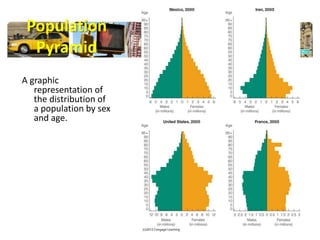
Population
  Pyramid
A graphic
   representation of
   the distribution of
   a population by sex
   and age.
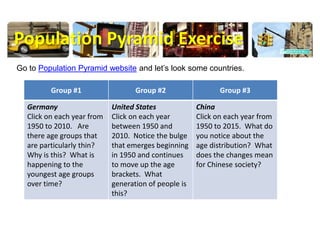
Population Pyramid Exercise
Go to Population Pyramid website and let‟s look some countries.

         Group #1                  Group #2                  Group #3

  Germany                   United States             China
  Click on each year from   Click on each year        Click on each year from
  1950 to 2010. Are         between 1950 and          1950 to 2015. What do
  there age groups that     2010. Notice the bulge    you notice about the
  are particularly thin?    that emerges beginning    age distribution? What
  Why is this? What is      in 1950 and continues     does the changes mean
  happening to the          to move up the age        for Chinese society?
  youngest age groups       brackets. What
  over time?                generation of people is
                            this?
Population Composition
• The biological and social characteristics of a
  population, including age, sex, race, marital
  status, education, occupation, income, and
  size of household.

• The sex ratio is the number of males for
  every hundred females in a given
  population.
   – A sex ratio of 100 indicates an equal number of
     males and females in the population.
   – A number greater than 100, indicates there are
     more males than females; if it is less than 100,
     there are more females than males.
Theories of Population Growth
•   The Malthusian Perspective
•   The Marxist Perspective
•   The Neo-Malthusian Perspective
•   Demographic Transition Theory
Malthusian Perspective
• If left unchecked, the population would
  exceed the available food supply.

• Population would increase in a geometric
  progression (2, 4, 8, …).

• The food supply would increase by an
  arithmetic progression (1, 2, 3, 4 . . .).
Marxist Perspective
• Using technology, food can be produced
  for a growing population.

• Overpopulation will lead to the eventual
  destruction of capitalism.

• Workers will become dissatisfied and
  develop class-consciousness because of
  shared oppression.
Marxist Perspective Applied to the
     Irish Potato Famine of 1846
Ireland operated as colony of
   Britain, who controlled
   their exports. A disease
   decimated the potato crop
   in 1846 and the British
   were reluctant to act. The
   British failed to send
   enough of their own crops
   to aid the hungry people
   and over 1 million Irish
   people died over the next
   decade.1

1.   Jim Donnelly, “The Irish Famine,” BBC History, The Irish Famine.
The Neo-Malthusian Perspective
• Overpopulation and rapid population
  growth result in global environmental
  problems.

• People should be encouraging zero
  population growth-roughly 2 children per
  couple.
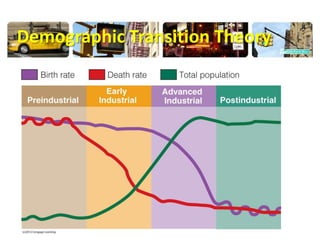
Demographic Transition Theory
Stage 1: Preindustrial Societies - little population
    growth, high birth rates offset by high death rates.

Stage 2: Early Industrialization - significant population
    growth, birth rates are relatively high, death rates
    decline.

Stage 3: Advanced Industrialization and Urbanization -
   very little population growth occurs, birth rates and
   death rates are low.

Stage 4: Postindustrialization - birth rates decline as
   more women are employed and raising children
   becomes more costly.
Demographic Transition Theory
The demographic transition
model has been criticized for
being narrowly applicable to the
Western world.

 Look how quickly this process
has happened in the rapidly
industrializing nations of Latin
America.
Theories of Migration
Conflict Theories             Functionalist Theories
• Split labor market theory   • Neoclassical economic
• World systems theory          approach
                              • New household economics
                                of migration approach

                              Other Theories
                               • Institutional theory-Groups
                                 ‘push’ and ‘pull’ migrants to
                                 new nations
                               • Network theory –Family and
                                 business networks create
                                 channels of migrants
Percentage of people living in
         cities 2009
Emergence and Evolution of the City
• The earliest humans are believed to have
  emerged anywhere from 40,000 to 1,000,000
  years ago.
• Scholars date the development of the first city
  between 3500 and 3100 BCE.

Three preconditions:
• A favorable physical environment.
• An advanced technology that could produce a
  social surplus.
• A well-developed political system to provide
  social stability to the economic system.
Preindustrial Cities
• The largest preindustrial city was Rome. By 100 C.E., it may have
  had a population of 650,000 (Chandler and Fox, 1974).
• Crowded housing conditions and a lack of adequate sewage
  facilities increased the hazards from plagues and fires, and death
  rates were high.
• Food supplies were limited.
• Migration to the city was difficult.
• Concept of nation-state emerged
              Jericho is believed to be
                the oldest know city,
               founded around 8,000
                         B.C.
Industrial Cities
• The Industrial Revolution changed the
  nature of the city.
  – Factories attract workers from rural area.
  – Rapidly developing transportation
    technology brings more of them, and from
    farther away.
  – Urban populations mushroom.
  – The metropolis is born
     • A central city and suburbs that dominate the
       cultural and economic life of a region.
Post Industrial Cities

• Economies gradually shift from secondary
  (manufacturing) production to tertiary (service
  and information-processing) production.
• Cities increasingly rely on an economic
  structure that is based on scientific knowledge
  rather than industrial production, and as a
  result, a class of professionals and technicians
  grows in size and influence.
Three Models of the City
Park’s Concentric Model based on
         Chicago in 1925

                    What are the some of the challenges
                    of the concentric model?
                    Can it be applied to other cities?
                    Are there geographic, political, and
                    demographic changes that could
                    distort this model?
Conflict Perspectives on Urban Growth
•Developers, capitalist class, and government leaders, not
individuals, determine how cities are laid out
•Land is developed according to its exchange value and
conflicts arise over the use value
•Governments subsidize growth in certain areas, allow others
to decline (uneven development theory)
•Entire neighborhoods have been „conquered‟ by gated
communities and public space is privatized
                             It is easy to see
                             how in a city like
                                  Charlotte,
                                government
                               subsidies can
                               influence the
                            economic health of
                             a neighborhood.
Symbolic Interactionist Perspectives on
                Cities
                              Sociologist Robert
                              Sampson, author of
                              The Great American
                              City, discusses how
                              high community
                              morale can positively
                              affect how people
                              respond to natural
                              disasters (Link)

                              Symbolic
                              interactionists focus
                              on peoples‟
                              experiences in city
                              life; how they view
                              their neighbors,
                              communities, how
                              they interact, and how
                              they perceive urban
                              living in general.
Simmel's View of City Life
• Urban life is stimulating; it shapes
  people's thoughts and actions.
• Many urban residents avoid emotional
  involvement with each other and try to
  ignore events taking place around them.
• Urban living can be liberating - people
  have opportunities for individualism and
  autonomy.
Suburbs
• Since World War II, the U.S. population has
  shifted as people moved to the suburbs.
• Suburbanites rely on urban centers for
  employment but pay property taxes to
  suburban governments and school districts.
  What would conflict,
  functionalist, and symbolic
  interactionists have to say
  about suburban life?
Suburban Wars

                                              People move to
                                              suburbs to find
                                              cheaper housing,
                                              better schools, and
                                              move away from the
                                              problems of the city

                                              How might conflict
                                              theorists view the
                                              proposed secession
                                              of Ballantyne and
                                              other affluent parts of
                                              cities?

Report from WSOCTV, aired on 4/12/12 (Link)
The World’s Ten Largest Metropolises


Questions for You:
1. Do you see how the Malthusians would be concerned about over-population?
2. Notice the cities that are currently the largest in the world-what do you think
   that this means for the future of global politics?

Population and urbanization

  • 1.
    Population and Urbanization Introduction to Sociology Seth Allen
  • 2.
    Chapter Outline • Demography:The Study of Population • Population Growth in Global Context • A Brief Glimpse at International Migration Theories • Urbanization in Global Perspective • Perspectives on Urbanization and the Growth of Cities • Problems in Global Cities • Urban Problems in the United States • Population and Urbanization in the Future
  • 3.
    Population • World’s populationof 6.8 billion in 2010 is increasing by more than 76 million people per year. • Between 2000 and 2030, almost all of the world’s 1.4 % annual population growth will occur in low-income countries in Africa, Asia, and Latin America.
  • 4.
    Changes in Population Changesoccur as a result of three processes: • Fertility (births) • Mortality (deaths) • Migration/Emigration
  • 5.
    How Did WeGet So Big So Fast? Link to YouTube video
  • 6.
    Population Pyramid Agraphic representation of the distribution of a population by sex and age.
  • 7.
    Population Pyramid Exercise Goto Population Pyramid website and let‟s look some countries. Group #1 Group #2 Group #3 Germany United States China Click on each year from Click on each year Click on each year from 1950 to 2010. Are between 1950 and 1950 to 2015. What do there age groups that 2010. Notice the bulge you notice about the are particularly thin? that emerges beginning age distribution? What Why is this? What is in 1950 and continues does the changes mean happening to the to move up the age for Chinese society? youngest age groups brackets. What over time? generation of people is this?
  • 8.
    Population Composition • Thebiological and social characteristics of a population, including age, sex, race, marital status, education, occupation, income, and size of household. • The sex ratio is the number of males for every hundred females in a given population. – A sex ratio of 100 indicates an equal number of males and females in the population. – A number greater than 100, indicates there are more males than females; if it is less than 100, there are more females than males.
  • 9.
    Theories of PopulationGrowth • The Malthusian Perspective • The Marxist Perspective • The Neo-Malthusian Perspective • Demographic Transition Theory
  • 10.
    Malthusian Perspective • Ifleft unchecked, the population would exceed the available food supply. • Population would increase in a geometric progression (2, 4, 8, …). • The food supply would increase by an arithmetic progression (1, 2, 3, 4 . . .).
  • 11.
    Marxist Perspective • Usingtechnology, food can be produced for a growing population. • Overpopulation will lead to the eventual destruction of capitalism. • Workers will become dissatisfied and develop class-consciousness because of shared oppression.
  • 12.
    Marxist Perspective Appliedto the Irish Potato Famine of 1846 Ireland operated as colony of Britain, who controlled their exports. A disease decimated the potato crop in 1846 and the British were reluctant to act. The British failed to send enough of their own crops to aid the hungry people and over 1 million Irish people died over the next decade.1 1. Jim Donnelly, “The Irish Famine,” BBC History, The Irish Famine.
  • 13.
    The Neo-Malthusian Perspective •Overpopulation and rapid population growth result in global environmental problems. • People should be encouraging zero population growth-roughly 2 children per couple.
  • 14.
    Demographic Transition Theory Stage1: Preindustrial Societies - little population growth, high birth rates offset by high death rates. Stage 2: Early Industrialization - significant population growth, birth rates are relatively high, death rates decline. Stage 3: Advanced Industrialization and Urbanization - very little population growth occurs, birth rates and death rates are low. Stage 4: Postindustrialization - birth rates decline as more women are employed and raising children becomes more costly.
  • 15.
  • 16.
    The demographic transition modelhas been criticized for being narrowly applicable to the Western world. Look how quickly this process has happened in the rapidly industrializing nations of Latin America.
  • 17.
    Theories of Migration ConflictTheories Functionalist Theories • Split labor market theory • Neoclassical economic • World systems theory approach • New household economics of migration approach Other Theories • Institutional theory-Groups ‘push’ and ‘pull’ migrants to new nations • Network theory –Family and business networks create channels of migrants
  • 18.
    Percentage of peopleliving in cities 2009
  • 19.
    Emergence and Evolutionof the City • The earliest humans are believed to have emerged anywhere from 40,000 to 1,000,000 years ago. • Scholars date the development of the first city between 3500 and 3100 BCE. Three preconditions: • A favorable physical environment. • An advanced technology that could produce a social surplus. • A well-developed political system to provide social stability to the economic system.
  • 20.
    Preindustrial Cities • Thelargest preindustrial city was Rome. By 100 C.E., it may have had a population of 650,000 (Chandler and Fox, 1974). • Crowded housing conditions and a lack of adequate sewage facilities increased the hazards from plagues and fires, and death rates were high. • Food supplies were limited. • Migration to the city was difficult. • Concept of nation-state emerged Jericho is believed to be the oldest know city, founded around 8,000 B.C.
  • 21.
    Industrial Cities • TheIndustrial Revolution changed the nature of the city. – Factories attract workers from rural area. – Rapidly developing transportation technology brings more of them, and from farther away. – Urban populations mushroom. – The metropolis is born • A central city and suburbs that dominate the cultural and economic life of a region.
  • 22.
    Post Industrial Cities •Economies gradually shift from secondary (manufacturing) production to tertiary (service and information-processing) production. • Cities increasingly rely on an economic structure that is based on scientific knowledge rather than industrial production, and as a result, a class of professionals and technicians grows in size and influence.
  • 23.
  • 24.
    Park’s Concentric Modelbased on Chicago in 1925 What are the some of the challenges of the concentric model? Can it be applied to other cities? Are there geographic, political, and demographic changes that could distort this model?
  • 25.
    Conflict Perspectives onUrban Growth •Developers, capitalist class, and government leaders, not individuals, determine how cities are laid out •Land is developed according to its exchange value and conflicts arise over the use value •Governments subsidize growth in certain areas, allow others to decline (uneven development theory) •Entire neighborhoods have been „conquered‟ by gated communities and public space is privatized It is easy to see how in a city like Charlotte, government subsidies can influence the economic health of a neighborhood.
  • 26.
    Symbolic Interactionist Perspectiveson Cities Sociologist Robert Sampson, author of The Great American City, discusses how high community morale can positively affect how people respond to natural disasters (Link) Symbolic interactionists focus on peoples‟ experiences in city life; how they view their neighbors, communities, how they interact, and how they perceive urban living in general.
  • 27.
    Simmel's View ofCity Life • Urban life is stimulating; it shapes people's thoughts and actions. • Many urban residents avoid emotional involvement with each other and try to ignore events taking place around them. • Urban living can be liberating - people have opportunities for individualism and autonomy.
  • 28.
    Suburbs • Since WorldWar II, the U.S. population has shifted as people moved to the suburbs. • Suburbanites rely on urban centers for employment but pay property taxes to suburban governments and school districts. What would conflict, functionalist, and symbolic interactionists have to say about suburban life?
  • 29.
    Suburban Wars People move to suburbs to find cheaper housing, better schools, and move away from the problems of the city How might conflict theorists view the proposed secession of Ballantyne and other affluent parts of cities? Report from WSOCTV, aired on 4/12/12 (Link)
  • 30.
    The World’s TenLargest Metropolises Questions for You: 1. Do you see how the Malthusians would be concerned about over-population? 2. Notice the cities that are currently the largest in the world-what do you think that this means for the future of global politics?

Editor's Notes

  • #26 Conflict theorists would point to the fact that elites control how cities grow, if and where they will prosper, and where the excluded will live. Emminent domain is a clause in the constituion that has been applied to evict people from their houses for other uses-consider the number of people living around Charlotte Douglas airport who have given up farms and houses so that the airport can expand. Another common tactic of elites is to exclude the poor by making parts of the city inaccesible-through lack of public transit & sidewalks-consider the public transit system in Atlanta