Migration
Studying its effect on urban areas
“It includes any movement within the political boundaries of a nation which
results in a change of usual place of residence.
It may consist of the crossing of a village or town boundary as a minimum
condition for qualifying the movement as internal migration. Thus, the concept of
internal migration involves implicitly an imposition of boundary lines which must
be crossed before a movement is counted as internal migration. ”
Source: censusindia.gov.in
CENSUS DEFINITION OF ‘MIGRATION’
QUICK FACTS
• The Constitution of India (Article 19) gives the right to all citizens to “to move freely throughout
the territory of India; to reside and settle in any part of the territory of India”.
• Internal migrants in India constitute a large population: 309 million internal migrants or 30 per
cent of the population (Census of India 2001), and by more recent estimates 326 million or 28.5 per
cent of the population (NSSO 2007–2008).
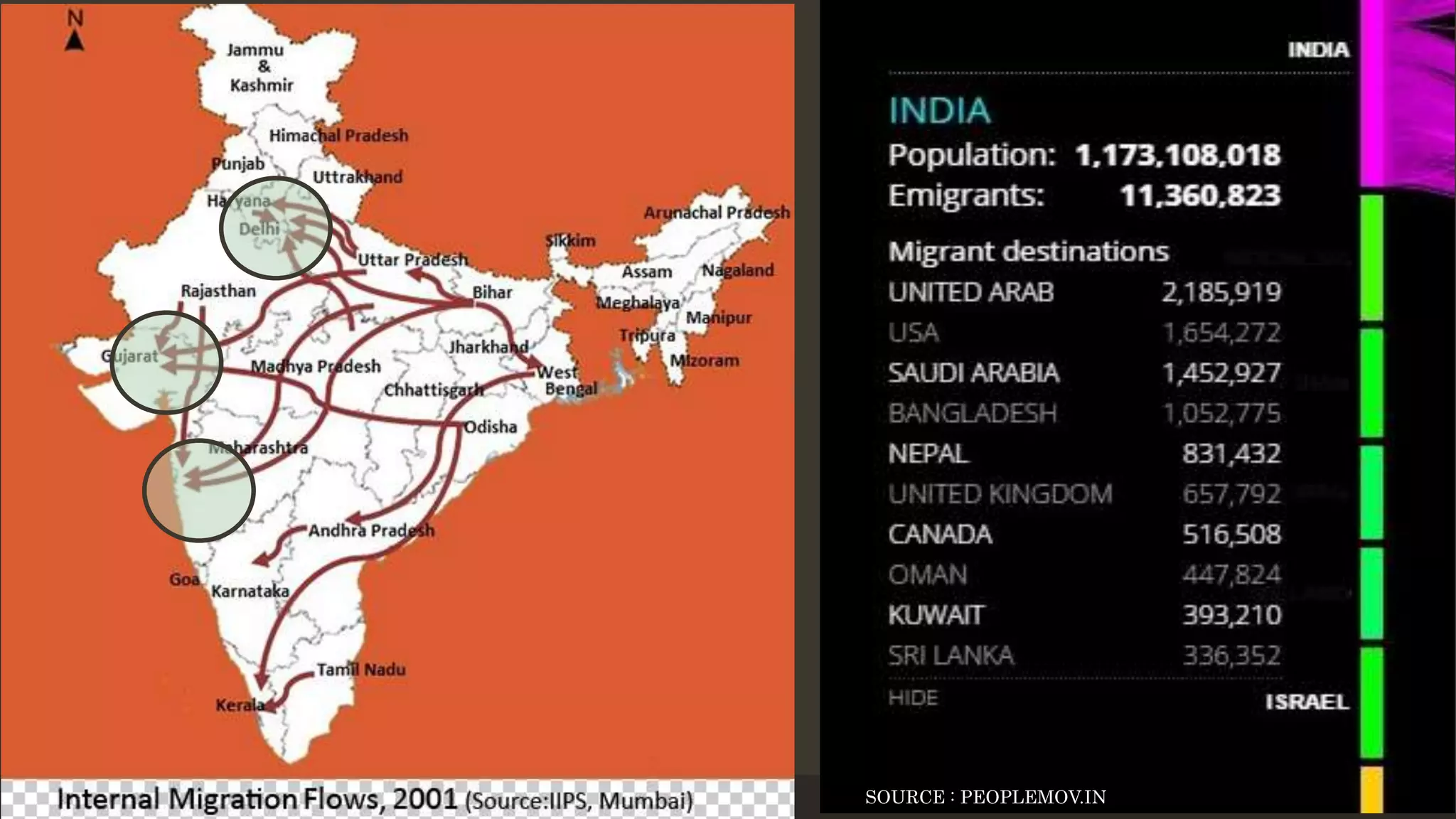
• Lead source states: Uttar Pradesh, Bihar, Rajasthan, Madhya Pradesh, Andhra Pradesh,
Chhattisgarh, Jharkhand, Orissa, Uttarakhand and Tamil Nadu.
• Key destination states: Delhi, Maharashtra, Gujarat, Haryana, Punjab and Karnataka.
• Migrants are mostly employed in the following subsectors: construction, domestic work, textile,
brick-kilns, transportation, mines, quarries and agriculture (Deshingkar and Akter 2009).
• Migration in India is primarily of two types:
• i. Long-term migration, resulting in the relocation of an individual or household;
• ii. Short-term or seasonal/ circular migration, involving back and forth movement between a source
and destination. Most short-term migrants belong to socioeconomically deprived groups, such as
Scheduled Castes or Scheduled Tribes, having negligible educational attainment, limited assets
and resource deficits
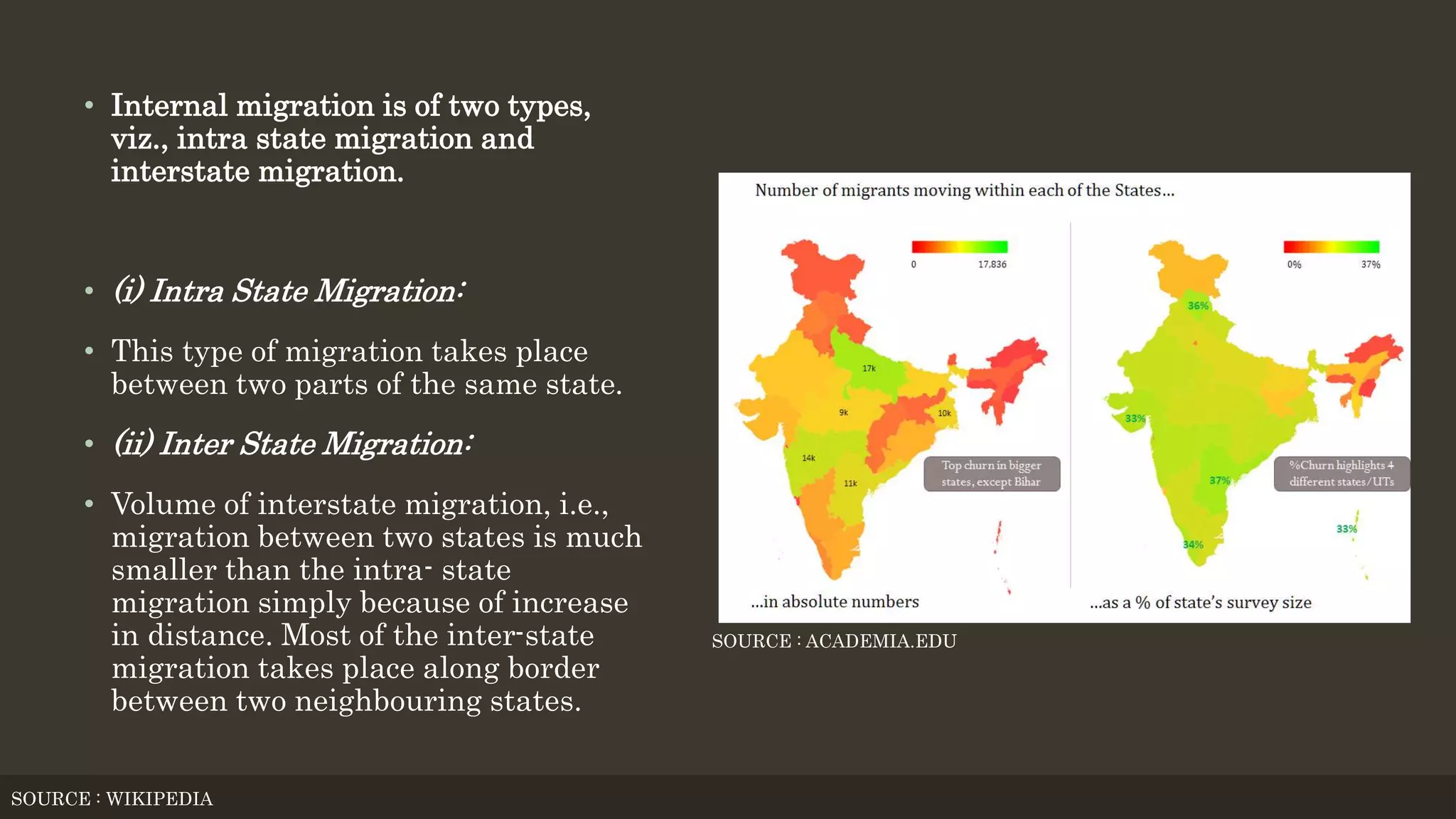
• Internal migration is of two types,
viz., intra state migration and
interstate migration.
• (i) Intra State Migration:
• This type of migration takes place
between two parts of the same state.
• (ii) Inter State Migration:
• Volume of interstate migration, i.e.,
migration between two states is much
smaller than the intra- state
migration simply because of increase
in distance. Most of the inter-state
migration takes place along border
between two neighbouring states.
SOURCE : WIKIPEDIA
SOURCE : ACADEMIA.EDU
Causes of migration
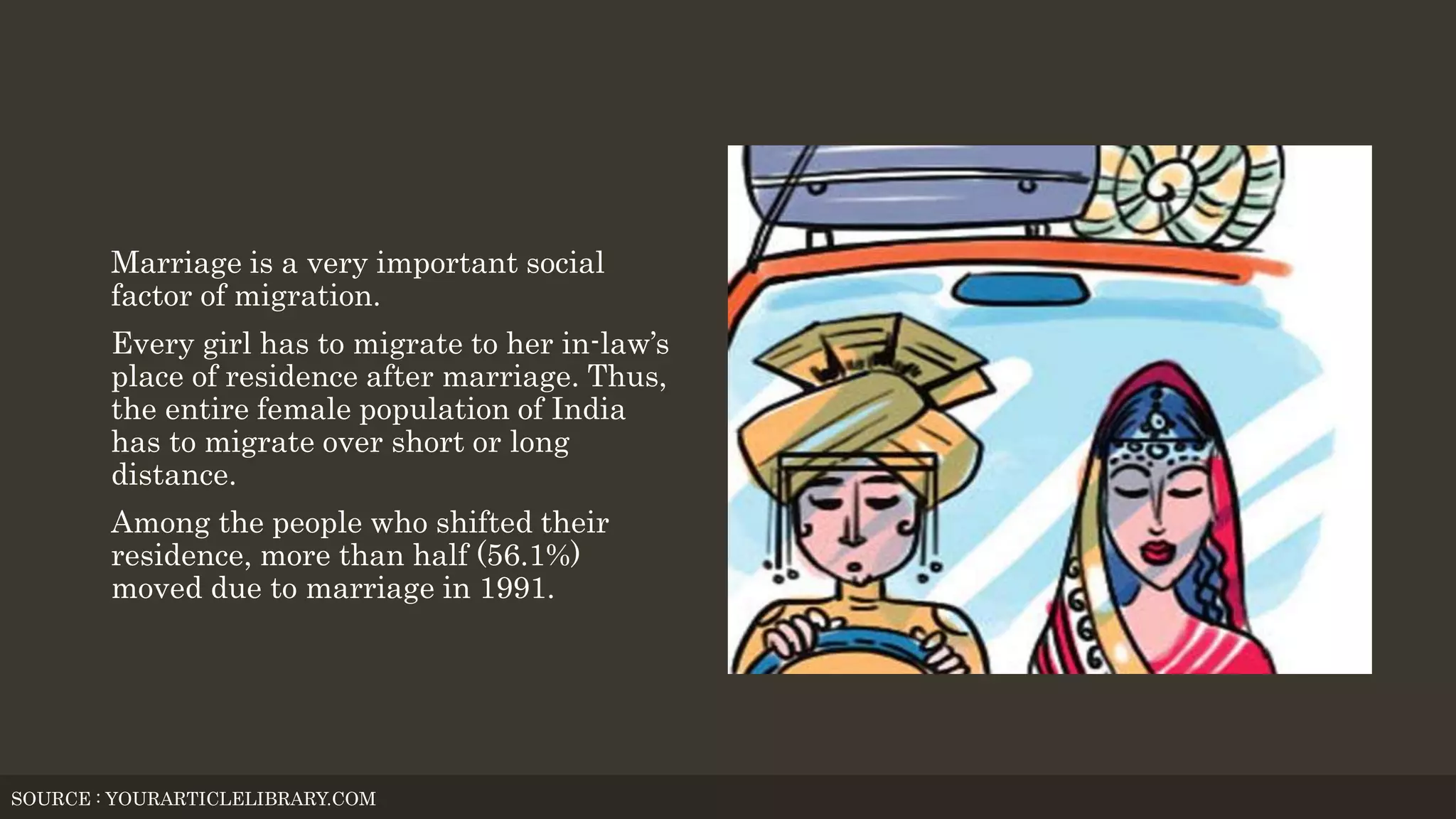
Marriage is a very important social
factor of migration.
Every girl has to migrate to her in-law’s
place of residence after marriage. Thus,
the entire female population of India
has to migrate over short or long
distance.
Among the people who shifted their
residence, more than half (56.1%)
moved due to marriage in 1991.
SOURCE : YOURARTICLELIBRARY.COM
• EMPLOYMENT
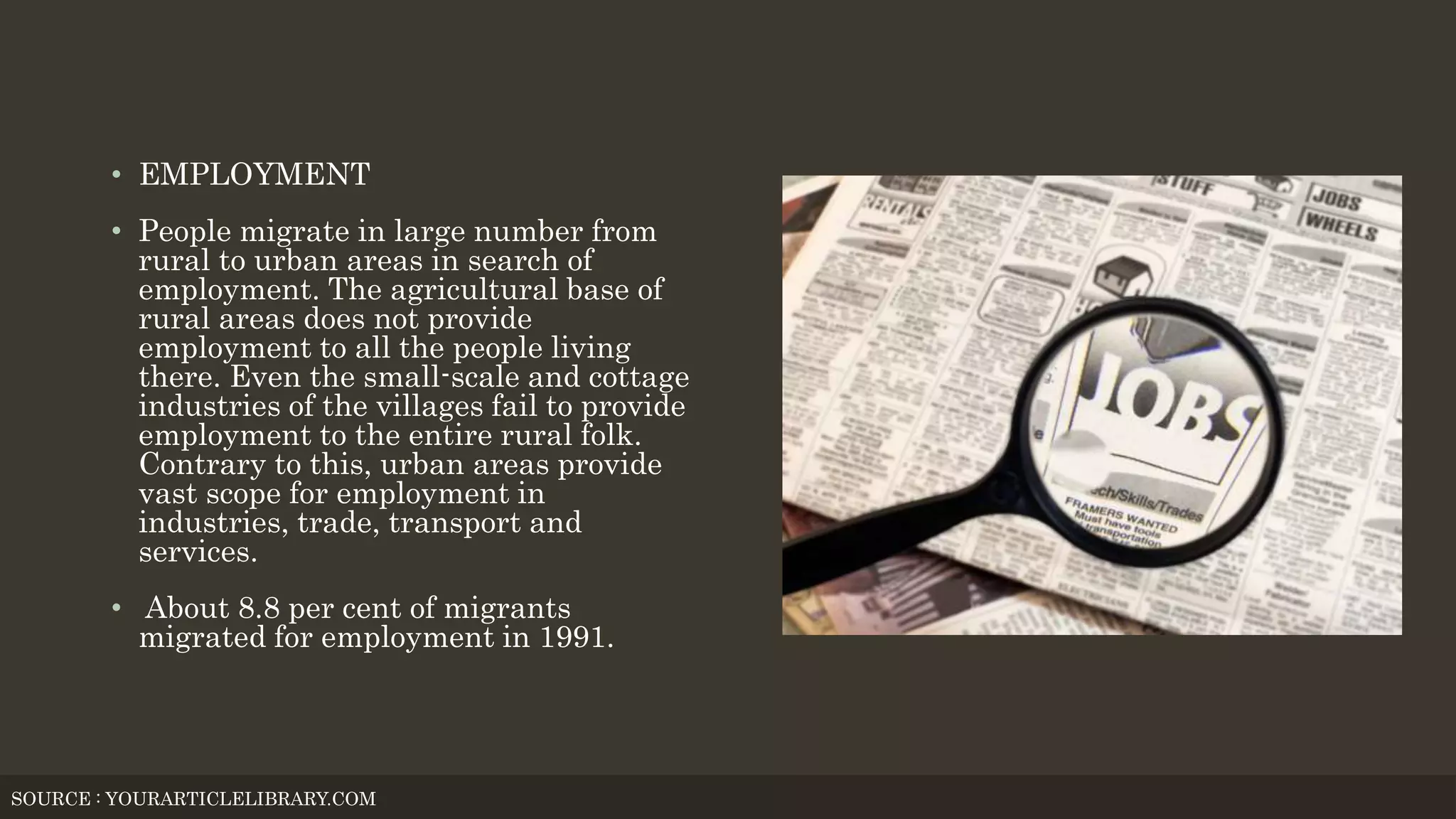
• People migrate in large number from
rural to urban areas in search of
employment. The agricultural base of
rural areas does not provide
employment to all the people living
there. Even the small-scale and cottage
industries of the villages fail to provide
employment to the entire rural folk.
Contrary to this, urban areas provide
vast scope for employment in
industries, trade, transport and
services.
• About 8.8 per cent of migrants
migrated for employment in 1991.
SOURCE : YOURARTICLELIBRARY.COM
• EDUCATION:
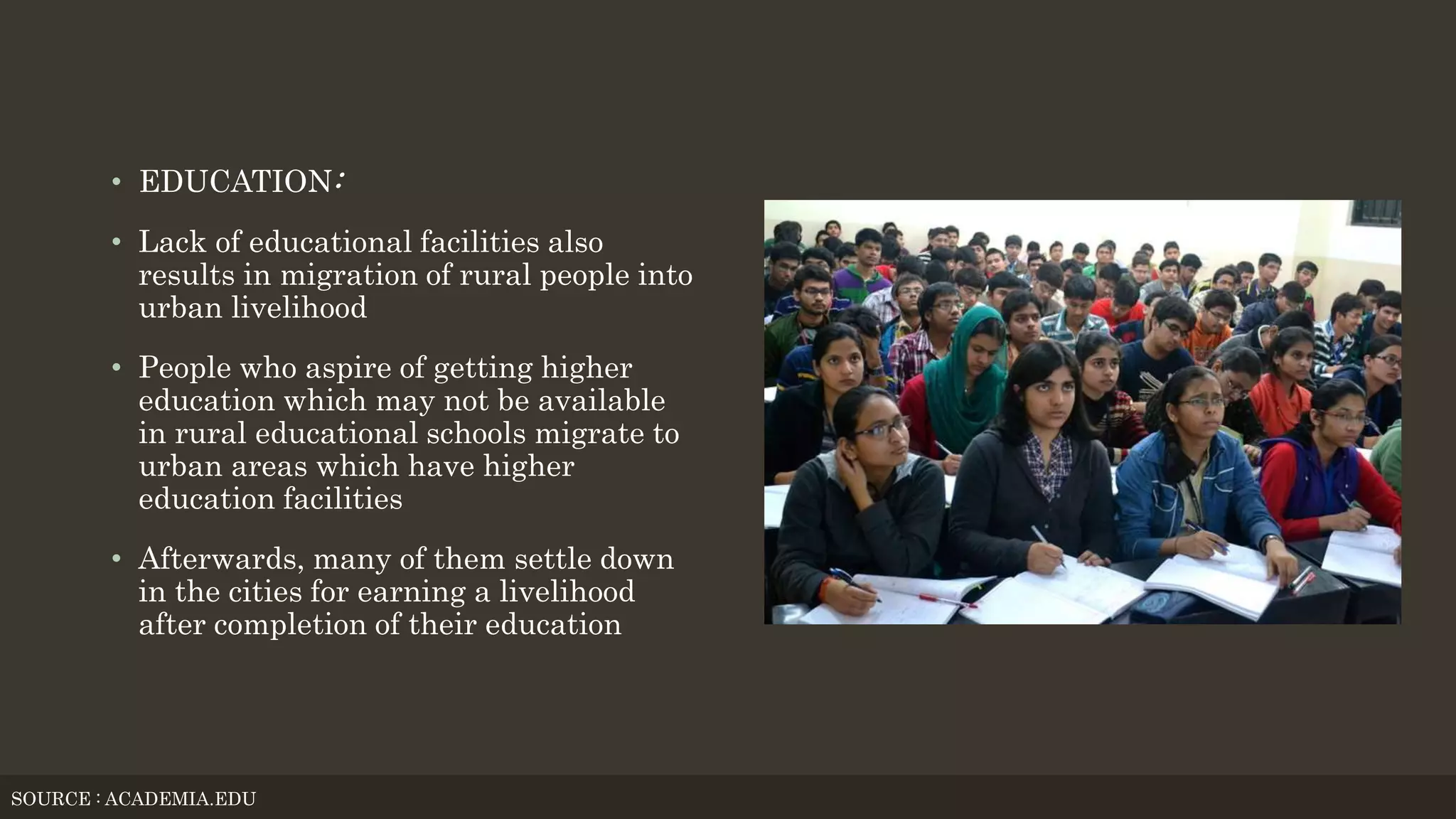
• Lack of educational facilities also
results in migration of rural people into
urban livelihood
• People who aspire of getting higher
education which may not be available
in rural educational schools migrate to
urban areas which have higher
education facilities
• Afterwards, many of them settle down
in the cities for earning a livelihood
after completion of their education
SOURCE : ACADEMIA.EDU
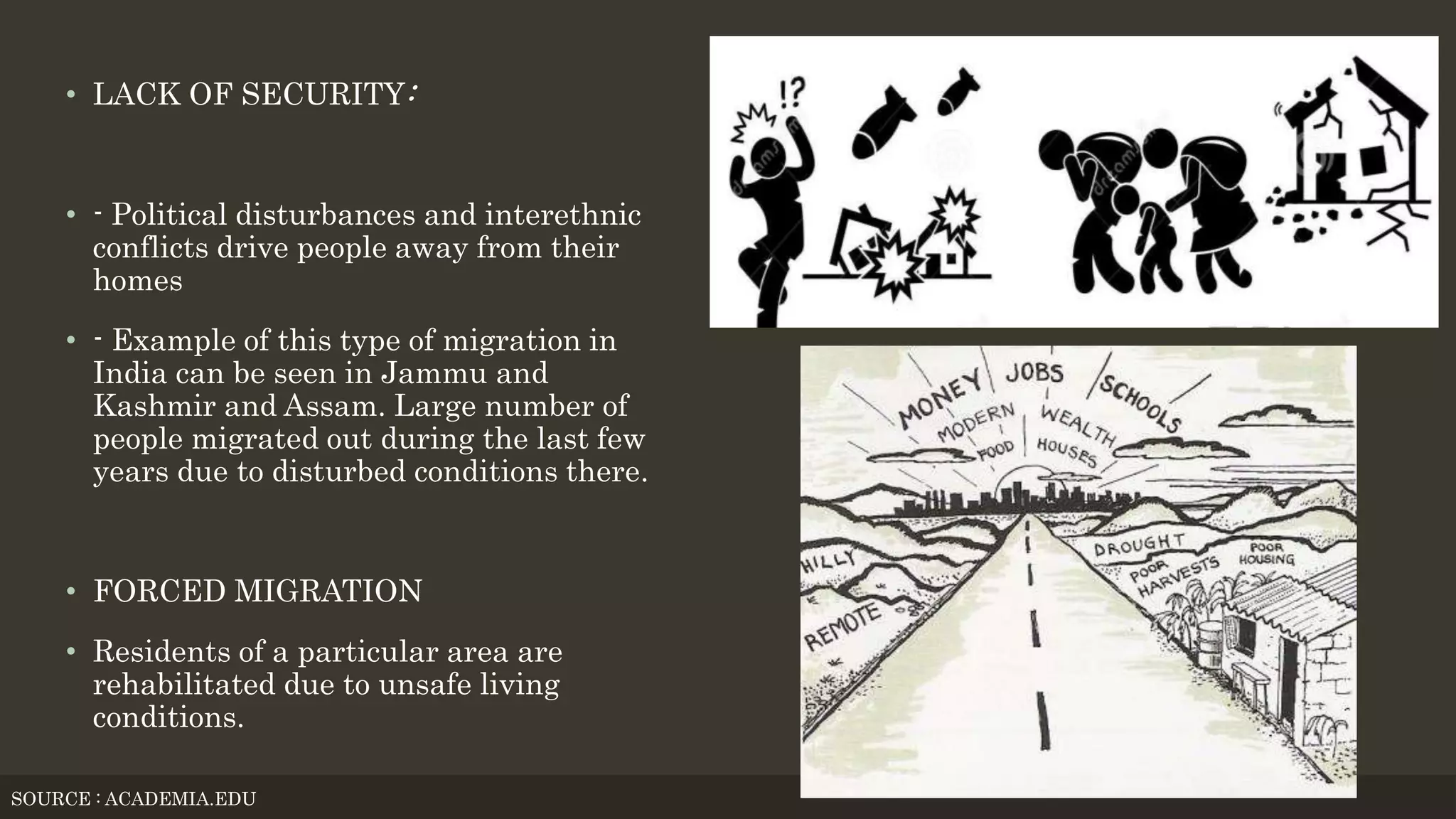
• LACK OF SECURITY:
• - Political disturbances and interethnic
conflicts drive people away from their
homes
• - Example of this type of migration in
India can be seen in Jammu and
Kashmir and Assam. Large number of
people migrated out during the last few
years due to disturbed conditions there.
• FORCED MIGRATION
• Residents of a particular area are
rehabilitated due to unsafe living
conditions.
SOURCE : ACADEMIA.EDU
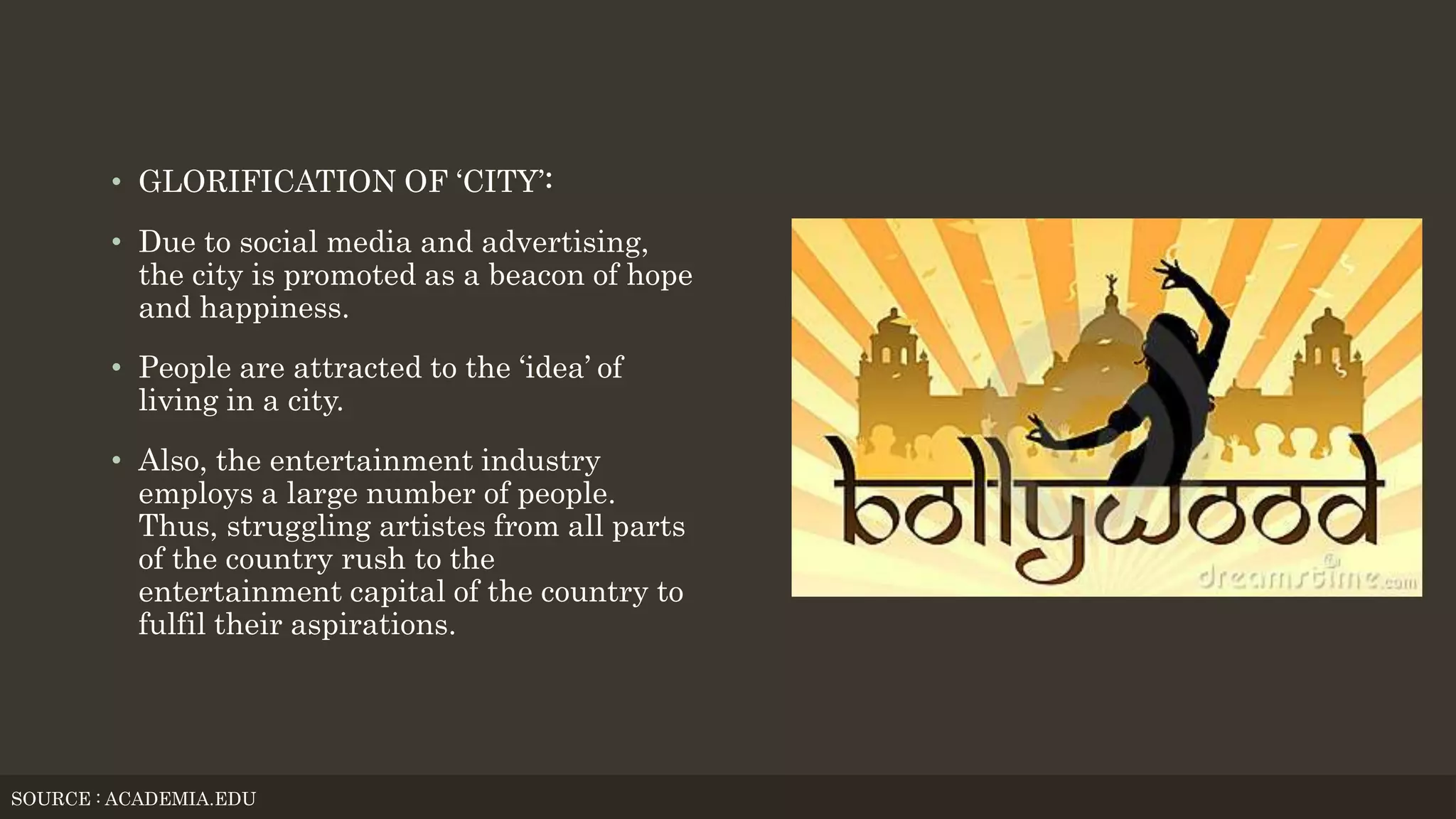
• GLORIFICATION OF ‘CITY’:
• Due to social media and advertising,
the city is promoted as a beacon of hope
and happiness.
• People are attracted to the ‘idea’ of
living in a city.
• Also, the entertainment industry
employs a large number of people.
Thus, struggling artistes from all parts
of the country rush to the
entertainment capital of the country to
fulfil their aspirations.
SOURCE : ACADEMIA.EDU
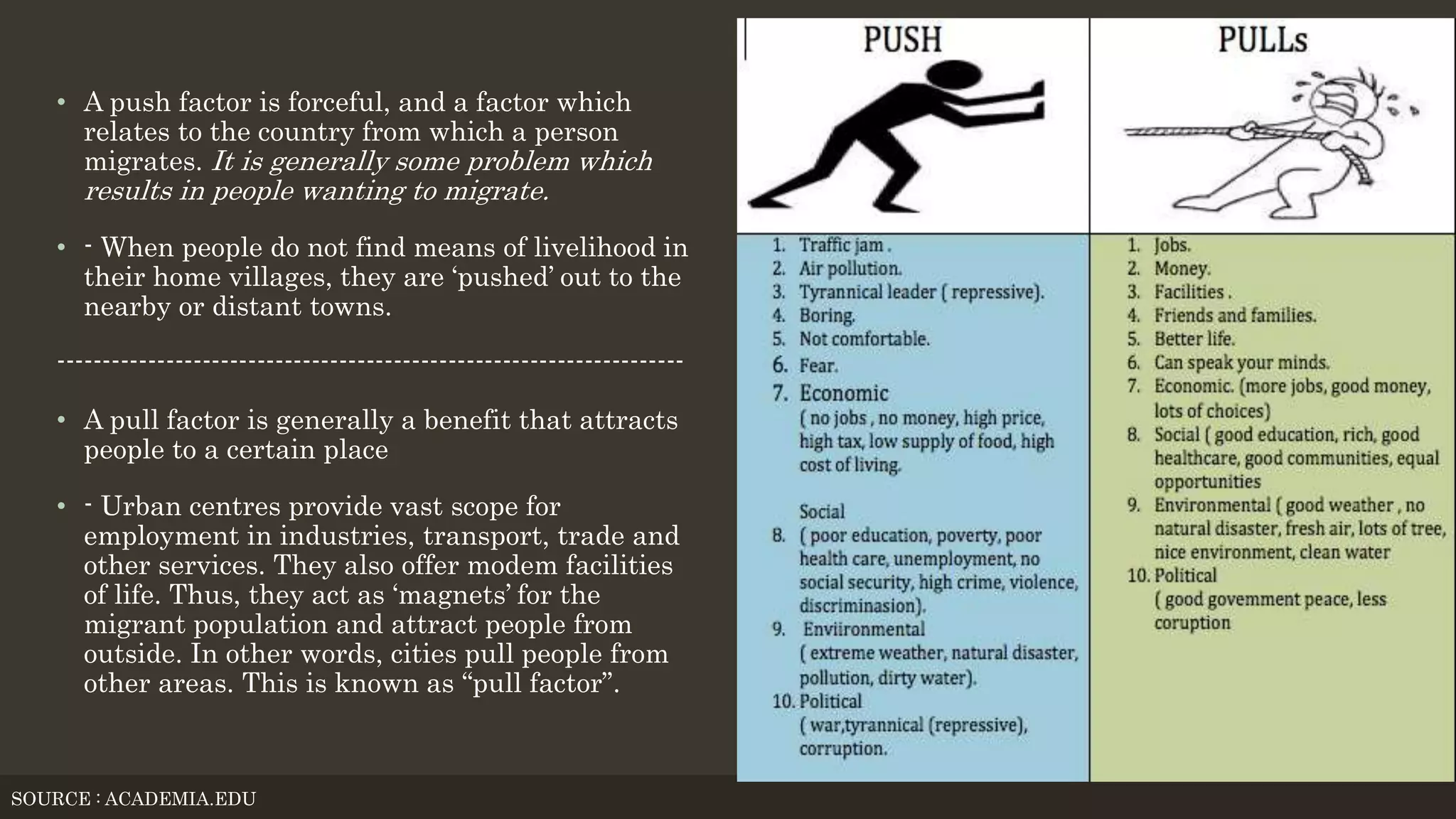
• A push factor is forceful, and a factor which
relates to the country from which a person
migrates. It is generally some problem which
results in people wanting to migrate.
• - When people do not find means of livelihood in
their home villages, they are ‘pushed’ out to the
nearby or distant towns.
---------------------------------------------------------------------
• A pull factor is generally a benefit that attracts
people to a certain place
• - Urban centres provide vast scope for
employment in industries, transport, trade and
other services. They also offer modem facilities
of life. Thus, they act as ‘magnets’ for the
migrant population and attract people from
outside. In other words, cities pull people from
other areas. This is known as “pull factor”.
SOURCE : ACADEMIA.EDU
Statistics
SOURCE : CENSUSINDIA.GOV.IN/CENSUS_FOR_YOU
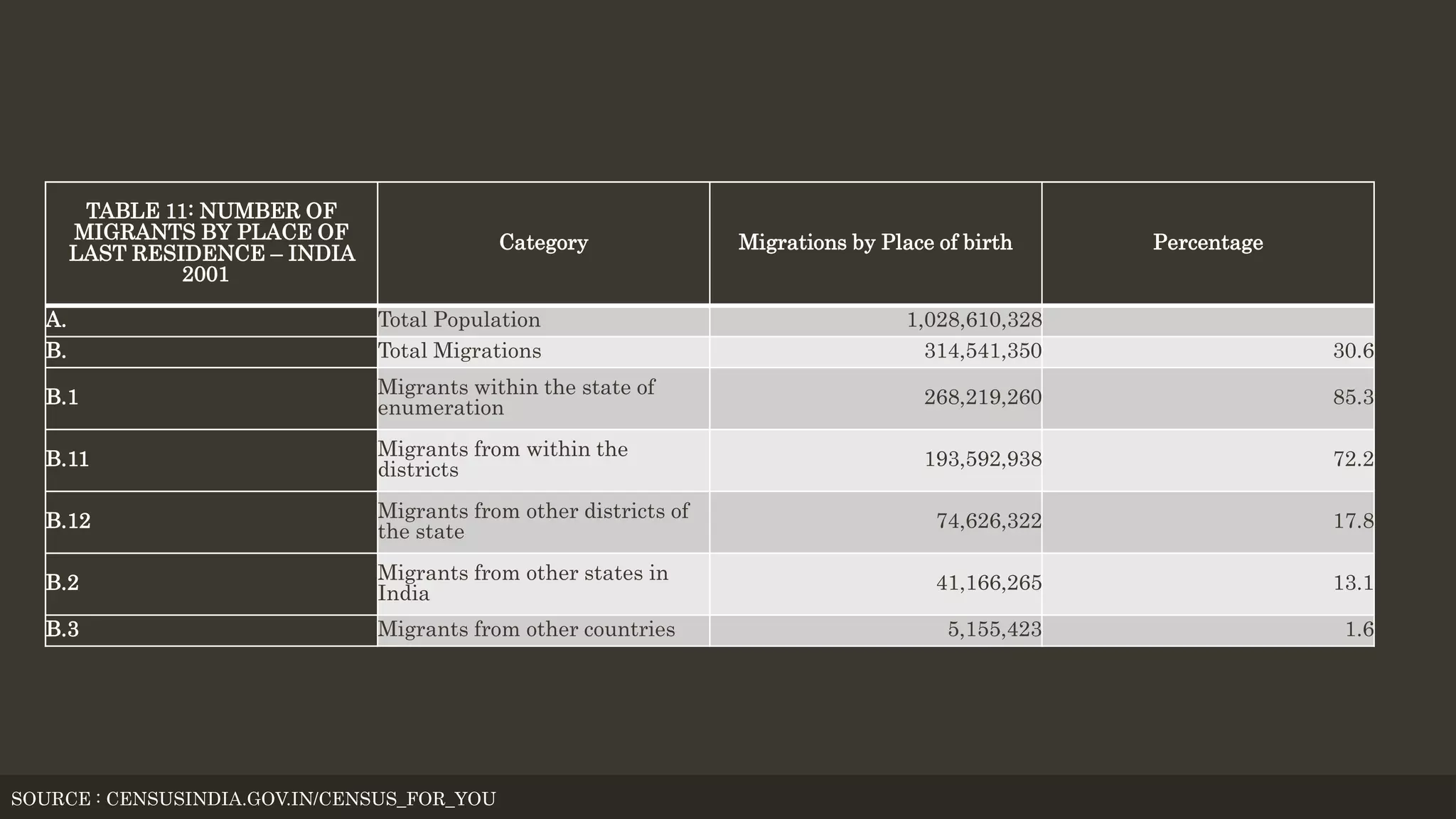
TABLE 11: NUMBER OF
MIGRANTS BY PLACE OF
LAST RESIDENCE – INDIA
2001
Category Migrations by Place of birth Percentage
A. Total Population 1,028,610,328
B. Total Migrations 314,541,350 30.6
B.1 Migrants within the state of
enumeration 268,219,260 85.3
B.11 Migrants from within the
districts 193,592,938 72.2
B.12 Migrants from other districts of
the state 74,626,322 17.8
B.2 Migrants from other states in
India 41,166,265 13.1
B.3 Migrants from other countries 5,155,423 1.6
SOURCE : CENSUSINDIA.GOV.IN/CENSUS_FOR_YOU
Number of Migrants Percentage to Migrants
Persons Males Females Persons Males Females
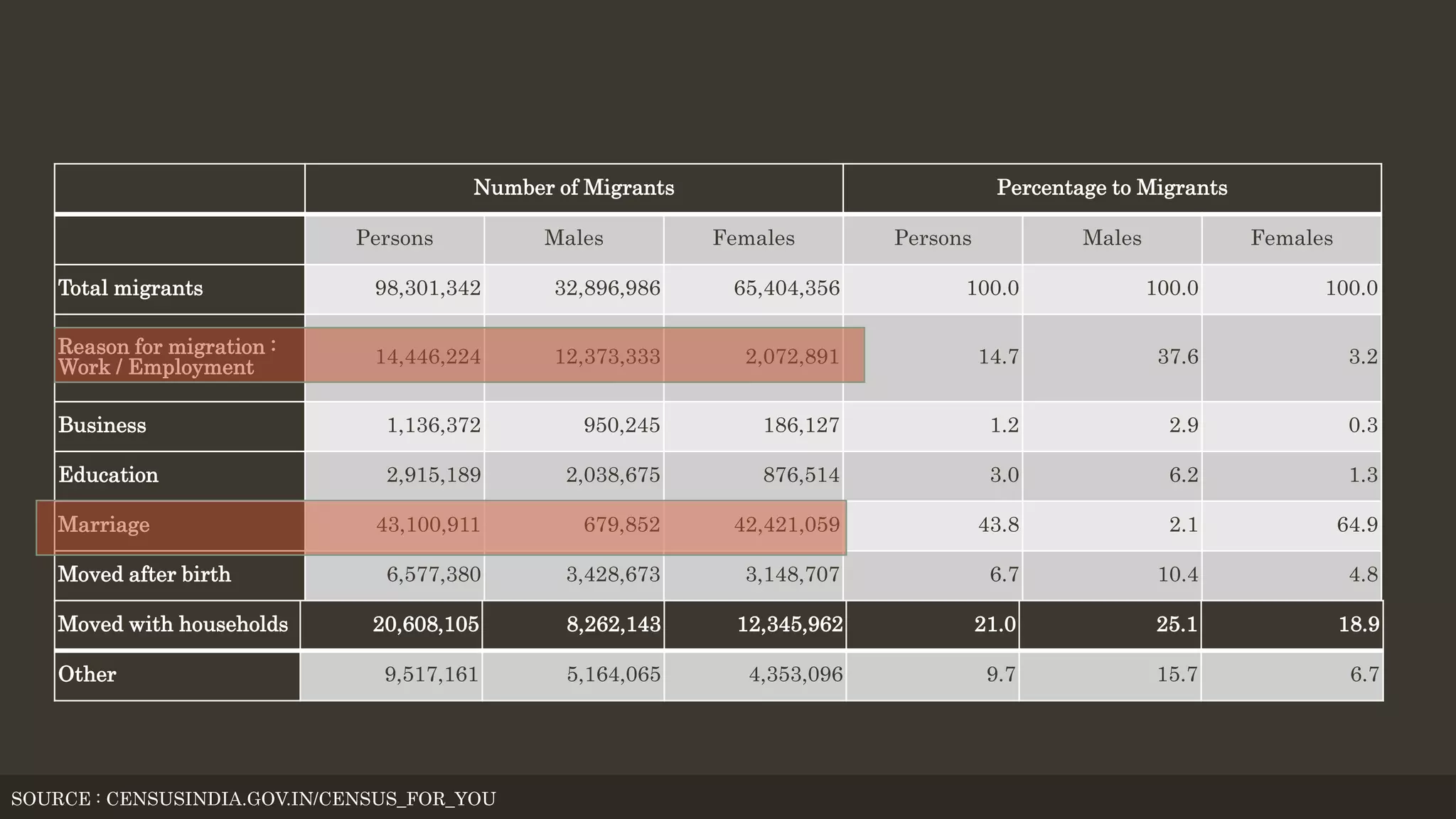
Total migrants 98,301,342 32,896,986 65,404,356 100.0 100.0 100.0
Reason for migration :
Work / Employment 14,446,224 12,373,333 2,072,891 14.7 37.6 3.2
Business 1,136,372 950,245 186,127 1.2 2.9 0.3
Education 2,915,189 2,038,675 876,514 3.0 6.2 1.3
Marriage 43,100,911 679,852 42,421,059 43.8 2.1 64.9
Moved after birth 6,577,380 3,428,673 3,148,707 6.7 10.4 4.8
Moved with households 20,608,105 8,262,143 12,345,962 21.0 25.1 18.9
Other 9,517,161 5,164,065 4,353,096 9.7 15.7 6.7
SOURCE : CENSUSINDIA.GOV.IN/CENSUS_FOR_YOU
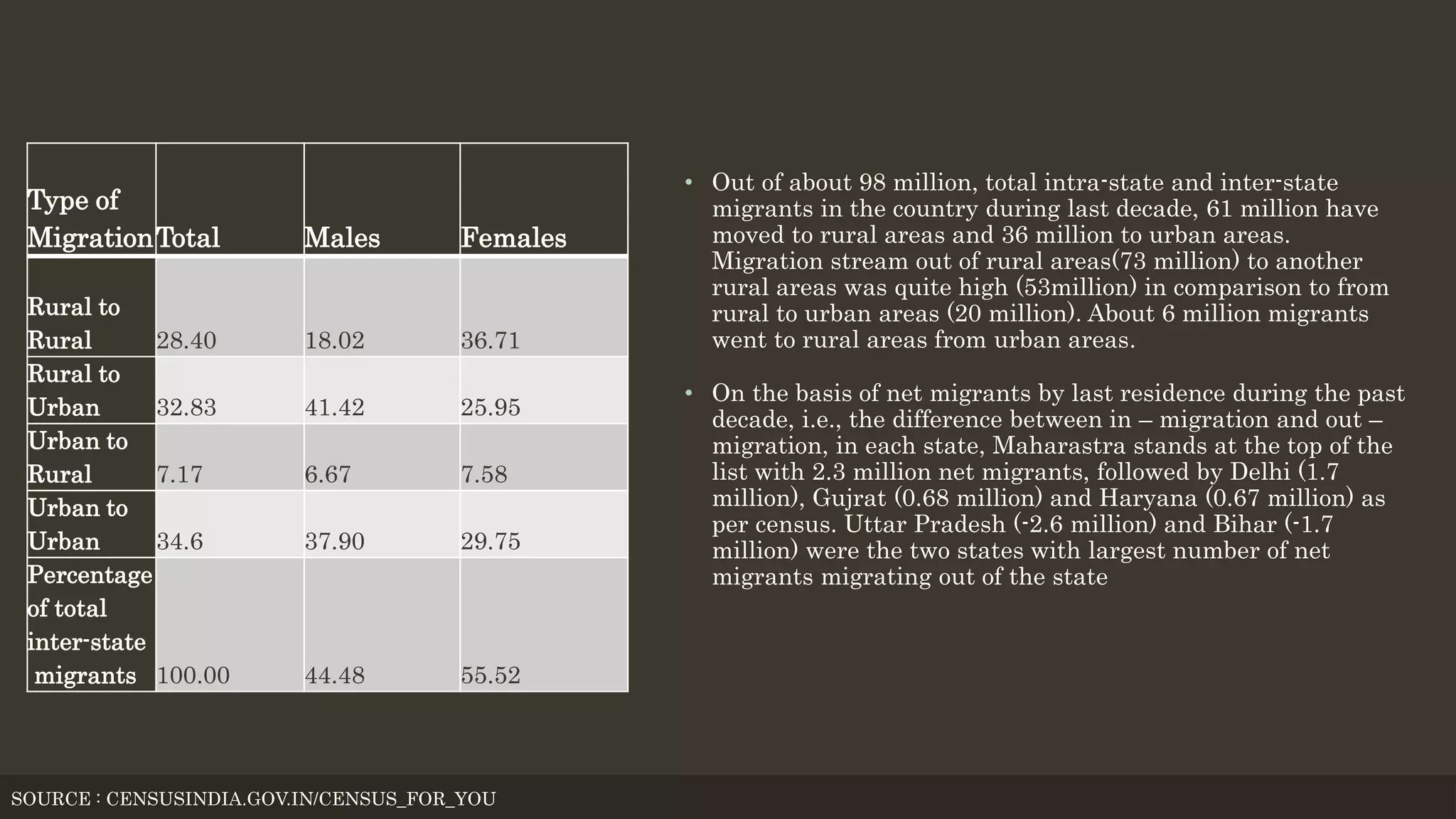
Type of
MigrationTotal Males Females
Rural to
Rural 28.40 18.02 36.71
Rural to
Urban 32.83 41.42 25.95
Urban to
Rural 7.17 6.67 7.58
Urban to
Urban 34.6 37.90 29.75
Percentage
of total
inter-state
migrants 100.00 44.48 55.52
• Out of about 98 million, total intra-state and inter-state
migrants in the country during last decade, 61 million have
moved to rural areas and 36 million to urban areas.
Migration stream out of rural areas(73 million) to another
rural areas was quite high (53million) in comparison to from
rural to urban areas (20 million). About 6 million migrants
went to rural areas from urban areas.
• On the basis of net migrants by last residence during the past
decade, i.e., the difference between in – migration and out –
migration, in each state, Maharastra stands at the top of the
list with 2.3 million net migrants, followed by Delhi (1.7
million), Gujrat (0.68 million) and Haryana (0.67 million) as
per census. Uttar Pradesh (-2.6 million) and Bihar (-1.7
million) were the two states with largest number of net
migrants migrating out of the state
SOURCE : PEOPLEMOV.IN
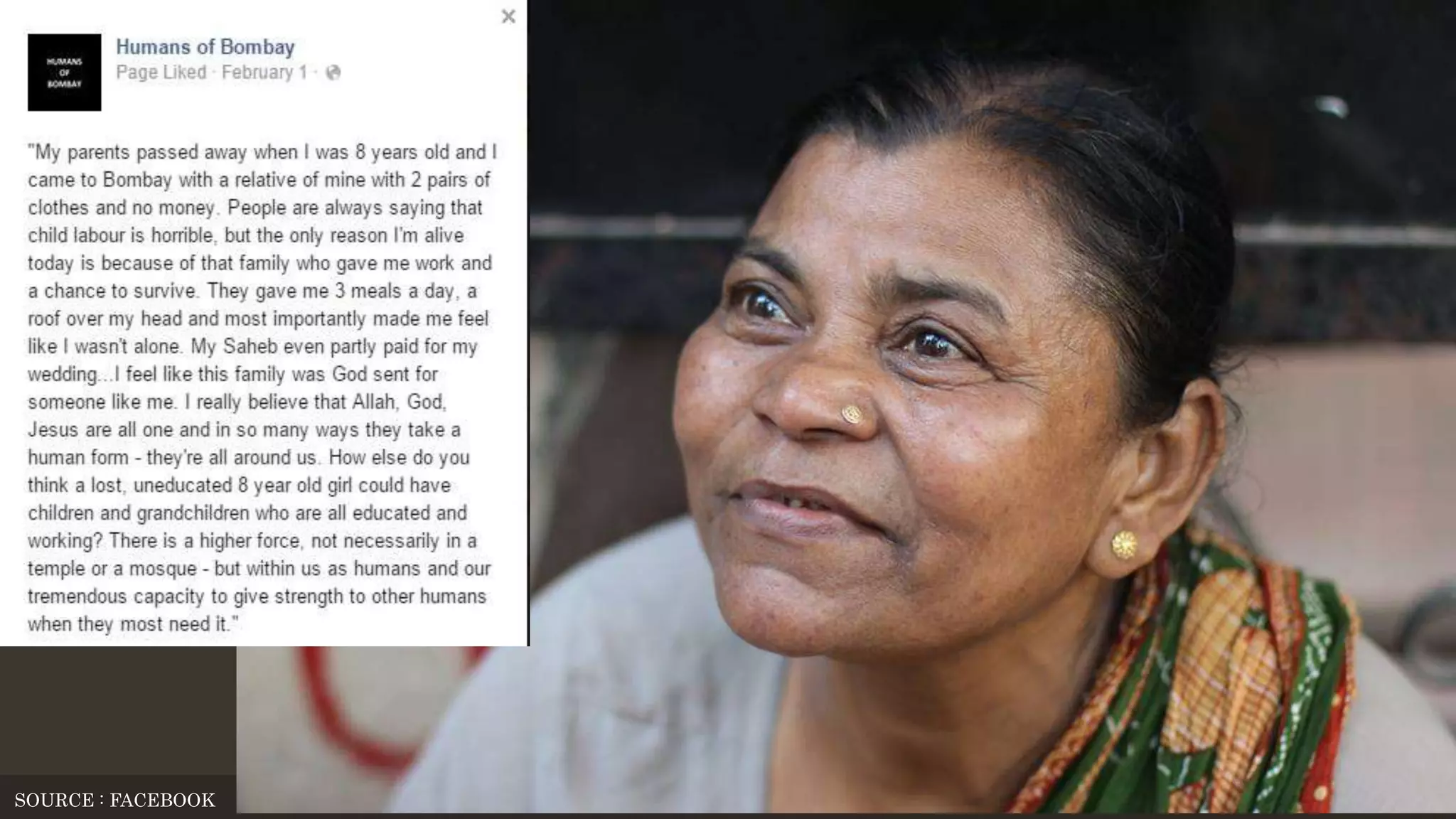
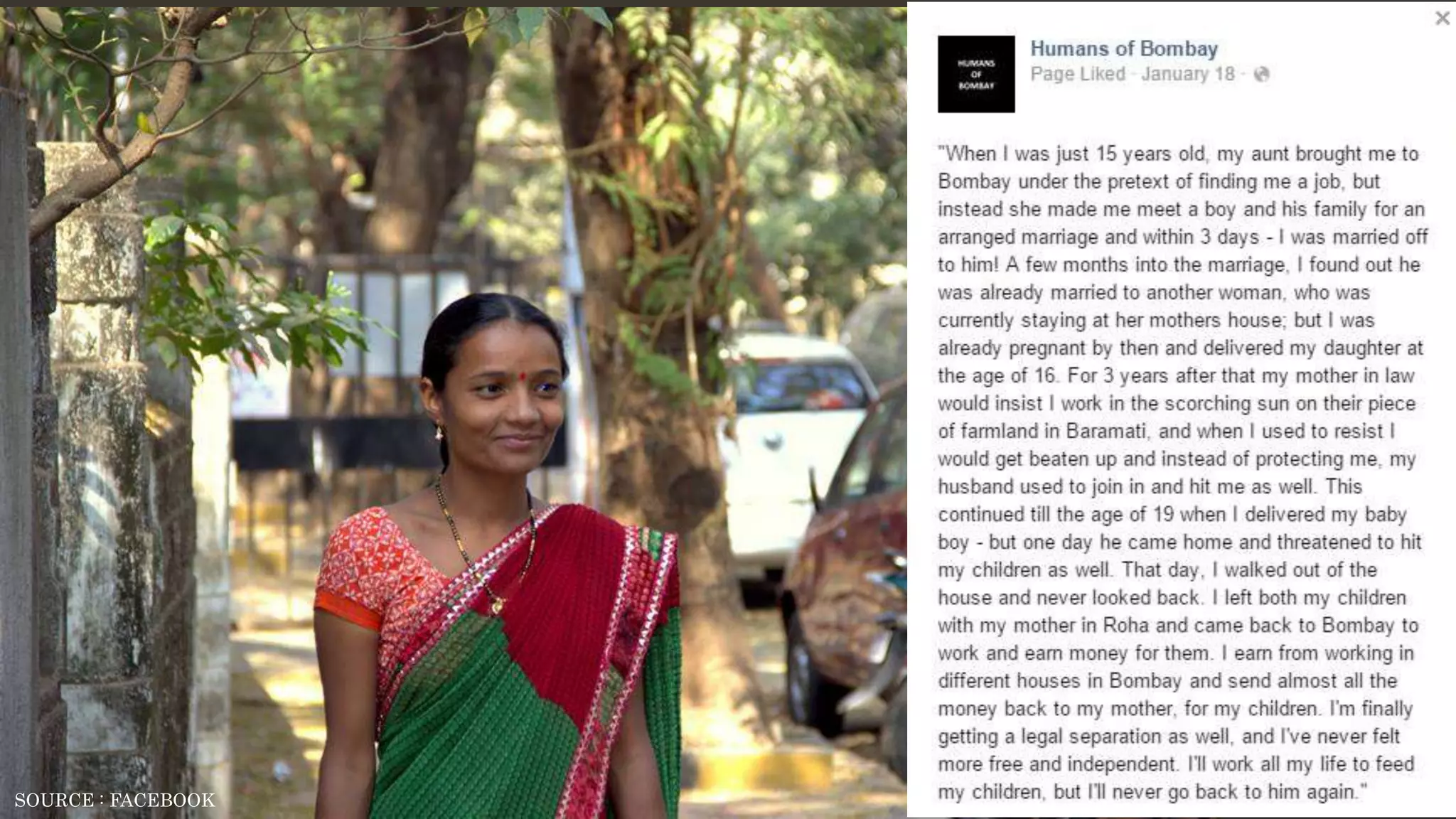
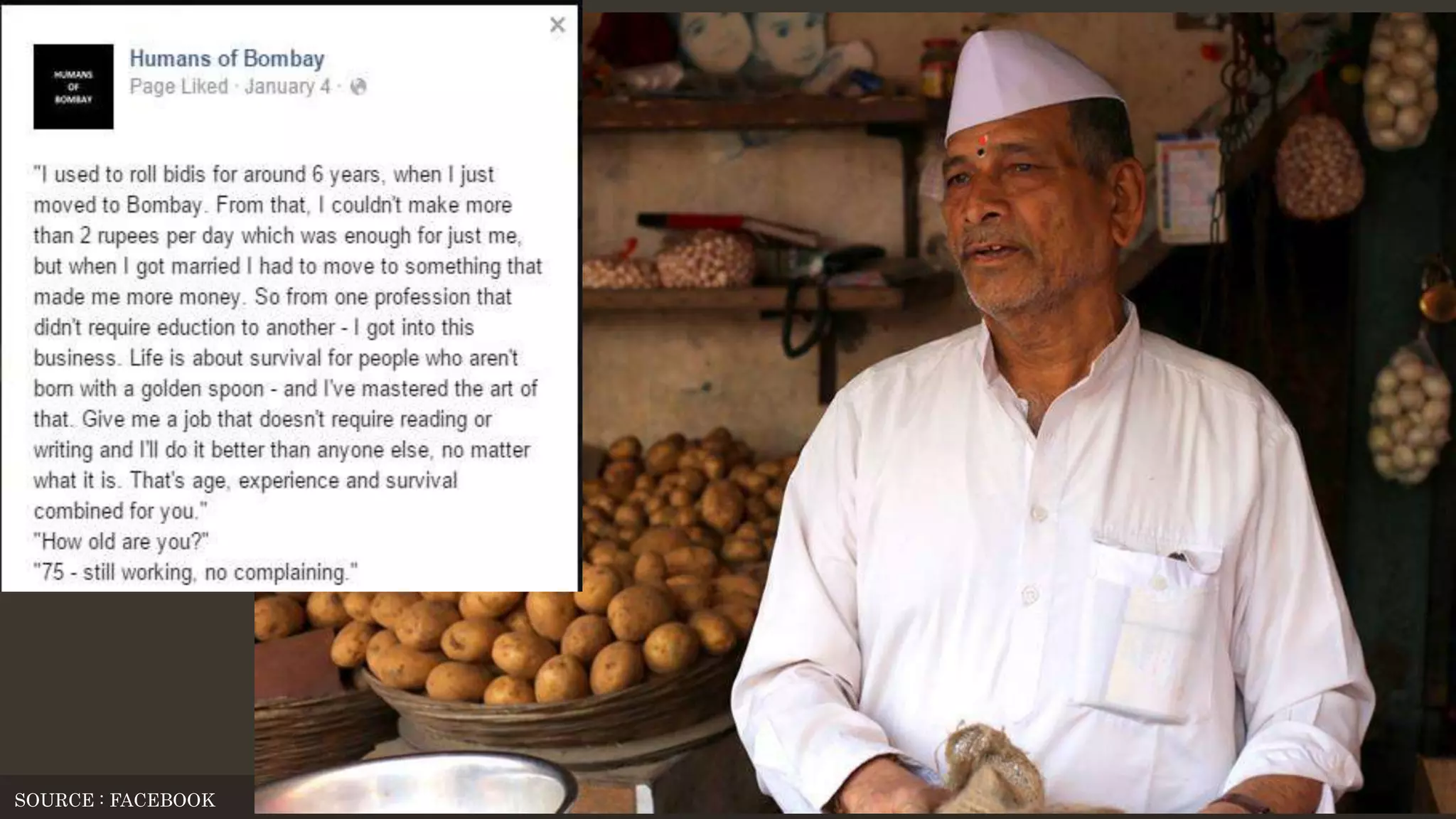
Stories from Mumbai
Talking to the Humans of Bombay
SOURCE : FACEBOOK
SOURCE : FACEBOOK
SOURCE : FACEBOOK
Effects of Migration
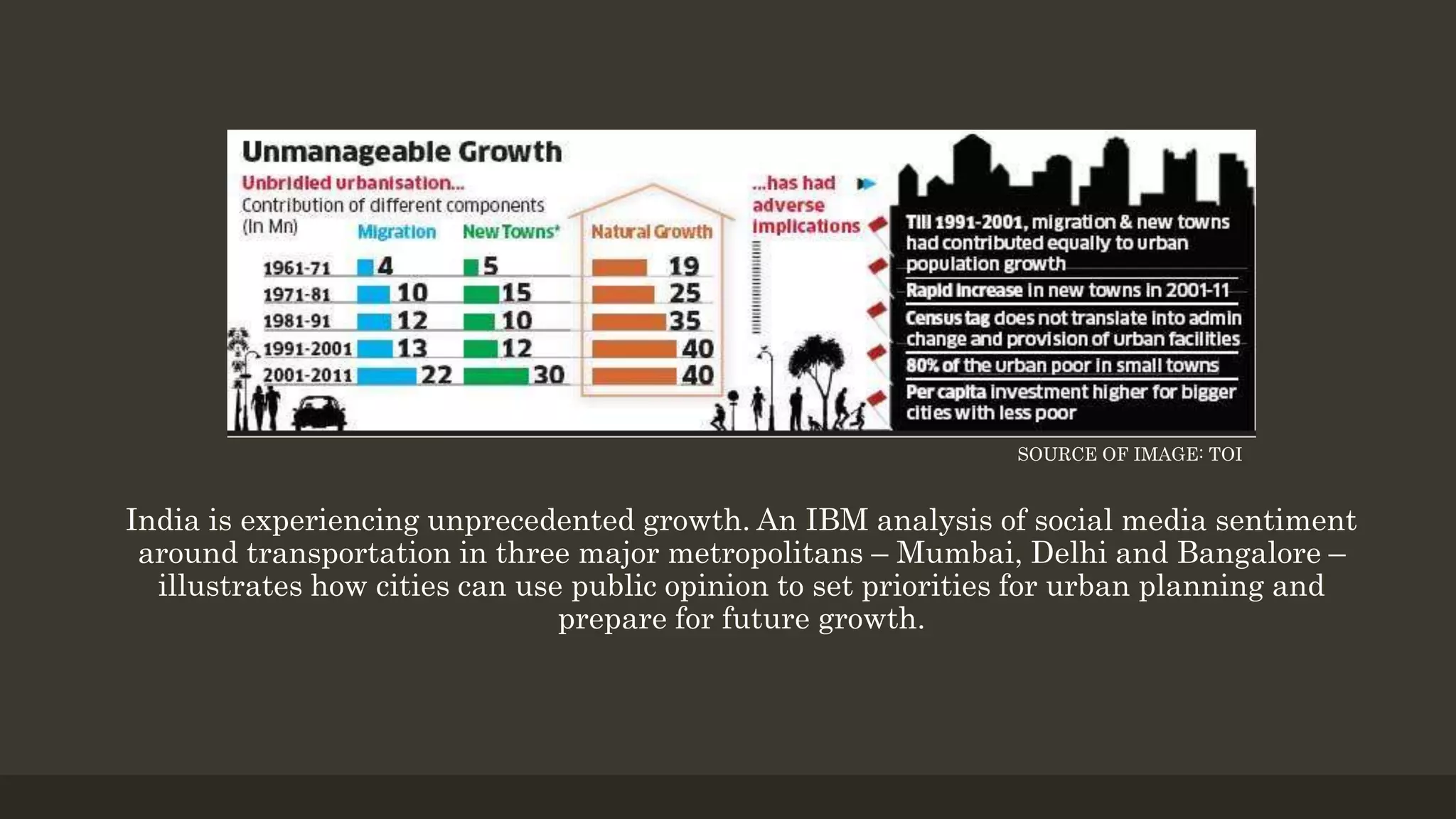
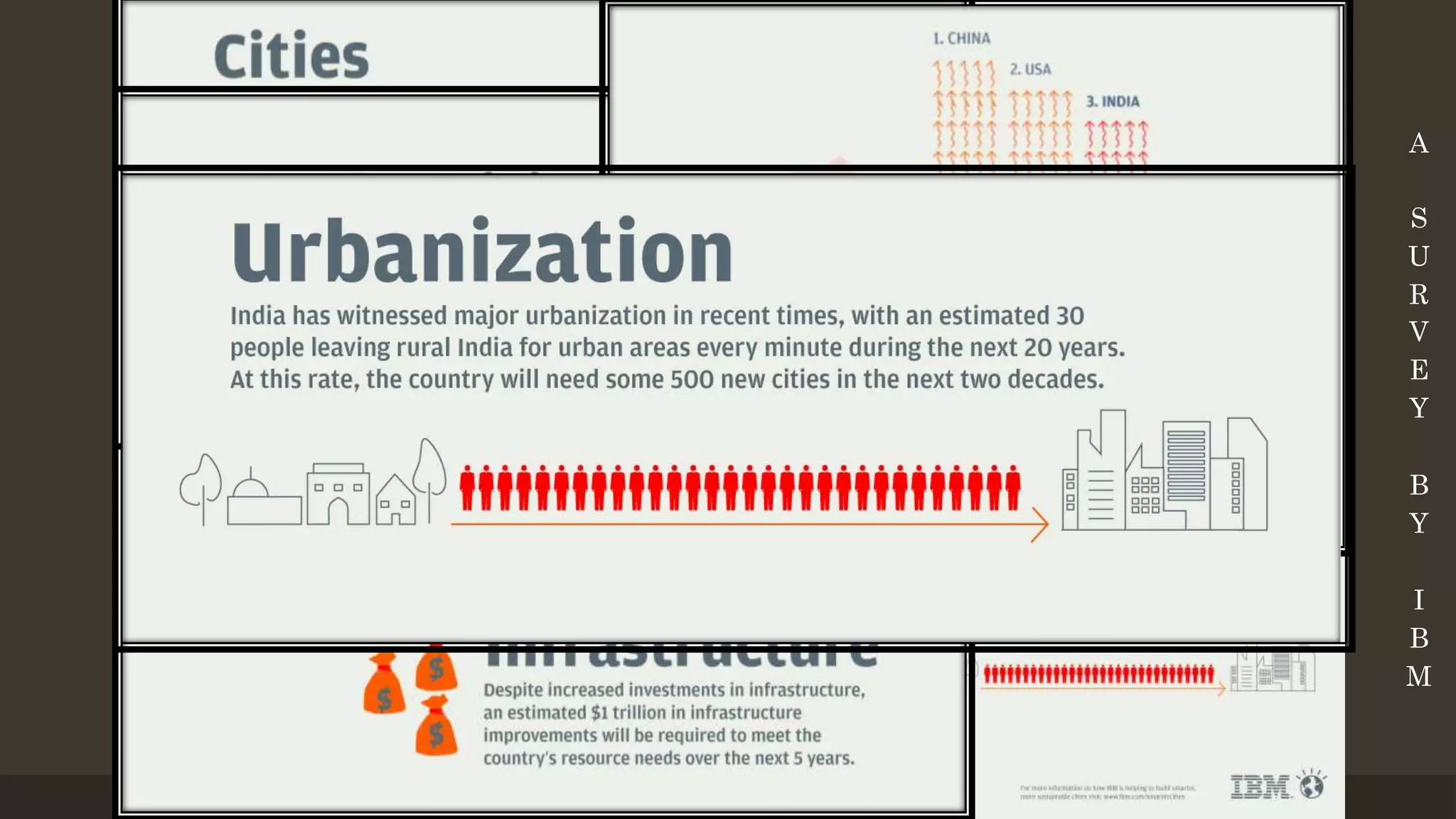
India is experiencing unprecedented growth. An IBM analysis of social media sentiment
around transportation in three major metropolitans – Mumbai, Delhi and Bangalore –
illustrates how cities can use public opinion to set priorities for urban planning and
prepare for future growth.
SOURCE OF IMAGE: TOI
A
S
U
R
V
E
Y
B
Y
I
B
M
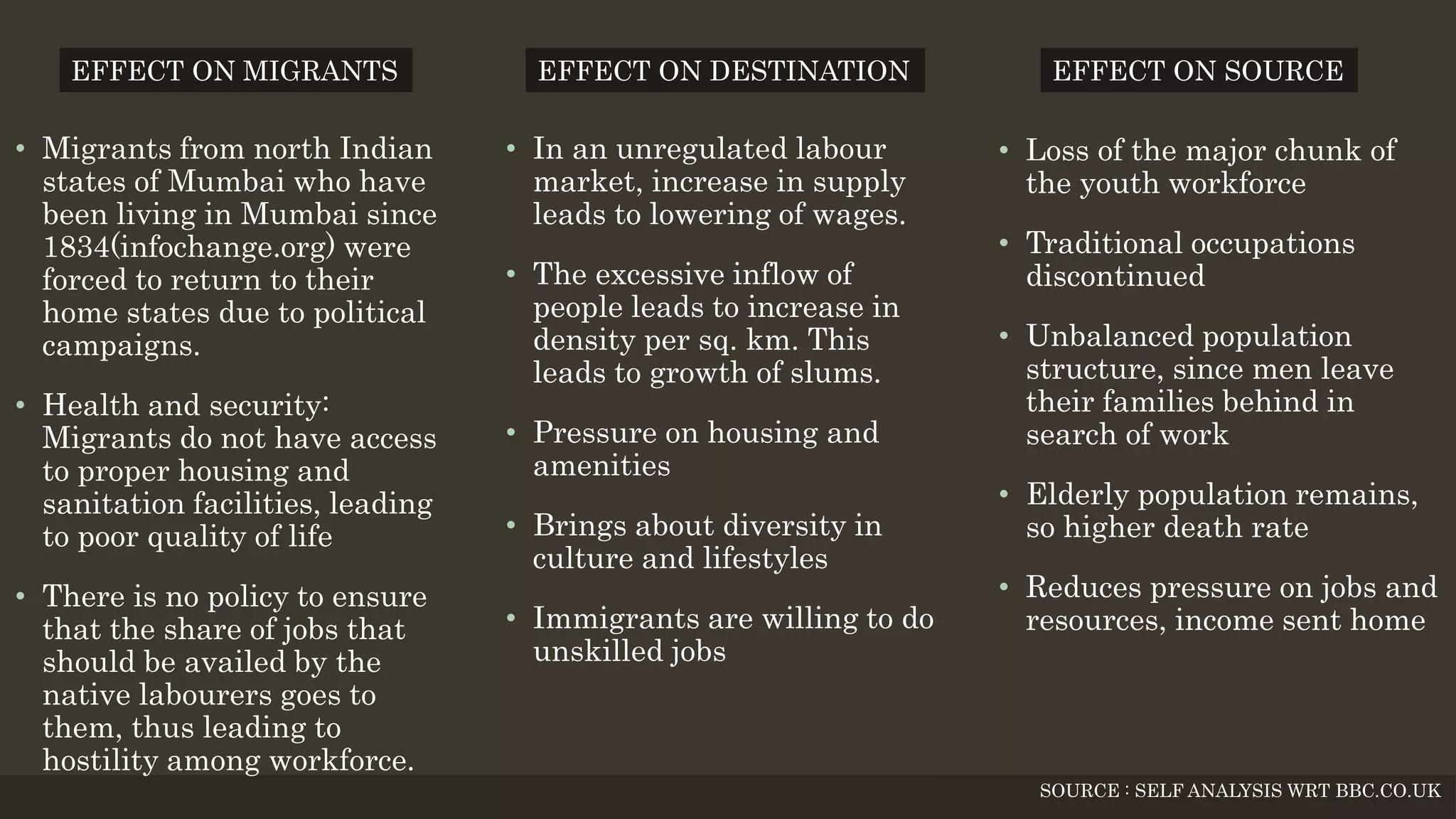
• Migrants from north Indian
states of Mumbai who have
been living in Mumbai since
1834(infochange.org) were
forced to return to their
home states due to political
campaigns.
• Health and security:
Migrants do not have access
to proper housing and
sanitation facilities, leading
to poor quality of life
• There is no policy to ensure
that the share of jobs that
should be availed by the
native labourers goes to
them, thus leading to
hostility among workforce.
• In an unregulated labour
market, increase in supply
leads to lowering of wages.
• The excessive inflow of
people leads to increase in
density per sq. km. This
leads to growth of slums.
• Pressure on housing and
amenities
• Brings about diversity in
culture and lifestyles
• Immigrants are willing to do
unskilled jobs
• Loss of the major chunk of
the youth workforce
• Traditional occupations
discontinued
• Unbalanced population
structure, since men leave
their families behind in
search of work
• Elderly population remains,
so higher death rate
• Reduces pressure on jobs and
resources, income sent home
EFFECT ON MIGRANTS EFFECT ON DESTINATION EFFECT ON SOURCE
SOURCE : SELF ANALYSIS WRT BBC.CO.UK
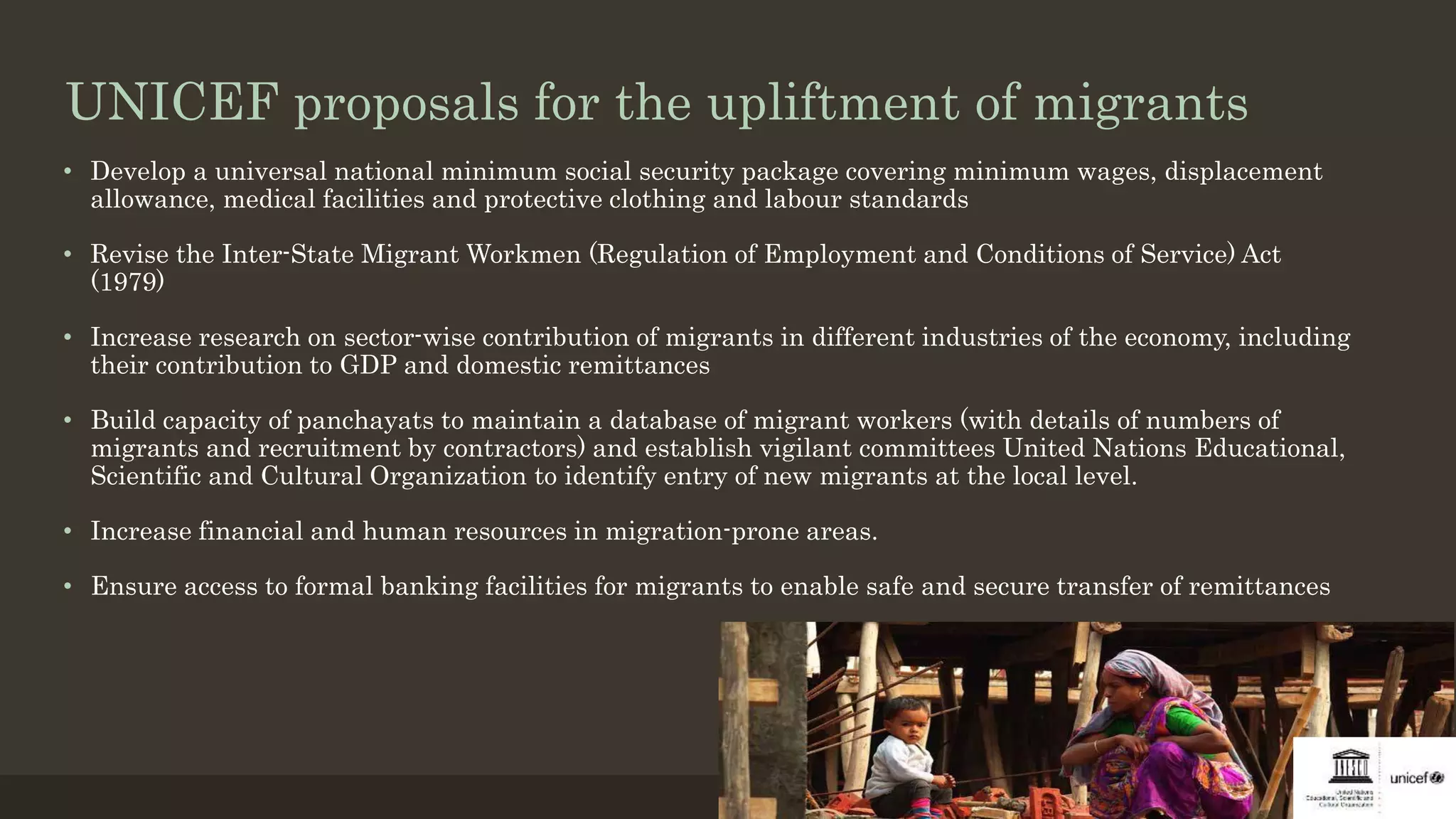
UNICEF proposals for the upliftment of migrants
• Develop a universal national minimum social security package covering minimum wages, displacement
allowance, medical facilities and protective clothing and labour standards
• Revise the Inter-State Migrant Workmen (Regulation of Employment and Conditions of Service) Act
(1979)
• Increase research on sector-wise contribution of migrants in different industries of the economy, including
their contribution to GDP and domestic remittances
• Build capacity of panchayats to maintain a database of migrant workers (with details of numbers of
migrants and recruitment by contractors) and establish vigilant committees United Nations Educational,
Scientific and Cultural Organization to identify entry of new migrants at the local level.
• Increase financial and human resources in migration-prone areas.
• Ensure access to formal banking facilities for migrants to enable safe and secure transfer of remittances
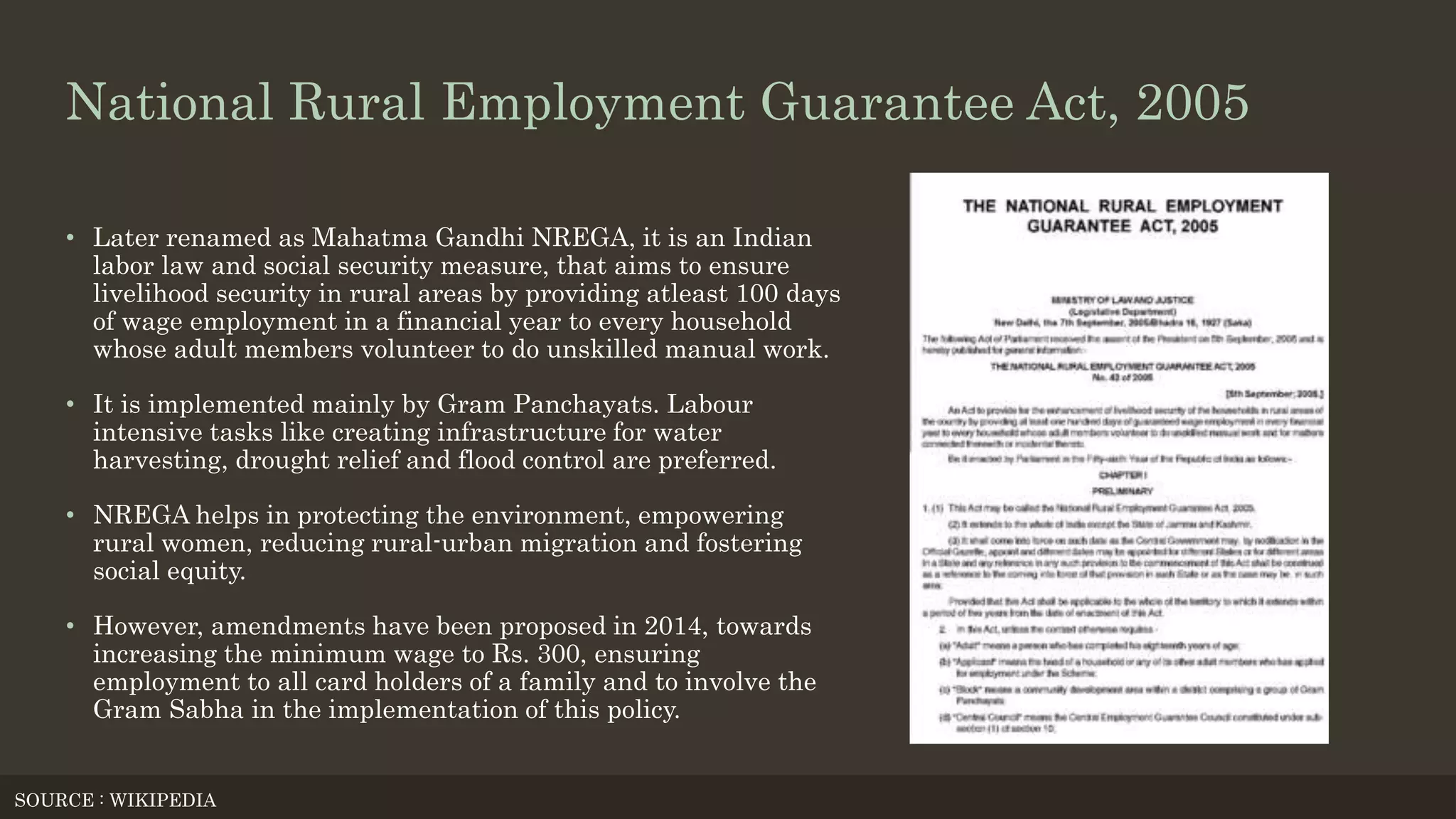
National Rural Employment Guarantee Act, 2005
• Later renamed as Mahatma Gandhi NREGA, it is an Indian
labor law and social security measure, that aims to ensure
livelihood security in rural areas by providing atleast 100 days
of wage employment in a financial year to every household
whose adult members volunteer to do unskilled manual work.
• It is implemented mainly by Gram Panchayats. Labour
intensive tasks like creating infrastructure for water
harvesting, drought relief and flood control are preferred.
• NREGA helps in protecting the environment, empowering
rural women, reducing rural-urban migration and fostering
social equity.
• However, amendments have been proposed in 2014, towards
increasing the minimum wage to Rs. 300, ensuring
employment to all card holders of a family and to involve the
Gram Sabha in the implementation of this policy.
SOURCE : WIKIPEDIA
THANK YOU
RASIKA DONGARE 09
JAYANT GYANCHANDANI
NEHA MALANKAR
RITHIKA RAVISHANKAR 40

Migration and its effects on urban life

  • 1.
  • 2.
    “It includes anymovement within the political boundaries of a nation which results in a change of usual place of residence. It may consist of the crossing of a village or town boundary as a minimum condition for qualifying the movement as internal migration. Thus, the concept of internal migration involves implicitly an imposition of boundary lines which must be crossed before a movement is counted as internal migration. ” Source: censusindia.gov.in CENSUS DEFINITION OF ‘MIGRATION’
  • 3.
    QUICK FACTS • TheConstitution of India (Article 19) gives the right to all citizens to “to move freely throughout the territory of India; to reside and settle in any part of the territory of India”. • Internal migrants in India constitute a large population: 309 million internal migrants or 30 per cent of the population (Census of India 2001), and by more recent estimates 326 million or 28.5 per cent of the population (NSSO 2007–2008). • Lead source states: Uttar Pradesh, Bihar, Rajasthan, Madhya Pradesh, Andhra Pradesh, Chhattisgarh, Jharkhand, Orissa, Uttarakhand and Tamil Nadu. • Key destination states: Delhi, Maharashtra, Gujarat, Haryana, Punjab and Karnataka. • Migrants are mostly employed in the following subsectors: construction, domestic work, textile, brick-kilns, transportation, mines, quarries and agriculture (Deshingkar and Akter 2009). • Migration in India is primarily of two types: • i. Long-term migration, resulting in the relocation of an individual or household; • ii. Short-term or seasonal/ circular migration, involving back and forth movement between a source and destination. Most short-term migrants belong to socioeconomically deprived groups, such as Scheduled Castes or Scheduled Tribes, having negligible educational attainment, limited assets and resource deficits
  • 4.
    • Internal migrationis of two types, viz., intra state migration and interstate migration. • (i) Intra State Migration: • This type of migration takes place between two parts of the same state. • (ii) Inter State Migration: • Volume of interstate migration, i.e., migration between two states is much smaller than the intra- state migration simply because of increase in distance. Most of the inter-state migration takes place along border between two neighbouring states. SOURCE : WIKIPEDIA SOURCE : ACADEMIA.EDU
  • 5.
  • 6.
    Marriage is avery important social factor of migration. Every girl has to migrate to her in-law’s place of residence after marriage. Thus, the entire female population of India has to migrate over short or long distance. Among the people who shifted their residence, more than half (56.1%) moved due to marriage in 1991. SOURCE : YOURARTICLELIBRARY.COM
  • 7.
    • EMPLOYMENT • Peoplemigrate in large number from rural to urban areas in search of employment. The agricultural base of rural areas does not provide employment to all the people living there. Even the small-scale and cottage industries of the villages fail to provide employment to the entire rural folk. Contrary to this, urban areas provide vast scope for employment in industries, trade, transport and services. • About 8.8 per cent of migrants migrated for employment in 1991. SOURCE : YOURARTICLELIBRARY.COM
  • 8.
    • EDUCATION: • Lackof educational facilities also results in migration of rural people into urban livelihood • People who aspire of getting higher education which may not be available in rural educational schools migrate to urban areas which have higher education facilities • Afterwards, many of them settle down in the cities for earning a livelihood after completion of their education SOURCE : ACADEMIA.EDU
  • 9.
    • LACK OFSECURITY: • - Political disturbances and interethnic conflicts drive people away from their homes • - Example of this type of migration in India can be seen in Jammu and Kashmir and Assam. Large number of people migrated out during the last few years due to disturbed conditions there. • FORCED MIGRATION • Residents of a particular area are rehabilitated due to unsafe living conditions. SOURCE : ACADEMIA.EDU
  • 10.
    • GLORIFICATION OF‘CITY’: • Due to social media and advertising, the city is promoted as a beacon of hope and happiness. • People are attracted to the ‘idea’ of living in a city. • Also, the entertainment industry employs a large number of people. Thus, struggling artistes from all parts of the country rush to the entertainment capital of the country to fulfil their aspirations. SOURCE : ACADEMIA.EDU
  • 11.
    • A pushfactor is forceful, and a factor which relates to the country from which a person migrates. It is generally some problem which results in people wanting to migrate. • - When people do not find means of livelihood in their home villages, they are ‘pushed’ out to the nearby or distant towns. --------------------------------------------------------------------- • A pull factor is generally a benefit that attracts people to a certain place • - Urban centres provide vast scope for employment in industries, transport, trade and other services. They also offer modem facilities of life. Thus, they act as ‘magnets’ for the migrant population and attract people from outside. In other words, cities pull people from other areas. This is known as “pull factor”. SOURCE : ACADEMIA.EDU
  • 12.
  • 13.
    SOURCE : CENSUSINDIA.GOV.IN/CENSUS_FOR_YOU TABLE11: NUMBER OF MIGRANTS BY PLACE OF LAST RESIDENCE – INDIA 2001 Category Migrations by Place of birth Percentage A. Total Population 1,028,610,328 B. Total Migrations 314,541,350 30.6 B.1 Migrants within the state of enumeration 268,219,260 85.3 B.11 Migrants from within the districts 193,592,938 72.2 B.12 Migrants from other districts of the state 74,626,322 17.8 B.2 Migrants from other states in India 41,166,265 13.1 B.3 Migrants from other countries 5,155,423 1.6
  • 14.
    SOURCE : CENSUSINDIA.GOV.IN/CENSUS_FOR_YOU Numberof Migrants Percentage to Migrants Persons Males Females Persons Males Females Total migrants 98,301,342 32,896,986 65,404,356 100.0 100.0 100.0 Reason for migration : Work / Employment 14,446,224 12,373,333 2,072,891 14.7 37.6 3.2 Business 1,136,372 950,245 186,127 1.2 2.9 0.3 Education 2,915,189 2,038,675 876,514 3.0 6.2 1.3 Marriage 43,100,911 679,852 42,421,059 43.8 2.1 64.9 Moved after birth 6,577,380 3,428,673 3,148,707 6.7 10.4 4.8 Moved with households 20,608,105 8,262,143 12,345,962 21.0 25.1 18.9 Other 9,517,161 5,164,065 4,353,096 9.7 15.7 6.7
  • 15.
    SOURCE : CENSUSINDIA.GOV.IN/CENSUS_FOR_YOU Typeof MigrationTotal Males Females Rural to Rural 28.40 18.02 36.71 Rural to Urban 32.83 41.42 25.95 Urban to Rural 7.17 6.67 7.58 Urban to Urban 34.6 37.90 29.75 Percentage of total inter-state migrants 100.00 44.48 55.52 • Out of about 98 million, total intra-state and inter-state migrants in the country during last decade, 61 million have moved to rural areas and 36 million to urban areas. Migration stream out of rural areas(73 million) to another rural areas was quite high (53million) in comparison to from rural to urban areas (20 million). About 6 million migrants went to rural areas from urban areas. • On the basis of net migrants by last residence during the past decade, i.e., the difference between in – migration and out – migration, in each state, Maharastra stands at the top of the list with 2.3 million net migrants, followed by Delhi (1.7 million), Gujrat (0.68 million) and Haryana (0.67 million) as per census. Uttar Pradesh (-2.6 million) and Bihar (-1.7 million) were the two states with largest number of net migrants migrating out of the state
  • 16.
  • 17.
    Stories from Mumbai Talkingto the Humans of Bombay
  • 18.
  • 19.
  • 20.
  • 21.
  • 22.
    India is experiencingunprecedented growth. An IBM analysis of social media sentiment around transportation in three major metropolitans – Mumbai, Delhi and Bangalore – illustrates how cities can use public opinion to set priorities for urban planning and prepare for future growth. SOURCE OF IMAGE: TOI
  • 23.
  • 24.
    • Migrants fromnorth Indian states of Mumbai who have been living in Mumbai since 1834(infochange.org) were forced to return to their home states due to political campaigns. • Health and security: Migrants do not have access to proper housing and sanitation facilities, leading to poor quality of life • There is no policy to ensure that the share of jobs that should be availed by the native labourers goes to them, thus leading to hostility among workforce. • In an unregulated labour market, increase in supply leads to lowering of wages. • The excessive inflow of people leads to increase in density per sq. km. This leads to growth of slums. • Pressure on housing and amenities • Brings about diversity in culture and lifestyles • Immigrants are willing to do unskilled jobs • Loss of the major chunk of the youth workforce • Traditional occupations discontinued • Unbalanced population structure, since men leave their families behind in search of work • Elderly population remains, so higher death rate • Reduces pressure on jobs and resources, income sent home EFFECT ON MIGRANTS EFFECT ON DESTINATION EFFECT ON SOURCE SOURCE : SELF ANALYSIS WRT BBC.CO.UK
  • 25.
    UNICEF proposals forthe upliftment of migrants • Develop a universal national minimum social security package covering minimum wages, displacement allowance, medical facilities and protective clothing and labour standards • Revise the Inter-State Migrant Workmen (Regulation of Employment and Conditions of Service) Act (1979) • Increase research on sector-wise contribution of migrants in different industries of the economy, including their contribution to GDP and domestic remittances • Build capacity of panchayats to maintain a database of migrant workers (with details of numbers of migrants and recruitment by contractors) and establish vigilant committees United Nations Educational, Scientific and Cultural Organization to identify entry of new migrants at the local level. • Increase financial and human resources in migration-prone areas. • Ensure access to formal banking facilities for migrants to enable safe and secure transfer of remittances
  • 26.
    National Rural EmploymentGuarantee Act, 2005 • Later renamed as Mahatma Gandhi NREGA, it is an Indian labor law and social security measure, that aims to ensure livelihood security in rural areas by providing atleast 100 days of wage employment in a financial year to every household whose adult members volunteer to do unskilled manual work. • It is implemented mainly by Gram Panchayats. Labour intensive tasks like creating infrastructure for water harvesting, drought relief and flood control are preferred. • NREGA helps in protecting the environment, empowering rural women, reducing rural-urban migration and fostering social equity. • However, amendments have been proposed in 2014, towards increasing the minimum wage to Rs. 300, ensuring employment to all card holders of a family and to involve the Gram Sabha in the implementation of this policy. SOURCE : WIKIPEDIA
  • 27.
    THANK YOU RASIKA DONGARE09 JAYANT GYANCHANDANI NEHA MALANKAR RITHIKA RAVISHANKAR 40