Migration
MIGRATION
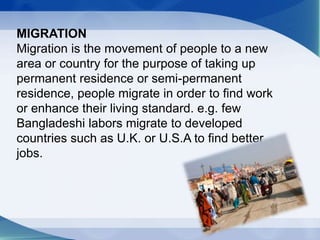
Migration is the movement of people to a new
area or country for the purpose of taking up
permanent residence or semi-permanent
residence, people migrate in order to find work
or enhance their living standard. e.g. few
Bangladeshi labors migrate to developed
countries such as U.K. or U.S.A to find better
jobs.
•TYPES OF MIGRATION
1.Internal migration: Moving to a new home within a state,
country, or continent.
2.External migration: Moving to a new home in a different
state, country, or continent
3.Immigration: moving into a new country (e.g. the pilgrims
immigrated to America)
4.Population transfer: When a government forces a large
group of people out of a region, usually based on ethnicity or
religion. This is also known as an involuntary or forced
migration.
5.Impelled migration(also known as “reluctant” or “imposed”
migration): Individuals are not forced out of their country , but
leave because of unfavorable situations such as warfare, political
problems or religious persecution.
6.Step migration: A series of shorter, less extreme migrations
from a person’s place of origin to final destination-such as moving
from a village, to a town, & finally to a city.
7.Chain migration: A series of migrations within a family or
defined group of people. A chain migration often begins with one
family member who sends money to bring other family members
to the new location.
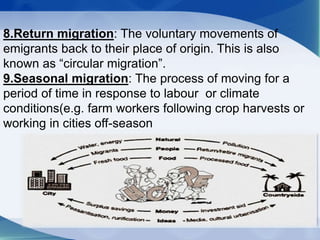
8.Return migration: The voluntary movements of
emigrants back to their place of origin. This is also
known as “circular migration”.
9.Seasonal migration: The process of moving for a
period of time in response to labour or climate
conditions(e.g. farm workers following crop harvests or
working in cities off-season
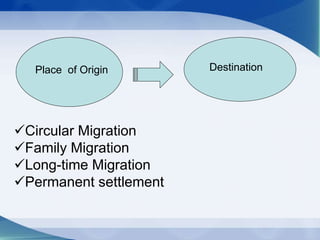
Place of Origin Destination
Circular Migration
Family Migration
Long-time Migration
Permanent settlement
WHY DO PEOPLE MIGRATE
Push Factors: Reasons for emigrating (leaving a
place) because of a difficulty (such as a food shortage,
war, flood, etc.)
Pull Factors: Reasons for immigrating (moving into a
place) because of something desirable (such as a nicer
climate, better food supply, freedom, etc
Several types of push and pull factors may
influence people in their movements
(sometimes at the same time), including:
Environmental (e.g., climate, natural
disasters)
Political (e.g., war)
Economic (e.g. work, recession)
Cultural (e.g., religious freedom, education
People Who Migrate-
Emigrant: A person who is leaving a country to reside in
another.
Immigrant: A person who is entering a country from
another to take up new residence.
Refugee: A person who is residing outside the country
of his or her origin due to fear of persecution for reasons
of race, religion, nationality, membership in a particular
social group, or political opinion.
Internally Displaced Person (IDP): A person
who is forced to leave his or her home region
because of unfavorable conditions (political,
social, environmental, etc.) but does not cross
any boundaries.
Migration Stream: A group migration from a
particular country, region, or city to a certain
destination
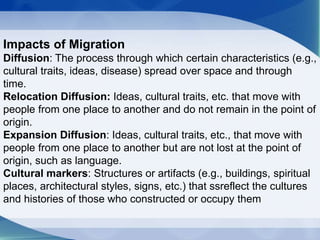
Impacts of Migration
Diffusion: The process through which certain characteristics (e.g.,
cultural traits, ideas, disease) spread over space and through
time.
Relocation Diffusion: Ideas, cultural traits, etc. that move with
people from one place to another and do not remain in the point of
origin.
Expansion Diffusion: Ideas, cultural traits, etc., that move with
people from one place to another but are not lost at the point of
origin, such as language.
Cultural markers: Structures or artifacts (e.g., buildings, spiritual
places, architectural styles, signs, etc.) that ssreflect the cultures
and histories of those who constructed or occupy them
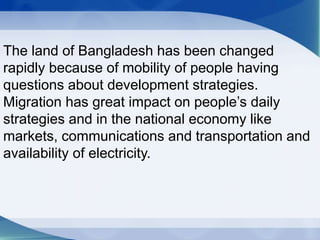
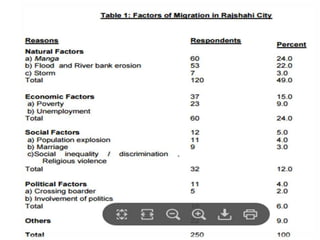
The land of Bangladesh has been changed
rapidly because of mobility of people having
questions about development strategies.
Migration has great impact on people’s daily
strategies and in the national economy like
markets, communications and transportation and
availability of electricity.
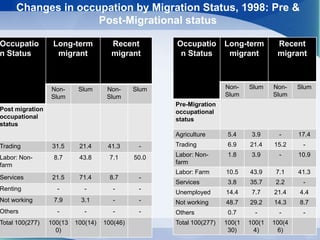
Changes in occupation by Migration Status, 1998: Pre &
Post-Migrational status
Occupatio
n Status
Long-term
migrant
Recent
migrant
Non-
Slum
Slum Non-
Slum
Slum
Post migration
occupational
status
Trading 31.5 21.4 41.3 -
Labor: Non-
farm
8.7 43.8 7.1 50.0
Services 21.5 71.4 8.7 -
Renting - - - -
Not working 7.9 3.1 - -
Others - - - -
Total 100(277) 100(13
0)
100(14) 100(46)
Occupatio
n Status
Long-term
migrant
Recent
migrant
Non-
Slum
Slum Non-
Slum
Slum
Pre-Migration
occupational
status
Agriculture 5.4 3.9 - 17.4
Trading 6.9 21.4 15.2 -
Labor: Non-
farm
1.8 3.9 - 10.9
Labor: Farm 10.5 43.9 7.1 41.3
Services 3.8 35.7 2.2 -
Unemployed 14.4 7.7 21.4 4.4
Not working 48.7 29.2 14.3 8.7
Others 0.7 - - -
Total 100(277) 100(1
30)
100(1
4)
100(4
6)
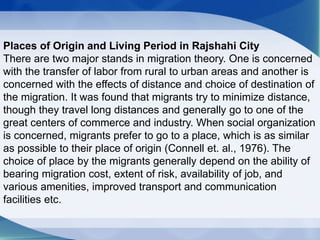
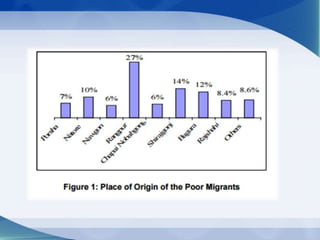
Places of Origin and Living Period in Rajshahi City
There are two major stands in migration theory. One is concerned
with the transfer of labor from rural to urban areas and another is
concerned with the effects of distance and choice of destination of
the migration. It was found that migrants try to minimize distance,
though they travel long distances and generally go to one of the
great centers of commerce and industry. When social organization
is concerned, migrants prefer to go to a place, which is as similar
as possible to their place of origin (Connell et. al., 1976). The
choice of place by the migrants generally depend on the ability of
bearing migration cost, extent of risk, availability of job, and
various amenities, improved transport and communication
facilities etc.
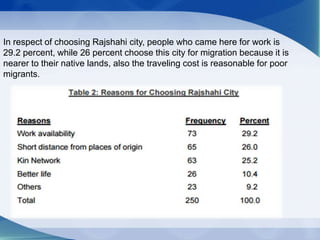
In respect of choosing Rajshahi city, people who came here for work is
29.2 percent, while 26 percent choose this city for migration because it is
nearer to their native lands, also the traveling cost is reasonable for poor
migrants.
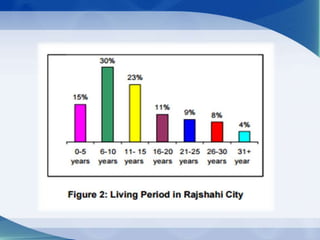
From studies it has seen that in Rajshahi, some migrant families
have been living from before the liberation period (1971), some
have been living after the liberation war and some have been
living for 0-5 years. Of the living period in Rajshahi city (Figure 2)
we find the highest percentage (30 percent) of migrant families
have been living in urban areas for 06-10 years. That is to say,
they have become urban bound in a certain period of time for a
particular reason. Generally we know that the main cause of it is
the devastating flood that took place in 1998 and some part of
northern region of the country faced serious losses. That is when
people migrated to different places among them the largest
number migrated to Rajshahi city.
Migration
Migration

Migration

  • 1.
  • 2.
    MIGRATION Migration is themovement of people to a new area or country for the purpose of taking up permanent residence or semi-permanent residence, people migrate in order to find work or enhance their living standard. e.g. few Bangladeshi labors migrate to developed countries such as U.K. or U.S.A to find better jobs.
  • 3.
    •TYPES OF MIGRATION 1.Internalmigration: Moving to a new home within a state, country, or continent. 2.External migration: Moving to a new home in a different state, country, or continent 3.Immigration: moving into a new country (e.g. the pilgrims immigrated to America) 4.Population transfer: When a government forces a large group of people out of a region, usually based on ethnicity or religion. This is also known as an involuntary or forced migration.
  • 4.
    5.Impelled migration(also knownas “reluctant” or “imposed” migration): Individuals are not forced out of their country , but leave because of unfavorable situations such as warfare, political problems or religious persecution. 6.Step migration: A series of shorter, less extreme migrations from a person’s place of origin to final destination-such as moving from a village, to a town, & finally to a city. 7.Chain migration: A series of migrations within a family or defined group of people. A chain migration often begins with one family member who sends money to bring other family members to the new location.
  • 5.
    8.Return migration: Thevoluntary movements of emigrants back to their place of origin. This is also known as “circular migration”. 9.Seasonal migration: The process of moving for a period of time in response to labour or climate conditions(e.g. farm workers following crop harvests or working in cities off-season
  • 6.
    Place of OriginDestination Circular Migration Family Migration Long-time Migration Permanent settlement
  • 7.
    WHY DO PEOPLEMIGRATE Push Factors: Reasons for emigrating (leaving a place) because of a difficulty (such as a food shortage, war, flood, etc.) Pull Factors: Reasons for immigrating (moving into a place) because of something desirable (such as a nicer climate, better food supply, freedom, etc
  • 8.
    Several types ofpush and pull factors may influence people in their movements (sometimes at the same time), including: Environmental (e.g., climate, natural disasters) Political (e.g., war) Economic (e.g. work, recession) Cultural (e.g., religious freedom, education
  • 9.
    People Who Migrate- Emigrant:A person who is leaving a country to reside in another. Immigrant: A person who is entering a country from another to take up new residence. Refugee: A person who is residing outside the country of his or her origin due to fear of persecution for reasons of race, religion, nationality, membership in a particular social group, or political opinion.
  • 10.
    Internally Displaced Person(IDP): A person who is forced to leave his or her home region because of unfavorable conditions (political, social, environmental, etc.) but does not cross any boundaries. Migration Stream: A group migration from a particular country, region, or city to a certain destination
  • 11.
    Impacts of Migration Diffusion:The process through which certain characteristics (e.g., cultural traits, ideas, disease) spread over space and through time. Relocation Diffusion: Ideas, cultural traits, etc. that move with people from one place to another and do not remain in the point of origin. Expansion Diffusion: Ideas, cultural traits, etc., that move with people from one place to another but are not lost at the point of origin, such as language. Cultural markers: Structures or artifacts (e.g., buildings, spiritual places, architectural styles, signs, etc.) that ssreflect the cultures and histories of those who constructed or occupy them
  • 13.
    The land ofBangladesh has been changed rapidly because of mobility of people having questions about development strategies. Migration has great impact on people’s daily strategies and in the national economy like markets, communications and transportation and availability of electricity.
  • 14.
    Changes in occupationby Migration Status, 1998: Pre & Post-Migrational status Occupatio n Status Long-term migrant Recent migrant Non- Slum Slum Non- Slum Slum Post migration occupational status Trading 31.5 21.4 41.3 - Labor: Non- farm 8.7 43.8 7.1 50.0 Services 21.5 71.4 8.7 - Renting - - - - Not working 7.9 3.1 - - Others - - - - Total 100(277) 100(13 0) 100(14) 100(46) Occupatio n Status Long-term migrant Recent migrant Non- Slum Slum Non- Slum Slum Pre-Migration occupational status Agriculture 5.4 3.9 - 17.4 Trading 6.9 21.4 15.2 - Labor: Non- farm 1.8 3.9 - 10.9 Labor: Farm 10.5 43.9 7.1 41.3 Services 3.8 35.7 2.2 - Unemployed 14.4 7.7 21.4 4.4 Not working 48.7 29.2 14.3 8.7 Others 0.7 - - - Total 100(277) 100(1 30) 100(1 4) 100(4 6)
  • 16.
    Places of Originand Living Period in Rajshahi City There are two major stands in migration theory. One is concerned with the transfer of labor from rural to urban areas and another is concerned with the effects of distance and choice of destination of the migration. It was found that migrants try to minimize distance, though they travel long distances and generally go to one of the great centers of commerce and industry. When social organization is concerned, migrants prefer to go to a place, which is as similar as possible to their place of origin (Connell et. al., 1976). The choice of place by the migrants generally depend on the ability of bearing migration cost, extent of risk, availability of job, and various amenities, improved transport and communication facilities etc.
  • 18.
    In respect ofchoosing Rajshahi city, people who came here for work is 29.2 percent, while 26 percent choose this city for migration because it is nearer to their native lands, also the traveling cost is reasonable for poor migrants.
  • 19.
    From studies ithas seen that in Rajshahi, some migrant families have been living from before the liberation period (1971), some have been living after the liberation war and some have been living for 0-5 years. Of the living period in Rajshahi city (Figure 2) we find the highest percentage (30 percent) of migrant families have been living in urban areas for 06-10 years. That is to say, they have become urban bound in a certain period of time for a particular reason. Generally we know that the main cause of it is the devastating flood that took place in 1998 and some part of northern region of the country faced serious losses. That is when people migrated to different places among them the largest number migrated to Rajshahi city.